






Case Study
Unilever Limited:
Transforming the “Finance” function
Presented By:
Akshata Dandekar
Dilip Kumar
Rahul Kumar
Rahul Lakkadwala
Rahul Yadav
Shashank Tiwari
Suchali Pal
Company Overview
 Type-dual listed Public Ltd. Company
 Industry- FMCG
 Founded- 1930 (merger)
 Headquarters – Unilever N.V. Rotterdam, Netherlands Unilever House, London, UK
 Key People – Paul Polman (CEO), Michael Treschow (Chairman)
 Products – Foods and beverages, cleaning agents & Personal care product
 Revenue – € 48.436 billion (2014)
 Operating Income - € 7.980 billion (2014)
 Net Income - € 5.15 billion (2014)
 Subsidiaries- Unilever Bangladesh, Unilever Nepal, Hindustan Unilever, Unilever
Australasia, Unilever Pakistan, Unilever Phillipines
Unilever Headquarters
Unilever, Rotterdam
Unilever, London
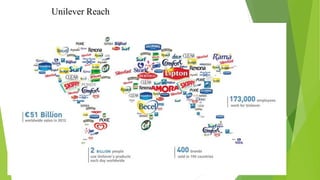
Unilever Reach
Case Overview
 Role of finance function becoming broader
 CFO is now becoming strategic partner of CEO for Decision
Making
 Finance operations getting complex by globalization
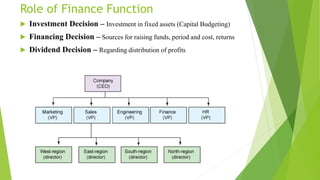
Role of Finance Function
 Investment Decision – Investment in fixed assets (Capital Budgeting)
 Financing Decision – Sources for raising funds, period and cost, returns
 Dividend Decision – Regarding distribution of profits
Transformation of Finance Function
 The transformation of finance function is sub-divided into 2 parts:-
 Traditional approach
 Modern approach
Traditional Approach
 According to this approach ,finance function is restricted to procurement of
funds.
 The term procurement refers to raising of fund externally as well as interrelated
aspects of raising funds.
 In this approach the resources could be raised from the combination of available
sources.
Limitations:-
 This approach is confirmed to procurement of funds only.
 It fails to consider an important aspect ie. allocation of funds.
 It deals with only outside ie. Investors, investment bankers.
Modern Approach
 The modern approach is an analytical way of looking into Financial problems of the
firm.
 According to this approach ,finance function covers both acquisition of funds as well as
allocation of funds to various uses.
 Finance Management is concerned with the isssue involved in raising of funds and
efficient and wise allocation of funds.
Finance Function at Unilever
• Unilever is one of the world’s largest producer of packet
consumer goods.
• Offers wide range of product, with 400 brand spanning
14 categories of food, personal and home product.
Management committee at Unilever
Paul Polman- Chief Executive Officer (CEO)
Michael Treschow- Non-Executive Chairman
Jean-Marc Huet- Chief Financial Officer (CFO)
David Blanchard- Chief R&D Officer
Douglas Baillie- Chief HR Officer
Facts of Unilever
1. Position in Fortune 500 list
2. Company Growth
 Organic moves- Expanded unilever around the globe.
 Inorganic moves- In 2008 it accquired Immarko, in
current year they sold Bourisn brand to Le Groupe
Bel for € 400 million.
3. Annual Revenue
4. Net Profit
5.Significance of Financial function
Treasury Management
“Top performing firms have top performing financial functions but
few finance functions are top performing”
• Managing or administering financial assets and holdings of a company.
• Optimizing the usage of company’s liquidity.
• Make proper use of investment.
• Minimizing financial risks.
Unilever treasury management
•Using short term(less than 1 year) and long term(more than 12
months period) borrowings.(Co. had 1794million Euro in 2008).
•Fixed( physical assets such as machinery, land, buildings,
installations, vehicles, or technology and current investments.
• Investing in Portfolio, Investments are well diversified.
•Pension funds are invested in property, Bonds , Hedge bonds.
•In 2008 company had 344 million Euros investment in recognizes
stock exchange and 560 million Euros in unlisted investments.
Risk Management
“With high investments comes high risk”
Identification Assessment Prioritization.
Then , Allocation of Resources Monitoring Controlling
the impact .
•Cos. are operating in various countries.
•Hedging their Investment’s(through the use of foreign borrowing’s
and Forward exchange contracts).
•“Setup global treasury centre "to manage foreign exchange risk and
manage overall financial risk.
3 main objectives of treasury bill
•Maintaining good relationship with banks.
•Reducing all local risks.
•To look for chances to create value for the company.
•More than 20,000 transactions per annum and external forex trades
of 10 billion dollar have been achieved.
Financial Performance of Unilever
2013- 2014
Operational Highlights of the year
 2014 was challenging year with significant economic
headwinds and weak markets but Unilever has delivered
competitive underlying sales growth and margin
expansion.
 Turnover was € 48.4 billion, down 2.7% with a negative
impact from foreign exchange of 4.6%.
 In December 2014 Unilever’s combined market
capitalization rose from €83.8 bn. to €93.9 bn.
 Underlying sales growth- USG is the actual reflection
of company’s profit excluding other changes.
Unilever underlying growth in 2013 was 4.3% which
reduced to 2.9% in 2014.
 Core Operating Margin- It is the margin ratio used
measure the company’s pricing strategy and
operating efficiency.
Unilever core operating margin in 2013 was 14.1%
which increased to 14.5% in 2014.
Key Indicators
 Underlying Volume Growth- It is the increase in turnover
attributable to the volume of the product sold.
Unilever UVG dropped down to 1.0% in 2014 from
2.5% in 2013.
Free Cash Flow- It is the measure of financial
performance calculate as operating cash minus capital
expenditure.
Unilever FCF went down from €3.9 billion in 2013 to
€3.1 billion in 2014 because they focused on Capital
Discipline.
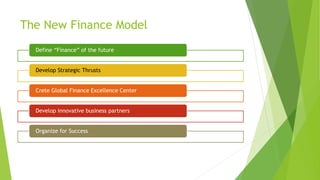
The New Finance Model
Define “Finance” of the future
Develop Strategic Thrusts
Crete Global Finance Excellence Center
Develop innovative business partners
Organize for Success
Conclusion
 Finance Function Challenging – Growing enormously
 Decided policies to control risk and return trade off
 Investment Vehicle- Univest-to implement strategic asset
allocation models
 Reduces its risk through hedging
 Economic slowdown sustained- Financial Policies
 High credit rating
 Proper debt-equity ratio
 Optimal WAC
 Met new regulatory demands

Unilever- Finance Transformation

  • 1.
    Case Study Unilever Limited: Transformingthe “Finance” function Presented By: Akshata Dandekar Dilip Kumar Rahul Kumar Rahul Lakkadwala Rahul Yadav Shashank Tiwari Suchali Pal
  • 2.
    Company Overview  Type-duallisted Public Ltd. Company  Industry- FMCG  Founded- 1930 (merger)  Headquarters – Unilever N.V. Rotterdam, Netherlands Unilever House, London, UK  Key People – Paul Polman (CEO), Michael Treschow (Chairman)  Products – Foods and beverages, cleaning agents & Personal care product  Revenue – € 48.436 billion (2014)  Operating Income - € 7.980 billion (2014)  Net Income - € 5.15 billion (2014)  Subsidiaries- Unilever Bangladesh, Unilever Nepal, Hindustan Unilever, Unilever Australasia, Unilever Pakistan, Unilever Phillipines
  • 3.
  • 4.
  • 5.
    Case Overview  Roleof finance function becoming broader  CFO is now becoming strategic partner of CEO for Decision Making  Finance operations getting complex by globalization
  • 6.
    Role of FinanceFunction  Investment Decision – Investment in fixed assets (Capital Budgeting)  Financing Decision – Sources for raising funds, period and cost, returns  Dividend Decision – Regarding distribution of profits
  • 7.
    Transformation of FinanceFunction  The transformation of finance function is sub-divided into 2 parts:-  Traditional approach  Modern approach
  • 8.
    Traditional Approach  Accordingto this approach ,finance function is restricted to procurement of funds.  The term procurement refers to raising of fund externally as well as interrelated aspects of raising funds.  In this approach the resources could be raised from the combination of available sources. Limitations:-  This approach is confirmed to procurement of funds only.  It fails to consider an important aspect ie. allocation of funds.  It deals with only outside ie. Investors, investment bankers.
  • 9.
    Modern Approach  Themodern approach is an analytical way of looking into Financial problems of the firm.  According to this approach ,finance function covers both acquisition of funds as well as allocation of funds to various uses.  Finance Management is concerned with the isssue involved in raising of funds and efficient and wise allocation of funds.
  • 10.
    Finance Function atUnilever • Unilever is one of the world’s largest producer of packet consumer goods. • Offers wide range of product, with 400 brand spanning 14 categories of food, personal and home product. Management committee at Unilever Paul Polman- Chief Executive Officer (CEO) Michael Treschow- Non-Executive Chairman Jean-Marc Huet- Chief Financial Officer (CFO) David Blanchard- Chief R&D Officer Douglas Baillie- Chief HR Officer
  • 11.
    Facts of Unilever 1.Position in Fortune 500 list 2. Company Growth  Organic moves- Expanded unilever around the globe.  Inorganic moves- In 2008 it accquired Immarko, in current year they sold Bourisn brand to Le Groupe Bel for € 400 million. 3. Annual Revenue 4. Net Profit 5.Significance of Financial function
  • 12.
    Treasury Management “Top performingfirms have top performing financial functions but few finance functions are top performing” • Managing or administering financial assets and holdings of a company. • Optimizing the usage of company’s liquidity. • Make proper use of investment. • Minimizing financial risks. Unilever treasury management •Using short term(less than 1 year) and long term(more than 12 months period) borrowings.(Co. had 1794million Euro in 2008). •Fixed( physical assets such as machinery, land, buildings, installations, vehicles, or technology and current investments.
  • 13.
    • Investing inPortfolio, Investments are well diversified. •Pension funds are invested in property, Bonds , Hedge bonds. •In 2008 company had 344 million Euros investment in recognizes stock exchange and 560 million Euros in unlisted investments. Risk Management “With high investments comes high risk” Identification Assessment Prioritization. Then , Allocation of Resources Monitoring Controlling the impact . •Cos. are operating in various countries. •Hedging their Investment’s(through the use of foreign borrowing’s and Forward exchange contracts). •“Setup global treasury centre "to manage foreign exchange risk and manage overall financial risk.
  • 14.
    3 main objectivesof treasury bill •Maintaining good relationship with banks. •Reducing all local risks. •To look for chances to create value for the company. •More than 20,000 transactions per annum and external forex trades of 10 billion dollar have been achieved.
  • 15.
    Financial Performance ofUnilever 2013- 2014 Operational Highlights of the year  2014 was challenging year with significant economic headwinds and weak markets but Unilever has delivered competitive underlying sales growth and margin expansion.  Turnover was € 48.4 billion, down 2.7% with a negative impact from foreign exchange of 4.6%.  In December 2014 Unilever’s combined market capitalization rose from €83.8 bn. to €93.9 bn.
  • 16.
     Underlying salesgrowth- USG is the actual reflection of company’s profit excluding other changes. Unilever underlying growth in 2013 was 4.3% which reduced to 2.9% in 2014.  Core Operating Margin- It is the margin ratio used measure the company’s pricing strategy and operating efficiency. Unilever core operating margin in 2013 was 14.1% which increased to 14.5% in 2014. Key Indicators
  • 17.
     Underlying VolumeGrowth- It is the increase in turnover attributable to the volume of the product sold. Unilever UVG dropped down to 1.0% in 2014 from 2.5% in 2013. Free Cash Flow- It is the measure of financial performance calculate as operating cash minus capital expenditure. Unilever FCF went down from €3.9 billion in 2013 to €3.1 billion in 2014 because they focused on Capital Discipline.
  • 18.
    The New FinanceModel Define “Finance” of the future Develop Strategic Thrusts Crete Global Finance Excellence Center Develop innovative business partners Organize for Success
  • 19.
    Conclusion  Finance FunctionChallenging – Growing enormously  Decided policies to control risk and return trade off  Investment Vehicle- Univest-to implement strategic asset allocation models  Reduces its risk through hedging  Economic slowdown sustained- Financial Policies  High credit rating  Proper debt-equity ratio  Optimal WAC  Met new regulatory demands

Editor's Notes