Autoimmunity
Autoimmunity
Dr. Al-Farah
Learning objectives
Learning objectives
• Define T & B cell tolerance, autoimmunity
• Discuss the pathogenesis of autoimmune disease
• Discuss various clinical presentations of autoimmune
diseases
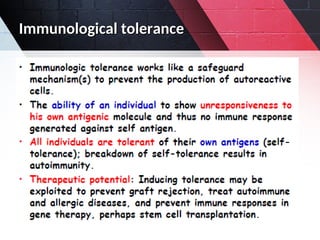
Immunological tolerance
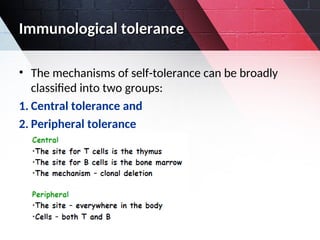
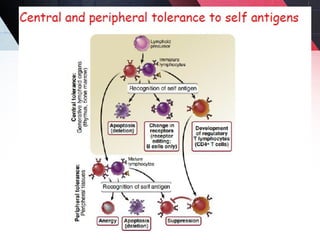
• The mechanisms of self-tolerance can be broadly
classified into two groups:
1. Central tolerance and
2. Peripheral tolerance
Immunological tolerance
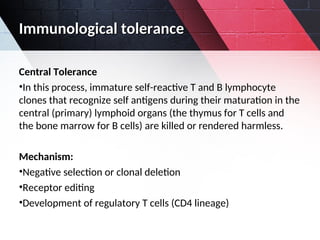
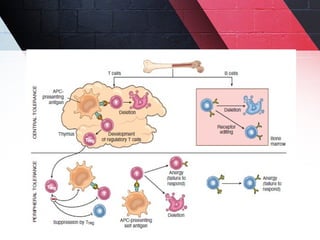
Central Tolerance
•In this process, immature self-reactive T and B lymphocyte
clones that recognize self antigens during their maturation in the
central (primary) lymphoid organs (the thymus for T cells and
the bone marrow for B cells) are killed or rendered harmless.
Mechanism:
•Negative selection or clonal deletion
•Receptor editing
•Development of regulatory T cells (CD4 lineage)
Immunological tolerance
Peripheral Tolerance
•In this process, immature self-reactive T and B lymphocyte
clones that escapes central tolerance, are deleted or muzzled in
the peripheral tissues.
Mechanisms:
•Clonal Anergy (a state of inactivation in which the lymphocytes remain
alive but are unable to respond to antigen)
•Suppression by regulatory T cells (Tregs)
•Deletion by apoptosis
Autoimmunity is a problem of
self/non-self discrimination.
Autoimmunity
Autoimmunity
Autoimmunity
Disorder in which tissue injury is
caused by an immunologic reaction
of the host to its own tissues.
Failure of Immune Tolerance
(Development of
Autoimmunity)
Characterstics of Autoimmune
diseases
diseases
• Ideally, at least three requirements should be met
before a disorder is categorized as truly caused by
autoimmunity:
(1) Presence of an immune reaction specific for some
self antigen or self tissue;
(2) Evidence that such a reaction is not secondary to
tissue damage but is of primary pathogenic
significance; and
(3) Absence of another well-defined cause of the
disease.
Mechanisms of Autoimmunity
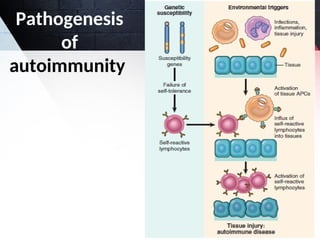
Role of Susceptibility Genes
Many autoimmune diseases exhibit a marked familial incidence
suggesting a genetic predisposition to these disorders
• However, that whether a person develops an autoimmune
disease or not is clearly multifactorial.
EXAMPLE
 Rheumatoid arthritis occurs predominantly in individuals carrying the HLA-DR4
gene.
 Ankylosing spondylitis is 100 times more likely to occur in people who carry
HLA-B27.
 Polymorphisms in the gene for NOD2 are associated with Crohn disease
Mechanisms of Autoimmunity
Role of Infections and Other Environmental Factors
There are several environmental agents that trigger
autoimmune diseases, most of which are either bacteria
or viruses.
EXAMPLE
 Pharyngitis caused by Streptococcus pyogenes predisposes to rheumatic fever.
 Some viruses, such as EBV and HIV, cause polyclonal B-cell activation, which may
result in production of autoantibodies.
 Ultraviolet (UV) radiation causes cell death and may lead to the exposure of
nuclear antigens, which elicit pathologic immune responses in lupus.
 Smoking is a risk factor for rheumatoid arthritis, perhaps because it leads to
chemical modification of self antigens.
Pathogenesis
of
autoimmunity
Induction of Autoimmunity
“Proposed Mechanisms!”
1. Molecular mimicry
2. Alteration of Normal Proteins
3. Sequestered antigens
4. Epitope Spreading
5. Failure of Regulatory T Cells
6. Polyclonal B cell activation
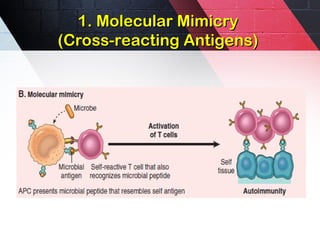
1. Molecular Mimicry
(Cross-reacting Antigens)
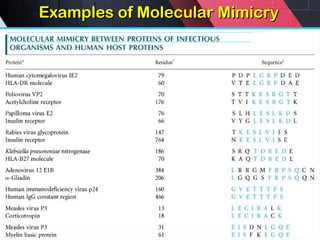
• Viruses and bacteria possess antigenic
determinants that are very similar, or even
identical, to normal host cell components.
• This phenomenon, known as molecular
mimicry, occurs in a wide variety of
organisms.
• Molecular mimicry may be the initiating step
in a variety of autoimmune diseases.
Examples of Molecular Mimicry
1. Molecular Mimicry
(Cross-reacting Antigens)
2. Alteration of Normal Proteins
• Surface antigens on host altered by chemical,
biological or physical means.
• This new antigenic determinant may be recognized
as foreign by the host.
EXAMPLE
• Procainamide-induced systemic lupus erythematosus is an
example of this mechanism.
• Citrullination of vimentin, collagen, fibrillin lead to
Rheumatoid arthritis
3. Sequestered antigens
• Some self-antigens are sequestered (hidden) in
specialized tissues.
• These are not seen by the developing immune
system – will not induce self-tolerance.
• Exposure of T cells to these normally
sequestered/tissue-specific self-antigens in the
periphery results in their activation.
Examples of
Examples of Sequestered
Sequestered Antigens
Antigens
1. Myelin basic protein (MBP), associated with
Multiple sclerosis
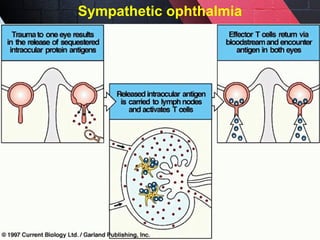
2. Lens and corneal proteins of the eye following
infection or trauma
Sympathetic ophthalmia
4. Epitope Spreading
• Epitope spreading is the term used to describe the new
exposure of sequestered autoantigens as a result of damage
to cells caused by viral infection.
EXAMPLE
• a multiple sclerosis–like disease was caused by infection with
an encephalomyelitis virus.
4. Failure of Regulatory T Cells
• An important function of Tr cells is to produce IL-10,
which inhibits proinflammatory Th-1 cells. Patients
with a mutation in the FoxP3 gene have an increase
in autoimmune diseases
Example
• In systemic lupus erythematosus, the function of
their regulatory T cells is lost.
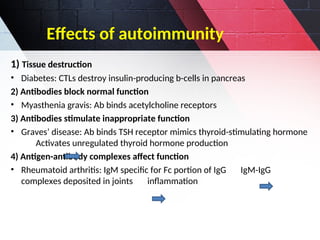
1) Tissue destruction
• Diabetes: CTLs destroy insulin-producing b-cells in pancreas
2) Antibodies block normal function
• Myasthenia gravis: Ab binds acetylcholine receptors
3) Antibodies stimulate inappropriate function
• Graves’ disease: Ab binds TSH receptor mimics thyroid-stimulating hormone
Activates unregulated thyroid hormone production
4) Antigen-antibody complexes affect function
• Rheumatoid arthritis: IgM specific for Fc portion of IgG IgM-IgG
complexes deposited in joints inflammation
Effects of autoimmunity
General Features of Autoimmune
Diseases
Diseases
• Autoimmune diseases tend to be chronic,
sometimes with relapses and remissions, and the
damage is often progressive.
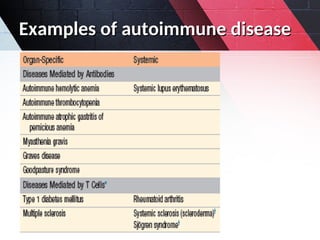
• The clinical and pathologic manifestations of an
autoimmune disease are determined by the extent
of tissue involvement (organ-specific disease OR
systemic disease) and nature of the underlying
immune response (auto-antibody mediated OR T
cell mediated).
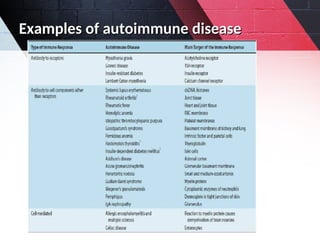
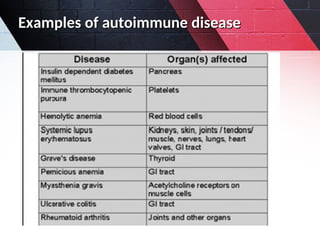
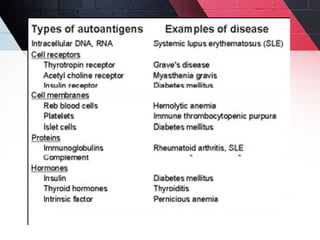
Examples of autoimmune disease
Thank you

Pathology lecture Autoimmunity diseases.ppt

  • 1.
  • 2.
    Learning objectives Learning objectives •Define T & B cell tolerance, autoimmunity • Discuss the pathogenesis of autoimmune disease • Discuss various clinical presentations of autoimmune diseases
  • 3.
  • 4.
    Immunological tolerance Immunological tolerance •The mechanisms of self-tolerance can be broadly classified into two groups: 1. Central tolerance and 2. Peripheral tolerance
  • 5.
    Immunological tolerance Immunological tolerance CentralTolerance •In this process, immature self-reactive T and B lymphocyte clones that recognize self antigens during their maturation in the central (primary) lymphoid organs (the thymus for T cells and the bone marrow for B cells) are killed or rendered harmless. Mechanism: •Negative selection or clonal deletion •Receptor editing •Development of regulatory T cells (CD4 lineage)
  • 6.
  • 7.
    Immunological tolerance Immunological tolerance PeripheralTolerance •In this process, immature self-reactive T and B lymphocyte clones that escapes central tolerance, are deleted or muzzled in the peripheral tissues. Mechanisms: •Clonal Anergy (a state of inactivation in which the lymphocytes remain alive but are unable to respond to antigen) •Suppression by regulatory T cells (Tregs) •Deletion by apoptosis
  • 10.
    Autoimmunity is aproblem of self/non-self discrimination. Autoimmunity
  • 11.
    Autoimmunity Autoimmunity Disorder in whichtissue injury is caused by an immunologic reaction of the host to its own tissues.
  • 12.
    Failure of ImmuneTolerance (Development of Autoimmunity)
  • 13.
    Characterstics of Autoimmune Charactersticsof Autoimmune diseases diseases • Ideally, at least three requirements should be met before a disorder is categorized as truly caused by autoimmunity: (1) Presence of an immune reaction specific for some self antigen or self tissue; (2) Evidence that such a reaction is not secondary to tissue damage but is of primary pathogenic significance; and (3) Absence of another well-defined cause of the disease.
  • 14.
  • 15.
  • 16.
    Mechanisms of Autoimmunity Mechanismsof Autoimmunity Role of Susceptibility Genes Many autoimmune diseases exhibit a marked familial incidence suggesting a genetic predisposition to these disorders • However, that whether a person develops an autoimmune disease or not is clearly multifactorial. EXAMPLE  Rheumatoid arthritis occurs predominantly in individuals carrying the HLA-DR4 gene.  Ankylosing spondylitis is 100 times more likely to occur in people who carry HLA-B27.  Polymorphisms in the gene for NOD2 are associated with Crohn disease
  • 17.
    Mechanisms of Autoimmunity Mechanismsof Autoimmunity Role of Infections and Other Environmental Factors There are several environmental agents that trigger autoimmune diseases, most of which are either bacteria or viruses. EXAMPLE  Pharyngitis caused by Streptococcus pyogenes predisposes to rheumatic fever.  Some viruses, such as EBV and HIV, cause polyclonal B-cell activation, which may result in production of autoantibodies.  Ultraviolet (UV) radiation causes cell death and may lead to the exposure of nuclear antigens, which elicit pathologic immune responses in lupus.  Smoking is a risk factor for rheumatoid arthritis, perhaps because it leads to chemical modification of self antigens.
  • 18.
  • 19.
    Induction of Autoimmunity Inductionof Autoimmunity “Proposed Mechanisms!” “Proposed Mechanisms!” 1. Molecular mimicry 2. Alteration of Normal Proteins 3. Sequestered antigens 4. Epitope Spreading 5. Failure of Regulatory T Cells 6. Polyclonal B cell activation
  • 20.
    1. Molecular Mimicry 1.Molecular Mimicry (Cross-reacting Antigens) (Cross-reacting Antigens) • Viruses and bacteria possess antigenic determinants that are very similar, or even identical, to normal host cell components. • This phenomenon, known as molecular mimicry, occurs in a wide variety of organisms. • Molecular mimicry may be the initiating step in a variety of autoimmune diseases.
  • 21.
    Examples of MolecularMimicry Examples of Molecular Mimicry
  • 22.
    1. Molecular Mimicry 1.Molecular Mimicry (Cross-reacting Antigens) (Cross-reacting Antigens)
  • 23.
    2. Alteration ofNormal Proteins 2. Alteration of Normal Proteins • Surface antigens on host altered by chemical, biological or physical means. • This new antigenic determinant may be recognized as foreign by the host. EXAMPLE • Procainamide-induced systemic lupus erythematosus is an example of this mechanism. • Citrullination of vimentin, collagen, fibrillin lead to Rheumatoid arthritis
  • 24.
    3. Sequestered antigens 3.Sequestered antigens • Some self-antigens are sequestered (hidden) in specialized tissues. • These are not seen by the developing immune system – will not induce self-tolerance. • Exposure of T cells to these normally sequestered/tissue-specific self-antigens in the periphery results in their activation.
  • 25.
    Examples of Examples ofSequestered Sequestered Antigens Antigens 1. Myelin basic protein (MBP), associated with Multiple sclerosis 2. Lens and corneal proteins of the eye following infection or trauma
  • 26.
  • 27.
    4. Epitope Spreading 4.Epitope Spreading • Epitope spreading is the term used to describe the new exposure of sequestered autoantigens as a result of damage to cells caused by viral infection. EXAMPLE • a multiple sclerosis–like disease was caused by infection with an encephalomyelitis virus.
  • 28.
    4. Failure ofRegulatory T Cells 4. Failure of Regulatory T Cells • An important function of Tr cells is to produce IL-10, which inhibits proinflammatory Th-1 cells. Patients with a mutation in the FoxP3 gene have an increase in autoimmune diseases Example • In systemic lupus erythematosus, the function of their regulatory T cells is lost.
  • 29.
    1) Tissue destruction •Diabetes: CTLs destroy insulin-producing b-cells in pancreas 2) Antibodies block normal function • Myasthenia gravis: Ab binds acetylcholine receptors 3) Antibodies stimulate inappropriate function • Graves’ disease: Ab binds TSH receptor mimics thyroid-stimulating hormone Activates unregulated thyroid hormone production 4) Antigen-antibody complexes affect function • Rheumatoid arthritis: IgM specific for Fc portion of IgG IgM-IgG complexes deposited in joints inflammation Effects of autoimmunity
  • 30.
    General Features ofAutoimmune General Features of Autoimmune Diseases Diseases • Autoimmune diseases tend to be chronic, sometimes with relapses and remissions, and the damage is often progressive. • The clinical and pathologic manifestations of an autoimmune disease are determined by the extent of tissue involvement (organ-specific disease OR systemic disease) and nature of the underlying immune response (auto-antibody mediated OR T cell mediated).
  • 31.
    Examples of autoimmunedisease Examples of autoimmune disease
  • 32.
    Examples of autoimmunedisease Examples of autoimmune disease
  • 33.
    Examples of autoimmunedisease Examples of autoimmune disease
  • 35.