GANGRENE
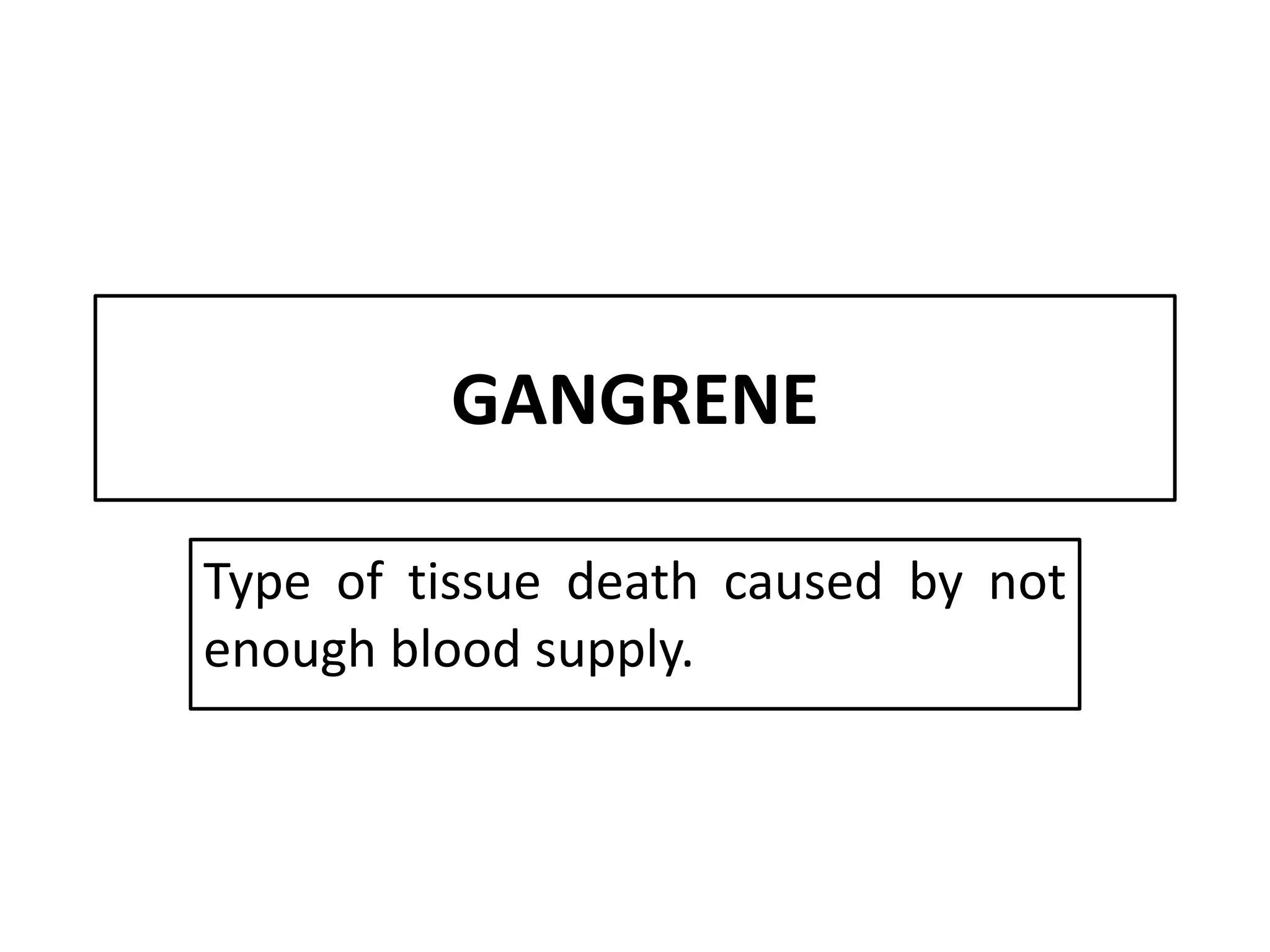
Type of tissue death caused by not
enough blood supply.
ETIOLOGY
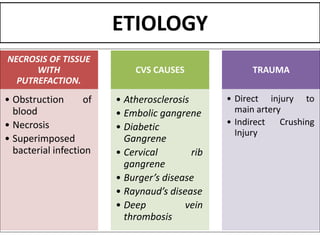
NECROSIS OF TISSUE
WITH
PUTREFACTION.
• Obstruction of
blood
• Necrosis
• Superimposed
bacterial infection
CVS CAUSES
• Atherosclerosis
• Embolic gangrene
• Diabetic
Gangrene
• Cervical rib
gangrene
• Burger’s disease
• Raynaud’s disease
• Deep vein
thrombosis
TRAUMA
• Direct injury to
main artery
• Indirect Crushing
Injury
ETIOLOGY
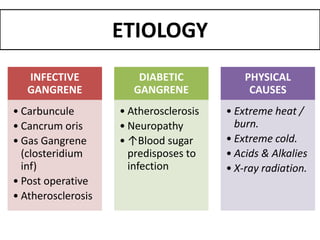
INFECTIVE
GANGRENE
• Carbuncule
• Cancrum oris
• Gas Gangrene
(closteridium
inf)
• Post operative
• Atherosclerosis
DIABETIC
GANGRENE
• Atherosclerosis
• Neuropathy
• ↑Blood sugar
predisposes to
infection
PHYSICAL
CAUSES
• Extreme heat /
burn.
• Extreme cold.
• Acids & Alkalies
• X-ray radiation.
CLINICAL FEATURES
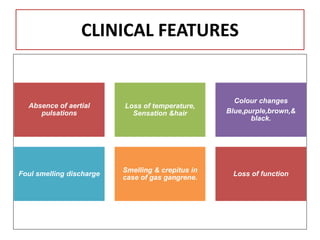
Absence of aertial
pulsations
Loss of temperature,
Sensation &hair
Colour changes
Blue,purple,brown,&
black.
Foul smelling discharge
Smelling & crepitus in
case of gas gangrene.
Loss of function
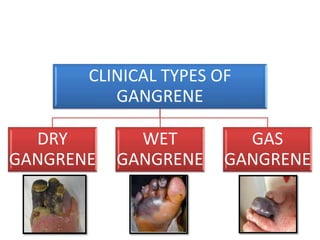
CLINICAL TYPES OF
GANGRENE
DRY
GANGRENE
WET
GANGRENE
GAS
GANGRENE
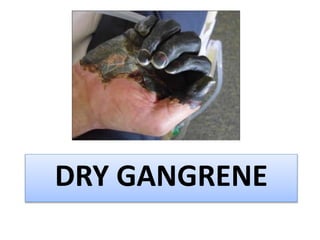
DRY GANGRENE
ETIOLOGY
 When there is gradual obstruction in the arterial lumen
 When the artery is occluded but the venous return is
intact
 When the gangrenous area is exposed to evaporation eg.
Toes
 When there is no infection
 When the gangrenous area was not primarily
oedematous
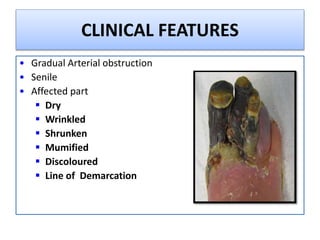
CLINICAL FEATURES
• Gradual Arterial obstruction
• Senile
• Affected part
 Dry
 Wrinkled
 Shrunken
 Mumified
 Discoloured
 Line of Demarcation
TREATMENT
• Ampulation
• Revascularation - atherosclerosed part of
artery
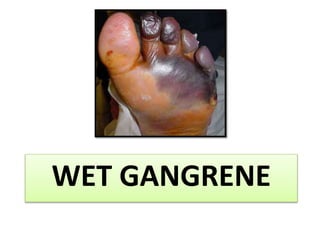
WET GANGRENE
ETIOLOGY
 Sudden arterial or venous obstruction -
 Embolism
 Crush injury
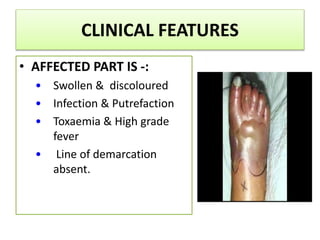
CLINICAL FEATURES
• AFFECTED PART IS -:
• Swollen & discoloured
• Infection & Putrefaction
• Toxaemia & High grade
fever
• Line of demarcation
absent.
TREATMENT
LIMB SAVING
 Heavy Antibiotic.
 Revascularisation.
LIFE SAVING
 Sacrifice the limb due to toxaemia.
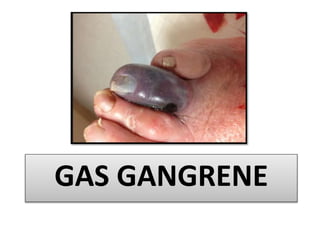
GAS GANGRENE
ETIOLOGY
CAUSATIVE ORGANISM
1. Clostridium - welchi (60%)
2. Clostri dium - odematiens
3. Clostridium - septicum
4. Clostridium - histolyticus
SOURCE – Mainly Soil
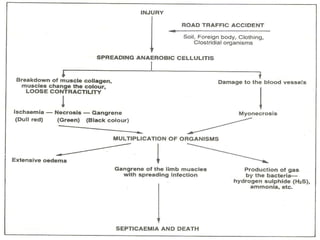
PATHOGENESIS
•Clostridium organism cause infective gangrene by involving
mainly skeletal muscle.
•Low blood supply and low oxygen perfussion
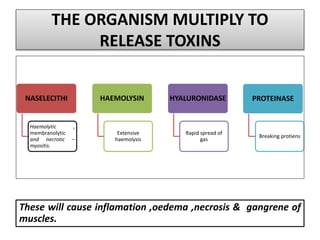
THE ORGANISM MULTIPLY TO
RELEASE TOXINS
NASELECITHI
Haemolytic ,
membranolytic
and necrotic –
myositis.
HAEMOLYSIN
Extensive
haemolysis
HYALURONIDASE
Rapid spread of
gas
PROTEINASE
Breaking protiens
These will cause inflamation ,oedema ,necrosis & gangrene of
muscles.
17
CLINICAL FEATURES
• Necrosis→septicaemia and P.C.F
• Crepitus felt due to gases
• Temperature – LOW GRADE
• Wound under tension–foul smelling
discharge
• Khaki brown coloured skin due to
haemolysis.
CLINICAL TYPES
FULMINANT
TYPE
• Rapid progress
• Toxemia
• Renal or liver
failure
MASSIVE TYPE
• Whole of one
limb involved
GROUP TYPE
• Extensors of
thigh
• Flexors of leg
SINGLE MUSCLE
TYPE
• One single
muscle
SUBCUTANEOUS
TYPE
• Superficial
PROPHYLAXIS
• Proper wound cleaning
• Antibiotics i / v
• Minimum use of tourniquet
• Gentle & effective p.O.P
• Anti gas gangrene serum.
TREATMENT
• Excision of necrotic tissue & muscle
• Proper antibiotic
• Blood transfusion.
• Hyperbaric oxygen.
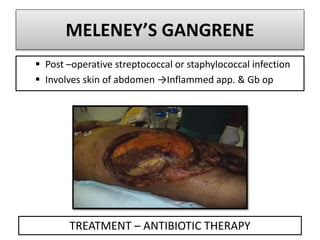
MELENEY’S GANGRENE
 Post –operative streptococcal or staphylococcal infection
 Involves skin of abdomen →Inflammed app. & Gb op
TREATMENT – ANTIBIOTIC THERAPY
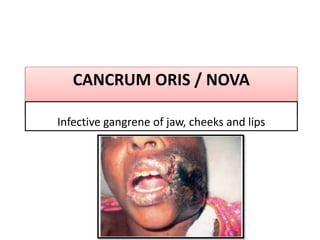
CANCRUM ORIS / NOVA
Infective gangrene of jaw, cheeks and lips
ETIOLOGY
• Fusiform bacillia
• Spirochete
(borelliavincentia)
PREDISPOSING FACTORS
• Malnourished children
• Famines
• Complication of
measles,kalazar
• Poor oral hyegine
• Enteric fever.
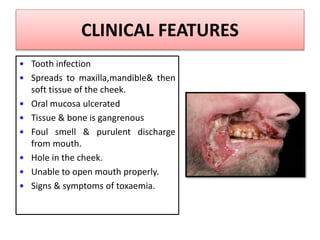
CLINICAL FEATURES
• Tooth infection
• Spreads to maxilla,mandible& then
soft tissue of the cheek.
• Oral mucosa ulcerated
• Tissue & bone is gangrenous
• Foul smell & purulent discharge
from mouth.
• Hole in the cheek.
• Unable to open mouth properly.
• Signs & symptoms of toxaemia.
TREATMENT
• Antibiotic systemic
• Multivitamins
• Repeated antibiotic mouth wash
• Sequestomy in chronic Osteomyelitis of mandible
• Plastic surgery of lip & soft tissue
INVESTIGATIONS
INVESTIGATIONS
(TOWARDS DETERMINING THE CAUSE)
 Blood sugar (diabetes)
 Serum cholesterol (atherosclerosis)
 Vdrl and kahn (syphilis)
 URINE FOR SUGAR , ACETONE BODIES, etc.
 X – ray for the following -:
 calcification of arteries (atherosclerosis)
 Gas bubbles (gas gangrene)
 Cervical rib
INVESTIGATIONS
(TOWARDS THE LEVEL OF GANGRENE)
 Level of arterial; pulsation.
 Temprature gradient by palpation or
thermocouple.
 Doppler ultrasound blood flow detector.
 Oscillometry to detect pulsation at different levels.
 Arteriography. It may help in selecting the site of
amputation.
THANK YOU !!!!!

Gangrene

  • 1.
    GANGRENE Type of tissuedeath caused by not enough blood supply.
  • 2.
    ETIOLOGY NECROSIS OF TISSUE WITH PUTREFACTION. •Obstruction of blood • Necrosis • Superimposed bacterial infection CVS CAUSES • Atherosclerosis • Embolic gangrene • Diabetic Gangrene • Cervical rib gangrene • Burger’s disease • Raynaud’s disease • Deep vein thrombosis TRAUMA • Direct injury to main artery • Indirect Crushing Injury
  • 3.
    ETIOLOGY INFECTIVE GANGRENE • Carbuncule • Cancrumoris • Gas Gangrene (closteridium inf) • Post operative • Atherosclerosis DIABETIC GANGRENE • Atherosclerosis • Neuropathy • ↑Blood sugar predisposes to infection PHYSICAL CAUSES • Extreme heat / burn. • Extreme cold. • Acids & Alkalies • X-ray radiation.
  • 4.
    CLINICAL FEATURES Absence ofaertial pulsations Loss of temperature, Sensation &hair Colour changes Blue,purple,brown,& black. Foul smelling discharge Smelling & crepitus in case of gas gangrene. Loss of function
  • 5.
  • 6.
  • 7.
    ETIOLOGY  When thereis gradual obstruction in the arterial lumen  When the artery is occluded but the venous return is intact  When the gangrenous area is exposed to evaporation eg. Toes  When there is no infection  When the gangrenous area was not primarily oedematous
  • 8.
    CLINICAL FEATURES • GradualArterial obstruction • Senile • Affected part  Dry  Wrinkled  Shrunken  Mumified  Discoloured  Line of Demarcation
  • 9.
    TREATMENT • Ampulation • Revascularation- atherosclerosed part of artery
  • 10.
  • 11.
    ETIOLOGY  Sudden arterialor venous obstruction -  Embolism  Crush injury
  • 12.
    CLINICAL FEATURES • AFFECTEDPART IS -: • Swollen & discoloured • Infection & Putrefaction • Toxaemia & High grade fever • Line of demarcation absent.
  • 13.
    TREATMENT LIMB SAVING  HeavyAntibiotic.  Revascularisation. LIFE SAVING  Sacrifice the limb due to toxaemia.
  • 14.
  • 15.
    ETIOLOGY CAUSATIVE ORGANISM 1. Clostridium- welchi (60%) 2. Clostri dium - odematiens 3. Clostridium - septicum 4. Clostridium - histolyticus SOURCE – Mainly Soil PATHOGENESIS •Clostridium organism cause infective gangrene by involving mainly skeletal muscle. •Low blood supply and low oxygen perfussion
  • 16.
    THE ORGANISM MULTIPLYTO RELEASE TOXINS NASELECITHI Haemolytic , membranolytic and necrotic – myositis. HAEMOLYSIN Extensive haemolysis HYALURONIDASE Rapid spread of gas PROTEINASE Breaking protiens These will cause inflamation ,oedema ,necrosis & gangrene of muscles.
  • 17.
  • 18.
    CLINICAL FEATURES • Necrosis→septicaemiaand P.C.F • Crepitus felt due to gases • Temperature – LOW GRADE • Wound under tension–foul smelling discharge • Khaki brown coloured skin due to haemolysis.
  • 19.
    CLINICAL TYPES FULMINANT TYPE • Rapidprogress • Toxemia • Renal or liver failure MASSIVE TYPE • Whole of one limb involved GROUP TYPE • Extensors of thigh • Flexors of leg SINGLE MUSCLE TYPE • One single muscle SUBCUTANEOUS TYPE • Superficial
  • 20.
    PROPHYLAXIS • Proper woundcleaning • Antibiotics i / v • Minimum use of tourniquet • Gentle & effective p.O.P • Anti gas gangrene serum.
  • 21.
    TREATMENT • Excision ofnecrotic tissue & muscle • Proper antibiotic • Blood transfusion. • Hyperbaric oxygen.
  • 22.
    MELENEY’S GANGRENE  Post–operative streptococcal or staphylococcal infection  Involves skin of abdomen →Inflammed app. & Gb op TREATMENT – ANTIBIOTIC THERAPY
  • 23.
    CANCRUM ORIS /NOVA Infective gangrene of jaw, cheeks and lips
  • 24.
    ETIOLOGY • Fusiform bacillia •Spirochete (borelliavincentia) PREDISPOSING FACTORS • Malnourished children • Famines • Complication of measles,kalazar • Poor oral hyegine • Enteric fever.
  • 25.
    CLINICAL FEATURES • Toothinfection • Spreads to maxilla,mandible& then soft tissue of the cheek. • Oral mucosa ulcerated • Tissue & bone is gangrenous • Foul smell & purulent discharge from mouth. • Hole in the cheek. • Unable to open mouth properly. • Signs & symptoms of toxaemia.
  • 26.
    TREATMENT • Antibiotic systemic •Multivitamins • Repeated antibiotic mouth wash • Sequestomy in chronic Osteomyelitis of mandible • Plastic surgery of lip & soft tissue
  • 27.
  • 28.
    INVESTIGATIONS (TOWARDS DETERMINING THECAUSE)  Blood sugar (diabetes)  Serum cholesterol (atherosclerosis)  Vdrl and kahn (syphilis)  URINE FOR SUGAR , ACETONE BODIES, etc.  X – ray for the following -:  calcification of arteries (atherosclerosis)  Gas bubbles (gas gangrene)  Cervical rib
  • 29.
    INVESTIGATIONS (TOWARDS THE LEVELOF GANGRENE)  Level of arterial; pulsation.  Temprature gradient by palpation or thermocouple.  Doppler ultrasound blood flow detector.  Oscillometry to detect pulsation at different levels.  Arteriography. It may help in selecting the site of amputation.
  • 30.