Ca-CERVIX
DEPARTMENT
OF
MEDICAL SURGICAL NURSING
LEARNING OBJECTIVES
At the end of this lecture, the students should be able to:
• Define the term ca-cervix .
• Explain Etiology of ca-cervix .
• Explain Pathophysiology of ca-cervix .
• Discuss the Stages of ca-cervix .
• Discuss the Clinical feature of ca-cervix.
• Describe the Diagnosis evaluation of ca-cervix
• Management of ca-cervix .
INTRODUCTION
Caner is the universal disease. It is less common
that once was because of early detection of cell
changes by pap smear .cervical cancer is the
commonest malignancy in female in India .
DEFINITION
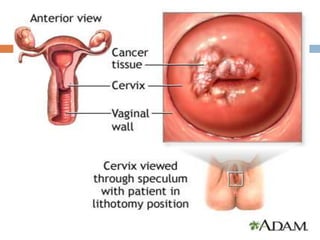
Cancer is the cervix predominantly squamous cell
cancer and also includes adenocarcinoma .This is
the primary malignant epithelial growth invading
the cervix .
ETIOLOGY
The exact cause is unknown .
A] Coitus and sperm factor .
B] Risk factor for cervical .
1.Actual risk factor.
 Low socio-economic status.
 Early age of first coitus.
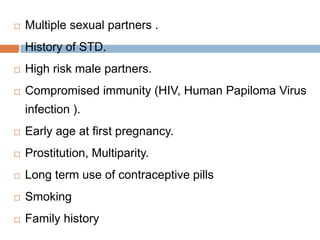
 Multiple sexual partners .
 History of STD.
 High risk male partners.
 Compromised immunity (HIV, Human Papiloma Virus
infection ).
 Early age at first pregnancy.
 Prostitution, Multiparity.
 Long term use of contraceptive pills
 Smoking
 Family history
PATHOPHYSIOLOGY
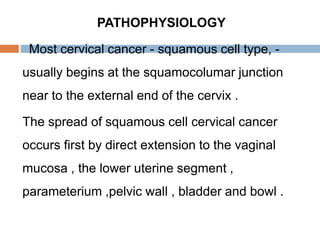
Most cervical cancer - squamous cell type, -
usually begins at the squamocolumar junction
near to the external end of the cervix .
The spread of squamous cell cervical cancer
occurs first by direct extension to the vaginal
mucosa , the lower uterine segment ,
parameterium ,pelvic wall , bladder and bowl .
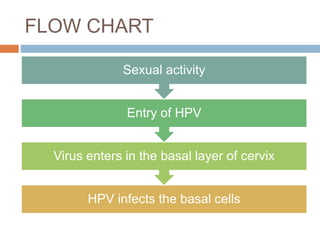
FLOW CHART
HPV infects the basal cells
Virus enters in the basal layer of cervix
Entry of HPV
Sexual activity
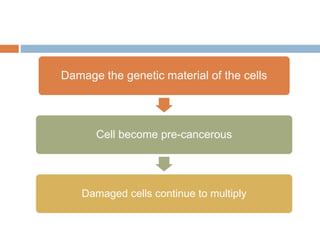
Damage the genetic material of the cells
Cell become pre-cancerous
Damaged cells continue to multiply
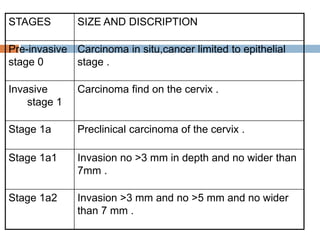
STAGES SIZE AND DISCRIPTION
Pre-invasive
stage 0
Carcinoma in situ,cancer limited to epithelial
stage .
Invasive
stage 1
Carcinoma find on the cervix .
Stage 1a Preclinical carcinoma of the cervix .
Stage 1a1 Invasion no >3 mm in depth and no wider than
7mm .
Stage 1a2 Invasion >3 mm and no >5 mm and no wider
than 7 mm .
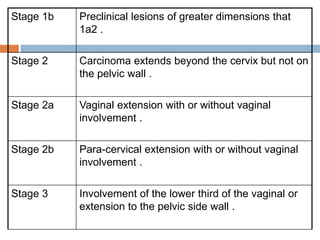
Stage 1b Preclinical lesions of greater dimensions that
1a2 .
Stage 2 Carcinoma extends beyond the cervix but not on
the pelvic wall .
Stage 2a Vaginal extension with or without vaginal
involvement .
Stage 2b Para-cervical extension with or without vaginal
involvement .
Stage 3 Involvement of the lower third of the vaginal or
extension to the pelvic side wall .
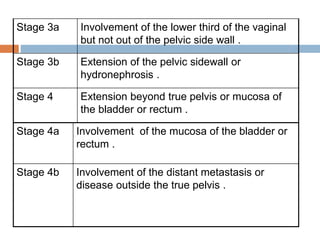
Stage 4a Involvement of the mucosa of the bladder or
rectum .
Stage 4b Involvement of the distant metastasis or
disease outside the true pelvis .
Stage 3a Involvement of the lower third of the vaginal
but not out of the pelvic side wall .
Stage 3b Extension of the pelvic sidewall or
hydronephrosis .
Stage 4 Extension beyond true pelvis or mucosa of
the bladder or rectum .
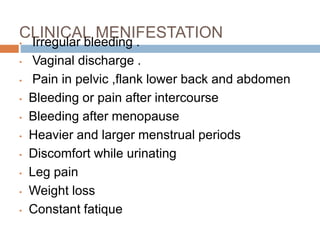
CLINICAL MENIFESTATION
• Irregular bleeding .
• Vaginal discharge .
• Pain in pelvic ,flank lower back and abdomen
• Bleeding or pain after intercourse
• Bleeding after menopause
• Heavier and larger menstrual periods
• Discomfort while urinating
• Leg pain
• Weight loss
• Constant fatique
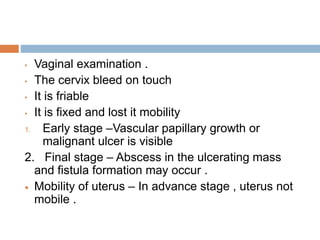
• Vaginal examination .
• The cervix bleed on touch
• It is friable
• It is fixed and lost it mobility
1. Early stage –Vascular papillary growth or
malignant ulcer is visible
2. Final stage – Abscess in the ulcerating mass
and fistula formation may occur .
 Mobility of uterus – In advance stage , uterus not
mobile .
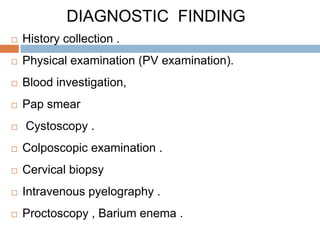
DIAGNOSTIC FINDING
 History collection .
 Physical examination (PV examination).
 Blood investigation,
 Pap smear
 Cystoscopy .
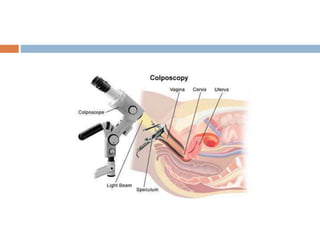
 Colposcopic examination .
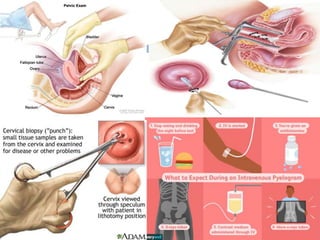
 Cervical biopsy
 Intravenous pyelography .
 Proctoscopy , Barium enema .
MANEGEMENT
Cervical cancer is treated with according to stage.
STAGE 0( Pre-invasive stage )
- Crosurgery .
- Conization .
- Laser therapy.
Cryosurgery
 insert an instrument called a cryoprobe into
vagina and press it against the cervix. Nitrogen
gas at a temperature of about -50ºC/-58ºF chills
the metal and creates an “ice ball” on the cervix.
 The ice ball kills the abnormal cells. During this
part of the procedure, patient may experience
some chills or cramping.
 For best results, hold the cryoprobe against the
cervix for three minutes. They will then remove it
for about five minutes to allow thawing to occur,
and then repeat the procedure.
Conization
 Conization is a surgery that removes the
abnormal, precancerous cells from
the cervix. Conization is essentially an
intensified biopsy of the cervix that removes a
large cone-shape section of the abnormal
tissue, as well as a small amount of normal
tissue so an area of normal tissue remains in
the cervix.
Laser therapy
 Laser therapy (sometimes called laser ablation) is a
treatment used to destroy abnormal cervical cells
so that normal cells can grow back in their place.
Most women need only one session of treatment. A
biopsy (a sample of the skin) is required before
laser therapy is used. Under local anaesthetic, a
laser beam is pointed onto the abnormal areas of
the cervix and the cells are destroyed. During the
treatment there may be a slight burning smell from
the laser.
 Treatment is not painful, just uncomfortable, like
bad period pains and cramping and the treatment
MANEGEMENT
The treatment for carcinoma cervix is extended by
1. Radiotherapy ( Stage 1b -4 ) .
2. Surgery
• Radical abdominal hysterectomy .
• Radical vaginal hysterectomy .
NURSING MANAGEMENT
 Listen to the patient’s fear and concerns and
offer reassurance when appropriate.
 encourage patient to use relaxation techniques
to promote comfort during diagnostic
procedures.
 Monitor the patient’s response to the therapy.
 Watch for the complications related to the
therapy by listening to and observing the
patient.
 Monitor the lab studies and obtain frequent
vital signs.
 Understand the treatment regimen.
 Give adequate fluid and nutritional intake to
promote tissue healing.
 Explain any surgical procedure or therapeutic
procedure to the patient, including what to
expect both before and after the procedure.
 Review the possible complications of any
procedure to be done.
 Remind the patient to watch for and report
adverse reactions.
 Reassure the patient that this disease and its
treatment shouldn’t radically alter her lifestyle
or prohibit sexual intimacy.
NURSING DIAGNOSIS
 Nursing diagnosis - Pain related to the disease
condition.
Goal – To reduce pain.
Intervention-
NURSING DIAGNOSIS
 Nursing diagnosis- Fear related to the disease
condition.
Goal - to reduce fear.
Intervention-
 Nursing diagnosis - Knowledge deficit related to
the disease condition.
Goal - To improve level of knowledge.
Intervention-
DISCHARE TEACHING
 Explain the importance of follow up to the
oncologist.
 Perform prescribed abdominal strengthening
excercises.
 Avoid heavy lifting for about 2 months.
 Avoid activities that increase pelvic congestion.
 Early ambulation
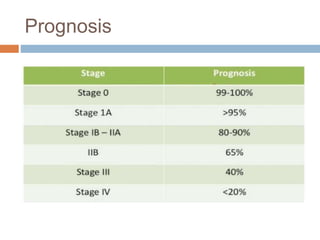
Prognosis
Summary
 So far we have discussed about the term ca-
cervix, Etiology, Pathophysiology, Stages
Clinical feature , Diagnosis evaluation and
Management of ca-cervix .
Bibliography
 Lewis et al, Medical Surgical Nursing, Mosby
Elsevier,7th edition.
 Joyce.M.Black et al, Medical Surgical Nursing,
Saunders publication.
 Brunner and Siddhartha, Medical Surgical
Nursing, Lippincott Williams and Wilkins.
Thank You

Ca cervix

  • 1.
  • 2.
    LEARNING OBJECTIVES At theend of this lecture, the students should be able to: • Define the term ca-cervix . • Explain Etiology of ca-cervix . • Explain Pathophysiology of ca-cervix . • Discuss the Stages of ca-cervix . • Discuss the Clinical feature of ca-cervix. • Describe the Diagnosis evaluation of ca-cervix • Management of ca-cervix .
  • 3.
    INTRODUCTION Caner is theuniversal disease. It is less common that once was because of early detection of cell changes by pap smear .cervical cancer is the commonest malignancy in female in India .
  • 4.
    DEFINITION Cancer is thecervix predominantly squamous cell cancer and also includes adenocarcinoma .This is the primary malignant epithelial growth invading the cervix .
  • 6.
    ETIOLOGY The exact causeis unknown . A] Coitus and sperm factor . B] Risk factor for cervical . 1.Actual risk factor.  Low socio-economic status.  Early age of first coitus.
  • 7.
     Multiple sexualpartners .  History of STD.  High risk male partners.  Compromised immunity (HIV, Human Papiloma Virus infection ).  Early age at first pregnancy.  Prostitution, Multiparity.  Long term use of contraceptive pills  Smoking  Family history
  • 8.
    PATHOPHYSIOLOGY Most cervical cancer- squamous cell type, - usually begins at the squamocolumar junction near to the external end of the cervix . The spread of squamous cell cervical cancer occurs first by direct extension to the vaginal mucosa , the lower uterine segment , parameterium ,pelvic wall , bladder and bowl .
  • 9.
    FLOW CHART HPV infectsthe basal cells Virus enters in the basal layer of cervix Entry of HPV Sexual activity
  • 10.
    Damage the geneticmaterial of the cells Cell become pre-cancerous Damaged cells continue to multiply
  • 11.
    STAGES SIZE ANDDISCRIPTION Pre-invasive stage 0 Carcinoma in situ,cancer limited to epithelial stage . Invasive stage 1 Carcinoma find on the cervix . Stage 1a Preclinical carcinoma of the cervix . Stage 1a1 Invasion no >3 mm in depth and no wider than 7mm . Stage 1a2 Invasion >3 mm and no >5 mm and no wider than 7 mm .
  • 12.
    Stage 1b Preclinicallesions of greater dimensions that 1a2 . Stage 2 Carcinoma extends beyond the cervix but not on the pelvic wall . Stage 2a Vaginal extension with or without vaginal involvement . Stage 2b Para-cervical extension with or without vaginal involvement . Stage 3 Involvement of the lower third of the vaginal or extension to the pelvic side wall .
  • 13.
    Stage 4a Involvementof the mucosa of the bladder or rectum . Stage 4b Involvement of the distant metastasis or disease outside the true pelvis . Stage 3a Involvement of the lower third of the vaginal but not out of the pelvic side wall . Stage 3b Extension of the pelvic sidewall or hydronephrosis . Stage 4 Extension beyond true pelvis or mucosa of the bladder or rectum .
  • 14.
    CLINICAL MENIFESTATION • Irregularbleeding . • Vaginal discharge . • Pain in pelvic ,flank lower back and abdomen • Bleeding or pain after intercourse • Bleeding after menopause • Heavier and larger menstrual periods • Discomfort while urinating • Leg pain • Weight loss • Constant fatique
  • 15.
    • Vaginal examination. • The cervix bleed on touch • It is friable • It is fixed and lost it mobility 1. Early stage –Vascular papillary growth or malignant ulcer is visible 2. Final stage – Abscess in the ulcerating mass and fistula formation may occur .  Mobility of uterus – In advance stage , uterus not mobile .
  • 16.
    DIAGNOSTIC FINDING  Historycollection .  Physical examination (PV examination).  Blood investigation,  Pap smear  Cystoscopy .  Colposcopic examination .  Cervical biopsy  Intravenous pyelography .  Proctoscopy , Barium enema .
  • 19.
    MANEGEMENT Cervical cancer istreated with according to stage. STAGE 0( Pre-invasive stage ) - Crosurgery . - Conization . - Laser therapy.
  • 20.
    Cryosurgery  insert aninstrument called a cryoprobe into vagina and press it against the cervix. Nitrogen gas at a temperature of about -50ºC/-58ºF chills the metal and creates an “ice ball” on the cervix.  The ice ball kills the abnormal cells. During this part of the procedure, patient may experience some chills or cramping.  For best results, hold the cryoprobe against the cervix for three minutes. They will then remove it for about five minutes to allow thawing to occur, and then repeat the procedure.
  • 21.
    Conization  Conization isa surgery that removes the abnormal, precancerous cells from the cervix. Conization is essentially an intensified biopsy of the cervix that removes a large cone-shape section of the abnormal tissue, as well as a small amount of normal tissue so an area of normal tissue remains in the cervix.
  • 22.
    Laser therapy  Lasertherapy (sometimes called laser ablation) is a treatment used to destroy abnormal cervical cells so that normal cells can grow back in their place. Most women need only one session of treatment. A biopsy (a sample of the skin) is required before laser therapy is used. Under local anaesthetic, a laser beam is pointed onto the abnormal areas of the cervix and the cells are destroyed. During the treatment there may be a slight burning smell from the laser.  Treatment is not painful, just uncomfortable, like bad period pains and cramping and the treatment
  • 23.
    MANEGEMENT The treatment forcarcinoma cervix is extended by 1. Radiotherapy ( Stage 1b -4 ) . 2. Surgery • Radical abdominal hysterectomy . • Radical vaginal hysterectomy .
  • 24.
    NURSING MANAGEMENT  Listento the patient’s fear and concerns and offer reassurance when appropriate.  encourage patient to use relaxation techniques to promote comfort during diagnostic procedures.  Monitor the patient’s response to the therapy.  Watch for the complications related to the therapy by listening to and observing the patient.
  • 25.
     Monitor thelab studies and obtain frequent vital signs.  Understand the treatment regimen.  Give adequate fluid and nutritional intake to promote tissue healing.  Explain any surgical procedure or therapeutic procedure to the patient, including what to expect both before and after the procedure.  Review the possible complications of any procedure to be done.
  • 26.
     Remind thepatient to watch for and report adverse reactions.  Reassure the patient that this disease and its treatment shouldn’t radically alter her lifestyle or prohibit sexual intimacy.
  • 27.
    NURSING DIAGNOSIS  Nursingdiagnosis - Pain related to the disease condition. Goal – To reduce pain. Intervention-
  • 28.
    NURSING DIAGNOSIS  Nursingdiagnosis- Fear related to the disease condition. Goal - to reduce fear. Intervention-
  • 29.
     Nursing diagnosis- Knowledge deficit related to the disease condition. Goal - To improve level of knowledge. Intervention-
  • 30.
    DISCHARE TEACHING  Explainthe importance of follow up to the oncologist.  Perform prescribed abdominal strengthening excercises.  Avoid heavy lifting for about 2 months.  Avoid activities that increase pelvic congestion.  Early ambulation
  • 31.
  • 32.
    Summary  So farwe have discussed about the term ca- cervix, Etiology, Pathophysiology, Stages Clinical feature , Diagnosis evaluation and Management of ca-cervix .
  • 33.
    Bibliography  Lewis etal, Medical Surgical Nursing, Mosby Elsevier,7th edition.  Joyce.M.Black et al, Medical Surgical Nursing, Saunders publication.  Brunner and Siddhartha, Medical Surgical Nursing, Lippincott Williams and Wilkins.
  • 34.