D R . A K S HA Y ( C O M - P T )
Physiotherapy in thoracic
surgery
ANATOMY OF THE THORAX
 The skeleton of the thorax is an osteocartilagenous
framework within which lie the principal organs of
respiration, the heart, major blood vessels, and the
oesophagus.
 It is conical in shape, narrow apically, broad at its
base and longer posteriorly.
 The bony structure consists of 12 thoracic vertebrae,
12 pairs of ribs and the sternum.
ANATOMY OF THE THORAX
 The musculature of the thoracic cage is in two layers.
 The outer layer consists of latissimus dorsi and trapezius, the
inner layer of the rhomboids and serratus anterior muscles.
 Anteriorly, the chest wall is covered by pectoralis major and
minor.
 The intercostal muscles run obliquely between the ribs.
 The diaphragm forms the lower border of the thorax. It is
convex upwards showing two cupolae, the right being slightly
higher than the left.
 It is made up of muscle fibres peripherally and is tendinous
centrally.
THORACIC SURGERY- Indications for surgery
 Tumor
 Pneumothorax - collection of air in the pleural cavity
 Empyema - collection of pus in the pleural cavity.
 Bronchiectasis - chronic lung condition in which
abnormal dilatation of the bronchi occurs associated
with obstruction and infection.
 Oesophageal perforation - Trauma and perforation
to the oesophagus may result from the accidental
swallowing of a foreign body (such as a dental plate).
Types of thoracic incision
POSTEROLATERAL THORACOTOMY
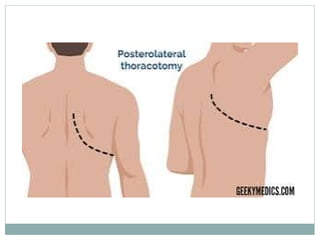
 This incision is most commonly used for operations on the lung.
It is a curved incision that starts at the level of the third thoracic
vertebra and follows the vertebral border of the scapula and the
line of the rib extending forward to the anterior angle or costal
margin.
 An incision through the bed of the fifth or sixth rib is used for
pneumonectomy or lobectomy.
 The muscles involved are the trapezius, latissimus dorsi,
rhomboids, serratus anterior and the corresponding intercostal.
 A small piece of rib, approximately 1 cm, may be removed to
allow easier retraction and avoid a painful fracture.
ANTEROLATERAL THORACOTOMY
 This incision is used primarily for cardiac surgery
but can be used to perform pleurectomy.
 The incision starts at the level of the fifth costal
cartilage.
 At the sternal edge it follows the rib line below the
breast to the posterior axillary line.
 The muscles cut are pectoralis major and minor,
serratus anterior and the corresponding intercostal.
MEDIAN STERNOTOMY
 This incision is used for lung volume reduction
surgery and bilateral pleurectomy.
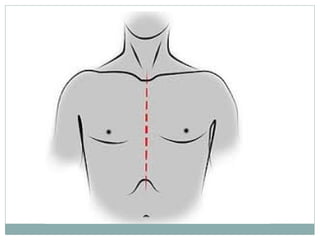
 It is a vertical incision that involves splitting the
sternum.
 The incision extends from just above the
suprasternal notch to a point about 3 cm below the
xiphisternum.
 No muscle is cut except the aponeuroses of pectoralis
major.
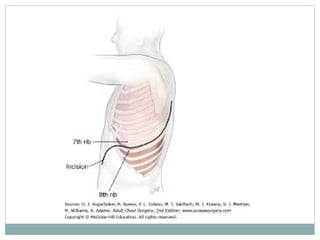
LEFT THORACO-LAPAROTOMY
 This incision is used for surgery on the lower oesophagus and
stomach.
 The thoracotomy incision follows the curve of the seventh rib
and extends anteriorly over the costal margin towards the
umbilicus.
 The muscles involved are lattisimus dorsi, serratus anterior,
the corresponding intercostal and the abdominal muscles.
 If an oesophageal tumour is involving the middle third of the
oesophagus, surgical access may be easier through a right
thoracotomy and a separate abdominal incision.
 If the tumour is in the upper third, then a cervical incision
will also be required.
VIDEO-ASSISTED THORACOSCOPIC
INCISIONS
 This technique aims to carry out conventional thoracic
operations through several very small (1–2 cm) incisions as
opposed to a posterolateral thoracotomy.
 Instead of the surgeon seeing inside the patient directly, an
endoscope with video camera attachment is introduced into
the chest through one of the small incisions – the surgeon
sees the image produced on television monitors in theatre.
 Specialised instruments are inserted via the other incisions so
the operation can be completed.
 Advantages are reduced pain and less impact on respiratory
mechanics in the postoperative period, and much smaller
scars.
OPERATIONS ON THE LUNG
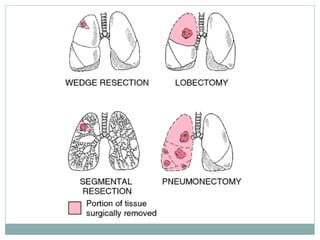
 Pneumonecomy - The whole lung is removed and the
resulting cavity will fill with protein-rich fluid and fibrin over
a period of weeks.
 Lobectomy - removal of a complete lobe with its lobar
bronchus.
 Segmental resection - A segment of a lobe along with its
segmental artery and bronchus are removed.
 Wedge resection - This is a small local resection of lung
tissue.
 Lung volume-reduction surgery - It is a procedure
designed to improve respiratory function in patients with
severe bullous emphysema.
Complications of pulmonary surgery
 Respiratory
• Sputum retention ± infection
• Atelectasis/lobar collapse
• Persistent air leak/pneumothorax
• Bronchopleural fistula
• Pleural effusion
• Surgical emphysema
• Respiratory failure
 Circulatory
• Haemorrhage
• Cardiac arrhythmia: atrial
fibrillation will occur in
approximately 30% of lung
resection patients
• Deep vein thrombosis
• Pulmonary embolus
• Myocardial infarction
 Wound
• Infection
• Chronic wound pain
• Failure to heal
 Neurological
• Stroke
• Recurrent laryngeal nerve
(RLN) damage
• Phrenic nerve damage,
resulting in paralysis of the
hemi-diaphragm
 Loss of joint range
• Loss of shoulder range on
operated side
• Postural changes
OPERATIONS ON THE PLEURA
 Pleurectomy - The procedure involves removing
the parietal layer of pleura from the chest wall in the
area adjacent to the lung injury.
 Decortication - Decortication is carried out
following chronic empyema. The procedure involves
the removal of the thickened, fibrous layer of visceral
pleura from the surface of the lung.
OPERATIONS ON THE OESOPHAGUS
 Oesophageal resection
 Repair of oesophageal perforations
THE PHYSIOTHERAPIST
AND THORACIC SURGERY
Pre-operative care
 The provision of pre-operative chest physiotherapy is not routine,
but it has been shown to be of benefit in highrisk patients.
 For example, Nagasaki et al. (1982) demonstrated that pre-operative
physiotherapy for elderly patients and those with COPD reduced
postoperative pulmonary morbidity.
 Patients with pre-existing COPD are prone to increased bronchial
secretions (Massard and Wihlm 1998) and may require chest
clearance prior to surgery.
 Physiotherapy may be requested by the patient’s medical team
following bronchoscopic findings (i.e. sputum retention).
 The pre-operative care may vary from simple education in
postoperative techniques to more intensive chest clearance.
Postoperative care
 Postoperative complications commonly present as a restrictive
pattern with reduced inspiratory capacity, reduced vital capacity
(VC) and reduced functional residual capacitty(FRC) (Craig 1981).
 There are changes in defence mechanisms owing to anaesthesia
and reduced cough effort (Scuderi and Olsen 1989) that can lead
to retention of secretions.
 Postoperative physiotherapy aims to minimise the risk of non-
infectious and infectious pulmonary complications (Scuderi and
Olsen 1989), the most common being atelectasis and pneumonia.
 Other common problems are loss of joint range in the shoulder on
the incision side and reduced mobility.
Aims of physiotherapy
• patient education;
• maximisation of lung volume;
• prevention of sputum retention;
• sputum clearance;
• maintenance of shoulder range of movement;
• early mobilisation.
Patient assessment
Database: obtained from medical notes
• Pre-operative information: pulmonary
function tests and arterial blood gases
• Surgical procedure and incision
• Concise relevant history of present
condition
• Relevant past medical history including
previous surgery
• Social history
• Drug history, specific note of
respiratory medicines, e.g. inhalers
Subjective: information the patient
tells you
• Ask open-ended questions: How do you
feel?
• Ask about pain control: Can the person
cough?
Objective: information based on examination
of the patient and tests carried out
• Cardiovascular status (CVS): blood pressure,
heart rate and rhythm
• Oxygen delivery system and FIV1
• Blood gases or O2 saturation
• Respiratory rate
• Chest X-ray
• Method of pain control
• Number and type of drains
• Auscultation
• Ability to cough
• Range of movement of shoulder on incision
side
Other
• reduced lung volume;
• retention of secretions;
• increased work of breathing;
• poor breathing control/pattern;
• ineffective cough;
• pain.
MODALITIES OF PHYSIOTHERAPY
 From the initial assessment and problem
identification a treatment plan can be formulated.
 The amount of chest physiotherapy required will
vary from patient to patient.
 The patient’s individual require ments will primarily
dictate how often and for how long treatment is
needed.
 Consultant preference and hospital protocols may
also influence this (Stiller and Munday 1992).
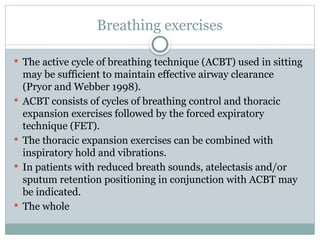
Breathing exercises
 The active cycle of breathing technique (ACBT) used in sitting
may be sufficient to maintain effective airway clearance
(Pryor and Webber 1998).
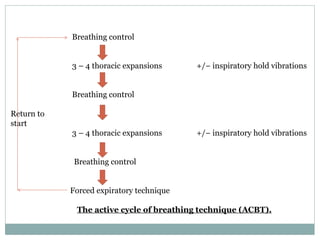
 ACBT consists of cycles of breathing control and thoracic
expansion exercises followed by the forced expiratory
technique (FET).
 The thoracic expansion exercises can be combined with
inspiratory hold and vibrations.
 In patients with reduced breath sounds, atelectasis and/or
sputum retention positioning in conjunction with ACBT may
be indicated.
 The whole
Breathing control
3 – 4 thoracic expansions +/− inspiratory hold vibrations
Breathing control
Return to
start
3 – 4 thoracic expansions +/− inspiratory hold vibrations
Breathing control
Forced expiratory technique
The active cycle of breathing technique (ACBT).
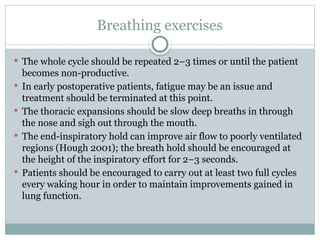
Breathing exercises
 The whole cycle should be repeated 2–3 times or until the patient
becomes non-productive.
 In early postoperative patients, fatigue may be an issue and
treatment should be terminated at this point.
 The thoracic expansions should be slow deep breaths in through
the nose and sigh out through the mouth.
 The end-inspiratory hold can improve air flow to poorly ventilated
regions (Hough 2001); the breath hold should be encouraged at
the height of the inspiratory effort for 2–3 seconds.
 Patients should be encouraged to carry out at least two full cycles
every waking hour in order to maintain improvements gained in
lung function.
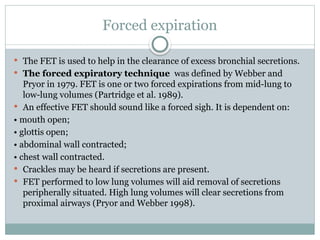
Forced expiration
 The FET is used to help in the clearance of excess bronchial secretions.
 The forced expiratory technique was defined by Webber and
Pryor in 1979. FET is one or two forced expirations from mid-lung to
low-lung volumes (Partridge et al. 1989).
 An effective FET should sound like a forced sigh. It is dependent on:
• mouth open;
• glottis open;
• abdominal wall contracted;
• chest wall contracted.
 Crackles may be heard if secretions are present.
 FET performed to low lung volumes will aid removal of secretions
peripherally situated. High lung volumes will clear secretions from
proximal airways (Pryor and Webber 1998).
Supported cough
 A cough is created by forced expiration against a closed glottis. This
causes a rise in intrathoracic pressure.
 As the glottis opens there is rapid, outward airflow and shearing of
secretions from the airway walls.
 Improved coughing and FET can be achieved if the wound is supported.
 This can be done by the physiotherapist during treatment sessions or by
the patient.
 The arm on the unoperated side is placed across the front of the thorax
and over the incision and drain sites.
 Firm overpressure is applied during coughing/FET.
 A towel, folded lengthways, passed around the back of the patient and
pulled across the front of the thorax can also be useful to support
coughing.
Positioning
 There are recognised positions for segmental drainage (Thoracic Society
1950) and these may be utilised if there is a segmental or lobar-specific
problem.
 It is much more likely, however, that modified positions only will be
required, especially in view of the changed anatomy of the area.
 Positioning can also be used to improve gas exchange.
 Improvement in oxygenation can be achieved in sidelying with the affected
lung uppermost; the ventilation/ perfusion match is improved, resulting in
increased oxygen uptake (Winslow et al. 1990).
 Pneumonectomy patients should not be positioned on their unoperated
side. This can result in bronchopleural fistula owing to space fluid washing
over the bronchial stump.
 Patients undergoing intrapericardial pneumonectomy should be treated in
sitting for the first four days unless advised otherwise by the medical team.
Early mobilisation
 Mobilisation should commence as soon as is safely possible as
functional residual capacity is maximally improved in standing
(Jenkins et al. 1988).
 Dull and Dull (1983) proposed that early mobilisation in
uncomplicated patients could render breathing exercises
unnecessary.
 Patients must be cardiovascularly stable and not requiring high
concentrations of oxygen before mobilisation can begin.
 If intercostal drains are on suction, mobility will be restricted to
standing and spot-marching at the bedside.
 Some anaesthetic departments restrict mobility when an epidural
is in situ owing to the risk of profound hypotension on mobilising.
Hospital protocols should be noted.
Shoulder exercises
 The shoulder on the operated side should be checked
for range of movement.
 The patient should practise elevation and abduction
of the shoulder at least three times a day.
 Auto-assisted exercises may be necessary to begin
with.
 Any limitation of range should be more formally
assessed and treated.
Adjuncts to physiotherapy
 Physiotherapy is a ‘hands on’ practice. There are
several adjuncts that can be used to augment the
basic breathing exercise regimen.
Incentive spirometer
Mini-tracheostomy
Heated humidification
Continuous positive airways pressure
Intermittent positive pressure breathing
Incentive spirometer
 Incentive spirometry is a feedback system to
encourage patients to take a deep breath and
produce a sustained maximal inspiration in order to
open atelectatic areas of lung (Su et al. 1991).
 It is cheap to provide, non-invasive and, when taught
well, needs minimal supervision.
 Bastin et al. (1997) deduced that deterioration in
incentive spirometer performance could be used as a
warning of pulmonary deterioration.
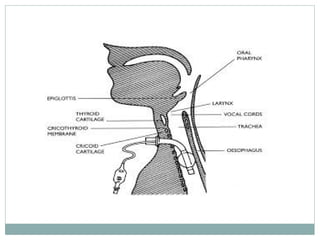
Mini-tracheostomy
 Sputum retention is a frequent complication in patients
recovering from thoracic surgery (Busch et al. 1994).
 It can be a result of sputum tenacity or a weak ineffective
cough.
 Mini-tracheostomy can be an invaluable tool in the
postoperative patient to aid removal of secretions in
conjunction with a physiotherapy regimen.
 Quidaciolu et al. (1994) concluded that
minitracheostomy was safe and effective in reducing
respiratory morbidity in high-risk patients following
pulmonary surgery.
Heated humidification
 Pulmonary secretions can become tenacious
following surgery.
 This may be a result of anaesthesia, infection or
dehydration – especially in oesophageal patients
who are ‘nil by mouth’.
 Improving humidification to the airways by heating
the oxygen/air delivery can help in mucus clearance.
Continuous positive airways pressure
 Patients with poor arterial blood gases and reduced lung
volume can be supported by the use of continuous
positive airways pressure (CPAP).
 It can be used continuously or intermittently.
 When used continuously it must be humidified.
 CPAP is effective in improving FRC and arterial oxygen in
patients with acute respiratory failure.
 It can also reduce the work of breathing (Keilty and Bott
1992).
 Care must be taken in thoracic patients because of the
anastamosis and medical opinion should be sought.
Intermittent positive pressure breathing
 There is little literature to support the use of intermittent
positive pressure breathing (IPPB), but with good teaching
and in the right patient it can be effective.
 It is of particular use in patients who have loss of lung volume
and are tiring.
 It works to improve lung volume and reduces the work of
breathing.
 Extreme care must be used when considering IPPB on lung
resection patients as the anastamosis may be vulnerable to
positive pressure.
 The physiotherapist should discuss the use of IPPB with the
patient’s medical team.
DISCHARGE
 Patients will reach discharge from treatment at varying points
in their recovery.
 A low-risk patient with no postoperative complications may
only need 3–4 days of physiotherapy.
 High-risk patients and those experiencing pulmonary
complications will need considerably more.
 FRC and VC can be regained even in lung resection patients.
 The time for full recovery of FRC is about two weeks and for VC
it can be in excess of three weeks (Craig 1981).
 Once discharged, the patient should be advised to continue
with regular breathing exercises and gradually increase their
mobility.
THNK YOU. . .
Click icon to add picture
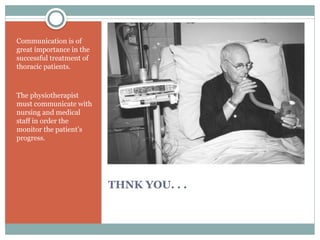
Communication is of
great importance in the
successful treatment of
thoracic patients.
The physiotherapist
must communicate with
nursing and medical
staff in order the
monitor the patient’s
progress.
Physiotherapy in thoracic surgery.pptx..

  • 1.
    D R .A K S HA Y ( C O M - P T ) Physiotherapy in thoracic surgery
  • 2.
    ANATOMY OF THETHORAX  The skeleton of the thorax is an osteocartilagenous framework within which lie the principal organs of respiration, the heart, major blood vessels, and the oesophagus.  It is conical in shape, narrow apically, broad at its base and longer posteriorly.  The bony structure consists of 12 thoracic vertebrae, 12 pairs of ribs and the sternum.
  • 3.
    ANATOMY OF THETHORAX  The musculature of the thoracic cage is in two layers.  The outer layer consists of latissimus dorsi and trapezius, the inner layer of the rhomboids and serratus anterior muscles.  Anteriorly, the chest wall is covered by pectoralis major and minor.  The intercostal muscles run obliquely between the ribs.  The diaphragm forms the lower border of the thorax. It is convex upwards showing two cupolae, the right being slightly higher than the left.  It is made up of muscle fibres peripherally and is tendinous centrally.
  • 4.
    THORACIC SURGERY- Indicationsfor surgery  Tumor  Pneumothorax - collection of air in the pleural cavity  Empyema - collection of pus in the pleural cavity.  Bronchiectasis - chronic lung condition in which abnormal dilatation of the bronchi occurs associated with obstruction and infection.  Oesophageal perforation - Trauma and perforation to the oesophagus may result from the accidental swallowing of a foreign body (such as a dental plate).
  • 5.
    Types of thoracicincision POSTEROLATERAL THORACOTOMY  This incision is most commonly used for operations on the lung. It is a curved incision that starts at the level of the third thoracic vertebra and follows the vertebral border of the scapula and the line of the rib extending forward to the anterior angle or costal margin.  An incision through the bed of the fifth or sixth rib is used for pneumonectomy or lobectomy.  The muscles involved are the trapezius, latissimus dorsi, rhomboids, serratus anterior and the corresponding intercostal.  A small piece of rib, approximately 1 cm, may be removed to allow easier retraction and avoid a painful fracture.
  • 7.
    ANTEROLATERAL THORACOTOMY  Thisincision is used primarily for cardiac surgery but can be used to perform pleurectomy.  The incision starts at the level of the fifth costal cartilage.  At the sternal edge it follows the rib line below the breast to the posterior axillary line.  The muscles cut are pectoralis major and minor, serratus anterior and the corresponding intercostal.
  • 9.
    MEDIAN STERNOTOMY  Thisincision is used for lung volume reduction surgery and bilateral pleurectomy.  It is a vertical incision that involves splitting the sternum.  The incision extends from just above the suprasternal notch to a point about 3 cm below the xiphisternum.  No muscle is cut except the aponeuroses of pectoralis major.
  • 11.
    LEFT THORACO-LAPAROTOMY  Thisincision is used for surgery on the lower oesophagus and stomach.  The thoracotomy incision follows the curve of the seventh rib and extends anteriorly over the costal margin towards the umbilicus.  The muscles involved are lattisimus dorsi, serratus anterior, the corresponding intercostal and the abdominal muscles.  If an oesophageal tumour is involving the middle third of the oesophagus, surgical access may be easier through a right thoracotomy and a separate abdominal incision.  If the tumour is in the upper third, then a cervical incision will also be required.
  • 13.
    VIDEO-ASSISTED THORACOSCOPIC INCISIONS  Thistechnique aims to carry out conventional thoracic operations through several very small (1–2 cm) incisions as opposed to a posterolateral thoracotomy.  Instead of the surgeon seeing inside the patient directly, an endoscope with video camera attachment is introduced into the chest through one of the small incisions – the surgeon sees the image produced on television monitors in theatre.  Specialised instruments are inserted via the other incisions so the operation can be completed.  Advantages are reduced pain and less impact on respiratory mechanics in the postoperative period, and much smaller scars.
  • 14.
    OPERATIONS ON THELUNG  Pneumonecomy - The whole lung is removed and the resulting cavity will fill with protein-rich fluid and fibrin over a period of weeks.  Lobectomy - removal of a complete lobe with its lobar bronchus.  Segmental resection - A segment of a lobe along with its segmental artery and bronchus are removed.  Wedge resection - This is a small local resection of lung tissue.  Lung volume-reduction surgery - It is a procedure designed to improve respiratory function in patients with severe bullous emphysema.
  • 16.
    Complications of pulmonarysurgery  Respiratory • Sputum retention ± infection • Atelectasis/lobar collapse • Persistent air leak/pneumothorax • Bronchopleural fistula • Pleural effusion • Surgical emphysema • Respiratory failure  Circulatory • Haemorrhage • Cardiac arrhythmia: atrial fibrillation will occur in approximately 30% of lung resection patients • Deep vein thrombosis • Pulmonary embolus • Myocardial infarction  Wound • Infection • Chronic wound pain • Failure to heal  Neurological • Stroke • Recurrent laryngeal nerve (RLN) damage • Phrenic nerve damage, resulting in paralysis of the hemi-diaphragm  Loss of joint range • Loss of shoulder range on operated side • Postural changes
  • 17.
    OPERATIONS ON THEPLEURA  Pleurectomy - The procedure involves removing the parietal layer of pleura from the chest wall in the area adjacent to the lung injury.  Decortication - Decortication is carried out following chronic empyema. The procedure involves the removal of the thickened, fibrous layer of visceral pleura from the surface of the lung.
  • 18.
    OPERATIONS ON THEOESOPHAGUS  Oesophageal resection  Repair of oesophageal perforations
  • 19.
    THE PHYSIOTHERAPIST AND THORACICSURGERY Pre-operative care  The provision of pre-operative chest physiotherapy is not routine, but it has been shown to be of benefit in highrisk patients.  For example, Nagasaki et al. (1982) demonstrated that pre-operative physiotherapy for elderly patients and those with COPD reduced postoperative pulmonary morbidity.  Patients with pre-existing COPD are prone to increased bronchial secretions (Massard and Wihlm 1998) and may require chest clearance prior to surgery.  Physiotherapy may be requested by the patient’s medical team following bronchoscopic findings (i.e. sputum retention).  The pre-operative care may vary from simple education in postoperative techniques to more intensive chest clearance.
  • 20.
    Postoperative care  Postoperativecomplications commonly present as a restrictive pattern with reduced inspiratory capacity, reduced vital capacity (VC) and reduced functional residual capacitty(FRC) (Craig 1981).  There are changes in defence mechanisms owing to anaesthesia and reduced cough effort (Scuderi and Olsen 1989) that can lead to retention of secretions.  Postoperative physiotherapy aims to minimise the risk of non- infectious and infectious pulmonary complications (Scuderi and Olsen 1989), the most common being atelectasis and pneumonia.  Other common problems are loss of joint range in the shoulder on the incision side and reduced mobility.
  • 21.
    Aims of physiotherapy •patient education; • maximisation of lung volume; • prevention of sputum retention; • sputum clearance; • maintenance of shoulder range of movement; • early mobilisation.
  • 22.
    Patient assessment Database: obtainedfrom medical notes • Pre-operative information: pulmonary function tests and arterial blood gases • Surgical procedure and incision • Concise relevant history of present condition • Relevant past medical history including previous surgery • Social history • Drug history, specific note of respiratory medicines, e.g. inhalers Subjective: information the patient tells you • Ask open-ended questions: How do you feel? • Ask about pain control: Can the person cough? Objective: information based on examination of the patient and tests carried out • Cardiovascular status (CVS): blood pressure, heart rate and rhythm • Oxygen delivery system and FIV1 • Blood gases or O2 saturation • Respiratory rate • Chest X-ray • Method of pain control • Number and type of drains • Auscultation • Ability to cough • Range of movement of shoulder on incision side Other • reduced lung volume; • retention of secretions; • increased work of breathing; • poor breathing control/pattern; • ineffective cough; • pain.
  • 23.
    MODALITIES OF PHYSIOTHERAPY From the initial assessment and problem identification a treatment plan can be formulated.  The amount of chest physiotherapy required will vary from patient to patient.  The patient’s individual require ments will primarily dictate how often and for how long treatment is needed.  Consultant preference and hospital protocols may also influence this (Stiller and Munday 1992).
  • 24.
    Breathing exercises  Theactive cycle of breathing technique (ACBT) used in sitting may be sufficient to maintain effective airway clearance (Pryor and Webber 1998).  ACBT consists of cycles of breathing control and thoracic expansion exercises followed by the forced expiratory technique (FET).  The thoracic expansion exercises can be combined with inspiratory hold and vibrations.  In patients with reduced breath sounds, atelectasis and/or sputum retention positioning in conjunction with ACBT may be indicated.  The whole
  • 25.
    Breathing control 3 –4 thoracic expansions +/− inspiratory hold vibrations Breathing control Return to start 3 – 4 thoracic expansions +/− inspiratory hold vibrations Breathing control Forced expiratory technique The active cycle of breathing technique (ACBT).
  • 26.
    Breathing exercises  Thewhole cycle should be repeated 2–3 times or until the patient becomes non-productive.  In early postoperative patients, fatigue may be an issue and treatment should be terminated at this point.  The thoracic expansions should be slow deep breaths in through the nose and sigh out through the mouth.  The end-inspiratory hold can improve air flow to poorly ventilated regions (Hough 2001); the breath hold should be encouraged at the height of the inspiratory effort for 2–3 seconds.  Patients should be encouraged to carry out at least two full cycles every waking hour in order to maintain improvements gained in lung function.
  • 27.
    Forced expiration  TheFET is used to help in the clearance of excess bronchial secretions.  The forced expiratory technique was defined by Webber and Pryor in 1979. FET is one or two forced expirations from mid-lung to low-lung volumes (Partridge et al. 1989).  An effective FET should sound like a forced sigh. It is dependent on: • mouth open; • glottis open; • abdominal wall contracted; • chest wall contracted.  Crackles may be heard if secretions are present.  FET performed to low lung volumes will aid removal of secretions peripherally situated. High lung volumes will clear secretions from proximal airways (Pryor and Webber 1998).
  • 28.
    Supported cough  Acough is created by forced expiration against a closed glottis. This causes a rise in intrathoracic pressure.  As the glottis opens there is rapid, outward airflow and shearing of secretions from the airway walls.  Improved coughing and FET can be achieved if the wound is supported.  This can be done by the physiotherapist during treatment sessions or by the patient.  The arm on the unoperated side is placed across the front of the thorax and over the incision and drain sites.  Firm overpressure is applied during coughing/FET.  A towel, folded lengthways, passed around the back of the patient and pulled across the front of the thorax can also be useful to support coughing.
  • 29.
    Positioning  There arerecognised positions for segmental drainage (Thoracic Society 1950) and these may be utilised if there is a segmental or lobar-specific problem.  It is much more likely, however, that modified positions only will be required, especially in view of the changed anatomy of the area.  Positioning can also be used to improve gas exchange.  Improvement in oxygenation can be achieved in sidelying with the affected lung uppermost; the ventilation/ perfusion match is improved, resulting in increased oxygen uptake (Winslow et al. 1990).  Pneumonectomy patients should not be positioned on their unoperated side. This can result in bronchopleural fistula owing to space fluid washing over the bronchial stump.  Patients undergoing intrapericardial pneumonectomy should be treated in sitting for the first four days unless advised otherwise by the medical team.
  • 30.
    Early mobilisation  Mobilisationshould commence as soon as is safely possible as functional residual capacity is maximally improved in standing (Jenkins et al. 1988).  Dull and Dull (1983) proposed that early mobilisation in uncomplicated patients could render breathing exercises unnecessary.  Patients must be cardiovascularly stable and not requiring high concentrations of oxygen before mobilisation can begin.  If intercostal drains are on suction, mobility will be restricted to standing and spot-marching at the bedside.  Some anaesthetic departments restrict mobility when an epidural is in situ owing to the risk of profound hypotension on mobilising. Hospital protocols should be noted.
  • 31.
    Shoulder exercises  Theshoulder on the operated side should be checked for range of movement.  The patient should practise elevation and abduction of the shoulder at least three times a day.  Auto-assisted exercises may be necessary to begin with.  Any limitation of range should be more formally assessed and treated.
  • 32.
    Adjuncts to physiotherapy Physiotherapy is a ‘hands on’ practice. There are several adjuncts that can be used to augment the basic breathing exercise regimen. Incentive spirometer Mini-tracheostomy Heated humidification Continuous positive airways pressure Intermittent positive pressure breathing
  • 33.
    Incentive spirometer  Incentivespirometry is a feedback system to encourage patients to take a deep breath and produce a sustained maximal inspiration in order to open atelectatic areas of lung (Su et al. 1991).  It is cheap to provide, non-invasive and, when taught well, needs minimal supervision.  Bastin et al. (1997) deduced that deterioration in incentive spirometer performance could be used as a warning of pulmonary deterioration.
  • 34.
    Mini-tracheostomy  Sputum retentionis a frequent complication in patients recovering from thoracic surgery (Busch et al. 1994).  It can be a result of sputum tenacity or a weak ineffective cough.  Mini-tracheostomy can be an invaluable tool in the postoperative patient to aid removal of secretions in conjunction with a physiotherapy regimen.  Quidaciolu et al. (1994) concluded that minitracheostomy was safe and effective in reducing respiratory morbidity in high-risk patients following pulmonary surgery.
  • 36.
    Heated humidification  Pulmonarysecretions can become tenacious following surgery.  This may be a result of anaesthesia, infection or dehydration – especially in oesophageal patients who are ‘nil by mouth’.  Improving humidification to the airways by heating the oxygen/air delivery can help in mucus clearance.
  • 37.
    Continuous positive airwayspressure  Patients with poor arterial blood gases and reduced lung volume can be supported by the use of continuous positive airways pressure (CPAP).  It can be used continuously or intermittently.  When used continuously it must be humidified.  CPAP is effective in improving FRC and arterial oxygen in patients with acute respiratory failure.  It can also reduce the work of breathing (Keilty and Bott 1992).  Care must be taken in thoracic patients because of the anastamosis and medical opinion should be sought.
  • 38.
    Intermittent positive pressurebreathing  There is little literature to support the use of intermittent positive pressure breathing (IPPB), but with good teaching and in the right patient it can be effective.  It is of particular use in patients who have loss of lung volume and are tiring.  It works to improve lung volume and reduces the work of breathing.  Extreme care must be used when considering IPPB on lung resection patients as the anastamosis may be vulnerable to positive pressure.  The physiotherapist should discuss the use of IPPB with the patient’s medical team.
  • 39.
    DISCHARGE  Patients willreach discharge from treatment at varying points in their recovery.  A low-risk patient with no postoperative complications may only need 3–4 days of physiotherapy.  High-risk patients and those experiencing pulmonary complications will need considerably more.  FRC and VC can be regained even in lung resection patients.  The time for full recovery of FRC is about two weeks and for VC it can be in excess of three weeks (Craig 1981).  Once discharged, the patient should be advised to continue with regular breathing exercises and gradually increase their mobility.
  • 40.
    THNK YOU. .. Click icon to add picture Communication is of great importance in the successful treatment of thoracic patients. The physiotherapist must communicate with nursing and medical staff in order the monitor the patient’s progress.