The Indian Dairy Industry
Presented By:
GROUP NO:- 7
Ananta Shah
Hiral Desai
Dimple Upadhyay
Jigna Nimbark
&Deepak Jha
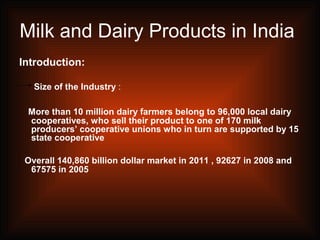
Milk and Dairy Products in India
Introduction:
Size of the Industry :
More than 10 million dairy farmers belong to 96,000 local dairy
cooperatives, who sell their product to one of 170 milk
producers’ cooperative unions who in turn are supported by 15
state cooperative
Overall 140,860 billion dollar market in 2011 , 92627 in 2008 and
67575 in 2005
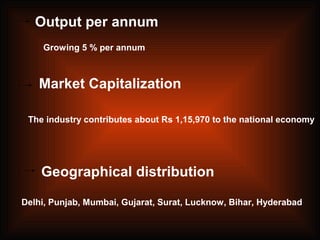
Output per annum
Market Capitalization
Growing 5 % per annum
The industry contributes about Rs 1,15,970 to the national economy
Geographical distribution
Delhi, Punjab, Mumbai, Gujarat, Surat, Lucknow, Bihar, Hyderabad
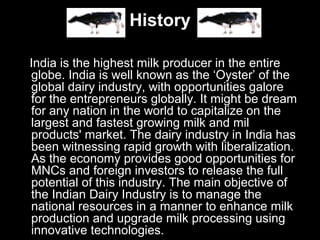
History
India is the highest milk producer in the entire
globe. India is well known as the ‘Oyster’ of the
global dairy industry, with opportunities galore
for the entrepreneurs globally. It might be dream
for any nation in the world to capitalize on the
largest and fastest growing milk and mil
products' market. The dairy industry in India has
been witnessing rapid growth with liberalization.
As the economy provides good opportunities for
MNCs and foreign investors to release the full
potential of this industry. The main objective of
the Indian Dairy Industry is to manage the
national resources in a manner to enhance milk
production and upgrade milk processing using
innovative technologies.
In India dairying from very much earlier is
regarded as an instrument for social and
economic development. The country’s
milk supply comes from millions of small
producers, who are dispersed throughout
the rural areas. All these farmers maintain
an average herd of one or two milch
animals, comprising cows and/or
buffaloes. Mostly ample labour and a
small land base encourage farmers to
practice dairying as an occupation
subsidiary to agriculture. As income from
crop production is seasonal instead
dairying provides a stable which is a
year-round income and also an important
economic incentive for the small farmer .
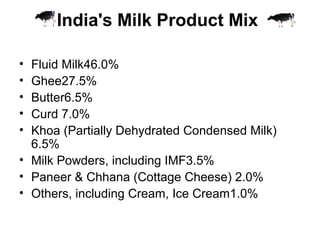
India's Milk Product Mix
• Fluid Milk46.0%
• Ghee27.5%
• Butter6.5%
• Curd 7.0%
• Khoa (Partially Dehydrated Condensed Milk)
6.5%
• Milk Powders, including IMF3.5%
• Paneer & Chhana (Cottage Cheese) 2.0%
• Others, including Cream, Ice Cream1.0%
Total contribution to the economy/ sales
The Indian Dairy Industry engages in the
production and processing of milk & cream.
This industry is involved in the manufacture
of various dairy products like cheese, curd,
yoghurt etc. The Indian Dairy Industry
specializes in the procurement, production,
processing, storage and distribution of dairy
products. India as nation stands first in its
share of dairy production in the international
scenario. The industry contributes about Rs
1,15,970 to the national economy.
The Indian Diary industry which is in the
developing stage provides gainful employment to
a vast majority of the rural households. It employs
about 8.47 million people on yearly basis out of
which 71% are women.
Jobs in Indian dairy industry are mainly in the
fields of production and processing of dairy
products. An individual with minimum of 60%
marks who has bachelor’s degree course in the
dairy technology can easily be availing an
opportunity to work in this industry. For the
graduation course in Dairy technology one has to
qualify the All India Entrance Test that is affiliated
to the Indian Council of Agricultural Research.
After that the person can continue with his
masters in dairy technology. Jobs would be for the
following positions.
Employment opportunities
• Dairy Scientists: The main job of the dairy
scientists is to deal with collection of milk and
taking care of the high yielding variety of animals.
• Dairy Technologists: the work of Dairy technology
requires procurement officers who take the
responsibility of collecting milk from farmers, milk
booths ad cattle-rearers. This particular
procurement officer should well understand the
latest technology that is applicable in maintaining
the quality of milk of the process of transporting it
to the desired location.
• Dairy Engineers: dairy engineers are usually
appointed is to set up and maintain dairy plants.
• Marketing Personnel: These individuals deal with
the sale and marketing of milk together with milk
products.
Latest developments
• Indian Dairy Industry is the largest milk
producer all over the world, around 100
million MTIndian Dairy Industries value
of output amounted to Rs. 1179 billion
in 2004-05 which approximately equals
combined output of paddy and wheat.
With 1/5th of the world’s bovine
population
• In India the Milch animals constitutes
45% indigenous cattle, 55 % buffaloes,
and 10% cross bred cows
• Intensive Dairy Development Programmed (IDDP):
The Schemes, modified under this programmes are on
the basis of the recommendation of the evaluation
studies which were launched during Eighth Plan period
and is being continued through out the Eleventh Plan
with an outlay of Rs. 32.49 core for 2009-10.
• Strengthening Infrastructure for Quality and Clean
Milk Production (CMP): this is a centrally sponsored
scheme which was launched in October 2003, which had
the main objective of improving the quality of raw milk
produced at the every village level in the India.
• Dairy Venture Capital Fund- this is introduced in the
Tenth Fiver Year Plan to bring about structural changes
in unorganized sector, which would measure like milk
processing at village level, marketing of pasteurized milk
in a cost effective manner, quality or the up gradation of
traditional technology to handle commercial scale using
modern equipments and management skills.
Market Size
• Rs 900 cr
• Amul approx market share 45%
• Nestle 23%
• Britannia has a significant share
• Other brands – Sapan , Vijaya , Mohan ,
Parag
• Configuration – Pouches & Tetrapacks
Leading Players
• Nestle ,
• Amul ,
• Britannia ,
• Dynamix Dairy ,
• Sterling Agro ,
• Haryana Milk Foods ,
• Mohan Food ,
• Modern Dairy ,
• K Dairy
Potential Markets (exports)
• Middle East , Gulf & Africa
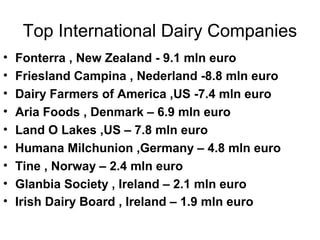
Top International Dairy Companies
• Fonterra , New Zealand - 9.1 mln euro
• Friesland Campina , Nederland -8.8 mln euro
• Dairy Farmers of America ,US -7.4 mln euro
• Aria Foods , Denmark – 6.9 mln euro
• Land O Lakes ,US – 7.8 mln euro
• Humana Milchunion ,Germany – 4.8 mln euro
• Tine , Norway – 2.4 mln euro
• Glanbia Society , Ireland – 2.1 mln euro
• Irish Dairy Board , Ireland – 1.9 mln euro
AMUL
• AMUL means "priceless" in Sanskrit. The
brand name "Amul," from the Sanskrit
"Amoolya," was suggested by a quality
control expert in Anand.
• Amul products have been in use in
millions of homes since 1946.
• Amul a leading food brand in India with a
Turnover: Rs. 52.55 billion in 2007-
08.
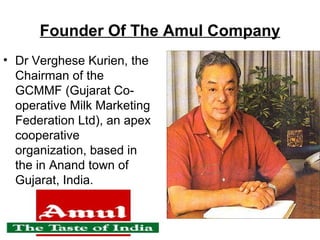
Founder Of The Amul Company
• Dr Verghese Kurien, the
Chairman of the
GCMMF (Gujarat Co-
operative Milk Marketing
Federation Ltd), an apex
cooperative
organization, based in
the in Anand town of
Gujarat, India.
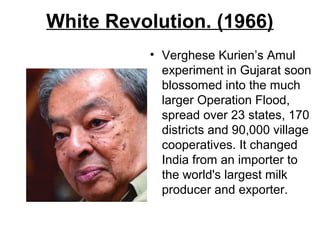
White Revolution. (1966)
• Verghese Kurien’s Amul
experiment in Gujarat soon
blossomed into the much
larger Operation Flood,
spread over 23 states, 170
districts and 90,000 village
cooperatives. It changed
India from an importer to
the world's largest milk
producer and exporter.
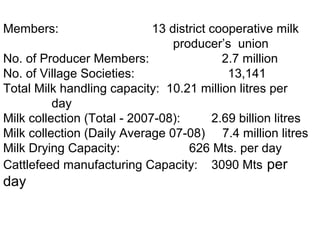
Members: 13 district cooperative milk
producer’s union
No. of Producer Members: 2.7 million
No. of Village Societies: 13,141
Total Milk handling capacity: 10.21 million litres per
day
Milk collection (Total - 2007-08): 2.69 billion litres
Milk collection (Daily Average 07-08) 7.4 million litres
Milk Drying Capacity: 626 Mts. per day
Cattlefeed manufacturing Capacity: 3090 Mts per
day
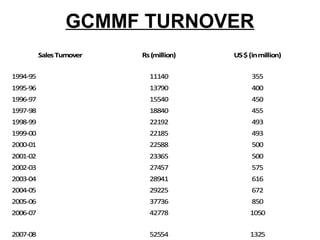
GCMMF TURNOVER
SalesTurnover Rs(million) US$(inmillion)
1994-95 11140 355
1995-96 13790 400
1996-97 15540 450
1997-98 18840 455
1998-99 22192 493
1999-00 22185 493
2000-01 22588 500
2001-02 23365 500
2002-03 27457 575
2003-04 28941 616
2004-05 29225 672
2005-06 37736 850
2006-07 42778 1050
2007-08 52554 1325
SalesTurnover Rs(million) US$(inmillion)
1994-95 11140 355
1995-96 13790 400
1996-97 15540 450
1997-98 18840 455
1998-99 22192 493
1999-00 22185 493
2000-01 22588 500
2001-02 23365 500
2002-03 27457 575
2003-04 28941 616
2004-05 29225 672
2005-06 37736 850
2006-07 42778 1050
2007-08 52554 1325
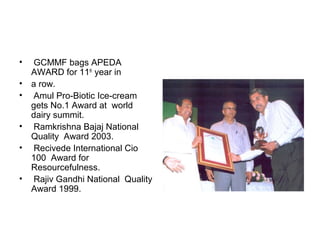
• GCMMF bags APEDA
AWARD for 11th
year in
• a row.
• Amul Pro-Biotic Ice-cream
gets No.1 Award at world
dairy summit.
• Ramkrishna Bajaj National
Quality Award 2003.
• Recivede International Cio
100 Award for
Resourcefulness.
• Rajiv Gandhi National Quality
Award 1999.
Certification
• ISO 9000-HACCP certified plants : All Amul
Ice Cream plants are ISO 9000-HACCP
certified.
• Amul is in the process of getting ISO 22000
(Improved version) certification for all its plants.
• No. 1 in Quality : Amul is ranked No.1 ice
cream in quality by “INSIGHT” (May-June,
2002), a bimonthly consumer magazine
published by Consumer Research and
Education Society (CERS) based at
Ahmedabad.
Amul dairy ppt

Amul dairy ppt

  • 2.
    The Indian DairyIndustry Presented By: GROUP NO:- 7 Ananta Shah Hiral Desai Dimple Upadhyay Jigna Nimbark &Deepak Jha
  • 3.
    Milk and DairyProducts in India Introduction: Size of the Industry : More than 10 million dairy farmers belong to 96,000 local dairy cooperatives, who sell their product to one of 170 milk producers’ cooperative unions who in turn are supported by 15 state cooperative Overall 140,860 billion dollar market in 2011 , 92627 in 2008 and 67575 in 2005
  • 4.
    Output per annum MarketCapitalization Growing 5 % per annum The industry contributes about Rs 1,15,970 to the national economy Geographical distribution Delhi, Punjab, Mumbai, Gujarat, Surat, Lucknow, Bihar, Hyderabad
  • 5.
    History India is thehighest milk producer in the entire globe. India is well known as the ‘Oyster’ of the global dairy industry, with opportunities galore for the entrepreneurs globally. It might be dream for any nation in the world to capitalize on the largest and fastest growing milk and mil products' market. The dairy industry in India has been witnessing rapid growth with liberalization. As the economy provides good opportunities for MNCs and foreign investors to release the full potential of this industry. The main objective of the Indian Dairy Industry is to manage the national resources in a manner to enhance milk production and upgrade milk processing using innovative technologies.
  • 6.
    In India dairyingfrom very much earlier is regarded as an instrument for social and economic development. The country’s milk supply comes from millions of small producers, who are dispersed throughout the rural areas. All these farmers maintain an average herd of one or two milch animals, comprising cows and/or buffaloes. Mostly ample labour and a small land base encourage farmers to practice dairying as an occupation subsidiary to agriculture. As income from crop production is seasonal instead dairying provides a stable which is a year-round income and also an important economic incentive for the small farmer .
  • 7.
    India's Milk ProductMix • Fluid Milk46.0% • Ghee27.5% • Butter6.5% • Curd 7.0% • Khoa (Partially Dehydrated Condensed Milk) 6.5% • Milk Powders, including IMF3.5% • Paneer & Chhana (Cottage Cheese) 2.0% • Others, including Cream, Ice Cream1.0%
  • 8.
    Total contribution tothe economy/ sales The Indian Dairy Industry engages in the production and processing of milk & cream. This industry is involved in the manufacture of various dairy products like cheese, curd, yoghurt etc. The Indian Dairy Industry specializes in the procurement, production, processing, storage and distribution of dairy products. India as nation stands first in its share of dairy production in the international scenario. The industry contributes about Rs 1,15,970 to the national economy.
  • 9.
    The Indian Diaryindustry which is in the developing stage provides gainful employment to a vast majority of the rural households. It employs about 8.47 million people on yearly basis out of which 71% are women. Jobs in Indian dairy industry are mainly in the fields of production and processing of dairy products. An individual with minimum of 60% marks who has bachelor’s degree course in the dairy technology can easily be availing an opportunity to work in this industry. For the graduation course in Dairy technology one has to qualify the All India Entrance Test that is affiliated to the Indian Council of Agricultural Research. After that the person can continue with his masters in dairy technology. Jobs would be for the following positions. Employment opportunities
  • 10.
    • Dairy Scientists:The main job of the dairy scientists is to deal with collection of milk and taking care of the high yielding variety of animals. • Dairy Technologists: the work of Dairy technology requires procurement officers who take the responsibility of collecting milk from farmers, milk booths ad cattle-rearers. This particular procurement officer should well understand the latest technology that is applicable in maintaining the quality of milk of the process of transporting it to the desired location. • Dairy Engineers: dairy engineers are usually appointed is to set up and maintain dairy plants. • Marketing Personnel: These individuals deal with the sale and marketing of milk together with milk products.
  • 11.
    Latest developments • IndianDairy Industry is the largest milk producer all over the world, around 100 million MTIndian Dairy Industries value of output amounted to Rs. 1179 billion in 2004-05 which approximately equals combined output of paddy and wheat. With 1/5th of the world’s bovine population • In India the Milch animals constitutes 45% indigenous cattle, 55 % buffaloes, and 10% cross bred cows
  • 12.
    • Intensive DairyDevelopment Programmed (IDDP): The Schemes, modified under this programmes are on the basis of the recommendation of the evaluation studies which were launched during Eighth Plan period and is being continued through out the Eleventh Plan with an outlay of Rs. 32.49 core for 2009-10. • Strengthening Infrastructure for Quality and Clean Milk Production (CMP): this is a centrally sponsored scheme which was launched in October 2003, which had the main objective of improving the quality of raw milk produced at the every village level in the India. • Dairy Venture Capital Fund- this is introduced in the Tenth Fiver Year Plan to bring about structural changes in unorganized sector, which would measure like milk processing at village level, marketing of pasteurized milk in a cost effective manner, quality or the up gradation of traditional technology to handle commercial scale using modern equipments and management skills.
  • 13.
    Market Size • Rs900 cr • Amul approx market share 45% • Nestle 23% • Britannia has a significant share • Other brands – Sapan , Vijaya , Mohan , Parag • Configuration – Pouches & Tetrapacks
  • 14.
    Leading Players • Nestle, • Amul , • Britannia , • Dynamix Dairy , • Sterling Agro , • Haryana Milk Foods , • Mohan Food , • Modern Dairy , • K Dairy
  • 15.
    Potential Markets (exports) •Middle East , Gulf & Africa
  • 16.
    Top International DairyCompanies • Fonterra , New Zealand - 9.1 mln euro • Friesland Campina , Nederland -8.8 mln euro • Dairy Farmers of America ,US -7.4 mln euro • Aria Foods , Denmark – 6.9 mln euro • Land O Lakes ,US – 7.8 mln euro • Humana Milchunion ,Germany – 4.8 mln euro • Tine , Norway – 2.4 mln euro • Glanbia Society , Ireland – 2.1 mln euro • Irish Dairy Board , Ireland – 1.9 mln euro
  • 17.
    AMUL • AMUL means"priceless" in Sanskrit. The brand name "Amul," from the Sanskrit "Amoolya," was suggested by a quality control expert in Anand. • Amul products have been in use in millions of homes since 1946. • Amul a leading food brand in India with a Turnover: Rs. 52.55 billion in 2007- 08.
  • 18.
    Founder Of TheAmul Company • Dr Verghese Kurien, the Chairman of the GCMMF (Gujarat Co- operative Milk Marketing Federation Ltd), an apex cooperative organization, based in the in Anand town of Gujarat, India.
  • 19.
    White Revolution. (1966) •Verghese Kurien’s Amul experiment in Gujarat soon blossomed into the much larger Operation Flood, spread over 23 states, 170 districts and 90,000 village cooperatives. It changed India from an importer to the world's largest milk producer and exporter.
  • 20.
    Members: 13 districtcooperative milk producer’s union No. of Producer Members: 2.7 million No. of Village Societies: 13,141 Total Milk handling capacity: 10.21 million litres per day Milk collection (Total - 2007-08): 2.69 billion litres Milk collection (Daily Average 07-08) 7.4 million litres Milk Drying Capacity: 626 Mts. per day Cattlefeed manufacturing Capacity: 3090 Mts per day
  • 21.
    GCMMF TURNOVER SalesTurnover Rs(million)US$(inmillion) 1994-95 11140 355 1995-96 13790 400 1996-97 15540 450 1997-98 18840 455 1998-99 22192 493 1999-00 22185 493 2000-01 22588 500 2001-02 23365 500 2002-03 27457 575 2003-04 28941 616 2004-05 29225 672 2005-06 37736 850 2006-07 42778 1050 2007-08 52554 1325 SalesTurnover Rs(million) US$(inmillion) 1994-95 11140 355 1995-96 13790 400 1996-97 15540 450 1997-98 18840 455 1998-99 22192 493 1999-00 22185 493 2000-01 22588 500 2001-02 23365 500 2002-03 27457 575 2003-04 28941 616 2004-05 29225 672 2005-06 37736 850 2006-07 42778 1050 2007-08 52554 1325
  • 22.
    • GCMMF bagsAPEDA AWARD for 11th year in • a row. • Amul Pro-Biotic Ice-cream gets No.1 Award at world dairy summit. • Ramkrishna Bajaj National Quality Award 2003. • Recivede International Cio 100 Award for Resourcefulness. • Rajiv Gandhi National Quality Award 1999.
  • 23.
    Certification • ISO 9000-HACCPcertified plants : All Amul Ice Cream plants are ISO 9000-HACCP certified. • Amul is in the process of getting ISO 22000 (Improved version) certification for all its plants. • No. 1 in Quality : Amul is ranked No.1 ice cream in quality by “INSIGHT” (May-June, 2002), a bimonthly consumer magazine published by Consumer Research and Education Society (CERS) based at Ahmedabad.