A STUDY ON
CONSUMER BUYING PATTERN TOWARDS AMUL MILK
Dissertation Submitted to the
Padmashree Dr. D.Y. Patil University
in partial fulfilment of the requirements for the award of the Degree
of
MASTERS IN BUSINESS ADMINISTRATION
Submitted by:
ROHAN.P.NAIK)
(Roll No.MBA-CORE-C-011179)
Research Guide:
Prof Vinod Dumbre
Department of Business Management
Padmashree Dr. D.Y. Patil University
CBD Belapur, Navi Mumbai
1
DECLARATION
I hereby declare that the dissertation “CONSUMER BUYING PATTERN
TOWARDS AMUL MILK” submitted for the MBA Degree at Padmashree Dr.
D.Y. Patil University’s Department of Business Management is my original work
and the dissertation has not formed the basis for the award of any degree, associate
ship, fellowship or any other similar titles.
Place: Navi Mumbai
Date:
Signature of the
Student
1
CERTIFICATE
This is to certify that the dissertation entitled “CONSUMER BUYING PATTERN
TOWARDS AMUL MILK “is the bona fide research work carried out by
Mr. ROHAN .P. NAIK student of MBA, at Padmashree Dr. D.Y. Patil University’s
Department of Business Management during the year 2011 -2013, in partial
fulfilment of the requirements for the award of the Degree of Master in Business
Management and that the dissertation has not formed the basis for the award
previously of any degree, diploma, associate ship, fellowship or any other similar
title.
(Mr Vinod Dhumbre)
(Dr. R. Gopal,
Director,
Department of Business Mgt,
Padmashree Dr. D.Y. Patil University)
Place: Mumbai
1
Date:
ACKNOWLEDGEMENTS
In the first place, I thank the Padmashree Dr. D. Y. Patil University, Department of
Business Management, Navi Mumbai for giving me an opportunity to work on this
project. I would also like to thank Mr. Vinod Dhumbre, Lecturer, Department of
Business Management, Padmashree Dr. D.Y. Patil University, Navi Mumbai for
having given me his valuable guidance for the project. Without his help it would
have been impossible for me to complete the project.
I would be failing in my duty if I do not acknowledge with a deep sense of gratitude
the sacrifices made by my parents and thus have helped me in completing the
project work successfully.
Place: Navi Mumbai
Date:
Signature of the student
1
TABLE OF CONTENTS
1
CHAPTE
R NO.
Title Page
No
1 GENERAL INFORMATION
1.1
1.2
1.3
INTRODUCTION AND HISTORY
INDUSTRY PROFILE
OBJECTIVE OF THE RESEARCH
9
22
25
1.4 LITERATURE REVIEW 26
2
2.1
2.2
About the Topic
Consumer Behaviour
Consumer Satisfaction
46
50
3 Marketing Research 51
4 Research Methodology 56
5 Data Analysis And Interpretation 61
6 SWOT Analysis 71
7 News Articles 73
8 GCMMF Overview: 79
9 Conclusion of (Amul milk) 111
10 Comparative Study 114
11 Annexure:
a)Bibliography & Webliography
b) Questionnaire
125
127
1
1
PREFACE
Today the business environment is rapidly changing in this competitive
environment the popular trend is also striving for maintaining its positions therefore
it become essential for the companies that they should know about their preference
& taste. Regarding a particular product it is of almost necessary to know the
consumers satisfaction to the value offered by the company in case of
dissatisfactory result it is essential to ascertain whether the dissatisfaction is for
entire product or part of it is and what value do the consumers expect from it?
The research will provide the relevant information to the organization about
consumer’s attitude towards their products & services.
The research work is sincere effort to find out the ultimate requirement of
consumers for the betterment of research as well as the organization.
1
Executive Summary
This final project was undertaken with the objective of “CONSUMER BUYING
PATTERN TOWARS AMUL MILK”
In the year 1946 the first milk union was established. This union was started with
250 liters of milk per day. In the year 1955 AMUL was established. In the year
1946 the union was known as KAIRA DISTRICT CO-OPERATIVE MILK
PRODUCERS’ UNION. This union selected the brand name AMUL in 1955.
The brand name Amul means “AMULYA”. This word derived form the
Sanskrit word “AMULYA” which means “PRICELESS”. A quality control
expert in Anand had suggested the brand name “AMUL”. Amul products have been
in use in millions of homes since 1946. Amul Butter, Amul Milk Powder, Amul
Ghee, Amulspray, Amul Cheese, Amul Chocolates, Amul Shrikhand, Amul Ice
cream, Nutramul, Amul Milk and Amulya have made Amul a leading food brand in
India. (The total sale is Rs. 6 billion in 2005). Today Amul is a symbol of many
things like of the high-quality products sold at reasonable prices, of the genesis of a
vast co-operative network, of the triumph of indigenous technology, of the
marketing savvy of a farmers' organization. And have a proven model for dairy
development (Generally known as “ANAND PATTERN”).
1
1
INTRODUCTION AND HISTORY
In the year 1946 the first milk union was established. This union was started with
250 liters of milk per day. In the year 1955 AMUL was established. In the year
1946 the union was known as KAIRA DISTRICT CO-OPERATIVE MILK
PRODUCERS’ UNION. This union selected the brand name AMUL in 1955.
The brand name Amul means “AMULYA”. This word derived form the
Sanskrit word “AMULYA” which means “PRICELESS”. A quality control
expert in Anand had suggested the brand name “AMUL”. Amul products have been
in use in millions of homes since 1946. Amul Butter, Amul Milk Powder, Amul
Ghee, Amulspray, Amul Cheese, Amul Chocolates, Amul Shrikhand, Amul Ice
cream, Nutramul, Amul Milk and Amulya have made Amul a leading food brand in
India. (The total sale is Rs. 6 billion in 2005). Today Amul is a symbol of many
things like of the high-quality products sold at reasonable prices, of the genesis of a
vast co-operative network, of the triumph of indigenous technology, of the
marketing savvy of a farmers' organization. And have a proven model for dairy
development (Generally known as “ANAND PATTERN”).
In the early 40’s, the main sources of earning for the farmers of Kaira
district was farming and selling of milk. That time there was high demand for milk
in Bombay. The main supplier of the milk was Polson dairy limited, which was a
privately owned company and held monopoly over the supply of milk at Bombay
from the Kaira district. This system leads to exploitation of poor and illiterates’
farmers by the private traders. The traders used to beside the prices of milk and the
farmers were forced to accept it without uttering a single word.
1
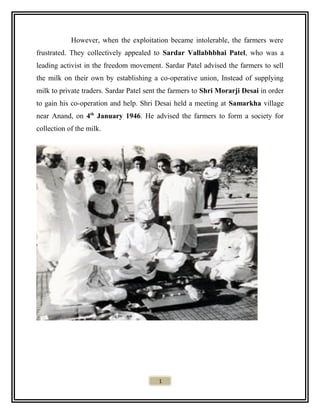
However, when the exploitation became intolerable, the farmers were
frustrated. They collectively appealed to Sardar Vallabhbhai Patel, who was a
leading activist in the freedom movement. Sardar Patel advised the farmers to sell
the milk on their own by establishing a co-operative union, Instead of supplying
milk to private traders. Sardar Patel sent the farmers to Shri Morarji Desai in order
to gain his co-operation and help. Shri Desai held a meeting at Samarkha village
near Anand, on 4th
January 1946. He advised the farmers to form a society for
collection of the milk.
1
These village societies would collect the milk themselves and would decide the
prices at which they can sell the milk. The district union was also form to collect the
milk from such village co-operative societies and to sell them. It was also resolved
that the Government should be asked to buy milk from the union.
However, the govt. did not seem to help farmers by any means. It gave
the negative response by turning down the demand for the milk. To respond to this
action of govt., the farmers of Kaira district went on a milk strike. For 15 whole
days not a single drop of milk was sold to the traders. As a result the Bombay milk
scheme was severely affected. The milk commissioner of Bombay then visited
Anand to assess the situation. Having seemed the condition, he decided to fulfill the
farmers demand.
Thus their cooperative unions were forced at the village and district level to
collect and sell milk on a cooperative basis, without the intervention of
Government. Mr. Verghese Kurien showed main interest in establishing union
who was supported by Shri Tribhuvandas Patel who lead the farmers in forming
1
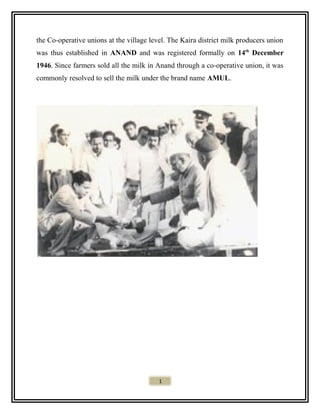
the Co-operative unions at the village level. The Kaira district milk producers union
was thus established in ANAND and was registered formally on 14th
December
1946. Since farmers sold all the milk in Anand through a co-operative union, it was
commonly resolved to sell the milk under the brand name AMUL.
1
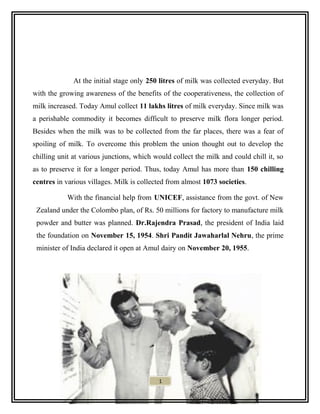
At the initial stage only 250 litres of milk was collected everyday. But
with the growing awareness of the benefits of the cooperativeness, the collection of
milk increased. Today Amul collect 11 lakhs litres of milk everyday. Since milk was
a perishable commodity it becomes difficult to preserve milk flora longer period.
Besides when the milk was to be collected from the far places, there was a fear of
spoiling of milk. To overcome this problem the union thought out to develop the
chilling unit at various junctions, which would collect the milk and could chill it, so
as to preserve it for a longer period. Thus, today Amul has more than 150 chilling
centres in various villages. Milk is collected from almost 1073 societies.
With the financial help from UNICEF, assistance from the govt. of New
Zealand under the Colombo plan, of Rs. 50 millions for factory to manufacture milk
powder and butter was planned. Dr.Rajendra Prasad, the president of India laid
the foundation on November 15, 1954. Shri Pandit Jawaharlal Nehru, the prime
minister of India declared it open at Amul dairy on November 20, 1955.
1
1
ACHIEVEMENTS:
Amul : Asia’s largest dairy co-operative was created way back in1946 to
make the milk producer self-reliant and conduct milk- business with pride. Amul
has always been the trend setter in bringing and adapting the most modern
technology to door steps to rural farmers.
Amul created history in following areas:
a) First self motivated and autonomous farmers‟ organization comprising of
more than 5000000 marginal milk producers of Kaira District.
b) Created Dairy co-operatives at village level functioning with milk
collection centres owned by them.
c) Computerized milk collection system with electronic scale and
computerized accounting system.
d) The first and only organization in world to get ISO 9000 standard for its
farmer’s co-operatives.
e) First to produce milk from powder from surplus milk.
Amul is the live example of how co-operation amongst the poor marginal
farmers can provide means for the socio-economic development of the under
privileged marginal farmers
1
AWARDS:
Amul a co-operative society and its co-operation has led many different
awards in its favor.
Magsaysay award for community leadership presented in manila,
Philippines to Shri Tribhuvandas Patel, Shri D N Khurody and Shri V.
Kurien
1964: “Padmabhusan” award given to Shri T.K. Patel
1965: “Padmshri awarded was given to V. Kurien, general manager, by
the president of India
1987: “Best Productivity” awarded by national productivity council for
the year 1985-86 awarded to Amul dairy.
1988: “Best Productivity” awarded for the second successive year 1986-
87 by the president of India, Mr. R. Venkatrao to kaira union.
1993: “ICA” Memenoto towards genuine and self sustaining co-
operative worldwide ICA regional office for Asia and pacific, New Delhi,
1996.
1999: G.B.Birla award.
Moreover the Amul union has achieved the prestigious ISO 9001-2000 and
HACCP Certificate and effects are got to obtain ISO 14000.
1
Amul in abroad:
Amul is going places. Literally. After having established its presence in China,
Mauritius and Hong Kong, Gujarat Cooperative Milk Marketing Federation
(GCMMF), India‟s largest milk cooperative, is waiting to flood the Japanese
market.
Then, GCMMF is also looking at Sri Lanka as one of its next export destinations.
Amul products are already available on shelves across several countries, including
the US, China, Australia, West Asian countries and Africa.
GCMMF recorded a turnover of Rs 2,922 crore last fiscal. Its products include
pouch milk, ultra heat treated (UHT) milk, ice-cream, butter, cheese and buttermilk.
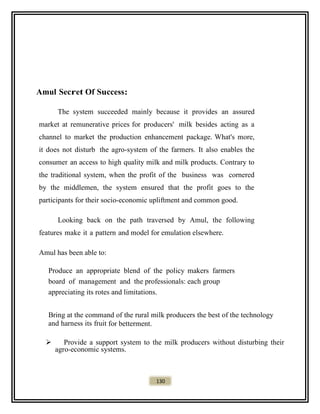
PEOPLE POWER: AMUL'S SECRET OF SUCCESS
The system succeeded mainly because it provides an assured market at
remunerative prices for producers' milk besides acting as a channel to market the
production enhancement package. What's more, it does not disturb the agro-system
1
of the farmers. It also enables the consumer an access to high quality milk and milk
products. Contrary to the traditional system, when the profit of the business was
cornered by the middlemen, the system ensured that the profit goes to the
participants for their socio-economic upliftment and common good.
Looking back on the path traversed by Amul, the following features make it a
pattern and model for emulation elsewhere.
Amul has been able to:
• Produce an appropriate blend of the policy makers farmers board of
management and the professionals: each group appreciating its rotes
and limitations,
• Bring at the command of the rural milk producers the best of the
technology and harness its fruit for betterment.
• Provide a support system to the milk producers without disturbing their
agro-economic systems,
• Plough back the profits, by prudent use of men, material and machines,
in the rural sector for the common good and betterment of the member
producers and
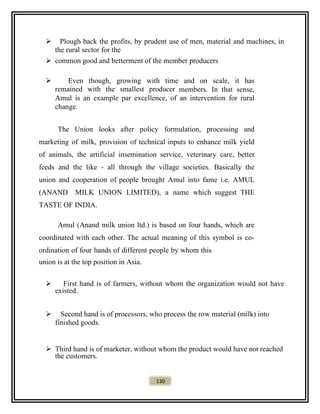
The Union looks after policy formulation, processing and marketing of milk,
provision of technical inputs to enhance milk yield of animals, the artificial
insemination service, veterinary care, better feeds and the like - all through the
1
village societies. Basically the union and cooperation of people brought Amul into
fame i.e. AMUL (ANAND MILK UNION LIMITED), a name which suggest
THE TASTE OF INDIA.
Plants:
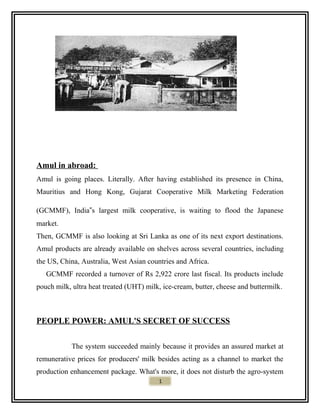
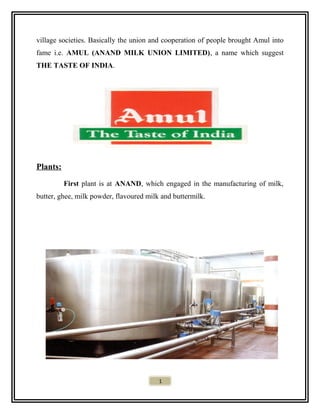
First plant is at ANAND, which engaged in the manufacturing of milk,
butter, ghee, milk powder, flavoured milk and buttermilk.
1
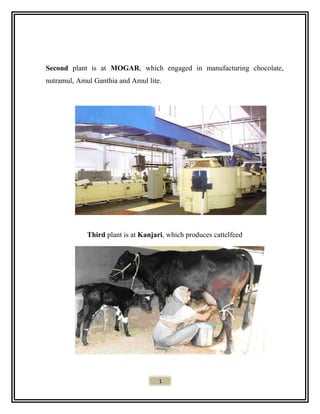
Second plant is at MOGAR, which engaged in manufacturing chocolate,
nutramul, Amul Ganthia and Amul lite.
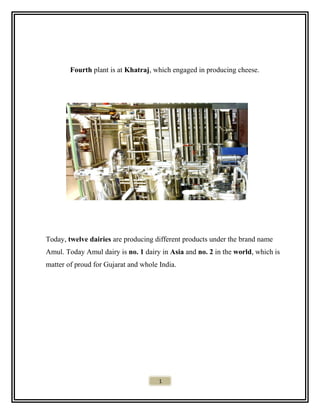
Third plant is at Kanjari, which produces cattelfeed
1
Fourth plant is at Khatraj, which engaged in producing cheese.
Today, twelve dairies are producing different products under the brand name
Amul. Today Amul dairy is no. 1 dairy in Asia and no. 2 in the world, which is
matter of proud for Gujarat and whole India.
1
1
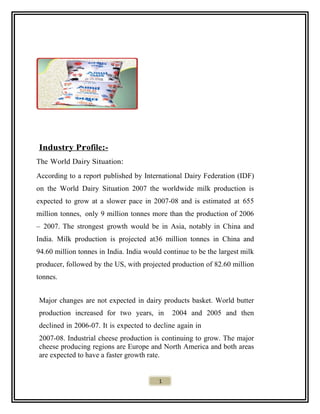
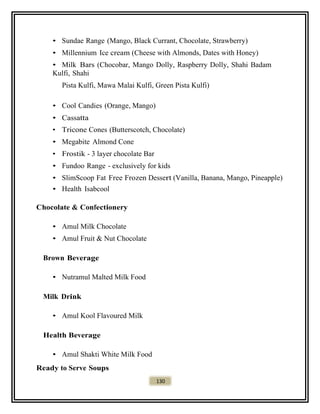
PRODUCT PROFILE:-
S.No. NAME TYPE FAT SOLID NATURAL
FATS
1. Tazaa Toned Milk 3.0% min. 8.5% min.
2. Slim &
Trim
Double Toned Milk 1.5% min. 9% min.
3. Gold Full Cream Milk 6% min. 9% min.
1
Industry Profile:-
The World Dairy Situation:
According to a report published by International Dairy Federation (IDF)
on the World Dairy Situation 2007 the worldwide milk production is
expected to grow at a slower pace in 2007-08 and is estimated at 655
million tonnes, only 9 million tonnes more than the production of 2006
– 2007. The strongest growth would be in Asia, notably in China and
India. Milk production is projected at36 million tonnes in China and
94.60 million tonnes in India. India would continue to be the largest milk
producer, followed by the US, with projected production of 82.60 million
tonnes.
Major changes are not expected in dairy products basket. World butter
production increased for two years, in 2004 and 2005 and then
declined in 2006-07. It is expected to decline again in
2007-08. Industrial cheese production is continuing to grow. The major
cheese producing regions are Europe and North America and both areas
are expected to have a faster growth rate.
1
The production of condensed and evaporated milks is subject to a
declining trend for many years in the developed market. It has been
replaced by many other dairy products, especially liquid milks of UHT
type, coffee cream and coffee whitener including some of the non-dairy
origin.
World trade in dairy products after a period of relative stagnation,
started recovery in the second half of 2006-07 and it continued in
the first half of 2007-08. The recovery is due to prosperity resulting
from economic demand. However, the bullish price situation is not
likely to continue long and would level down.
Export of butter and butter-oil recovered in 2006-07 and this recovery continued
in early2007-08.
The total volume of the world trade in cheese has accelerated and this trend is
likely to continue in the year 2008.
The outlook for the trade in dairy commodities for 2007-08 appears
bright. However, since the new market equilibrium, in respect of
prices has to be found, the question is whether international trade
in dairy products will continue its growth in 2007-08 at the same
momentum as in previous years. Because of the price situation in 2007-
08, one may ask whether demand can follow the expected trends, but it
would be premature to expect stagnation in the trade. In established
markets, the potential for demand to reduce slightly can release the
additional supplies, which are needed to maintain the growth of trade.
1
IndianDairIndustry—
A Profile:
India’s dairy sector is expected to triple its production in the next 10
years in veiw of expanding potential for export to Europe and the
West. Morever with WTO regulations expected to come into force in
coming years all the develope countries which are amoung big
exporters today would have to withdraw the support and subsidy to
their domestic milk product sector. Also India today is the lowest cost
producer of per litre of milk in the world, at 27 cents, compared with the
US’
63 cent. Also to take advantage of this lowest cost of milk production
and increasing production in yhe country multinational companies are
planning to expand their activities here. Some of those milk producers
have already obtained quality standard certificates from the
authorities. This will help them in marketing their products in foreign
countries in processed form.
The urban market for milk products is expected to grow at an accelerated pace of
around33% per annum to around Rs.83, 500 crores by year 2010.
This growth is going to come from the greater emphasis on the
processed food sector and also by increase in the conversation of milk
into milk products. By 2010, the value of Indian dairy produce is
expected to be Rs 10, 00,000 million.Presently the market is valued at
around Rs7, 00,000mn.
1
OBJECTIVE OF THE RESEARCH
 To know awareness of people towards Amul products
 To know the preference of Amul products with comparison to
other competitive brands.
 To know the factors which affects consumer’s buying behaviour while
purchase milk.
 Swot analysis of Amul
 To study various factors such as quality, price, easy available etc. Is
influencing lot and influences positively
 Ideas about to increase the sale of the “Amul
1
1
LITERATURE REVIEW
Abstract
In this paper we describe a case study of a dairy cooperative, AMUL, in western
India that has developed a successful model for doing business in large emerging
economy. It has been primarily responsible, through its innovative practices, for
India to become world’s largest producer of milk. This paper draws various lessons
from the experiences of AMUL that would be useful to cooperatives globally as
well as firms that are interested in doing business in large emerging markets like
India and China.
Many of these economies have underdeveloped markets and fragmented
supply bases. Market failures for many of these small producers are high. On the
other hand, the size of both, markets and the suppliers is large. As a result, firms
that identify appropriate business strategies that take into account these
characteristics are more likely to succeed in these markets. The following are some
key message from AMUL’s success: firms in these environments need to
simultaneously develop markets and suppliers to synchronize demand and supply
planning, develop or become a part of network of producers (i.e., cooperatives in
this case) to obtain scale economies, focus on operational effectiveness to achieve
cost leadership to enable low price strategy. In addition, a central focus to bring the
diverse element together and a long-term approach are required.
In emerging economies different industrial sectors may be at different stages
of development. In some of the sectors all of the above environmental
characteristics faced may not hold. However, a subset of strategies followed by
AMUL would still be very useful. Thus, firms that are contemplating addressing
large undeveloped markets or have an intention of taking advantage of extensive but
1
marginal supplier base would still benefit.
Introduction
Since the turn of 19th
century, Cooperatives have existed as dominant forms
of organization in the dairy industry around the world. Sometimes they have played
the role of developing infant industry while at other times they have been used to
strengthen weak production bases in an environment where market failures tend to
be higher for marginal producers. In some other cases, a network of small producers
have organized themselves to better market their products. Management of these
cooperatives have also led to some interesting managerial insights for managers in
emerging as well as developed economies.
Large emerging economies, e.g., India and China, have complexities that
range from development of markets (where the largest segment of population is the
one which has low purchasing power) to integration of low cost suppliers who are
predominantly very small. For firms that aspire to conduct substantial business in
such markets, such complexities have to be recognized and then overcome. The
challenge is to understand the linkages between markets and the society. This would
also require development of a new business model that helps a firm grow in such
environments. This paper is about one such successful model. The Kaira District
Milk Cooperative Union or AMUL in India is an example of how to develop a
network of firms in order to overcome the complexities of a large yet fragmented
market like those in emerging economies by creating value for suppliers as well as
the customers. AMUL has led the milk dairy revolution in India that has now
emerged as one of the largest milk producers in the world.
In this article we will describe the breakthrough vision that led to the
simultaneous development of the market and supply side through a process of
social development and education at AMUL. Clearly, implementation of this vision
1
in a competitive environment and maintaining sustained growth and profitability
requires development of competitiveness on several dimensions and operational
effectiveness. This article provides insights into management of very large supply
chains by adapting and integrating a variety of strategies and techniques. This
includes building networks, developing trust & values in the network, developing
fair mechanisms for sharing benefits across the supply chain, coordination for
operational effectiveness, innovation and new technology for gaining
competitiveness. It is noteworthy that these successes were achieved within the
framework of a network of cooperatives organized in a hierarchical manner. There
are many lessons in AMUL’s success not only for the cooperative sector but also
for firms who intend to do business in emerging markets.
The AMUL Story
The Kaira District Cooperative Milk Producers’ Union Limited was established on
December 14, 1946 as a response to exploitation of marginal milk producers in the
city of Anand (in Kaira district of the western state of Gujarat in India) by traders or
agents of existing dairies. Producers had to travel long distances to deliver milk to
the only dairy, the Polson Dairy in Anand – often milk went sour, especially in the
summer season, as producers had to physically carry milk in individual containers.
These agents decided the prices and the off-take from the farmers by the season.
Milk is a commodity that has to be collected twice a day from each cow/buffalo. In
winter, the producer was either left with surplus unsold milk or had to sell it at very
low prices. Moreover, the government at that time had given monopoly rights to
Polson Dairy (around that time Polson was the most well known butter brand in the
country) to collect milk from Anand and supply to Bombay city in turn (about 400
1
kilometers away). India ranked nowhere amongst milk producing countries in the
world in 1946.
The producers of Kaira district took advice of the nationalist leaders, Sardar
Vallabhbhai Patel (who later became the first Home Minister of free India) and
Morarji Desai (who later become the Prime Minister of India). They advised the
farmers to form a cooperative and supply directly to the Bombay Milk Scheme
instead of selling it to Polson (who did the same but gave low prices to the
producers). Thus the Kaira District Cooperative was established to collect and
process milk in the district of Kaira. Milk collection was also decentralized, as most
producers were marginal farmers who would deliver 1-2 litres of milk per day.
Village level cooperatives were established to organize the marginal milk producers
in each of these villages. The first modern dairy of the Kaira Union was established
at Anand (which popularly came to be known as AMUL dairy after its brand name).
The new plant had the capacity to pasteurise 300,000 pounds of milk per day,
manufacture 10,000 pounds of butter per day, 12,500 pounds of milk powder per
day and 1,200 pounds of casein per day. Indigenous R&D and technology
development at the Cooperative had led to the successful production of skimmed
milk powder from buffalo milk – the first time on a commercial scale anywhere in
the world. The foundations of a modern dairy industry in India had just been laid as
India had one of the largest buffalo populations in the world.
We move to year 2000. The dairy industry in India and particularly in the
State of Gujarat looks very different. India has emerged as the largest milk
producing country in the world (see Table 1). Gujarat emerges as the most
successful State in terms of milk and milk product production through its
cooperative dairy movement. The Kaira District Cooperative Milk
1
Producers’ Union Limited, Anand becomes the focal point of dairy development in
the entire region and AMUL emerges as one of the most recognized brands in India,
ahead of many international brands1
.
Starting with a single shared plant at Anand and two village cooperative
societies for milk procurement, the dairy cooperative movement in the State of
Gujarat had evolved into a network of 2.12 million milk producers (called farmers)
who are organized in 10,411 milk collection independent cooperatives (called
Village Societies). These Village Societies (VS) supply milk to thirteen independent
dairy cooperatives (called Unions). AMUL is one such Union. Milk and milk
products from these Unions are marketed by a common marketing organization
(called Federation). Figure 1 gives the hierarchical structure of this extensive
network of cooperatives. Gujarat Cooperative Milk Marketing Federation or
GCMMF is the marketing entity for products of all Unions in the State of Gujarat2
.
GCMMF has 42 regional distribution centers in India, serves over 500,000 retail
outlets and exports to more than 15 countries. All these organizations are
independent legal entities yet loosely tied together with a common destiny! (In a
recent survey GCMMF was ranked amongst the top ten FMCG firms in the country
while AMUL was rated the second most recognized brand in India amongst all
Indian and MNC offerings). Interestingly, the Gujarat movement spread all over
India and a similar structure was replicated (all are at different levels of
achievement but their trajectory appears to be quite similar). Two national
organizations, the National Dairy Development Board (NDDB) and the National
Co-operative Dairy Federation of India (NCDFI) were established to coordinate the
dairy activities through cooperatives in all the States of the country. The former
provides financing for development while the latter manages a national milk grid
and coordinates the deficit and surplus milk and milk powder across the states of
India. In the early nineties, AMUL was asked by the Government of Sri Lanka to
1
establish a dairy on similar lines in Sri Lanka. Interestingly, while Polson folded up
sometimes in 1960s, the cooperatives are faced with new competition in liberalizing
India – from multi-national corporations (MNCs) that brought in new and improved
product portfolio, international network and immense financial support. The
Cooperatives face new challenges that test the robustness of their approach and their
commitment to the movement and a new style of management thinking.
Today AMUL is a symbol of many things. Of a promise to member farmers
who are assured a guaranteed purchase of all the milk that they produce at pre-
determined prices. Of high-quality products sold at reasonable prices to consumers.
Of developing and coordinating a vast co-operative network. Of making a strong
business proposition out of serving a large number of small and marginal suppliers.
Of the triumph of indigenous technology. Of the marketing savvy of a farmers'
organisation.
In the remaining part of the paper, we first review the role that cooperatives have
played in the development of dairy industry globally and how is this sector
adjusting to new global challenges. Next, we look at AMUL within this context and
highlight their journey towards excellence. Specifically, we study how AMUL
achieved this exalted status, what were the ingredients of its success, how did the
belief in cooperation transform the business environment and the lives of people,
and what lessons does it hold for other businesses.
1
Cooperatives and the Global Dairy Industry
Three broad questions have intrigued researchers and practitioners on cooperatives3
:
what are the objectives of cooperatives, what determines the success and failure of
cooperatives and how do cooperatives act as organizations of social and economic
change. While most of the observations are based on normative judgments of what
the cooperatives are supposed to do, some studies reflect the true behavior of agents
within a cooperative framework thereby making the debate on cooperatives more
complex but also interesting. To these themes we add another question that reflects
in some ways our own enquiry through this paper: are mechanisms of cooperation
that cooperatives employ any different from those used by other industrial
organizations?
Traditionally, cooperatives have been established to serve the needs of its
members in order to maximize their returns. Governments have usually seen these
organizations as effective mechanisms for delivering their own programmes (e.g.,
sector development or poverty reduction, etc.). Researchers have looked at
cooperatives as channels for re-distributing wealth, improving the opportunities for
the weaker sections of the society, alternative institutions for property ownership,
efforts in democratic and participative governance of organizations4
etc. (this
discussion draws from Shah, 1995). In that, the cooperatives have often sought
protection of sorts from uncertainties in the market place. Globally, modern day
cooperatives are agglomeration of many such small groupings that serve some of
the above objectives but have now moved from being protected entities to becoming
market driven. This makes such cooperatives an interesting organizational
alternative to traditional business enterprises (i.e., investor owned firms) in terms of
concern for shareholders, distributional effectiveness and ability to provide
product/service variety5
.
In emerging economies, cooperatives have been used as institutions to
1
organize marginal producers thereby providing scale effects to a network of such
producers. Sometimes, it is the government that organizes these marginal producers
and may also manage the collective (as in
various cooperatives in former Soviet Union and Africa). On other occasions,
producers themselves come together to produce and distribute their own products
(as in the case of AMUL, majority of cooperatives in North America etc6
.). While
control and subsidies from the government distort the performance of former,
producer-driven cooperatives have to develop systems and processes that respond to
market requirements and be competitive. In that, the determinants of success for this
kind of cooperatives are no different from those of other commercial organizations.
Moreover, they recognize that in order to optimize the objective function of the
marginal producers, they have to serve the market very effectively7
. Cooperatives
are, however, different from other commercial organizations in one respect – they
are bound to serve the suppliers (i.e., the producers of goods & services who happen
to be the members of the cooperatives) in good and bad times. In that, they present
an interesting model to other commercial organizations on strategic management of
resources and their conservation.
Globally, cooperatives have played the role of preventing market failures for small
producers especially in the dairy industry8
. Traditionally, a large number of these
cooperatives have had small membership and produced predominantly raw products
(i.e., fluid milk) or products with some value addition (i.e., dry powder, butter etc.).
This situation has been changing dramatically in the last decade and especially in
the last three years. There has been a spate of mergers all around the world to create
1
fewer but larger dairy cooperatives. In many cases, these cooperatives look very
different from the merged entities. Cooperative dairies that operate with small
membership have retained a certain focus (i.e., geographical or product related) in
their offerings9
. There have been several factors driving the restructuring of the
dairy business (which has chiefly been organized around cooperative principles).
These include efficiencies in managing fewer large plants versus a number of under-
utilized small plants, need for more milk supply (and declining membership), need
to offer wide variety, improvements in trucking & milk handling thereby facilitating
long hauls, opening of new international markets (also markets for new products),
seeking marketing clout and need to bring investment from outside the cooperatives.
In USA, for instance, there were 592 cooperatives (with a membership of 281,065
producers) that marketed milk to plants and handlers in 1973. This number reduced
to 226 (with 87,938 members) in 1997. However, the share of milk delivered by the
cooperatives increased by 9 percent during this period though the share of dairy
sales of small cooperatives reduced from 43.8 percent in 1975 to about 30 per cent
in 1998 (Blayney and Manchester, 2000)10
. The two largest dairy cooperatives in the
US, Dairy Farmers of America and Land O’Lakes had annual sales of US$ 7.9 and
5.1 billion respectively11
.
1
Dairy Farmers of America was formed by the merger of four large cooperatives in
the US in 1998. It consists of 25,499 members across 45 states of USA12
.
Consolidation in cooperatives during the last five years was also in anticipation of
(and reaction to) the consolidated Federal Milk Marketing Order of 2000 which
removed geographical anomalies in minimum support prices for dairy products
hence reduced the need to locate spatially distributed processing centers to take
advantage of varying prices. It helped dairy cooperatives to forge alliances with
firms in various regions.
European (and especially Scandinavian) dairy cooperatives have also seen
tremendous consolidation. Danish cooperatives, mostly producers’ cooperatives,
have often faced difficulties in raising capital internally for investment (though
government support has been quite strong on this count) and have been re-
structuring since mid-70s (Hansen et al. 1980). Dairy coops in Denmark have
reduced to 45 units in 2002 from 1500 in 1930s with one large dairy processing 90
per cent of the available milk. The Danish Dairy Board, however, invests in R&D,
allots quota for milk supply to individual farms, regulates prices and quality, and
supports the efforts of the cooperatives in international markets. It believes that its
competition is from dairies outside Denmark13
. Similar has been the experience of
dairy farmers in other parts of Europe with a higher involvement of government in
reshaping the structure of the industry. Many Irish cooperatives have, however,
converted to non-cooperative forms (Hamm, 2001). Outside Europe and USA, the
experience of dairy cooperatives in New Zealand is instructive. The New Zealand
Dairy Board (NZDB) zealously guards the structure of the industry, which had an
annual worldwide sale of NZ$3.5 billion in 1996. Dairy cooperatives collect milk
from individual farmers and sell processed products in the domestic markets and to
1
NZDB for exports14
. Akoorie and Scott-Kennel (1999) argue that this structure
looks more like strategic partnership between producers and the board (the global
marketing arm) with the later providing capital for growth and innovation.
Interestingly, the form that a producing organization should take and the
relationship that it should have with its marketing has been the center of debate in
managing dairy cooperatives. AMUL in India has learnt from many of these
experiences and has been influenced by practices in dairies around the world
especially in its formative years. It has, however, formed it own organizational
structure (i.e., AMUL is a cooperative of village cooperatives) to bring about a
change in the lives of marginal farmers of India.
in the region of the cooperative, the sociology of cooperation, interface of the dairy
cooperative and the rural power structure, relation of the State and the Cooperative
and the role of government in its growth (interestingly, AMUL has successfully
managed to exercise its independence from the government unlike other
cooperatives in India), elements & replicability of the cooperative movement at
Anand, cost effectiveness of subsidies to AMUL (in its initial years) etc.15
A few studies have evaluated the operational effectiveness of the operations at
AMUL16
. Studies have reported usage of mobile veterinary dispensaries, wireless
sets to link mobile units to service centers as early 1951, developing a programme
of cross breeding of cows in early 1970s etc. that have led to a phenomenal rise in
productivity of milk (Patel, 1988).
We have, however, not come across any research paper or study that looks at the
entire supply chain to understand the role of managerial practices in achieving its
objectives successfully. There have been no studies that look at managerial
practices, efficiency and performance of cooperatives either. We now present, how
1
AMUL developed a robust organization based on sound values and commercial
interests.
AMUL’s Journey towards Excellence
AMUL’s journey towards excellence is marked by some critical understanding of
the business environment in large emerging economies like India where markets
have to be developed by combining efficiency related initiatives with increasing the
base of marginal suppliers and consumers. The essence of AMUL’s efforts were as
follows:
• It combined market and social development in an emerging economy. It
recognized the inter-linkages between various environments that governed the
lives of marginal milk farmers and the unmet needs of consumers. It also
changed the supply chain paradigm in order to reduce the cost to the consumer
while increasing the return to the supplier.
• It realized that in order to achieve their objectives, it had to benefit a large
number of people – both suppliers and consumers. While large scale had the
danger of failure due to poor control and required more resources, it also had the
advantage of creating a momentum that would be necessary to bring more
people into the fold and thereby help more suppliers and consumers.
• It also realized that its goal could only be achieved in the long run and this
required developing values in people and processes that were robust, replicable
and transparent.
It also realized that the cooperative would not be independent and viable in the face
of competition if it were not financially sound. This implied that AMUL had to
1
develop distinct capabilities that would deliver competitive advantage to its
operations.
Leadership
While Kaira Union (or AMUL) had the support of national leaders who were at the
forefront of the Indian independence movement, its local leaders were trained in
Gandhian simplicity17
and had their feet rooted firmly amongst people whom they
had mobilized – the poor farmers of Anand. The foremost amongst them was
Tribhuvandas Patel18
who had led the movement for the formation of cooperatives
of small and marginal farmers in order to compete against investor owned
enterprises on one hand, and keep bureaucracy away on the other hand.
Tribhuvandas was the first Chairman of the cooperative. His skills lay in organizing
the village producers, in making them believe in the power of cooperation and their
rights towards improvement of human condition. He is remembered as fair and
honest person whose highest sense of accountability to the members of the union
laid the foundation of trust between network members19
. Another important aspect
of his remarkable management style was his gentleness and ability to repose trust in
people – he gave complete autonomy to managers of the union and earned complete
commitment from them20
. Verghese Kurien21
was one such manager who would,
first, shape the destiny of the Union and then the milk movement throughout the
country.
1
Kurien emerged as the father of the dairy movement in India. He managed to keep
the government and bureaucrats away from the cooperative22
and gave shape to the
modern structure of the cooperative, worked tirelessly to establish the values of
modern economics, technology and concern for farmers within the cooperative. He
interfaced with global financing agencies to build new projects at AMUL. He
worked with the Unions to bring the best of technology to the plants. He worked
with marginal village farmers to create systems that would increase milk yields. He
understood that without meeting the needs of customers he would not be able to
satisfy his obligations to the farmers. In short, Kurien shaped the destiny of the milk
movement in India through NDDB (as its Chairman) and particularly at GCMMF
and cooperatives in Gujarat. He helped build a modern organization with
professional management systems that would support the aspirations of farmers and
customers.
Several young people left better paying jobs to help create a dream of making
India the milk capital of the world. Kurien had learnt the persuasive charm of
Tribhuvandas through plain speaking and had soon created a cadre of highly
capable managers to whom he had delegated both management as well as
commitment. These leaders were created at the village, district and state levels in
different organizations of the network.
He was charismatic in his communication and committed in his effort. Over a
period of time, he developed a very close link with the poor farmers who, as he
always says, “were his employers” at the cooperative. He would travel through the
villages along with Tribhuvandas and work out the details of how the milk
collection cooperative would work, how trucks would pickup milk from village
1
societies, how the cattle would have to be taken care of and how all of this would
help the poor milk farmer come out of poverty and the clutches of the middleman.
Operational details were meticulously planned and executed. And then, he along
with two of his close associates would work on the design of the dairy plant
including conducting experiments to create powder out of buffalo milk – a task that
was ridiculed by all who heard of it including the international aid agencies in the
dairy industry. Tribhuvandas and Kurien were able to convince the government also
of the value of his efforts and secured funding for several projects of the
cooperative. He was slowly laying the foundation of a modern dairy industry in
India. Membership of the cooperative started to increase, professional managers
started to join AMUL and production capacity at AMUL started to expand (and this
expansion was done through innovative changes to processes at the plant and
through equipment designed and fabricated in-house). Kurien had transformed
AMUL from a dream into a major industrial entity – a network of plants,
cooperative societies, research centers, an institute for training future managers in
rural management, secondary services like veterinary/artificial insemination
expertise/feed factory etc. Kurien’s biggest strength lay in his ability to convince
people that the cause of rural farmers was important thus establishing an important
shared value. Subsequently, he could convince the government to replicate the
AMUL model in almost all states of the country.
Strategy
AMUL’s business strategy is driven by its twin objectives of (i) long-term,
sustainable growth to its member farmers, and (ii) value proposition to a large
customer base by providing milk and other dairy products a low price. Its strategy,
which evolved over time, comprises of elements described below.
Simultaneous Development of Suppliers and Customers: From the very early stages
1
of the formation of AMUL, the cooperative realized that sustained growth for the
long-term was contingent on matching supply and demand. Further, given the
primitive state of the market and the suppliers of milk, their development in a
synchronous manner was critical for the continued growth of the industry. The
organization also recognized that in view of the poor infrastructure in India, such
development could not be left to market forces and proactive interventions were
required. Accordingly, AMUL and GCMMF adopted a number of strategies to
assure such growth. For example, at the time AMUL was formed, the vast majority
of consumers had limited purchasing power and was value conscious with very low
levels of consumption of milk and other dairy products. Thus, AMUL adopted a low
price strategy to make their products affordable and guarantee value to the
consumer. The success of this strategy is well recognized and remains the main
plank of AMUL's strategy even today. The choice of product mix and the sequence
in which AMUL introduced its products is consistent with this philosophy.
Beginning with liquid milk, the product mix was enhanced slowly by progressive
addition of higher value products while maintaining desired growth in existing
products. Even today, while competing in the market for high value dairy products,
GCMMF ensures that adequate supplies of low value products are maintained.
On the supply side, as mentioned earlier, the member-suppliers were typically small
and marginal- farmers had severe liquidity problems, were illiterate and had no prior
training in dairy farming. AMUL and other cooperative Unions adopted a number of
strategies to develop the supply of milk and assure steady growth. First, for the short
term, the procurement prices were set so as to provide fair and reasonable return.
Second, aware of the liquidity problems, cash payments for milk supply was made
with minimum of delay. For the long-term, the Unions followed a multi-pronged
1
strategy of education and support. For example, only part of the surplus generated
by the Unions is paid to the members in the form of dividends. A substantial part of
this surplus is used for activities that promote growth of milk supply and improve
yields. These include provision of veterinary services, support for cold storage
facilities at the village societies etc. In parallel, the Unions have put in place a
number of initiatives to help educate the members.
To summarize, the dual strategy of simultaneous development of the market
and member farmers has resulted in parallel growth of demand and supply at a
steady pace and in turn assured the growth of the industry over an extended period
of time.
Cost Leadership: AMUL’s objective of providing a value proposition to a large
customer base led naturally to a choice of cost leadership position. Given the low
purchasing power of the Indian consumer and the marginal discretionary spending
power, the only viable option for AMUL was to price its products as low as
possible. This in turn led to a focus on costs and had significant implications for
managing its operations and supply chain practices (described later).
Focus on Core Activities: In view of its small beginnings and limited resources, it
became clear fairly early that AMUL would not be in a position to be an integrated
player from milk production to delivery to the consumer23
. Accordingly, it chose a
strategy to focus on core dairy activities and rely on third parties for other
complementary needs. This philosophy is reflected in almost all phases of AMUL
network spanning R&D, production, collection, processing, marketing, distribution,
retailing etc. For example, AMUL focused on processing of liquid milk and
conversion to variety of dairy products and associated research and development.
On the other hand, logistics of milk collection and distribution of products to
customers was managed through third parties.
1
However, it played a proactive role in making support services available to its
members wherever it found that markets for such services were not developed. For
example, in the initial stages, its small and marginal member farmers did not have
access to finance, veterinary service, knowledge of basic animal husbandry etc.
Thus to assure continued growth in milk production and supply, AMUL actively
sought and worked with partners to provide these required services. In cases where
such partnerships could not be established, AMUL developed the necessary
capabilities and provided the services. These aspects are elaborated later in this
section.
These include logistics of milk collection, distribution of dairy products, sale of
products through dealers and retail stores, some veterinary services etc. It is worth
noting that a number of these third parties are not in the organized sector, and many
are not professionally managed. Hence, while third parties perform the activities,
the Unions and GCMMF have developed a number of mechanisms to retain control
and assure quality and timely deliveries (see the sub-section on Coordination for
Competitiveness later in the paper for more details). This is particularly critical for a
perishable product such as liquid milk.
Financial Strategy: AMUL’s finance strategy is driven primarily by its desire to be
self-reliant and thus depend on internally generated resources for funding its growth
and development. This choice was motivated by the relatively underdeveloped
financial markets with limited access to funds, and the reluctance to depend on
Government support and thus be obliged to cede control to bureaucracy. AMUL’s
financial strategy may thus be characterized by two elements: (a) retention of
surplus to fund growth and development, and (b) limited/ no credit, i.e., all
1
transactions are essentially cash only. For example, payment for milk procured by
village societies is in cash and within 12 hours of procurement (most, however, pay
at the same time as the receipt of milk). Similarly, no dispatches of finished
products are made without advance payment from distributors etc. This was
particularly important, given the limited liquidity position of farmer/suppliers and
the absence of banking facilities in rural India. This strategy strongly helped AMUL
implement its own vision of growth and development. It is important to mention
that many of the above approaches were at variance with industry practices of both
domestic and MNC competitors of AMUL.
1
Organization
AMUL is organized as a cooperative of cooperatives (i.e., each village society, a
cooperative in itself, is a member of the AMUL cooperative) thereby deriving the
advantage of scale and uniformity in decision making. The founders of Kaira Union
realized that to fulfill their objectives, a large number of marginal farmers had to
benefit from the cooperative – a network of stakeholders had to be built. And once
built, it had to grow so as to draw more rural poor to undertake dairy farming as a
means of livelihood. The network had to have several layers – the organizational
network where the voice of the owners governed all decisions, a physical network
of support services and product delivery process and a network of small farmers that
could deliver the benefit of a large corporation in the market place. More
importantly, a process had to be put in place to build these networks.
Building an organizational network that would represent the farmers and the
customers was the most complicated task. A loose confederation was developed
with GCMMF representing the voice of the customers, the Unions representing the
milk processors and the village societies representing the farmers. Competition in
the markets ensured that the entire network was responding to the requirements of
the customers at prices that were very competitive. The task of ensuring that returns
to the farmers was commensurate with the objectives with which the cooperatives
were setup was achieved through representation of farmers at different levels of
decision making throughout the network – the board of directors of societies,
Unions and the Federation comprised farmers themselves. In order to ensure that
most returns from sales went to the producers, the intermediaries had to operate
very effectively and on razor thin margins. This turned out to be a blessing in
disguise – the operations remained very “lean” and started to provide cost based
advantage to the entire network.
1
AMUL established a group to standardize the process of organizing farmers
into village societies. In addition to establishing the criteria for selecting members,
the group had to train the VS to run the cooperative democratically, profitably and
with concern for its members. This included establishing procedures for milk
collection, testing, payment for milk purchased from member farmers and its
subsequent sale to the union, accounting, ensuring timely collection and dispatch of
milk on milk routes established by the union, etc. The Village Societies Division at
AMUL acts as the internal representative of village societies in their dealings with
the Union. Cooperative development programmes at the village level for educating
& training its members have become an important part of the strategy to build this
extensive network.
Milk procurement activity at AMUL comprises development and servicing of
village societies, increasing milk collection, procurement of milk from societies &
its transport to the chilling locations, and resolving problems of farmers and village
societies. Their stated objective is to ensure that producers get maximum benefits.
The Village Societies Division coordinates these activities. Milk collection takes
place over a large number of pre-defined routes according to a precise timetable.
The field staff of this division also help village societies interface with the Union on
various issues ranging from improvement of collection, resolving disputes, repair of
equipments to obtaining financing for purchase of equipment etc. In addition, they
are also responsible for the formation of new societies, which is an important
activity at AMUL.
In essence, the organization structure of AMUL allows effective utilization of
resources without losing the democratic aspiration of individual members. It is
obvious that such a system needs charismatic leadership to achieve consensus
1
across issues – a process that has long-term benefits for any organization.
1
ABOUT THE TOPIC:-
CONSUMER BEHAVIOUR:-
 It is defined as all psychological, social and physical behavior of potential
customers as they become aware, evaluate, purchase, consume, and tell to
others about product and services.
 Buying behavior involves both individual ( psychological) and group
process.
 Buyer behavior is reflected from awareness right through post
purchase evaluation indicating satisfaction and non satisfaction , from
purchaser
 Buyer behavior includes communication, purchasing and consumption
behavior
 Consumer behavior is basically social in nature hence the social factors
play important roles in shaping buying behavior
 Buyer behavior includes both customer and industrial behavior.
“Hence consumer behavior is an orderly process whereby the consumer
interacts with the environment for making a purchase decision on products “
1
CONSUMER BEHAVIOR AND MARKETING MANAGEMENT
Marketing managements work around consumers which is actually the market
for them
 Understanding their behavior is very vital in every segment to plan marketing
activities accordingly.
 Both industrial and individual customers are vital in marketing
management
DIVERSITY OF CONSUMER BEHAVIOR:-
 customer and consumer words are referred as synonyms but the
difference exists
 customer - the purchaser of product or service , may or may not be the
end user
 consumer- the end user , may or may not be the purchaser
 New age of business demands differentiation of customers by individual
differences in consumer expectations, preferences and influences.
1
 Firms need to go into deep of consumer behavior to analyze and act to
achieve objectives
CONCEPT & NEED FOR STUDYING CONSUMER BEHAVIOR:-
Consumer behaviour can be said to be the study of how individual make decision on
how to spend their available resources (time, money, effort) on various
consumption related items. This simple definition of consumer behaviour tells the
markets to resolve every activity around the ultimate consumers & gauge their
behaviour by specially focusing on:
 Who buys products or services?
 How do they buy products or services?
 Where do they buy them?
 How often they buy them?
 Why do they buy them?
 How often they use them?
These questions will help in understanding better what factors influences the
decision making process of the customers. The decision making process identifies
the number of people who are involve in this process & describes a role to them
like users, decides, influences & buyers.
1
It is believed that consumers or customers make purchase decision on the basis of
receipt of a small number of selectivity chosen pieces of information. Thus it will
be very important to understand what & how mush them to evaluate the goods &
services offerings.
CONSUMER DECISION MAKING PROCESS:-
 Stimuli- need, reasons, influences, gathering information
 Information processing- process , analyze information about product
 Decision making - on the basis of analysis , decision to go for
 Response- response to buy without any prejudice
 For industrial buyers the process is almost similar only with addition of
re-buy, modified re buy or new task.
FACTOR INFLUENCING BUYING BEHAVIOR:-
 Individual factors
 Cognitive thinking process – perception , attitudes , Needs/motives
 Personal characteristics – demography, lifestyles ,personal traits
1
 Environmental factors
 Culture- values ,beliefs, sub cultural / cross cultural factors
 Social class- social class , society
 Influence groups – family, opinion leaders, reference group
 Situational variables – purchase occasion , market communication,
shopping behavior, price , sales influence , product position
CONSUMER SATISFACTION:-
All business firms have realized that marketing is a core element of management
philosophy & the key to its success lies in focusing more & more on the customers.
That is, it will be the customer who will decide where the firm is heading. Thus the
challenge before the marketer is to ensure that they should satisfy every customer.
Satisfaction is an important element in the evaluating stage. Satisfaction refers to
the buyers state of being adequately rewarded in a buying situation for the sacrifices
he has made one the customer purchase & use the product they may then become
either satisfy or dissatisfied.
The result of satisfaction to customer form the purchase of the product or services is
that more favourable post-purchase attitude, higher purchase intention & brand
loyalty to be exhibited that the same behaviour is likely to be exhibited in a similar
purchasing situation. The term ‘consumer’ is a typically used to refer to someone
who regularly purchase from a particular store or company.
1
Customers are people who are happy with the product & services & are willing to
come back & pay for it again.
Today the firms aim to give satisfaction to the customer through marketing
concepts. The firm try to help the buyers in the solving the problem then
competitors. The marketers must see that consumers with purchasing power
constitute a potentials buyers are identified. It is essential for the marketer to carry
out the business in such a way that they give satisfaction to consumers needed.
When a firm markets a product or service it should aim to enjoy consumer’s
satisfaction & profit maximization.
CONSUMER RESEARCH:-
Consumer research is the methodology used to study consumer behavior research
offer set diverse to identify consumer needs it is used to identify both felt & unfelt
needs, to learn how consumers. Perceive product & brand & stores. What their
attitudes are before and after promotional campaigns & how & why they make their
consumption decision.
MARKETING RESEARCH:-
Marketing research plays an important role in the process of marketing. Starting
with market component of the total marketing talks. It helps the firm to acquire a
better understanding of the consumers, the competition and the marketing
environment.
1
DEFINITION
“Marketing research is a systematic gathering, recording and analysis marketing
problem to facilitate decision making.”
- Coundiff & Still.
“Marketing research is a systematic problem analysis, model building and fact
finding for the purpose of important decision making and control in the marketing
of goods and services.
- Phillip Kotler.
MAIN STEPS INVOLVED IN MARKETING RESEARCH
Defining the Marketing Problem to be tackled and identifying the market
research problem involved in the task.
(1)Define the problem and its objectives.
(2)Identify the problem.
(3) Determine the information needed.
(4)Determine the sources of information.
(5)Decide research methods.
(6)Tabulate, Analyze and interpret the data.
1
(7)Prepare research report.
(8)Follow-up the stud
1) Define the problem and its objectives :- This includes an effective job in
planning and designing a research project that will provide the needed information.
It also includes the establishment of a general framework of major marketing
elements such as the industry elements, competitive elements, marketing elements
and company elements.
2)Identify the problem :- Identifying the problem involves getting acquainted with
the company, its business, its products and market environment, advertising by
means of library consultation and extensive interviewing of company’s officials.
3)Determining the specific Information needed :- In general the producer, the
manufacturer, the wholesaler and the retailer try to find out four things namely :-
(1) What to sell
1
(2) When to sell
(3) Where to sell
4) Determine the sources of information :-
Primary Data :- Primary datas are those which are gathered
specially for the project at hand, directly – e.g. through questionnaires &
interviews. Primary data sources include company salesman, middleman,
consumers, buyers, trade association’s executives & other businessman & even
competitors.
Secondary Data :- These are generally published sources, which
have been collected originally for some other purpose. Source are internal
company records, government publication, reports & publication, reports &
journals, trade, professional and business associations publications & reports.
5) Decide Research methods for collecting data: - If it is found that the secondary
data cannot be of much use, collection of primary data become necessary. Three
widely used methods of gathering primary data are :-
A) Survey
B) Observation
C) Experimentation
A) Survey Method: - In this method, information gathered directly from individual
respondents, either through personal interviews or through mail questionnaires or
telephone interviews.
1
B) Observation Method: - The research data are gathered through observing and
recording their actions in a marketing situation. This technique is highly accurate. It
is rather an expensive technique.
C) Experimental Method: - This method involves carrying out a small scale trial
solution to a problem, while at the same time, attempting to control all factors
relevant to the problem. The main assumption here is that the test conditions are
essentially the same as those that will be encountered later when conclusions
derived from the experiment are applied to a broader marketing area.
1
D) The Panel Research:- In this technique the same group of respondents is
contacted for more then one occasion; and the information obtained to find out if
there has been any in their taste demand or they want any special quality, color,
size, packing in the product.
 Preparation of questionnaire
 Presetting of questionnaire
 Planning of the sample
6) Tabulate, Analysis and Interpret the Data:-
The report must give/contain the following information:-
a) The title of research
b) The name of the organization for which it has been Conducted
c) The objectives of research
d) The methodology used
e) Organization and the planning of the report
f) A table of contents along with charts and diagrams used in the reports
g) The main report containing the findings
h) Conclusion arrived at end recommendations suggested
i) Appendices (containing questionnaire / forms used sample design, instructions.)
1
7) Follow-up the study :-
The researchers, in the last stage, should follow up this study to find if his
recommendations are being implemented and if not then why.
RESEARCH METHODOLOGY:-
RESEARCH PROBLEM
 Seek the general perception of consumer towards Amul Milk.
 To know the consumer psyche and their behaviour towards Amul Milk .
OBJECTIVE OF THE RESEARCH
 To know the relationship of sales with the advertisement.
 To know awareness of people towards Amul Milk.
 To know which advertisement tool is mostly preferred by people.
 To know the preference of Amul Milk with comparison to
Other competitive brands .
 To know the factors which affects consumer’s buying behaviour to purchase
milk.
1
1
Information requirement
• First, I had to know about all the competitors present in the Milk
segment (Reputed and well established brands as well as Local brands).
• Before going for the survey I had to know the comparative packs and
prices of all the competitors existing in the market.
• Since Milk is a product that used daily hence I had to trace the market and
segment it, which mainly deals with people of various age groups.
• The main information needed is the various types of brands available in the
market, their calorific value and various other facts.
• As Amul milk advertisements are mainly done through hoardings but on
television the advertisement is being telecasted timely and on the proper time
or not.
130
RESEARCH DESIGN
A Research design specifies the methods and procedures for conducting a particular
study. It is a map (or) blue print to which the research is to be conducted.
Descriptive research design has been considered as a suitable methodology for
present study and for data analysis.
SAMPLING DESIGN
The sampling design used was Convenience sampling, which is a non-probability
sampling method. The convenience factors were the availability and approachability
of the respondents.
POPULATION
All types of outlets that stock and sell Amul milk in the markets. The outlets have
been classified into as follows
 Convenience stores: All kinds of shops including bakeries
 Eateries: all kinds of eating joints
130
SOURCES OF DATA
Primary sources
The primary data was collected through questionnaires. They were filled using the
scheduled method of data collection by the researcher.
Secondary sources
The secondary sources were used only for collecting information regarding the
sample; they were however not used for analysis
LIMITATIONS OF THE RESEARCH :-
The limitations of the research were as follows
1. Lack of proper experience on the part of the researcher in conducting such studies
in the past.
2. Time frame required was not enough to survey more number of outlets.
ANALYSIS TECHNIQUES
Quantitative analysis is performed using the data collected at each outlet to
estimate the presence of Amul milk. Tools Utilized
 Percentage Analysis
130
 Graph Chart
SAMPLING
1. Sampling Technique: Non probability sampling
(A non probability sampling technique is
that in which each element in the
population does not have an equal
chance of getting selected)
2. Sample Unit : People who buy milk available
in retail outlets, superstores, etc
3. Sample size : 50
4. Method : Direct interview through questionnaire.
5. scale : Dycpnomic scale and likent scal
130
DATA ANALYSIS AND INTERPRETATION:-
The collected data were not easily understandable, so I like to analyze the collected
data in a systematic manner and interpreted with simple method.
The analysis and interpretation of the data involves the analyzing of the
collected data and interpretation it with pictorial representation such as bar charts,
pie charts and others.
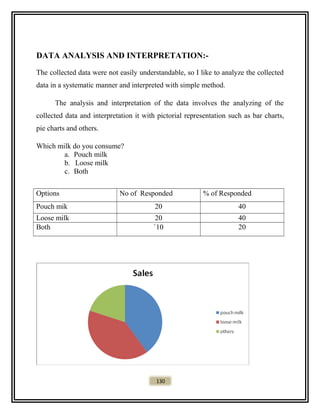
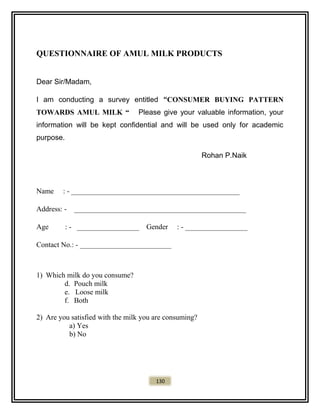
Which milk do you consume?
a. Pouch milk
b. Loose milk
c. Both
Options No of Responded % of Responded
Pouch mik 20 40
Loose milk 20 40
Both `10 20
130
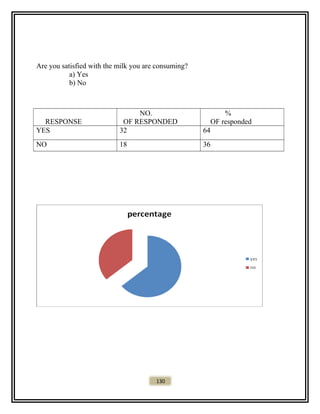
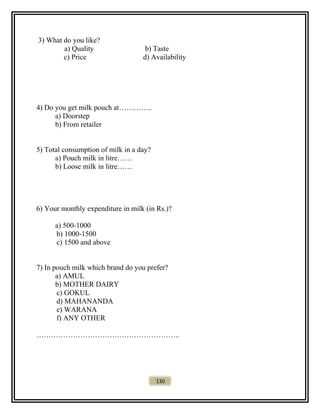
Are you satisfied with the milk you are consuming?
a) Yes
b) No
RESPONSE
NO.
OF RESPONDED
%
OF responded
YES 32 64
NO 18 36
130
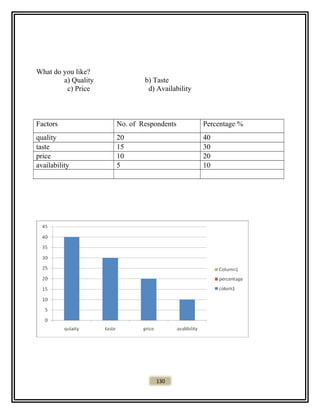
What do you like?
a) Quality b) Taste
c) Price d) Availability
Factors No. of Respondents Percentage %
quality 20 40
taste 15 30
price 10 20
availability 5 10
130
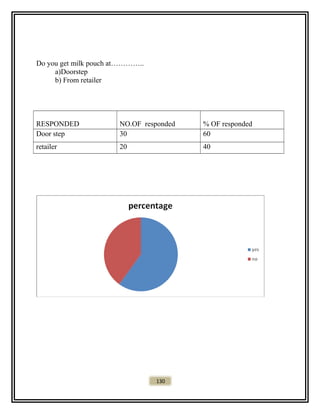
Do you get milk pouch at…………..
a)Doorstep
b) From retailer
RESPONDED NO.OF responded % OF responded
Door step 30 60
retailer 20 40
130
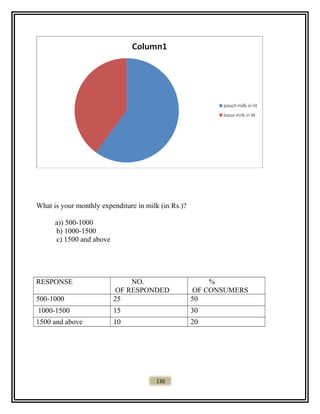
What is total consumption of milk in a day?
a) Pouch milk in litre……
b) Loose milk in litre……
RESPONDED NO.OF responded % OF responded
Pouch milk in
litre……
30 60
b)Loose milk in
litre……
20 40
130
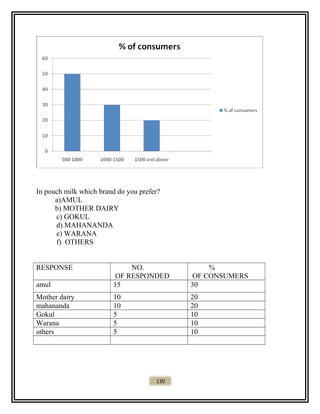
What is your monthly expenditure in milk (in Rs.)?
a)) 500-1000
b) 1000-1500
c) 1500 and above
RESPONSE NO.
OF RESPONDED
%
OF CONSUMERS
500-1000 25 50
1000-1500 15 30
1500 and above 10 20
130
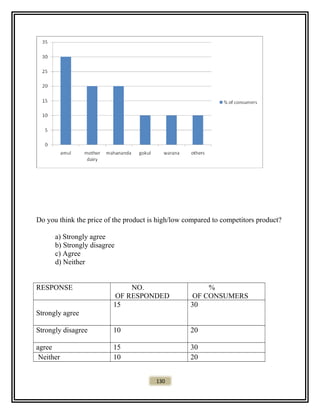
In pouch milk which brand do you prefer?
a)AMUL
b) MOTHER DAIRY
c) GOKUL
d) MAHANANDA
e) WARANA
f) OTHERS
RESPONSE NO.
OF RESPONDED
%
OF CONSUMERS
amul 15 30
Mother dairy 10 20
mahananda 10 20
Gokul 5 10
Warana 5 10
others 5 10
130
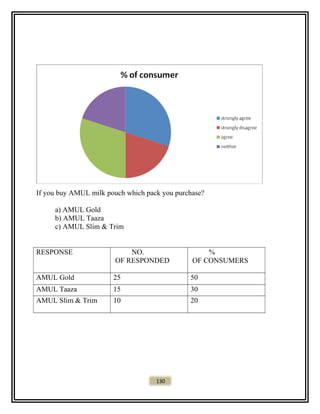
Do you think the price of the product is high/low compared to competitors product?
a) Strongly agree
b) Strongly disagree
c) Agree
d) Neither
RESPONSE NO.
OF RESPONDED
%
OF CONSUMERS
Strongly agree
15 30
Strongly disagree 10 20
agree 15 30
Neither 10 20
130
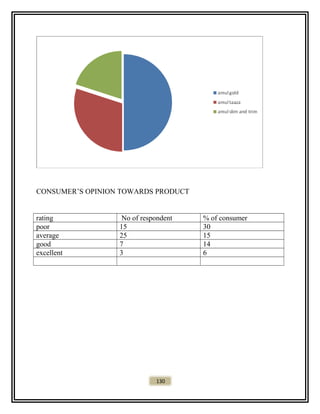
If you buy AMUL milk pouch which pack you purchase?
a) AMUL Gold
b) AMUL Taaza
c) AMUL Slim & Trim
RESPONSE NO.
OF RESPONDED
%
OF CONSUMERS
AMUL Gold 25 50
AMUL Taaza 15 30
AMUL Slim & Trim 10 20
130
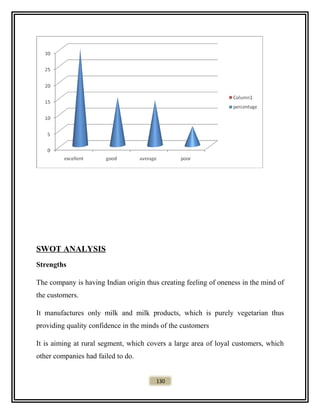
CONSUMER’S OPINION TOWARDS PRODUCT
rating No of respondent % of consumer
poor 15 30
average 25 15
good 7 14
excellent 3 6
130
SWOT ANALYSIS
Strengths
The company is having Indian origin thus creating feeling of oneness in the mind of
the customers.
It manufactures only milk and milk products, which is purely vegetarian thus
providing quality confidence in the minds of the customers
It is aiming at rural segment, which covers a large area of loyal customers, which
other companies had failed to do.
130
People are quite confident for the quality products provided by Amul.
Amul has its base in India with its butter and so can easily promote chocolates
without fearing of loses.
Weaknesses
There are various big players in the chocolate market, which acts as major
competitors restricting their growth.
Lack of capital invested as compared to other companies.
Improper distribution channel in India.
Opportunities
There is a lot of potential for growth and development as huge population stay in
rural market where other companies are not targeting.
The chocolate market is at growth stage with very less competition so by
introducing new brand and intensive advertising there can be a very good scope in
future.
Threats
130
The major threat is from other companies who hold the majority share of consumers
in Indian market i.e. Cadburys and Nestle.
There exists no brand loyalty in the chocolate market and consumers frequently
shift their brands.
New companies’ entering in Indian market like Fantasie fine poses lot problems for
Amul.
130
Newsarticles
VergheseKurienlaidfoundationforco-opdairymovement
Anand(Gujarat), Sep 9: The architect of 'white revolution', Verghese Kurien, who
led 'Operation Flood' to transform India from a milk-deficient country to the world's
biggest milk producer, is credited with laying the foundation of the nation's co-
operative dairy model. Hailed as the undisputed 'Milkman of India', who created the
billion dollar brand Amul, Kurien, who passed away this morning at the age of 90,
had received both national and international recognition. The Indian government
had conferred on him the Padma Vibhushan while he was also the recipient of
World Food Price, Ramon Magsaysay award for Community Leadership, Carnegie-
Wateler World Peace Prize and International Person of the Year award from US.
Born in Kozhikode, Kerala on November 26, 1921, Kurien had graduated in science
from Loyola College in Chennai (1940) and obtained his degree in engineering from
the Guindy College of Engineering in Chennai. After a stint at TISCO, Jamshedpur,
Kurien got the Government of India's (GoI) scholarship to study dairy engineering.
130
130
On his return to India, Dr Kurien was assigned to join Government Creamery
located at Anand in Gujarat to serve his bond period. By the end of 1949, Kurien
got release orders from his job at the creamery. Kurien joined Kaira District
Cooperative Milk Producers' Union Limited in 1949, on the request of
Tribhuvandas Patel, the then dairy chairman. The dairy was formed at the
initiative of Sardar Vallabhabhai Patel. Later, Patel asked Kurien to help set up a
dairy processing plant, which saw the birth of Amul. Amul's co-operative model
became a success and it was replicated throughout Gujarat. The different dairy
unions were later brought under the banner of Gujarat Co-operative Milk
Marketing Federation (GCMMF). Dedicating his professional life to
empowering the Indian farmers through co-operatives, Kurien, served GCMMF
from 1973 to 2006, and Institute of Rural Management (IRMA) from 1979 to
2006. Kurien's tenure at Anand changed the destiny of Indian dairy industry. He
began helping the fledgling dairy co-operative. The first dairy co-operative
union in Gujarat was formed in 1946 with two village dairy co-operative
societies as its members. The number of member societies has now increased to
16,100, with 3.2 million members pouring milk. Kurien is also credited with
being the first one to produce powder from buffalo milk, when elsewhere in the
130
world, cow milk was used to produce milk powder. Impressed by the success of
Amul, then Prime Minister Lal Bahadur Shastri established the National Dairy
Development Board (NDDB) to replicate the Amul model across the country
and Kurien was made its chairman. NDDB launched 'Operation Flood' in 1970,
making India the largest milk producer in the world. He served as chairman of
NDDB for 33 years from 1965 to 1998. The Board ensured replication of Amul
model across India. It played an instrumental role in increasing the milk
production of the country significantly. India's milk procurement increased from
20 million metric tonnes (MMT) per year in the 60s to 122 MMT in 2011. Dr
Kurien's main contribution was in designing of systems and institutions, which
enabled people to develop themselves, as he believed the development of man
can best be achieved by putting in his hands the instruments of development.
Interestingly, the 'milkman' of India did not consume milk himself. He used to
say, "I do not drink milk as I don't like it."
130
Mother Dairy vs Amul in Delhi
TNN Jul 12, 2003, 02.30am IST
NEW DELHI: Read between the lines, however, Ms Patel's proposal entails
marketing of the milk products sourced from NDDB under the Mother Dairy brand
across the country, instead of the present arrangement where different state
federations market them under their own respective brands, for example, Verka in
Punjab and Milma in Kerala. Not only would this put Mother Dairy in direct
competition against Amul, but it would also cannibalise the state brands under
which milk is currently marketed.
The Amul Vs Mother Dairy competition is already being felt in Delhi. Amul has
launched its ice-cream here, while Mother Dairy has hit back by launching its
butter. Besides, Mother Dairy is now no longer buying the nearly 1 lakh litres of
milk from GCMMF, nor are its outlets here selling Amul products. So ugly has the
competition become that even the senior bosses at Amul and NDDB have been
washing their dirty linen in public.
Source: Economic times
130
Amul Secret Of Success:
The system succeeded mainly because it provides an assured
market at remunerative prices for producers' milk besides acting as a
channel to market the production enhancement package. What's more,
it does not disturb the agro-system of the farmers. It also enables the
consumer an access to high quality milk and milk products. Contrary to
the traditional system, when the profit of the business was cornered
by the middlemen, the system ensured that the profit goes to the
participants for their socio-economic upliftment and common good.
Looking back on the path traversed by Amul, the following
features make it a pattern and model for emulation elsewhere.
Amul has been able to:
Produce an appropriate blend of the policy makers farmers
board of management and the professionals: each group
appreciating its rotes and limitations.
Bring at the command of the rural milk producers the best of the technology
and harness its fruit for betterment.
 Provide a support system to the milk producers without disturbing their
agro-economic systems.
130
 Plough back the profits, by prudent use of men, material and machines, in
the rural sector for the
 common good and betterment of the member producers
 Even though, growing with time and on scale, it has
remained with the smallest producer members. In that sense,
Amul is an example par excellence, of an intervention for rural
change.
The Union looks after policy formulation, processing and
marketing of milk, provision of technical inputs to enhance milk yield
of animals, the artificial insemination service, veterinary care, better
feeds and the like - all through the village societies. Basically the
union and cooperation of people brought Amul into fame i.e. AMUL
(ANAND MILK UNION LIMITED), a name which suggest THE
TASTE OF INDIA.
Amul (Anand milk union ltd.) is based on four hands, which are
coordinated with each other. The actual meaning of this symbol is co-
ordination of four hands of different people by whom this
union is at the top position in Asia.
 First hand is of farmers, without whom the organization would not have
existed.
 Second hand is of processors, who process the row material (milk) into
finished goods.
 Third hand is of marketer, without whom the product would have not reached
the customers.
130
 Fourth hand is of customers, without whom the products would have not
carried on.
GCMMF Overview:
Gujarat Cooperative Milk Marketing Federation (GCMMF) is India's
largest food products marketing organisation. It is a state level apex
body of milk cooperatives in Gujarat which aims to provide
remunerative returns to the farmers and also serve the interest of
consumers by providing quality products which are good value for
money.
Gujarat Cooperative Milk Marketing Federation Ltd (GCMMF) is
the largest Organisation in FMCG industry engaged in marketing of
milk & milk products under the brand names of AMUL and SAGAR
with an annual turnover exceeding Rs 5000 crores.
GCMMF is a unique organisation. It's a body created by
Farmers, managed by competent professionals serving a very
competitive and challenging consumer market. It is a true testimony of
synergistic national development through the practice of modern
management methods.
GCMMF will be an outstanding marketing organization, with
specialization in marketing of food and dairy products both fresh and
long life with customer focus and IT integrated. The network would
consist of over 100 offices, 7500 stockiest covering at least every
130
Taluka. Head quarter servicing nearly 10 lakh outlets with a turnover of
Rs.10,000 Cr and serving several co-operatives. GCMMF shall also
create markets for its products in neighbouring countries.
130
The Gujarat Cooperative Milk Marketing Federation Ltd, Anand (GCMMF) is the
largest food products marketing organisation of India. It is the apex organization of
the Dairy Cooperatives of Gujarat. This State has been a pioneer in organizing dairy
cooperatives and our success has not only been emulated in India but serves as a
model for rest of the World. Over the last five and a half decades, Dairy
Cooperatives in Gujarat have created an economic network that links more than
2.8 million village milk producers with millions of consumers in India and abroad
through a cooperative system that includes 13,141 Village Dairy Cooperative
Societies (VDCS) at the village level, affiliated to 13 District Cooperative Milk
Producers’ Unions at the District level and GCMMF at the State level. These
cooperatives collect on an average 7.5 million litres of milk per day from their
producer members, more than 70% of whom are small, marginal farmers and
landless labourers and include a sizeable population of tribal folk and people
belonging to the scheduled castes.
The turnover of GCMMF (AMUL) during 2008-09 was Rs. 67.11 billion. It markets
the products, produced by the district milk unions in 30 dairy plants, under the
renowned AMUL brand name. The combined processing capacity of these plants is
11.6 million litres per day, with four dairy plants having processing capacity in
excess of 1 million Litres per day. The farmers of Gujarat own the largest state of
the art dairy plant in Asia – Mother Dairy, Gandhinagar, Gujarat – which can handle
2.5 million litres of milk per day and process 100 MTs of milk powder daily. During
the last year, 3.1 billion litres of milk was collected by Member Unions of GCMMF.
Huge capacities for milk drying, product manufacture and cattle feed manufacture
have been installed. All its products are manufactured under the most hygienic
conditions. All dairy plants of the unions are ISO 9001-2000, ISO 22000 and
HACCP certified. GCMMF (AMUL)’s Total Quality Management ensures the
quality of products right from the starting point (milk producer) through the value
chain until it reaches the consumer
130
Ever since the movement was launched fifty-five years ago, Gujarat’s Dairy
Cooperatives have brought about a significant social and economic change to our
rural people. The Dairy Cooperatives have helped in ending the exploitation of
farmers and demonstrated that when our rural producers benefit, the community and
nation benefits as well.
The Gujarat Cooperative Milk Marketing Federation Ltd. cannot be viewed simply
as a business enterprise. It is an institution created by the milk producers themselves
to primarily safeguard their interest economically, socially as well as
democratically. Business houses create profit in order to distribute it to the
shareholders. In the case of GCMMF the surplus is ploughed back to farmers
through the District Unions as well as the village societies. This circulation of
capital with value addition within the structure not only benefits the final
beneficiary – the farmer – but eventually contributes to the development of the
village community. This is the most significant contribution the Amul Model
cooperatives has made in building the Nation.
The Three Tier Amul Model
The Amul Model is a three-tier cooperative structure. This structure consists of a
Dairy Cooperative Society at the village level affiliated to a Milk Union at the
District level which in turn is further federated into a Milk Federation at the State
level. The above three-tier structure was set-up in order to delegate the various
functions, milk collection is done at the Village Dairy Society, Milk Procurement &
Processing at the District Milk Union and Milk & Milk Products Marketing at the
State Milk Federation.
This helps in eliminating not only internal competition but also ensuring that
economies of scale is achieved. As the above structure was first evolved at Amul in
Gujarat and thereafter replicated all over the country under the Operation Flood
130
Programme, it is known as the ‘Amul Model’ or ‘Anand Pattern’ of Dairy
Cooperatives.
Responsible for Marketing of Milk & Milk Products Responsible for Procurement
& Processing of Milk Responsible for Collection of Milk Responsible for Milk
Production.
Village Dairy Cooperative Society (VDCS)
The milk producers of a village, having surplus milk after own consumption, come
together and form a Village Dairy Cooperative Society (VDCS). The Village Dairy
Cooperative is the primary society under the three-tier structure. It has membership
of milk producers of the village and is governed by an elected Management
Committee consisting of 9 to 12 elected representatives of the milk producers based
on the principle of one member, one vote. The village society further appoints a
Secretary (a paid employee and member secretary of the Management Committee)
for management of the day-to-day functions. It also employs various people for
assisting the Secretary in accomplishing his / her daily duties. The main functions of
the VDCS are as follows:
 Collection of surplus milk from the milk producers of the village & payment
based on quality & quantity
 Providing support services to the members like Veterinary First Aid,
Artificial Insemination services, cattle-feed sales, mineral mixture sales, fodder
& fodder seed sales, conducting training on Animal Husbandry & Dairying, etc.
 Selling liquid milk for local consumers of the village
 Supplying milk to the District Milk Union
Thus, the VDCS in an independent entity managed locally by the milk producers
and assisted by the District Milk Union.
130
130
District Cooperative Milk Producers’ Union (Milk Union)
The Village Societies of a District (ranging from 75 to 1653 per Milk Union in
Gujarat) having surplus milk after local sales come together and form a District
Milk Union. The Milk Union is the second tier under the three-tier structure. It has
membership of Village Dairy Societies of the District and is governed by a Board of
Directors consisting of 9 to 18 elected representatives of the Village Societies. The
Milk Union further appoints a professional Managing Director (paid employee and
member secretary of the Board) for management of the day-to-day functions. It also
employs various people for assisting the Managing Director in accomplishing his /
her daily duties. The main functions of the Milk Union are as follows:
 Procurement of milk from the Village Dairy Societies of the District
 Arranging transportation of raw milk from the VDCS to the Milk Union.
 Providing input services to the producers like Veterinary Care, Artificial
Insemination services, cattle-feed sales, mineral mixture sales, fodder & fodder
seed sales, etc.
 Conducting training on Cooperative Development, Animal Husbandry &
Dairying for milk producers and conducting specialised skill development &
Leadership Development training for VDCS staff & Management Committee
members.
 Providing management support to the VDCS along with regular supervision
of its activities.
 Establish Chilling Centres & Dairy Plants for processing the milk received
from the villages.
 Selling liquid milk & milk products within the District
 Process milk into various milk & milk products as per the requirement of
State Marketing Federation.
 Decide on the prices of milk to be paid to milk producers as well on the prices
of support services provided to members.
130
State Cooperative Milk Federation (Federation)
The Milk Unions of a State are federated into a State Cooperative Milk Federation.
The Federation is the apex tier under the three-tier structure. It has membership of
all the cooperative Milk Unions of the State and is governed by a Board of Directors
consisting of one elected representative of each Milk Union. The State Federation
further appoints a Managing Director (paid employee and member secretary of the
Board) for management of the day-to-day functions. It also employs various people
for assisting the Managing Director in accomplishing his daily duties. The main
functions of the Federation are as follows:
 Marketing of milk & milk products processed / manufactured by Milk
Unions.
 Establish distribution network for marketing of milk & milk products.
 Arranging transportation of milk & milk products from the Milk Unions to
the market.
 Creating & maintaining a brand for marketing of milk & milk products (brand
building).
 Providing support services to the Milk Unions & members like Technical
Inputs, management support & advisory services.
 Pooling surplus milk from the Milk Unions and supplying it to deficit Milk
Unions.
 Establish feeder-balancing Dairy Plants for processing the surplus milk of the
Milk Unions.
 Arranging for common purchase of raw materials used in manufacture /
packaging of milk products.
 Decide on the prices of milk & milk products to be paid to Milk Unions.
130
 Decide on the products to be manufactured at various Milk Unions (product-
mix) and capacity required for the same.
 Conduct long-term Milk Production, Procurement & Processing as well as
Marketing Planning.
 Arranging Finance for the Milk Unions and providing them technical know-
how.
 Designing & Providing training on Cooperative Development, Technical &
Marketing functions.
 Conflict Resolution & keeping the entire structure intact.
Wemove to the year 2008. The dairy industry in India and particularly in the State
of Gujarat looks very different. India for one has emerged as the largest milk
producing country in the World. Gujarat has emerged as the most successful State in
terms of milk and milk product production through its cooperative dairy movement.
The Kaira District Cooperative Milk Producers’ Union Limited, Anand has become
the focal point of dairy development in the entire region and AMUL has emerged as
one of the most recognized brands in India, ahead of many international brands.
Today, we have around 176 cooperative dairy Unions formed by 1,25,000 dairy
cooperative societies having a total membership of around 13 million farmers on the
same pattern, who are processing and marketing milk and milk products profitably,
be it Amul in Gujarat or Verka in Punjab, Vijaya in Andhra Pradesh or a Nandini in
Karnataka. This entire process has created more than 190 dairy processing plants
spread all over India with large investments by these farmers’ institutions. These
cooperatives today collect approximately 23 million kgs. of milk per day and pay an
aggregate amount of more than Rs.125 billion to the milk producers in a year.
Impact of The Amul Model
The effects of Operation Flood Programme are more appraised by the World Bank
in its recent evaluation report. It has been proved that an investment of Rs.
130
20 billion over 20 years under Operation Flood Programme in 70s & 80s has
contributed in increase of India’s milk production by 40 Million Metric Tonne
(MMT) i.e. from about 20 MMT in pre- Operation Flood period to more than
60 MMT at the end of Operation flood Programme. Thus, an incremental return of
Rs. 400 billion annually have been generated by an investment of Rs. 20 billion
over a period of 20 years. This has been the most beneficial project funded by the
World Bank anywhere in the World. One can continue to see the effect of these
efforts as India’s milk production continues to increase and now stands at 90 MMT.
Despite this fourfold increase in milk production, there has not been drop in the
prices of milk during the period and has continued to grow.
Due to this movement, the country’s milk production tripled between the years 1971
to 1996. Similarly, the per capita milk consumption doubled from 111 gms per day
in 1973 to 222 gms per day in 2000. Thus, these cooperatives have not just been
instrumental in economic development of the rural society of India but it also has
provided vital ingredient for improving health & nutritional requirement of the
Indian society. Very few industries of India have such parallels of development
encompassing such a large population.
These dairy cooperatives have been responsible in uplifting the social & economic
status of the women folk in particular as women are basically involved in dairying
while the men are busy with their agriculture. This has also provided a definite
source of income to the women leading to their economic emancipation.
The three-tier ‘Amul Model’ has been instrumental in bringing about the White
Revolution in the country. As per the assessment report of the World Bank on the
Impact of Dairy Development in India, the ‘Anand Pattern’ has demonstrated the
following benefits:
• The role of dairying in poverty reduction
• The fact that rural development involves more than agricultural production
• The value of national ‘ownership’ in development
130
• The beneficial effects of higher incomes in relieving the worst aspects of
poverty
• The capacity of dairying to create jobs
• The capacity of dairying to benefit the poor at low cost
• The importance of commercial approach to development
• The capacity of single-commodity projects to have multi-dimensional impacts
• The importance of getting government out of commercial enterprises
• The importance of market failure in agriculture
• The power & problems of participatory organisations
• The importance of policy
Achievement of the Amul Movements
1. The phenomenal growth of milk production in India – from 20 million MT to
100 million MT in a span of just 40 years – has been made possible only
because of the dairy cooperative movement. This has propelled India to
emerge as the largest milk producing country in the World today.
2. The dairy cooperative movement has also encouraged Indian dairy farmers to
keep more animals, which has resulted in the 500 million cattle & buffalo
population in the country – the largest in the World.
3. The dairy cooperative movement has garnered a large base of milk producers,
with their membership today boasting of more than 13 million member
families.
4. The dairy cooperative movement has spread across the length and breadth of
the country, covering more than 125,000 villages of 180 Districts in 22
States.
130
5. The dairy cooperatives have been able to maintain democratic structure at
least at the grass-root level with the management committee of the village
level unit elected from among the members in majority of the villages.
6. The dairy cooperatives have also been instrumental in bridging the social
divide of caste, creed, race, religion & language at the villages, by offering
open and voluntary membership.
7. The dairy cooperatives have been successfully propagating the concepts of
scientific animal husbandry & efficiency of operations, which has resulted in
low cost of production & processing of milk.
8. The movement has been successful because of a well-developed procurement
system & supportive federal structures at District & State levels.
9. Dairy Cooperatives have always been proactive in building large processing
capacities, which has further propelled growth of milk production.
10.The dairy cooperatives are among those few institutions in India, which still
cherish a strong Cooperative identity, values and purpose. They still boast of
idealism & good will of members and employees.
11.The dairy cooperatives have removed the poor farmers of India from the
shackles of agents & middlemen and provided an assured market for their
produce. As these are the institutions run by farmers themselves, it has also
resulted in fair returns to the members for their produce
12.Dairy cooperatives have been able to create a market perception of honesty &
transparency with their clean management
Achievements of the GCMMF
 2.8 million milk producer member families
 13,759 village societies
 13 District Unions
130
 8.5 million liters of milk procured per day
 Rs. 150 million disbursed in cash daily
 GCMMF is the largest cooperative business of small producers with an
annual turnover of Rs. 53 billion
 The Govt. of India has honoured Amul with the “Best of all categories Rajiv
Gandhi National Quality Award”.
 Largest milk handling capacity in Asia
 Largest Cold Chain Network
 48 Sales offices, 3000 Wholesale Distributors, 5 lakh retail outlets
 Export to 37 countries worth Rs. 150 crores
 Winner of APEDA award for nine consecutive years
130
Amul Brand Building
GCMMF (AMUL) has the largest distribution network for any FMCG company. It
has nearly 50 sales offices spread all over the country, more than 3,000 wholesale
dealers and more than 5,00,000 retailers.
AMUL is also the largest exporter of dairy products in the country. AMUL is
available today in over 40 countries of the world. AMUL is exporting a wide variety
of products which include Whole and Skimmed Milk Powder, Cottage Cheese
(Paneer), UHT Milk, Clarified Butter (Ghee) and Indigenous Sweets. The major
markets are USA, West Indies, and countries in Africa, the Gulf Region, and
[SAARC] SAARCneighbours, Singapore, The Philippines, Thailand, Japan and
China.
In September 2007, Amul emerged as the leading Indian brand according to a
survey by Synovate to find out Asia's top 1000 Brands.
PRODUCTS
Amul's product range includes milk powders, milk, butter, ghee, cheese, Masti
Dahi, Yoghurt, Buttermilk chocolate, ice cream, cream, shrikhand, paneer, gulab
jamuns, flavoured milk, basundi, Nutramul brand and others. In January 2006,
Amul plans to launch India's first sports drink Stamina, which will be competing
with Coca Cola's Powerade and PepsiCo's Gatorade .
130
In August 2007, Amul introduced Kool Koko, a chocolate milk brand extending its
product offering in the milk products segment. Other Amul brands are Amul Kool, a
low calorie thirst quenching drink; Masti Butter Milk; Kool Cafe, ready to drink
coffee and India's first sports drink Stamina.
Amul's sugar-free Pro-Biotic Ice-cream won The International Dairy Federation
Marketing Award for 2007.
Mascot
Since 1967 Amul products' mascot has been the very recognisable "Amul baby" (a
chubby butter girl usually dressed in polka dotted dress) showing up on hoardings
and product wrappers with the equally recognisable tagline Utterly Butterly
Delicious Amul.The mascot was first used for Amul butter. But in recent years in a
second wave of ad campaign for Amul products, she has also been used for other
product like ghee and milk.
Advertising
An Amul butter ad on Pakistan's Kargil Warfiasco. The image shows the "Amul
baby" in between George Fernandes and Atal Behari Vajpayee.
In 1966, Amul hired Sylvester daCunha, then managing director of the advertising
agency AS to design a new ad campaign for Amul Butter. daCunha designed an add
campaign as series of hoardings with topical ads, relating to day-to-day issues. The
campaign was widely popular and earned aGuiness world record for the longest
running ad campaign in the world. Since the 1980s, cartoon artist Bharat
Dabholkar has been involved with sketching the Amul ads, who rejected the trend
of using celebrities in advertisement campaigns. Dabholkar credited chairman
130
Varghese Kurien with creating a free atmosphere that fostered the development of
the ads.
Despite encountering political pressure on several occasions, daCunha's agency has
made it a policy of not backing down. Some of the more controversial Amul ads
include one commenting on Naxalite uprising in West Bengal, on the Indian
Airlines employees strike, and the one depicting the Amul butter girl wearing
a Gandhi cap.
In popular Culture
The establishment of Amul is also known as White Revolution. The White
Revolution of India inspired the notable Indian film-maker Shyam Benegal to base
his film Manthan (1976) on it. The film starred Smita Patil, Girish
Karnad, Naseeruddin Shah and Amrish Puri. The film itself was financed by over
five lakh rural farmers in Gujarat who contributed Rs 2 each to the film'š budget.
Upon its release, these same farmers went in truckloads to watch 'their' film, making
it a commercial success, the film was chosen for the 1977 National Film Award for
Best Feature Film in Hindi. The Amul success story is taken up as a case study in
marketing in many premier management institutes across the world.
The White Revolution ushered an era of plenty from a measly amount of milk
production and distribution. Aside from the great measurable success that this
project was, it also demonstrated the power of "collective might". A small set of
poor farmers of Kheda district in Gujarat had the vision and foresight to act in a way
that was good for the society and not for the self alone.
130
Mission:
We at GCMMF endeavor to satisfy the taste and nutritional
requirements of the customer of the world through excellence in the
marketing by our committed team. Through co-operative
networking, we are committed to offering quality product that provides best value
for money.
Organization Structure:
Organization Structure is divided into two parts:
• External Organization Structure
• Internal Organization Structure
External Organization Structure
External Organization Structure is the organization structure that
affects the organization from the out side.
State Level
Marketing
Federation
District Milk
Product Union
Ltd.
Village Milk
130
Product Union
Ltd.
As we know, GCMMF is unit of Gujarat Milk Marketing
Federation, which is a co-operative organization. The villagers of more
than 10000 villages of Gujarat are the bases of this structure. They all
make village milk producers union, district level milk producers union
and then a state level marketing federation is established. The structure
is line relationship, which provides easy way tooperation. It also
provides better communication between two stages
Production Function:
Explosion of the production technology and changes in technical
field is going to bring out revolution in the industry sector which
eventually gives stand to study and favors the come backing subject i.e.
production and management.
Production and operation management is planning,
organizing, staffing, directing and controlling of all the production
system those portion of organization that convert inputs into
products and services. In general production system takes raw
material, personnel, machines, buildings and other resources and
produce products and services.
The core of production system is its conversion subsystem where
in workers; raw materials are used to convert inputs into products and
services. This production department is at heart of the firm, as it is able
130
to produce low cost products and superior quality in timely manners.
Thus, there arises enormous need of giving due importance to
this department as a whole and a strong concrete base being foundation
pillars of a manufacturing organization, if the intention
is to succeed domestically and globally.
Distribution Network:
Most producers work with marketing intermediaries to bring
their products to market. The marketing intermediaries make up a
marketing channel also called distribution cannel. Distribution channels
are sets of interdependent organizations involved in the process of
making a product or service available for use or consumption.
The Head Office of GCMMF is located at Anand. The entire
market is divided in 5 zones. The zonal offices are located at
Ahmedabad, Mumbai, New Delhi, Kolkata and Chennai. Moreover
there are 49 Depots located across the country and GCMMF caters to 13
Export markets.
A zero level of channel also called a direct marketing channel
consists of a manufacturer selling directly to the final customers. A one
level channel; contains one selling intermediary such as retailer to the
final customers. A two level channel two intermediaries are typically
wholesaler and retailer. A three level channel are typically wholesaler,
retailer and jobber in between.
GCMMF has an excellent distribution. It is its distribution
channel, which has made it so popular. GCMMF’s products like milk
and milk products are perishable. It becomes that much important for
them to have a good distribution
130
Managing Competition:
The Indian market is dominated by a large number of small local and
regional players. There are an estimated 150 manufacturers in the
organized segment, which accounts for 30-35% of sales and about
1000 units in the unorganized segments of the market. In the
organized segment the significant brands are Kwality Walls ,
Vadilal, Amul, Havmor, Mother dairy and Baskins & Robbins.
GCMMF is facing very tough competition from both in and outside
India.
Amul combats competition from its competitors by providing
quality products at a price which its customers value. Along with good
quality products and reasonable price the packaging is also very good.
Most of its products are available in many flavors. Excellent
advertising backs its products and helps GCMMF (AMUL) to leave its
competitors a tough time. Also Amul has come out with Amul Parlours
to cater to various segments of customers. Amul has a very strong
Brand Image in the Domestic market. Many products are exported by
GCMMF.
130
Advertising by Amul:
Amul has two agencies that look after its entire range of products namely
FCB Ulka and Da cuna
FCB Ulka looks after a broad range of products namely, Amul Lite
Breadspread, Amul Shrikhand, Amul Chocolates, Amul Paneer, Amul
SnowCap Softy Mix Ice cream, Amul/Sagar Ghee, Amul Infant Milk
Formula 1 & 2, Sagar Tea and Coffee whitener, Amul Spray Infant
Milk Food, Amul Mithaee, Amul Gulab Jamun, Amulya Dairy
Whitener, Mithaimate Sweetened Condensed Milk, Amul Ice cream,
Sagar Skimmed Milk Powder and Amul Whole milk Powder
Areas of Operation:
Besides India, AMUL has entered overseas markets such as
Mauritius, UAE, USA, Bangladesh, Australia, China, Singapore,
Hong Kong and a few South African nations. Otherpotential
markets being considered include Sri Lanka.
130
130
List of Products
Marketed:-
Bread spreads
• Amul Butter
• Amul Lite Low Fat Breadspread
• Amul Cooking Butter
Cheese Range
• Amul Pasteurized Processed Cheddar Cheese
• Amul Processed Cheese Spread
• Amul Pizza (Mozarella) Cheese
• Amul Shredded Pizza Cheese
• Amul Emmental Cheese
• Amul Gouda Cheese
• Amul Malai Paneer (cottage cheese), Frozen, Refrigerated and Tinned
• Utterly Delicious Pizza
Mithaee Range (Ethnic sweets)
• Amul Shrikhand (Mango, Saffron, Almond Pistachio, Cardamom)
• Amul Amrakhand
• Amul Mithaee Gulabjamuns
• Amul Mithaee Gulabjamun Mix
• Amul Mithaee Kulfi Mix
• Avsar Ladoos
130
Pure Ghee
• Amul Pure Ghee
• Sagar Pure Ghee
• Amul Cow Ghee
UHT Milk Range
• Amul Shakti 3% fat Milk
• Amul Taaza 1.5% fat Milk
• Amul Gold 4.5% fat Milk
• Amul Lite Slim-n-Trim Milk 0% fat milk
• Amul Shakti Toned Milk
• Amul Fresh Cream
• Amul Snowcap Softy Mix
Infant Milk Range
• Amul Infant Milk Formula 1 (0-6 months)
• Amul Infant Milk Formula 2 (6 months above)
• Amulspray Infant Milk Food
Milk Powders
• Amul Full Cream Milk Powder
• Amulya Dairy Whitener
• Sagar Skimmed Milk Powder
• Sagar Tea and Coffee Whitener
130
Fresh milk
• Amul Taaza Toned Milk 3% fat
• Amul Gold Full Cream Milk 6% fat
• Amul Shakti Standardized Milk 4.5% fat
• Amul Slim & Trim Double Toned Milk 1.5% fat
• Amul Saathi Skimmed Milk 0% fat
• Amul Cow Milk
Sweetened Condensed Milk
Amul Mithaimate Sweetened Condensed Milk
Curd Products
• Yogi Sweetened Flavored Dahi (Dessert)
• Amul Masti Dahi (fresh curd)
• Amul Butter Milk
• Amul Lassee
Amul Ice creams
• Royal Treat Range (Rajbhog, Cappuchino, Chocochips, Butterscotch,
Tutti Frutti)
• Nut-o-Mania Range (Kaju Drakshi, Kesar Pista,
Roasted Almond, Kesar
Carnival, Badshahi Badam Kulfi, Shista Pista Kulfi)
• Utsav Range (Anjir, Roasted Almond)
• Simply Delicious Range (Vanilla, Strawberry, Pineapple, Rose, Chocolate)
• Nature's Treat (Alphanso Mango, Fresh Litchi, Anjir, Fresh
Strawberry, BlackCurrant)
130
• Sundae Range (Mango, Black Currant, Chocolate, Strawberry)
• Millennium Ice cream (Cheese with Almonds, Dates with Honey)
• Milk Bars (Chocobar, Mango Dolly, Raspberry Dolly, Shahi Badam
Kulfi, Shahi
Pista Kulfi, Mawa Malai Kulfi, Green Pista Kulfi)
• Cool Candies (Orange, Mango)
• Cassatta
• Tricone Cones (Butterscotch, Chocolate)
• Megabite Almond Cone
• Frostik - 3 layer chocolate Bar
• Fundoo Range - exclusively for kids
• SlimScoop Fat Free Frozen Dessert (Vanilla, Banana, Mango, Pineapple)
• Health Isabcool
Chocolate & Confectionery
• Amul Milk Chocolate
• Amul Fruit & Nut Chocolate
Brown Beverage
• Nutramul Malted Milk Food
Milk Drink
• Amul Kool Flavoured Milk
Health Beverage
• Amul Shakti White Milk Food
Ready to Serve Soups
130
• Masti Tomato Soup
• Masti Hot & Sour Soup
Marketing
GCMMF is the marketing arm of the network and manages the physical
delivery and distribution of milk and dairy products from all the Unions to
customers. GCMMF is also responsible for all decisions related to market
development and customer management. These activities, which range from long-
term planning to medium-term and short-term operational decisions are described
below.
As mentioned earlier, introduction of new products and choice of product mix
and markets should be consistent with the growth strategy, and synchronous with
growth in milk supply. GCMMF’s demand growth strategy may be characterized by
two key elements: (i) developing markets for its high value products by graduating
customer segments from low value products, and (ii) maintaining a healthy level of
customer base for its base products (low value segment). This strategy often
requires GCMMF to allocate sufficient quantity of milk supply to low value
products, thereby sacrificing additional profits that could be generated by converting
the same to high value products.
Interestingly, advertisement & promotion (a la FMCG) was not considered to be
enough of value addition and hence the budget was kept relatively small. Instead,
GCMMF preferred a lower price with emphasis on efficiency in advertising. In this
context, GCMMF provides umbrella branding to all the products of the network.
For example, liquid milk as well as various milk products produced by different
Unions are sold under the same brand name of AMUL. Interestingly, the advertising
has centered on building a common identity (e.g., a happy & healthy “cartoon”
130
AMUL girl) and evoking national emotion (e.g., the key advertising slogan says
“AMUL - The Taste of India”).
GCMMF also plays a key role in working with the Unions to coordinate the supply
of milk and dairy products. In essence, it procures from multiple production plants
(the thirteen Unions), which in turn procure from the Village Societies registered
with each Union. GCMMF distributes its products through third party distribution
depots that are managed by distributors who are exclusive to GCMMF. These
distributors are also responsible for servicing retail outlets all over the country.
GCMMF sales staff manages this process. Retailing of GCMMF’s products takes
place through the FMCG retail network in India most of whom are small retailers.
Liquid milk is distributed by vendors who deliver milk at homes. Since 1999,
GCMMF has started web based ordering facilities for its customers. A well-defined
supply chain has been developed to service customers who order in this manner.
Operations & Supply Chain Management
As mentioned earlier, the strategy, design and practices in AMUL’s network are
strongly driven by the objective of establishing and operating an efficient supply
chain from milk production and procurement to product delivery to customers.
Management of this network is built around two key elements – (a) coordination of
the diverse elements of the network and (b) use of appropriate technology that
includes product, process and information technology and managerial practices and
systems. In what follows, we describe various features of these elements that have
contributed to the evolution of an efficient supply chain.
Coordination for Competitiveness
130
Robust coordination is one of the key reasons for the success of operations
involving such an extensive network of producers and distributors at GCMMF.
Some interesting mechanisms exist for coordinating the supply chain at GCMMF.
These range from ensuring fair share allocation of benefits to various stakeholders
in the chain to coordinated planning of production and distribution. More
importantly, the reason for setting up of this cooperative is not amiss to any one in
this large network organization. Employees, third part service providers, and
distributors are constantly reminded that they work for the farmers and the entire
network strives to provide the best returns to the farmers, the real owners of the
cooperative. It may be remembered that coordination mechanisms have to link the
lives and activities of 2.12 million small suppliers and 0.5 million retailers!
There appear to be two critical mechanisms of coordination that ensure that
decision making is coherent and that the farmers gain the most from this effort.
These mechanisms are:
• Inter-locking Control
Coordination Agency: Unique Role of
• Federation Inter-locking Control
Each Village Society elects a chairperson and a secretary from amongst its member
farmers of good standing to manage the administration of the VS. Nine of these
chairpersons (from amongst those VS affiliated to a Union) are elected to form the
Board of Directors of the Union. The Chairperson of the Union Board is elected
from amongst these members. The managing director of the Union, who is a
professional manager, reports to the chairperson and the board. All chairpersons of
all the Unions form the Board of Directors of GCMMF. The managing director of
GCMMF reports to its Board of Directors. Each individual organization, the Union
or GCMMF, is run by professional managers and highly trained staff. It must be
130
pointed that all members of all the boards in the chain are farmers who pour milk
each day in their respective Village Societies.
A key reason for developing such an inter-locking control mechanism is to
ensure that the interest of the farmer is always kept at the top of the agenda through
its representatives who constitute the Boards of different entities that comprise the
supply chain. This form of direct representation also ensures that professional
managers and farmers work together as a team to strengthen the cooperative25
. This
helps in coordinating decisions across different entities as well as speeding both the
flow of information to the respective constituents and decisions
Coordination Agency: Unique Role of the Federation
In addition to being the marketing and distribution arm of the Unions, GCMMF
plays the role of a coordinator to the entire network within the State – coordinating
procurement requirements with other Federations (in other states), determining the
best production allocation for its product mix from amongst its Unions, managing
inter-dairy movements, etc. It works with two very clear objectives: to ensure that
all milk that the farmers produce gets sold in the market either as milk or as value
added products and to ensure that milk is made available to an increasingly large
sections of the society at affordable prices. In addition, it has to plan its production
at different Unions in such a way that market requirement matches with unique
strengths of each Union and that each of them also gets a fair return on its capacity.
In this regard, GCMMF follows an interesting strategy. GCMMF, in consultation
with all the Unions, decides on the product mix at each Union location. Some
considerations that govern this choice are the strengths of each Union, the demand
for various products in its region as well as the country, long term strategy of each
Union, procurement volumes at different Unions, distribution costs from various
locations etc. Demand for daily products and supply of milk vary with the season.
130
Further, demand and supply seasons run counter to each other making the planning
problem more complex. In making allocations to Unions, GCMMF is guided by two
main objectives – (i) maximizing the network surplus, and (ii) maintaining equity
among unions for the surplus realized. In this regard, very often GCMMF is willing
to sacrifice realizable surplus and allocate products to “less efficient” Unions in
order to achieve better balance in surpluses accruing to the Unions.
Technology for Effectiveness
Service to customers required the following: better and newer “products”,
“processes” that would deliver the low cost advantage to the network and
“practices” that would ensure high productivity and delivery of the right product at
the right time. Thus technology or knowledge that was embodied in products,
processes, and practices became an important factor in delivering effectiveness to
the network of cooperatives. One distinguishing feature of AMUL (in comparison
with other similar cooperatives globally) is the large variety in their product mix.
Producing them not only requires diverse skills but also knowledge of different
types of processes. AMUL dairy led the way in developing many of these products
and establishing the processes for other member Unions.
Equally impressive are the achievements on process technology. While
several continuous innovations to equipment and processes have been done at
AMUL, the most significant one has been the development of processes for using
buffalo milk to produce a variety of end products. Gujarat (and most of India) is a
buffalo predominant area. As more farmers joined the cooperatives, the need to
develop a mechanism for storage of increasing quantities of milk became intense.
Moreover, the cooperative was established on the promise that it would buy any
quantity of milk that a member farmer wanted to sell. The need to store milk in
130
powder form increases as excess milk quantities in winter seasons could then be
used in lean summer seasons. Moreover, demand for liquid milk was not growing
along with growth in milk production. No technology, however, existed worldwide
to produce powder from buffalo milk. Engineers at AMUL successfully developed a
commercially viable process for the same – first time in the history of global diary
industry. Subsequently, it also developed a process for making baby food out of this
milk powder. It has also developed a unique process for making good quality cheese
out of buffalo milk thereby converting a perceived liability into a source of
comparative advantage – the task was done through process technology research.
Most of its plants are state of art and automated. Similar efforts in the area of
“embryo transfer technology” have helped create a high yield breed of cattle in the
country. AMUL’s innovations in the areas of energy conservation and recovery
have also contributed to reduction in cost of its operations. AMUL also
indigenously developed a low cost process for providing long shelf life to many of
its perishable products.
TQM at the grassroots has been a strong movement to develop leadership,
operational and strategic capabilities in the entire network – farmers, village
cooperatives, dairy plants, distributors and wholesalers and retailers. Key elements
of this TQM movement have been:
• Friday Departmental Meetings: Each Friday, at a prescribed time, every one in
the network (from the farmers to the carry & forwarding agents) joins their
respective departmental meeting to discuss quality initiatives and share policy
related information.
• Training for Transformational Leadership so that individuals are able to control
their thoughts, feelings and behavior and take more responsibility in one’s life
and surrounding environment.
130
• Application of Hoshin Kanri principles to bring about a bottom-up setting of
objectives – aligning policies for effective management of Unions & village
societies on hand with those of channel member on the other hand. ISO/HACCP
certification was obtained for all the Unions and each village society is in the
process of obtaining the same.
• Training for farmers and their families emphasizing the need for good health
care for not only cattle during its pregnancy and feeding but also for expecting
and feeding mothers and the whole family. This effort has brought about a
significant social change towards such issues in villages that have cooperative
milk societies.
• Retail Census: GCMMF undertakes a census of all retail outlets (over 500,000)
to evaluate customer perceptions and distribution efficacy of their network.
Interestingly, this is being done by wholesalers in their respective territories at
their own cost. This information is used for policy deployment exercise.
The extent of IT usage includes a B2C ordering portal, an ERP based supply chain
planning system for the flow of material in the network, a net based dairy kiosk at
some village societies (for dissemination of dairy related information), automated
milk collection stations at village societies and a GIS based data network
connecting villages societies to markets. Milk collection information at more than
10,000 villages is available to all dairies (or Unions) to enable them make faster
decisions in terms of production & distribution planning, and disease control in
more than 6,700,000 animals. Similarly, this is linked with information at all 45
distribution offices and 3900 distributors. This network is being extended to cover
all related field offices in the network. The GCMMF cyber store delivers AMUL
products at the doorsteps of the consumers in 125 cities across the country.
What is remarkable about the above is implementation of very contemporary
130
practices in rural areas where both education and infrastructure are generally low.
One of the key sources of competitive advantage has been the ability of the
cooperative to continuously implement good practices across all elements of the
network – the federation, unions, village societies and the distribution channel.
Whether it is implementation of small group activities or quality circles at the
federation or SPC and TQM at the Unions or housekeeping and good accounting
practices at the village societies level, the network has developed very interesting
ways of rolling out improvement programmes across different entities. While these
programs may not be very unique, the scale is impressive. One of the key strengths
of GCMMF & AMUL can surely be characterized as development of processes that
allow them to implement these practices across a large number of members.
Growth and Challenges
From its inception with the formation of its first milk cooperative, AMUL network
has sustained an impressive growth rate for more than 50 years culminating in the
emergence of Indian dairy industry as the world’s leading milk producer. However,
it is unclear whether AMUL’s strategy and practices that have worked well for long
can maintain this growth trajectory in a changing environment with globalization
and increased competition. In this section we describe some of AMUL’s initiatives
and discuss briefly opportunities for growth and challenges that need to be
overcome.
AMUL’s growth during the past five decades has been fuelled primarily by growth
in milk supply with corresponding pricing strategy to generate demand. This growth
has been sustained by a two-pronged strategy – (a) growth in the number of member
130
farmers by widening its coverage with more village societies and increasing the
membership in each society, and (b) growth in per capita milk supply from its
members. This growth is achieved by increasing milk yields and by helping
members raise their investments in cattle. It is worth noting that AMUL has funded
these support activities from its earnings (instead of repatriating them to the
members either as dividends or with a higher procurement price). It is expected that
AMUL’s growth in the immediate future will continue to rely on this strategy.
However, in the new emerging environment, several challenges have become
apparent and AMUL network needs to evolve proactive mechanisms to counter
these threats. First, competitors are cutting into milk supply by offering marginally
higher procurement prices thereby challenging the practice of provision of services
for long-term growth in lieu of higher prices in the short-term. Second, for a section
of its membership, dairy activity is a stepping-stone for upward mobility in the
society. Typically, such members .
on to other occupations after raising their economic position through milk
production. As a result, AMUL is unable to realize the full benefits of its long-term
strategy, and finds new members (mostly marginal farmers) to replace those who
have higher potential and capacity.
By progressively increasing the share of higher value products AMUL has
been able to grow at a faster rate than the growth in milk supply. AMUL has been
rather cautious in implementing this strategy and has always ensured retention of its
customer base for liquid milk and low value products. With slowdown in the growth
of milk supply this strategy is likely to come under pressure and AMUL will be
forced to make some hard choices. More important, it is fairly clear that its low
price, cost efficient strategy may not be appropriate for the high value segment.
130
Thus, AMUL may have to adopt a dual strategy specific to its target markets,
which in turn may lead to dilution in focus.
A part of AMUL’s growth has come from diversification into other agri-products
such as vegetable oils, instant foods etc. In some of these initiatives AMUL adapted
its successful cooperative organization structure, but the experience to date has been
somewhat mixed. More recently, the network is exploring conventional joint
venture arrangements with suitable partners for diversification into areas such as
fast food and speciality chocolates. While it is too early to assess the success of
these ventures, challenges involved are becoming quite visible. For example,
diversification has resulted in expansion of the network with disparate elements,
each motivated by their own objectives. This in turn has led to a lack of focus
within the network and dilution in the commonality of purpose. These
developments are likely to have serious implications for coordination and control in
the network. More important, shared vision and common goal was one of the main
planks of AMUL’sgrowth during the past 50 years, and its dilution is likely to
adversely impact the network performance.
130
Conclusion
It is well recognized that markets that are fragmented or producers that are too small
to build competitive infrastructures or those who are unable to manage
technological changes in their operational processes would benefit the most through
a cooperative organization. Consequently a large number of cooperatives have taken
roots amongst producers of food (especially those that are perishable). However,
there are interesting cooperative formations in India and China that are starting to
emerge amongst small producers in auto-components (especially those serving the
replacement markets), amongst small scale dyeing communities and the power-
loom operators in the textile industry. In these cases, the producers are coming
together to develop a common brand.
that is based on stringent quality certifications that would distinguish them from
other small producers and for usage of common property resources. The example of
AMUL provides a number of lessons for such organizations to compete successfully
in the face of increasing globalization and competition. More generally, the AMUL
case presents a successful model for operating in emerging economies characterized
by either large under-developed suppliers and/or markets with high potential.
130
The largest segment of the market in emerging economies desires value for
money from its purchases. Development of such markets requires careful nurturing
and a long-term approach. Initial success in these markets is typically based on a
low price strategy (providing value for money) supported by cost leadership. This
strategy helps to grow the market exponentially by focusing on the largest segment
of the population, the middle and the lower middle class. In this context, it is
important for global players to note that the value proposition perceived by
consumers is influenced to a large extent by the state of markets and the economy
and cultural factors. Development of an appropriate value proposition suitable for
large mass markets in India requires a thorough understanding of the environment
and a focus on costs. This in turn, requires designing the organization structure and
practices in a manner that it delivers continued market share through cost
leadership. AMUL is a good example of this strategy. Firms that are able to develop
control processes through better use of operational practices and supply chain
coordination are the ones that are able to serve large volumes and enjoy top line
growth in revenues.
Development of suppliers likewise requires nurturing with a long-term
perspective. It is interesting to note that this was achieved by AMUL through a
process of education and social development activities - activities that are not
usually considered to be standard business practices. This type of ‘out of the box’
vision is essential for developing innovative mechanism in new, unfamiliar
environments where building of relationship with consumers goes much beyond
marketing messages and useful product offerings.
130
Environments with underdeveloped markets and suppliers (as in the case of AMUL)
add one more dimension of complexity relating to the relative pace of growth of
these two areas. Through its pricing strategy, AMUL has been able balance the
growth in markets and suppliers and has achieved some degree of synchronization.
Otherwise, gaps between demand and supply would require complementary
strategies.
The AMUL example is also instructive for multinational companies and
others contemplating operations in emerging markets by taking advantage of the
local small and medium enterprises. In such cases large businesses are built by
forging linkages with these enterprises thereby changing the boundaries of the
entering firm. Such a partnership reduces the operational risk while providing a
credible source of understanding the behaviour of the consumer through the
experience of partners. It also provides operational flexibility and makes the
network responsive to changes within and outside. To be effective it is important
that decision-making be decentralized to the extent possible, with appropriate
coordination mechanisms to ensure consistency in the system. The leadership of
such organizations have always been larger than life and have been seen to play an
important role in the building of the society even today
Firms that are able to overcome the hesitation of deploying IT for achieving
operational excellence in emerging economies gain considerably from its network
effect. Most firms either automate decision making to such an extent that it
130
eliminates local initiatives (as many SAP implementations in India are finding out
that it has added more rigidity in decision making as opposed to using it in
conjunction with a more flexible “telephone” mode of communicating) or use
manual systems that lead to inaccurate data based decision-making.
COMPARATIVE STUDY OF COMPETITORS PRODUCT
MOTHER DAIRY
History
• Mother Dairy - Delhi was set up in 1974 under the Operation Flood
Programme.
• It is now a subsidiary company of National Dairy Development Board
(NDDB).
• Mother Dairy sources its entire requirement of liquid milk from dairy
cooperatives.
• Similarly, Mother Dairy sources fruits and vegetables from farmers/growers
associations.
• This is the place from where milk is distributed in Delhi city.
130
ORGANISATIONAL BACKGROUND
Mother Dairy was set up in 1974. Mother dairy Kolkata is a government of West
Bengal project, was started under Operation Flood II of National Dairy
Development Board . It was set up initially to cater to the demand of the Kolkata
urban agglomeration spread over the Kolkata Metropolitan area, later it reached out
to the consumers of other districts also. The commissioning of the Dairy started in
July 1978. Initially, the management of Mother Dairy was looked after by the
National Dairy Development Board . On 24th March 1982 , the then Honourable
Chief Minister Shri Jyoti Basu dedicated Mother Dairy Calcutta to the rural milk
producers and urban milk consumers of West Bengal.
Mother Dairy is an IS/ISO 9002, IS 15000 HACCP and IS 14001 EMS certified
organization. Moreover, its Quality Assurance Laboratory is certified by National
Accreditation Board for Testing and Calibration Laboratory (NABL)-Department
of Science and Technology, Government of India.
At Mother dairy milk is produced by mixing raw milk, white butter and skim milk
powder. Skim milk powder is made by mixing cow and buffalo milk obtained
during breeding seasons through various co-operatives in West Bengal and
converting them into powder in order to store for a longer period. Raw milk is
obtained on a daily basis from the co-operatives. It is then stored in chilling plants
and transferred to the Mother dairy factory through insulated tanks. While raw milk
is stored in the cold chain at 2°C skim milk powder and white butter is stored under
normal temperature. This milk is then pasteurised at 78° C in order to make it free
from germs and then it is homogenised.
Mother dairy is presently selling Milk & Milk Products like Khatta Doi , Flavoured
Yoghurt, Plain yoghurt, Paneer, Ice cream and Packaged Drinking Water. The
entire product mix is shown below :
130
Double toned Milk
It‟s fresh it‟s pure it‟s co-operative milk with assurance of Mother dairy. Mother
dairy double toned milk - tasty and nutritious with low fat content. A dream come
true , especially for all the calorie conscious people who love the taste of milk but
are worried of its cream content. Mother dairy double toned milk complements your
daily workout perfectly. So , to maintain complete harmony between your body and
soul you‟ve got to “fresh and pure”.
Toned Milk
Mother dairy bulk vended token milk – healthy and tasty to the last drop.
Homogenised to evenly distribute the cream content , it‟s thicker and a lot easier to
digest. It‟s the magic of homogenisation that makes your kheer thicker and shake
frothier. Fortified with Vitamin A , which not only is good for your complexion but
also helps prevent night blindness. What‟s more , it gives your children the energy
to stay active through work and play
130
Full Cream Milk
Mother dairy full cream milk - wholesome and healthy. Packed with energy and
nutrition thats essential for growing kids. It makes them stronger from within and
keeps them active and healthy. So before they go to bed , and after they rise give
them Mother dairy full cream milk to keep them healthy and wise and to see them
„grow faster‟.
Cow Milk
Mother dairy‟s cow milk has a yellowish tinge due to presence of an element
called carotene and is a good source of Vitamin –A,B-12 and Vitamin D. Cow
milk is considered to be easily digestible. Whether poured on breakfast cereal or
enjoyed alone as a cold glass of milk, this can be enjoyed year around.
Skimmed Milk
In skimmed milk , as much of the fat as is possible is removed , yet it continues to
supply all the nutrients that full cream milk does. The young at heart would
particularly find it a tempting option. So its the best option to remain energetic
and young
130
LITERATURE REVIEW
CURRENT SCENARIO
Mother dairy has a market share of around 33 % in the branded sector in West
Bengal where it sells 3.4 lakh litres of milk daily on an average and undertakes its
marketing operations through around 51 distributors and around 600 retailers in
Kolkata itself. It has a huge advantage over its competitors as it is the only player
when it comes to sale of loose milk through token. Before the entrance of
competitors like Amul ,sale of loose milk through Mother Dairy booths was around
35 % of the entire sale in branded segment , when Mother dairy was the only player
in the market. However since last five years the sale is continuously declining and
presently it is just 8-9 %.
130
Achievements
• Mother Dairy markets approximately 3.2 million liters of milk daily in the
markets of Delhi, Mumbai, Saurashtra and Hyderabad.
• Mother Dairy milk has a market share of 66% in the branded sector in Delhi
where it sells 2.5 million liters of milk daily
• And undertakes its marketing operations through around 1400 retail outlets
and over 1000 exclusive outlets of Mother Dairy
Vision and Mission
• Vision – “Provide quality food and beverages to consumers at affordable
prices while ensuring fair returns to the producers.”
• Mission – “Mother Dairy’s heritage is intrinsically linked to the cooperative
movement in India. With determination & pride we will continue to serve our
130
farmers, rural India & our consumers. Our values reflect who we are & what
we firmly believe in.”
• Mother Dairy ice creams launched in the year 1995 have shown continuous
growth over the years and today boasts of approximately 62% market share
in Delhi and NCR.
• Mother Dairy also manufactures and markets a wide range of dairy products
that include Butter, Mishti Doi, Paneer, Dahi, Ghee, Cheese, UHT Milk,
Probiotic Products, Lassi & Flavoured Milk and most of these products are
available across the country.
130
Products Milk
130
Diary Products
130
SWOT ANALYSIS OF MOTHER DAIRY
STRENGTHS
• The major strength of the Mother Dairy is the different variety of Milks and a
recognized BRAND name.
• The increasing demand for these products.
• 62% market share in Delhi NCR region
WEAKNESS
• Scarce Mother Dairy Outlets
• Less Margin given to the Outlet owners to match the existing competitors
OPPORTUNITIES
130
• There is a scope of business as there is a demand for dairy products.
• Dairy should open more outlets to get the maximum advantage of the
demand.
• Need to put more stress in the face-to-face direct marketing to reach to the
customers
• The increasing demand for these products presents a great opportunity for the
Mother Diary to increase and scale up the production
THREATS
 Increasing competition from the other brands
 Strong supply chain management by the competitors
 Strong marketing strategy by competitors by offering the discount coupons to
consumers and providing healthy commissions to the retailers
CONCLUSION:-
Majority of the customers are satisfied with the Amul milk and Milk products
because of its good quality, reputation, easy availabilities.
From the survey conducted it is observed that Amul milk has a good market share.
From the study conducted the following conclusions can be drawn. In order the
dreams comes into reality and for turning liabilities into assets one must have to
meet the needs of the customers.
130
The factors considered by the customer before purchasing milk are freshness, taste,
thickness and availability.
Finally I conclude that, majority of the customers are satisfied with the Amul milk
and Milk products because of its good quality, reputation, easy availabilities. Some
customers are not satisfied with the Amul Milk because of high price, lack of dealer
services, spoilage and low shelf life etc. therefore, if slight modification in the
marketing programme such as dealers and outlets, promotion programmers, product
lines etc., definitely company can be as a monopoly and strong market leader.
Amul has also to take care of its competitors into consideration and more
importantly its customers before making any move.
130
BIBLIOGRAPHY
AND
WEBLIOGRAPHY
130
Marketing Management Philip Kotler, The Millennium Edition, Prentice Hall
Of India Private Limited, New Delhi.
Periodical: Business World
Research Methodology: C.R.Kothari , 2nd
edition.
S.N Murty and U Bhojanna
Websites:
i. www.google.co.in
ii. www.wikipedia.com
iii. www.amul.com.
iv. www.marketresearch.com
v. www.dairy.com
130
ANNEXURE
130
QUESTIONNAIRE OF AMUL MILK PRODUCTS
Dear Sir/Madam,
I am conducting a survey entitled “CONSUMER BUYING PATTERN
TOWARDS AMUL MILK “ Please give your valuable information, your
information will be kept confidential and will be used only for academic
purpose.
Rohan P.Naik
Name : - ______________________________________________
Address: - _______________________________________________
Age : - _________________ Gender : - _________________
Contact No.: - _________________________
1) Which milk do you consume?
d. Pouch milk
e. Loose milk
f. Both
2) Are you satisfied with the milk you are consuming?
a) Yes
b) No
130
3) What do you like?
a) Quality b) Taste
c) Price d) Availability
4) Do you get milk pouch at…………..
a) Doorstep
b) From retailer
5) Total consumption of milk in a day?
a) Pouch milk in litre……
b) Loose milk in litre……
6) Your monthly expenditure in milk (in Rs.)?
a) 500-1000
b) 1000-1500
c) 1500 and above
7) In pouch milk which brand do you prefer?
a) AMUL
b) MOTHER DAIRY
c) GOKUL
d) MAHANANDA
e) WARANA
f) ANY OTHER
…………………………………………………..
130
8) Do you think the price of the product is high/low compared to competitor’s
product?
a) Strongly agree
b) Strongly disagree
c) Agree
d) Neither
9) If you buy AMUL milk pouch which pack you purchase?
a) AMUL Gold
b) AMUL Taaza
c) AMUL Slim & Trim
10) What is the reason for buying/ not buying AMUL?
a)……………………………………………………..
b)……………………………………………………..
c)…………………………………………………..…
11) What are your suggestion/ expectations from AMUL?
a)………………………………………………………
b)………………………………………………………
c)………………………………………………………
12) CONSUMER OPINION TOWARDS PRODUCT?
rating No of respondent % of consumer
poor 15 30
average 25 15
good 7 14
excellent 3 6
130
131

Project Report on Amul

  • 1.
    A STUDY ON CONSUMERBUYING PATTERN TOWARDS AMUL MILK Dissertation Submitted to the Padmashree Dr. D.Y. Patil University in partial fulfilment of the requirements for the award of the Degree of MASTERS IN BUSINESS ADMINISTRATION Submitted by: ROHAN.P.NAIK) (Roll No.MBA-CORE-C-011179) Research Guide: Prof Vinod Dumbre Department of Business Management Padmashree Dr. D.Y. Patil University CBD Belapur, Navi Mumbai 1
  • 2.
    DECLARATION I hereby declarethat the dissertation “CONSUMER BUYING PATTERN TOWARDS AMUL MILK” submitted for the MBA Degree at Padmashree Dr. D.Y. Patil University’s Department of Business Management is my original work and the dissertation has not formed the basis for the award of any degree, associate ship, fellowship or any other similar titles. Place: Navi Mumbai Date: Signature of the Student 1
  • 3.
    CERTIFICATE This is tocertify that the dissertation entitled “CONSUMER BUYING PATTERN TOWARDS AMUL MILK “is the bona fide research work carried out by Mr. ROHAN .P. NAIK student of MBA, at Padmashree Dr. D.Y. Patil University’s Department of Business Management during the year 2011 -2013, in partial fulfilment of the requirements for the award of the Degree of Master in Business Management and that the dissertation has not formed the basis for the award previously of any degree, diploma, associate ship, fellowship or any other similar title. (Mr Vinod Dhumbre) (Dr. R. Gopal, Director, Department of Business Mgt, Padmashree Dr. D.Y. Patil University) Place: Mumbai 1
  • 4.
    Date: ACKNOWLEDGEMENTS In the firstplace, I thank the Padmashree Dr. D. Y. Patil University, Department of Business Management, Navi Mumbai for giving me an opportunity to work on this project. I would also like to thank Mr. Vinod Dhumbre, Lecturer, Department of Business Management, Padmashree Dr. D.Y. Patil University, Navi Mumbai for having given me his valuable guidance for the project. Without his help it would have been impossible for me to complete the project. I would be failing in my duty if I do not acknowledge with a deep sense of gratitude the sacrifices made by my parents and thus have helped me in completing the project work successfully. Place: Navi Mumbai Date: Signature of the student 1
  • 5.
  • 6.
    CHAPTE R NO. Title Page No 1GENERAL INFORMATION 1.1 1.2 1.3 INTRODUCTION AND HISTORY INDUSTRY PROFILE OBJECTIVE OF THE RESEARCH 9 22 25 1.4 LITERATURE REVIEW 26 2 2.1 2.2 About the Topic Consumer Behaviour Consumer Satisfaction 46 50 3 Marketing Research 51 4 Research Methodology 56 5 Data Analysis And Interpretation 61 6 SWOT Analysis 71 7 News Articles 73 8 GCMMF Overview: 79 9 Conclusion of (Amul milk) 111 10 Comparative Study 114 11 Annexure: a)Bibliography & Webliography b) Questionnaire 125 127 1
  • 7.
  • 8.
    PREFACE Today the businessenvironment is rapidly changing in this competitive environment the popular trend is also striving for maintaining its positions therefore it become essential for the companies that they should know about their preference & taste. Regarding a particular product it is of almost necessary to know the consumers satisfaction to the value offered by the company in case of dissatisfactory result it is essential to ascertain whether the dissatisfaction is for entire product or part of it is and what value do the consumers expect from it? The research will provide the relevant information to the organization about consumer’s attitude towards their products & services. The research work is sincere effort to find out the ultimate requirement of consumers for the betterment of research as well as the organization. 1
  • 9.
    Executive Summary This finalproject was undertaken with the objective of “CONSUMER BUYING PATTERN TOWARS AMUL MILK” In the year 1946 the first milk union was established. This union was started with 250 liters of milk per day. In the year 1955 AMUL was established. In the year 1946 the union was known as KAIRA DISTRICT CO-OPERATIVE MILK PRODUCERS’ UNION. This union selected the brand name AMUL in 1955. The brand name Amul means “AMULYA”. This word derived form the Sanskrit word “AMULYA” which means “PRICELESS”. A quality control expert in Anand had suggested the brand name “AMUL”. Amul products have been in use in millions of homes since 1946. Amul Butter, Amul Milk Powder, Amul Ghee, Amulspray, Amul Cheese, Amul Chocolates, Amul Shrikhand, Amul Ice cream, Nutramul, Amul Milk and Amulya have made Amul a leading food brand in India. (The total sale is Rs. 6 billion in 2005). Today Amul is a symbol of many things like of the high-quality products sold at reasonable prices, of the genesis of a vast co-operative network, of the triumph of indigenous technology, of the marketing savvy of a farmers' organization. And have a proven model for dairy development (Generally known as “ANAND PATTERN”). 1
  • 10.
  • 11.
    INTRODUCTION AND HISTORY Inthe year 1946 the first milk union was established. This union was started with 250 liters of milk per day. In the year 1955 AMUL was established. In the year 1946 the union was known as KAIRA DISTRICT CO-OPERATIVE MILK PRODUCERS’ UNION. This union selected the brand name AMUL in 1955. The brand name Amul means “AMULYA”. This word derived form the Sanskrit word “AMULYA” which means “PRICELESS”. A quality control expert in Anand had suggested the brand name “AMUL”. Amul products have been in use in millions of homes since 1946. Amul Butter, Amul Milk Powder, Amul Ghee, Amulspray, Amul Cheese, Amul Chocolates, Amul Shrikhand, Amul Ice cream, Nutramul, Amul Milk and Amulya have made Amul a leading food brand in India. (The total sale is Rs. 6 billion in 2005). Today Amul is a symbol of many things like of the high-quality products sold at reasonable prices, of the genesis of a vast co-operative network, of the triumph of indigenous technology, of the marketing savvy of a farmers' organization. And have a proven model for dairy development (Generally known as “ANAND PATTERN”). In the early 40’s, the main sources of earning for the farmers of Kaira district was farming and selling of milk. That time there was high demand for milk in Bombay. The main supplier of the milk was Polson dairy limited, which was a privately owned company and held monopoly over the supply of milk at Bombay from the Kaira district. This system leads to exploitation of poor and illiterates’ farmers by the private traders. The traders used to beside the prices of milk and the farmers were forced to accept it without uttering a single word. 1
  • 12.
    However, when theexploitation became intolerable, the farmers were frustrated. They collectively appealed to Sardar Vallabhbhai Patel, who was a leading activist in the freedom movement. Sardar Patel advised the farmers to sell the milk on their own by establishing a co-operative union, Instead of supplying milk to private traders. Sardar Patel sent the farmers to Shri Morarji Desai in order to gain his co-operation and help. Shri Desai held a meeting at Samarkha village near Anand, on 4th January 1946. He advised the farmers to form a society for collection of the milk. 1
  • 13.
    These village societieswould collect the milk themselves and would decide the prices at which they can sell the milk. The district union was also form to collect the milk from such village co-operative societies and to sell them. It was also resolved that the Government should be asked to buy milk from the union. However, the govt. did not seem to help farmers by any means. It gave the negative response by turning down the demand for the milk. To respond to this action of govt., the farmers of Kaira district went on a milk strike. For 15 whole days not a single drop of milk was sold to the traders. As a result the Bombay milk scheme was severely affected. The milk commissioner of Bombay then visited Anand to assess the situation. Having seemed the condition, he decided to fulfill the farmers demand. Thus their cooperative unions were forced at the village and district level to collect and sell milk on a cooperative basis, without the intervention of Government. Mr. Verghese Kurien showed main interest in establishing union who was supported by Shri Tribhuvandas Patel who lead the farmers in forming 1
  • 14.
    the Co-operative unionsat the village level. The Kaira district milk producers union was thus established in ANAND and was registered formally on 14th December 1946. Since farmers sold all the milk in Anand through a co-operative union, it was commonly resolved to sell the milk under the brand name AMUL. 1
  • 15.
    At the initialstage only 250 litres of milk was collected everyday. But with the growing awareness of the benefits of the cooperativeness, the collection of milk increased. Today Amul collect 11 lakhs litres of milk everyday. Since milk was a perishable commodity it becomes difficult to preserve milk flora longer period. Besides when the milk was to be collected from the far places, there was a fear of spoiling of milk. To overcome this problem the union thought out to develop the chilling unit at various junctions, which would collect the milk and could chill it, so as to preserve it for a longer period. Thus, today Amul has more than 150 chilling centres in various villages. Milk is collected from almost 1073 societies. With the financial help from UNICEF, assistance from the govt. of New Zealand under the Colombo plan, of Rs. 50 millions for factory to manufacture milk powder and butter was planned. Dr.Rajendra Prasad, the president of India laid the foundation on November 15, 1954. Shri Pandit Jawaharlal Nehru, the prime minister of India declared it open at Amul dairy on November 20, 1955. 1
  • 16.
  • 17.
    ACHIEVEMENTS: Amul : Asia’slargest dairy co-operative was created way back in1946 to make the milk producer self-reliant and conduct milk- business with pride. Amul has always been the trend setter in bringing and adapting the most modern technology to door steps to rural farmers. Amul created history in following areas: a) First self motivated and autonomous farmers‟ organization comprising of more than 5000000 marginal milk producers of Kaira District. b) Created Dairy co-operatives at village level functioning with milk collection centres owned by them. c) Computerized milk collection system with electronic scale and computerized accounting system. d) The first and only organization in world to get ISO 9000 standard for its farmer’s co-operatives. e) First to produce milk from powder from surplus milk. Amul is the live example of how co-operation amongst the poor marginal farmers can provide means for the socio-economic development of the under privileged marginal farmers 1
  • 18.
    AWARDS: Amul a co-operativesociety and its co-operation has led many different awards in its favor. Magsaysay award for community leadership presented in manila, Philippines to Shri Tribhuvandas Patel, Shri D N Khurody and Shri V. Kurien 1964: “Padmabhusan” award given to Shri T.K. Patel 1965: “Padmshri awarded was given to V. Kurien, general manager, by the president of India 1987: “Best Productivity” awarded by national productivity council for the year 1985-86 awarded to Amul dairy. 1988: “Best Productivity” awarded for the second successive year 1986- 87 by the president of India, Mr. R. Venkatrao to kaira union. 1993: “ICA” Memenoto towards genuine and self sustaining co- operative worldwide ICA regional office for Asia and pacific, New Delhi, 1996. 1999: G.B.Birla award. Moreover the Amul union has achieved the prestigious ISO 9001-2000 and HACCP Certificate and effects are got to obtain ISO 14000. 1
  • 19.
    Amul in abroad: Amulis going places. Literally. After having established its presence in China, Mauritius and Hong Kong, Gujarat Cooperative Milk Marketing Federation (GCMMF), India‟s largest milk cooperative, is waiting to flood the Japanese market. Then, GCMMF is also looking at Sri Lanka as one of its next export destinations. Amul products are already available on shelves across several countries, including the US, China, Australia, West Asian countries and Africa. GCMMF recorded a turnover of Rs 2,922 crore last fiscal. Its products include pouch milk, ultra heat treated (UHT) milk, ice-cream, butter, cheese and buttermilk. PEOPLE POWER: AMUL'S SECRET OF SUCCESS The system succeeded mainly because it provides an assured market at remunerative prices for producers' milk besides acting as a channel to market the production enhancement package. What's more, it does not disturb the agro-system 1
  • 20.
    of the farmers.It also enables the consumer an access to high quality milk and milk products. Contrary to the traditional system, when the profit of the business was cornered by the middlemen, the system ensured that the profit goes to the participants for their socio-economic upliftment and common good. Looking back on the path traversed by Amul, the following features make it a pattern and model for emulation elsewhere. Amul has been able to: • Produce an appropriate blend of the policy makers farmers board of management and the professionals: each group appreciating its rotes and limitations, • Bring at the command of the rural milk producers the best of the technology and harness its fruit for betterment. • Provide a support system to the milk producers without disturbing their agro-economic systems, • Plough back the profits, by prudent use of men, material and machines, in the rural sector for the common good and betterment of the member producers and The Union looks after policy formulation, processing and marketing of milk, provision of technical inputs to enhance milk yield of animals, the artificial insemination service, veterinary care, better feeds and the like - all through the 1
  • 21.
    village societies. Basicallythe union and cooperation of people brought Amul into fame i.e. AMUL (ANAND MILK UNION LIMITED), a name which suggest THE TASTE OF INDIA. Plants: First plant is at ANAND, which engaged in the manufacturing of milk, butter, ghee, milk powder, flavoured milk and buttermilk. 1
  • 22.
    Second plant isat MOGAR, which engaged in manufacturing chocolate, nutramul, Amul Ganthia and Amul lite. Third plant is at Kanjari, which produces cattelfeed 1
  • 23.
    Fourth plant isat Khatraj, which engaged in producing cheese. Today, twelve dairies are producing different products under the brand name Amul. Today Amul dairy is no. 1 dairy in Asia and no. 2 in the world, which is matter of proud for Gujarat and whole India. 1
  • 24.
  • 25.
    PRODUCT PROFILE:- S.No. NAMETYPE FAT SOLID NATURAL FATS 1. Tazaa Toned Milk 3.0% min. 8.5% min. 2. Slim & Trim Double Toned Milk 1.5% min. 9% min. 3. Gold Full Cream Milk 6% min. 9% min. 1
  • 26.
    Industry Profile:- The WorldDairy Situation: According to a report published by International Dairy Federation (IDF) on the World Dairy Situation 2007 the worldwide milk production is expected to grow at a slower pace in 2007-08 and is estimated at 655 million tonnes, only 9 million tonnes more than the production of 2006 – 2007. The strongest growth would be in Asia, notably in China and India. Milk production is projected at36 million tonnes in China and 94.60 million tonnes in India. India would continue to be the largest milk producer, followed by the US, with projected production of 82.60 million tonnes. Major changes are not expected in dairy products basket. World butter production increased for two years, in 2004 and 2005 and then declined in 2006-07. It is expected to decline again in 2007-08. Industrial cheese production is continuing to grow. The major cheese producing regions are Europe and North America and both areas are expected to have a faster growth rate. 1
  • 27.
    The production ofcondensed and evaporated milks is subject to a declining trend for many years in the developed market. It has been replaced by many other dairy products, especially liquid milks of UHT type, coffee cream and coffee whitener including some of the non-dairy origin. World trade in dairy products after a period of relative stagnation, started recovery in the second half of 2006-07 and it continued in the first half of 2007-08. The recovery is due to prosperity resulting from economic demand. However, the bullish price situation is not likely to continue long and would level down. Export of butter and butter-oil recovered in 2006-07 and this recovery continued in early2007-08. The total volume of the world trade in cheese has accelerated and this trend is likely to continue in the year 2008. The outlook for the trade in dairy commodities for 2007-08 appears bright. However, since the new market equilibrium, in respect of prices has to be found, the question is whether international trade in dairy products will continue its growth in 2007-08 at the same momentum as in previous years. Because of the price situation in 2007- 08, one may ask whether demand can follow the expected trends, but it would be premature to expect stagnation in the trade. In established markets, the potential for demand to reduce slightly can release the additional supplies, which are needed to maintain the growth of trade. 1
  • 28.
    IndianDairIndustry— A Profile: India’s dairysector is expected to triple its production in the next 10 years in veiw of expanding potential for export to Europe and the West. Morever with WTO regulations expected to come into force in coming years all the develope countries which are amoung big exporters today would have to withdraw the support and subsidy to their domestic milk product sector. Also India today is the lowest cost producer of per litre of milk in the world, at 27 cents, compared with the US’ 63 cent. Also to take advantage of this lowest cost of milk production and increasing production in yhe country multinational companies are planning to expand their activities here. Some of those milk producers have already obtained quality standard certificates from the authorities. This will help them in marketing their products in foreign countries in processed form. The urban market for milk products is expected to grow at an accelerated pace of around33% per annum to around Rs.83, 500 crores by year 2010. This growth is going to come from the greater emphasis on the processed food sector and also by increase in the conversation of milk into milk products. By 2010, the value of Indian dairy produce is expected to be Rs 10, 00,000 million.Presently the market is valued at around Rs7, 00,000mn. 1
  • 29.
    OBJECTIVE OF THERESEARCH  To know awareness of people towards Amul products  To know the preference of Amul products with comparison to other competitive brands.  To know the factors which affects consumer’s buying behaviour while purchase milk.  Swot analysis of Amul  To study various factors such as quality, price, easy available etc. Is influencing lot and influences positively  Ideas about to increase the sale of the “Amul 1
  • 30.
  • 31.
    LITERATURE REVIEW Abstract In thispaper we describe a case study of a dairy cooperative, AMUL, in western India that has developed a successful model for doing business in large emerging economy. It has been primarily responsible, through its innovative practices, for India to become world’s largest producer of milk. This paper draws various lessons from the experiences of AMUL that would be useful to cooperatives globally as well as firms that are interested in doing business in large emerging markets like India and China. Many of these economies have underdeveloped markets and fragmented supply bases. Market failures for many of these small producers are high. On the other hand, the size of both, markets and the suppliers is large. As a result, firms that identify appropriate business strategies that take into account these characteristics are more likely to succeed in these markets. The following are some key message from AMUL’s success: firms in these environments need to simultaneously develop markets and suppliers to synchronize demand and supply planning, develop or become a part of network of producers (i.e., cooperatives in this case) to obtain scale economies, focus on operational effectiveness to achieve cost leadership to enable low price strategy. In addition, a central focus to bring the diverse element together and a long-term approach are required. In emerging economies different industrial sectors may be at different stages of development. In some of the sectors all of the above environmental characteristics faced may not hold. However, a subset of strategies followed by AMUL would still be very useful. Thus, firms that are contemplating addressing large undeveloped markets or have an intention of taking advantage of extensive but 1
  • 32.
    marginal supplier basewould still benefit. Introduction Since the turn of 19th century, Cooperatives have existed as dominant forms of organization in the dairy industry around the world. Sometimes they have played the role of developing infant industry while at other times they have been used to strengthen weak production bases in an environment where market failures tend to be higher for marginal producers. In some other cases, a network of small producers have organized themselves to better market their products. Management of these cooperatives have also led to some interesting managerial insights for managers in emerging as well as developed economies. Large emerging economies, e.g., India and China, have complexities that range from development of markets (where the largest segment of population is the one which has low purchasing power) to integration of low cost suppliers who are predominantly very small. For firms that aspire to conduct substantial business in such markets, such complexities have to be recognized and then overcome. The challenge is to understand the linkages between markets and the society. This would also require development of a new business model that helps a firm grow in such environments. This paper is about one such successful model. The Kaira District Milk Cooperative Union or AMUL in India is an example of how to develop a network of firms in order to overcome the complexities of a large yet fragmented market like those in emerging economies by creating value for suppliers as well as the customers. AMUL has led the milk dairy revolution in India that has now emerged as one of the largest milk producers in the world. In this article we will describe the breakthrough vision that led to the simultaneous development of the market and supply side through a process of social development and education at AMUL. Clearly, implementation of this vision 1
  • 33.
    in a competitiveenvironment and maintaining sustained growth and profitability requires development of competitiveness on several dimensions and operational effectiveness. This article provides insights into management of very large supply chains by adapting and integrating a variety of strategies and techniques. This includes building networks, developing trust & values in the network, developing fair mechanisms for sharing benefits across the supply chain, coordination for operational effectiveness, innovation and new technology for gaining competitiveness. It is noteworthy that these successes were achieved within the framework of a network of cooperatives organized in a hierarchical manner. There are many lessons in AMUL’s success not only for the cooperative sector but also for firms who intend to do business in emerging markets. The AMUL Story The Kaira District Cooperative Milk Producers’ Union Limited was established on December 14, 1946 as a response to exploitation of marginal milk producers in the city of Anand (in Kaira district of the western state of Gujarat in India) by traders or agents of existing dairies. Producers had to travel long distances to deliver milk to the only dairy, the Polson Dairy in Anand – often milk went sour, especially in the summer season, as producers had to physically carry milk in individual containers. These agents decided the prices and the off-take from the farmers by the season. Milk is a commodity that has to be collected twice a day from each cow/buffalo. In winter, the producer was either left with surplus unsold milk or had to sell it at very low prices. Moreover, the government at that time had given monopoly rights to Polson Dairy (around that time Polson was the most well known butter brand in the country) to collect milk from Anand and supply to Bombay city in turn (about 400 1
  • 34.
    kilometers away). Indiaranked nowhere amongst milk producing countries in the world in 1946. The producers of Kaira district took advice of the nationalist leaders, Sardar Vallabhbhai Patel (who later became the first Home Minister of free India) and Morarji Desai (who later become the Prime Minister of India). They advised the farmers to form a cooperative and supply directly to the Bombay Milk Scheme instead of selling it to Polson (who did the same but gave low prices to the producers). Thus the Kaira District Cooperative was established to collect and process milk in the district of Kaira. Milk collection was also decentralized, as most producers were marginal farmers who would deliver 1-2 litres of milk per day. Village level cooperatives were established to organize the marginal milk producers in each of these villages. The first modern dairy of the Kaira Union was established at Anand (which popularly came to be known as AMUL dairy after its brand name). The new plant had the capacity to pasteurise 300,000 pounds of milk per day, manufacture 10,000 pounds of butter per day, 12,500 pounds of milk powder per day and 1,200 pounds of casein per day. Indigenous R&D and technology development at the Cooperative had led to the successful production of skimmed milk powder from buffalo milk – the first time on a commercial scale anywhere in the world. The foundations of a modern dairy industry in India had just been laid as India had one of the largest buffalo populations in the world. We move to year 2000. The dairy industry in India and particularly in the State of Gujarat looks very different. India has emerged as the largest milk producing country in the world (see Table 1). Gujarat emerges as the most successful State in terms of milk and milk product production through its cooperative dairy movement. The Kaira District Cooperative Milk 1
  • 35.
    Producers’ Union Limited,Anand becomes the focal point of dairy development in the entire region and AMUL emerges as one of the most recognized brands in India, ahead of many international brands1 . Starting with a single shared plant at Anand and two village cooperative societies for milk procurement, the dairy cooperative movement in the State of Gujarat had evolved into a network of 2.12 million milk producers (called farmers) who are organized in 10,411 milk collection independent cooperatives (called Village Societies). These Village Societies (VS) supply milk to thirteen independent dairy cooperatives (called Unions). AMUL is one such Union. Milk and milk products from these Unions are marketed by a common marketing organization (called Federation). Figure 1 gives the hierarchical structure of this extensive network of cooperatives. Gujarat Cooperative Milk Marketing Federation or GCMMF is the marketing entity for products of all Unions in the State of Gujarat2 . GCMMF has 42 regional distribution centers in India, serves over 500,000 retail outlets and exports to more than 15 countries. All these organizations are independent legal entities yet loosely tied together with a common destiny! (In a recent survey GCMMF was ranked amongst the top ten FMCG firms in the country while AMUL was rated the second most recognized brand in India amongst all Indian and MNC offerings). Interestingly, the Gujarat movement spread all over India and a similar structure was replicated (all are at different levels of achievement but their trajectory appears to be quite similar). Two national organizations, the National Dairy Development Board (NDDB) and the National Co-operative Dairy Federation of India (NCDFI) were established to coordinate the dairy activities through cooperatives in all the States of the country. The former provides financing for development while the latter manages a national milk grid and coordinates the deficit and surplus milk and milk powder across the states of India. In the early nineties, AMUL was asked by the Government of Sri Lanka to 1
  • 36.
    establish a dairyon similar lines in Sri Lanka. Interestingly, while Polson folded up sometimes in 1960s, the cooperatives are faced with new competition in liberalizing India – from multi-national corporations (MNCs) that brought in new and improved product portfolio, international network and immense financial support. The Cooperatives face new challenges that test the robustness of their approach and their commitment to the movement and a new style of management thinking. Today AMUL is a symbol of many things. Of a promise to member farmers who are assured a guaranteed purchase of all the milk that they produce at pre- determined prices. Of high-quality products sold at reasonable prices to consumers. Of developing and coordinating a vast co-operative network. Of making a strong business proposition out of serving a large number of small and marginal suppliers. Of the triumph of indigenous technology. Of the marketing savvy of a farmers' organisation. In the remaining part of the paper, we first review the role that cooperatives have played in the development of dairy industry globally and how is this sector adjusting to new global challenges. Next, we look at AMUL within this context and highlight their journey towards excellence. Specifically, we study how AMUL achieved this exalted status, what were the ingredients of its success, how did the belief in cooperation transform the business environment and the lives of people, and what lessons does it hold for other businesses. 1
  • 37.
    Cooperatives and theGlobal Dairy Industry Three broad questions have intrigued researchers and practitioners on cooperatives3 : what are the objectives of cooperatives, what determines the success and failure of cooperatives and how do cooperatives act as organizations of social and economic change. While most of the observations are based on normative judgments of what the cooperatives are supposed to do, some studies reflect the true behavior of agents within a cooperative framework thereby making the debate on cooperatives more complex but also interesting. To these themes we add another question that reflects in some ways our own enquiry through this paper: are mechanisms of cooperation that cooperatives employ any different from those used by other industrial organizations? Traditionally, cooperatives have been established to serve the needs of its members in order to maximize their returns. Governments have usually seen these organizations as effective mechanisms for delivering their own programmes (e.g., sector development or poverty reduction, etc.). Researchers have looked at cooperatives as channels for re-distributing wealth, improving the opportunities for the weaker sections of the society, alternative institutions for property ownership, efforts in democratic and participative governance of organizations4 etc. (this discussion draws from Shah, 1995). In that, the cooperatives have often sought protection of sorts from uncertainties in the market place. Globally, modern day cooperatives are agglomeration of many such small groupings that serve some of the above objectives but have now moved from being protected entities to becoming market driven. This makes such cooperatives an interesting organizational alternative to traditional business enterprises (i.e., investor owned firms) in terms of concern for shareholders, distributional effectiveness and ability to provide product/service variety5 . In emerging economies, cooperatives have been used as institutions to 1
  • 38.
    organize marginal producersthereby providing scale effects to a network of such producers. Sometimes, it is the government that organizes these marginal producers and may also manage the collective (as in various cooperatives in former Soviet Union and Africa). On other occasions, producers themselves come together to produce and distribute their own products (as in the case of AMUL, majority of cooperatives in North America etc6 .). While control and subsidies from the government distort the performance of former, producer-driven cooperatives have to develop systems and processes that respond to market requirements and be competitive. In that, the determinants of success for this kind of cooperatives are no different from those of other commercial organizations. Moreover, they recognize that in order to optimize the objective function of the marginal producers, they have to serve the market very effectively7 . Cooperatives are, however, different from other commercial organizations in one respect – they are bound to serve the suppliers (i.e., the producers of goods & services who happen to be the members of the cooperatives) in good and bad times. In that, they present an interesting model to other commercial organizations on strategic management of resources and their conservation. Globally, cooperatives have played the role of preventing market failures for small producers especially in the dairy industry8 . Traditionally, a large number of these cooperatives have had small membership and produced predominantly raw products (i.e., fluid milk) or products with some value addition (i.e., dry powder, butter etc.). This situation has been changing dramatically in the last decade and especially in the last three years. There has been a spate of mergers all around the world to create 1
  • 39.
    fewer but largerdairy cooperatives. In many cases, these cooperatives look very different from the merged entities. Cooperative dairies that operate with small membership have retained a certain focus (i.e., geographical or product related) in their offerings9 . There have been several factors driving the restructuring of the dairy business (which has chiefly been organized around cooperative principles). These include efficiencies in managing fewer large plants versus a number of under- utilized small plants, need for more milk supply (and declining membership), need to offer wide variety, improvements in trucking & milk handling thereby facilitating long hauls, opening of new international markets (also markets for new products), seeking marketing clout and need to bring investment from outside the cooperatives. In USA, for instance, there were 592 cooperatives (with a membership of 281,065 producers) that marketed milk to plants and handlers in 1973. This number reduced to 226 (with 87,938 members) in 1997. However, the share of milk delivered by the cooperatives increased by 9 percent during this period though the share of dairy sales of small cooperatives reduced from 43.8 percent in 1975 to about 30 per cent in 1998 (Blayney and Manchester, 2000)10 . The two largest dairy cooperatives in the US, Dairy Farmers of America and Land O’Lakes had annual sales of US$ 7.9 and 5.1 billion respectively11 . 1
  • 40.
    Dairy Farmers ofAmerica was formed by the merger of four large cooperatives in the US in 1998. It consists of 25,499 members across 45 states of USA12 . Consolidation in cooperatives during the last five years was also in anticipation of (and reaction to) the consolidated Federal Milk Marketing Order of 2000 which removed geographical anomalies in minimum support prices for dairy products hence reduced the need to locate spatially distributed processing centers to take advantage of varying prices. It helped dairy cooperatives to forge alliances with firms in various regions. European (and especially Scandinavian) dairy cooperatives have also seen tremendous consolidation. Danish cooperatives, mostly producers’ cooperatives, have often faced difficulties in raising capital internally for investment (though government support has been quite strong on this count) and have been re- structuring since mid-70s (Hansen et al. 1980). Dairy coops in Denmark have reduced to 45 units in 2002 from 1500 in 1930s with one large dairy processing 90 per cent of the available milk. The Danish Dairy Board, however, invests in R&D, allots quota for milk supply to individual farms, regulates prices and quality, and supports the efforts of the cooperatives in international markets. It believes that its competition is from dairies outside Denmark13 . Similar has been the experience of dairy farmers in other parts of Europe with a higher involvement of government in reshaping the structure of the industry. Many Irish cooperatives have, however, converted to non-cooperative forms (Hamm, 2001). Outside Europe and USA, the experience of dairy cooperatives in New Zealand is instructive. The New Zealand Dairy Board (NZDB) zealously guards the structure of the industry, which had an annual worldwide sale of NZ$3.5 billion in 1996. Dairy cooperatives collect milk from individual farmers and sell processed products in the domestic markets and to 1
  • 41.
    NZDB for exports14 .Akoorie and Scott-Kennel (1999) argue that this structure looks more like strategic partnership between producers and the board (the global marketing arm) with the later providing capital for growth and innovation. Interestingly, the form that a producing organization should take and the relationship that it should have with its marketing has been the center of debate in managing dairy cooperatives. AMUL in India has learnt from many of these experiences and has been influenced by practices in dairies around the world especially in its formative years. It has, however, formed it own organizational structure (i.e., AMUL is a cooperative of village cooperatives) to bring about a change in the lives of marginal farmers of India. in the region of the cooperative, the sociology of cooperation, interface of the dairy cooperative and the rural power structure, relation of the State and the Cooperative and the role of government in its growth (interestingly, AMUL has successfully managed to exercise its independence from the government unlike other cooperatives in India), elements & replicability of the cooperative movement at Anand, cost effectiveness of subsidies to AMUL (in its initial years) etc.15 A few studies have evaluated the operational effectiveness of the operations at AMUL16 . Studies have reported usage of mobile veterinary dispensaries, wireless sets to link mobile units to service centers as early 1951, developing a programme of cross breeding of cows in early 1970s etc. that have led to a phenomenal rise in productivity of milk (Patel, 1988). We have, however, not come across any research paper or study that looks at the entire supply chain to understand the role of managerial practices in achieving its objectives successfully. There have been no studies that look at managerial practices, efficiency and performance of cooperatives either. We now present, how 1
  • 42.
    AMUL developed arobust organization based on sound values and commercial interests. AMUL’s Journey towards Excellence AMUL’s journey towards excellence is marked by some critical understanding of the business environment in large emerging economies like India where markets have to be developed by combining efficiency related initiatives with increasing the base of marginal suppliers and consumers. The essence of AMUL’s efforts were as follows: • It combined market and social development in an emerging economy. It recognized the inter-linkages between various environments that governed the lives of marginal milk farmers and the unmet needs of consumers. It also changed the supply chain paradigm in order to reduce the cost to the consumer while increasing the return to the supplier. • It realized that in order to achieve their objectives, it had to benefit a large number of people – both suppliers and consumers. While large scale had the danger of failure due to poor control and required more resources, it also had the advantage of creating a momentum that would be necessary to bring more people into the fold and thereby help more suppliers and consumers. • It also realized that its goal could only be achieved in the long run and this required developing values in people and processes that were robust, replicable and transparent. It also realized that the cooperative would not be independent and viable in the face of competition if it were not financially sound. This implied that AMUL had to 1
  • 43.
    develop distinct capabilitiesthat would deliver competitive advantage to its operations. Leadership While Kaira Union (or AMUL) had the support of national leaders who were at the forefront of the Indian independence movement, its local leaders were trained in Gandhian simplicity17 and had their feet rooted firmly amongst people whom they had mobilized – the poor farmers of Anand. The foremost amongst them was Tribhuvandas Patel18 who had led the movement for the formation of cooperatives of small and marginal farmers in order to compete against investor owned enterprises on one hand, and keep bureaucracy away on the other hand. Tribhuvandas was the first Chairman of the cooperative. His skills lay in organizing the village producers, in making them believe in the power of cooperation and their rights towards improvement of human condition. He is remembered as fair and honest person whose highest sense of accountability to the members of the union laid the foundation of trust between network members19 . Another important aspect of his remarkable management style was his gentleness and ability to repose trust in people – he gave complete autonomy to managers of the union and earned complete commitment from them20 . Verghese Kurien21 was one such manager who would, first, shape the destiny of the Union and then the milk movement throughout the country. 1
  • 44.
    Kurien emerged asthe father of the dairy movement in India. He managed to keep the government and bureaucrats away from the cooperative22 and gave shape to the modern structure of the cooperative, worked tirelessly to establish the values of modern economics, technology and concern for farmers within the cooperative. He interfaced with global financing agencies to build new projects at AMUL. He worked with the Unions to bring the best of technology to the plants. He worked with marginal village farmers to create systems that would increase milk yields. He understood that without meeting the needs of customers he would not be able to satisfy his obligations to the farmers. In short, Kurien shaped the destiny of the milk movement in India through NDDB (as its Chairman) and particularly at GCMMF and cooperatives in Gujarat. He helped build a modern organization with professional management systems that would support the aspirations of farmers and customers. Several young people left better paying jobs to help create a dream of making India the milk capital of the world. Kurien had learnt the persuasive charm of Tribhuvandas through plain speaking and had soon created a cadre of highly capable managers to whom he had delegated both management as well as commitment. These leaders were created at the village, district and state levels in different organizations of the network. He was charismatic in his communication and committed in his effort. Over a period of time, he developed a very close link with the poor farmers who, as he always says, “were his employers” at the cooperative. He would travel through the villages along with Tribhuvandas and work out the details of how the milk collection cooperative would work, how trucks would pickup milk from village 1
  • 45.
    societies, how thecattle would have to be taken care of and how all of this would help the poor milk farmer come out of poverty and the clutches of the middleman. Operational details were meticulously planned and executed. And then, he along with two of his close associates would work on the design of the dairy plant including conducting experiments to create powder out of buffalo milk – a task that was ridiculed by all who heard of it including the international aid agencies in the dairy industry. Tribhuvandas and Kurien were able to convince the government also of the value of his efforts and secured funding for several projects of the cooperative. He was slowly laying the foundation of a modern dairy industry in India. Membership of the cooperative started to increase, professional managers started to join AMUL and production capacity at AMUL started to expand (and this expansion was done through innovative changes to processes at the plant and through equipment designed and fabricated in-house). Kurien had transformed AMUL from a dream into a major industrial entity – a network of plants, cooperative societies, research centers, an institute for training future managers in rural management, secondary services like veterinary/artificial insemination expertise/feed factory etc. Kurien’s biggest strength lay in his ability to convince people that the cause of rural farmers was important thus establishing an important shared value. Subsequently, he could convince the government to replicate the AMUL model in almost all states of the country. Strategy AMUL’s business strategy is driven by its twin objectives of (i) long-term, sustainable growth to its member farmers, and (ii) value proposition to a large customer base by providing milk and other dairy products a low price. Its strategy, which evolved over time, comprises of elements described below. Simultaneous Development of Suppliers and Customers: From the very early stages 1
  • 46.
    of the formationof AMUL, the cooperative realized that sustained growth for the long-term was contingent on matching supply and demand. Further, given the primitive state of the market and the suppliers of milk, their development in a synchronous manner was critical for the continued growth of the industry. The organization also recognized that in view of the poor infrastructure in India, such development could not be left to market forces and proactive interventions were required. Accordingly, AMUL and GCMMF adopted a number of strategies to assure such growth. For example, at the time AMUL was formed, the vast majority of consumers had limited purchasing power and was value conscious with very low levels of consumption of milk and other dairy products. Thus, AMUL adopted a low price strategy to make their products affordable and guarantee value to the consumer. The success of this strategy is well recognized and remains the main plank of AMUL's strategy even today. The choice of product mix and the sequence in which AMUL introduced its products is consistent with this philosophy. Beginning with liquid milk, the product mix was enhanced slowly by progressive addition of higher value products while maintaining desired growth in existing products. Even today, while competing in the market for high value dairy products, GCMMF ensures that adequate supplies of low value products are maintained. On the supply side, as mentioned earlier, the member-suppliers were typically small and marginal- farmers had severe liquidity problems, were illiterate and had no prior training in dairy farming. AMUL and other cooperative Unions adopted a number of strategies to develop the supply of milk and assure steady growth. First, for the short term, the procurement prices were set so as to provide fair and reasonable return. Second, aware of the liquidity problems, cash payments for milk supply was made with minimum of delay. For the long-term, the Unions followed a multi-pronged 1
  • 47.
    strategy of educationand support. For example, only part of the surplus generated by the Unions is paid to the members in the form of dividends. A substantial part of this surplus is used for activities that promote growth of milk supply and improve yields. These include provision of veterinary services, support for cold storage facilities at the village societies etc. In parallel, the Unions have put in place a number of initiatives to help educate the members. To summarize, the dual strategy of simultaneous development of the market and member farmers has resulted in parallel growth of demand and supply at a steady pace and in turn assured the growth of the industry over an extended period of time. Cost Leadership: AMUL’s objective of providing a value proposition to a large customer base led naturally to a choice of cost leadership position. Given the low purchasing power of the Indian consumer and the marginal discretionary spending power, the only viable option for AMUL was to price its products as low as possible. This in turn led to a focus on costs and had significant implications for managing its operations and supply chain practices (described later). Focus on Core Activities: In view of its small beginnings and limited resources, it became clear fairly early that AMUL would not be in a position to be an integrated player from milk production to delivery to the consumer23 . Accordingly, it chose a strategy to focus on core dairy activities and rely on third parties for other complementary needs. This philosophy is reflected in almost all phases of AMUL network spanning R&D, production, collection, processing, marketing, distribution, retailing etc. For example, AMUL focused on processing of liquid milk and conversion to variety of dairy products and associated research and development. On the other hand, logistics of milk collection and distribution of products to customers was managed through third parties. 1
  • 48.
    However, it playeda proactive role in making support services available to its members wherever it found that markets for such services were not developed. For example, in the initial stages, its small and marginal member farmers did not have access to finance, veterinary service, knowledge of basic animal husbandry etc. Thus to assure continued growth in milk production and supply, AMUL actively sought and worked with partners to provide these required services. In cases where such partnerships could not be established, AMUL developed the necessary capabilities and provided the services. These aspects are elaborated later in this section. These include logistics of milk collection, distribution of dairy products, sale of products through dealers and retail stores, some veterinary services etc. It is worth noting that a number of these third parties are not in the organized sector, and many are not professionally managed. Hence, while third parties perform the activities, the Unions and GCMMF have developed a number of mechanisms to retain control and assure quality and timely deliveries (see the sub-section on Coordination for Competitiveness later in the paper for more details). This is particularly critical for a perishable product such as liquid milk. Financial Strategy: AMUL’s finance strategy is driven primarily by its desire to be self-reliant and thus depend on internally generated resources for funding its growth and development. This choice was motivated by the relatively underdeveloped financial markets with limited access to funds, and the reluctance to depend on Government support and thus be obliged to cede control to bureaucracy. AMUL’s financial strategy may thus be characterized by two elements: (a) retention of surplus to fund growth and development, and (b) limited/ no credit, i.e., all 1
  • 49.
    transactions are essentiallycash only. For example, payment for milk procured by village societies is in cash and within 12 hours of procurement (most, however, pay at the same time as the receipt of milk). Similarly, no dispatches of finished products are made without advance payment from distributors etc. This was particularly important, given the limited liquidity position of farmer/suppliers and the absence of banking facilities in rural India. This strategy strongly helped AMUL implement its own vision of growth and development. It is important to mention that many of the above approaches were at variance with industry practices of both domestic and MNC competitors of AMUL. 1
  • 50.
    Organization AMUL is organizedas a cooperative of cooperatives (i.e., each village society, a cooperative in itself, is a member of the AMUL cooperative) thereby deriving the advantage of scale and uniformity in decision making. The founders of Kaira Union realized that to fulfill their objectives, a large number of marginal farmers had to benefit from the cooperative – a network of stakeholders had to be built. And once built, it had to grow so as to draw more rural poor to undertake dairy farming as a means of livelihood. The network had to have several layers – the organizational network where the voice of the owners governed all decisions, a physical network of support services and product delivery process and a network of small farmers that could deliver the benefit of a large corporation in the market place. More importantly, a process had to be put in place to build these networks. Building an organizational network that would represent the farmers and the customers was the most complicated task. A loose confederation was developed with GCMMF representing the voice of the customers, the Unions representing the milk processors and the village societies representing the farmers. Competition in the markets ensured that the entire network was responding to the requirements of the customers at prices that were very competitive. The task of ensuring that returns to the farmers was commensurate with the objectives with which the cooperatives were setup was achieved through representation of farmers at different levels of decision making throughout the network – the board of directors of societies, Unions and the Federation comprised farmers themselves. In order to ensure that most returns from sales went to the producers, the intermediaries had to operate very effectively and on razor thin margins. This turned out to be a blessing in disguise – the operations remained very “lean” and started to provide cost based advantage to the entire network. 1
  • 51.
    AMUL established agroup to standardize the process of organizing farmers into village societies. In addition to establishing the criteria for selecting members, the group had to train the VS to run the cooperative democratically, profitably and with concern for its members. This included establishing procedures for milk collection, testing, payment for milk purchased from member farmers and its subsequent sale to the union, accounting, ensuring timely collection and dispatch of milk on milk routes established by the union, etc. The Village Societies Division at AMUL acts as the internal representative of village societies in their dealings with the Union. Cooperative development programmes at the village level for educating & training its members have become an important part of the strategy to build this extensive network. Milk procurement activity at AMUL comprises development and servicing of village societies, increasing milk collection, procurement of milk from societies & its transport to the chilling locations, and resolving problems of farmers and village societies. Their stated objective is to ensure that producers get maximum benefits. The Village Societies Division coordinates these activities. Milk collection takes place over a large number of pre-defined routes according to a precise timetable. The field staff of this division also help village societies interface with the Union on various issues ranging from improvement of collection, resolving disputes, repair of equipments to obtaining financing for purchase of equipment etc. In addition, they are also responsible for the formation of new societies, which is an important activity at AMUL. In essence, the organization structure of AMUL allows effective utilization of resources without losing the democratic aspiration of individual members. It is obvious that such a system needs charismatic leadership to achieve consensus 1
  • 52.
    across issues –a process that has long-term benefits for any organization. 1
  • 53.
    ABOUT THE TOPIC:- CONSUMERBEHAVIOUR:-  It is defined as all psychological, social and physical behavior of potential customers as they become aware, evaluate, purchase, consume, and tell to others about product and services.  Buying behavior involves both individual ( psychological) and group process.  Buyer behavior is reflected from awareness right through post purchase evaluation indicating satisfaction and non satisfaction , from purchaser  Buyer behavior includes communication, purchasing and consumption behavior  Consumer behavior is basically social in nature hence the social factors play important roles in shaping buying behavior  Buyer behavior includes both customer and industrial behavior. “Hence consumer behavior is an orderly process whereby the consumer interacts with the environment for making a purchase decision on products “ 1
  • 54.
    CONSUMER BEHAVIOR ANDMARKETING MANAGEMENT Marketing managements work around consumers which is actually the market for them  Understanding their behavior is very vital in every segment to plan marketing activities accordingly.  Both industrial and individual customers are vital in marketing management DIVERSITY OF CONSUMER BEHAVIOR:-  customer and consumer words are referred as synonyms but the difference exists  customer - the purchaser of product or service , may or may not be the end user  consumer- the end user , may or may not be the purchaser  New age of business demands differentiation of customers by individual differences in consumer expectations, preferences and influences. 1
  • 55.
     Firms needto go into deep of consumer behavior to analyze and act to achieve objectives CONCEPT & NEED FOR STUDYING CONSUMER BEHAVIOR:- Consumer behaviour can be said to be the study of how individual make decision on how to spend their available resources (time, money, effort) on various consumption related items. This simple definition of consumer behaviour tells the markets to resolve every activity around the ultimate consumers & gauge their behaviour by specially focusing on:  Who buys products or services?  How do they buy products or services?  Where do they buy them?  How often they buy them?  Why do they buy them?  How often they use them? These questions will help in understanding better what factors influences the decision making process of the customers. The decision making process identifies the number of people who are involve in this process & describes a role to them like users, decides, influences & buyers. 1
  • 56.
    It is believedthat consumers or customers make purchase decision on the basis of receipt of a small number of selectivity chosen pieces of information. Thus it will be very important to understand what & how mush them to evaluate the goods & services offerings. CONSUMER DECISION MAKING PROCESS:-  Stimuli- need, reasons, influences, gathering information  Information processing- process , analyze information about product  Decision making - on the basis of analysis , decision to go for  Response- response to buy without any prejudice  For industrial buyers the process is almost similar only with addition of re-buy, modified re buy or new task. FACTOR INFLUENCING BUYING BEHAVIOR:-  Individual factors  Cognitive thinking process – perception , attitudes , Needs/motives  Personal characteristics – demography, lifestyles ,personal traits 1
  • 57.
     Environmental factors Culture- values ,beliefs, sub cultural / cross cultural factors  Social class- social class , society  Influence groups – family, opinion leaders, reference group  Situational variables – purchase occasion , market communication, shopping behavior, price , sales influence , product position CONSUMER SATISFACTION:- All business firms have realized that marketing is a core element of management philosophy & the key to its success lies in focusing more & more on the customers. That is, it will be the customer who will decide where the firm is heading. Thus the challenge before the marketer is to ensure that they should satisfy every customer. Satisfaction is an important element in the evaluating stage. Satisfaction refers to the buyers state of being adequately rewarded in a buying situation for the sacrifices he has made one the customer purchase & use the product they may then become either satisfy or dissatisfied. The result of satisfaction to customer form the purchase of the product or services is that more favourable post-purchase attitude, higher purchase intention & brand loyalty to be exhibited that the same behaviour is likely to be exhibited in a similar purchasing situation. The term ‘consumer’ is a typically used to refer to someone who regularly purchase from a particular store or company. 1
  • 58.
    Customers are peoplewho are happy with the product & services & are willing to come back & pay for it again. Today the firms aim to give satisfaction to the customer through marketing concepts. The firm try to help the buyers in the solving the problem then competitors. The marketers must see that consumers with purchasing power constitute a potentials buyers are identified. It is essential for the marketer to carry out the business in such a way that they give satisfaction to consumers needed. When a firm markets a product or service it should aim to enjoy consumer’s satisfaction & profit maximization. CONSUMER RESEARCH:- Consumer research is the methodology used to study consumer behavior research offer set diverse to identify consumer needs it is used to identify both felt & unfelt needs, to learn how consumers. Perceive product & brand & stores. What their attitudes are before and after promotional campaigns & how & why they make their consumption decision. MARKETING RESEARCH:- Marketing research plays an important role in the process of marketing. Starting with market component of the total marketing talks. It helps the firm to acquire a better understanding of the consumers, the competition and the marketing environment. 1
  • 59.
    DEFINITION “Marketing research isa systematic gathering, recording and analysis marketing problem to facilitate decision making.” - Coundiff & Still. “Marketing research is a systematic problem analysis, model building and fact finding for the purpose of important decision making and control in the marketing of goods and services. - Phillip Kotler. MAIN STEPS INVOLVED IN MARKETING RESEARCH Defining the Marketing Problem to be tackled and identifying the market research problem involved in the task. (1)Define the problem and its objectives. (2)Identify the problem. (3) Determine the information needed. (4)Determine the sources of information. (5)Decide research methods. (6)Tabulate, Analyze and interpret the data. 1
  • 60.
    (7)Prepare research report. (8)Follow-upthe stud 1) Define the problem and its objectives :- This includes an effective job in planning and designing a research project that will provide the needed information. It also includes the establishment of a general framework of major marketing elements such as the industry elements, competitive elements, marketing elements and company elements. 2)Identify the problem :- Identifying the problem involves getting acquainted with the company, its business, its products and market environment, advertising by means of library consultation and extensive interviewing of company’s officials. 3)Determining the specific Information needed :- In general the producer, the manufacturer, the wholesaler and the retailer try to find out four things namely :- (1) What to sell 1
  • 61.
    (2) When tosell (3) Where to sell 4) Determine the sources of information :- Primary Data :- Primary datas are those which are gathered specially for the project at hand, directly – e.g. through questionnaires & interviews. Primary data sources include company salesman, middleman, consumers, buyers, trade association’s executives & other businessman & even competitors. Secondary Data :- These are generally published sources, which have been collected originally for some other purpose. Source are internal company records, government publication, reports & publication, reports & journals, trade, professional and business associations publications & reports. 5) Decide Research methods for collecting data: - If it is found that the secondary data cannot be of much use, collection of primary data become necessary. Three widely used methods of gathering primary data are :- A) Survey B) Observation C) Experimentation A) Survey Method: - In this method, information gathered directly from individual respondents, either through personal interviews or through mail questionnaires or telephone interviews. 1
  • 62.
    B) Observation Method:- The research data are gathered through observing and recording their actions in a marketing situation. This technique is highly accurate. It is rather an expensive technique. C) Experimental Method: - This method involves carrying out a small scale trial solution to a problem, while at the same time, attempting to control all factors relevant to the problem. The main assumption here is that the test conditions are essentially the same as those that will be encountered later when conclusions derived from the experiment are applied to a broader marketing area. 1
  • 63.
    D) The PanelResearch:- In this technique the same group of respondents is contacted for more then one occasion; and the information obtained to find out if there has been any in their taste demand or they want any special quality, color, size, packing in the product.  Preparation of questionnaire  Presetting of questionnaire  Planning of the sample 6) Tabulate, Analysis and Interpret the Data:- The report must give/contain the following information:- a) The title of research b) The name of the organization for which it has been Conducted c) The objectives of research d) The methodology used e) Organization and the planning of the report f) A table of contents along with charts and diagrams used in the reports g) The main report containing the findings h) Conclusion arrived at end recommendations suggested i) Appendices (containing questionnaire / forms used sample design, instructions.) 1
  • 64.
    7) Follow-up thestudy :- The researchers, in the last stage, should follow up this study to find if his recommendations are being implemented and if not then why. RESEARCH METHODOLOGY:- RESEARCH PROBLEM  Seek the general perception of consumer towards Amul Milk.  To know the consumer psyche and their behaviour towards Amul Milk . OBJECTIVE OF THE RESEARCH  To know the relationship of sales with the advertisement.  To know awareness of people towards Amul Milk.  To know which advertisement tool is mostly preferred by people.  To know the preference of Amul Milk with comparison to Other competitive brands .  To know the factors which affects consumer’s buying behaviour to purchase milk. 1
  • 65.
  • 66.
    Information requirement • First,I had to know about all the competitors present in the Milk segment (Reputed and well established brands as well as Local brands). • Before going for the survey I had to know the comparative packs and prices of all the competitors existing in the market. • Since Milk is a product that used daily hence I had to trace the market and segment it, which mainly deals with people of various age groups. • The main information needed is the various types of brands available in the market, their calorific value and various other facts. • As Amul milk advertisements are mainly done through hoardings but on television the advertisement is being telecasted timely and on the proper time or not. 130
  • 67.
    RESEARCH DESIGN A Researchdesign specifies the methods and procedures for conducting a particular study. It is a map (or) blue print to which the research is to be conducted. Descriptive research design has been considered as a suitable methodology for present study and for data analysis. SAMPLING DESIGN The sampling design used was Convenience sampling, which is a non-probability sampling method. The convenience factors were the availability and approachability of the respondents. POPULATION All types of outlets that stock and sell Amul milk in the markets. The outlets have been classified into as follows  Convenience stores: All kinds of shops including bakeries  Eateries: all kinds of eating joints 130
  • 68.
    SOURCES OF DATA Primarysources The primary data was collected through questionnaires. They were filled using the scheduled method of data collection by the researcher. Secondary sources The secondary sources were used only for collecting information regarding the sample; they were however not used for analysis LIMITATIONS OF THE RESEARCH :- The limitations of the research were as follows 1. Lack of proper experience on the part of the researcher in conducting such studies in the past. 2. Time frame required was not enough to survey more number of outlets. ANALYSIS TECHNIQUES Quantitative analysis is performed using the data collected at each outlet to estimate the presence of Amul milk. Tools Utilized  Percentage Analysis 130
  • 69.
     Graph Chart SAMPLING 1.Sampling Technique: Non probability sampling (A non probability sampling technique is that in which each element in the population does not have an equal chance of getting selected) 2. Sample Unit : People who buy milk available in retail outlets, superstores, etc 3. Sample size : 50 4. Method : Direct interview through questionnaire. 5. scale : Dycpnomic scale and likent scal 130
  • 70.
    DATA ANALYSIS ANDINTERPRETATION:- The collected data were not easily understandable, so I like to analyze the collected data in a systematic manner and interpreted with simple method. The analysis and interpretation of the data involves the analyzing of the collected data and interpretation it with pictorial representation such as bar charts, pie charts and others. Which milk do you consume? a. Pouch milk b. Loose milk c. Both Options No of Responded % of Responded Pouch mik 20 40 Loose milk 20 40 Both `10 20 130
  • 71.
    Are you satisfiedwith the milk you are consuming? a) Yes b) No RESPONSE NO. OF RESPONDED % OF responded YES 32 64 NO 18 36 130
  • 72.
    What do youlike? a) Quality b) Taste c) Price d) Availability Factors No. of Respondents Percentage % quality 20 40 taste 15 30 price 10 20 availability 5 10 130
  • 73.
    Do you getmilk pouch at………….. a)Doorstep b) From retailer RESPONDED NO.OF responded % OF responded Door step 30 60 retailer 20 40 130
  • 74.
    What is totalconsumption of milk in a day? a) Pouch milk in litre…… b) Loose milk in litre…… RESPONDED NO.OF responded % OF responded Pouch milk in litre…… 30 60 b)Loose milk in litre…… 20 40 130
  • 75.
    What is yourmonthly expenditure in milk (in Rs.)? a)) 500-1000 b) 1000-1500 c) 1500 and above RESPONSE NO. OF RESPONDED % OF CONSUMERS 500-1000 25 50 1000-1500 15 30 1500 and above 10 20 130
  • 76.
    In pouch milkwhich brand do you prefer? a)AMUL b) MOTHER DAIRY c) GOKUL d) MAHANANDA e) WARANA f) OTHERS RESPONSE NO. OF RESPONDED % OF CONSUMERS amul 15 30 Mother dairy 10 20 mahananda 10 20 Gokul 5 10 Warana 5 10 others 5 10 130
  • 77.
    Do you thinkthe price of the product is high/low compared to competitors product? a) Strongly agree b) Strongly disagree c) Agree d) Neither RESPONSE NO. OF RESPONDED % OF CONSUMERS Strongly agree 15 30 Strongly disagree 10 20 agree 15 30 Neither 10 20 130
  • 78.
    If you buyAMUL milk pouch which pack you purchase? a) AMUL Gold b) AMUL Taaza c) AMUL Slim & Trim RESPONSE NO. OF RESPONDED % OF CONSUMERS AMUL Gold 25 50 AMUL Taaza 15 30 AMUL Slim & Trim 10 20 130
  • 79.
    CONSUMER’S OPINION TOWARDSPRODUCT rating No of respondent % of consumer poor 15 30 average 25 15 good 7 14 excellent 3 6 130
  • 80.
    SWOT ANALYSIS Strengths The companyis having Indian origin thus creating feeling of oneness in the mind of the customers. It manufactures only milk and milk products, which is purely vegetarian thus providing quality confidence in the minds of the customers It is aiming at rural segment, which covers a large area of loyal customers, which other companies had failed to do. 130
  • 81.
    People are quiteconfident for the quality products provided by Amul. Amul has its base in India with its butter and so can easily promote chocolates without fearing of loses. Weaknesses There are various big players in the chocolate market, which acts as major competitors restricting their growth. Lack of capital invested as compared to other companies. Improper distribution channel in India. Opportunities There is a lot of potential for growth and development as huge population stay in rural market where other companies are not targeting. The chocolate market is at growth stage with very less competition so by introducing new brand and intensive advertising there can be a very good scope in future. Threats 130
  • 82.
    The major threatis from other companies who hold the majority share of consumers in Indian market i.e. Cadburys and Nestle. There exists no brand loyalty in the chocolate market and consumers frequently shift their brands. New companies’ entering in Indian market like Fantasie fine poses lot problems for Amul. 130
  • 83.
    Newsarticles VergheseKurienlaidfoundationforco-opdairymovement Anand(Gujarat), Sep 9:The architect of 'white revolution', Verghese Kurien, who led 'Operation Flood' to transform India from a milk-deficient country to the world's biggest milk producer, is credited with laying the foundation of the nation's co- operative dairy model. Hailed as the undisputed 'Milkman of India', who created the billion dollar brand Amul, Kurien, who passed away this morning at the age of 90, had received both national and international recognition. The Indian government had conferred on him the Padma Vibhushan while he was also the recipient of World Food Price, Ramon Magsaysay award for Community Leadership, Carnegie- Wateler World Peace Prize and International Person of the Year award from US. Born in Kozhikode, Kerala on November 26, 1921, Kurien had graduated in science from Loyola College in Chennai (1940) and obtained his degree in engineering from the Guindy College of Engineering in Chennai. After a stint at TISCO, Jamshedpur, Kurien got the Government of India's (GoI) scholarship to study dairy engineering. 130
  • 84.
  • 85.
    On his returnto India, Dr Kurien was assigned to join Government Creamery located at Anand in Gujarat to serve his bond period. By the end of 1949, Kurien got release orders from his job at the creamery. Kurien joined Kaira District Cooperative Milk Producers' Union Limited in 1949, on the request of Tribhuvandas Patel, the then dairy chairman. The dairy was formed at the initiative of Sardar Vallabhabhai Patel. Later, Patel asked Kurien to help set up a dairy processing plant, which saw the birth of Amul. Amul's co-operative model became a success and it was replicated throughout Gujarat. The different dairy unions were later brought under the banner of Gujarat Co-operative Milk Marketing Federation (GCMMF). Dedicating his professional life to empowering the Indian farmers through co-operatives, Kurien, served GCMMF from 1973 to 2006, and Institute of Rural Management (IRMA) from 1979 to 2006. Kurien's tenure at Anand changed the destiny of Indian dairy industry. He began helping the fledgling dairy co-operative. The first dairy co-operative union in Gujarat was formed in 1946 with two village dairy co-operative societies as its members. The number of member societies has now increased to 16,100, with 3.2 million members pouring milk. Kurien is also credited with being the first one to produce powder from buffalo milk, when elsewhere in the 130
  • 86.
    world, cow milkwas used to produce milk powder. Impressed by the success of Amul, then Prime Minister Lal Bahadur Shastri established the National Dairy Development Board (NDDB) to replicate the Amul model across the country and Kurien was made its chairman. NDDB launched 'Operation Flood' in 1970, making India the largest milk producer in the world. He served as chairman of NDDB for 33 years from 1965 to 1998. The Board ensured replication of Amul model across India. It played an instrumental role in increasing the milk production of the country significantly. India's milk procurement increased from 20 million metric tonnes (MMT) per year in the 60s to 122 MMT in 2011. Dr Kurien's main contribution was in designing of systems and institutions, which enabled people to develop themselves, as he believed the development of man can best be achieved by putting in his hands the instruments of development. Interestingly, the 'milkman' of India did not consume milk himself. He used to say, "I do not drink milk as I don't like it." 130
  • 87.
    Mother Dairy vsAmul in Delhi TNN Jul 12, 2003, 02.30am IST NEW DELHI: Read between the lines, however, Ms Patel's proposal entails marketing of the milk products sourced from NDDB under the Mother Dairy brand across the country, instead of the present arrangement where different state federations market them under their own respective brands, for example, Verka in Punjab and Milma in Kerala. Not only would this put Mother Dairy in direct competition against Amul, but it would also cannibalise the state brands under which milk is currently marketed. The Amul Vs Mother Dairy competition is already being felt in Delhi. Amul has launched its ice-cream here, while Mother Dairy has hit back by launching its butter. Besides, Mother Dairy is now no longer buying the nearly 1 lakh litres of milk from GCMMF, nor are its outlets here selling Amul products. So ugly has the competition become that even the senior bosses at Amul and NDDB have been washing their dirty linen in public. Source: Economic times 130

  • 88.
    Amul Secret OfSuccess: The system succeeded mainly because it provides an assured market at remunerative prices for producers' milk besides acting as a channel to market the production enhancement package. What's more, it does not disturb the agro-system of the farmers. It also enables the consumer an access to high quality milk and milk products. Contrary to the traditional system, when the profit of the business was cornered by the middlemen, the system ensured that the profit goes to the participants for their socio-economic upliftment and common good. Looking back on the path traversed by Amul, the following features make it a pattern and model for emulation elsewhere. Amul has been able to: Produce an appropriate blend of the policy makers farmers board of management and the professionals: each group appreciating its rotes and limitations. Bring at the command of the rural milk producers the best of the technology and harness its fruit for betterment.  Provide a support system to the milk producers without disturbing their agro-economic systems. 130
  • 89.
     Plough backthe profits, by prudent use of men, material and machines, in the rural sector for the  common good and betterment of the member producers  Even though, growing with time and on scale, it has remained with the smallest producer members. In that sense, Amul is an example par excellence, of an intervention for rural change. The Union looks after policy formulation, processing and marketing of milk, provision of technical inputs to enhance milk yield of animals, the artificial insemination service, veterinary care, better feeds and the like - all through the village societies. Basically the union and cooperation of people brought Amul into fame i.e. AMUL (ANAND MILK UNION LIMITED), a name which suggest THE TASTE OF INDIA. Amul (Anand milk union ltd.) is based on four hands, which are coordinated with each other. The actual meaning of this symbol is co- ordination of four hands of different people by whom this union is at the top position in Asia.  First hand is of farmers, without whom the organization would not have existed.  Second hand is of processors, who process the row material (milk) into finished goods.  Third hand is of marketer, without whom the product would have not reached the customers. 130
  • 90.
     Fourth handis of customers, without whom the products would have not carried on. GCMMF Overview: Gujarat Cooperative Milk Marketing Federation (GCMMF) is India's largest food products marketing organisation. It is a state level apex body of milk cooperatives in Gujarat which aims to provide remunerative returns to the farmers and also serve the interest of consumers by providing quality products which are good value for money. Gujarat Cooperative Milk Marketing Federation Ltd (GCMMF) is the largest Organisation in FMCG industry engaged in marketing of milk & milk products under the brand names of AMUL and SAGAR with an annual turnover exceeding Rs 5000 crores. GCMMF is a unique organisation. It's a body created by Farmers, managed by competent professionals serving a very competitive and challenging consumer market. It is a true testimony of synergistic national development through the practice of modern management methods. GCMMF will be an outstanding marketing organization, with specialization in marketing of food and dairy products both fresh and long life with customer focus and IT integrated. The network would consist of over 100 offices, 7500 stockiest covering at least every 130
  • 91.
    Taluka. Head quarterservicing nearly 10 lakh outlets with a turnover of Rs.10,000 Cr and serving several co-operatives. GCMMF shall also create markets for its products in neighbouring countries. 130
  • 92.
    The Gujarat CooperativeMilk Marketing Federation Ltd, Anand (GCMMF) is the largest food products marketing organisation of India. It is the apex organization of the Dairy Cooperatives of Gujarat. This State has been a pioneer in organizing dairy cooperatives and our success has not only been emulated in India but serves as a model for rest of the World. Over the last five and a half decades, Dairy Cooperatives in Gujarat have created an economic network that links more than 2.8 million village milk producers with millions of consumers in India and abroad through a cooperative system that includes 13,141 Village Dairy Cooperative Societies (VDCS) at the village level, affiliated to 13 District Cooperative Milk Producers’ Unions at the District level and GCMMF at the State level. These cooperatives collect on an average 7.5 million litres of milk per day from their producer members, more than 70% of whom are small, marginal farmers and landless labourers and include a sizeable population of tribal folk and people belonging to the scheduled castes. The turnover of GCMMF (AMUL) during 2008-09 was Rs. 67.11 billion. It markets the products, produced by the district milk unions in 30 dairy plants, under the renowned AMUL brand name. The combined processing capacity of these plants is 11.6 million litres per day, with four dairy plants having processing capacity in excess of 1 million Litres per day. The farmers of Gujarat own the largest state of the art dairy plant in Asia – Mother Dairy, Gandhinagar, Gujarat – which can handle 2.5 million litres of milk per day and process 100 MTs of milk powder daily. During the last year, 3.1 billion litres of milk was collected by Member Unions of GCMMF. Huge capacities for milk drying, product manufacture and cattle feed manufacture have been installed. All its products are manufactured under the most hygienic conditions. All dairy plants of the unions are ISO 9001-2000, ISO 22000 and HACCP certified. GCMMF (AMUL)’s Total Quality Management ensures the quality of products right from the starting point (milk producer) through the value chain until it reaches the consumer 130
  • 93.
    Ever since themovement was launched fifty-five years ago, Gujarat’s Dairy Cooperatives have brought about a significant social and economic change to our rural people. The Dairy Cooperatives have helped in ending the exploitation of farmers and demonstrated that when our rural producers benefit, the community and nation benefits as well. The Gujarat Cooperative Milk Marketing Federation Ltd. cannot be viewed simply as a business enterprise. It is an institution created by the milk producers themselves to primarily safeguard their interest economically, socially as well as democratically. Business houses create profit in order to distribute it to the shareholders. In the case of GCMMF the surplus is ploughed back to farmers through the District Unions as well as the village societies. This circulation of capital with value addition within the structure not only benefits the final beneficiary – the farmer – but eventually contributes to the development of the village community. This is the most significant contribution the Amul Model cooperatives has made in building the Nation. The Three Tier Amul Model The Amul Model is a three-tier cooperative structure. This structure consists of a Dairy Cooperative Society at the village level affiliated to a Milk Union at the District level which in turn is further federated into a Milk Federation at the State level. The above three-tier structure was set-up in order to delegate the various functions, milk collection is done at the Village Dairy Society, Milk Procurement & Processing at the District Milk Union and Milk & Milk Products Marketing at the State Milk Federation. This helps in eliminating not only internal competition but also ensuring that economies of scale is achieved. As the above structure was first evolved at Amul in Gujarat and thereafter replicated all over the country under the Operation Flood 130
  • 94.
    Programme, it isknown as the ‘Amul Model’ or ‘Anand Pattern’ of Dairy Cooperatives. Responsible for Marketing of Milk & Milk Products Responsible for Procurement & Processing of Milk Responsible for Collection of Milk Responsible for Milk Production. Village Dairy Cooperative Society (VDCS) The milk producers of a village, having surplus milk after own consumption, come together and form a Village Dairy Cooperative Society (VDCS). The Village Dairy Cooperative is the primary society under the three-tier structure. It has membership of milk producers of the village and is governed by an elected Management Committee consisting of 9 to 12 elected representatives of the milk producers based on the principle of one member, one vote. The village society further appoints a Secretary (a paid employee and member secretary of the Management Committee) for management of the day-to-day functions. It also employs various people for assisting the Secretary in accomplishing his / her daily duties. The main functions of the VDCS are as follows:  Collection of surplus milk from the milk producers of the village & payment based on quality & quantity  Providing support services to the members like Veterinary First Aid, Artificial Insemination services, cattle-feed sales, mineral mixture sales, fodder & fodder seed sales, conducting training on Animal Husbandry & Dairying, etc.  Selling liquid milk for local consumers of the village  Supplying milk to the District Milk Union Thus, the VDCS in an independent entity managed locally by the milk producers and assisted by the District Milk Union. 130
  • 95.
  • 96.
    District Cooperative MilkProducers’ Union (Milk Union) The Village Societies of a District (ranging from 75 to 1653 per Milk Union in Gujarat) having surplus milk after local sales come together and form a District Milk Union. The Milk Union is the second tier under the three-tier structure. It has membership of Village Dairy Societies of the District and is governed by a Board of Directors consisting of 9 to 18 elected representatives of the Village Societies. The Milk Union further appoints a professional Managing Director (paid employee and member secretary of the Board) for management of the day-to-day functions. It also employs various people for assisting the Managing Director in accomplishing his / her daily duties. The main functions of the Milk Union are as follows:  Procurement of milk from the Village Dairy Societies of the District  Arranging transportation of raw milk from the VDCS to the Milk Union.  Providing input services to the producers like Veterinary Care, Artificial Insemination services, cattle-feed sales, mineral mixture sales, fodder & fodder seed sales, etc.  Conducting training on Cooperative Development, Animal Husbandry & Dairying for milk producers and conducting specialised skill development & Leadership Development training for VDCS staff & Management Committee members.  Providing management support to the VDCS along with regular supervision of its activities.  Establish Chilling Centres & Dairy Plants for processing the milk received from the villages.  Selling liquid milk & milk products within the District  Process milk into various milk & milk products as per the requirement of State Marketing Federation.  Decide on the prices of milk to be paid to milk producers as well on the prices of support services provided to members. 130
  • 97.
    State Cooperative MilkFederation (Federation) The Milk Unions of a State are federated into a State Cooperative Milk Federation. The Federation is the apex tier under the three-tier structure. It has membership of all the cooperative Milk Unions of the State and is governed by a Board of Directors consisting of one elected representative of each Milk Union. The State Federation further appoints a Managing Director (paid employee and member secretary of the Board) for management of the day-to-day functions. It also employs various people for assisting the Managing Director in accomplishing his daily duties. The main functions of the Federation are as follows:  Marketing of milk & milk products processed / manufactured by Milk Unions.  Establish distribution network for marketing of milk & milk products.  Arranging transportation of milk & milk products from the Milk Unions to the market.  Creating & maintaining a brand for marketing of milk & milk products (brand building).  Providing support services to the Milk Unions & members like Technical Inputs, management support & advisory services.  Pooling surplus milk from the Milk Unions and supplying it to deficit Milk Unions.  Establish feeder-balancing Dairy Plants for processing the surplus milk of the Milk Unions.  Arranging for common purchase of raw materials used in manufacture / packaging of milk products.  Decide on the prices of milk & milk products to be paid to Milk Unions. 130
  • 98.
     Decide onthe products to be manufactured at various Milk Unions (product- mix) and capacity required for the same.  Conduct long-term Milk Production, Procurement & Processing as well as Marketing Planning.  Arranging Finance for the Milk Unions and providing them technical know- how.  Designing & Providing training on Cooperative Development, Technical & Marketing functions.  Conflict Resolution & keeping the entire structure intact. Wemove to the year 2008. The dairy industry in India and particularly in the State of Gujarat looks very different. India for one has emerged as the largest milk producing country in the World. Gujarat has emerged as the most successful State in terms of milk and milk product production through its cooperative dairy movement. The Kaira District Cooperative Milk Producers’ Union Limited, Anand has become the focal point of dairy development in the entire region and AMUL has emerged as one of the most recognized brands in India, ahead of many international brands. Today, we have around 176 cooperative dairy Unions formed by 1,25,000 dairy cooperative societies having a total membership of around 13 million farmers on the same pattern, who are processing and marketing milk and milk products profitably, be it Amul in Gujarat or Verka in Punjab, Vijaya in Andhra Pradesh or a Nandini in Karnataka. This entire process has created more than 190 dairy processing plants spread all over India with large investments by these farmers’ institutions. These cooperatives today collect approximately 23 million kgs. of milk per day and pay an aggregate amount of more than Rs.125 billion to the milk producers in a year. Impact of The Amul Model The effects of Operation Flood Programme are more appraised by the World Bank in its recent evaluation report. It has been proved that an investment of Rs. 130
  • 99.
    20 billion over20 years under Operation Flood Programme in 70s & 80s has contributed in increase of India’s milk production by 40 Million Metric Tonne (MMT) i.e. from about 20 MMT in pre- Operation Flood period to more than 60 MMT at the end of Operation flood Programme. Thus, an incremental return of Rs. 400 billion annually have been generated by an investment of Rs. 20 billion over a period of 20 years. This has been the most beneficial project funded by the World Bank anywhere in the World. One can continue to see the effect of these efforts as India’s milk production continues to increase and now stands at 90 MMT. Despite this fourfold increase in milk production, there has not been drop in the prices of milk during the period and has continued to grow. Due to this movement, the country’s milk production tripled between the years 1971 to 1996. Similarly, the per capita milk consumption doubled from 111 gms per day in 1973 to 222 gms per day in 2000. Thus, these cooperatives have not just been instrumental in economic development of the rural society of India but it also has provided vital ingredient for improving health & nutritional requirement of the Indian society. Very few industries of India have such parallels of development encompassing such a large population. These dairy cooperatives have been responsible in uplifting the social & economic status of the women folk in particular as women are basically involved in dairying while the men are busy with their agriculture. This has also provided a definite source of income to the women leading to their economic emancipation. The three-tier ‘Amul Model’ has been instrumental in bringing about the White Revolution in the country. As per the assessment report of the World Bank on the Impact of Dairy Development in India, the ‘Anand Pattern’ has demonstrated the following benefits: • The role of dairying in poverty reduction • The fact that rural development involves more than agricultural production • The value of national ‘ownership’ in development 130
  • 100.
    • The beneficialeffects of higher incomes in relieving the worst aspects of poverty • The capacity of dairying to create jobs • The capacity of dairying to benefit the poor at low cost • The importance of commercial approach to development • The capacity of single-commodity projects to have multi-dimensional impacts • The importance of getting government out of commercial enterprises • The importance of market failure in agriculture • The power & problems of participatory organisations • The importance of policy Achievement of the Amul Movements 1. The phenomenal growth of milk production in India – from 20 million MT to 100 million MT in a span of just 40 years – has been made possible only because of the dairy cooperative movement. This has propelled India to emerge as the largest milk producing country in the World today. 2. The dairy cooperative movement has also encouraged Indian dairy farmers to keep more animals, which has resulted in the 500 million cattle & buffalo population in the country – the largest in the World. 3. The dairy cooperative movement has garnered a large base of milk producers, with their membership today boasting of more than 13 million member families. 4. The dairy cooperative movement has spread across the length and breadth of the country, covering more than 125,000 villages of 180 Districts in 22 States. 130
  • 101.
    5. The dairycooperatives have been able to maintain democratic structure at least at the grass-root level with the management committee of the village level unit elected from among the members in majority of the villages. 6. The dairy cooperatives have also been instrumental in bridging the social divide of caste, creed, race, religion & language at the villages, by offering open and voluntary membership. 7. The dairy cooperatives have been successfully propagating the concepts of scientific animal husbandry & efficiency of operations, which has resulted in low cost of production & processing of milk. 8. The movement has been successful because of a well-developed procurement system & supportive federal structures at District & State levels. 9. Dairy Cooperatives have always been proactive in building large processing capacities, which has further propelled growth of milk production. 10.The dairy cooperatives are among those few institutions in India, which still cherish a strong Cooperative identity, values and purpose. They still boast of idealism & good will of members and employees. 11.The dairy cooperatives have removed the poor farmers of India from the shackles of agents & middlemen and provided an assured market for their produce. As these are the institutions run by farmers themselves, it has also resulted in fair returns to the members for their produce 12.Dairy cooperatives have been able to create a market perception of honesty & transparency with their clean management Achievements of the GCMMF  2.8 million milk producer member families  13,759 village societies  13 District Unions 130
  • 102.
     8.5 millionliters of milk procured per day  Rs. 150 million disbursed in cash daily  GCMMF is the largest cooperative business of small producers with an annual turnover of Rs. 53 billion  The Govt. of India has honoured Amul with the “Best of all categories Rajiv Gandhi National Quality Award”.  Largest milk handling capacity in Asia  Largest Cold Chain Network  48 Sales offices, 3000 Wholesale Distributors, 5 lakh retail outlets  Export to 37 countries worth Rs. 150 crores  Winner of APEDA award for nine consecutive years 130
  • 103.
    Amul Brand Building GCMMF(AMUL) has the largest distribution network for any FMCG company. It has nearly 50 sales offices spread all over the country, more than 3,000 wholesale dealers and more than 5,00,000 retailers. AMUL is also the largest exporter of dairy products in the country. AMUL is available today in over 40 countries of the world. AMUL is exporting a wide variety of products which include Whole and Skimmed Milk Powder, Cottage Cheese (Paneer), UHT Milk, Clarified Butter (Ghee) and Indigenous Sweets. The major markets are USA, West Indies, and countries in Africa, the Gulf Region, and [SAARC] SAARCneighbours, Singapore, The Philippines, Thailand, Japan and China. In September 2007, Amul emerged as the leading Indian brand according to a survey by Synovate to find out Asia's top 1000 Brands. PRODUCTS Amul's product range includes milk powders, milk, butter, ghee, cheese, Masti Dahi, Yoghurt, Buttermilk chocolate, ice cream, cream, shrikhand, paneer, gulab jamuns, flavoured milk, basundi, Nutramul brand and others. In January 2006, Amul plans to launch India's first sports drink Stamina, which will be competing with Coca Cola's Powerade and PepsiCo's Gatorade . 130
  • 104.
    In August 2007,Amul introduced Kool Koko, a chocolate milk brand extending its product offering in the milk products segment. Other Amul brands are Amul Kool, a low calorie thirst quenching drink; Masti Butter Milk; Kool Cafe, ready to drink coffee and India's first sports drink Stamina. Amul's sugar-free Pro-Biotic Ice-cream won The International Dairy Federation Marketing Award for 2007. Mascot Since 1967 Amul products' mascot has been the very recognisable "Amul baby" (a chubby butter girl usually dressed in polka dotted dress) showing up on hoardings and product wrappers with the equally recognisable tagline Utterly Butterly Delicious Amul.The mascot was first used for Amul butter. But in recent years in a second wave of ad campaign for Amul products, she has also been used for other product like ghee and milk. Advertising An Amul butter ad on Pakistan's Kargil Warfiasco. The image shows the "Amul baby" in between George Fernandes and Atal Behari Vajpayee. In 1966, Amul hired Sylvester daCunha, then managing director of the advertising agency AS to design a new ad campaign for Amul Butter. daCunha designed an add campaign as series of hoardings with topical ads, relating to day-to-day issues. The campaign was widely popular and earned aGuiness world record for the longest running ad campaign in the world. Since the 1980s, cartoon artist Bharat Dabholkar has been involved with sketching the Amul ads, who rejected the trend of using celebrities in advertisement campaigns. Dabholkar credited chairman 130
  • 105.
    Varghese Kurien withcreating a free atmosphere that fostered the development of the ads. Despite encountering political pressure on several occasions, daCunha's agency has made it a policy of not backing down. Some of the more controversial Amul ads include one commenting on Naxalite uprising in West Bengal, on the Indian Airlines employees strike, and the one depicting the Amul butter girl wearing a Gandhi cap. In popular Culture The establishment of Amul is also known as White Revolution. The White Revolution of India inspired the notable Indian film-maker Shyam Benegal to base his film Manthan (1976) on it. The film starred Smita Patil, Girish Karnad, Naseeruddin Shah and Amrish Puri. The film itself was financed by over five lakh rural farmers in Gujarat who contributed Rs 2 each to the film'š budget. Upon its release, these same farmers went in truckloads to watch 'their' film, making it a commercial success, the film was chosen for the 1977 National Film Award for Best Feature Film in Hindi. The Amul success story is taken up as a case study in marketing in many premier management institutes across the world. The White Revolution ushered an era of plenty from a measly amount of milk production and distribution. Aside from the great measurable success that this project was, it also demonstrated the power of "collective might". A small set of poor farmers of Kheda district in Gujarat had the vision and foresight to act in a way that was good for the society and not for the self alone. 130
  • 106.
    Mission: We at GCMMFendeavor to satisfy the taste and nutritional requirements of the customer of the world through excellence in the marketing by our committed team. Through co-operative networking, we are committed to offering quality product that provides best value for money. Organization Structure: Organization Structure is divided into two parts: • External Organization Structure • Internal Organization Structure External Organization Structure External Organization Structure is the organization structure that affects the organization from the out side. State Level Marketing Federation District Milk Product Union Ltd. Village Milk 130
  • 107.
    Product Union Ltd. As weknow, GCMMF is unit of Gujarat Milk Marketing Federation, which is a co-operative organization. The villagers of more than 10000 villages of Gujarat are the bases of this structure. They all make village milk producers union, district level milk producers union and then a state level marketing federation is established. The structure is line relationship, which provides easy way tooperation. It also provides better communication between two stages Production Function: Explosion of the production technology and changes in technical field is going to bring out revolution in the industry sector which eventually gives stand to study and favors the come backing subject i.e. production and management. Production and operation management is planning, organizing, staffing, directing and controlling of all the production system those portion of organization that convert inputs into products and services. In general production system takes raw material, personnel, machines, buildings and other resources and produce products and services. The core of production system is its conversion subsystem where in workers; raw materials are used to convert inputs into products and services. This production department is at heart of the firm, as it is able 130
  • 108.
    to produce lowcost products and superior quality in timely manners. Thus, there arises enormous need of giving due importance to this department as a whole and a strong concrete base being foundation pillars of a manufacturing organization, if the intention is to succeed domestically and globally. Distribution Network: Most producers work with marketing intermediaries to bring their products to market. The marketing intermediaries make up a marketing channel also called distribution cannel. Distribution channels are sets of interdependent organizations involved in the process of making a product or service available for use or consumption. The Head Office of GCMMF is located at Anand. The entire market is divided in 5 zones. The zonal offices are located at Ahmedabad, Mumbai, New Delhi, Kolkata and Chennai. Moreover there are 49 Depots located across the country and GCMMF caters to 13 Export markets. A zero level of channel also called a direct marketing channel consists of a manufacturer selling directly to the final customers. A one level channel; contains one selling intermediary such as retailer to the final customers. A two level channel two intermediaries are typically wholesaler and retailer. A three level channel are typically wholesaler, retailer and jobber in between. GCMMF has an excellent distribution. It is its distribution channel, which has made it so popular. GCMMF’s products like milk and milk products are perishable. It becomes that much important for them to have a good distribution 130
  • 109.
    Managing Competition: The Indianmarket is dominated by a large number of small local and regional players. There are an estimated 150 manufacturers in the organized segment, which accounts for 30-35% of sales and about 1000 units in the unorganized segments of the market. In the organized segment the significant brands are Kwality Walls , Vadilal, Amul, Havmor, Mother dairy and Baskins & Robbins. GCMMF is facing very tough competition from both in and outside India. Amul combats competition from its competitors by providing quality products at a price which its customers value. Along with good quality products and reasonable price the packaging is also very good. Most of its products are available in many flavors. Excellent advertising backs its products and helps GCMMF (AMUL) to leave its competitors a tough time. Also Amul has come out with Amul Parlours to cater to various segments of customers. Amul has a very strong Brand Image in the Domestic market. Many products are exported by GCMMF. 130
  • 110.
    Advertising by Amul: Amulhas two agencies that look after its entire range of products namely FCB Ulka and Da cuna FCB Ulka looks after a broad range of products namely, Amul Lite Breadspread, Amul Shrikhand, Amul Chocolates, Amul Paneer, Amul SnowCap Softy Mix Ice cream, Amul/Sagar Ghee, Amul Infant Milk Formula 1 & 2, Sagar Tea and Coffee whitener, Amul Spray Infant Milk Food, Amul Mithaee, Amul Gulab Jamun, Amulya Dairy Whitener, Mithaimate Sweetened Condensed Milk, Amul Ice cream, Sagar Skimmed Milk Powder and Amul Whole milk Powder Areas of Operation: Besides India, AMUL has entered overseas markets such as Mauritius, UAE, USA, Bangladesh, Australia, China, Singapore, Hong Kong and a few South African nations. Otherpotential markets being considered include Sri Lanka. 130
  • 111.
  • 112.
    List of Products Marketed:- Breadspreads • Amul Butter • Amul Lite Low Fat Breadspread • Amul Cooking Butter Cheese Range • Amul Pasteurized Processed Cheddar Cheese • Amul Processed Cheese Spread • Amul Pizza (Mozarella) Cheese • Amul Shredded Pizza Cheese • Amul Emmental Cheese • Amul Gouda Cheese • Amul Malai Paneer (cottage cheese), Frozen, Refrigerated and Tinned • Utterly Delicious Pizza Mithaee Range (Ethnic sweets) • Amul Shrikhand (Mango, Saffron, Almond Pistachio, Cardamom) • Amul Amrakhand • Amul Mithaee Gulabjamuns • Amul Mithaee Gulabjamun Mix • Amul Mithaee Kulfi Mix • Avsar Ladoos 130
  • 113.
    Pure Ghee • AmulPure Ghee • Sagar Pure Ghee • Amul Cow Ghee UHT Milk Range • Amul Shakti 3% fat Milk • Amul Taaza 1.5% fat Milk • Amul Gold 4.5% fat Milk • Amul Lite Slim-n-Trim Milk 0% fat milk • Amul Shakti Toned Milk • Amul Fresh Cream • Amul Snowcap Softy Mix Infant Milk Range • Amul Infant Milk Formula 1 (0-6 months) • Amul Infant Milk Formula 2 (6 months above) • Amulspray Infant Milk Food Milk Powders • Amul Full Cream Milk Powder • Amulya Dairy Whitener • Sagar Skimmed Milk Powder • Sagar Tea and Coffee Whitener 130
  • 114.
    Fresh milk • AmulTaaza Toned Milk 3% fat • Amul Gold Full Cream Milk 6% fat • Amul Shakti Standardized Milk 4.5% fat • Amul Slim & Trim Double Toned Milk 1.5% fat • Amul Saathi Skimmed Milk 0% fat • Amul Cow Milk Sweetened Condensed Milk Amul Mithaimate Sweetened Condensed Milk Curd Products • Yogi Sweetened Flavored Dahi (Dessert) • Amul Masti Dahi (fresh curd) • Amul Butter Milk • Amul Lassee Amul Ice creams • Royal Treat Range (Rajbhog, Cappuchino, Chocochips, Butterscotch, Tutti Frutti) • Nut-o-Mania Range (Kaju Drakshi, Kesar Pista, Roasted Almond, Kesar Carnival, Badshahi Badam Kulfi, Shista Pista Kulfi) • Utsav Range (Anjir, Roasted Almond) • Simply Delicious Range (Vanilla, Strawberry, Pineapple, Rose, Chocolate) • Nature's Treat (Alphanso Mango, Fresh Litchi, Anjir, Fresh Strawberry, BlackCurrant) 130
  • 115.
    • Sundae Range(Mango, Black Currant, Chocolate, Strawberry) • Millennium Ice cream (Cheese with Almonds, Dates with Honey) • Milk Bars (Chocobar, Mango Dolly, Raspberry Dolly, Shahi Badam Kulfi, Shahi Pista Kulfi, Mawa Malai Kulfi, Green Pista Kulfi) • Cool Candies (Orange, Mango) • Cassatta • Tricone Cones (Butterscotch, Chocolate) • Megabite Almond Cone • Frostik - 3 layer chocolate Bar • Fundoo Range - exclusively for kids • SlimScoop Fat Free Frozen Dessert (Vanilla, Banana, Mango, Pineapple) • Health Isabcool Chocolate & Confectionery • Amul Milk Chocolate • Amul Fruit & Nut Chocolate Brown Beverage • Nutramul Malted Milk Food Milk Drink • Amul Kool Flavoured Milk Health Beverage • Amul Shakti White Milk Food Ready to Serve Soups 130
  • 116.
    • Masti TomatoSoup • Masti Hot & Sour Soup Marketing GCMMF is the marketing arm of the network and manages the physical delivery and distribution of milk and dairy products from all the Unions to customers. GCMMF is also responsible for all decisions related to market development and customer management. These activities, which range from long- term planning to medium-term and short-term operational decisions are described below. As mentioned earlier, introduction of new products and choice of product mix and markets should be consistent with the growth strategy, and synchronous with growth in milk supply. GCMMF’s demand growth strategy may be characterized by two key elements: (i) developing markets for its high value products by graduating customer segments from low value products, and (ii) maintaining a healthy level of customer base for its base products (low value segment). This strategy often requires GCMMF to allocate sufficient quantity of milk supply to low value products, thereby sacrificing additional profits that could be generated by converting the same to high value products. Interestingly, advertisement & promotion (a la FMCG) was not considered to be enough of value addition and hence the budget was kept relatively small. Instead, GCMMF preferred a lower price with emphasis on efficiency in advertising. In this context, GCMMF provides umbrella branding to all the products of the network. For example, liquid milk as well as various milk products produced by different Unions are sold under the same brand name of AMUL. Interestingly, the advertising has centered on building a common identity (e.g., a happy & healthy “cartoon” 130
  • 117.
    AMUL girl) andevoking national emotion (e.g., the key advertising slogan says “AMUL - The Taste of India”). GCMMF also plays a key role in working with the Unions to coordinate the supply of milk and dairy products. In essence, it procures from multiple production plants (the thirteen Unions), which in turn procure from the Village Societies registered with each Union. GCMMF distributes its products through third party distribution depots that are managed by distributors who are exclusive to GCMMF. These distributors are also responsible for servicing retail outlets all over the country. GCMMF sales staff manages this process. Retailing of GCMMF’s products takes place through the FMCG retail network in India most of whom are small retailers. Liquid milk is distributed by vendors who deliver milk at homes. Since 1999, GCMMF has started web based ordering facilities for its customers. A well-defined supply chain has been developed to service customers who order in this manner. Operations & Supply Chain Management As mentioned earlier, the strategy, design and practices in AMUL’s network are strongly driven by the objective of establishing and operating an efficient supply chain from milk production and procurement to product delivery to customers. Management of this network is built around two key elements – (a) coordination of the diverse elements of the network and (b) use of appropriate technology that includes product, process and information technology and managerial practices and systems. In what follows, we describe various features of these elements that have contributed to the evolution of an efficient supply chain. Coordination for Competitiveness 130
  • 118.
    Robust coordination isone of the key reasons for the success of operations involving such an extensive network of producers and distributors at GCMMF. Some interesting mechanisms exist for coordinating the supply chain at GCMMF. These range from ensuring fair share allocation of benefits to various stakeholders in the chain to coordinated planning of production and distribution. More importantly, the reason for setting up of this cooperative is not amiss to any one in this large network organization. Employees, third part service providers, and distributors are constantly reminded that they work for the farmers and the entire network strives to provide the best returns to the farmers, the real owners of the cooperative. It may be remembered that coordination mechanisms have to link the lives and activities of 2.12 million small suppliers and 0.5 million retailers! There appear to be two critical mechanisms of coordination that ensure that decision making is coherent and that the farmers gain the most from this effort. These mechanisms are: • Inter-locking Control Coordination Agency: Unique Role of • Federation Inter-locking Control Each Village Society elects a chairperson and a secretary from amongst its member farmers of good standing to manage the administration of the VS. Nine of these chairpersons (from amongst those VS affiliated to a Union) are elected to form the Board of Directors of the Union. The Chairperson of the Union Board is elected from amongst these members. The managing director of the Union, who is a professional manager, reports to the chairperson and the board. All chairpersons of all the Unions form the Board of Directors of GCMMF. The managing director of GCMMF reports to its Board of Directors. Each individual organization, the Union or GCMMF, is run by professional managers and highly trained staff. It must be 130
  • 119.
    pointed that allmembers of all the boards in the chain are farmers who pour milk each day in their respective Village Societies. A key reason for developing such an inter-locking control mechanism is to ensure that the interest of the farmer is always kept at the top of the agenda through its representatives who constitute the Boards of different entities that comprise the supply chain. This form of direct representation also ensures that professional managers and farmers work together as a team to strengthen the cooperative25 . This helps in coordinating decisions across different entities as well as speeding both the flow of information to the respective constituents and decisions Coordination Agency: Unique Role of the Federation In addition to being the marketing and distribution arm of the Unions, GCMMF plays the role of a coordinator to the entire network within the State – coordinating procurement requirements with other Federations (in other states), determining the best production allocation for its product mix from amongst its Unions, managing inter-dairy movements, etc. It works with two very clear objectives: to ensure that all milk that the farmers produce gets sold in the market either as milk or as value added products and to ensure that milk is made available to an increasingly large sections of the society at affordable prices. In addition, it has to plan its production at different Unions in such a way that market requirement matches with unique strengths of each Union and that each of them also gets a fair return on its capacity. In this regard, GCMMF follows an interesting strategy. GCMMF, in consultation with all the Unions, decides on the product mix at each Union location. Some considerations that govern this choice are the strengths of each Union, the demand for various products in its region as well as the country, long term strategy of each Union, procurement volumes at different Unions, distribution costs from various locations etc. Demand for daily products and supply of milk vary with the season. 130
  • 120.
    Further, demand andsupply seasons run counter to each other making the planning problem more complex. In making allocations to Unions, GCMMF is guided by two main objectives – (i) maximizing the network surplus, and (ii) maintaining equity among unions for the surplus realized. In this regard, very often GCMMF is willing to sacrifice realizable surplus and allocate products to “less efficient” Unions in order to achieve better balance in surpluses accruing to the Unions. Technology for Effectiveness Service to customers required the following: better and newer “products”, “processes” that would deliver the low cost advantage to the network and “practices” that would ensure high productivity and delivery of the right product at the right time. Thus technology or knowledge that was embodied in products, processes, and practices became an important factor in delivering effectiveness to the network of cooperatives. One distinguishing feature of AMUL (in comparison with other similar cooperatives globally) is the large variety in their product mix. Producing them not only requires diverse skills but also knowledge of different types of processes. AMUL dairy led the way in developing many of these products and establishing the processes for other member Unions. Equally impressive are the achievements on process technology. While several continuous innovations to equipment and processes have been done at AMUL, the most significant one has been the development of processes for using buffalo milk to produce a variety of end products. Gujarat (and most of India) is a buffalo predominant area. As more farmers joined the cooperatives, the need to develop a mechanism for storage of increasing quantities of milk became intense. Moreover, the cooperative was established on the promise that it would buy any quantity of milk that a member farmer wanted to sell. The need to store milk in 130
  • 121.
    powder form increasesas excess milk quantities in winter seasons could then be used in lean summer seasons. Moreover, demand for liquid milk was not growing along with growth in milk production. No technology, however, existed worldwide to produce powder from buffalo milk. Engineers at AMUL successfully developed a commercially viable process for the same – first time in the history of global diary industry. Subsequently, it also developed a process for making baby food out of this milk powder. It has also developed a unique process for making good quality cheese out of buffalo milk thereby converting a perceived liability into a source of comparative advantage – the task was done through process technology research. Most of its plants are state of art and automated. Similar efforts in the area of “embryo transfer technology” have helped create a high yield breed of cattle in the country. AMUL’s innovations in the areas of energy conservation and recovery have also contributed to reduction in cost of its operations. AMUL also indigenously developed a low cost process for providing long shelf life to many of its perishable products. TQM at the grassroots has been a strong movement to develop leadership, operational and strategic capabilities in the entire network – farmers, village cooperatives, dairy plants, distributors and wholesalers and retailers. Key elements of this TQM movement have been: • Friday Departmental Meetings: Each Friday, at a prescribed time, every one in the network (from the farmers to the carry & forwarding agents) joins their respective departmental meeting to discuss quality initiatives and share policy related information. • Training for Transformational Leadership so that individuals are able to control their thoughts, feelings and behavior and take more responsibility in one’s life and surrounding environment. 130
  • 122.
    • Application ofHoshin Kanri principles to bring about a bottom-up setting of objectives – aligning policies for effective management of Unions & village societies on hand with those of channel member on the other hand. ISO/HACCP certification was obtained for all the Unions and each village society is in the process of obtaining the same. • Training for farmers and their families emphasizing the need for good health care for not only cattle during its pregnancy and feeding but also for expecting and feeding mothers and the whole family. This effort has brought about a significant social change towards such issues in villages that have cooperative milk societies. • Retail Census: GCMMF undertakes a census of all retail outlets (over 500,000) to evaluate customer perceptions and distribution efficacy of their network. Interestingly, this is being done by wholesalers in their respective territories at their own cost. This information is used for policy deployment exercise. The extent of IT usage includes a B2C ordering portal, an ERP based supply chain planning system for the flow of material in the network, a net based dairy kiosk at some village societies (for dissemination of dairy related information), automated milk collection stations at village societies and a GIS based data network connecting villages societies to markets. Milk collection information at more than 10,000 villages is available to all dairies (or Unions) to enable them make faster decisions in terms of production & distribution planning, and disease control in more than 6,700,000 animals. Similarly, this is linked with information at all 45 distribution offices and 3900 distributors. This network is being extended to cover all related field offices in the network. The GCMMF cyber store delivers AMUL products at the doorsteps of the consumers in 125 cities across the country. What is remarkable about the above is implementation of very contemporary 130
  • 123.
    practices in ruralareas where both education and infrastructure are generally low. One of the key sources of competitive advantage has been the ability of the cooperative to continuously implement good practices across all elements of the network – the federation, unions, village societies and the distribution channel. Whether it is implementation of small group activities or quality circles at the federation or SPC and TQM at the Unions or housekeeping and good accounting practices at the village societies level, the network has developed very interesting ways of rolling out improvement programmes across different entities. While these programs may not be very unique, the scale is impressive. One of the key strengths of GCMMF & AMUL can surely be characterized as development of processes that allow them to implement these practices across a large number of members. Growth and Challenges From its inception with the formation of its first milk cooperative, AMUL network has sustained an impressive growth rate for more than 50 years culminating in the emergence of Indian dairy industry as the world’s leading milk producer. However, it is unclear whether AMUL’s strategy and practices that have worked well for long can maintain this growth trajectory in a changing environment with globalization and increased competition. In this section we describe some of AMUL’s initiatives and discuss briefly opportunities for growth and challenges that need to be overcome. AMUL’s growth during the past five decades has been fuelled primarily by growth in milk supply with corresponding pricing strategy to generate demand. This growth has been sustained by a two-pronged strategy – (a) growth in the number of member 130
  • 124.
    farmers by wideningits coverage with more village societies and increasing the membership in each society, and (b) growth in per capita milk supply from its members. This growth is achieved by increasing milk yields and by helping members raise their investments in cattle. It is worth noting that AMUL has funded these support activities from its earnings (instead of repatriating them to the members either as dividends or with a higher procurement price). It is expected that AMUL’s growth in the immediate future will continue to rely on this strategy. However, in the new emerging environment, several challenges have become apparent and AMUL network needs to evolve proactive mechanisms to counter these threats. First, competitors are cutting into milk supply by offering marginally higher procurement prices thereby challenging the practice of provision of services for long-term growth in lieu of higher prices in the short-term. Second, for a section of its membership, dairy activity is a stepping-stone for upward mobility in the society. Typically, such members . on to other occupations after raising their economic position through milk production. As a result, AMUL is unable to realize the full benefits of its long-term strategy, and finds new members (mostly marginal farmers) to replace those who have higher potential and capacity. By progressively increasing the share of higher value products AMUL has been able to grow at a faster rate than the growth in milk supply. AMUL has been rather cautious in implementing this strategy and has always ensured retention of its customer base for liquid milk and low value products. With slowdown in the growth of milk supply this strategy is likely to come under pressure and AMUL will be forced to make some hard choices. More important, it is fairly clear that its low price, cost efficient strategy may not be appropriate for the high value segment. 130
  • 125.
    Thus, AMUL mayhave to adopt a dual strategy specific to its target markets, which in turn may lead to dilution in focus. A part of AMUL’s growth has come from diversification into other agri-products such as vegetable oils, instant foods etc. In some of these initiatives AMUL adapted its successful cooperative organization structure, but the experience to date has been somewhat mixed. More recently, the network is exploring conventional joint venture arrangements with suitable partners for diversification into areas such as fast food and speciality chocolates. While it is too early to assess the success of these ventures, challenges involved are becoming quite visible. For example, diversification has resulted in expansion of the network with disparate elements, each motivated by their own objectives. This in turn has led to a lack of focus within the network and dilution in the commonality of purpose. These developments are likely to have serious implications for coordination and control in the network. More important, shared vision and common goal was one of the main planks of AMUL’sgrowth during the past 50 years, and its dilution is likely to adversely impact the network performance. 130
  • 126.
    Conclusion It is wellrecognized that markets that are fragmented or producers that are too small to build competitive infrastructures or those who are unable to manage technological changes in their operational processes would benefit the most through a cooperative organization. Consequently a large number of cooperatives have taken roots amongst producers of food (especially those that are perishable). However, there are interesting cooperative formations in India and China that are starting to emerge amongst small producers in auto-components (especially those serving the replacement markets), amongst small scale dyeing communities and the power- loom operators in the textile industry. In these cases, the producers are coming together to develop a common brand. that is based on stringent quality certifications that would distinguish them from other small producers and for usage of common property resources. The example of AMUL provides a number of lessons for such organizations to compete successfully in the face of increasing globalization and competition. More generally, the AMUL case presents a successful model for operating in emerging economies characterized by either large under-developed suppliers and/or markets with high potential. 130
  • 127.
    The largest segmentof the market in emerging economies desires value for money from its purchases. Development of such markets requires careful nurturing and a long-term approach. Initial success in these markets is typically based on a low price strategy (providing value for money) supported by cost leadership. This strategy helps to grow the market exponentially by focusing on the largest segment of the population, the middle and the lower middle class. In this context, it is important for global players to note that the value proposition perceived by consumers is influenced to a large extent by the state of markets and the economy and cultural factors. Development of an appropriate value proposition suitable for large mass markets in India requires a thorough understanding of the environment and a focus on costs. This in turn, requires designing the organization structure and practices in a manner that it delivers continued market share through cost leadership. AMUL is a good example of this strategy. Firms that are able to develop control processes through better use of operational practices and supply chain coordination are the ones that are able to serve large volumes and enjoy top line growth in revenues. Development of suppliers likewise requires nurturing with a long-term perspective. It is interesting to note that this was achieved by AMUL through a process of education and social development activities - activities that are not usually considered to be standard business practices. This type of ‘out of the box’ vision is essential for developing innovative mechanism in new, unfamiliar environments where building of relationship with consumers goes much beyond marketing messages and useful product offerings. 130
  • 128.
    Environments with underdevelopedmarkets and suppliers (as in the case of AMUL) add one more dimension of complexity relating to the relative pace of growth of these two areas. Through its pricing strategy, AMUL has been able balance the growth in markets and suppliers and has achieved some degree of synchronization. Otherwise, gaps between demand and supply would require complementary strategies. The AMUL example is also instructive for multinational companies and others contemplating operations in emerging markets by taking advantage of the local small and medium enterprises. In such cases large businesses are built by forging linkages with these enterprises thereby changing the boundaries of the entering firm. Such a partnership reduces the operational risk while providing a credible source of understanding the behaviour of the consumer through the experience of partners. It also provides operational flexibility and makes the network responsive to changes within and outside. To be effective it is important that decision-making be decentralized to the extent possible, with appropriate coordination mechanisms to ensure consistency in the system. The leadership of such organizations have always been larger than life and have been seen to play an important role in the building of the society even today Firms that are able to overcome the hesitation of deploying IT for achieving operational excellence in emerging economies gain considerably from its network effect. Most firms either automate decision making to such an extent that it 130
  • 129.
    eliminates local initiatives(as many SAP implementations in India are finding out that it has added more rigidity in decision making as opposed to using it in conjunction with a more flexible “telephone” mode of communicating) or use manual systems that lead to inaccurate data based decision-making. COMPARATIVE STUDY OF COMPETITORS PRODUCT MOTHER DAIRY History • Mother Dairy - Delhi was set up in 1974 under the Operation Flood Programme. • It is now a subsidiary company of National Dairy Development Board (NDDB). • Mother Dairy sources its entire requirement of liquid milk from dairy cooperatives. • Similarly, Mother Dairy sources fruits and vegetables from farmers/growers associations. • This is the place from where milk is distributed in Delhi city. 130

  • 130.
    ORGANISATIONAL BACKGROUND Mother Dairywas set up in 1974. Mother dairy Kolkata is a government of West Bengal project, was started under Operation Flood II of National Dairy Development Board . It was set up initially to cater to the demand of the Kolkata urban agglomeration spread over the Kolkata Metropolitan area, later it reached out to the consumers of other districts also. The commissioning of the Dairy started in July 1978. Initially, the management of Mother Dairy was looked after by the National Dairy Development Board . On 24th March 1982 , the then Honourable Chief Minister Shri Jyoti Basu dedicated Mother Dairy Calcutta to the rural milk producers and urban milk consumers of West Bengal. Mother Dairy is an IS/ISO 9002, IS 15000 HACCP and IS 14001 EMS certified organization. Moreover, its Quality Assurance Laboratory is certified by National Accreditation Board for Testing and Calibration Laboratory (NABL)-Department of Science and Technology, Government of India. At Mother dairy milk is produced by mixing raw milk, white butter and skim milk powder. Skim milk powder is made by mixing cow and buffalo milk obtained during breeding seasons through various co-operatives in West Bengal and converting them into powder in order to store for a longer period. Raw milk is obtained on a daily basis from the co-operatives. It is then stored in chilling plants and transferred to the Mother dairy factory through insulated tanks. While raw milk is stored in the cold chain at 2°C skim milk powder and white butter is stored under normal temperature. This milk is then pasteurised at 78° C in order to make it free from germs and then it is homogenised. Mother dairy is presently selling Milk & Milk Products like Khatta Doi , Flavoured Yoghurt, Plain yoghurt, Paneer, Ice cream and Packaged Drinking Water. The entire product mix is shown below : 130
  • 131.
    Double toned Milk It‟sfresh it‟s pure it‟s co-operative milk with assurance of Mother dairy. Mother dairy double toned milk - tasty and nutritious with low fat content. A dream come true , especially for all the calorie conscious people who love the taste of milk but are worried of its cream content. Mother dairy double toned milk complements your daily workout perfectly. So , to maintain complete harmony between your body and soul you‟ve got to “fresh and pure”. Toned Milk Mother dairy bulk vended token milk – healthy and tasty to the last drop. Homogenised to evenly distribute the cream content , it‟s thicker and a lot easier to digest. It‟s the magic of homogenisation that makes your kheer thicker and shake frothier. Fortified with Vitamin A , which not only is good for your complexion but also helps prevent night blindness. What‟s more , it gives your children the energy to stay active through work and play 130
  • 132.
    Full Cream Milk Motherdairy full cream milk - wholesome and healthy. Packed with energy and nutrition thats essential for growing kids. It makes them stronger from within and keeps them active and healthy. So before they go to bed , and after they rise give them Mother dairy full cream milk to keep them healthy and wise and to see them „grow faster‟. Cow Milk Mother dairy‟s cow milk has a yellowish tinge due to presence of an element called carotene and is a good source of Vitamin –A,B-12 and Vitamin D. Cow milk is considered to be easily digestible. Whether poured on breakfast cereal or enjoyed alone as a cold glass of milk, this can be enjoyed year around. Skimmed Milk In skimmed milk , as much of the fat as is possible is removed , yet it continues to supply all the nutrients that full cream milk does. The young at heart would particularly find it a tempting option. So its the best option to remain energetic and young 130
  • 133.
    LITERATURE REVIEW CURRENT SCENARIO Motherdairy has a market share of around 33 % in the branded sector in West Bengal where it sells 3.4 lakh litres of milk daily on an average and undertakes its marketing operations through around 51 distributors and around 600 retailers in Kolkata itself. It has a huge advantage over its competitors as it is the only player when it comes to sale of loose milk through token. Before the entrance of competitors like Amul ,sale of loose milk through Mother Dairy booths was around 35 % of the entire sale in branded segment , when Mother dairy was the only player in the market. However since last five years the sale is continuously declining and presently it is just 8-9 %. 130
  • 134.
    Achievements • Mother Dairymarkets approximately 3.2 million liters of milk daily in the markets of Delhi, Mumbai, Saurashtra and Hyderabad. • Mother Dairy milk has a market share of 66% in the branded sector in Delhi where it sells 2.5 million liters of milk daily • And undertakes its marketing operations through around 1400 retail outlets and over 1000 exclusive outlets of Mother Dairy Vision and Mission • Vision – “Provide quality food and beverages to consumers at affordable prices while ensuring fair returns to the producers.” • Mission – “Mother Dairy’s heritage is intrinsically linked to the cooperative movement in India. With determination & pride we will continue to serve our 130
  • 135.
    farmers, rural India& our consumers. Our values reflect who we are & what we firmly believe in.” • Mother Dairy ice creams launched in the year 1995 have shown continuous growth over the years and today boasts of approximately 62% market share in Delhi and NCR. • Mother Dairy also manufactures and markets a wide range of dairy products that include Butter, Mishti Doi, Paneer, Dahi, Ghee, Cheese, UHT Milk, Probiotic Products, Lassi & Flavoured Milk and most of these products are available across the country. 130
  • 136.
  • 137.
  • 138.
    SWOT ANALYSIS OFMOTHER DAIRY STRENGTHS • The major strength of the Mother Dairy is the different variety of Milks and a recognized BRAND name. • The increasing demand for these products. • 62% market share in Delhi NCR region WEAKNESS • Scarce Mother Dairy Outlets • Less Margin given to the Outlet owners to match the existing competitors OPPORTUNITIES 130
  • 139.
    • There isa scope of business as there is a demand for dairy products. • Dairy should open more outlets to get the maximum advantage of the demand. • Need to put more stress in the face-to-face direct marketing to reach to the customers • The increasing demand for these products presents a great opportunity for the Mother Diary to increase and scale up the production THREATS  Increasing competition from the other brands  Strong supply chain management by the competitors  Strong marketing strategy by competitors by offering the discount coupons to consumers and providing healthy commissions to the retailers CONCLUSION:- Majority of the customers are satisfied with the Amul milk and Milk products because of its good quality, reputation, easy availabilities. From the survey conducted it is observed that Amul milk has a good market share. From the study conducted the following conclusions can be drawn. In order the dreams comes into reality and for turning liabilities into assets one must have to meet the needs of the customers. 130
  • 140.
    The factors consideredby the customer before purchasing milk are freshness, taste, thickness and availability. Finally I conclude that, majority of the customers are satisfied with the Amul milk and Milk products because of its good quality, reputation, easy availabilities. Some customers are not satisfied with the Amul Milk because of high price, lack of dealer services, spoilage and low shelf life etc. therefore, if slight modification in the marketing programme such as dealers and outlets, promotion programmers, product lines etc., definitely company can be as a monopoly and strong market leader. Amul has also to take care of its competitors into consideration and more importantly its customers before making any move. 130
  • 141.
  • 142.
    Marketing Management PhilipKotler, The Millennium Edition, Prentice Hall Of India Private Limited, New Delhi. Periodical: Business World Research Methodology: C.R.Kothari , 2nd edition. S.N Murty and U Bhojanna Websites: i. www.google.co.in ii. www.wikipedia.com iii. www.amul.com. iv. www.marketresearch.com v. www.dairy.com 130
  • 143.
  • 144.
    QUESTIONNAIRE OF AMULMILK PRODUCTS Dear Sir/Madam, I am conducting a survey entitled “CONSUMER BUYING PATTERN TOWARDS AMUL MILK “ Please give your valuable information, your information will be kept confidential and will be used only for academic purpose. Rohan P.Naik Name : - ______________________________________________ Address: - _______________________________________________ Age : - _________________ Gender : - _________________ Contact No.: - _________________________ 1) Which milk do you consume? d. Pouch milk e. Loose milk f. Both 2) Are you satisfied with the milk you are consuming? a) Yes b) No 130
  • 145.
    3) What doyou like? a) Quality b) Taste c) Price d) Availability 4) Do you get milk pouch at………….. a) Doorstep b) From retailer 5) Total consumption of milk in a day? a) Pouch milk in litre…… b) Loose milk in litre…… 6) Your monthly expenditure in milk (in Rs.)? a) 500-1000 b) 1000-1500 c) 1500 and above 7) In pouch milk which brand do you prefer? a) AMUL b) MOTHER DAIRY c) GOKUL d) MAHANANDA e) WARANA f) ANY OTHER ………………………………………………….. 130
  • 146.
    8) Do youthink the price of the product is high/low compared to competitor’s product? a) Strongly agree b) Strongly disagree c) Agree d) Neither 9) If you buy AMUL milk pouch which pack you purchase? a) AMUL Gold b) AMUL Taaza c) AMUL Slim & Trim 10) What is the reason for buying/ not buying AMUL? a)…………………………………………………….. b)…………………………………………………….. c)…………………………………………………..… 11) What are your suggestion/ expectations from AMUL? a)……………………………………………………… b)……………………………………………………… c)……………………………………………………… 12) CONSUMER OPINION TOWARDS PRODUCT? rating No of respondent % of consumer poor 15 30 average 25 15 good 7 14 excellent 3 6 130
  • 147.