PRESTIGE INSTITUTE OF
MANAGEMENT AND RESEARCH
PRESENTATION
ON
AMUL
GUIDED BY PREPARED BY
Prof. Mohit Moghe Sapna Malviya
Prachi Bajaj
Sheena Gahlot
Amul: The origin
• The mighty Ganges at it's origin is but a tiny stream in the Gangotri
ranges of the Himalayas. Similar is the story of Amul which inspired
'Operation Flood' and heralded the 'White Revolution' in India.
• It began with two village cooperatives and 250 liters of milk per
day, nothing but a trickle compared to the flood it has become
today.
• Today Amul collects, processes and distributes over a million liters
of milk and milk products per day, during the peak, on behalf of
more than a thousand village cooperatives owned by half a million
farmer members.
• Amul too has become a symbol of the aspirations of millions of
farmers. Creating a pattern of liberation and self-reliance for every
farmer to follow.
The Birth of Amul
• It all began when milk
became a symbol of
protest
• Founded in 1946 to
stop the exploitation by
middlemen
• Inspired by the freedom
movement
• Amul is an Indian dairy
cooperative, based
at Anand in the state
of Gujarat India.
• The word amul is derived
from the
Sanskrit word amulya ,
meaning rare, valuable .[
• The co-operative was
initially referred to
as Anand Milk Federation
Union Limited hence the
name AMUL.
• Formed in 1946, it is a brand managed by a cooperative
body, the Gujarat Co-operative Milk Marketing
Federation Ltd. (GCMMF), which today is jointly owned
by 3 million milk producers in Gujarat.[
• Amul spurred India's White Revolution , which made
the country the world's largest producer of milk and
milk products.
• In the process Amul became the largest food brand in
India and has ventured into markets overseas.
• Dr Verghese Kurien, founder-chairman of the GCMMF
for more than 30 years (1973–2006), is credited with
the success of Amul.
• The Agricultural and Processed
Food Products Export
Development Authority
(APEDA) was established by
the Government of India
under the Agricultural and
Processed Food Products
Export Development Authority
Act passed by the Parliament
in December, 1985.
• APEDA is mandated with the
responsibility of export
promotion and development
of the diary products,
GCMMF
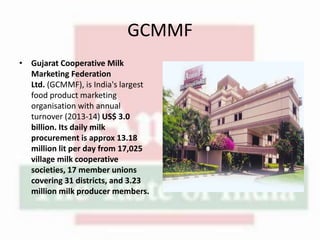
• Gujarat Cooperative Milk
Marketing Federation
Ltd. (GCMMF), is India's largest
food product marketing
organisation with annual
turnover (2013-14) US$ 3.0
billion. Its daily milk
procurement is approx 13.18
million lit per day from 17,025
village milk cooperative
societies, 17 member unions
covering 31 districts, and 3.23
million milk producer members.
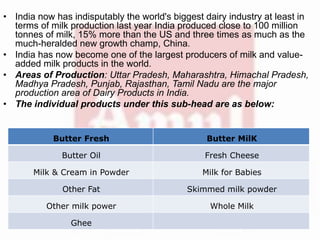
• India now has indisputably the world's biggest dairy industry at least in
terms of milk production last year India produced close to 100 million
tonnes of milk, 15% more than the US and three times as much as the
much-heralded new growth champ, China.
• India has now become one of the largest producers of milk and value-
added milk products in the world.
• Areas of Production: Uttar Pradesh, Maharashtra, Himachal Pradesh,
Madhya Pradesh, Punjab, Rajasthan, Tamil Nadu are the major
production area of Dairy Products in India.
• The individual products under this sub-head are as below:
Butter Fresh Butter MilK
Butter Oil Fresh Cheese
Milk & Cream in Powder Milk for Babies
Other Fat Skimmed milk powder
Other milk power Whole Milk
Ghee
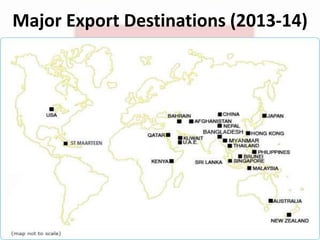
Major Export Destinations (2013-14)
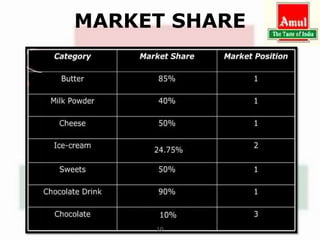
MARKET SHARE
10
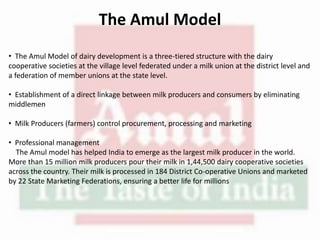
The Amul Model
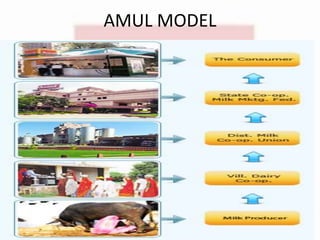
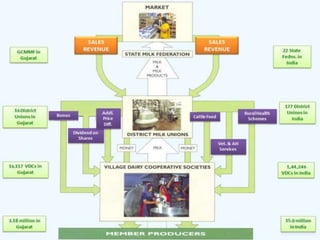
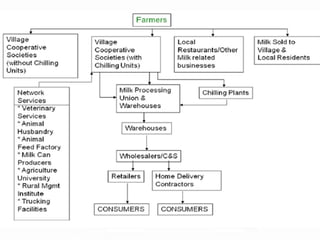
• The Amul Model of dairy development is a three-tiered structure with the dairy
cooperative societies at the village level federated under a milk union at the district level and
a federation of member unions at the state level.
• Establishment of a direct linkage between milk producers and consumers by eliminating
middlemen
• Milk Producers (farmers) control procurement, processing and marketing
• Professional management
The Amul model has helped India to emerge as the largest milk producer in the world.
More than 15 million milk producers pour their milk in 1,44,500 dairy cooperative societies
across the country. Their milk is processed in 184 District Co-operative Unions and marketed
by 22 State Marketing Federations, ensuring a better life for millions
AMUL MODEL
Supply chain
Management
MILK PROCUREMENT
• Total milk procurement by our member unions during the year 2013-
14 growth of 3.6 per cent over 131.03 lakh’s kilograms (13.10 million
kg) The highest procurement was recorded during February 2014 at
169.44 lakh’s kilograms (16.94 million kg) per day.
SALES
• During the year, sales of our Federation registered an highest ever,
record growth in sales of 32.10 per cent to reach Rs.18143.46 crores.
Distribution
• GCMMF coordinated with various unions to get a regular
supply of milk and dairy products.
• The processed milk and dairy products were procured from
district dairy unions and distributed through third party
distributors.
• To ensure quality and timely deliveries, GCMMF and the
district unions had several mechanisms in place.
• The unions monitored the supplies of milk and the
distribution of finished products .
Distribution Process
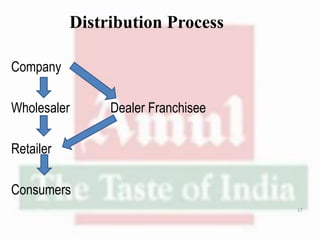
Company
Wholesaler Dealer Franchisee
Retailer
Consumers
17
Innovation
• The evolution of IT in AMUL was took place in
the guidance of DR.B.M Vyas.
• The milk collection center at village cooperative
societies, were first automated.
• Data analysis software utilization for milk
production estimation and increasing
productivity.
• VATS network between all the level of
distribution network and GCMMF.
19
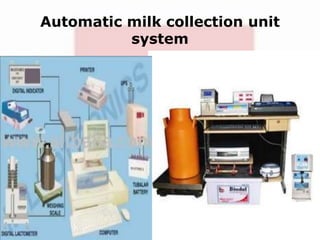
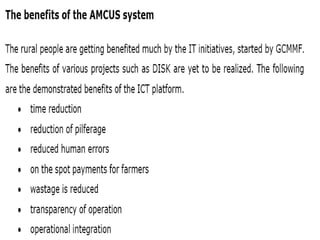
Automatic milk collection unit
system
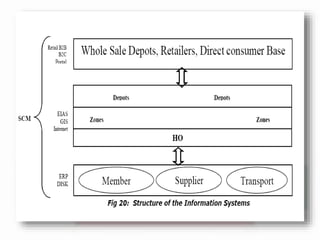
INFORMATION TECHNOLOGY INTEGRATION
• Processing of 10 Million payments daily, amounting to
transactions worth USD 3.78 million in cash.
• Radical changes in business processes - eliminating
middlemen.
• Improved delivery mechanisms and transparency of
business operations.
• Due to this process, AMUL is able to collect six million
litres of milk per day.
• Huge reduction in processing time for effecting
payments to the farmers from a week to couple of
minute.
• Movement of 5000 trucks to 200 dairy processing plants twice a day
in a most optimum manner.
• Practicing just in time supply chain management with six sigma
accuracy.
• Online order placements of Amul’s products on the web.
• Step further towards integrating Cow-to-Consumer (C2C) IT Value Chain with
implementation of “Common WD Software”, popularly known as Distributor
Management System (DMS). This application is supported with Mobile based order
booking application (Sales force automisation – SFA) for Wholesale Distributors
saleman.
• Mobile Application based Order Booking for Fresh products across branches. This is
very helpful to our 2000+ Milk distributors in sending order directly from the
market, monitoring transactions and credit limits
23
Amul adopts green tech for its chocolate plant
• The goal of this project is to promote energy efficiency and
environment friendly technologies in Indian small and
medium enterprises.
• The pilot project, introduced for the first time in India, will
result into energy saving of around 47 percent and
reduction in CO2 emission by 39%.
Cold Storage Network
• Chillers in proximity of villages
• Prompt transport to district facilities for
further dispatch to consumers/ processing
units.
• Chilled trucks to transport processed products
• Delivery to local chillers by insulated rail
tankers and chilled trucks.
• Refrigerators and freezers with retailers and
departmental stores to retain freshness. 26
CONCLUSION
• AMUL,s supply chain and distribute network is
widely spread in the country as well as in the
world.
• Some achievements by AMUL are:-
National Productivity Council Awards 1985-86
and 1986-87
Shakari Vikas Ratna Award 2004
Baroda Productivity Council Award 1997-98
Care Awards – Healthcare category 2013
CII National Awards for food safty in 2013
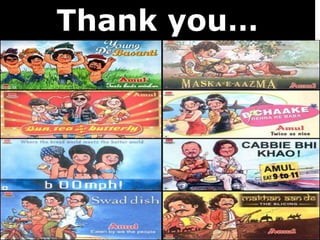
Thank you…

Amul (2)

  • 1.
    PRESTIGE INSTITUTE OF MANAGEMENTAND RESEARCH PRESENTATION ON AMUL GUIDED BY PREPARED BY Prof. Mohit Moghe Sapna Malviya Prachi Bajaj Sheena Gahlot
  • 2.
    Amul: The origin •The mighty Ganges at it's origin is but a tiny stream in the Gangotri ranges of the Himalayas. Similar is the story of Amul which inspired 'Operation Flood' and heralded the 'White Revolution' in India. • It began with two village cooperatives and 250 liters of milk per day, nothing but a trickle compared to the flood it has become today. • Today Amul collects, processes and distributes over a million liters of milk and milk products per day, during the peak, on behalf of more than a thousand village cooperatives owned by half a million farmer members. • Amul too has become a symbol of the aspirations of millions of farmers. Creating a pattern of liberation and self-reliance for every farmer to follow.
  • 3.
    The Birth ofAmul • It all began when milk became a symbol of protest • Founded in 1946 to stop the exploitation by middlemen • Inspired by the freedom movement
  • 4.
    • Amul isan Indian dairy cooperative, based at Anand in the state of Gujarat India. • The word amul is derived from the Sanskrit word amulya , meaning rare, valuable .[ • The co-operative was initially referred to as Anand Milk Federation Union Limited hence the name AMUL.
  • 5.
    • Formed in1946, it is a brand managed by a cooperative body, the Gujarat Co-operative Milk Marketing Federation Ltd. (GCMMF), which today is jointly owned by 3 million milk producers in Gujarat.[ • Amul spurred India's White Revolution , which made the country the world's largest producer of milk and milk products. • In the process Amul became the largest food brand in India and has ventured into markets overseas. • Dr Verghese Kurien, founder-chairman of the GCMMF for more than 30 years (1973–2006), is credited with the success of Amul.
  • 6.
    • The Agriculturaland Processed Food Products Export Development Authority (APEDA) was established by the Government of India under the Agricultural and Processed Food Products Export Development Authority Act passed by the Parliament in December, 1985. • APEDA is mandated with the responsibility of export promotion and development of the diary products,
  • 7.
    GCMMF • Gujarat CooperativeMilk Marketing Federation Ltd. (GCMMF), is India's largest food product marketing organisation with annual turnover (2013-14) US$ 3.0 billion. Its daily milk procurement is approx 13.18 million lit per day from 17,025 village milk cooperative societies, 17 member unions covering 31 districts, and 3.23 million milk producer members.
  • 8.
    • India nowhas indisputably the world's biggest dairy industry at least in terms of milk production last year India produced close to 100 million tonnes of milk, 15% more than the US and three times as much as the much-heralded new growth champ, China. • India has now become one of the largest producers of milk and value- added milk products in the world. • Areas of Production: Uttar Pradesh, Maharashtra, Himachal Pradesh, Madhya Pradesh, Punjab, Rajasthan, Tamil Nadu are the major production area of Dairy Products in India. • The individual products under this sub-head are as below: Butter Fresh Butter MilK Butter Oil Fresh Cheese Milk & Cream in Powder Milk for Babies Other Fat Skimmed milk powder Other milk power Whole Milk Ghee
  • 9.
  • 10.
  • 11.
    The Amul Model •The Amul Model of dairy development is a three-tiered structure with the dairy cooperative societies at the village level federated under a milk union at the district level and a federation of member unions at the state level. • Establishment of a direct linkage between milk producers and consumers by eliminating middlemen • Milk Producers (farmers) control procurement, processing and marketing • Professional management The Amul model has helped India to emerge as the largest milk producer in the world. More than 15 million milk producers pour their milk in 1,44,500 dairy cooperative societies across the country. Their milk is processed in 184 District Co-operative Unions and marketed by 22 State Marketing Federations, ensuring a better life for millions
  • 12.
  • 14.
  • 15.
    MILK PROCUREMENT • Totalmilk procurement by our member unions during the year 2013- 14 growth of 3.6 per cent over 131.03 lakh’s kilograms (13.10 million kg) The highest procurement was recorded during February 2014 at 169.44 lakh’s kilograms (16.94 million kg) per day. SALES • During the year, sales of our Federation registered an highest ever, record growth in sales of 32.10 per cent to reach Rs.18143.46 crores.
  • 16.
    Distribution • GCMMF coordinatedwith various unions to get a regular supply of milk and dairy products. • The processed milk and dairy products were procured from district dairy unions and distributed through third party distributors. • To ensure quality and timely deliveries, GCMMF and the district unions had several mechanisms in place. • The unions monitored the supplies of milk and the distribution of finished products .
  • 17.
    Distribution Process Company Wholesaler DealerFranchisee Retailer Consumers 17
  • 19.
    Innovation • The evolutionof IT in AMUL was took place in the guidance of DR.B.M Vyas. • The milk collection center at village cooperative societies, were first automated. • Data analysis software utilization for milk production estimation and increasing productivity. • VATS network between all the level of distribution network and GCMMF. 19
  • 20.
  • 22.
    INFORMATION TECHNOLOGY INTEGRATION •Processing of 10 Million payments daily, amounting to transactions worth USD 3.78 million in cash. • Radical changes in business processes - eliminating middlemen. • Improved delivery mechanisms and transparency of business operations. • Due to this process, AMUL is able to collect six million litres of milk per day. • Huge reduction in processing time for effecting payments to the farmers from a week to couple of minute.
  • 23.
    • Movement of5000 trucks to 200 dairy processing plants twice a day in a most optimum manner. • Practicing just in time supply chain management with six sigma accuracy. • Online order placements of Amul’s products on the web. • Step further towards integrating Cow-to-Consumer (C2C) IT Value Chain with implementation of “Common WD Software”, popularly known as Distributor Management System (DMS). This application is supported with Mobile based order booking application (Sales force automisation – SFA) for Wholesale Distributors saleman. • Mobile Application based Order Booking for Fresh products across branches. This is very helpful to our 2000+ Milk distributors in sending order directly from the market, monitoring transactions and credit limits 23
  • 25.
    Amul adopts greentech for its chocolate plant • The goal of this project is to promote energy efficiency and environment friendly technologies in Indian small and medium enterprises. • The pilot project, introduced for the first time in India, will result into energy saving of around 47 percent and reduction in CO2 emission by 39%.
  • 26.
    Cold Storage Network •Chillers in proximity of villages • Prompt transport to district facilities for further dispatch to consumers/ processing units. • Chilled trucks to transport processed products • Delivery to local chillers by insulated rail tankers and chilled trucks. • Refrigerators and freezers with retailers and departmental stores to retain freshness. 26
  • 27.
    CONCLUSION • AMUL,s supplychain and distribute network is widely spread in the country as well as in the world. • Some achievements by AMUL are:- National Productivity Council Awards 1985-86 and 1986-87 Shakari Vikas Ratna Award 2004 Baroda Productivity Council Award 1997-98 Care Awards – Healthcare category 2013 CII National Awards for food safty in 2013
  • 28.