A 
SUMMER PROJECT 
PRESENTATION ON 
ā€œ A study on consumer behavior towards Amul products in 
Sabarkantha district ā€ 
SUBMITTED TO:- 
Mr. P. K. PATEL 
Adjunct Professor, 
College of Agribusiness Management, 
S. D. Agricultural University, 
S. K. Nagar-385 506. 
ABM - 595 
SUBMITTED BY: 
CHAUDHARY BHAVINKUMAR B. 
Reg. No.:- 08-00107-2013 
College of Agribusiness Management, 
S. D. Agricultural University, 
S. K. Nagar-385 506. 
COLLEGE OF AGRIBUSINESS MANAGEMENT 1
OUTLINE 
Introduction 
Research methodology 
Results and discussion 
Finding and conclusion 
References 
2
INTRODUCTION ON CONSUMER BEHAVIOR 
• According to Blackwell, Miniard and Engel, 
Consumer behavior involves the activities people 
undertake when obtaining, consuming, and disposing 
of products and services. 
• Consumer behavior is referred to as the study of 
when, why, how, where and what people do or do not 
buy products. It attempts to understand the buyer 
decision making process, both individually or groups. 
3
INTRODUCTION ON DAIRY INDUSTRY 
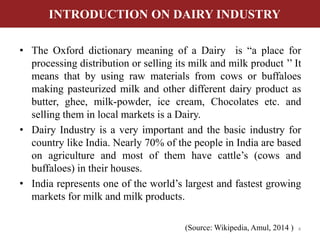
• The Oxford dictionary meaning of a Dairy is ā€œa place for 
processing distribution or selling its milk and milk product ’’ It 
means that by using raw materials from cows or buffaloes 
making pasteurized milk and other different dairy product as 
butter, ghee, milk-powder, ice cream, Chocolates etc. and 
selling them in local markets is a Dairy. 
• Dairy Industry is a very important and the basic industry for 
country like India. Nearly 70% of the people in India are based 
on agriculture and most of them have cattle’s (cows and 
buffaloes) in their houses. 
• India represents one of the world’s largest and fastest growing 
markets for milk and milk products. 
(Source: Wikipedia, Amul, 2014 ) 4
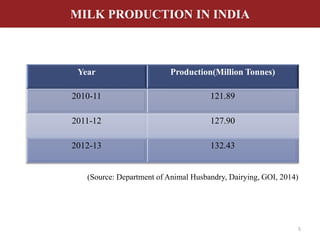
MILK PRODUCTION IN INDIA 
5 
Year Production(Million Tonnes) 
2010-11 121.89 
2011-12 127.90 
2012-13 132.43 
(Source: Department of Animal Husbandry, Dairying, GOI, 2014)
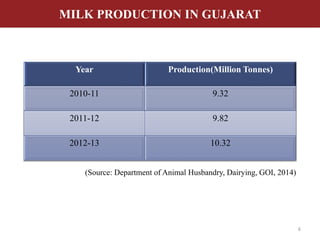
MILK PRODUCTION IN GUJARAT 
6 
Year Production(Million Tonnes) 
2010-11 9.32 
2011-12 9.82 
2012-13 10.32 
(Source: Department of Animal Husbandry, Dairying, GOI, 2014)
INTRODUCTION ON AMUL 
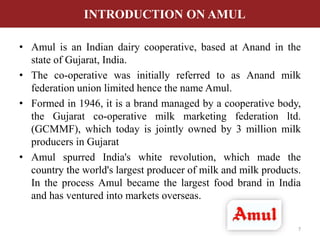
• Amul is an Indian dairy cooperative, based at Anand in the 
state of Gujarat, India. 
• The co-operative was initially referred to as Anand milk 
federation union limited hence the name Amul. 
• Formed in 1946, it is a brand managed by a cooperative body, 
the Gujarat co-operative milk marketing federation ltd. 
(GCMMF), which today is jointly owned by 3 million milk 
producers in Gujarat 
• Amul spurred India's white revolution, which made the 
country the world's largest producer of milk and milk products. 
In the process Amul became the largest food brand in India 
and has ventured into markets overseas. 
7
• GCMMF (AMUL) has the largest distribution network for any 
FMCG company. It has nearly 50 sales offices spread all over 
the country, more than 5,000 wholesale dealers and more than 
7,00,000 retailers. 
• Amul became the world's largest vegetarian cheese and the 
largest pouched-milk brand. 
• AMUL is also the largest exporter of dairy products in the 
country. AMUL is available today in over 40 countries of the 
world. 
• In September 2007, Amul emerged as the leading Indian brand 
according to a survey by Synovate to find out Asia's top 1000 
Brands. 
(Source: Amul dairy, Anand, 2014) 
Conti… 
8
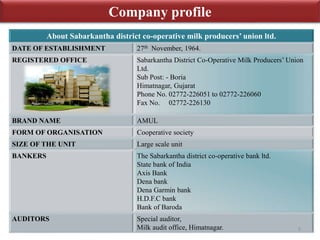
Company profile 
About Sabarkantha district co-operative milk producers’ union ltd. 
DATE OF ESTABLISHMENT 27th November, 1964. 
REGISTERED OFFICE Sabarkantha District Co-Operative Milk Producers’ Union 
Ltd. 
Sub Post: - Boria 
Himatnagar, Gujarat 
Phone No. 02772-226051 to 02772-226060 
Fax No. 02772-226130 
BRAND NAME AMUL 
FORM OF ORGANISATION Cooperative society 
SIZE OF THE UNIT Large scale unit 
BANKERS The Sabarkantha district co-operative bank ltd. 
State bank of India 
Axis Bank 
Dena bank 
Dena Garmin bank 
H.D.F.C bank 
Bank of Baroda 
AUDITORS Special auditor, 
Milk audit office, Himatnagar. 9
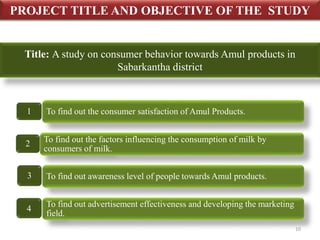
PROJECT TITLE AND OBJECTIVE OF THE STUDY 
Title: A study on consumer behavior towards Amul products in 
1 To find out the consumer satisfaction of Amul Products. 
2 
To find out the factors influencing the consumption of milk by 
consumers of milk. 
3 To find out awareness level of people towards Amul products. 
To find out advertisement effectiveness and developing the marketing 
field. 
4 
Sabarkantha district 
10
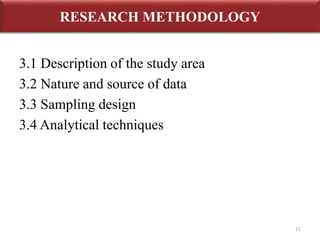
RESEARCH METHODOLOGY 
3.1 Description of the study area 
3.2 Nature and source of data 
3.3 Sampling design 
3.4 Analytical techniques 
11
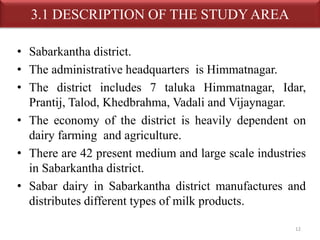
3.1 DESCRIPTION OF THE STUDY AREA 
• Sabarkantha district. 
• The administrative headquarters is Himmatnagar. 
• The district includes 7 taluka Himmatnagar, Idar, 
Prantij, Talod, Khedbrahma, Vadali and Vijaynagar. 
• The economy of the district is heavily dependent on 
dairy farming and agriculture. 
• There are 42 present medium and large scale industries 
in Sabarkantha district. 
• Sabar dairy in Sabarkantha district manufactures and 
distributes different types of milk products. 
12
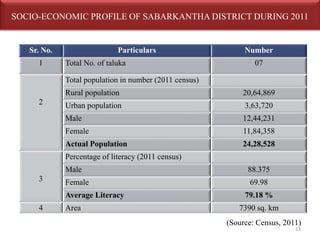
SOCIO-ECONOMIC PROFILE OF SABARKANTHA DISTRICT DURING 2011 
Sr. No. Particulars Number 
1 Total No. of taluka 07 
2 
Total population in number (2011 census) 
Rural population 20,64,869 
Urban population 3,63,720 
Male 12,44,231 
Female 11,84,358 
Actual Population 24,28,528 
3 
Percentage of literacy (2011 census) 
Male 88.375 
Female 69.98 
Average Literacy 79.18 % 
4 Area 7390 sq. km 
(Source: Census, 2011) 
13
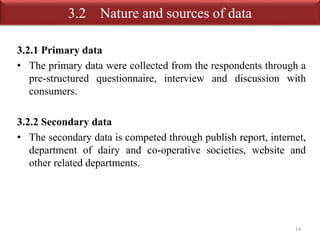
3.2 Nature and sources of data 
3.2.1 Primary data 
• The primary data were collected from the respondents through a 
pre-structured questionnaire, interview and discussion with 
consumers. 
3.2.2 Secondary data 
• The secondary data is competed through publish report, internet, 
department of dairy and co-operative societies, website and 
other related departments. 
14
3.3 Sampling design 
• A random sampling was adopted as 
appropriate sampling procedure for the study. 
• Sabarkantha district was selected purposely 
for the study. 
15
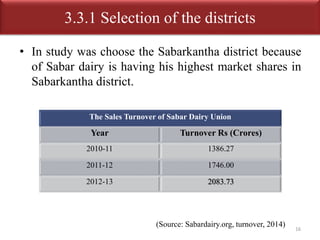
3.3.1 Selection of the districts 
• In study was choose the Sabarkantha district because 
of Sabar dairy is having his highest market shares in 
Sabarkantha district. 
The Sales Turnover of Sabar Dairy Union 
Year Turnover Rs (Crores) 
2010-11 1386.27 
2011-12 1746.00 
2012-13 2083.73 
16 
(Source: Sabardairy.org, turnover, 2014)
3.3.2 Selection of the taluka 
In the second stage, it was proposed to select from 
Sabarkantha district, there were three talukas. Himatnagar, 
Idar, and Khedbrahma talukas were Randomly selected in 
the study. 
17
3.3.3 Sample size 
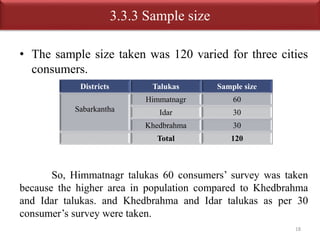
• The sample size taken was 120 varied for three cities 
consumers. 
Districts Talukas Sample size 
Sabarkantha 
Himmatnagr 60 
Idar 30 
Khedbrahma 30 
Total 120 
So, Himmatnagr talukas 60 consumers’ survey was taken 
because the higher area in population compared to Khedbrahma 
and Idar talukas. and Khedbrahma and Idar talukas as per 30 
consumer’s survey were taken. 
18
3.4 Sampling Techniques 
• In order to achieve the objectives of the present study, 
the sampling techniques adopted as simple random 
sampling. Total 120 consumers were selected. 
• The data collected from the primary and the 
secondary sources were analyzed. The data were 
subjected to statistical analysis through the tabular 
and graphing techniques. 
19
20
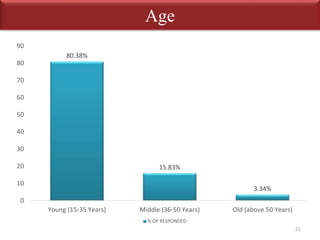
Age 
80.38% 
15.83% 
3.34% 
90 
80 
70 
60 
50 
40 
30 
20 
10 
0 
Young (15-35 Years) Middle (36-50 Years) Old (above 50 Years) 
% OF RESPONDED 
21
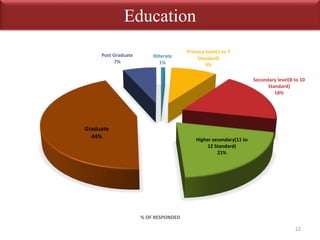
Education 
Illiterate 
1% 
Primary level(1 to 7 
Standard) 
9% 
Secondary level(8 to 10 
Standard) 
18% 
Higher secondary(11 to 
12 Standard) 
21% 
Post Graduate 
Graduate 
44% 
7% 
% OF RESPONDED 
22
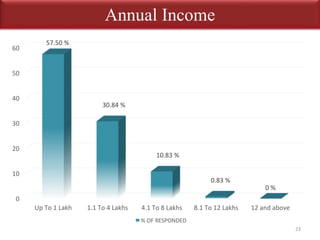
Annual Income 
60 
50 
40 
30 
20 
10 
0 
57.50 % 
30.84 % 
10.83 % 
0.83 % 
0 % 
Up To 1 Lakh 1.1 To 4 Lakhs 4.1 To 8 Lakhs 8.1 To 12 Lakhs 12 and above 
% OF RESPONDED 
23
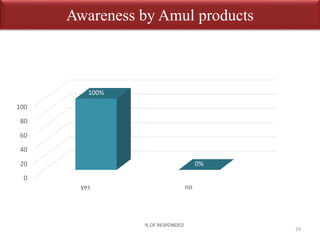
Awareness by Amul products 
100 
80 
60 
40 
20 
0 
100% 
yes no 
0% 
% OF RESPONDED 
24
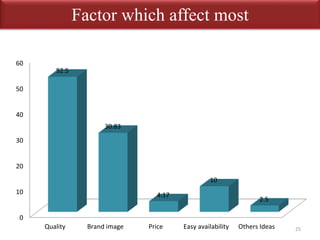
Factor which affect most 
60 
50 
40 
30 
20 
10 
0 
52.5 
30.83 
4.17 
10 
2.5 
Quality Brand image Price Easy availability Others Ideas 
25
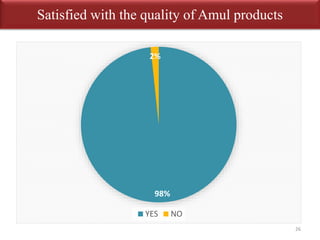
Satisfied with the quality of Amul products 
26 
2% 
98% 
YES NO
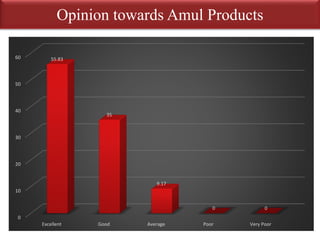
Opinion towards Amul Products 
27 
60 
50 
40 
30 
20 
10 
0 
55.83 
35 
9.17 
0 0 
Excellent Good Average Poor Very Poor
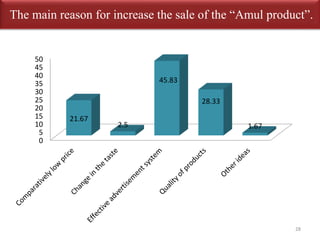
The main reason for increase the sale of the ā€œAmul productā€. 
50 
45 
40 
35 
30 
25 
20 
15 
10 
5 
0 
21.67 
2.5 
45.83 
28.33 
1.67 
28
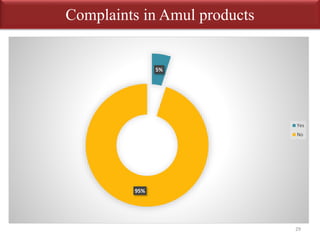
Complaints in Amul products 
29 
5% 
95% 
Yes 
No
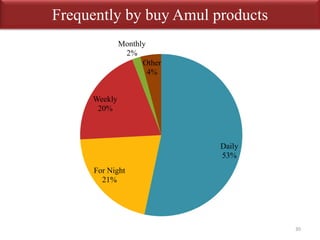
Frequently by buy Amul products 
30 
Daily 
53% 
Weekly 
20% 
For Night 
21% 
Monthly 
2% 
Other 
4%
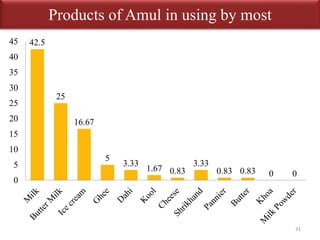
Products of Amul in using by most 
31 
42.5 
25 
16.67 
5 
3.33 
1.67 0.83 
3.33 
0.83 0.83 0 0 
45 
40 
35 
30 
25 
20 
15 
10 
5 
0
FINDINGS and conclusion 
32
FINDINGS 
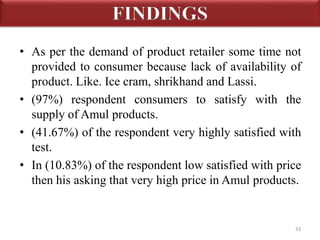
• As per the demand of product retailer some time not 
provided to consumer because lack of availability of 
product. Like. Ice cram, shrikhand and Lassi. 
• (97%) respondent consumers to satisfy with the 
supply of Amul products. 
• (41.67%) of the respondent very highly satisfied with 
test. 
• In (10.83%) of the respondent low satisfied with price 
then his asking that very high price in Amul products. 
33
Conti… 
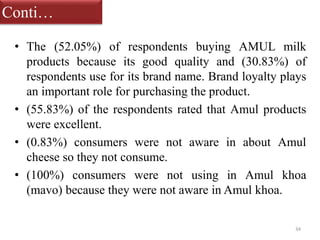
• The (52.05%) of respondents buying AMUL milk 
products because its good quality and (30.83%) of 
respondents use for its brand name. Brand loyalty plays 
an important role for purchasing the product. 
• (55.83%) of the respondents rated that Amul products 
were excellent. 
• (0.83%) consumers were not aware in about Amul 
cheese so they not consume. 
• (100%) consumers were not using in Amul khoa 
(mavo) because they were not aware in Amul khoa. 
34
SUGGESTIONS 
• If company require Amul improving products awareness in 
Sabarkantha district. Like khoa. 
• Increase advertisement in Sabarkantha district, through tv. 
Advertisement, local newspaper so every Amul consumer 
awareness about the new product and known about product 
features. 
• It is necessary to take proper care of new products marketing in 
every area and give prescribed information to every retailer 
those sell Amul products. 
• Provide enough stock to retailer as per their demand so they 
easily completing consumer demand. 
35
Conti…. 
• Most of the respondent not uses cheese, Amul masti dahi and 
Amul lassi. Suggest that improve product awareness in 
customer’s mind by advertisement. 
• Improve a service of product and most of the respondent said 
that packing of food was not good, it’s required more attractive 
packing. 
36
CONCLUSION 
• Consumers were interested for quality or customer oriented 
product rather than having the brand image. Ice-cream, 
shrikhand, milk, Kool, lassi etc. Are consumed mostly because 
its quality good and dairy product. Amul was the market leader 
and local ice-cream vendors acquire the second position in 
terms market share. So try to increase the advertisement and 
lack of availibity in the rural area is the main weakness for the 
company. 
• The brand awareness for Amul new products were very less in 
Khedbrahma compared to Himmatnagar taluka. It is weakness 
for the company. In today time quality, price, availability is the 
major factors considered for the customer while buying a 
particular brand. 
37
REFERENCES 
• Sabar Dairy2014. [Online] Available at: 
http://www.sabardairy.org/. [Accessed 26 July 2014]. 
• Amul Dairy2014. [Online] Available at: 
http://www.amuldairy.org/. [Accessed 26 July 2014]. 
• Milk Production by States - National Dairy Development 
Board . 2014. [Online] Available 
at: http://www.nddb.coop/English/Statistics/Pages/Milk- 
Production-States.aspx. [Accessed 27 July 2014]. 
• Sabarkantha District Population Census 2011, Gujarat literacy 
sex ratio and density. 2014.[Online] Available 
at:http://www.census2011.co.in/census/district/186 
sabarkantha.html. [Accessed 26 July 2014]. 
38
39 
9428831153

Consumer Behavior towards Amul Products

  • 1.
    A SUMMER PROJECT PRESENTATION ON ā€œ A study on consumer behavior towards Amul products in Sabarkantha district ā€ SUBMITTED TO:- Mr. P. K. PATEL Adjunct Professor, College of Agribusiness Management, S. D. Agricultural University, S. K. Nagar-385 506. ABM - 595 SUBMITTED BY: CHAUDHARY BHAVINKUMAR B. Reg. No.:- 08-00107-2013 College of Agribusiness Management, S. D. Agricultural University, S. K. Nagar-385 506. COLLEGE OF AGRIBUSINESS MANAGEMENT 1
  • 2.
    OUTLINE Introduction Researchmethodology Results and discussion Finding and conclusion References 2
  • 3.
    INTRODUCTION ON CONSUMERBEHAVIOR • According to Blackwell, Miniard and Engel, Consumer behavior involves the activities people undertake when obtaining, consuming, and disposing of products and services. • Consumer behavior is referred to as the study of when, why, how, where and what people do or do not buy products. It attempts to understand the buyer decision making process, both individually or groups. 3
  • 4.
    INTRODUCTION ON DAIRYINDUSTRY • The Oxford dictionary meaning of a Dairy is ā€œa place for processing distribution or selling its milk and milk product ’’ It means that by using raw materials from cows or buffaloes making pasteurized milk and other different dairy product as butter, ghee, milk-powder, ice cream, Chocolates etc. and selling them in local markets is a Dairy. • Dairy Industry is a very important and the basic industry for country like India. Nearly 70% of the people in India are based on agriculture and most of them have cattle’s (cows and buffaloes) in their houses. • India represents one of the world’s largest and fastest growing markets for milk and milk products. (Source: Wikipedia, Amul, 2014 ) 4
  • 5.
    MILK PRODUCTION ININDIA 5 Year Production(Million Tonnes) 2010-11 121.89 2011-12 127.90 2012-13 132.43 (Source: Department of Animal Husbandry, Dairying, GOI, 2014)
  • 6.
    MILK PRODUCTION INGUJARAT 6 Year Production(Million Tonnes) 2010-11 9.32 2011-12 9.82 2012-13 10.32 (Source: Department of Animal Husbandry, Dairying, GOI, 2014)
  • 7.
    INTRODUCTION ON AMUL • Amul is an Indian dairy cooperative, based at Anand in the state of Gujarat, India. • The co-operative was initially referred to as Anand milk federation union limited hence the name Amul. • Formed in 1946, it is a brand managed by a cooperative body, the Gujarat co-operative milk marketing federation ltd. (GCMMF), which today is jointly owned by 3 million milk producers in Gujarat • Amul spurred India's white revolution, which made the country the world's largest producer of milk and milk products. In the process Amul became the largest food brand in India and has ventured into markets overseas. 7
  • 8.
    • GCMMF (AMUL)has the largest distribution network for any FMCG company. It has nearly 50 sales offices spread all over the country, more than 5,000 wholesale dealers and more than 7,00,000 retailers. • Amul became the world's largest vegetarian cheese and the largest pouched-milk brand. • AMUL is also the largest exporter of dairy products in the country. AMUL is available today in over 40 countries of the world. • In September 2007, Amul emerged as the leading Indian brand according to a survey by Synovate to find out Asia's top 1000 Brands. (Source: Amul dairy, Anand, 2014) Conti… 8
  • 9.
    Company profile AboutSabarkantha district co-operative milk producers’ union ltd. DATE OF ESTABLISHMENT 27th November, 1964. REGISTERED OFFICE Sabarkantha District Co-Operative Milk Producers’ Union Ltd. Sub Post: - Boria Himatnagar, Gujarat Phone No. 02772-226051 to 02772-226060 Fax No. 02772-226130 BRAND NAME AMUL FORM OF ORGANISATION Cooperative society SIZE OF THE UNIT Large scale unit BANKERS The Sabarkantha district co-operative bank ltd. State bank of India Axis Bank Dena bank Dena Garmin bank H.D.F.C bank Bank of Baroda AUDITORS Special auditor, Milk audit office, Himatnagar. 9
  • 10.
    PROJECT TITLE ANDOBJECTIVE OF THE STUDY Title: A study on consumer behavior towards Amul products in 1 To find out the consumer satisfaction of Amul Products. 2 To find out the factors influencing the consumption of milk by consumers of milk. 3 To find out awareness level of people towards Amul products. To find out advertisement effectiveness and developing the marketing field. 4 Sabarkantha district 10
  • 11.
    RESEARCH METHODOLOGY 3.1Description of the study area 3.2 Nature and source of data 3.3 Sampling design 3.4 Analytical techniques 11
  • 12.
    3.1 DESCRIPTION OFTHE STUDY AREA • Sabarkantha district. • The administrative headquarters is Himmatnagar. • The district includes 7 taluka Himmatnagar, Idar, Prantij, Talod, Khedbrahma, Vadali and Vijaynagar. • The economy of the district is heavily dependent on dairy farming and agriculture. • There are 42 present medium and large scale industries in Sabarkantha district. • Sabar dairy in Sabarkantha district manufactures and distributes different types of milk products. 12
  • 13.
    SOCIO-ECONOMIC PROFILE OFSABARKANTHA DISTRICT DURING 2011 Sr. No. Particulars Number 1 Total No. of taluka 07 2 Total population in number (2011 census) Rural population 20,64,869 Urban population 3,63,720 Male 12,44,231 Female 11,84,358 Actual Population 24,28,528 3 Percentage of literacy (2011 census) Male 88.375 Female 69.98 Average Literacy 79.18 % 4 Area 7390 sq. km (Source: Census, 2011) 13
  • 14.
    3.2 Nature andsources of data 3.2.1 Primary data • The primary data were collected from the respondents through a pre-structured questionnaire, interview and discussion with consumers. 3.2.2 Secondary data • The secondary data is competed through publish report, internet, department of dairy and co-operative societies, website and other related departments. 14
  • 15.
    3.3 Sampling design • A random sampling was adopted as appropriate sampling procedure for the study. • Sabarkantha district was selected purposely for the study. 15
  • 16.
    3.3.1 Selection ofthe districts • In study was choose the Sabarkantha district because of Sabar dairy is having his highest market shares in Sabarkantha district. The Sales Turnover of Sabar Dairy Union Year Turnover Rs (Crores) 2010-11 1386.27 2011-12 1746.00 2012-13 2083.73 16 (Source: Sabardairy.org, turnover, 2014)
  • 17.
    3.3.2 Selection ofthe taluka In the second stage, it was proposed to select from Sabarkantha district, there were three talukas. Himatnagar, Idar, and Khedbrahma talukas were Randomly selected in the study. 17
  • 18.
    3.3.3 Sample size • The sample size taken was 120 varied for three cities consumers. Districts Talukas Sample size Sabarkantha Himmatnagr 60 Idar 30 Khedbrahma 30 Total 120 So, Himmatnagr talukas 60 consumers’ survey was taken because the higher area in population compared to Khedbrahma and Idar talukas. and Khedbrahma and Idar talukas as per 30 consumer’s survey were taken. 18
  • 19.
    3.4 Sampling Techniques • In order to achieve the objectives of the present study, the sampling techniques adopted as simple random sampling. Total 120 consumers were selected. • The data collected from the primary and the secondary sources were analyzed. The data were subjected to statistical analysis through the tabular and graphing techniques. 19
  • 20.
  • 21.
    Age 80.38% 15.83% 3.34% 90 80 70 60 50 40 30 20 10 0 Young (15-35 Years) Middle (36-50 Years) Old (above 50 Years) % OF RESPONDED 21
  • 22.
    Education Illiterate 1% Primary level(1 to 7 Standard) 9% Secondary level(8 to 10 Standard) 18% Higher secondary(11 to 12 Standard) 21% Post Graduate Graduate 44% 7% % OF RESPONDED 22
  • 23.
    Annual Income 60 50 40 30 20 10 0 57.50 % 30.84 % 10.83 % 0.83 % 0 % Up To 1 Lakh 1.1 To 4 Lakhs 4.1 To 8 Lakhs 8.1 To 12 Lakhs 12 and above % OF RESPONDED 23
  • 24.
    Awareness by Amulproducts 100 80 60 40 20 0 100% yes no 0% % OF RESPONDED 24
  • 25.
    Factor which affectmost 60 50 40 30 20 10 0 52.5 30.83 4.17 10 2.5 Quality Brand image Price Easy availability Others Ideas 25
  • 26.
    Satisfied with thequality of Amul products 26 2% 98% YES NO
  • 27.
    Opinion towards AmulProducts 27 60 50 40 30 20 10 0 55.83 35 9.17 0 0 Excellent Good Average Poor Very Poor
  • 28.
    The main reasonfor increase the sale of the ā€œAmul productā€. 50 45 40 35 30 25 20 15 10 5 0 21.67 2.5 45.83 28.33 1.67 28
  • 29.
    Complaints in Amulproducts 29 5% 95% Yes No
  • 30.
    Frequently by buyAmul products 30 Daily 53% Weekly 20% For Night 21% Monthly 2% Other 4%
  • 31.
    Products of Amulin using by most 31 42.5 25 16.67 5 3.33 1.67 0.83 3.33 0.83 0.83 0 0 45 40 35 30 25 20 15 10 5 0
  • 32.
  • 33.
    FINDINGS • Asper the demand of product retailer some time not provided to consumer because lack of availability of product. Like. Ice cram, shrikhand and Lassi. • (97%) respondent consumers to satisfy with the supply of Amul products. • (41.67%) of the respondent very highly satisfied with test. • In (10.83%) of the respondent low satisfied with price then his asking that very high price in Amul products. 33
  • 34.
    Conti… • The(52.05%) of respondents buying AMUL milk products because its good quality and (30.83%) of respondents use for its brand name. Brand loyalty plays an important role for purchasing the product. • (55.83%) of the respondents rated that Amul products were excellent. • (0.83%) consumers were not aware in about Amul cheese so they not consume. • (100%) consumers were not using in Amul khoa (mavo) because they were not aware in Amul khoa. 34
  • 35.
    SUGGESTIONS • Ifcompany require Amul improving products awareness in Sabarkantha district. Like khoa. • Increase advertisement in Sabarkantha district, through tv. Advertisement, local newspaper so every Amul consumer awareness about the new product and known about product features. • It is necessary to take proper care of new products marketing in every area and give prescribed information to every retailer those sell Amul products. • Provide enough stock to retailer as per their demand so they easily completing consumer demand. 35
  • 36.
    Conti…. • Mostof the respondent not uses cheese, Amul masti dahi and Amul lassi. Suggest that improve product awareness in customer’s mind by advertisement. • Improve a service of product and most of the respondent said that packing of food was not good, it’s required more attractive packing. 36
  • 37.
    CONCLUSION • Consumerswere interested for quality or customer oriented product rather than having the brand image. Ice-cream, shrikhand, milk, Kool, lassi etc. Are consumed mostly because its quality good and dairy product. Amul was the market leader and local ice-cream vendors acquire the second position in terms market share. So try to increase the advertisement and lack of availibity in the rural area is the main weakness for the company. • The brand awareness for Amul new products were very less in Khedbrahma compared to Himmatnagar taluka. It is weakness for the company. In today time quality, price, availability is the major factors considered for the customer while buying a particular brand. 37
  • 38.
    REFERENCES • SabarDairy2014. [Online] Available at: http://www.sabardairy.org/. [Accessed 26 July 2014]. • Amul Dairy2014. [Online] Available at: http://www.amuldairy.org/. [Accessed 26 July 2014]. • Milk Production by States - National Dairy Development Board . 2014. [Online] Available at: http://www.nddb.coop/English/Statistics/Pages/Milk- Production-States.aspx. [Accessed 27 July 2014]. • Sabarkantha District Population Census 2011, Gujarat literacy sex ratio and density. 2014.[Online] Available at:http://www.census2011.co.in/census/district/186 sabarkantha.html. [Accessed 26 July 2014]. 38
  • 39.