26 September 2014 
Alan Fourie 
Senior Application Specialist 
DuPont Nutrition and Health SSA 
Imagine trouble-free UHT processing for hours and hours!
What is FoodPro® Cleanline? 
9/25/2014 
“The Modification of Milk Surface Properties by 
Glycerophospholipid Cholesterol Acyltransferase (GCAT)” 
Abstract: 
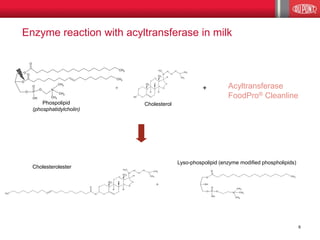
The presentation will focus on the application of the FoodPro® Cleanline enzyme Glycerophospholipid Cholesterol Acyltransferase (GCAT) in the milk, which converts cholesterol to cholesterol esters and lysophospholipids. Lysophospholipids are surface-active amphiphiles that will act as biosurfactants and prevent protein aggregation and promote refolding of proteins (chaperone-like properties), resulting in various processing advantages and increased emulsion stability when used in the manufacture of milk and dairy products. GCAT can reduce free cholesterol in milk by as much as 65 to 85%, which could potentially be an important advantage from a nutritional point of view when producing milk and dairy products.
What is your UHT unit performance today? 
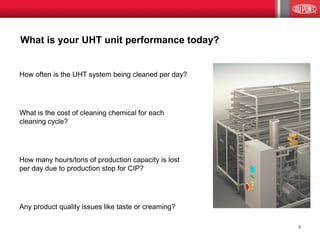
How often is the UHT system being cleaned per day? What is the cost of cleaning chemical for each cleaning cycle? How many hours/tons of production capacity is lost per day due to production stop for CIP? Any product quality issues like taste or creaming? 
3
What is an enzyme? 
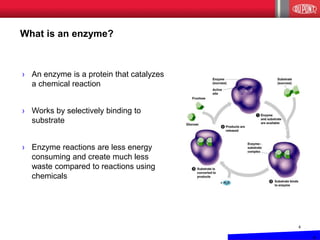
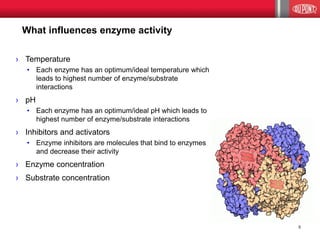
›An enzyme is a protein that catalyzes a chemical reaction 
›Works by selectively binding to substrate 
›Enzyme reactions are less energy consuming and create much less waste compared to reactions using chemicals 
4 
4
›Temperature 
•Each enzyme has an optimum/ideal temperature which leads to highest number of enzyme/substrate interactions 
›pH 
•Each enzyme has an optimum/ideal pH which leads to highest number of enzyme/substrate interactions 
›Inhibitors and activators 
•Enzyme inhibitors are molecules that bind to enzymes and decrease their activity 
›Enzyme concentration 
›Substrate concentration 
What influences enzyme activity 
5
Acyltransferase 
FoodPro® Cleanline 
O 
O 
CH3 
O 
P 
OH 
O 
O 
N 
+ 
CH3 
CH3 
CH3 
+ OH 
Lyso-phospolipid (enzyme modified phospholipids) 
Phospolipid 
(phosphatidylcholin) 
Cholesterol 
Cholesterolester 
+ 
13 
9 14 
10 8 
17 
12 
11 
15 
16 
5 7 
6 
20 
CH3 
18 
CH3 
1 19 
23 
22 
4 
24 
2 
3 
H 
H 
H 
H 
HO 
CH3 
CH3 
H3C 
+ 
Enzyme reaction with acyltransferase in milk 
6 
13 
9 14 
10 8 
17 
12 
11 
15 
16 
5 7 
6 
20 
CH3 
18 
CH3 
1 19 
23 
22 
4 
24 
2 
3 
H 
H 
H 
H 
O 
CH3 
CH3 
H3C 
O 
H3C 
O 
O 
O 
CH3 
O 
CH3 
O 
P 
OH 
O 
O N 
+ 
CH3 
CH3 
CH3
Why this new development? 
During the production of UHT milk, the heating surface of the heating unit foul due to 
build up of proteins and sugars and minerals from the milk 
This results in pressure building in the system and reduced heat transfer. When the 
pressure becomes too high and the heat transfer is reduced, the unit needs to be 
cleaned 
This can also result in burnt taste of the UHT milk 
Cleaning and sterilisation takes time, up to 2 hours, and takes significant amounts of 
cleaning compounds 
This can lead to: 
Not meeting overall performance on capacity, cost and quality 
High costs for cleaning: hours spent and chemicals consumed 
Product rejection due to taste 
7
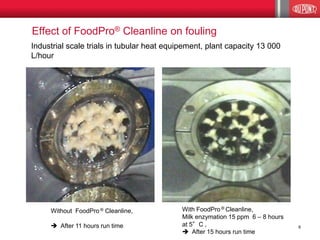
Without FoodPro ® Cleanline, 
 After 11 hours run time 
With FoodPro ® Cleanline, 
Milk enzymation 15 ppm 6 – 8 hours at 5°C , 
 After 15 hours run time 
Industrial scale trials in tubular heat equipement, plant capacity 13 000 L/hour 
Effect of FoodPro® Cleanline on fouling 
8
Fouling of heat exchangers in the dairy industry is a quite severe problem, both technically and economically. 
During a normal working cycle, the heat exchanger is subject to undesired material accumulation along its working surfaces, normally referred to as Fouling. 
Fouling formation causes increased pressure drop over plate heat exchangers, and also leads to reduced heat transfer and thereby increased energy consumption. 
Result: loss of production capacity as well as increased costs for manpower, 
energy and detergent consumption during processing and cleaning. 
The enzymatic treatment of milk will greatly reduce fouling rates 
Effect of FoodPro® Cleanline on fouling 
9
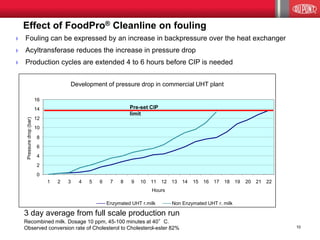
Effect of FoodPro® Cleanline on fouling 
Development of pressure drop in commercial UHT plant 
0 
2 
4 
6 
8 
10 
12 
14 
16 
1 
2 
3 
4 
5 
6 
7 
8 
9 
10 
11 
12 
13 
14 
15 
16 
17 
18 
19 
20 
21 
22 
Hours 
Pressure drop (bar) 
Enzymated UHT r.milk 
Non Enzymated UHT r. milk 
Pre-set CIP limit 
3 day average from full scale production run 
Recombined milk. Dosage 10 ppm, 45-100 minutes at 40°C. Observed conversion rate of Cholesterol to Cholesterol-ester 82% 
›Fouling can be expressed by an increase in backpressure over the heat exchanger 
›Acyltransferase reduces the increase in pressure drop 
›Production cycles are extended 4 to 6 hours before CIP is needed 
10
11 
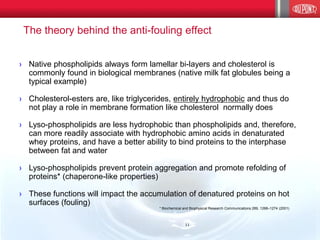
›Native phospholipids always form lamellar bi-layers and cholesterol is commonly found in biological membranes (native milk fat globules being a typical example) 
›Cholesterol-esters are, like triglycerides, entirely hydrophobic and thus do not play a role in membrane formation like cholesterol normally does 
›Lyso-phospholipids are less hydrophobic than phospholipids and, therefore, can more readily associate with hydrophobic amino acids in denaturated whey proteins, and have a better ability to bind proteins to the interphase between fat and water 
›Lyso-phospholipids prevent protein aggregation and promote refolding of proteins* (chaperone-like properties) 
›These functions will impact the accumulation of denatured proteins on hot surfaces (fouling) 
* Biochemical and Biophysical Research Communications 289, 1268–1274 (2001) 
The theory behind the anti-fouling effect
Plate heat exchanger 
Fouling on heat exchanger 
Clean heat exchanger 
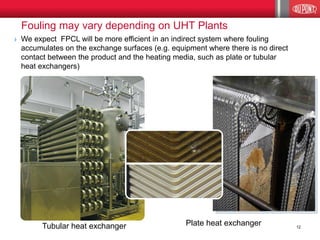
Fouling may vary depending on UHT Plants 
Tubular heat exchanger We expect FPCL will be more efficient in an indirect system where fouling accumulates on the exchange surfaces (e.g. equipment where there is no direct contact between the product and the heating media, such as plate or tubular heat exchangers) 
12
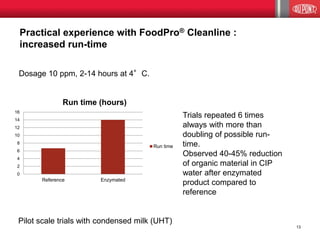
Practical experience with FoodPro® Cleanline : increased run-time 
Dosage 10 ppm, 2-14 hours at 4°C. 
Trials repeated 6 times always with more than doubling of possible run- time. 
Observed 40-45% reduction of organic material in CIP water after enzymated product compared to reference 
Pilot scale trials with condensed milk (UHT) 
13 
0 
2 
4 
6 
8 
10 
12 
14 
16 
Reference 
Enzymated 
Run time (hours) 
Run time
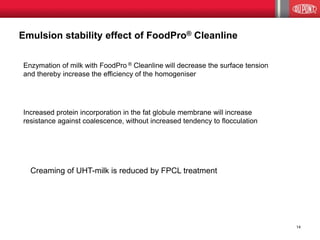
Emulsion stability effect of FoodPro® Cleanline 
Enzymation of milk with FoodPro ® Cleanline will decrease the surface tension and thereby increase the efficiency of the homogeniser Increased protein incorporation in the fat globule membrane will increase resistance against coalescence, without increased tendency to flocculation 
14 
Creaming of UHT-milk is reduced by FPCL treatment
15 
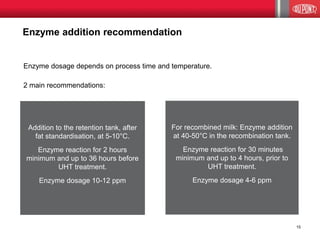
Enzyme addition recommendation 
Enzyme dosage depends on process time and temperature. 
2 main recommendations: 
Addition to the retention tank, after fat standardisation, at 5-10°C. Enzyme reaction for 2 hours minimum and up to 36 hours before UHT treatment. Enzyme dosage 10-12 ppm 
For recombined milk: Enzyme addition at 40-50°C in the recombination tank. 
Enzyme reaction for 30 minutes minimum and up to 4 hours, prior to UHT treatment. 
Enzyme dosage 4-6 ppm
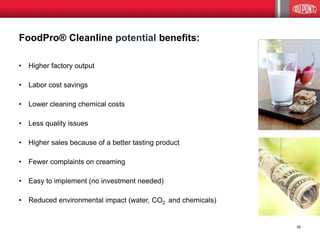
FoodPro® Cleanline potential benefits: 
•Higher factory output 
•Labor cost savings 
•Lower cleaning chemical costs 
•Less quality issues 
•Higher sales because of a better tasting product 
•Fewer complaints on creaming 
•Easy to implement (no investment needed) 
•Reduced environmental impact (water, CO2 and chemicals) 
16
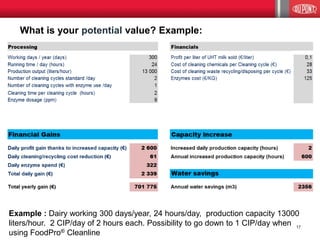
What is your potential value? Example: 
Example : Dairy working 300 days/year, 24 hours/day, production capacity 13000 liters/hour. 2 CIP/day of 2 hours each. Possibility to go down to 1 CIP/day when using FoodPro® Cleanline 
17
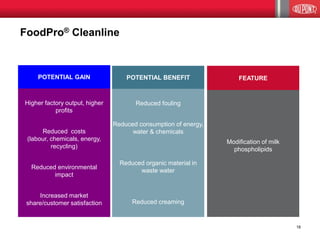
FoodPro® Cleanline 
FEATURE 
Modification of milk phospholipids 
POTENTIAL BENEFIT 
Reduced fouling 
Reduced consumption of energy, water & chemicals 
Reduced organic material in waste water 
Reduced creaming 
POTENTIAL GAIN 
Higher factory output, higher profits 
Reduced costs (labour, chemicals, energy, recycling) 
Reduced environmental impact 
Increased market share/customer satisfaction 
18
Copyright © 2011 DuPont or its affiliates. All rights reserved. 
The DuPont Oval Logo, DuPont™, The miracles of science™ 
and all products denoted with ™ or ® are registered trademarks 
or trademarks of E. I. du Pont de Nemours and Company or its 
affiliates. 
Images reproduced by E. I. du Pont de Nemours and Company 
under license from the National Geographic Society. 
1/17/2012 19

Food Pro Clean Line - Alan Fourie

  • 1.
    26 September 2014 Alan Fourie Senior Application Specialist DuPont Nutrition and Health SSA Imagine trouble-free UHT processing for hours and hours!
  • 2.
    What is FoodPro®Cleanline? 9/25/2014 “The Modification of Milk Surface Properties by Glycerophospholipid Cholesterol Acyltransferase (GCAT)” Abstract: The presentation will focus on the application of the FoodPro® Cleanline enzyme Glycerophospholipid Cholesterol Acyltransferase (GCAT) in the milk, which converts cholesterol to cholesterol esters and lysophospholipids. Lysophospholipids are surface-active amphiphiles that will act as biosurfactants and prevent protein aggregation and promote refolding of proteins (chaperone-like properties), resulting in various processing advantages and increased emulsion stability when used in the manufacture of milk and dairy products. GCAT can reduce free cholesterol in milk by as much as 65 to 85%, which could potentially be an important advantage from a nutritional point of view when producing milk and dairy products.
  • 3.
    What is yourUHT unit performance today? How often is the UHT system being cleaned per day? What is the cost of cleaning chemical for each cleaning cycle? How many hours/tons of production capacity is lost per day due to production stop for CIP? Any product quality issues like taste or creaming? 3
  • 4.
    What is anenzyme? ›An enzyme is a protein that catalyzes a chemical reaction ›Works by selectively binding to substrate ›Enzyme reactions are less energy consuming and create much less waste compared to reactions using chemicals 4 4
  • 5.
    ›Temperature •Each enzymehas an optimum/ideal temperature which leads to highest number of enzyme/substrate interactions ›pH •Each enzyme has an optimum/ideal pH which leads to highest number of enzyme/substrate interactions ›Inhibitors and activators •Enzyme inhibitors are molecules that bind to enzymes and decrease their activity ›Enzyme concentration ›Substrate concentration What influences enzyme activity 5
  • 6.
    Acyltransferase FoodPro® Cleanline O O CH3 O P OH O O N + CH3 CH3 CH3 + OH Lyso-phospolipid (enzyme modified phospholipids) Phospolipid (phosphatidylcholin) Cholesterol Cholesterolester + 13 9 14 10 8 17 12 11 15 16 5 7 6 20 CH3 18 CH3 1 19 23 22 4 24 2 3 H H H H HO CH3 CH3 H3C + Enzyme reaction with acyltransferase in milk 6 13 9 14 10 8 17 12 11 15 16 5 7 6 20 CH3 18 CH3 1 19 23 22 4 24 2 3 H H H H O CH3 CH3 H3C O H3C O O O CH3 O CH3 O P OH O O N + CH3 CH3 CH3
  • 7.
    Why this newdevelopment? During the production of UHT milk, the heating surface of the heating unit foul due to build up of proteins and sugars and minerals from the milk This results in pressure building in the system and reduced heat transfer. When the pressure becomes too high and the heat transfer is reduced, the unit needs to be cleaned This can also result in burnt taste of the UHT milk Cleaning and sterilisation takes time, up to 2 hours, and takes significant amounts of cleaning compounds This can lead to: Not meeting overall performance on capacity, cost and quality High costs for cleaning: hours spent and chemicals consumed Product rejection due to taste 7
  • 8.
    Without FoodPro ®Cleanline,  After 11 hours run time With FoodPro ® Cleanline, Milk enzymation 15 ppm 6 – 8 hours at 5°C ,  After 15 hours run time Industrial scale trials in tubular heat equipement, plant capacity 13 000 L/hour Effect of FoodPro® Cleanline on fouling 8
  • 9.
    Fouling of heatexchangers in the dairy industry is a quite severe problem, both technically and economically. During a normal working cycle, the heat exchanger is subject to undesired material accumulation along its working surfaces, normally referred to as Fouling. Fouling formation causes increased pressure drop over plate heat exchangers, and also leads to reduced heat transfer and thereby increased energy consumption. Result: loss of production capacity as well as increased costs for manpower, energy and detergent consumption during processing and cleaning. The enzymatic treatment of milk will greatly reduce fouling rates Effect of FoodPro® Cleanline on fouling 9
  • 10.
    Effect of FoodPro®Cleanline on fouling Development of pressure drop in commercial UHT plant 0 2 4 6 8 10 12 14 16 1 2 3 4 5 6 7 8 9 10 11 12 13 14 15 16 17 18 19 20 21 22 Hours Pressure drop (bar) Enzymated UHT r.milk Non Enzymated UHT r. milk Pre-set CIP limit 3 day average from full scale production run Recombined milk. Dosage 10 ppm, 45-100 minutes at 40°C. Observed conversion rate of Cholesterol to Cholesterol-ester 82% ›Fouling can be expressed by an increase in backpressure over the heat exchanger ›Acyltransferase reduces the increase in pressure drop ›Production cycles are extended 4 to 6 hours before CIP is needed 10
  • 11.
    11 ›Native phospholipidsalways form lamellar bi-layers and cholesterol is commonly found in biological membranes (native milk fat globules being a typical example) ›Cholesterol-esters are, like triglycerides, entirely hydrophobic and thus do not play a role in membrane formation like cholesterol normally does ›Lyso-phospholipids are less hydrophobic than phospholipids and, therefore, can more readily associate with hydrophobic amino acids in denaturated whey proteins, and have a better ability to bind proteins to the interphase between fat and water ›Lyso-phospholipids prevent protein aggregation and promote refolding of proteins* (chaperone-like properties) ›These functions will impact the accumulation of denatured proteins on hot surfaces (fouling) * Biochemical and Biophysical Research Communications 289, 1268–1274 (2001) The theory behind the anti-fouling effect
  • 12.
    Plate heat exchanger Fouling on heat exchanger Clean heat exchanger Fouling may vary depending on UHT Plants Tubular heat exchanger We expect FPCL will be more efficient in an indirect system where fouling accumulates on the exchange surfaces (e.g. equipment where there is no direct contact between the product and the heating media, such as plate or tubular heat exchangers) 12
  • 13.
    Practical experience withFoodPro® Cleanline : increased run-time Dosage 10 ppm, 2-14 hours at 4°C. Trials repeated 6 times always with more than doubling of possible run- time. Observed 40-45% reduction of organic material in CIP water after enzymated product compared to reference Pilot scale trials with condensed milk (UHT) 13 0 2 4 6 8 10 12 14 16 Reference Enzymated Run time (hours) Run time
  • 14.
    Emulsion stability effectof FoodPro® Cleanline Enzymation of milk with FoodPro ® Cleanline will decrease the surface tension and thereby increase the efficiency of the homogeniser Increased protein incorporation in the fat globule membrane will increase resistance against coalescence, without increased tendency to flocculation 14 Creaming of UHT-milk is reduced by FPCL treatment
  • 15.
    15 Enzyme additionrecommendation Enzyme dosage depends on process time and temperature. 2 main recommendations: Addition to the retention tank, after fat standardisation, at 5-10°C. Enzyme reaction for 2 hours minimum and up to 36 hours before UHT treatment. Enzyme dosage 10-12 ppm For recombined milk: Enzyme addition at 40-50°C in the recombination tank. Enzyme reaction for 30 minutes minimum and up to 4 hours, prior to UHT treatment. Enzyme dosage 4-6 ppm
  • 16.
    FoodPro® Cleanline potentialbenefits: •Higher factory output •Labor cost savings •Lower cleaning chemical costs •Less quality issues •Higher sales because of a better tasting product •Fewer complaints on creaming •Easy to implement (no investment needed) •Reduced environmental impact (water, CO2 and chemicals) 16
  • 17.
    What is yourpotential value? Example: Example : Dairy working 300 days/year, 24 hours/day, production capacity 13000 liters/hour. 2 CIP/day of 2 hours each. Possibility to go down to 1 CIP/day when using FoodPro® Cleanline 17
  • 18.
    FoodPro® Cleanline FEATURE Modification of milk phospholipids POTENTIAL BENEFIT Reduced fouling Reduced consumption of energy, water & chemicals Reduced organic material in waste water Reduced creaming POTENTIAL GAIN Higher factory output, higher profits Reduced costs (labour, chemicals, energy, recycling) Reduced environmental impact Increased market share/customer satisfaction 18
  • 19.
    Copyright © 2011DuPont or its affiliates. All rights reserved. The DuPont Oval Logo, DuPont™, The miracles of science™ and all products denoted with ™ or ® are registered trademarks or trademarks of E. I. du Pont de Nemours and Company or its affiliates. Images reproduced by E. I. du Pont de Nemours and Company under license from the National Geographic Society. 1/17/2012 19