STRATEGY MANAGEMENT
Rahul Balyan – 06
Shashwat Bhair – 09
Manpreet Singh – 30
Saksham Saxena - 49
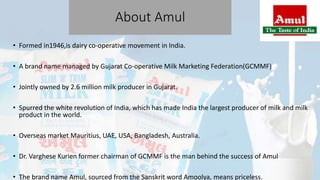
About Amul
• Formed in1946,is dairy co-operative movement in India.
• A brand name managed by Gujarat Co-operative Milk Marketing Federation(GCMMF)
• Jointly owned by 2.6 million milk producer in Gujarat.
• Spurred the white revolution of India, which has made India the largest producer of milk and milk
product in the world.
• Overseas market Mauritius, UAE, USA, Bangladesh, Australia.
• Dr. Varghese Kurien former chairman of GCMMF is the man behind the success of Amul
• The brand name Amul, sourced from the Sanskrit word Amoolya, means priceless.
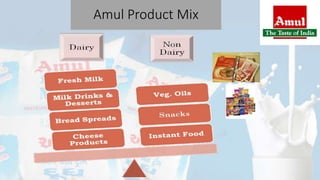
Amul Product Mix
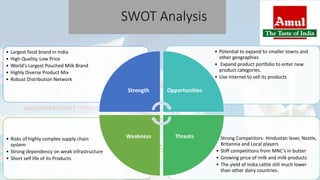
SWOT Analysis
• Strong Competitors- Hindustan lever, Nestle,
Britannia and Local players
• Stiff competitions from MNC’s in butter
• Growing price of milk and milk products
• The yield of India cattle still much lower
than other dairy countries.
• Risks of highly complex supply chain
system
• Strong dependency on weak infrastructure
• Short self life of its Products
• Potential to expand to smaller towns and
other geographies
• Expand product portfolio to enter new
product categories.
• Use internet to sell its products
• Largest food brand in India
• High Quality, Low Price
• World's Largest Pouched Milk Brand
• Highly Diverse Product Mix
• Robust Distribution Network
Strength Opportunities
ThreatsWeakness
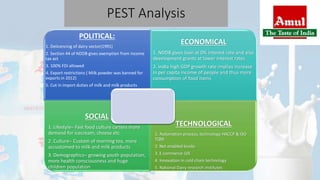
PEST Analysis
POLITICAL:
1. Delicencing of dairy sector(1991)
2. Section 44 of NDDB gives exemption from income
tax act
3. 100% FDI allowed
4. Export restrictions ( Milk powder was banned for
exports in 2012)
5. Cut in import duties of milk and milk products
ECONOMICAL
1. NDDB gives loan at 0% interest rate and also
development grants at lower interest rates
2. India high GDP growth rate implies increase
in per capita income of people and thus more
consumption of food items
SOCIAL
1. Lifestyle– Fast food culture carters more
demand for icecream, cheese etc
2. Culture– Custom of morning tea, more
accustomed to milk and milk products
3. Demographics– growing youth population,
more health consciousness and huge
children population
TECHNOLOGICAL
1. Automation process, technology HACCP & ISO
TQM
2. Net enabled kiosks
3. E commerce GIS
4. Innovation in cold chain technology
5. National Dairy research institutes
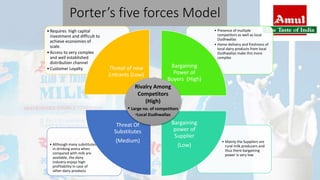
Porter’s five forces Model
• Mainly the Suppliers are
rural milk producers and
thus there bargaining
power is very low
• Although many substitutes
in drinking arena when
compared with milk are
available, the dairy
industry enjoys high
profitability in case of
other dairy products
• Presence of multiple
competitors as well as local
Dudhwallas
• Home delivery and freshness of
local dairy products from local
Dudhwallas make this more
complex
•Requires high capital
investment and difficult to
achieve economies of
scale.
•Access to very complex
and well established
distribution channel
•Customer Loyalty Threat of new
Entrants (Low)
Bargaining
Power of
Buyers (High)
Bargaining
power of
Supplier
(Low)
Threat Of
Substitutes
(Medium)
Rivalry Among
Competitors
(High)
• Large no. of competitors
•Local Dudhwallas
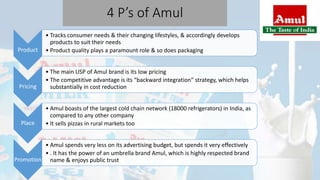
4 P’s of Amul
Product
• Tracks consumer needs & their changing lifestyles, & accordingly develops
products to suit their needs
• Product quality plays a paramount role & so does packaging
Pricing
• The main USP of Amul brand is its low pricing
• The competitive advantage is its “backward integration” strategy, which helps
substantially in cost reduction
Place
• Amul boasts of the largest cold chain network (18000 refrigerators) in India, as
compared to any other company
• It sells pizzas in rural markets too
Promotion
• Amul spends very less on its advertising budget, but spends it very effectively
• . It has the power of an umbrella brand Amul, which is highly respected brand
name & enjoys public trust
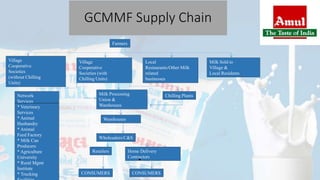
GCMMF Supply Chain
Farmers
Village
Cooperative
Societies (with
Chilling Units)
Village
Cooperative
Societies
(without Chilling
Units)
Local
Restaurants/Other Milk
related
businesses
Milk Sold to
Village &
Local Residents
Milk Processing
Union &
Warehouses
Warehouses
Wholesalers/C&S
Retailers Home Delivery
Contractors
CONSUMERS
Network
Services
* Veterinary
Services
* Animal
Husbandry
* Animal
Feed Factory
* Milk Can
Producers
* Agriculture
University
* Rural Mgmt
Institute
* Trucking
Chilling Plants
CONSUMERS
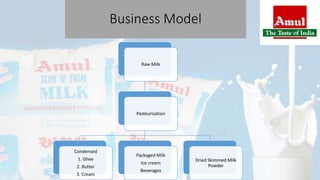
Business Model
Raw Milk
Pasteurization
Condensed
1. Ghee
2. Butter
3. Cream
Packaged Milk
Ice cream
Beverages
Dried Skimmed Milk
Powder
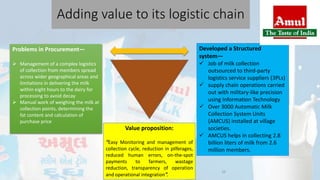
Adding value to its logistic chain
Problems in Procurement—
 Management of a complex logistics
of collection from members spread
across wider geographical areas and
limitations in delivering the milk
within eight hours to the dairy for
processing to avoid decay
 Manual work of weighing the milk at
collection points, determining the
fat content and calculation of
purchase price
Developed a Structured
system—
 Job of milk collection
outsourced to third-party
logistics service suppliers (3PLs)
 supply chain operations carried
out with military-like precision
using Information Technology
 Over 3000 Automatic Milk
Collection System Units
(AMCUS) installed at village
societies.
 AMCUS helps in collecting 2.8
billion liters of milk from 2.6
million members.
Value proposition:
“Easy Monitoring and management of
collection cycle, reduction in pilferages,
reduced human errors, on-the-spot
payments to farmers, wastage
reduction, transparency of operation
and operational integration”.
10
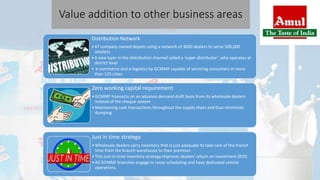
Value addition to other business areas
Distribution Network
•47 company owned depots using a network of 3000 dealers to serve 500,000
retailers
•A new layer in the distribution channel called a 'super distributor', who operates at
district level
• e-commerce and e-logistics by GCMMF capable of servicing consumers in more
than 125 cities
Zero working capital requirement
•GCMMF transacts on an advance demand draft basis from its wholesale dealers
instead of the cheque system
•Maintaining cash transactions throughout the supply chain and thus minimizes
dumping
Just in time strategy
•Wholesale dealers carry inventory that is just adequate to take care of the transit
time from the branch warehouse to their premises
•This just-in-time inventory strategy improves dealers' return on investment (ROI)
•All GCMMF branches engage in route scheduling and have dedicated vehicle
operations.
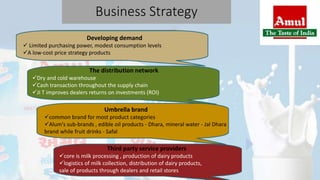
Business Strategy
Developing demand
 Limited purchasing power, modest consumption levels
A low-cost price strategy products
The distribution network
Dry and cold warehouse
Cash transaction throughout the supply chain
JI T improves dealers returns on investments (ROI)
Umbrella brand
common brand for most product categories
Alum's sub-brands , edible oil products - Dhara, mineral water - Jal Dhara
brand while fruit drinks - Safal
Third party service providers
core is milk processing , production of dairy products
logistics of milk collection, distribution of dairy products,
sale of products through dealers and retail stores
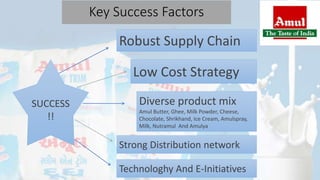
SUCCESS
!!
Robust Supply Chain
Low Cost Strategy
Diverse product mix
Amul Butter, Ghee, Milk Powder, Cheese,
Chocolate, Shrikhand, Ice Cream, Amulspray,
Milk, Nutramul And Amulya
Strong Distribution network
Technologhy And E-Initiatives
Key Success Factors
New
Products
Existing
products
Marketing
•venture out on new products like Toned
milk,Condensed milk that can be used for
sweets, Baby food products
•There are certain product like Amul
basundi, gulab jamoon, chocolates etc
which are not as popular as Amul ice
cream. Amul must try to understand the
cause of this thorough market research
and work on improving these products
•Though Amul’s hoardings are a huge
success, it can penetrate even better in the
rural areas by advertising through the
media via cable channels and newspapers
What Next!!
Amul strategy presentation ppt

Amul strategy presentation ppt

  • 1.
    STRATEGY MANAGEMENT Rahul Balyan– 06 Shashwat Bhair – 09 Manpreet Singh – 30 Saksham Saxena - 49
  • 2.
    About Amul • Formedin1946,is dairy co-operative movement in India. • A brand name managed by Gujarat Co-operative Milk Marketing Federation(GCMMF) • Jointly owned by 2.6 million milk producer in Gujarat. • Spurred the white revolution of India, which has made India the largest producer of milk and milk product in the world. • Overseas market Mauritius, UAE, USA, Bangladesh, Australia. • Dr. Varghese Kurien former chairman of GCMMF is the man behind the success of Amul • The brand name Amul, sourced from the Sanskrit word Amoolya, means priceless.
  • 3.
  • 4.
    SWOT Analysis • StrongCompetitors- Hindustan lever, Nestle, Britannia and Local players • Stiff competitions from MNC’s in butter • Growing price of milk and milk products • The yield of India cattle still much lower than other dairy countries. • Risks of highly complex supply chain system • Strong dependency on weak infrastructure • Short self life of its Products • Potential to expand to smaller towns and other geographies • Expand product portfolio to enter new product categories. • Use internet to sell its products • Largest food brand in India • High Quality, Low Price • World's Largest Pouched Milk Brand • Highly Diverse Product Mix • Robust Distribution Network Strength Opportunities ThreatsWeakness
  • 5.
    PEST Analysis POLITICAL: 1. Delicencingof dairy sector(1991) 2. Section 44 of NDDB gives exemption from income tax act 3. 100% FDI allowed 4. Export restrictions ( Milk powder was banned for exports in 2012) 5. Cut in import duties of milk and milk products ECONOMICAL 1. NDDB gives loan at 0% interest rate and also development grants at lower interest rates 2. India high GDP growth rate implies increase in per capita income of people and thus more consumption of food items SOCIAL 1. Lifestyle– Fast food culture carters more demand for icecream, cheese etc 2. Culture– Custom of morning tea, more accustomed to milk and milk products 3. Demographics– growing youth population, more health consciousness and huge children population TECHNOLOGICAL 1. Automation process, technology HACCP & ISO TQM 2. Net enabled kiosks 3. E commerce GIS 4. Innovation in cold chain technology 5. National Dairy research institutes
  • 6.
    Porter’s five forcesModel • Mainly the Suppliers are rural milk producers and thus there bargaining power is very low • Although many substitutes in drinking arena when compared with milk are available, the dairy industry enjoys high profitability in case of other dairy products • Presence of multiple competitors as well as local Dudhwallas • Home delivery and freshness of local dairy products from local Dudhwallas make this more complex •Requires high capital investment and difficult to achieve economies of scale. •Access to very complex and well established distribution channel •Customer Loyalty Threat of new Entrants (Low) Bargaining Power of Buyers (High) Bargaining power of Supplier (Low) Threat Of Substitutes (Medium) Rivalry Among Competitors (High) • Large no. of competitors •Local Dudhwallas
  • 7.
    4 P’s ofAmul Product • Tracks consumer needs & their changing lifestyles, & accordingly develops products to suit their needs • Product quality plays a paramount role & so does packaging Pricing • The main USP of Amul brand is its low pricing • The competitive advantage is its “backward integration” strategy, which helps substantially in cost reduction Place • Amul boasts of the largest cold chain network (18000 refrigerators) in India, as compared to any other company • It sells pizzas in rural markets too Promotion • Amul spends very less on its advertising budget, but spends it very effectively • . It has the power of an umbrella brand Amul, which is highly respected brand name & enjoys public trust
  • 8.
    GCMMF Supply Chain Farmers Village Cooperative Societies(with Chilling Units) Village Cooperative Societies (without Chilling Units) Local Restaurants/Other Milk related businesses Milk Sold to Village & Local Residents Milk Processing Union & Warehouses Warehouses Wholesalers/C&S Retailers Home Delivery Contractors CONSUMERS Network Services * Veterinary Services * Animal Husbandry * Animal Feed Factory * Milk Can Producers * Agriculture University * Rural Mgmt Institute * Trucking Chilling Plants CONSUMERS
  • 9.
    Business Model Raw Milk Pasteurization Condensed 1.Ghee 2. Butter 3. Cream Packaged Milk Ice cream Beverages Dried Skimmed Milk Powder
  • 10.
    Adding value toits logistic chain Problems in Procurement—  Management of a complex logistics of collection from members spread across wider geographical areas and limitations in delivering the milk within eight hours to the dairy for processing to avoid decay  Manual work of weighing the milk at collection points, determining the fat content and calculation of purchase price Developed a Structured system—  Job of milk collection outsourced to third-party logistics service suppliers (3PLs)  supply chain operations carried out with military-like precision using Information Technology  Over 3000 Automatic Milk Collection System Units (AMCUS) installed at village societies.  AMCUS helps in collecting 2.8 billion liters of milk from 2.6 million members. Value proposition: “Easy Monitoring and management of collection cycle, reduction in pilferages, reduced human errors, on-the-spot payments to farmers, wastage reduction, transparency of operation and operational integration”. 10
  • 11.
    Value addition toother business areas Distribution Network •47 company owned depots using a network of 3000 dealers to serve 500,000 retailers •A new layer in the distribution channel called a 'super distributor', who operates at district level • e-commerce and e-logistics by GCMMF capable of servicing consumers in more than 125 cities Zero working capital requirement •GCMMF transacts on an advance demand draft basis from its wholesale dealers instead of the cheque system •Maintaining cash transactions throughout the supply chain and thus minimizes dumping Just in time strategy •Wholesale dealers carry inventory that is just adequate to take care of the transit time from the branch warehouse to their premises •This just-in-time inventory strategy improves dealers' return on investment (ROI) •All GCMMF branches engage in route scheduling and have dedicated vehicle operations.
  • 12.
    Business Strategy Developing demand Limited purchasing power, modest consumption levels A low-cost price strategy products The distribution network Dry and cold warehouse Cash transaction throughout the supply chain JI T improves dealers returns on investments (ROI) Umbrella brand common brand for most product categories Alum's sub-brands , edible oil products - Dhara, mineral water - Jal Dhara brand while fruit drinks - Safal Third party service providers core is milk processing , production of dairy products logistics of milk collection, distribution of dairy products, sale of products through dealers and retail stores
  • 13.
    SUCCESS !! Robust Supply Chain LowCost Strategy Diverse product mix Amul Butter, Ghee, Milk Powder, Cheese, Chocolate, Shrikhand, Ice Cream, Amulspray, Milk, Nutramul And Amulya Strong Distribution network Technologhy And E-Initiatives Key Success Factors
  • 14.
    New Products Existing products Marketing •venture out onnew products like Toned milk,Condensed milk that can be used for sweets, Baby food products •There are certain product like Amul basundi, gulab jamoon, chocolates etc which are not as popular as Amul ice cream. Amul must try to understand the cause of this thorough market research and work on improving these products •Though Amul’s hoardings are a huge success, it can penetrate even better in the rural areas by advertising through the media via cable channels and newspapers What Next!!