TALKING
ABOUT THE
     PAST
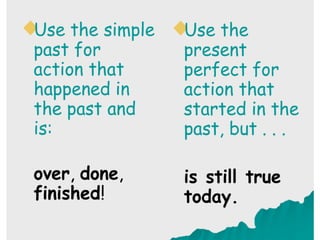
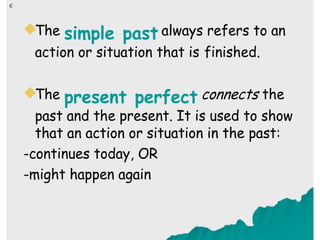
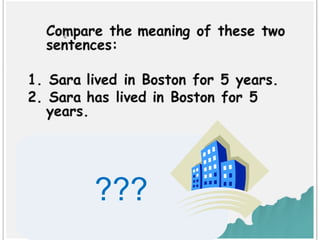
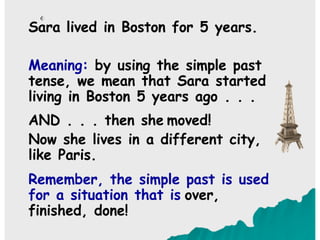
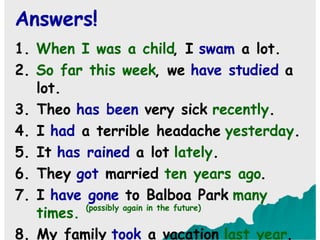
SIMPLE PAST vs. PRESENT
PERFECT
???
PRESENT PERFECT
CONTINUOUS
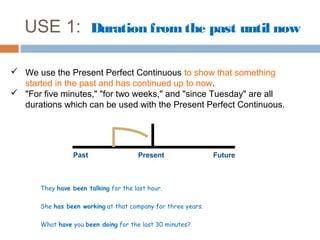
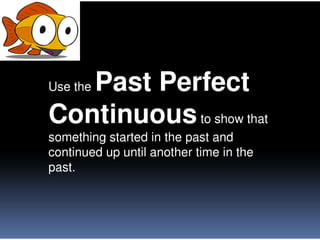
USE 1: Duration from the past until now

 We use the Present Perfect Continuous to show that something
  started in the past and has continued up to now.
 "For five minutes," "for two weeks," and "since Tuesday" are all
  durations which can be used with the Present Perfect Continuous.


                  Past                 Present                 Future


       They have been talking for the last hour.

       She has been working at that company for three years.

       What have you been doing for the last 30 minutes?
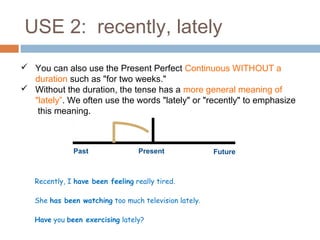
USE 2: recently, lately
 You can also use the Present Perfect Continuous WITHOUT a
  duration such as "for two weeks."
 Without the duration, the tense has a more general meaning of
  "lately”. We often use the words "lately" or "recently" to emphasize
   this meaning.


              Past                Present              Future


   Recently, I have been feeling really tired.

   She has been watching too much television lately.

   Have you been exercising lately?
Important!!
Remember that the Present Perfect Continuous has the meaning
of "lately" or "recently."

 If you use the Present Perfect Continuous in a question such
as "Have you been feeling all right?“, it can suggest that the
person looks sick or unhealthy.

 A question such as "Have you been smoking?" can suggest
that you smell the smoke on the person.

 Using this tense in a question suggests you can see, smell,
hear or feel the results of the action. It is possible to insult
someone by using this tense incorrectly.
ADVERB PLACEMENT
  The examples below show the placement for grammar
  adverbs such as: always, only, never, ever, still, just, etc.


Examples:
   You have only been waiting here for one hour.

   Have you only been waiting here for one hour?
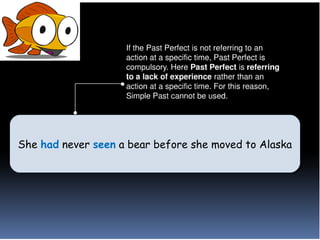
She never saw a bear before she moved to Alaska


                                      ???
She had never seen a bear before she moved to Alaska
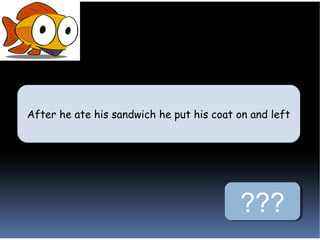
After he ate his sandwich he put his coat on and left


                                          ???
After he had eaten his sandwich he put his coat on
                    and left
                    and left


            In that case, it’s better to use the past
           perfect in the first clause to make clear
                    the sequence of events
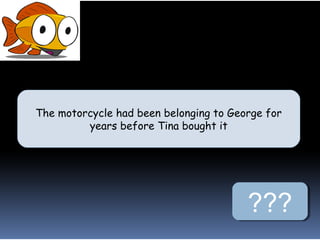
The motorcycle had been belonging to George for
         years before Tina bought it
          years before Tina bought it


                                        ???
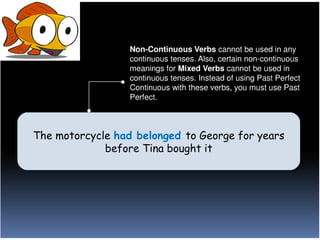
The motorcycle had belonged to George for years
             before Tina bought it
              before Tina bought it
Let’s practise!
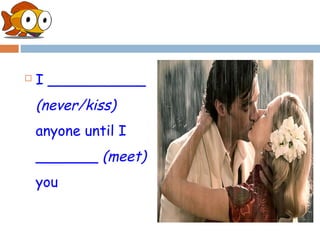
   I ___________
    (never/kiss)
    anyone until I
    _______ (meet)
    you
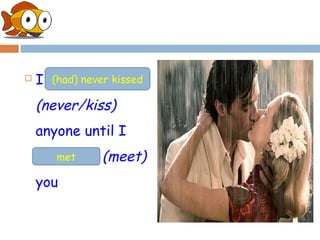
   I ___________
      (had) never kissed

    (never/kiss)
    anyone until I
    _______ (meet)
      met

    you
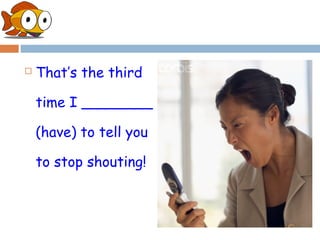
   That’s the third

    time I ________

    (have) to tell you

    to stop shouting!
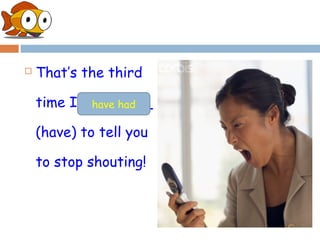
   That’s the third

    time I ________
            have had

    (have) to tell you

    to stop shouting!
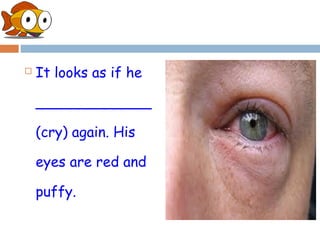
   It looks as if he

    _____________

    (cry) again. His

    eyes are red and

    puffy.
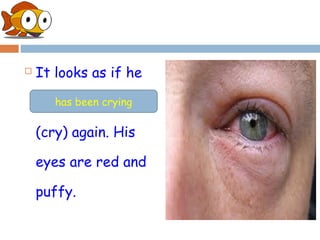
   It looks as if he

    _____________
      has been crying

    (cry) again. His

    eyes are red and

    puffy.
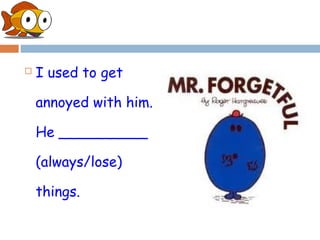
   I used to get

    annoyed with him.

    He __________

    (always/lose)

    things.
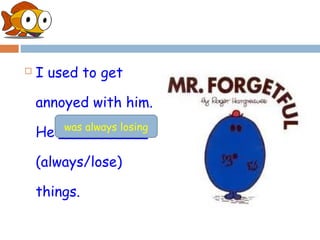
   I used to get

    annoyed with him.
        was always losing
    He __________

    (always/lose)

    things.
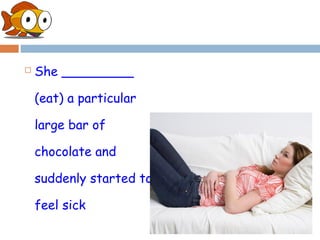
   She _________

    (eat) a particular

    large bar of

    chocolate and

    suddenly started to

    feel sick
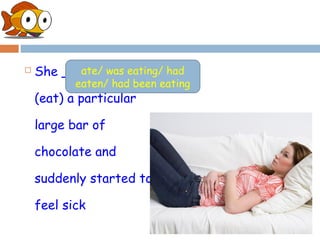
   She _________
          ate/ was eating/ had
           eaten/ had been eating
    (eat) a particular

    large bar of

    chocolate and

    suddenly started to

    feel sick
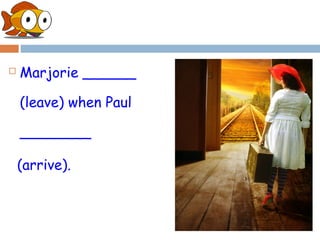
   Marjorie ______

    (leave) when Paul

    ________

    (arrive).
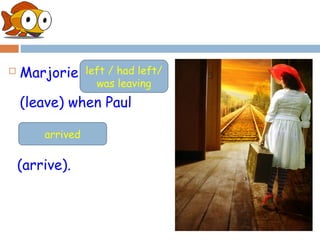
   Marjorie ______ left/
             left / had
                 was leaving
    (leave) when Paul

    ________
       arrived

    (arrive).
   You know that book

    you __________

    (tell) me about last

    week?

    Well, I _________

    (buy). Look!
   You know that book

    you __________
          told / were telling

    (tell) me about last

    week?
              have bought
    Well, I _________

    (buy). Look!
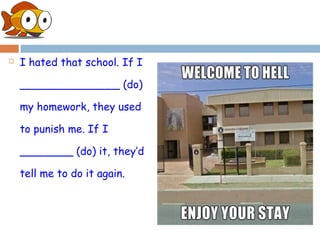
   I hated that school. If I

    _______________ (do)

    my homework, they used

    to punish me. If I

    ________ (do) it, they’d

    tell me to do it again.
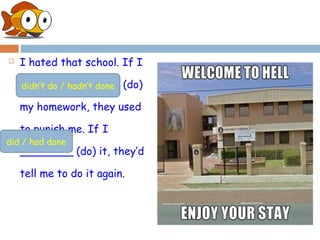
   I hated that school. If I

    _______________ (do)
    didn’t do / hadn’t done

    my homework, they used

    to punish me. If I
did / had done
    ________ (do) it, they’d

    tell me to do it again.
Further ways of talking about the past
Used to / would


o
 Used to + infinitive can be used to
 Used to + infinitive can be used to
 o

refer to past situations and habitual actions in
the past.
the past.

I used to walk to school when I was a child

I used to have a parrot, but he escaped
Used to / would


oWould + infinitive
oWould + infinitive         can be used to
                             can be used to
refer to past habitual actions but not
situations or states

Every summer we used to / would go to
Scotland to visit my grandmother

X I would have a parrot, but he escaped
Underline the correct
option(s)
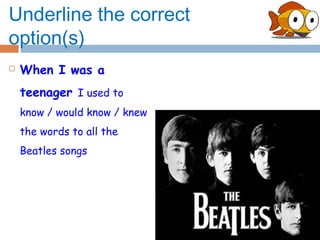
   When I was a
    teenager I used to
    know / would know / knew
    the words to all the
    Beatles songs
Underline the correct
option(s)
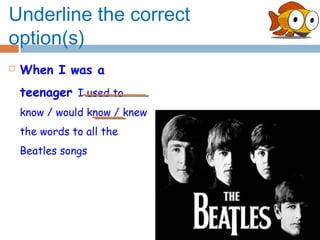
   When I was a
    teenager I used to
    know / would know / knew
    the words to all the
    Beatles songs
Underline the correct
option(s)

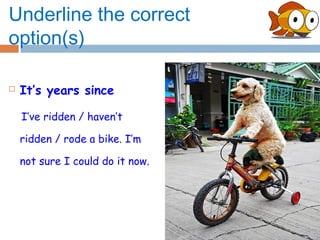
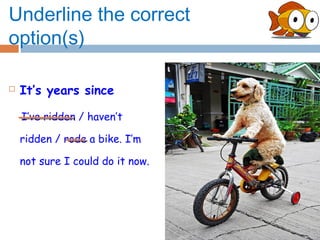
   It’s years since

    I’ve ridden / haven’t

    ridden / rode a bike. I’m

    not sure I could do it now.
Underline the correct
option(s)

   It’s years since

    I’ve ridden / haven’t

    ridden / rode a bike. I’m

    not sure I could do it now.
Underline the correct
option(s)

   I’d like to have travelled /
    have liked to travel /

    have liked to have travelled

    more when I was younger
Underline the correct
option(s)

   I’d like to have travelled /
    have liked to travel /

   have liked to have travelled

    more when I was younger
Underline the correct
option(s)

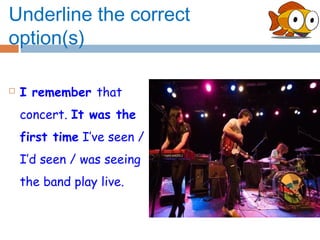
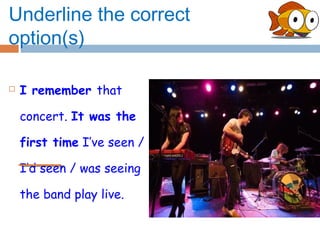
   I remember that
    concert. It was the
    first time I’ve seen /
    I’d seen / was seeing
    the band play live.
Underline the correct
option(s)

   I remember that

    concert. It was the

    first time I’ve seen /

    I’d seen / was seeing

    the band play live.
Underline the correct
option(s)

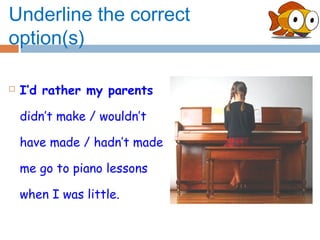
   I’d rather my parents

    didn’t make / wouldn’t

    have made / hadn’t made

    me go to piano lessons

    when I was little.
Underline the correct
option(s)

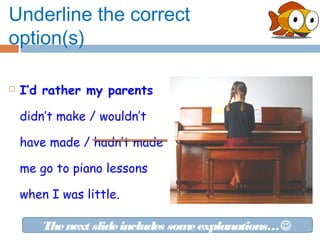
   I’d rather my parents

    didn’t make / wouldn’t

    have made / hadn’t made

    me go to piano lessons

    when I was little.

        The next slide includes som explanations… 
                                   e
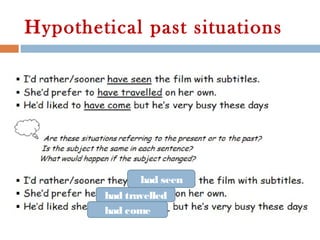
Hypothetical past situations


               had seen
        had travelled
        had come
Underline the correct
option(s)

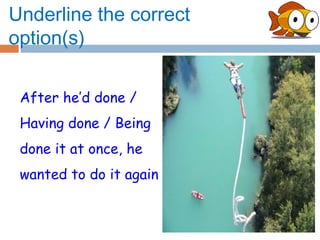
 After he’d done /
 Having done / Being
 done it at once, he
 wanted to do it again
Underline the correct
option(s)

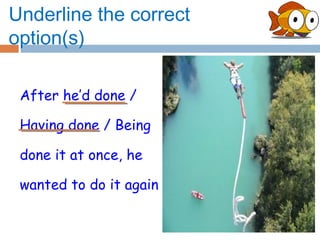
 After he’d done /

 Having done / Being

 done it at once, he

 wanted to do it again
Underline the correct
option(s)

It has not rained since

 he’s been here / he

 got here / his arrival
Underline the correct
option(s)

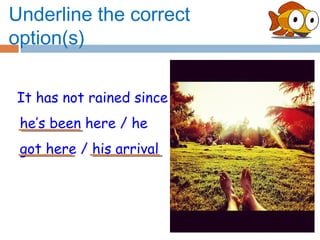
It has not rained since
 he’s been here / he
 got here / his arrival
Talking about the past

Talking about the past

  • 1.
  • 2.
    SIMPLE PAST vs.PRESENT PERFECT
  • 6.
  • 17.
  • 18.
    USE 1: Durationfrom the past until now  We use the Present Perfect Continuous to show that something started in the past and has continued up to now.  "For five minutes," "for two weeks," and "since Tuesday" are all durations which can be used with the Present Perfect Continuous. Past Present Future They have been talking for the last hour. She has been working at that company for three years. What have you been doing for the last 30 minutes?
  • 19.
    USE 2: recently,lately  You can also use the Present Perfect Continuous WITHOUT a duration such as "for two weeks."  Without the duration, the tense has a more general meaning of "lately”. We often use the words "lately" or "recently" to emphasize this meaning. Past Present Future Recently, I have been feeling really tired. She has been watching too much television lately. Have you been exercising lately?
  • 20.
    Important!! Remember that thePresent Perfect Continuous has the meaning of "lately" or "recently."  If you use the Present Perfect Continuous in a question such as "Have you been feeling all right?“, it can suggest that the person looks sick or unhealthy.  A question such as "Have you been smoking?" can suggest that you smell the smoke on the person.  Using this tense in a question suggests you can see, smell, hear or feel the results of the action. It is possible to insult someone by using this tense incorrectly.
  • 21.
    ADVERB PLACEMENT The examples below show the placement for grammar adverbs such as: always, only, never, ever, still, just, etc. Examples: You have only been waiting here for one hour. Have you only been waiting here for one hour?
  • 34.
    She never sawa bear before she moved to Alaska She never saw a bear before she moved to Alaska ???
  • 35.
    She had neverseen a bear before she moved to Alaska She had never seen a bear before she moved to Alaska
  • 36.
    After he atehis sandwich he put his coat on and left After he ate his sandwich he put his coat on and left ???
  • 37.
    After he hadeaten his sandwich he put his coat on After he had eaten his sandwich he put his coat on and left and left In that case, it’s better to use the past perfect in the first clause to make clear the sequence of events
  • 40.
    The motorcycle hadbeen belonging to George for The motorcycle had been belonging to George for years before Tina bought it years before Tina bought it ???
  • 41.
    The motorcycle hadbelonged to George for years The motorcycle had belonged to George for years before Tina bought it before Tina bought it
  • 43.
  • 44.
    I ___________ (never/kiss) anyone until I _______ (meet) you
  • 45.
    I ___________ (had) never kissed (never/kiss) anyone until I _______ (meet) met you
  • 46.
    That’s the third time I ________ (have) to tell you to stop shouting!
  • 47.
    That’s the third time I ________ have had (have) to tell you to stop shouting!
  • 48.
    It looks as if he _____________ (cry) again. His eyes are red and puffy.
  • 49.
    It looks as if he _____________ has been crying (cry) again. His eyes are red and puffy.
  • 50.
    I used to get annoyed with him. He __________ (always/lose) things.
  • 51.
    I used to get annoyed with him. was always losing He __________ (always/lose) things.
  • 52.
    She _________ (eat) a particular large bar of chocolate and suddenly started to feel sick
  • 53.
    She _________ ate/ was eating/ had eaten/ had been eating (eat) a particular large bar of chocolate and suddenly started to feel sick
  • 54.
    Marjorie ______ (leave) when Paul ________ (arrive).
  • 55.
    Marjorie ______ left/ left / had was leaving (leave) when Paul ________ arrived (arrive).
  • 56.
    You know that book you __________ (tell) me about last week? Well, I _________ (buy). Look!
  • 57.
    You know that book you __________ told / were telling (tell) me about last week? have bought Well, I _________ (buy). Look!
  • 58.
    I hated that school. If I _______________ (do) my homework, they used to punish me. If I ________ (do) it, they’d tell me to do it again.
  • 59.
    I hated that school. If I _______________ (do) didn’t do / hadn’t done my homework, they used to punish me. If I did / had done ________ (do) it, they’d tell me to do it again.
  • 60.
    Further ways oftalking about the past
  • 61.
    Used to /would o Used to + infinitive can be used to Used to + infinitive can be used to o refer to past situations and habitual actions in refer to past situations and habitual actions in the past. the past. I used to walk to school when I was a child I used to walk to school when I was a child I used to have a parrot, but he escaped I used to have a parrot, but he escaped
  • 62.
    Used to /would oWould + infinitive oWould + infinitive can be used to can be used to refer to past habitual actions but not refer to past habitual actions but not situations or states situations or states Every summer we used to / would go to Every summer we used to / would go to Scotland to visit my grandmother Scotland to visit my grandmother X I would have a parrot, but he escaped X I would have a parrot, but he escaped
  • 63.
    Underline the correct option(s)  When I was a teenager I used to know / would know / knew the words to all the Beatles songs
  • 64.
    Underline the correct option(s)  When I was a teenager I used to know / would know / knew the words to all the Beatles songs
  • 65.
    Underline the correct option(s)  It’s years since I’ve ridden / haven’t ridden / rode a bike. I’m not sure I could do it now.
  • 66.
    Underline the correct option(s)  It’s years since I’ve ridden / haven’t ridden / rode a bike. I’m not sure I could do it now.
  • 67.
    Underline the correct option(s)  I’d like to have travelled / have liked to travel / have liked to have travelled more when I was younger
  • 68.
    Underline the correct option(s)  I’d like to have travelled / have liked to travel /  have liked to have travelled more when I was younger
  • 69.
    Underline the correct option(s)  I remember that concert. It was the first time I’ve seen / I’d seen / was seeing the band play live.
  • 70.
    Underline the correct option(s)  I remember that concert. It was the first time I’ve seen / I’d seen / was seeing the band play live.
  • 71.
    Underline the correct option(s)  I’d rather my parents didn’t make / wouldn’t have made / hadn’t made me go to piano lessons when I was little.
  • 72.
    Underline the correct option(s)  I’d rather my parents didn’t make / wouldn’t have made / hadn’t made me go to piano lessons when I was little. The next slide includes som explanations…  e
  • 73.
    Hypothetical past situations had seen had travelled had come
  • 74.
    Underline the correct option(s) After he’d done / Having done / Being done it at once, he wanted to do it again
  • 75.
    Underline the correct option(s) After he’d done / Having done / Being done it at once, he wanted to do it again
  • 76.
    Underline the correct option(s) Ithas not rained since he’s been here / he got here / his arrival
  • 77.
    Underline the correct option(s) Ithas not rained since he’s been here / he got here / his arrival