PAST SIMPLE VS. PRESENT PERFECT SIMPLE
“the 7th October” is a past and finishedexpression of time. Theactionindicatedby “started” is complete.We startedourlessonsonthe7th October.Yes, wedid. We´vehad8 lessonsthisyear.“Thisyear” isanunfinished time   expression. Westillhavelessonsnow. Theactionisnot complete.
ACTIONS EXPRESSED BY PAST SIMPLE AND PRESENT PERFECTPRESENT PERFECT SIMPLEPAST SIMPLECompletedactionsthattook place in a finishedperiod of time:   Carol bought a new dressyesterday.A sequence of pastactions:   He got upat eighto´clock, gotdressedand hadbreakfastbeforeleavingforwork.Unfinishedactions:We´velivedin Madrid for 2 years. (= westilllivethere)Actionsthathave a presentconsequence:I´vecutmy finger.Actionsthattook place at no specific time:Haveyoueverseenany of Pedro Almodovar´s films?
PRESENT PERFECT SIMPLEPAST SIMPLEPeriods of time that are not finished.today    tonight    this week/month/ year    this morning/ afternoon / eveningCompleted and finished periods of time.yesterday last week/month/year    two weeks ago    in 2005    when I was a boy    when I met himTIME EXPRESSIONS
Exercise 1Choose the right tense to complete the sentences:Past Simple or Present Perfect Simple?
have studiedI                      (study) English since I was a child.
metI              (meet) my husband two years ago when I was livingin London.
have beenI                    (go) to many concerts in my life.wentIn fact, I             (go) to U2´s concert in Barcelona last year.
  Remember:                    “Go” has two                       “has gone”  present perfect forms                                             “has been”         Peter has gone shopping.  = He didn´t come back.  Peter has been shopping.  = He´s back now.
FORAND SINCE WITH  PRESENT  PERFECTSINCE                  (preposition or conjunction)FOR (preposition)We use “for” with periods of time to stress the duration of an action that started in the past and continues in the present.We´ve had lessons for two months.I´ve been a teacher for 20 years.We use “since” to mark the start of an action that began in the past and continues in the present.It can be a preposition:I´ve been a teacher since 1989.or a conjunction, followed by a clause (subject and verb):I´ve been a teacher since I left university.
JUST“Just” is an adverb used with the present perfect to emphasize that the action expressed by the verb was completed very recently.I´ve just explained to you the difference between “for” and “since”.  (some minutes ago)You´ve just read an example that shows the use of “just” with the present perfect simple.  (30 seconds ago)“just” is placed before the past participle.
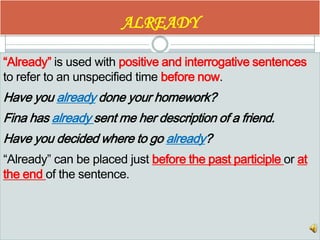
ALREADY“Already” is used with positive and interrogative sentences to refer to an unspecified time before now.Have you alreadydone your homework?Fina has already sent me her description of a friend.Have you decided where to go already?“Already” can be placed just before the past participle or at the end of the sentence.
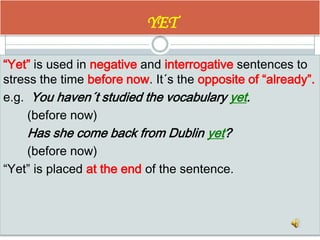
YET“Yet” is used in negative and interrogative sentences to stress the time before now. It´s the opposite of “already”.e.g.  You haven´t studied the vocabulary yet.       (before now)Has she come back from Dublin yet?       (before now)“Yet” is placed at the end of the sentence.
Exercise 2Choose the right word to complete the sentences.
 “already”or “yet?”yetHave you seen this film     ?“for” or “since?”No, I haven´t. Actually, I haven´t been to the         cinema      a long time.for
for or since?My parents have been married       they were at university.sinceyetor just?justIndeed, they´ve       celebrated their 50th wedding anniversary.
already or yet?alreadyPeter has done the ironing         .                     But he hasn´t cooked dinner     .     yet

Past simple vs. present perfect

  • 1.
    PAST SIMPLE VS.PRESENT PERFECT SIMPLE
  • 2.
    “the 7th October”is a past and finishedexpression of time. Theactionindicatedby “started” is complete.We startedourlessonsonthe7th October.Yes, wedid. We´vehad8 lessonsthisyear.“Thisyear” isanunfinished time expression. Westillhavelessonsnow. Theactionisnot complete.
  • 3.
    ACTIONS EXPRESSED BYPAST SIMPLE AND PRESENT PERFECTPRESENT PERFECT SIMPLEPAST SIMPLECompletedactionsthattook place in a finishedperiod of time: Carol bought a new dressyesterday.A sequence of pastactions: He got upat eighto´clock, gotdressedand hadbreakfastbeforeleavingforwork.Unfinishedactions:We´velivedin Madrid for 2 years. (= westilllivethere)Actionsthathave a presentconsequence:I´vecutmy finger.Actionsthattook place at no specific time:Haveyoueverseenany of Pedro Almodovar´s films?
  • 4.
    PRESENT PERFECT SIMPLEPASTSIMPLEPeriods of time that are not finished.today tonight this week/month/ year this morning/ afternoon / eveningCompleted and finished periods of time.yesterday last week/month/year two weeks ago in 2005 when I was a boy when I met himTIME EXPRESSIONS
  • 5.
    Exercise 1Choose theright tense to complete the sentences:Past Simple or Present Perfect Simple?
  • 6.
    have studiedI (study) English since I was a child.
  • 7.
    metI (meet) my husband two years ago when I was livingin London.
  • 8.
    have beenI (go) to many concerts in my life.wentIn fact, I (go) to U2´s concert in Barcelona last year.
  • 9.
    Remember: “Go” has two “has gone” present perfect forms “has been” Peter has gone shopping. = He didn´t come back. Peter has been shopping. = He´s back now.
  • 10.
    FORAND SINCE WITH PRESENT PERFECTSINCE (preposition or conjunction)FOR (preposition)We use “for” with periods of time to stress the duration of an action that started in the past and continues in the present.We´ve had lessons for two months.I´ve been a teacher for 20 years.We use “since” to mark the start of an action that began in the past and continues in the present.It can be a preposition:I´ve been a teacher since 1989.or a conjunction, followed by a clause (subject and verb):I´ve been a teacher since I left university.
  • 11.
    JUST“Just” is anadverb used with the present perfect to emphasize that the action expressed by the verb was completed very recently.I´ve just explained to you the difference between “for” and “since”. (some minutes ago)You´ve just read an example that shows the use of “just” with the present perfect simple. (30 seconds ago)“just” is placed before the past participle.
  • 12.
    ALREADY“Already” is usedwith positive and interrogative sentences to refer to an unspecified time before now.Have you alreadydone your homework?Fina has already sent me her description of a friend.Have you decided where to go already?“Already” can be placed just before the past participle or at the end of the sentence.
  • 13.
    YET“Yet” is usedin negative and interrogative sentences to stress the time before now. It´s the opposite of “already”.e.g. You haven´t studied the vocabulary yet. (before now)Has she come back from Dublin yet? (before now)“Yet” is placed at the end of the sentence.
  • 14.
    Exercise 2Choose theright word to complete the sentences.
  • 15.
    “already”or “yet?”yetHaveyou seen this film ?“for” or “since?”No, I haven´t. Actually, I haven´t been to the cinema a long time.for
  • 16.
    for or since?Myparents have been married they were at university.sinceyetor just?justIndeed, they´ve celebrated their 50th wedding anniversary.
  • 17.
    already or yet?alreadyPeterhas done the ironing . But he hasn´t cooked dinner . yet