Simple Past vs.
Past Continuous
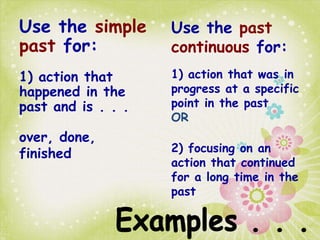
Use the simple
past for:

Use the past
continuous for:

1) action that
happened in the
past and is . . .

1) action that was in
progress at a specific
point in the past
OR

over, done,
finished

2) focusing on an
action that continued
for a long time in the
past
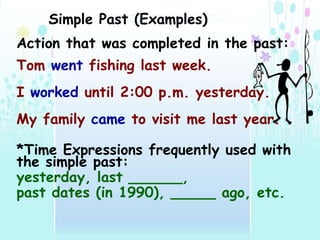
Simple Past (Examples)
Action that was completed in the past:
Tom went fishing last week.
I worked until 2:00 p.m. yesterday.
My family came to visit me last year.
*Time Expressions frequently used with
the simple past:
yesterday, last ______,
past dates (in 1990), _____ ago, etc.
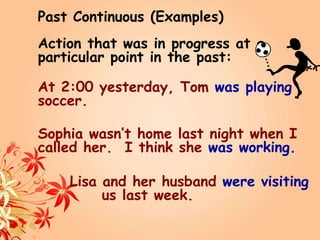
Past Continuous (Examples)

Action that was in progress at a
particular point in the past:
At 2:00 yesterday, Tom was playing
soccer.
Sophia wasn’t home last night when I
called her. I think she was working.
Lisa and her husband were visiting
us last week.
Grammar
Structure:

Here are some reminders
about how to make the
simple past and past
continuous:
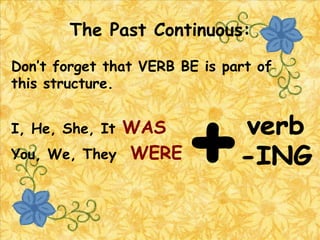
The Past Continuous:
Don’t forget that VERB BE is part of
this structure.

WAS
You, We, They WERE
I, He, She, It
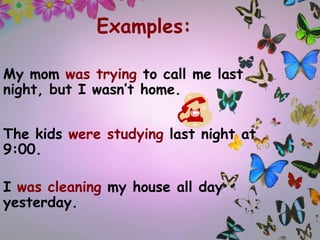
Examples:
My mom was trying to call me last
night, but I wasn’t home.
The kids were studying last night at
9:00.
I was cleaning my house all day
yesterday.
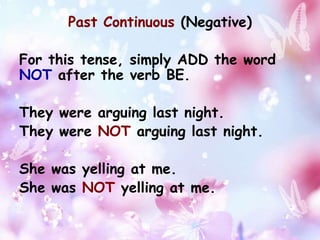
Past Continuous (Negative)
For this tense, simply ADD the word
NOT after the verb BE.
They were arguing last night.
They were NOT arguing last night.
She was yelling at me.
She was NOT yelling at me.
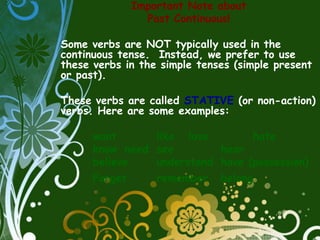
Important Note about
Past Continuous!
Some verbs are NOT typically used in the
continuous tense. Instead, we prefer to use
these verbs in the simple tenses (simple present
or past).
These verbs are called STATIVE (or non-action)
verbs. Here are some examples:

want
like love
hate
know need see
hear
believe
understand have (possession)
Forget

remember

belong
Examples:
I liked Rome.
NOT:
I was liking Rome.
She had a headache.
NOT:
She was having a headache.
I knew the answer.
NOT:
I was knowing the answer.
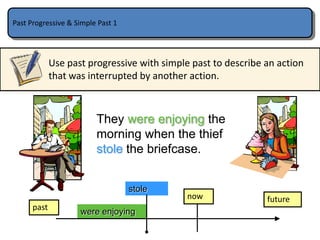
Past Progressive & Simple Past 1

Use past progressive with simple past to describe an action
that was interrupted by another action.

They were enjoying the
morning when the thief
stole the briefcase.
stole
past

were enjoying

now

future
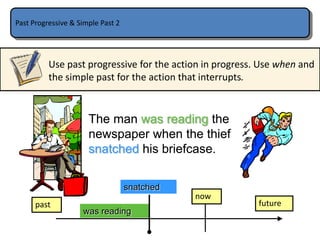
Past Progressive & Simple Past 2

Use past progressive for the action in progress. Use when and
the simple past for the action that interrupts.

The man was reading the
newspaper when the thief
snatched his briefcase.
snatched
past

now

was reading

future
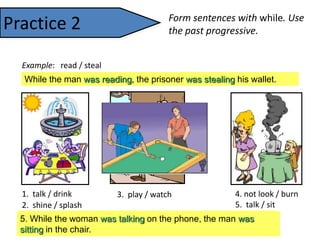
Practice 2

Form sentences with while. Use
the past progressive.

Example: read / steal

While the man was reading, the prisoner was stealing his wallet.

1. talk / drink
4. not look / burn
3. play / watch
5. talk / sit
2. shine / splash
4. While the woman was not looking, theother manman was
5. While the woman was talkingpool, thewere drinking burning.
3. While one sun waswere talking, fountain wasthe was
man was playing on the toast splashing.
1.
the women shining, the they phone, was tea.
2.
sitting in the chair.
watching.
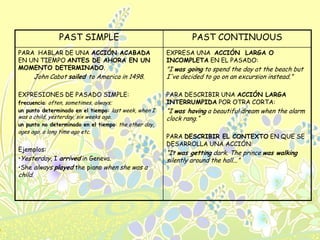
PAST SIMPLE

PAST CONTINUOUS

PARA HABLAR DE UNA ACCIÓN ACABADA
EN UN TIEMPO ANTES DE AHORA EN UN
MOMENTO DETERMINADO.

EXPRESA UNA ACCIÓN LARGA O
INCOMPLETA EN EL PASADO:

EXPRESIONES DE PASADO SIMPLE:

PARA DESCRIBIR UNA ACCIÓN LARGA
INTERRUMPIDA POR OTRA CORTA:

John Cabot sailed to America in 1498.

frecuencia: often, sometimes, always;
un punto determinado en el tiempo: last week, when I

was a child, yesterday, six weeks ago.

un punto no determinado en el tiempo: the other day,

ages ago, a long time ago etc.

Ejemplos:
•Yesterday, I arrived in Geneva.
•She always played the piano when she was a
child.

"I was going to spend the day at the beach but
I've decided to go on an excursion instead.”

“I was having a beautiful dream when the alarm
clock rang.“
PARA DESCRIBIR EL CONTEXTO EN QUE SE
DESARROLLA UNA ACCIÓN:

“It was getting dark. The prince was walking
silently around the hall...”
• Exercise 1
• Exercise 2
In the www section

Simple Past vs Past Continuous

  • 1.
  • 2.
    Use the simple pastfor: Use the past continuous for: 1) action that happened in the past and is . . . 1) action that was in progress at a specific point in the past OR over, done, finished 2) focusing on an action that continued for a long time in the past
  • 3.
    Simple Past (Examples) Actionthat was completed in the past: Tom went fishing last week. I worked until 2:00 p.m. yesterday. My family came to visit me last year. *Time Expressions frequently used with the simple past: yesterday, last ______, past dates (in 1990), _____ ago, etc.
  • 4.
    Past Continuous (Examples) Actionthat was in progress at a particular point in the past: At 2:00 yesterday, Tom was playing soccer. Sophia wasn’t home last night when I called her. I think she was working. Lisa and her husband were visiting us last week.
  • 5.
    Grammar Structure: Here are somereminders about how to make the simple past and past continuous:
  • 6.
    The Past Continuous: Don’tforget that VERB BE is part of this structure. WAS You, We, They WERE I, He, She, It
  • 7.
    Examples: My mom wastrying to call me last night, but I wasn’t home. The kids were studying last night at 9:00. I was cleaning my house all day yesterday.
  • 8.
    Past Continuous (Negative) Forthis tense, simply ADD the word NOT after the verb BE. They were arguing last night. They were NOT arguing last night. She was yelling at me. She was NOT yelling at me.
  • 9.
    Important Note about PastContinuous! Some verbs are NOT typically used in the continuous tense. Instead, we prefer to use these verbs in the simple tenses (simple present or past). These verbs are called STATIVE (or non-action) verbs. Here are some examples: want like love hate know need see hear believe understand have (possession) Forget remember belong
  • 10.
    Examples: I liked Rome. NOT: Iwas liking Rome. She had a headache. NOT: She was having a headache. I knew the answer. NOT: I was knowing the answer.
  • 11.
    Past Progressive &Simple Past 1 Use past progressive with simple past to describe an action that was interrupted by another action. They were enjoying the morning when the thief stole the briefcase. stole past were enjoying now future
  • 12.
    Past Progressive &Simple Past 2 Use past progressive for the action in progress. Use when and the simple past for the action that interrupts. The man was reading the newspaper when the thief snatched his briefcase. snatched past now was reading future
  • 13.
    Practice 2 Form sentenceswith while. Use the past progressive. Example: read / steal While the man was reading, the prisoner was stealing his wallet. 1. talk / drink 4. not look / burn 3. play / watch 5. talk / sit 2. shine / splash 4. While the woman was not looking, theother manman was 5. While the woman was talkingpool, thewere drinking burning. 3. While one sun waswere talking, fountain wasthe was man was playing on the toast splashing. 1. the women shining, the they phone, was tea. 2. sitting in the chair. watching.
  • 14.
    PAST SIMPLE PAST CONTINUOUS PARAHABLAR DE UNA ACCIÓN ACABADA EN UN TIEMPO ANTES DE AHORA EN UN MOMENTO DETERMINADO. EXPRESA UNA ACCIÓN LARGA O INCOMPLETA EN EL PASADO: EXPRESIONES DE PASADO SIMPLE: PARA DESCRIBIR UNA ACCIÓN LARGA INTERRUMPIDA POR OTRA CORTA: John Cabot sailed to America in 1498. frecuencia: often, sometimes, always; un punto determinado en el tiempo: last week, when I was a child, yesterday, six weeks ago. un punto no determinado en el tiempo: the other day, ages ago, a long time ago etc. Ejemplos: •Yesterday, I arrived in Geneva. •She always played the piano when she was a child. "I was going to spend the day at the beach but I've decided to go on an excursion instead.” “I was having a beautiful dream when the alarm clock rang.“ PARA DESCRIBIR EL CONTEXTO EN QUE SE DESARROLLA UNA ACCIÓN: “It was getting dark. The prince was walking silently around the hall...”
  • 15.
    • Exercise 1 •Exercise 2 In the www section