FUTURE FORMSFUTURE FORMS
BACHILLERATOBACHILLERATO
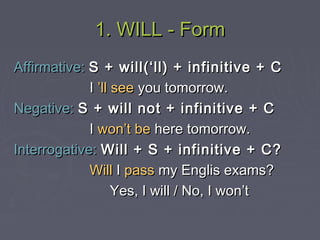
1. WILL - Form1. WILL - Form
Affirmative:Affirmative: S + will(‘ll) + infinitive + CS + will(‘ll) + infinitive + C
II ’ll see’ll see you tomorrow.you tomorrow.
Negative:Negative: S + will not + infinitive + CS + will not + infinitive + C
II won’t bewon’t be here tomorrow.here tomorrow.
Interrogative:Interrogative: Will + S + infinitive + C?Will + S + infinitive + C?
WillWill II passpass my Englis exams?my Englis exams?
Yes, I will / No, I won’tYes, I will / No, I won’t
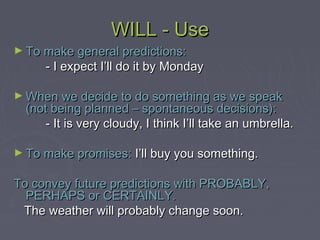
WILL - UseWILL - Use
► To make general predictions:To make general predictions:
- I expect I’ll do it by Monday- I expect I’ll do it by Monday
► When we decide to do something as we speakWhen we decide to do something as we speak
(not being planned – spontaneous decisions):(not being planned – spontaneous decisions):
- It is very cloudy, I think I’ll take an umbrella.- It is very cloudy, I think I’ll take an umbrella.
► To make promises:To make promises: I’ll buy you something.I’ll buy you something.
To convey future predictions with PROBABLY,To convey future predictions with PROBABLY,
PERHAPS or CERTAINLY.PERHAPS or CERTAINLY.
The weather will probably change soon.The weather will probably change soon.
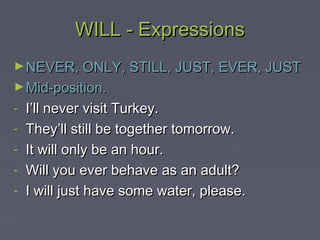
WILL - ExpressionsWILL - Expressions
►NEVER, ONLY, STILL, JUST, EVER, JUSTNEVER, ONLY, STILL, JUST, EVER, JUST
►Mid-position.Mid-position.
- I’ll never visit Turkey.I’ll never visit Turkey.
- They’ll still be together tomorrow.They’ll still be together tomorrow.
- It will only be an hour.It will only be an hour.
- Will you ever behave as an adult?Will you ever behave as an adult?
- I will just have some water, please.I will just have some water, please.
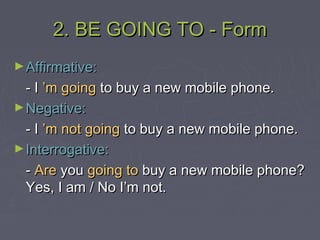
2. BE GOING TO - Form2. BE GOING TO - Form
►Affirmative:Affirmative:
- I- I ’m going’m going to buy a new mobile phone.to buy a new mobile phone.
►Negative:Negative:
- I- I ’m not going’m not going to buy a new mobile phone.to buy a new mobile phone.
►Interrogative:Interrogative:
-- AreAre youyou going togoing to buy a new mobile phone?buy a new mobile phone?
Yes, I am / No I’m not.Yes, I am / No I’m not.
BE GOING TO - UseBE GOING TO - Use
►To express plans and intentions.To express plans and intentions.
- I’m going to study science at university.- I’m going to study science at university.
►To make predictions based on evidence, onTo make predictions based on evidence, on
what you see, that is, there are some clueswhat you see, that is, there are some clues
by means of which you predict something.by means of which you predict something.
- Look at the cloudy sky. It is going to rain.- Look at the cloudy sky. It is going to rain.
BE GOING TO - UseBE GOING TO - Use
►Se utiliza para expresar la intención queSe utiliza para expresar la intención que
tiene el sujeto de realizar una determinadatiene el sujeto de realizar una determinada
acción en un futuro más o menosacción en un futuro más o menos
inmediato, o la certeza que tiene de queinmediato, o la certeza que tiene de que
algo va a ocurrir.algo va a ocurrir.
►Por tanto, el futuro con WILL puede no serPor tanto, el futuro con WILL puede no ser
tan inmediato como con BE GOING TO.tan inmediato como con BE GOING TO.
►La premeditación, presente en GOING TO,La premeditación, presente en GOING TO,
no se da en WILL.no se da en WILL.
BE GOING TO - ExpressionsBE GOING TO - Expressions
►NEVER, EVER, JUST, ONLY, STILLNEVER, EVER, JUST, ONLY, STILL
►Mid-positionMid-position
►Are you ever going to visit Paris?Are you ever going to visit Paris?
►I’m just going to post a letter.I’m just going to post a letter.
►I’m never going to fly again.I’m never going to fly again.
3. PRESENT CONTINUOUS3. PRESENT CONTINUOUS
►When an event has been planned for theWhen an event has been planned for the
future:future:
►We’We’re goingre going to Italy next April.to Italy next April.
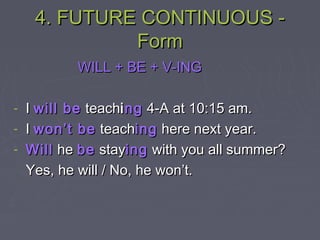
4. FUTURE CONTINUOUS -4. FUTURE CONTINUOUS -
FormForm
WILL + BE + V-INGWILL + BE + V-ING
- II will bewill be teachteachiingng 4-A at 10:15 am.4-A at 10:15 am.
- II won’t bewon’t be teachteachinging here next year.here next year.
- WillWill hehe bebe staystayinging with you all summer?with you all summer?
Yes, he will / No, he won’t.Yes, he will / No, he won’t.
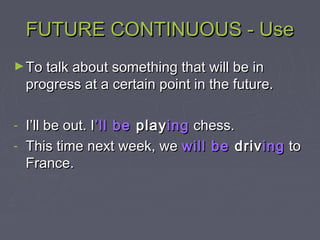
FUTURE CONTINUOUS - UseFUTURE CONTINUOUS - Use
►To talk about something that will be inTo talk about something that will be in
progress at a certain point in the future.progress at a certain point in the future.
- I’ll be out. II’ll be out. I’ll be’ll be playplayinging chess.chess.
- This time next week, weThis time next week, we will bewill be drivdrivinging toto
France.France.
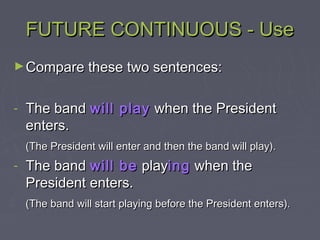
FUTURE CONTINUOUS - UseFUTURE CONTINUOUS - Use
►Compare these two sentences:Compare these two sentences:
- The bandThe band will playwill play when the Presidentwhen the President
enters.enters.
(The President will enter and then the band will play).(The President will enter and then the band will play).
- The bandThe band will bewill be playplayinging when thewhen the
President enters.President enters.
(The band will start playing before the President enters).(The band will start playing before the President enters).
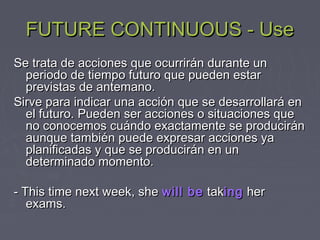
FUTURE CONTINUOUS - UseFUTURE CONTINUOUS - Use
Se trata de acciones que ocurrirán durante unSe trata de acciones que ocurrirán durante un
periodo de tiempo futuro que pueden estarperiodo de tiempo futuro que pueden estar
previstas de antemano.previstas de antemano.
Sirve para indicar una acción que se desarrollará enSirve para indicar una acción que se desarrollará en
el futuro. Pueden ser acciones o situaciones queel futuro. Pueden ser acciones o situaciones que
no conocemos cuándo exactamente se produciránno conocemos cuándo exactamente se producirán
aunque también puede expresar acciones yaaunque también puede expresar acciones ya
planificadas y que se producirán en unplanificadas y que se producirán en un
determinado momento.determinado momento.
- This time next week, she- This time next week, she will bewill be taktakinging herher
exams.exams.
FUTURE PERFECT SIMPLE -FUTURE PERFECT SIMPLE -
FormForm
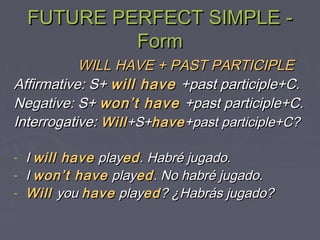
WILL HAVE + PAST PARTICIPLEWILL HAVE + PAST PARTICIPLE
Affirmative: S+Affirmative: S+ will havewill have +past participle+C.+past participle+C.
Negative: S+Negative: S+ won’t havewon’t have +past participle+C.+past participle+C.
Interrogative:Interrogative: WillWill+S++S+havehave+past participle+C?+past participle+C?
- II will havewill have playplayeded. Habré jugado.. Habré jugado.
- II won’t havewon’t have playplayeded. No habré jugado.. No habré jugado.
- WillWill youyou havehave playplayeded? ¿Habrás jugado?? ¿Habrás jugado?
FUTURE PERFECT SIMPLE -FUTURE PERFECT SIMPLE -
UseUse
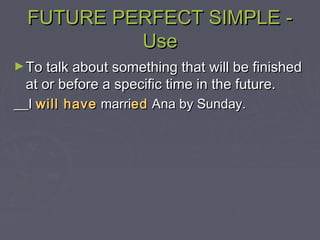
►To talk about something that will be finishedTo talk about something that will be finished
at or before a specific time in the future.at or before a specific time in the future.
II will havewill have marrimarrieded Ana by Sunday.Ana by Sunday.
FUTURE PERFECT SIMPLE -FUTURE PERFECT SIMPLE -
UseUse
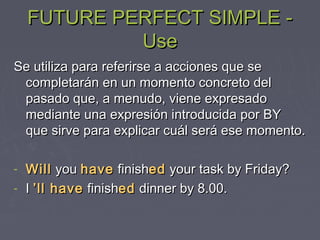
Se utiliza para referirse a acciones que seSe utiliza para referirse a acciones que se
completarán en un momento concreto delcompletarán en un momento concreto del
pasado que, a menudo, viene expresadopasado que, a menudo, viene expresado
mediante una expresión introducida por BYmediante una expresión introducida por BY
que sirve para explicar cuál será ese momento.que sirve para explicar cuál será ese momento.
- WillWill youyou havehave finishfinisheded your task by Friday?your task by Friday?
- II ’ll have’ll have finishfinisheded dinner by 8.00.dinner by 8.00.

Future forms

  • 1.
  • 2.
    1. WILL -Form1. WILL - Form Affirmative:Affirmative: S + will(‘ll) + infinitive + CS + will(‘ll) + infinitive + C II ’ll see’ll see you tomorrow.you tomorrow. Negative:Negative: S + will not + infinitive + CS + will not + infinitive + C II won’t bewon’t be here tomorrow.here tomorrow. Interrogative:Interrogative: Will + S + infinitive + C?Will + S + infinitive + C? WillWill II passpass my Englis exams?my Englis exams? Yes, I will / No, I won’tYes, I will / No, I won’t
  • 3.
    WILL - UseWILL- Use ► To make general predictions:To make general predictions: - I expect I’ll do it by Monday- I expect I’ll do it by Monday ► When we decide to do something as we speakWhen we decide to do something as we speak (not being planned – spontaneous decisions):(not being planned – spontaneous decisions): - It is very cloudy, I think I’ll take an umbrella.- It is very cloudy, I think I’ll take an umbrella. ► To make promises:To make promises: I’ll buy you something.I’ll buy you something. To convey future predictions with PROBABLY,To convey future predictions with PROBABLY, PERHAPS or CERTAINLY.PERHAPS or CERTAINLY. The weather will probably change soon.The weather will probably change soon.
  • 4.
    WILL - ExpressionsWILL- Expressions ►NEVER, ONLY, STILL, JUST, EVER, JUSTNEVER, ONLY, STILL, JUST, EVER, JUST ►Mid-position.Mid-position. - I’ll never visit Turkey.I’ll never visit Turkey. - They’ll still be together tomorrow.They’ll still be together tomorrow. - It will only be an hour.It will only be an hour. - Will you ever behave as an adult?Will you ever behave as an adult? - I will just have some water, please.I will just have some water, please.
  • 5.
    2. BE GOINGTO - Form2. BE GOING TO - Form ►Affirmative:Affirmative: - I- I ’m going’m going to buy a new mobile phone.to buy a new mobile phone. ►Negative:Negative: - I- I ’m not going’m not going to buy a new mobile phone.to buy a new mobile phone. ►Interrogative:Interrogative: -- AreAre youyou going togoing to buy a new mobile phone?buy a new mobile phone? Yes, I am / No I’m not.Yes, I am / No I’m not.
  • 6.
    BE GOING TO- UseBE GOING TO - Use ►To express plans and intentions.To express plans and intentions. - I’m going to study science at university.- I’m going to study science at university. ►To make predictions based on evidence, onTo make predictions based on evidence, on what you see, that is, there are some clueswhat you see, that is, there are some clues by means of which you predict something.by means of which you predict something. - Look at the cloudy sky. It is going to rain.- Look at the cloudy sky. It is going to rain.
  • 7.
    BE GOING TO- UseBE GOING TO - Use ►Se utiliza para expresar la intención queSe utiliza para expresar la intención que tiene el sujeto de realizar una determinadatiene el sujeto de realizar una determinada acción en un futuro más o menosacción en un futuro más o menos inmediato, o la certeza que tiene de queinmediato, o la certeza que tiene de que algo va a ocurrir.algo va a ocurrir. ►Por tanto, el futuro con WILL puede no serPor tanto, el futuro con WILL puede no ser tan inmediato como con BE GOING TO.tan inmediato como con BE GOING TO. ►La premeditación, presente en GOING TO,La premeditación, presente en GOING TO, no se da en WILL.no se da en WILL.
  • 8.
    BE GOING TO- ExpressionsBE GOING TO - Expressions ►NEVER, EVER, JUST, ONLY, STILLNEVER, EVER, JUST, ONLY, STILL ►Mid-positionMid-position ►Are you ever going to visit Paris?Are you ever going to visit Paris? ►I’m just going to post a letter.I’m just going to post a letter. ►I’m never going to fly again.I’m never going to fly again.
  • 9.
    3. PRESENT CONTINUOUS3.PRESENT CONTINUOUS ►When an event has been planned for theWhen an event has been planned for the future:future: ►We’We’re goingre going to Italy next April.to Italy next April.
  • 10.
    4. FUTURE CONTINUOUS-4. FUTURE CONTINUOUS - FormForm WILL + BE + V-INGWILL + BE + V-ING - II will bewill be teachteachiingng 4-A at 10:15 am.4-A at 10:15 am. - II won’t bewon’t be teachteachinging here next year.here next year. - WillWill hehe bebe staystayinging with you all summer?with you all summer? Yes, he will / No, he won’t.Yes, he will / No, he won’t.
  • 11.
    FUTURE CONTINUOUS -UseFUTURE CONTINUOUS - Use ►To talk about something that will be inTo talk about something that will be in progress at a certain point in the future.progress at a certain point in the future. - I’ll be out. II’ll be out. I’ll be’ll be playplayinging chess.chess. - This time next week, weThis time next week, we will bewill be drivdrivinging toto France.France.
  • 12.
    FUTURE CONTINUOUS -UseFUTURE CONTINUOUS - Use ►Compare these two sentences:Compare these two sentences: - The bandThe band will playwill play when the Presidentwhen the President enters.enters. (The President will enter and then the band will play).(The President will enter and then the band will play). - The bandThe band will bewill be playplayinging when thewhen the President enters.President enters. (The band will start playing before the President enters).(The band will start playing before the President enters).
  • 13.
    FUTURE CONTINUOUS -UseFUTURE CONTINUOUS - Use Se trata de acciones que ocurrirán durante unSe trata de acciones que ocurrirán durante un periodo de tiempo futuro que pueden estarperiodo de tiempo futuro que pueden estar previstas de antemano.previstas de antemano. Sirve para indicar una acción que se desarrollará enSirve para indicar una acción que se desarrollará en el futuro. Pueden ser acciones o situaciones queel futuro. Pueden ser acciones o situaciones que no conocemos cuándo exactamente se produciránno conocemos cuándo exactamente se producirán aunque también puede expresar acciones yaaunque también puede expresar acciones ya planificadas y que se producirán en unplanificadas y que se producirán en un determinado momento.determinado momento. - This time next week, she- This time next week, she will bewill be taktakinging herher exams.exams.
  • 14.
    FUTURE PERFECT SIMPLE-FUTURE PERFECT SIMPLE - FormForm WILL HAVE + PAST PARTICIPLEWILL HAVE + PAST PARTICIPLE Affirmative: S+Affirmative: S+ will havewill have +past participle+C.+past participle+C. Negative: S+Negative: S+ won’t havewon’t have +past participle+C.+past participle+C. Interrogative:Interrogative: WillWill+S++S+havehave+past participle+C?+past participle+C? - II will havewill have playplayeded. Habré jugado.. Habré jugado. - II won’t havewon’t have playplayeded. No habré jugado.. No habré jugado. - WillWill youyou havehave playplayeded? ¿Habrás jugado?? ¿Habrás jugado?
  • 15.
    FUTURE PERFECT SIMPLE-FUTURE PERFECT SIMPLE - UseUse ►To talk about something that will be finishedTo talk about something that will be finished at or before a specific time in the future.at or before a specific time in the future. II will havewill have marrimarrieded Ana by Sunday.Ana by Sunday.
  • 16.
    FUTURE PERFECT SIMPLE-FUTURE PERFECT SIMPLE - UseUse Se utiliza para referirse a acciones que seSe utiliza para referirse a acciones que se completarán en un momento concreto delcompletarán en un momento concreto del pasado que, a menudo, viene expresadopasado que, a menudo, viene expresado mediante una expresión introducida por BYmediante una expresión introducida por BY que sirve para explicar cuál será ese momento.que sirve para explicar cuál será ese momento. - WillWill youyou havehave finishfinisheded your task by Friday?your task by Friday? - II ’ll have’ll have finishfinisheded dinner by 8.00.dinner by 8.00.