Past Simple
Regular Verbs
Past Simple
Regular Verbs
Forma Affermativa
I walked
You walked
He walked
She walked
It walked
We walked
You walked
They walked
Past Simple
Regular Verbs
Come si costruisce?
Il Past Simple dei verbi regolari si forma aggiungendo il suffisso –ed alla forma base del
verbo senza il to
Ricorda che la forma base è quella che trovi sul dizionario:
to walk è la forma base, ma per formare il Simple Past si toglie il to.
Ricorda che il suffisso è una particella che si aggiunge ad un’altra parola!
Forma Base Suffisso -ed
walk -ed
Past Simple
Regular Verbs
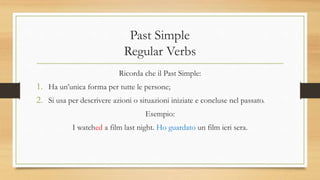
Ricorda che il Past Simple:
1. Ha un’unica forma per tutte le persone;
2. Si usa per descrivere azioni o situazioni iniziate e concluse nel passato.
Esempio:
I watched a film last night. Ho guardato un film ieri sera.
Past Simple
Regular Verbs
Ricorda che il Past Simple:
3. Può coincidere con un passato recente (yesterday, last week, ecc.) o lontano (in
1945, fifty years ago, ecc.). La cosa importante è che l’azione sia conclusa.
Esempi
• I listened to the music yesterday. Ho ascoltato la musica ieri.
• The Romans invaded Britain in 55 B.C. (Before Christ). I Romani invasero la Gran
Bretagna nel 55 A.C. (Avanti Cristo).
Past Simple – Regular Verbs
Pronuncia del suffisso –ed
1. /id/ dopo un suono t o d
STARTED /startid/
DECIDED /disaidid/
2. /t/ dopo una consonante sorda (cioè «aspra»)
WATCHED /uotscht/
LIKED /laikt/
STOPPED /stopt/
Past Simple – Regular Verbs
Pronuncia del suffisso –ed
3. /d/ dopo una consonante sonora o vocale (cioè dopo un suono «dolce»)
RAINED /reind/
LOVED /lavd/
PLAYED /pleid/
Past Simple – Regular Verbs
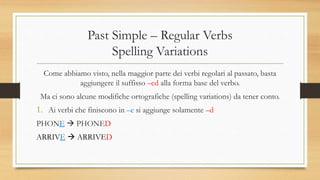
Spelling Variations
Come abbiamo visto, nella maggior parte dei verbi regolari al passato, basta
aggiungere il suffisso –ed alla forma base del verbo.
Ma ci sono alcune modifiche ortografiche (spelling variations) da tener conto.
1. Ai verbi che finiscono in –e si aggiunge solamente –d
PHONE  PHONED
ARRIVE  ARRIVED
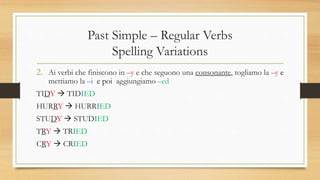
Past Simple – Regular Verbs
Spelling Variations
2. Ai verbi che finiscono in –y e che seguono una consonante, togliamo la –y e
mettiamo la –i e poi aggiungiamo –ed
TIDY  TIDIED
HURRY  HURRIED
STUDY  STUDIED
TRY  TRIED
CRY  CRIED
Past Simple – Regular Verbs
Spelling Variations
3. Alcuni verbi raddoppiano la consonante finale prima di aggiungere –ed
STOP  STOPPED
ROB  ROBBED
PLAN  PLANNED
PREFER  PREFERRED
Past Simple
Irregular Verbs
Molti verbi inglesi al Past Simple hanno una forma irregolare.
Questo vuol dire che non si aggiunge un suffisso –ed alla forma base del verbo, ma
hanno una loro forma propria.
Quindi non esiste una regola per la formazione dei verbi irregolari e soprattutto vanno
imparati a memoria.
Esempi
I go to the cinema every Saturday. Vado al cinema ogni sabato. (Present Simple)
I went to the cinema yesterday. Sono andato al cinema ieri (Past Simple)

Past simple (regular verbs)

  • 1.
  • 2.
    Past Simple Regular Verbs FormaAffermativa I walked You walked He walked She walked It walked We walked You walked They walked
  • 3.
    Past Simple Regular Verbs Comesi costruisce? Il Past Simple dei verbi regolari si forma aggiungendo il suffisso –ed alla forma base del verbo senza il to Ricorda che la forma base è quella che trovi sul dizionario: to walk è la forma base, ma per formare il Simple Past si toglie il to. Ricorda che il suffisso è una particella che si aggiunge ad un’altra parola! Forma Base Suffisso -ed walk -ed
  • 4.
    Past Simple Regular Verbs Ricordache il Past Simple: 1. Ha un’unica forma per tutte le persone; 2. Si usa per descrivere azioni o situazioni iniziate e concluse nel passato. Esempio: I watched a film last night. Ho guardato un film ieri sera.
  • 5.
    Past Simple Regular Verbs Ricordache il Past Simple: 3. Può coincidere con un passato recente (yesterday, last week, ecc.) o lontano (in 1945, fifty years ago, ecc.). La cosa importante è che l’azione sia conclusa. Esempi • I listened to the music yesterday. Ho ascoltato la musica ieri. • The Romans invaded Britain in 55 B.C. (Before Christ). I Romani invasero la Gran Bretagna nel 55 A.C. (Avanti Cristo).
  • 6.
    Past Simple –Regular Verbs Pronuncia del suffisso –ed 1. /id/ dopo un suono t o d STARTED /startid/ DECIDED /disaidid/ 2. /t/ dopo una consonante sorda (cioè «aspra») WATCHED /uotscht/ LIKED /laikt/ STOPPED /stopt/
  • 7.
    Past Simple –Regular Verbs Pronuncia del suffisso –ed 3. /d/ dopo una consonante sonora o vocale (cioè dopo un suono «dolce») RAINED /reind/ LOVED /lavd/ PLAYED /pleid/
  • 8.
    Past Simple –Regular Verbs Spelling Variations Come abbiamo visto, nella maggior parte dei verbi regolari al passato, basta aggiungere il suffisso –ed alla forma base del verbo. Ma ci sono alcune modifiche ortografiche (spelling variations) da tener conto. 1. Ai verbi che finiscono in –e si aggiunge solamente –d PHONE  PHONED ARRIVE  ARRIVED
  • 9.
    Past Simple –Regular Verbs Spelling Variations 2. Ai verbi che finiscono in –y e che seguono una consonante, togliamo la –y e mettiamo la –i e poi aggiungiamo –ed TIDY  TIDIED HURRY  HURRIED STUDY  STUDIED TRY  TRIED CRY  CRIED
  • 10.
    Past Simple –Regular Verbs Spelling Variations 3. Alcuni verbi raddoppiano la consonante finale prima di aggiungere –ed STOP  STOPPED ROB  ROBBED PLAN  PLANNED PREFER  PREFERRED
  • 11.
    Past Simple Irregular Verbs Moltiverbi inglesi al Past Simple hanno una forma irregolare. Questo vuol dire che non si aggiunge un suffisso –ed alla forma base del verbo, ma hanno una loro forma propria. Quindi non esiste una regola per la formazione dei verbi irregolari e soprattutto vanno imparati a memoria. Esempi I go to the cinema every Saturday. Vado al cinema ogni sabato. (Present Simple) I went to the cinema yesterday. Sono andato al cinema ieri (Past Simple)