TEMA: PASADO SIMPLE
AUTOR: María José Cárdenas.
 USAGES
WAS/WERE FORM
 REGULAR IREGULAR PAST FORM
 NEGATIVE FORM
 QUESTION FORM
 CONCLUSION
USAGES
1.To express an action that started and
finished at a specific time in the past.
Examples:
 I saw a movie yesterday.
Last year, I traveled to Japan.
2.To list a series of completed actions in the past.
These actions happen first, second…
Examples:
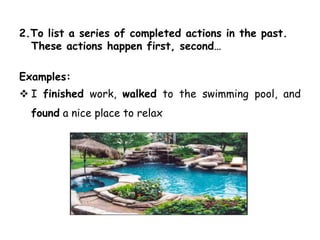
 I finished work, walked to the swimming pool, and
found a nice place to relax
3.It can be used with a duration which starts and stops in the
past. A duration is a longer action often indicated by
expressions such as: for two years, for five minutes, all day,
all year, etc.
Examples
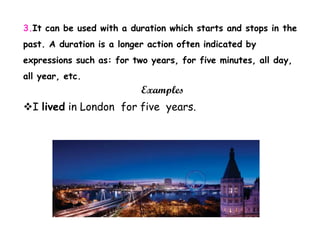
I lived in London for five years.
4.The Simple Past can also be used to describe a habit which
stopped in the past.
It can have the same meaning as “used to.” To make it clear
that we are talking about a habit, we often add expressions
such as: always, often, usually, never, when I was a child,
when I was younger, etc
Examples:
 I studied English when I was a child.
 He played the guitar.
 He didn't play the piano.
5. The Simple Past can also be used to describe past facts or
generalizations which are no longer true. As in USE 4 above, this
use of the Simple Past is quite similar to the expression “used to."
Examples:
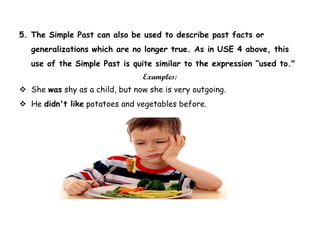
 She was shy as a child, but now she is very outgoing.
 He didn't like potatoes and vegetables before.
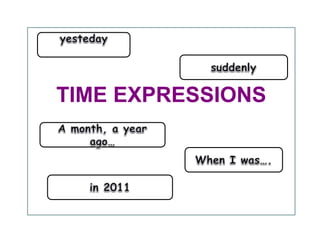
TIME EXPRESSIONS
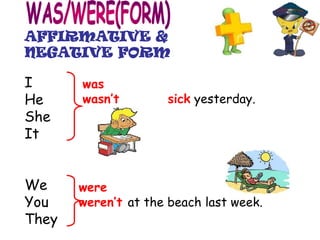
I
He
She
It
We
You
They
was
wasn’t sick yesterday.
were
weren’t at the beach last week.
AFFIRMATIVE &
NEGATIVE FORM
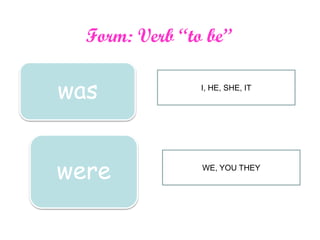
Form: Verb “to be”
was
were
I, HE, SHE, IT
WE, YOU THEY
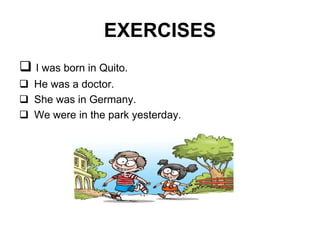
EXERCISES
 I was born in Quito.
 He was a doctor.
 She was in Germany.
 We were in the park yesterday.
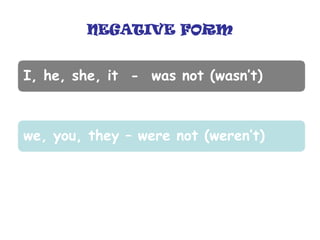
NEGATIVE FORM
I, he, she, it - was not (wasn’t)
we, you, they – were not (weren’t)
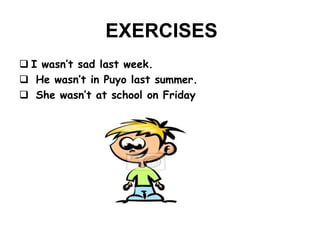
EXERCISES
 I wasn’t sad last week.
 He wasn’t in Puyo last summer.
 She wasn’t at school on Friday
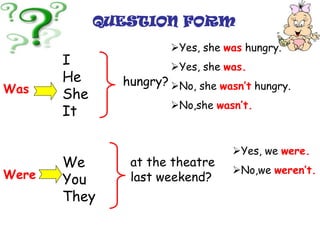
Was
Were
I
He
She
It
We
You
They
hungry?
Yes, she was hungry.
Yes, she was.
No, she wasn’t hungry.
No,she wasn’t.
at the theatre
last weekend?
Yes, we were.
No,we weren’t.
QUESTION FORM
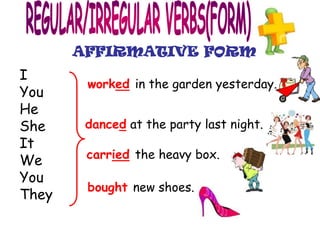
I
You
He
She
It
We
You
They
worked in the garden yesterday.
danced at the party last night.
carried the heavy box.
bought new shoes.
AFFIRMATIVE FORM
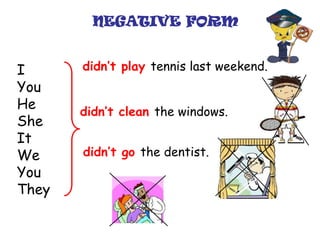
I
You
He
She
It
We
You
They
didn’t play tennis last weekend.
didn’t clean the windows.
didn’t go the dentist.
NEGATIVE FORM
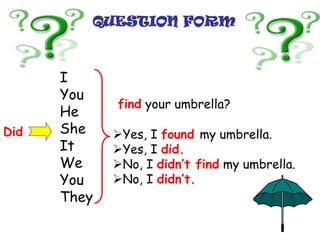
Did
I
You
He
She
It
We
You
They
find your umbrella?
Yes, I found my umbrella.
Yes, I did.
No, I didn’t find my umbrella.
No, I didn’t.
QUESTION FORM
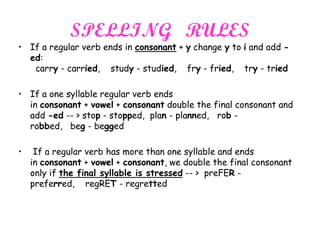
SPELLING RULES
• If a regular verb ends in consonant + y change y to i and add -
ed:
carry - carried, study - studied, fry - fried, try - tried
• If a one syllable regular verb ends
in consonant + vowel + consonant double the final consonant and
add -ed -- > stop - stopped, plan - planned, rob -
robbed, beg - begged
• If a regular verb has more than one syllable and ends
in consonant + vowel + consonant, we double the final consonant
only if the final syllable is stressed -- > preFER -
preferred, regRET - regretted
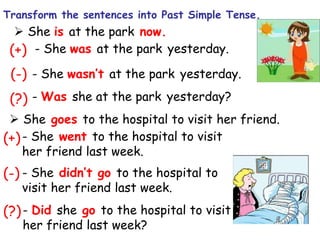
 She is at the park now.
(+)
(-) - She wasn’t at the park yesterday.
(?) - Was she at the park yesterday?
 She goes to the hospital to visit her friend.
- She went to the hospital to visit
her friend last week.
- She didn’t go to the hospital to
visit her friend last week.
- Did she go to the hospital to visit
her friend last week?
(+)
(-)
(?)
- She was at the park yesterday.
Transform the sentences into Past Simple Tense.
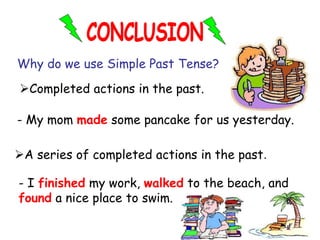
Why do we use Simple Past Tense?
A series of completed actions in the past.
Completed actions in the past.
- I finished my work, walked to the beach, and
found a nice place to swim.
- My mom made some pancake for us yesterday.
BIBLIOGRAPHY
 American Language Book 1
 http://faculty.mu.edu.sa/download.php?fid=77142

Past Simple Tense by Maria Jose Cardenas

  • 1.
    TEMA: PASADO SIMPLE AUTOR:María José Cárdenas.
  • 2.
     USAGES WAS/WERE FORM REGULAR IREGULAR PAST FORM  NEGATIVE FORM  QUESTION FORM  CONCLUSION
  • 3.
    USAGES 1.To express anaction that started and finished at a specific time in the past. Examples:  I saw a movie yesterday. Last year, I traveled to Japan.
  • 4.
    2.To list aseries of completed actions in the past. These actions happen first, second… Examples:  I finished work, walked to the swimming pool, and found a nice place to relax
  • 5.
    3.It can beused with a duration which starts and stops in the past. A duration is a longer action often indicated by expressions such as: for two years, for five minutes, all day, all year, etc. Examples I lived in London for five years.
  • 6.
    4.The Simple Pastcan also be used to describe a habit which stopped in the past. It can have the same meaning as “used to.” To make it clear that we are talking about a habit, we often add expressions such as: always, often, usually, never, when I was a child, when I was younger, etc Examples:  I studied English when I was a child.  He played the guitar.  He didn't play the piano.
  • 7.
    5. The SimplePast can also be used to describe past facts or generalizations which are no longer true. As in USE 4 above, this use of the Simple Past is quite similar to the expression “used to." Examples:  She was shy as a child, but now she is very outgoing.  He didn't like potatoes and vegetables before.
  • 8.
  • 9.
    I He She It We You They was wasn’t sick yesterday. were weren’tat the beach last week. AFFIRMATIVE & NEGATIVE FORM
  • 10.
    Form: Verb “tobe” was were I, HE, SHE, IT WE, YOU THEY
  • 11.
    EXERCISES  I wasborn in Quito.  He was a doctor.  She was in Germany.  We were in the park yesterday.
  • 12.
    NEGATIVE FORM I, he,she, it - was not (wasn’t) we, you, they – were not (weren’t)
  • 13.
    EXERCISES  I wasn’tsad last week.  He wasn’t in Puyo last summer.  She wasn’t at school on Friday
  • 14.
    Was Were I He She It We You They hungry? Yes, she washungry. Yes, she was. No, she wasn’t hungry. No,she wasn’t. at the theatre last weekend? Yes, we were. No,we weren’t. QUESTION FORM
  • 16.
    I You He She It We You They worked in thegarden yesterday. danced at the party last night. carried the heavy box. bought new shoes. AFFIRMATIVE FORM
  • 17.
    I You He She It We You They didn’t play tennislast weekend. didn’t clean the windows. didn’t go the dentist. NEGATIVE FORM
  • 18.
    Did I You He She It We You They find your umbrella? Yes,I found my umbrella. Yes, I did. No, I didn’t find my umbrella. No, I didn’t. QUESTION FORM
  • 19.
    SPELLING RULES • Ifa regular verb ends in consonant + y change y to i and add - ed: carry - carried, study - studied, fry - fried, try - tried • If a one syllable regular verb ends in consonant + vowel + consonant double the final consonant and add -ed -- > stop - stopped, plan - planned, rob - robbed, beg - begged • If a regular verb has more than one syllable and ends in consonant + vowel + consonant, we double the final consonant only if the final syllable is stressed -- > preFER - preferred, regRET - regretted
  • 21.
     She isat the park now. (+) (-) - She wasn’t at the park yesterday. (?) - Was she at the park yesterday?  She goes to the hospital to visit her friend. - She went to the hospital to visit her friend last week. - She didn’t go to the hospital to visit her friend last week. - Did she go to the hospital to visit her friend last week? (+) (-) (?) - She was at the park yesterday. Transform the sentences into Past Simple Tense.
  • 22.
    Why do weuse Simple Past Tense? A series of completed actions in the past. Completed actions in the past. - I finished my work, walked to the beach, and found a nice place to swim. - My mom made some pancake for us yesterday.
  • 23.
    BIBLIOGRAPHY  American LanguageBook 1  http://faculty.mu.edu.sa/download.php?fid=77142