Past simple
Passato semplice
Il past simple si usa per parlare:
• di un’azione che è iniziata e si è conclusa nel passato: We
played football yesterday;
• può coincidere con un passato recente o lontano.
L’importante è che l’azione si sia conclusa.
Il past simple corrisponde in italiano:
• al passato prossimo: I went to Rome yesterday;
• al passato remoto: Dickens was a great writer;
• all’imperfetto: It was sunny on Sunday.
Il past simple è accompagnato da delle
keywords:
• yesterday (morning /afternoon / evening);
• last (Monday/month/week/ summer/ year);
• A week/ month/ year/ two days/ 20 minutes ago;
• in 2013 / June / the twentieth century….
NB. In inglese le espressioni di tempo passato si mettono all’inizio o
alla fine di una frase.
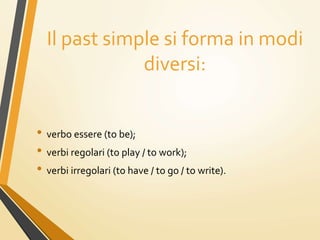
Il past simple si forma in modi
diversi:
• verbo essere (to be);
• verbi regolari (to play / to work);
• verbi irregolari (to have / to go / to write).
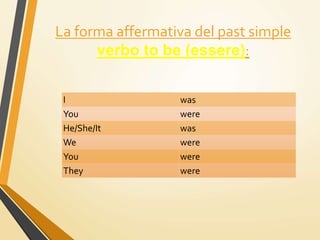
La forma affermativa del past simple
verbo to be (essere):
I was
You were
He/She/It was
We were
You were
They were
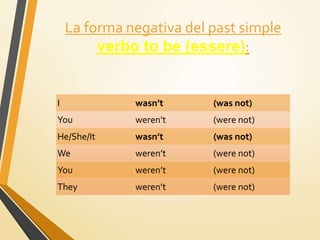
La forma negativa del past simple
verbo to be (essere):
I wasn’t (was not)
You weren’t (were not)
He/She/It wasn’t (was not)
We weren’t (were not)
You weren’t (were not)
They weren’t (were not)
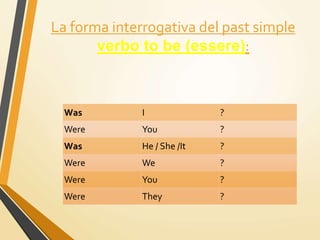
La forma interrogativa del past simple
verbo to be (essere):
Was I ?
Were You ?
Was He / She /It ?
Were We ?
Were You ?
Were They ?
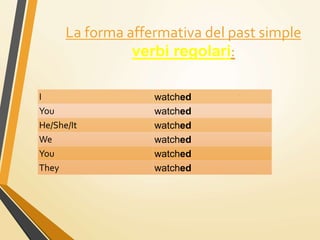
La forma affermativa del past simple
verbi regolari:
I watched
You watched
He/She/It watched
We watched
You watched
They watched
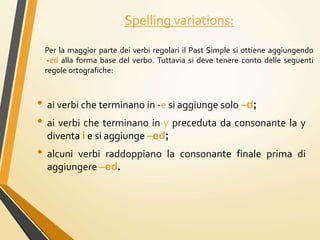
Spelling variations:
Per la maggior parte dei verbi regolari il Past Simple si ottiene aggiungendo
-ed alla forma base del verbo. Tuttavia si deve tenere conto delle seguenti
regole ortografiche:
• ai verbi che terminano in -e si aggiunge solo –d;
• ai verbi che terminano in y preceduta da consonante la y
diventa i e si aggiunge –ed;
• alcuni verbi raddoppiano la consonante finale prima di
aggiungere –ed.
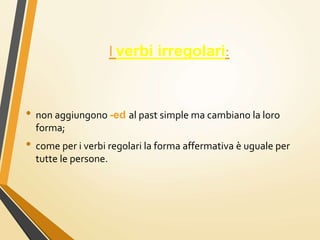
I verbi irregolari:
• non aggiungono -ed al past simple ma cambiano la loro
forma;
• come per i verbi regolari la forma affermativa è uguale per
tutte le persone.
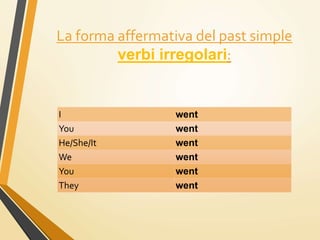
La forma affermativa del past simple
verbi irregolari:
I went
You went
He/She/It went
We went
You went
They went
La forma negativa
del past simple:
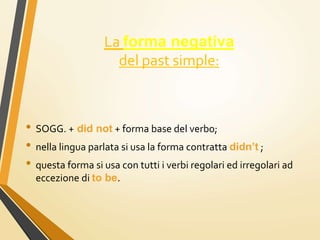
• SOGG. + did not + forma base del verbo;
• nella lingua parlata si usa la forma contratta didn’t ;
• questa forma si usa con tutti i verbi regolari ed irregolari ad
eccezione di to be.
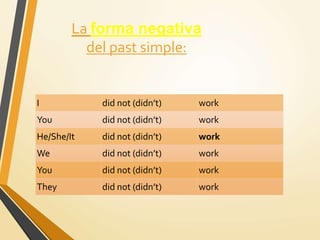
I did not (didn’t) work
You did not (didn’t) work
He/She/It did not (didn’t) work
We did not (didn’t) work
You did not (didn’t) work
They did not (didn’t) work
La forma negativa
del past simple:
La forma interrogativa
del past simple:
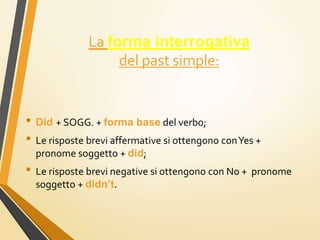
• Did + SOGG. + forma base del verbo;
• Le risposte brevi affermative si ottengono conYes +
pronome soggetto + did;
• Le risposte brevi negative si ottengono con No + pronome
soggetto + didn’t.
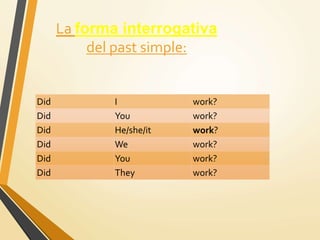
Did I work?
Did You work?
Did He/she/it work?
Did We work?
Did You work?
Did They work?
La forma interrogativa
del past simple:
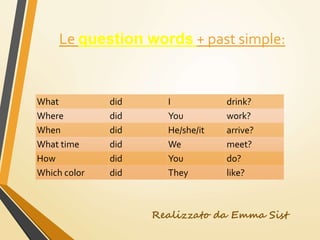
What did I drink?
Where did You work?
When did He/she/it arrive?
What time did We meet?
How did You do?
Which color did They like?
Le question words + past simple:
Realizzato da Emma Sist

Past simple

  • 1.
  • 2.
    Il past simplesi usa per parlare: • di un’azione che è iniziata e si è conclusa nel passato: We played football yesterday; • può coincidere con un passato recente o lontano. L’importante è che l’azione si sia conclusa.
  • 3.
    Il past simplecorrisponde in italiano: • al passato prossimo: I went to Rome yesterday; • al passato remoto: Dickens was a great writer; • all’imperfetto: It was sunny on Sunday.
  • 4.
    Il past simpleè accompagnato da delle keywords: • yesterday (morning /afternoon / evening); • last (Monday/month/week/ summer/ year); • A week/ month/ year/ two days/ 20 minutes ago; • in 2013 / June / the twentieth century…. NB. In inglese le espressioni di tempo passato si mettono all’inizio o alla fine di una frase.
  • 5.
    Il past simplesi forma in modi diversi: • verbo essere (to be); • verbi regolari (to play / to work); • verbi irregolari (to have / to go / to write).
  • 6.
    La forma affermativadel past simple verbo to be (essere): I was You were He/She/It was We were You were They were
  • 7.
    La forma negativadel past simple verbo to be (essere): I wasn’t (was not) You weren’t (were not) He/She/It wasn’t (was not) We weren’t (were not) You weren’t (were not) They weren’t (were not)
  • 8.
    La forma interrogativadel past simple verbo to be (essere): Was I ? Were You ? Was He / She /It ? Were We ? Were You ? Were They ?
  • 9.
    La forma affermativadel past simple verbi regolari: I watched You watched He/She/It watched We watched You watched They watched
  • 10.
    Spelling variations: Per lamaggior parte dei verbi regolari il Past Simple si ottiene aggiungendo -ed alla forma base del verbo. Tuttavia si deve tenere conto delle seguenti regole ortografiche: • ai verbi che terminano in -e si aggiunge solo –d; • ai verbi che terminano in y preceduta da consonante la y diventa i e si aggiunge –ed; • alcuni verbi raddoppiano la consonante finale prima di aggiungere –ed.
  • 11.
    I verbi irregolari: •non aggiungono -ed al past simple ma cambiano la loro forma; • come per i verbi regolari la forma affermativa è uguale per tutte le persone.
  • 12.
    La forma affermativadel past simple verbi irregolari: I went You went He/She/It went We went You went They went
  • 13.
    La forma negativa delpast simple: • SOGG. + did not + forma base del verbo; • nella lingua parlata si usa la forma contratta didn’t ; • questa forma si usa con tutti i verbi regolari ed irregolari ad eccezione di to be.
  • 14.
    I did not(didn’t) work You did not (didn’t) work He/She/It did not (didn’t) work We did not (didn’t) work You did not (didn’t) work They did not (didn’t) work La forma negativa del past simple:
  • 15.
    La forma interrogativa delpast simple: • Did + SOGG. + forma base del verbo; • Le risposte brevi affermative si ottengono conYes + pronome soggetto + did; • Le risposte brevi negative si ottengono con No + pronome soggetto + didn’t.
  • 16.
    Did I work? DidYou work? Did He/she/it work? Did We work? Did You work? Did They work? La forma interrogativa del past simple:
  • 17.
    What did Idrink? Where did You work? When did He/she/it arrive? What time did We meet? How did You do? Which color did They like? Le question words + past simple: Realizzato da Emma Sist