Passive House
Definition The term ‘Passive House’refers to a specific construction standard for residential buildings with good comfort conditions during winter and summer, without traditional heating systems and without active cooling Acknowledgement This presentation is based on material contributed by Erwin Mlecnik from the  Passive House Platform (PHP) Belgium . The graph on screen 5 comes from  PHI Darmstadt
Scientific definition “ The term passive house refers to a specific construction standard for residential buildings with good comfort conditions during winter and summer, without traditional heating systems and without active cooling. Typically this includes very good insulation levels, very good airtightness of the building, whilst a good indoor air quality is guaranteed by a mechanical ventilation system with highly efficient heat recovery. Thereby the design heat load is limited to the load that can be transported by the minimum required ventilation air. However space heating does not have to be carried through the ventilation system.  For 40 - 60˚ Northern latitudes, under conditions specified in the PHPP calculation model:  the total energy demand for space heating and cooling is limited to  15 kWh/m2.a treated floor area;  the total primary energy use for all appliances, domestic hot water and space heating and cooling is limited to 120 kWh/m2.a
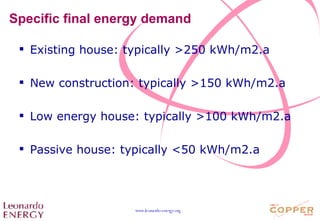
Specific final energy demand Existing house: typically >250 kWh/m2.a New construction: typically >150 kWh/m2 .a Low energy house: typically >100 kWh/m2 .a Passive house: typically <50 kWh/m2 .a
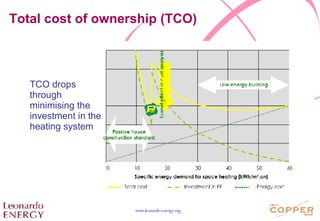
Total cost of ownership (TCO) TCO drops through minimising the investment in the heating system
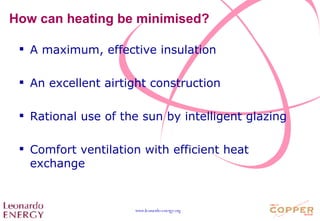
How can heating be minimised? A maximum, effective insulation An excellent airtight construction Rational use of the sun by intelligent glazing Comfort ventilation with efficient heat exchange
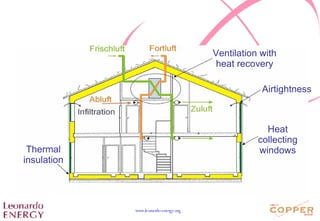
Ventilation with heat recovery Heat collecting windows Airtightness Thermal insulation
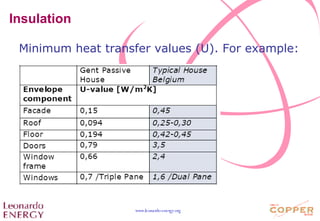
Insulation Minimum heat transfer values (U). For example:
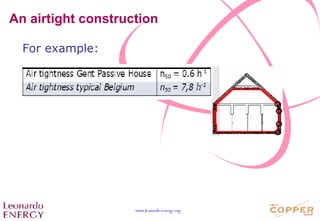
An airtight construction For example:
Rational use of the sun A right design for the size and position of windows Intelligent glazing (e.g. triple pane glazing) Limit the risk of overheating in summer,  for example by: Extra ventilation Mechanical ventilation at night A removable sun protection on the windows
Ventilation The ventilation system with heat recovery is a crucial part of a passive house The ventillation system should be controllable by the owners. It has to be adaptable according to the situation (guests, a party, cooking or not …) Wet rooms (bathroom, kitchen…) need extra air extraction to avoid moisture
Heat recovery A heat exchanger in the ventilation system recycles a large part of the heat. Efficiencies are typically 80% - 90% Extra heating can be provided by a system of tubes in the ground that pre-heat the air coming from outside The ground is warmer than the air in winter, but colder than the air in summer, so the same system can pre-cool the incoming air in summer In some cases, an extra after heating by a solar boiler or a solar-gas boiler is provided
Combined with other energy efficient techniques In most cases, the construction standards of a passive house are combined with: High efficient domestic appliances Efficient lighting A solar water heater Or a photo-voltaic system for generating electricity making a dwelling to a large extent independent from external energy sources
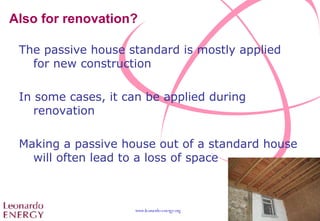
Also for renovation? The passive house standard is mostly applied for new construction In some cases, it can be applied during renovation  Making a passive house out of a standard house will often lead to a loss of space
Pioneering countries Germany is the trendsetter in passive houses In addition, passive houses have been built in Austria, Belgium, Luxemburg, the Netherlands, Northern Italy and Switzerland In some countries, like Germany, Austria and Belgium, subsidies are granted for the construction of passive houses
Round-up A passive house is a house with a minimum heating system but with good comfort conditions This can be achieved by maximum insulation, an excellent air tightness, intelligent glazing and a ventilation system with heat recovery Energy consumption is up to 85% lower compared to a standard house
Links European Passive Houses http ://www.europeanpassivehouses.org International Links http://www.igpassivhaus.at   in Belgium http://www.passivehouse.be in Germany http://www.passivehouse.com

Passive House

  • 1.
  • 2.
    Definition The term‘Passive House’refers to a specific construction standard for residential buildings with good comfort conditions during winter and summer, without traditional heating systems and without active cooling Acknowledgement This presentation is based on material contributed by Erwin Mlecnik from the Passive House Platform (PHP) Belgium . The graph on screen 5 comes from PHI Darmstadt
  • 3.
    Scientific definition “The term passive house refers to a specific construction standard for residential buildings with good comfort conditions during winter and summer, without traditional heating systems and without active cooling. Typically this includes very good insulation levels, very good airtightness of the building, whilst a good indoor air quality is guaranteed by a mechanical ventilation system with highly efficient heat recovery. Thereby the design heat load is limited to the load that can be transported by the minimum required ventilation air. However space heating does not have to be carried through the ventilation system. For 40 - 60˚ Northern latitudes, under conditions specified in the PHPP calculation model: the total energy demand for space heating and cooling is limited to 15 kWh/m2.a treated floor area; the total primary energy use for all appliances, domestic hot water and space heating and cooling is limited to 120 kWh/m2.a
  • 4.
    Specific final energydemand Existing house: typically >250 kWh/m2.a New construction: typically >150 kWh/m2 .a Low energy house: typically >100 kWh/m2 .a Passive house: typically <50 kWh/m2 .a
  • 5.
    Total cost ofownership (TCO) TCO drops through minimising the investment in the heating system
  • 6.
    How can heatingbe minimised? A maximum, effective insulation An excellent airtight construction Rational use of the sun by intelligent glazing Comfort ventilation with efficient heat exchange
  • 7.
    Ventilation with heatrecovery Heat collecting windows Airtightness Thermal insulation
  • 8.
    Insulation Minimum heattransfer values (U). For example:
  • 9.
  • 10.
    Rational use ofthe sun A right design for the size and position of windows Intelligent glazing (e.g. triple pane glazing) Limit the risk of overheating in summer, for example by: Extra ventilation Mechanical ventilation at night A removable sun protection on the windows
  • 11.
    Ventilation The ventilationsystem with heat recovery is a crucial part of a passive house The ventillation system should be controllable by the owners. It has to be adaptable according to the situation (guests, a party, cooking or not …) Wet rooms (bathroom, kitchen…) need extra air extraction to avoid moisture
  • 12.
    Heat recovery Aheat exchanger in the ventilation system recycles a large part of the heat. Efficiencies are typically 80% - 90% Extra heating can be provided by a system of tubes in the ground that pre-heat the air coming from outside The ground is warmer than the air in winter, but colder than the air in summer, so the same system can pre-cool the incoming air in summer In some cases, an extra after heating by a solar boiler or a solar-gas boiler is provided
  • 13.
    Combined with otherenergy efficient techniques In most cases, the construction standards of a passive house are combined with: High efficient domestic appliances Efficient lighting A solar water heater Or a photo-voltaic system for generating electricity making a dwelling to a large extent independent from external energy sources
  • 14.
    Also for renovation?The passive house standard is mostly applied for new construction In some cases, it can be applied during renovation Making a passive house out of a standard house will often lead to a loss of space
  • 15.
    Pioneering countries Germanyis the trendsetter in passive houses In addition, passive houses have been built in Austria, Belgium, Luxemburg, the Netherlands, Northern Italy and Switzerland In some countries, like Germany, Austria and Belgium, subsidies are granted for the construction of passive houses
  • 16.
    Round-up A passivehouse is a house with a minimum heating system but with good comfort conditions This can be achieved by maximum insulation, an excellent air tightness, intelligent glazing and a ventilation system with heat recovery Energy consumption is up to 85% lower compared to a standard house
  • 17.
    Links European PassiveHouses http ://www.europeanpassivehouses.org International Links http://www.igpassivhaus.at in Belgium http://www.passivehouse.be in Germany http://www.passivehouse.com