the ‘passive house’ energy design standard Dylan Lamar, BSCE Architecture Graduate Student making a leap toward carbon-neutral buildings
Source: Intergovernmental Panel on Climate Change Countering global warming requires rethinking every facet of human society.
Source: UN Environmental Programme Source: Architecture 2030
 
the ‘passive house’ energy design standard an energy efficiency design standard (and methodology) achieving 90% reductions in space heating energy, and 70% reduction in total building energy use.
“ Passive House?… didn’t we already try that back in the 80’s?” From German: “Passivhaus” Not limited to houses House as Passive Machine (not confined to passive  solar concerns) Source: Passivhaus Institut
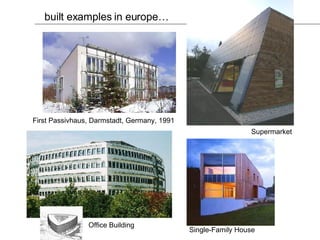
built examples in europe… First Passivhaus, Darmstadt, Germany, 1991 Supermarket Office Building Single-Family House
built examples in Europe… Manufacturing Plant Austria Apartment building Cologne, Germany
built examples in Europe… Gym Heidelberg, Germany  School Waldshut, Germany
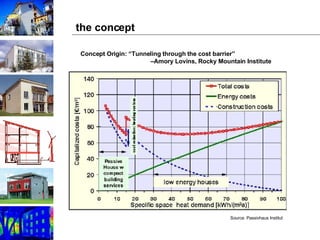
the concept Concept Origin: “Tunneling through the cost barrier” – Amory Lovins, Rocky Mountain Institute  Source: Passivhaus Institut
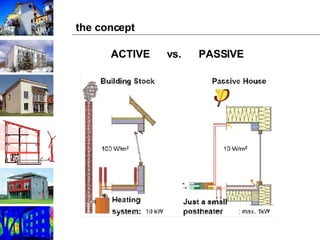
the concept Source: Passivhaus Institut ACTIVE  vs.  PASSIVE
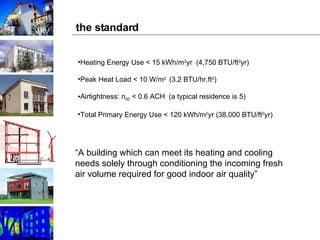
the standard Heating Energy Use < 15 kWh/m 2 yr  (4,750 BTU/ft 2 yr) Peak Heat Load < 10 W/m 2  (3.2 BTU/hr.ft 2 ) Airtightness: n 50  < 0.6 ACH  (a typical residence is 5) Total Primary Energy Use < 120 kWh/m 2 yr (38,000 BTU/ft 2 yr) “ A building which can meet its heating and cooling needs solely through conditioning the incoming fresh air volume required for good indoor air quality”
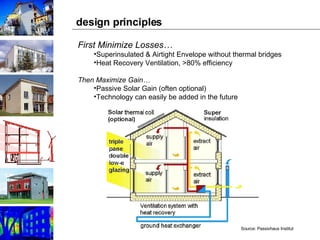
design principles First Minimize Losses… Superinsulated & Airtight Envelope without thermal bridges Heat Recovery Ventilation, >80% efficiency Then Maximize Gain… Passive Solar Gain (often optional) Technology can easily be added in the future Source: Passivhaus Institut
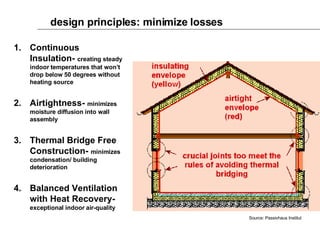
design principles: minimize losses Continuous Insulation-  creating steady indoor temperatures that won’t drop below 50 degrees without heating source Airtightness-  minimizes moisture diffusion into wall assembly  Thermal Bridge Free Construction-  minimizes condensation/ building deterioration Balanced Ventilation with Heat Recovery-  exceptional indoor air-quality Source: Passivhaus Institut
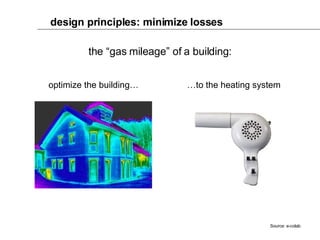
design principles: minimize losses Source: e-colab optimize the building… … to the heating system the “gas mileage” of a building:
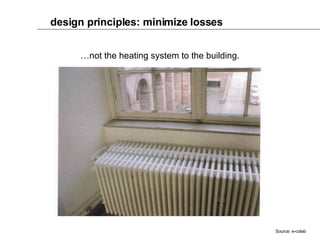
design principles: minimize losses Source: e-colab … not the heating system to the building.
design principles: minimize losses Heat Recovery Ventilation
the result Source: Passivhaus Institut
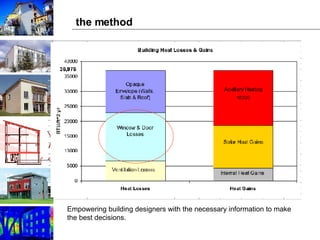
the method The “Passive House Planning Package” (PHPP)  An Excel-based steady-state energy design program Extremely detailed Calculations are transparent and customizable
the method Empowering building designers with the necessary information to make the best decisions.
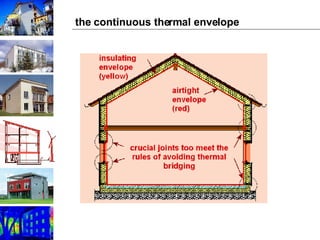
a tour of Passive House design and construction… Generating form based on energy concerns -Compactness -Glazing Area Detailing the Continuous Thermal Envelope -Eliminating thermal bridges -Achieving airtightness Simplifying the mechanical system
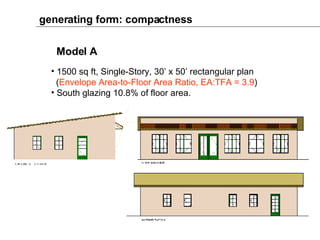
generating form: compactness Model A 1500 sq ft, Single-Story, 30’ x 50’ rectangular plan ( Envelope Area-to-Floor Area Ratio, EA:TFA = 3.9 ) South glazing 10.8% of floor area.
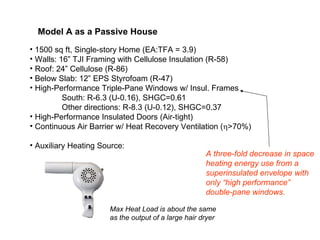
Model A as a Passive House 1500 sq ft, Single-story Home (EA:TFA = 3.9) Walls: 16” TJI Framing with Cellulose Insulation (R-58) Roof: 24” Cellulose (R-86) Below Slab: 12” EPS Styrofoam (R-47) High-Performance Triple-Pane Windows w/ Insul. Frames South: R-6.3 (U-0.16), SHGC=0.61 Other directions: R-8.3 (U-0.12), SHGC=0.37 High-Performance Insulated Doors (Air-tight) Continuous Air Barrier w/ Heat Recovery Ventilation (  >70%) Auxiliary Heating Source: Max Heat Load is about the same as the output of a large hair dryer A three-fold decrease in space heating energy use from a superinsulated envelope with only “high performance” double-pane windows.
Model B A two-story version of Model A… 1500 sq ft, Double-story 25’ x 30’ ( EA:TFA = 2.9 )  Exact same windows and doors as Model A.
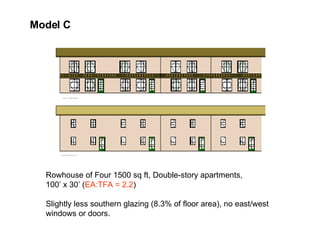
Model C Rowhouse of Four 1500 sq ft, Double-story apartments,  100’ x 30’ ( EA:TFA = 2.2 )  Slightly less southern glazing (8.3% of floor area), no east/west windows or doors.
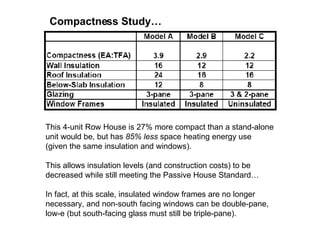
This 4-unit Row House is 27% more compact than a stand-alone unit would be, but has  85% less  space heating energy use (given the same insulation and windows). This allows insulation levels (and construction costs) to be decreased while still meeting the Passive House Standard… In fact, at this scale, insulated window frames are no longer necessary, and non-south facing windows can be double-pane, low-e (but south-facing glass must still be triple-pane). Compactness Study…
generating form: compactness Other issues: Compactness is not always intuitive, especially as building size changes. Compactness should not preclude daylighting and natural ventilation. Architects must accept that if we intend to burn fossil fuels to condition our buildings, we must also accept our responsibility to create a conservative form. We must accept the limitations of compact forms as a direct result of the limitations of renewable energy resources.
the continuous thermal envelope
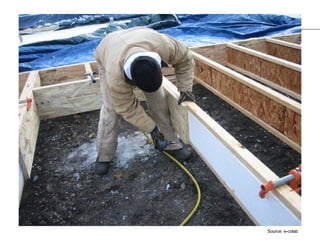
Source: e-colab Floating slab allows continuous insulation
passive house news… Source: e-colab
Source: e-colab
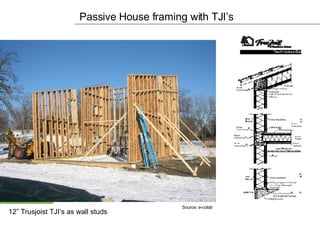
Passive House framing with TJI’s 12” Trusjoist TJI’s as wall studs Source: e-colab
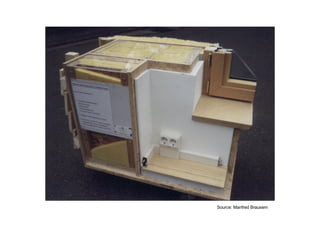
Source: Manfred Brausem
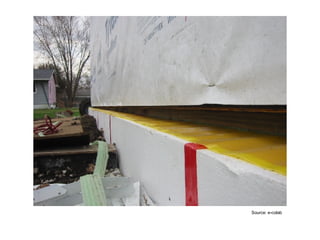
passive house news… Source: e-colab
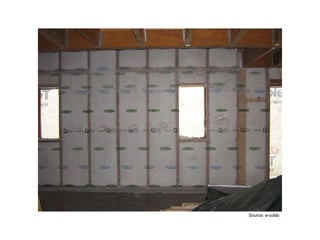
Insulated header above window  Source: e-colab
Source: e-colab
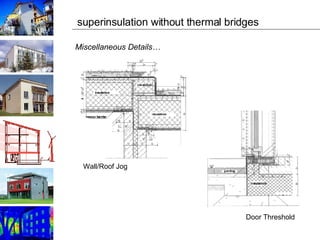
superinsulation without thermal bridges Miscellaneous Details… Wall/Roof Jog Door Threshold
Minimize roof penetrations by combining all plumbing fixtures to one vent Source: e-colab
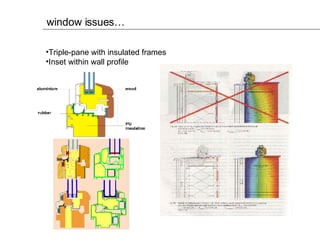
window issues… Triple-pane with insulated frames Inset within wall profile
Continuous air barrier is applied to achieve… … Air Leakage (@ 50 Pa) of less than 0.6 house volumes per hour airtightness…
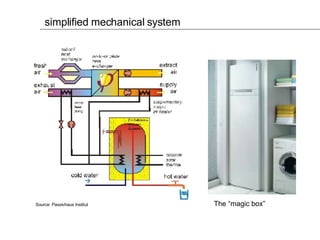
simplified mechanical system The “magic box” Source: Passivhaus Institut
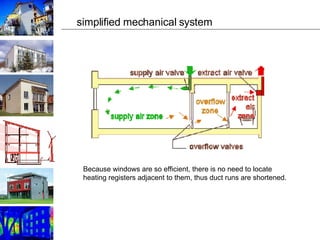
simplified mechanical system Because windows are so efficient, there is no need to locate heating registers adjacent to them, thus duct runs are shortened.
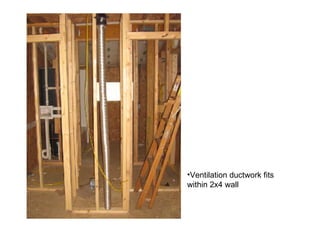
Ventilation ductwork fits within 2x4 wall
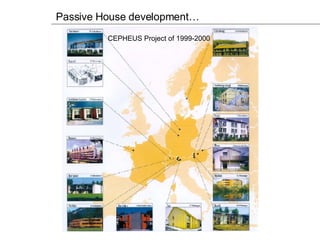
Passive House development… CEPHEUS Project of 1999-2000
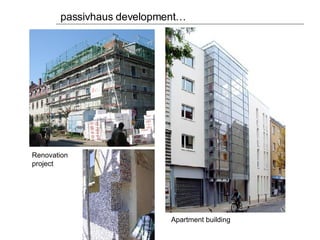
passivhaus development… Renovation project Apartment building
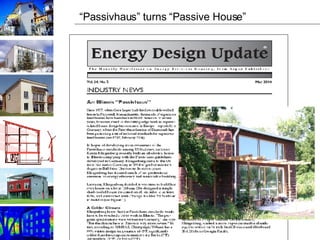
“ Passivhaus” turns “Passive House”
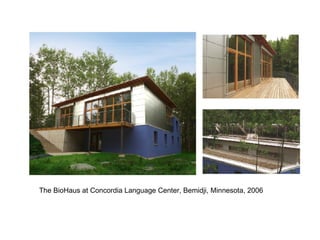
The BioHaus at Concordia Language Center, Bemidji, Minnesota, 2006
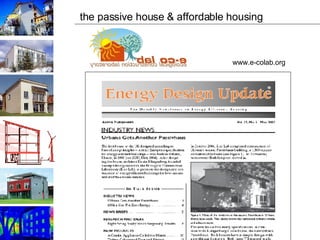
the passive house & affordable housing www.e-colab.org
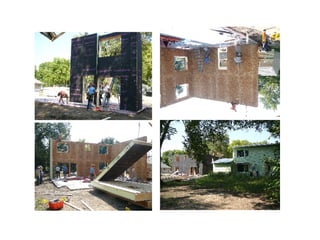
Prefabricated Panel Construction
 
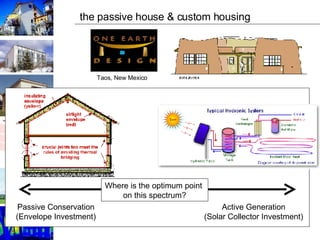
the passive house & custom housing Taos, New Mexico Passive Conservation (Envelope Investment) Active Generation (Solar Collector Investment) Where is the optimum point  on this spectrum?
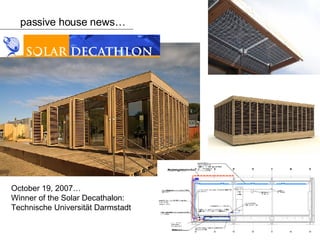
passive house news… October 19, 2007…  Winner of the Solar Decathalon: Technische Universität Darmstadt
passive house development…
Conclusions We cannot talk of sustainable development without solving the energy issue. Piecemeal improvements will not get us there in time to prevent catastrophic climate change. The Passive House method is the most ambitious and most verified energy efficiency design method Given the Passive House methodology, architects are empowered with the necessary tools to make the right design decisions. For more information: www.passivehouse.us [email_address]

Passive House In Depth for Professionals

  • 1.
    the ‘passive house’energy design standard Dylan Lamar, BSCE Architecture Graduate Student making a leap toward carbon-neutral buildings
  • 2.
    Source: Intergovernmental Panelon Climate Change Countering global warming requires rethinking every facet of human society.
  • 3.
    Source: UN EnvironmentalProgramme Source: Architecture 2030
  • 4.
  • 5.
    the ‘passive house’energy design standard an energy efficiency design standard (and methodology) achieving 90% reductions in space heating energy, and 70% reduction in total building energy use.
  • 6.
    “ Passive House?…didn’t we already try that back in the 80’s?” From German: “Passivhaus” Not limited to houses House as Passive Machine (not confined to passive solar concerns) Source: Passivhaus Institut
  • 7.
    built examples ineurope… First Passivhaus, Darmstadt, Germany, 1991 Supermarket Office Building Single-Family House
  • 8.
    built examples inEurope… Manufacturing Plant Austria Apartment building Cologne, Germany
  • 9.
    built examples inEurope… Gym Heidelberg, Germany School Waldshut, Germany
  • 10.
    the concept ConceptOrigin: “Tunneling through the cost barrier” – Amory Lovins, Rocky Mountain Institute Source: Passivhaus Institut
  • 11.
    the concept Source:Passivhaus Institut ACTIVE vs. PASSIVE
  • 12.
    the standard HeatingEnergy Use < 15 kWh/m 2 yr (4,750 BTU/ft 2 yr) Peak Heat Load < 10 W/m 2 (3.2 BTU/hr.ft 2 ) Airtightness: n 50 < 0.6 ACH (a typical residence is 5) Total Primary Energy Use < 120 kWh/m 2 yr (38,000 BTU/ft 2 yr) “ A building which can meet its heating and cooling needs solely through conditioning the incoming fresh air volume required for good indoor air quality”
  • 13.
    design principles FirstMinimize Losses… Superinsulated & Airtight Envelope without thermal bridges Heat Recovery Ventilation, >80% efficiency Then Maximize Gain… Passive Solar Gain (often optional) Technology can easily be added in the future Source: Passivhaus Institut
  • 14.
    design principles: minimizelosses Continuous Insulation- creating steady indoor temperatures that won’t drop below 50 degrees without heating source Airtightness- minimizes moisture diffusion into wall assembly Thermal Bridge Free Construction- minimizes condensation/ building deterioration Balanced Ventilation with Heat Recovery- exceptional indoor air-quality Source: Passivhaus Institut
  • 15.
    design principles: minimizelosses Source: e-colab optimize the building… … to the heating system the “gas mileage” of a building:
  • 16.
    design principles: minimizelosses Source: e-colab … not the heating system to the building.
  • 17.
    design principles: minimizelosses Heat Recovery Ventilation
  • 18.
    the result Source:Passivhaus Institut
  • 19.
    the method The“Passive House Planning Package” (PHPP) An Excel-based steady-state energy design program Extremely detailed Calculations are transparent and customizable
  • 20.
    the method Empoweringbuilding designers with the necessary information to make the best decisions.
  • 21.
    a tour ofPassive House design and construction… Generating form based on energy concerns -Compactness -Glazing Area Detailing the Continuous Thermal Envelope -Eliminating thermal bridges -Achieving airtightness Simplifying the mechanical system
  • 22.
    generating form: compactnessModel A 1500 sq ft, Single-Story, 30’ x 50’ rectangular plan ( Envelope Area-to-Floor Area Ratio, EA:TFA = 3.9 ) South glazing 10.8% of floor area.
  • 23.
    Model A asa Passive House 1500 sq ft, Single-story Home (EA:TFA = 3.9) Walls: 16” TJI Framing with Cellulose Insulation (R-58) Roof: 24” Cellulose (R-86) Below Slab: 12” EPS Styrofoam (R-47) High-Performance Triple-Pane Windows w/ Insul. Frames South: R-6.3 (U-0.16), SHGC=0.61 Other directions: R-8.3 (U-0.12), SHGC=0.37 High-Performance Insulated Doors (Air-tight) Continuous Air Barrier w/ Heat Recovery Ventilation (  >70%) Auxiliary Heating Source: Max Heat Load is about the same as the output of a large hair dryer A three-fold decrease in space heating energy use from a superinsulated envelope with only “high performance” double-pane windows.
  • 24.
    Model B Atwo-story version of Model A… 1500 sq ft, Double-story 25’ x 30’ ( EA:TFA = 2.9 ) Exact same windows and doors as Model A.
  • 25.
    Model C Rowhouseof Four 1500 sq ft, Double-story apartments, 100’ x 30’ ( EA:TFA = 2.2 ) Slightly less southern glazing (8.3% of floor area), no east/west windows or doors.
  • 26.
    This 4-unit RowHouse is 27% more compact than a stand-alone unit would be, but has 85% less space heating energy use (given the same insulation and windows). This allows insulation levels (and construction costs) to be decreased while still meeting the Passive House Standard… In fact, at this scale, insulated window frames are no longer necessary, and non-south facing windows can be double-pane, low-e (but south-facing glass must still be triple-pane). Compactness Study…
  • 27.
    generating form: compactnessOther issues: Compactness is not always intuitive, especially as building size changes. Compactness should not preclude daylighting and natural ventilation. Architects must accept that if we intend to burn fossil fuels to condition our buildings, we must also accept our responsibility to create a conservative form. We must accept the limitations of compact forms as a direct result of the limitations of renewable energy resources.
  • 28.
  • 29.
    Source: e-colab Floatingslab allows continuous insulation
  • 30.
    passive house news…Source: e-colab
  • 31.
  • 32.
    Passive House framingwith TJI’s 12” Trusjoist TJI’s as wall studs Source: e-colab
  • 33.
  • 34.
    passive house news…Source: e-colab
  • 35.
    passive house news…Source: e-colab
  • 36.
    Insulated header abovewindow Source: e-colab
  • 37.
  • 38.
    superinsulation without thermalbridges Miscellaneous Details… Wall/Roof Jog Door Threshold
  • 39.
    Minimize roof penetrationsby combining all plumbing fixtures to one vent Source: e-colab
  • 40.
    window issues… Triple-panewith insulated frames Inset within wall profile
  • 41.
    Continuous air barrieris applied to achieve… … Air Leakage (@ 50 Pa) of less than 0.6 house volumes per hour airtightness…
  • 42.
    simplified mechanical systemThe “magic box” Source: Passivhaus Institut
  • 43.
    simplified mechanical systemBecause windows are so efficient, there is no need to locate heating registers adjacent to them, thus duct runs are shortened.
  • 44.
  • 45.
    Passive House development…CEPHEUS Project of 1999-2000
  • 46.
    passivhaus development… Renovationproject Apartment building
  • 47.
    “ Passivhaus” turns“Passive House”
  • 48.
    The BioHaus atConcordia Language Center, Bemidji, Minnesota, 2006
  • 49.
    the passive house& affordable housing www.e-colab.org
  • 50.
  • 51.
  • 52.
    the passive house& custom housing Taos, New Mexico Passive Conservation (Envelope Investment) Active Generation (Solar Collector Investment) Where is the optimum point on this spectrum?
  • 53.
    passive house news…October 19, 2007… Winner of the Solar Decathalon: Technische Universität Darmstadt
  • 54.
  • 55.
    Conclusions We cannottalk of sustainable development without solving the energy issue. Piecemeal improvements will not get us there in time to prevent catastrophic climate change. The Passive House method is the most ambitious and most verified energy efficiency design method Given the Passive House methodology, architects are empowered with the necessary tools to make the right design decisions. For more information: www.passivehouse.us [email_address]