




















Welcome!


           TM
The Passive House Building Energy Standard


       by Tim Delhey Eian, Certified Passive House™ Consultant
TM
TM
     Overview


     Definition
     Motivation
     History
     Basics
     Benefits
     Delivery
Definition
Certified Passive House™


                   TM


“A rigorous, voluntary building energy standard
focusing on highest energy efficiency and quality of life
at low operating cost.”


The Passive House Standard is the most rigorous building energy standard in the world. Consultants, projects or building components that have obtained
the right to carry the logo have committed themselves to design excellence and the Passive House energy performance criteria.
TM
     It’s a tool!
Motivation
TM
     Finance


     $
TM
     Resource


                Source: dreamstime.com
TM
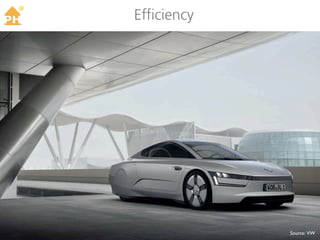
     Efficiency


                  Source: VW
TM
     Opportunity
TM
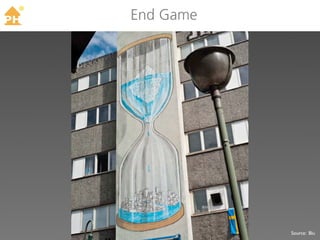
     End Game


                Source: Blu
History
TM
     Early warning signs
TM
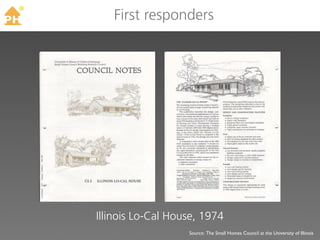
        First responders


     Illinois Lo-Cal House, 1974
                        Source: The Small Homes Council at the University of Illinois
TM
     Common sense
TM
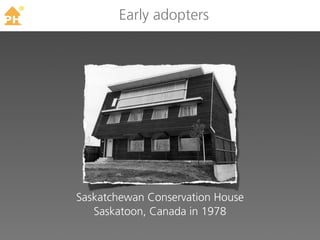
            Early adopters


     Saskatchewan Conservation House
        Saskatoon, Canada in 1978
TM
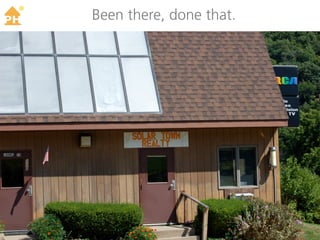
     Been there, done that.
TM
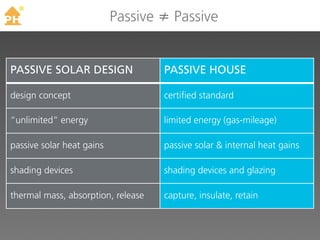
                           Passive ≠ Passive


PASSIVE SOLAR DESIGN                PASSIVE HOUSE

design concept                      certified standard

“unlimited” energy                  limited energy (gas-mileage)

passive solar heat gains            passive solar & internal heat gains

shading devices                     shading devices and glazing

thermal mass, absorption, release   capture, insulate, retain
TM
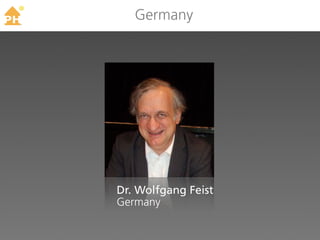
        Germany


     Dr. Wolfgang Feist
     Germany
TM
          Architype


1990


       1996: PHI - Passivhaus Institut
                                     Source: Passiv Haus Institut
TM
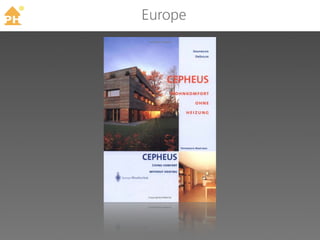
     Europe
TM
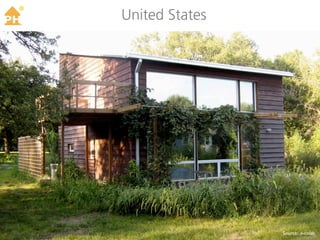
                             United States


Smith House - Urbana, IL - 2003 - e-colab (first built in the U.S.) - Zonee-colab
                                                                      Source: 3
TM
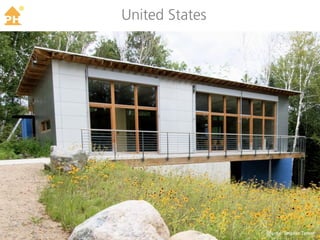
     United States


                     Source: Stephan Tanner
TM
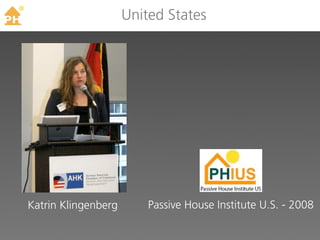
                          United States


     Katrin Klingenberg       Passive House Institute U.S. - 2008
TM
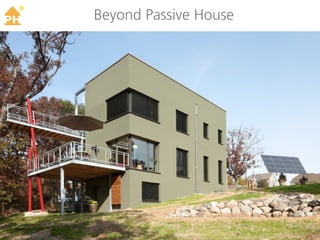
     Beyond Passive House
TM
           Pedigree


     2011: 20a & 25k+ PH
The Basics
TM
           Concept


     Conservation first
     Minimize losses
     Maximize gains
Architect:       Tim Eian/TE Studio, Ltd.
                                                                 Street:        3429 Benjamin St. NE


TM
                                                          Postcode/City:

                                                   Mechanical System:
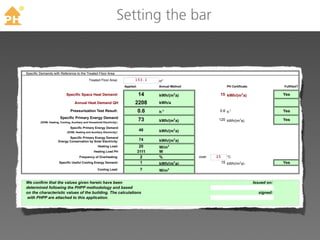
                                                                           Setting the bar
                                                                                Minneapolis, MN 55418
                                                                                TE Studio, Ltd.
                                                               Street:          3429 Benjamin St. NE
                                                       Postcode/City:           Minneapolis, MN 55418

                                                  Year of Construction:                2009                                                         0.17
                                                                                                                            A/V Ratio:
                                            Number of Dwelling Units:                       1                     Interior Temperature:             20.0           °C

                                                  Enclosed Volume Ve:                  916.8      m3              Internal Heat Gains:               2.1           W/m2
                                                Number of Occupants:                       2.0

     Specific Demands with Reference to the Treated Floor Area
                                                    Treated Floor Area:                153.1      m2
                                                                                Applied:          Annual Method                           PH Certificate:                 Fulfilled?

                                  Specific Space Heat Demand:                              14     kWh/(m2 a)                       15 kWh/(m2 a)                          Yes

                                         Annual Heat Demand QH                         2208       kWh/a

                                     Pressurization Test Result:                           0.6    h-1                              0.6 h-1                                Yes
                             Specific Primary Energy Demand
              (DHW, Heating, Cooling, Auxiliary and Household Electricity) :
                                                                                           73     kWh/(m2 a)                      120 kWh/(m2a)                           Yes
                                     Specific Primary Energy Demand
                                   (DHW, Heating and Auxiliary Electricity) :
                                                                                           48     kWh/(m2 a)
                                   Specific Primary Energy Demand
                            Energy Conservation by Solar Electricity:                      74     kWh/(m2 a)
                                                            Heating Load:                   20    W/m2
                                                         Heating Load PH                   3111   W
                                             Frequency of Overheating:                       2    %                  over       25        °C
                            Specific Useful Cooling Energy Demand:                           1    kWh/(m2 a)                         15 kWh/(m2a)                         Yes
                                                            Cooling Load:                   7     W/m2


     We confirm that the values given herein have been                                                                                                      Issued on:
     determined following the PHPP methodology and based
     on the characteristic values of the building. The calculations                                                                                           signed:
     with PHPP are attached to this application.
TM
        Metric vs. Prescriptive


Energy per square foot and year


        gas mileage for buildings
TM
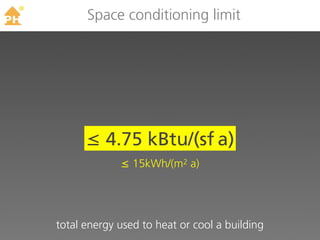
           Space conditioning limit


           ≤ 4.75 kBtu/(sf a)
                  ≤ 15kWh/(m2 a)


     total energy used to heat or cool a building
TM
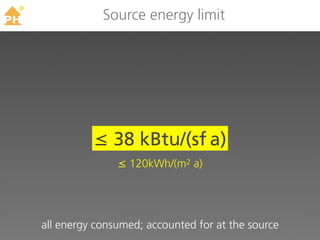
                 Source energy limit


               ≤ 38 kBtu/(sf a)
                    ≤ 120kWh/(m2 a)


     all energy consumed; accounted for at the source
TM
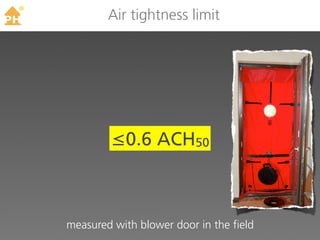
             Air tightness limit


              ≤0.6 ACH50


     measured with blower door in the field
TM
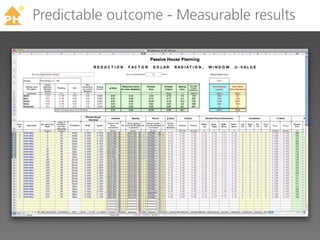
     Predictable outcome - Measurable results
TM
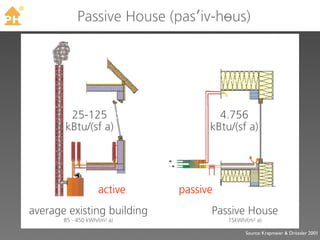
                 Passive House (pas′iv-ho̵us)


             25-125                       4.756
            kBtu/(sf a)                 kBtu/(sf a)


                         active   passive
     average existing building          Passive House
            85 - 450 kWh/(m2 a)             15kWh/(m2 a)

                                                  Source: Krapmeier & Drössler 2001
TM
        Global standard

     think globally, build locally
TM
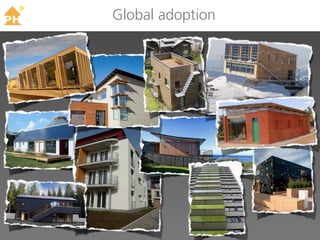
     Global adoption
TM
     EU code
Benefits
TM
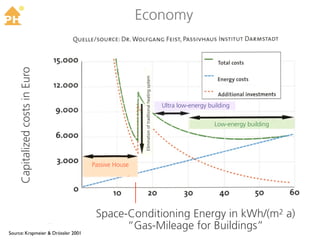
                                                    Economy
     Capitalized costs in Euro


                                                     Elimination of traditional heating system
                                                                                                 Ultra low-energy building


                                                                                                                    Low-energy building


                                    Passive House


                                     Space-Conditioning Energy in kWh/(m2 a)
Source: Krapmeier & Drössler 2001
                                           “Gas-Mileage for Buildings”
TM
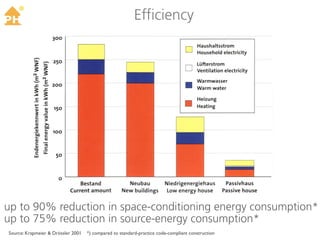
                                                          Efficiency


up to 90% reduction in space-conditioning energy consumption*
up to 75% reduction in source-energy consumption*
Source: Krapmeier & Drössler 2001   *) compared to standard-practice code-compliant construction
TM
     Environment
TM
     Comfort
TM
     Health
TM
     Quality construction
TM
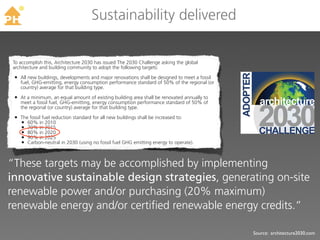
                                    Sustainability delivered

To accomplish this, Architecture 2030 has issued The 2030 Challenge asking the global
architecture and building community to adopt the following targets:

 • All new buildings, developments and major renovations shall be designed to meet a fossil
   fuel, GHG-emitting, energy consumption performance standard of 50% of the regional (or
   country) average for that building type.

 • At a minimum, an equal amount of existing building area shall be renovated annually to
   meet a fossil fuel, GHG-emitting, energy consumption performance standard of 50% of
   the regional (or country) average for that building type.

 • The fossil fuel reduction standard for all new buildings shall be increased to:
   • 60% in 2010
   • 70% in 2015
   • 80% in 2020
   • 90% in 2025
   • Carbon-neutral in 2030 (using no fossil fuel GHG emitting energy to operate).


“These targets may be accomplished by implementing
innovative sustainable design strategies, generating on-site
renewable power and/or purchasing (20% maximum)
renewable energy and/or certified renewable energy credits.”

                                                                                              Source: architecture2030.com
TM
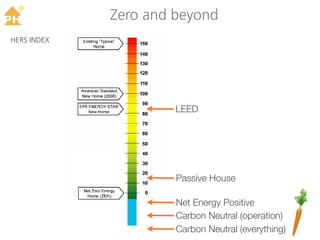
             Zero and beyond
HERS INDEX


             Z        LEED


                      Passive House

                      Net Energy Positive
                      Carbon Neutral (operation)
                      Carbon Neutral (everything)
Delivery
TM
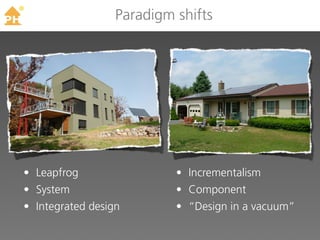
                       Paradigm shifts


     • Leapfrog                 • Incrementalism
     • System                   • Component
     • Integrated design        • “Design in a vacuum”
TM
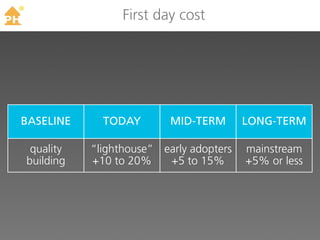
                      First day cost


BASELINE          TODAY        MID-TERM       LONG-TERM

      quality   “lighthouse” early adopters   mainstream
     building   +10 to 20%    +5 to 15%       +5% or less
TM
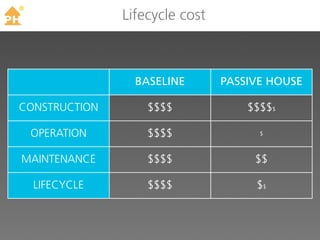
                 Lifecycle cost


                   BASELINE       PASSIVE HOUSE

CONSTRUCTION         $$$$             $$$$$

     OPERATION       $$$$               $


 MAINTENANCE         $$$$              $$

     LIFECYCLE       $$$$              $$
Thanks.
resources


      TM


phmn.org

passivehousealliance.org

passivehouse-international.org

passivehouse.us

passivehouse.com

Passive House slideshow for Passive House Minn

  • 1.
  • 2.
    The Passive HouseBuilding Energy Standard by Tim Delhey Eian, Certified Passive House™ Consultant
  • 3.
  • 4.
    TM Overview Definition Motivation History Basics Benefits Delivery
  • 5.
  • 6.
    Certified Passive House™ TM “A rigorous, voluntary building energy standard focusing on highest energy efficiency and quality of life at low operating cost.” The Passive House Standard is the most rigorous building energy standard in the world. Consultants, projects or building components that have obtained the right to carry the logo have committed themselves to design excellence and the Passive House energy performance criteria.
  • 7.
    TM It’s a tool!
  • 8.
  • 9.
    TM Finance $
  • 10.
    TM Resource Source: dreamstime.com
  • 11.
    TM Efficiency Source: VW
  • 12.
    TM Opportunity
  • 13.
    TM End Game Source: Blu
  • 14.
  • 15.
    TM Early warning signs
  • 16.
    TM First responders Illinois Lo-Cal House, 1974 Source: The Small Homes Council at the University of Illinois
  • 17.
    TM Common sense
  • 18.
    TM Early adopters Saskatchewan Conservation House Saskatoon, Canada in 1978
  • 19.
    TM Been there, done that.
  • 20.
    TM Passive ≠ Passive PASSIVE SOLAR DESIGN PASSIVE HOUSE design concept certified standard “unlimited” energy limited energy (gas-mileage) passive solar heat gains passive solar & internal heat gains shading devices shading devices and glazing thermal mass, absorption, release capture, insulate, retain
  • 21.
    TM Germany Dr. Wolfgang Feist Germany
  • 22.
    TM Architype 1990 1996: PHI - Passivhaus Institut Source: Passiv Haus Institut
  • 23.
    TM Europe
  • 24.
    TM United States Smith House - Urbana, IL - 2003 - e-colab (first built in the U.S.) - Zonee-colab Source: 3
  • 25.
    TM United States Source: Stephan Tanner
  • 26.
    TM United States Katrin Klingenberg Passive House Institute U.S. - 2008
  • 27.
    TM Beyond Passive House
  • 28.
    TM Pedigree 2011: 20a & 25k+ PH
  • 29.
  • 30.
    TM Concept Conservation first Minimize losses Maximize gains
  • 31.
    Architect: Tim Eian/TE Studio, Ltd. Street: 3429 Benjamin St. NE TM Postcode/City: Mechanical System: Setting the bar Minneapolis, MN 55418 TE Studio, Ltd. Street: 3429 Benjamin St. NE Postcode/City: Minneapolis, MN 55418 Year of Construction: 2009 0.17 A/V Ratio: Number of Dwelling Units: 1 Interior Temperature: 20.0 °C Enclosed Volume Ve: 916.8 m3 Internal Heat Gains: 2.1 W/m2 Number of Occupants: 2.0 Specific Demands with Reference to the Treated Floor Area Treated Floor Area: 153.1 m2 Applied: Annual Method PH Certificate: Fulfilled? Specific Space Heat Demand: 14 kWh/(m2 a) 15 kWh/(m2 a) Yes Annual Heat Demand QH 2208 kWh/a Pressurization Test Result: 0.6 h-1 0.6 h-1 Yes Specific Primary Energy Demand (DHW, Heating, Cooling, Auxiliary and Household Electricity) : 73 kWh/(m2 a) 120 kWh/(m2a) Yes Specific Primary Energy Demand (DHW, Heating and Auxiliary Electricity) : 48 kWh/(m2 a) Specific Primary Energy Demand Energy Conservation by Solar Electricity: 74 kWh/(m2 a) Heating Load: 20 W/m2 Heating Load PH 3111 W Frequency of Overheating: 2 % over 25 °C Specific Useful Cooling Energy Demand: 1 kWh/(m2 a) 15 kWh/(m2a) Yes Cooling Load: 7 W/m2 We confirm that the values given herein have been Issued on: determined following the PHPP methodology and based on the characteristic values of the building. The calculations signed: with PHPP are attached to this application.
  • 32.
    TM Metric vs. Prescriptive Energy per square foot and year gas mileage for buildings
  • 33.
    TM Space conditioning limit ≤ 4.75 kBtu/(sf a) ≤ 15kWh/(m2 a) total energy used to heat or cool a building
  • 34.
    TM Source energy limit ≤ 38 kBtu/(sf a) ≤ 120kWh/(m2 a) all energy consumed; accounted for at the source
  • 35.
    TM Air tightness limit ≤0.6 ACH50 measured with blower door in the field
  • 36.
    TM Predictable outcome - Measurable results
  • 37.
    TM Passive House (pas′iv-ho̵us) 25-125 4.756 kBtu/(sf a) kBtu/(sf a) active passive average existing building Passive House 85 - 450 kWh/(m2 a) 15kWh/(m2 a) Source: Krapmeier & Drössler 2001
  • 38.
    TM Global standard think globally, build locally
  • 39.
    TM Global adoption
  • 40.
    TM EU code
  • 41.
  • 42.
    TM Economy Capitalized costs in Euro Elimination of traditional heating system Ultra low-energy building Low-energy building Passive House Space-Conditioning Energy in kWh/(m2 a) Source: Krapmeier & Drössler 2001 “Gas-Mileage for Buildings”
  • 43.
    TM Efficiency up to 90% reduction in space-conditioning energy consumption* up to 75% reduction in source-energy consumption* Source: Krapmeier & Drössler 2001 *) compared to standard-practice code-compliant construction
  • 44.
    TM Environment
  • 45.
    TM Comfort
  • 46.
    TM Health
  • 47.
    TM Quality construction
  • 48.
    TM Sustainability delivered To accomplish this, Architecture 2030 has issued The 2030 Challenge asking the global architecture and building community to adopt the following targets: • All new buildings, developments and major renovations shall be designed to meet a fossil fuel, GHG-emitting, energy consumption performance standard of 50% of the regional (or country) average for that building type. • At a minimum, an equal amount of existing building area shall be renovated annually to meet a fossil fuel, GHG-emitting, energy consumption performance standard of 50% of the regional (or country) average for that building type. • The fossil fuel reduction standard for all new buildings shall be increased to: • 60% in 2010 • 70% in 2015 • 80% in 2020 • 90% in 2025 • Carbon-neutral in 2030 (using no fossil fuel GHG emitting energy to operate). “These targets may be accomplished by implementing innovative sustainable design strategies, generating on-site renewable power and/or purchasing (20% maximum) renewable energy and/or certified renewable energy credits.” Source: architecture2030.com
  • 49.
    TM Zero and beyond HERS INDEX Z LEED Passive House Net Energy Positive Carbon Neutral (operation) Carbon Neutral (everything)
  • 50.
  • 51.
    TM Paradigm shifts • Leapfrog • Incrementalism • System • Component • Integrated design • “Design in a vacuum”
  • 52.
    TM First day cost BASELINE TODAY MID-TERM LONG-TERM quality “lighthouse” early adopters mainstream building +10 to 20% +5 to 15% +5% or less
  • 53.
    TM Lifecycle cost BASELINE PASSIVE HOUSE CONSTRUCTION $$$$ $$$$$ OPERATION $$$$ $ MAINTENANCE $$$$ $$ LIFECYCLE $$$$ $$
  • 54.
  • 55.
    resources TM phmn.org passivehousealliance.org passivehouse-international.org passivehouse.us passivehouse.com