Windows and glazed area
                                technologies and materials in
                                Europe
                                Bertrand Cazes


IEA - Building Envelope Technologies and Policies Workshop – 17 Nov 2011
About Glass for Europe

• 4 member companies and 1associate:
   • Run 58 of the 67 float lines based in the EU & EU
     candidate countries
   • Above 90% of the EU production             In association with:


• Flat glass:
   • Primarily building, automotive & solar-energy glass
   • Also furnitures, electronics, appliances

• Supporter of building energy-efficiency
                                                                       2
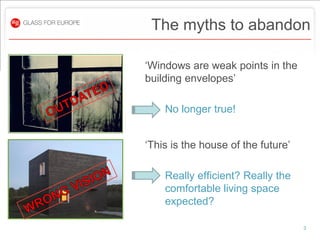
The myths to abandon

‘Windows are weak points in the
building envelopes’

    No longer true!


‘This is the house of the future’

    Really efficient? Really the
    comfortable living space
    expected?

                                    3
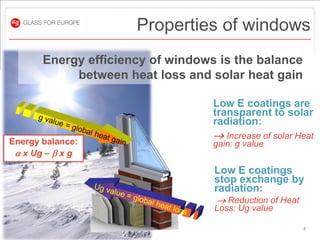
Properties of windows
       Energy efficiency of windows is the balance
            between heat loss and solar heat gain

                                   Low E coatings are
                                   transparent to solar
                                   radiation:
                                    Increase of solar Heat
Energy balance:                    gain: g value
 a x Ug – b x g
                                   Low E coatings
                                   stop exchange by
                                   radiation:
                                    Reduction of Heat
                                   Loss: Ug value

                                                         4
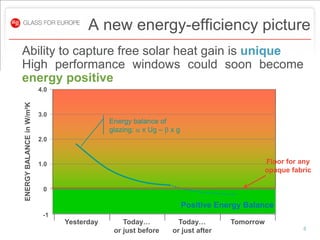
A new energy-efficiency picture
Ability to capture free solar heat gain is unique
High performance windows could soon become
energy positive
                          4.0
ENERGY BALANCE in W/m²K


                          3.0
                                            Energy balance of
                                            glazing: a x Ug – b x g
                          2.0


                          1.0                                                              Floor for any
                                                                                           opaque fabric

                           0
                                Yesterday       Today…            Today…        Tomorrow
                                             or just before     or Positive Energy Balance
                                                                   just after
                           -1
                                Yesterday       Today…            Today…        Tomorrow
                                             or just before     or just after                        5
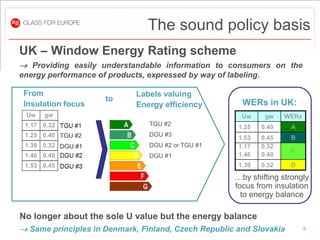
The sound policy basis
UK – Window Energy Rating scheme
 Providing easily understandable information to consumers on the
energy performance of products, expressed by way of labeling.

 From                        Labels valuing
                     to
 Insulation focus            Energy efficiency          WERs in UK:
 Uw   gw                                                Uw       gw    WERs
 1.17 0.32 TGU #1               TGU #2                 1.25     0.40    A
 1.25 0.40 TGU #2               DGU #3
                                                       1.53     0.45    B
 1.39 0.32 DGU #1               DGU #2 or TGU #1       1.17     0.32
                                                                        C
 1.46 0.40 DGU #2               DGU #1                 1.46     0.40
 1.53 0.45 DGU #3                                      1.39     0.32    D

                                                      …by shifting strongly
                                                      focus from insulation
                                                        to energy balance

No longer about the sole U value but the energy balance
 Same principles in Denmark, Finland, Czech Republic and Slovakia            6
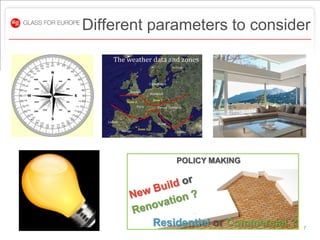
Different parameters to consider


             POLICY MAKING


         Residential or Commercial ?   7
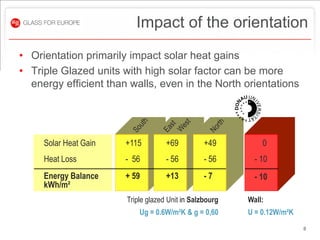
Impact of the orientation
• Orientation primarily impact solar heat gains
• Triple Glazed units with high solar factor can be more
  energy efficient than walls, even in the North orientations


     Solar Heat Gain   +115         +69          +49         0
     Heat Loss         - 56         - 56         - 56      - 10
     Energy Balance    + 59         +13          -7        - 10
     kWh/m²
                       Triple glazed Unit in Salzbourg   Wall:
                           Ug = 0.6W/m²K & g = 0,60      U = 0.12W/m²K
                                                                         8
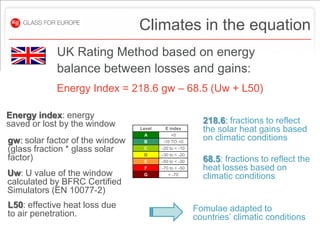
Climates in the equation
            UK Rating Method based on energy
            balance between losses and gains:
            Energy Index = 218.6 gw – 68.5 (Uw + L50)

Energy index: energy
saved or lost by the window                               218.6: fractions to reflect
                                 Level     E index        the solar heat gains based
                                   A          >0
gw: solar factor of the window     B      -10 TO <0
                                                          on climatic conditions
(glass fraction * glass solar      C     -20 to < -10
                                   D     -30 to < -20
factor)                            E     -50 to < -30     68.5: fractions to reflect the
                                   F     -70 to < -50     heat losses based on
Uw: U value of the window          G        < -70
                                                          climatic conditions
calculated by BFRC Certified
Simulators (EN 10077-2)
L50: effective heat loss due                            Fomulae adapted to
to air penetration.                                     countries’ climatic conditions
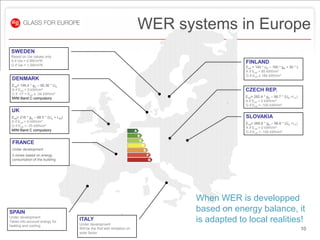
WER systems in Europe
 SWEDEN
 Based on Uw values only
 A if Uw = 0.9W/m²K                                                                              FINLAND
 G if Uw = 1.5W/m²K
                                                                                                 Eref = 140 * uw – 160 * gw + 50 * L
                                                                                                 A if Eref < 85 kWh/m²
                                                                                                 G if Eref ≥ 185 kWh/m²
 DENMARK
 Eref= 196,4 * gw – 90,36 * Uw
 A if Eref > 0 kWh/m²                                                                            CZECH REP.
 C if -17 > Eref ≥ -34 kWh/m²
 MINI Band C compulsory                                                                          Eref= 282.4 * gw – 98.7 * (Uw +Lw)
                                                                                                 A if Eref > 0 kWh/m²
                                                                                                 G if Eref < -100 kWh/m²
 UK
 Eref= 218 * gw – 68.5 * (Uw + L50)                                                              SLOVAKIA
 A if Eref > 0 kWh/m²                                                                            Eref= 266.6 * gw – 96.6 * (Uw +Lw)
 G if Eref < -70 kWh/m²
                                                                                                 A if Eref > 0 kWh/m²
 MINI Band C compulsory
                                                                                                 G if Eref < -100 kWh/m²


 FRANCE
 Under development
 3 zones based on energy
 consumption of the building


                                                                                    When WER is developped
SPAIN                                                                               based on energy balance, it
Under development
Takes into account energy for
                                      ITALY
                                      Under development
                                                                                    is adapted to local realities!
heating and cooling
                                      Will be the first with limitation on                                                             10
                                      solar factor
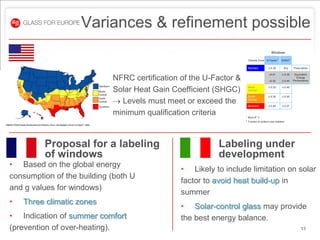
Variances & refinement possible


                            NFRC certification of the U-Factor &
                            Solar Heat Gain Coefficient (SHGC)
                             Levels must meet or exceed the
                            minimum qualification criteria


         Proposal for a labeling                         Labeling under
         of windows                                      development
• Based on the global energy
                                               • Likely to include limitation on solar
consumption of the building (both U
                                               factor to avoid heat build-up in
and g values for windows)
                                               summer
•   Three climatic zones
                                               • Solar-control glass may provide
• Indication of summer comfort                 the best energy balance.
(prevention of over-heating).                                                    11
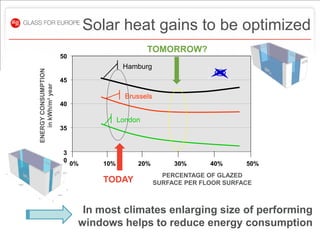
Solar heat gains to be optimized
                                                TOMORROW?
                     50
                                        Hamburg
ENERGY CONSUMPTION


                     45
    in kWh/m² year


                                         Brussels
                     40

                                       London
                     35


                     3
                     0
                          0%     10%        20%          30%      40%      50%
                                                      PERCENTAGE OF GLAZED
                                 TODAY              SURFACE PER FLOOR SURFACE


                            In most climates enlarging size of performing
                           windows helps to reduce energy consumption
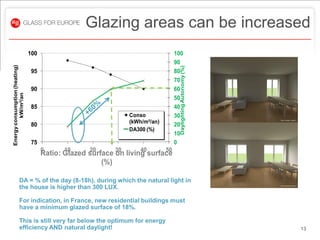
Glazing areas can be increased
                               100                                             100
                                                                               90
Energy consumption (heating)


                                                                                 Daylighting Autonomy (%)
                                95                                             80
                                                                               70
                                90                                             60
         kW/m²/an


                                                                               50
                                85                                             40
                                                               Conso           30
                                                               (kWh/m²/an)
                                80                                             20
                                                               DA300 (%)
                                                                               10
                                75                                             0
                                     Ratio: Glazed surface 30 living surface
                                     0      10     20
                                                           on      40     50

                                                       (%)
                   VELUX software
               DA = % of the day (8-18h), during which the natural light in
               the house is higher than 300 LUX.

               For indication, in France, new residential buildings must
               have a minimum glazed surface of 18%.

               This is still very far below the optimum for energy
               efficiency AND natural daylight!                                                             13
Way to reduce artificial lighting

• As buildings become more efficient, lighting
  becomes the most important consumer of
  energy in buildings

• Electricity remains one of the most carbon
  intensive form of energy

• Regulatory requirements and standards:
   •   EU EPBD directive: Nearly Zero Energy Buildings - to
       become the norm as of 2020 - lighting included in energy
       demand (office buildings).
   •   Passive Haus: electricity for lighting and appliances have
       to be minimised (German standard)
   •   Proposal for a criterion on ‘daylight availability’ for the
       EU Ecolabel for office buildings
   •   Active House: daylight factor > 5% on average
   •   Need to envisage criterion on daylight autonomy

   Easiest answer is Daylight thanks to glazed areas
Conclusion
Hopefully, the myths are dead!
It’s time to build differently with a holistic
energy balance approach

•   Energy efficiency of windows must take into
    account thermal losses AND solar heat gains
    • Calculation should be based on a robust methodology
    • Different climatic conditions with direct impact on energy
      consumption of the building.
    • Artificial lighting through Daylighting autonomy should be part of
      the energetic performance of the window
    • NEXT STEP: properly take account of the orientation and size of
      windows in addition to the location
                                                                       15
Thank you!
                                                                    Bertrand Cazes
                                                           info@glassforeurope.com
                                                            www.glassforeurope.com


IEA - Building Envelope Technologies and Policies Workshop – 17 Nov 2011
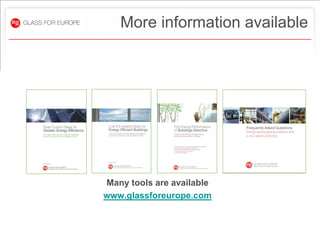
More information available


Many tools are available
www.glassforeurope.com
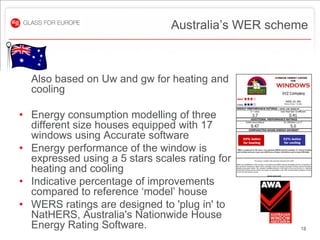
Australia’s WER scheme


  Also based on Uw and gw for heating and
  cooling

• Energy consumption modelling of three
  different size houses equipped with 17
  windows using Accurate software
• Energy performance of the window is
  expressed using a 5 stars scales rating for
  heating and cooling
• Indicative percentage of improvements
  compared to reference ‘model’ house
• WERS ratings are designed to 'plug in' to
  NatHERS, Australia's Nationwide House
  Energy Rating Software.                           18
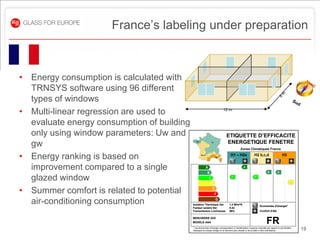
France’s labeling under preparation


• Energy consumption is calculated with
  TRNSYS software using 96 different
  types of windows
• Multi-linear regression are used to                                     12 m


  evaluate energy consumption of building
  only using window parameters: Uw and                                       ETIQUETTE D’EFFICACITE
  gw                                           H2a
                                                                             ENERGETIQUE FENETRE
                                                                                           Zones Climatiques France

• Energy ranking is based on                         H2b,c,d                      H1 – H2a               H2 b,c,d                    H3


  improvement compared to a single                                                            A
                                                                                                                       B         B

  glazed window                                                                   C                       C
                                                                                                                                             D


• Summer comfort is related to potential
  air-conditioning consumption              Isolation Thermique Uw:             1.4 W/m²K
                                                                                                               Economies d’énergie*
                                            Facteur solaire Sw:                 0.42
                                            Transmission Lumineuse              56%                            Confort d’été

                                            MENUISERIE XXX
                                            MODELE AAA                                                                FR
                                            * Les économies d’énergie correspondent à l’amélioration moyenne calculée par rapport à une fenêtre
                                            classique en simple vitrage et ne tiennent pas compte ni de la taille ni des orientations             19
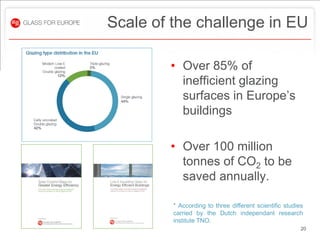
Scale of the challenge in EU

        • Over 85% of
          inefficient glazing
          surfaces in Europe’s
          buildings

        • Over 100 million
          tonnes of CO2 to be
          saved annually.

         * According to three different scientific studies
         carried by the Dutch independant research
         institute TNO.
                                                         20
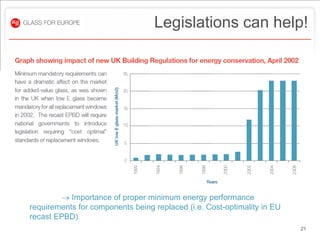
Legislations can help!


          Importance of proper minimum energy performance
requirements for components being replaced (i.e. Cost-optimality in EU
recast EPBD)
                                                                         21
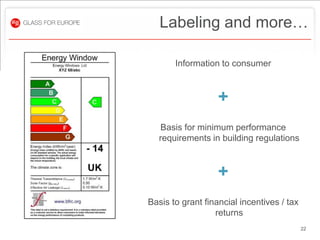
Labeling and more…

       Information to consumer


                   +
   Basis for minimum performance
   requirements in building regulations


                   +
Basis to grant financial incentives / tax
                  returns
                                            22

Windows and glazed area technologies and materials in Europe

  • 1.
    Windows and glazedarea technologies and materials in Europe Bertrand Cazes IEA - Building Envelope Technologies and Policies Workshop – 17 Nov 2011
  • 2.
    About Glass forEurope • 4 member companies and 1associate: • Run 58 of the 67 float lines based in the EU & EU candidate countries • Above 90% of the EU production In association with: • Flat glass: • Primarily building, automotive & solar-energy glass • Also furnitures, electronics, appliances • Supporter of building energy-efficiency 2
  • 3.
    The myths toabandon ‘Windows are weak points in the building envelopes’ No longer true! ‘This is the house of the future’ Really efficient? Really the comfortable living space expected? 3
  • 4.
    Properties of windows Energy efficiency of windows is the balance between heat loss and solar heat gain Low E coatings are transparent to solar radiation:  Increase of solar Heat Energy balance: gain: g value a x Ug – b x g Low E coatings stop exchange by radiation:  Reduction of Heat Loss: Ug value 4
  • 5.
    A new energy-efficiencypicture Ability to capture free solar heat gain is unique High performance windows could soon become energy positive 4.0 ENERGY BALANCE in W/m²K 3.0 Energy balance of glazing: a x Ug – b x g 2.0 1.0 Floor for any opaque fabric 0 Yesterday Today… Today… Tomorrow or just before or Positive Energy Balance just after -1 Yesterday Today… Today… Tomorrow or just before or just after 5
  • 6.
    The sound policybasis UK – Window Energy Rating scheme  Providing easily understandable information to consumers on the energy performance of products, expressed by way of labeling. From Labels valuing to Insulation focus Energy efficiency WERs in UK: Uw gw Uw gw WERs 1.17 0.32 TGU #1 TGU #2 1.25 0.40 A 1.25 0.40 TGU #2 DGU #3 1.53 0.45 B 1.39 0.32 DGU #1 DGU #2 or TGU #1 1.17 0.32 C 1.46 0.40 DGU #2 DGU #1 1.46 0.40 1.53 0.45 DGU #3 1.39 0.32 D …by shifting strongly focus from insulation to energy balance No longer about the sole U value but the energy balance  Same principles in Denmark, Finland, Czech Republic and Slovakia 6
  • 7.
    Different parameters toconsider POLICY MAKING Residential or Commercial ? 7
  • 8.
    Impact of theorientation • Orientation primarily impact solar heat gains • Triple Glazed units with high solar factor can be more energy efficient than walls, even in the North orientations Solar Heat Gain +115 +69 +49 0 Heat Loss - 56 - 56 - 56 - 10 Energy Balance + 59 +13 -7 - 10 kWh/m² Triple glazed Unit in Salzbourg Wall: Ug = 0.6W/m²K & g = 0,60 U = 0.12W/m²K 8
  • 9.
    Climates in theequation UK Rating Method based on energy balance between losses and gains: Energy Index = 218.6 gw – 68.5 (Uw + L50) Energy index: energy saved or lost by the window 218.6: fractions to reflect Level E index the solar heat gains based A >0 gw: solar factor of the window B -10 TO <0 on climatic conditions (glass fraction * glass solar C -20 to < -10 D -30 to < -20 factor) E -50 to < -30 68.5: fractions to reflect the F -70 to < -50 heat losses based on Uw: U value of the window G < -70 climatic conditions calculated by BFRC Certified Simulators (EN 10077-2) L50: effective heat loss due Fomulae adapted to to air penetration. countries’ climatic conditions
  • 10.
    WER systems inEurope SWEDEN Based on Uw values only A if Uw = 0.9W/m²K FINLAND G if Uw = 1.5W/m²K Eref = 140 * uw – 160 * gw + 50 * L A if Eref < 85 kWh/m² G if Eref ≥ 185 kWh/m² DENMARK Eref= 196,4 * gw – 90,36 * Uw A if Eref > 0 kWh/m² CZECH REP. C if -17 > Eref ≥ -34 kWh/m² MINI Band C compulsory Eref= 282.4 * gw – 98.7 * (Uw +Lw) A if Eref > 0 kWh/m² G if Eref < -100 kWh/m² UK Eref= 218 * gw – 68.5 * (Uw + L50) SLOVAKIA A if Eref > 0 kWh/m² Eref= 266.6 * gw – 96.6 * (Uw +Lw) G if Eref < -70 kWh/m² A if Eref > 0 kWh/m² MINI Band C compulsory G if Eref < -100 kWh/m² FRANCE Under development 3 zones based on energy consumption of the building When WER is developped SPAIN based on energy balance, it Under development Takes into account energy for ITALY Under development is adapted to local realities! heating and cooling Will be the first with limitation on 10 solar factor
  • 11.
    Variances & refinementpossible NFRC certification of the U-Factor & Solar Heat Gain Coefficient (SHGC)  Levels must meet or exceed the minimum qualification criteria Proposal for a labeling Labeling under of windows development • Based on the global energy • Likely to include limitation on solar consumption of the building (both U factor to avoid heat build-up in and g values for windows) summer • Three climatic zones • Solar-control glass may provide • Indication of summer comfort the best energy balance. (prevention of over-heating). 11
  • 12.
    Solar heat gainsto be optimized TOMORROW? 50 Hamburg ENERGY CONSUMPTION 45 in kWh/m² year Brussels 40 London 35 3 0 0% 10% 20% 30% 40% 50% PERCENTAGE OF GLAZED TODAY SURFACE PER FLOOR SURFACE In most climates enlarging size of performing windows helps to reduce energy consumption
  • 13.
    Glazing areas canbe increased 100 100 90 Energy consumption (heating) Daylighting Autonomy (%) 95 80 70 90 60 kW/m²/an 50 85 40 Conso 30 (kWh/m²/an) 80 20 DA300 (%) 10 75 0 Ratio: Glazed surface 30 living surface 0 10 20 on 40 50 (%) VELUX software DA = % of the day (8-18h), during which the natural light in the house is higher than 300 LUX. For indication, in France, new residential buildings must have a minimum glazed surface of 18%. This is still very far below the optimum for energy efficiency AND natural daylight! 13
  • 14.
    Way to reduceartificial lighting • As buildings become more efficient, lighting becomes the most important consumer of energy in buildings • Electricity remains one of the most carbon intensive form of energy • Regulatory requirements and standards: • EU EPBD directive: Nearly Zero Energy Buildings - to become the norm as of 2020 - lighting included in energy demand (office buildings). • Passive Haus: electricity for lighting and appliances have to be minimised (German standard) • Proposal for a criterion on ‘daylight availability’ for the EU Ecolabel for office buildings • Active House: daylight factor > 5% on average • Need to envisage criterion on daylight autonomy  Easiest answer is Daylight thanks to glazed areas
  • 15.
    Conclusion Hopefully, the mythsare dead! It’s time to build differently with a holistic energy balance approach • Energy efficiency of windows must take into account thermal losses AND solar heat gains • Calculation should be based on a robust methodology • Different climatic conditions with direct impact on energy consumption of the building. • Artificial lighting through Daylighting autonomy should be part of the energetic performance of the window • NEXT STEP: properly take account of the orientation and size of windows in addition to the location 15
  • 16.
    Thank you! Bertrand Cazes info@glassforeurope.com www.glassforeurope.com IEA - Building Envelope Technologies and Policies Workshop – 17 Nov 2011
  • 17.
    More information available Manytools are available www.glassforeurope.com
  • 18.
    Australia’s WER scheme Also based on Uw and gw for heating and cooling • Energy consumption modelling of three different size houses equipped with 17 windows using Accurate software • Energy performance of the window is expressed using a 5 stars scales rating for heating and cooling • Indicative percentage of improvements compared to reference ‘model’ house • WERS ratings are designed to 'plug in' to NatHERS, Australia's Nationwide House Energy Rating Software. 18
  • 19.
    France’s labeling underpreparation • Energy consumption is calculated with TRNSYS software using 96 different types of windows • Multi-linear regression are used to 12 m evaluate energy consumption of building only using window parameters: Uw and ETIQUETTE D’EFFICACITE gw H2a ENERGETIQUE FENETRE Zones Climatiques France • Energy ranking is based on H2b,c,d H1 – H2a H2 b,c,d H3 improvement compared to a single A B B glazed window C C D • Summer comfort is related to potential air-conditioning consumption Isolation Thermique Uw: 1.4 W/m²K Economies d’énergie* Facteur solaire Sw: 0.42 Transmission Lumineuse 56% Confort d’été MENUISERIE XXX MODELE AAA FR * Les économies d’énergie correspondent à l’amélioration moyenne calculée par rapport à une fenêtre classique en simple vitrage et ne tiennent pas compte ni de la taille ni des orientations 19
  • 20.
    Scale of thechallenge in EU • Over 85% of inefficient glazing surfaces in Europe’s buildings • Over 100 million tonnes of CO2 to be saved annually. * According to three different scientific studies carried by the Dutch independant research institute TNO. 20
  • 21.
    Legislations can help!  Importance of proper minimum energy performance requirements for components being replaced (i.e. Cost-optimality in EU recast EPBD) 21
  • 22.
    Labeling and more… Information to consumer + Basis for minimum performance requirements in building regulations + Basis to grant financial incentives / tax returns 22