Energy Efficient
        - Buildings Envelope
- From the ECBC Perspective

              ECBC Awareness Workshop
              Saint-Gobain Glass India Ltd
ECBC - Building Envelope
 Opaque Wall & Spandrels: Insulation materials
 and their R-values / U Value;
 Vision Glass or fenestration / glazing:
     U-factors,
     Solar heat gain coefficients (SHGC) or SF
     Visible light transmittance
 Shading: overhangs and side fins,
 Air leakage though facade
 Building envelope sealing details
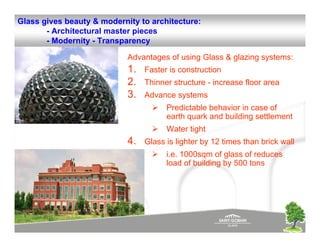
Glass gives beauty & modernity to architecture:
       - Architectural master pieces
       - Modernity - Transparency

                            Advantages of using Glass & glazing systems:
                            1.   Faster is construction
                            2.   Thinner structure - increase floor area
                            3.   Advance systems
                                       Predictable behavior in case of
                                       earth quark and building settlement
                                       Water tight
                            4.   Glass is lighter by 12 times than brick wall
                                       i.e. 1000sqm of glass of reduces
                                       load of building by 500 tons
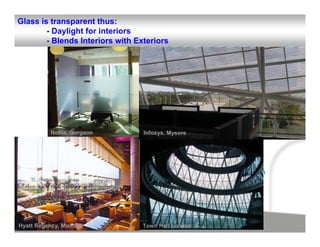
Glass is transparent thus:
        - Daylight for interiors
        - Blends Interiors with Exteriors


          Nokia, Gurgaon          Infosys, Mysore


                                   But, it is important to:
                                   1. Control Light – Based on direction
                                      of façade – Minimize Glare
                                   2. Control Energy – Based on the
                                      direction & location – Minimize
                                      Heat Gain


Hyatt Regency, Mumbai             Town Hall London
Key Performance Factors

 Total Heat Gain / Heat Transmission
    SHGC or SF : Solar Heat Gain Coefficient or
    Solar Factor
    U Value
 Light Transmission: percentage of incident
 light transmitted
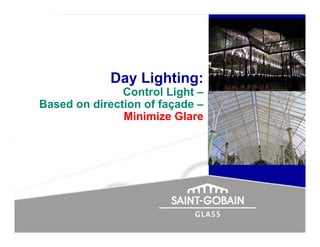
Day Lighting:
               Control Light –
Based on direction of façade –
               Minimize Glare
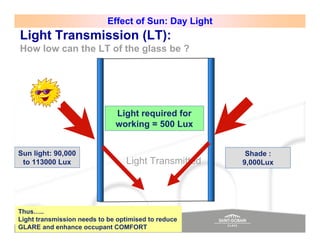
Effect of Sun: Day Light
Light Transmission (LT):
How low can the LT of the glass be ?


                              Light required for
                              working = 500 Lux


Sun light: 90,000                                       Shade :
 to 113000 Lux                   Light Transmitted     9,000Lux


Thus…..
Light transmission needs to be optimised to reduce
GLARE and enhance occupant COMFORT
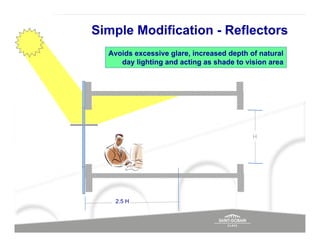
Simple Modification - Reflectors
  Avoids excessive glare, increased depth of natural
     day lighting and acting as shade to vision area


                                           H


    2.5 H
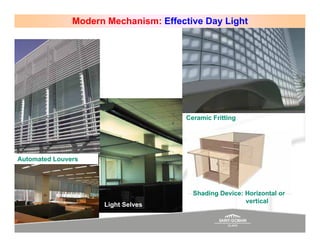
Modern Mechanism: Effective Day Light


                                      Ceramic Fritting


Automated Louvers


                                        Shading Device: Horizontal or
                                                        vertical
                     Light Selves
Total Heat Gain / Heat
          Transferred
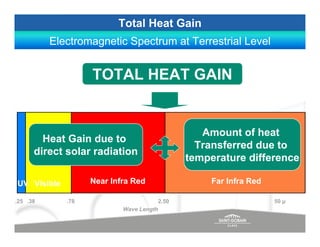
Total Heat Gain
          Electromagnetic Spectrum at Terrestrial Level


                   TOTAL HEAT GAIN


                                                   Amount of heat
        Heat Gain due to
                                                  Transferred due to
      direct solar radiation
                                                temperature difference

UV Visible         Near Infra Red                    Far Infra Red

.25 .38      .78                         2.50                        50 µ
                           Wave Length
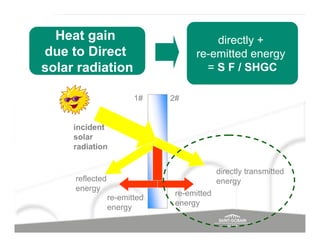
Heat gain                             directly +
due to Direct                       re-emitted energy
solar radiation                       = S F / SHGC

                        1#    2#


     incident
     solar
     radiation


                                            directly transmitted
     reflected                              energy
     energy
                               re-emitted
                 re-emitted
                               energy
                 energy
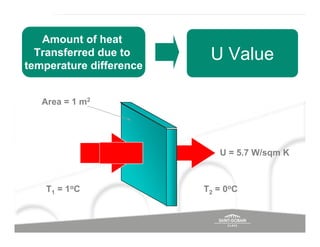
Amount of heat
  Transferred due to      U Value
temperature difference


   Area = 1 m2


                            U = 5.7 W/sqm K


    T1 = 1oC             T2 = 0oC
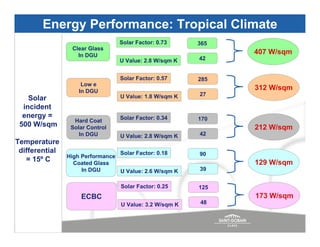
Energy Performance: Tropical Climate
                                 Solar Factor: 0.73     365
                 Clear Glass
                   In DGU
                                                              407 W/sqm
                                 U Value: 2.8 W/sqm K   42


                                 Solar Factor: 0.57     285
                     Low e
                    In DGU
                                                              312 W/sqm
                                 U Value: 1.8 W/sqm K   27
    Solar
  incident
  energy =                       Solar Factor: 0.34     170
                  Hard Coat
 500 W/sqm       Solar Control                                212 W/sqm
                    In DGU       U Value: 2.8 W/sqm K   42
Temperature
 differential                    Solar Factor: 0.18     90
                High Performance
   = 15º C        Coated Glass                                129 W/sqm
                     In DGU      U Value: 2.6 W/sqm K   39


                                 Solar Factor: 0.25     125
                    ECBC                                      173 W/sqm
                                 U Value: 3.2 W/sqm K   48
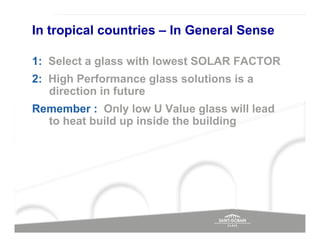
In tropical countries – In General Sense

1: Select a glass with lowest SOLAR FACTOR
2: High Performance glass solutions is a
   direction in future
Remember : Only low U Value glass will lead
  to heat build up inside the building
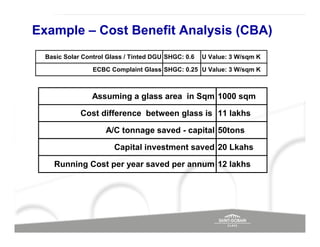
Example – Cost Benefit Analysis (CBA)
  Basic Solar Control Glass / Tinted DGU SHGC: 0.6   U Value: 3 W/sqm K

                 ECBC Complaint Glass SHGC: 0.25 U Value: 3 W/sqm K


                 Assuming a glass area in Sqm 1000 sqm

             Cost difference between glass is 11 lakhs

                     A/C tonnage saved - capital 50tons

                        Capital investment saved 20 Lkahs

    Running Cost per year saved per annum 12 lakhs
Prescriptive
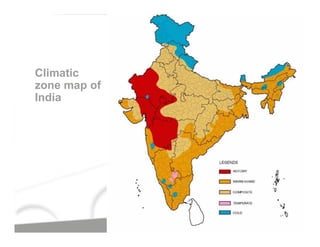
Climatic
zone map of
India
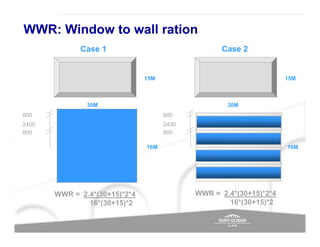
WWR: Window to wall ration
             Case 1                               Case 2


                               15M                                  15M


               30M                                  30M
800                                  800
2400                                 2400
800                                  800

                               16M                                  16M


       WWR = 2.4*(30+15)*2*4                WWR = 2.4*(30+15)*2*4
               16*(30+15)*2                         16*(30+15)*2
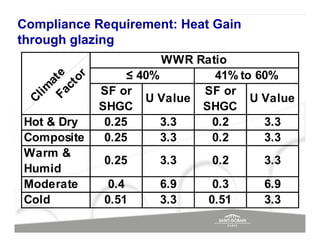
Compliance Requirement: Heat Gain
through glazing
                        WWR Ratio
                  ≤ 40%        41% to 60%
  Fa e
        or
      at
     ct

             SF or           SF or
    im


                     U Value         U Value
 Cl


             SHGC            SHGC
Hot & Dry     0.25      3.3   0.2      3.3
Composite     0.25      3.3   0.2      3.3
Warm &
             0.25     3.3     0.2      3.3
Humid
Moderate      0.4     6.9      0.3     6.9
Cold         0.51     3.3     0.51     3.3
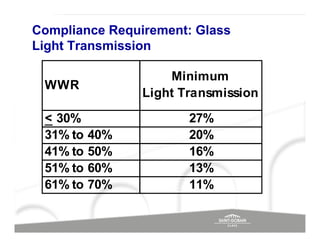
Compliance Requirement: Glass
Light Transmission

                    Minimum
 WWR
                Light Transmission

 < 30%                 27%
 31% to   40%          20%
 41% to   50%          16%
 51% to   60%          13%
 61% to   70%          11%
Trade off
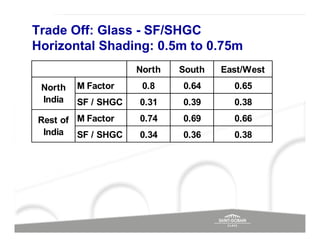
Trade Off: Glass - SF/SHGC
Horizontal Shading: 0.5m to 0.75m
                     North   South   East/West
 North   M Factor     0.8    0.64      0.65
 India   SF / SHGC   0.31    0.39      0.38
Rest of M Factor     0.74    0.69      0.66
 India SF / SHGC     0.34    0.36      0.38
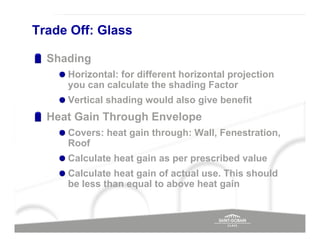
Trade Off: Glass

  Shading
     Horizontal: for different horizontal projection
     you can calculate the shading Factor
     Vertical shading would also give benefit
  Heat Gain Through Envelope
     Covers: heat gain through: Wall, Fenestration,
     Roof
     Calculate heat gain as per prescribed value
     Calculate heat gain of actual use. This should
     be less than equal to above heat gain
How do we get this
performance from Glass ?
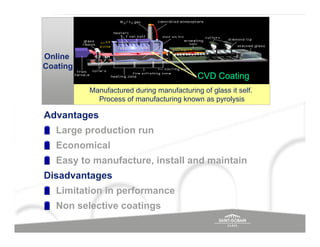
Online
Coating
                                           CVD Coating
          Manufactured during manufacturing of glass it self.
            Process of manufacturing known as pyrolysis

Advantages
   Large production run
   Economical
   Easy to manufacture, install and maintain
Disadvantages
   Limitation in performance
   Non selective coatings
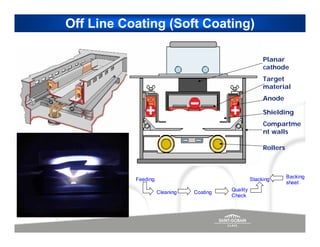
Off Line Coating (Soft Coating)

                                                         Planar
                                                         cathode
                                                         Target
                                                         material
                                                         Anode

                                                         Shielding
                                                         Compartme
                                                         nt walls

                                                         Rollers


           Feeding                                  Stacking       Backing
                                                                   sheet
                     Cleaning   Coating   Quality
                                          Check
Off Line Coating (Soft Coating)
Coating Process:
  Argon gas is pumped into the chamber.
  The cathode, supplies the chamber with electrons,
  which bombard the argon gas, ionising it.
  The magnets, and cathode situated above or within
  the target material, focus the movement of the
  ionised argon atoms towards the target
  The argon ions bombard the target, forcing atoms of
  the target to be released into the chamber.
  The positive target ions are sputtered onto the glass
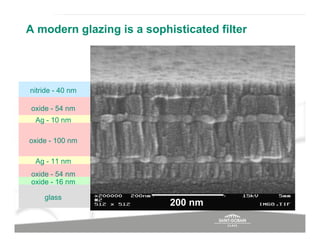
A modern glazing is a sophisticated filter


nitride - 40 nm

 oxide - 54 nm
  Ag - 10 nm

oxide - 100 nm

  Ag - 11 nm
 oxide - 54 nm
 oxide - 16 nm

    glass
                           200 nm
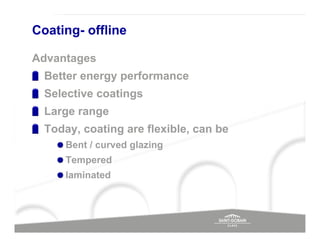
Coating- offline

Advantages
  Better energy performance
  Selective coatings
  Large range
  Today, coating are flexible, can be
      Bent / curved glazing
      Tempered
      laminated
Conclusion
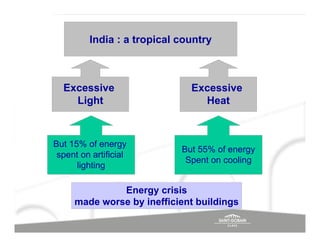
India : a tropical country


  Excessive                   Excessive
    Light                       Heat


But 15% of energy
                            But 55% of energy
 spent on artificial
                             Spent on cooling
      lighting

              Energy crisis
     made worse by inefficient buildings
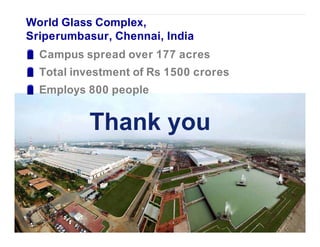
World Glass Complex,
Sriperumbasur, Chennai, India
  Campus spread over 177 acres
  Total investment of Rs 1500 crores
  Employs 800 people


           Thank you

Green Buildings Facade Approach

  • 1.
    Energy Efficient - Buildings Envelope - From the ECBC Perspective ECBC Awareness Workshop Saint-Gobain Glass India Ltd
  • 2.
    ECBC - BuildingEnvelope Opaque Wall & Spandrels: Insulation materials and their R-values / U Value; Vision Glass or fenestration / glazing: U-factors, Solar heat gain coefficients (SHGC) or SF Visible light transmittance Shading: overhangs and side fins, Air leakage though facade Building envelope sealing details
  • 3.
    Glass gives beauty& modernity to architecture: - Architectural master pieces - Modernity - Transparency Advantages of using Glass & glazing systems: 1. Faster is construction 2. Thinner structure - increase floor area 3. Advance systems Predictable behavior in case of earth quark and building settlement Water tight 4. Glass is lighter by 12 times than brick wall i.e. 1000sqm of glass of reduces load of building by 500 tons
  • 4.
    Glass is transparentthus: - Daylight for interiors - Blends Interiors with Exteriors Nokia, Gurgaon Infosys, Mysore But, it is important to: 1. Control Light – Based on direction of façade – Minimize Glare 2. Control Energy – Based on the direction & location – Minimize Heat Gain Hyatt Regency, Mumbai Town Hall London
  • 5.
    Key Performance Factors Total Heat Gain / Heat Transmission SHGC or SF : Solar Heat Gain Coefficient or Solar Factor U Value Light Transmission: percentage of incident light transmitted
  • 6.
    Day Lighting: Control Light – Based on direction of façade – Minimize Glare
  • 7.
    Effect of Sun:Day Light Light Transmission (LT): How low can the LT of the glass be ? Light required for working = 500 Lux Sun light: 90,000 Shade : to 113000 Lux Light Transmitted 9,000Lux Thus….. Light transmission needs to be optimised to reduce GLARE and enhance occupant COMFORT
  • 8.
    Simple Modification -Reflectors Avoids excessive glare, increased depth of natural day lighting and acting as shade to vision area H 2.5 H
  • 9.
    Modern Mechanism: EffectiveDay Light Ceramic Fritting Automated Louvers Shading Device: Horizontal or vertical Light Selves
  • 10.
    Total Heat Gain/ Heat Transferred
  • 11.
    Total Heat Gain Electromagnetic Spectrum at Terrestrial Level TOTAL HEAT GAIN Amount of heat Heat Gain due to Transferred due to direct solar radiation temperature difference UV Visible Near Infra Red Far Infra Red .25 .38 .78 2.50 50 µ Wave Length
  • 12.
    Heat gain directly + due to Direct re-emitted energy solar radiation = S F / SHGC 1# 2# incident solar radiation directly transmitted reflected energy energy re-emitted re-emitted energy energy
  • 13.
    Amount of heat Transferred due to U Value temperature difference Area = 1 m2 U = 5.7 W/sqm K T1 = 1oC T2 = 0oC
  • 14.
    Energy Performance: TropicalClimate Solar Factor: 0.73 365 Clear Glass In DGU 407 W/sqm U Value: 2.8 W/sqm K 42 Solar Factor: 0.57 285 Low e In DGU 312 W/sqm U Value: 1.8 W/sqm K 27 Solar incident energy = Solar Factor: 0.34 170 Hard Coat 500 W/sqm Solar Control 212 W/sqm In DGU U Value: 2.8 W/sqm K 42 Temperature differential Solar Factor: 0.18 90 High Performance = 15º C Coated Glass 129 W/sqm In DGU U Value: 2.6 W/sqm K 39 Solar Factor: 0.25 125 ECBC 173 W/sqm U Value: 3.2 W/sqm K 48
  • 15.
    In tropical countries– In General Sense 1: Select a glass with lowest SOLAR FACTOR 2: High Performance glass solutions is a direction in future Remember : Only low U Value glass will lead to heat build up inside the building
  • 16.
    Example – CostBenefit Analysis (CBA) Basic Solar Control Glass / Tinted DGU SHGC: 0.6 U Value: 3 W/sqm K ECBC Complaint Glass SHGC: 0.25 U Value: 3 W/sqm K Assuming a glass area in Sqm 1000 sqm Cost difference between glass is 11 lakhs A/C tonnage saved - capital 50tons Capital investment saved 20 Lkahs Running Cost per year saved per annum 12 lakhs
  • 17.
  • 18.
  • 19.
    WWR: Window towall ration Case 1 Case 2 15M 15M 30M 30M 800 800 2400 2400 800 800 16M 16M WWR = 2.4*(30+15)*2*4 WWR = 2.4*(30+15)*2*4 16*(30+15)*2 16*(30+15)*2
  • 20.
    Compliance Requirement: HeatGain through glazing WWR Ratio ≤ 40% 41% to 60% Fa e or at ct SF or SF or im U Value U Value Cl SHGC SHGC Hot & Dry 0.25 3.3 0.2 3.3 Composite 0.25 3.3 0.2 3.3 Warm & 0.25 3.3 0.2 3.3 Humid Moderate 0.4 6.9 0.3 6.9 Cold 0.51 3.3 0.51 3.3
  • 21.
    Compliance Requirement: Glass LightTransmission Minimum WWR Light Transmission < 30% 27% 31% to 40% 20% 41% to 50% 16% 51% to 60% 13% 61% to 70% 11%
  • 22.
  • 23.
    Trade Off: Glass- SF/SHGC Horizontal Shading: 0.5m to 0.75m North South East/West North M Factor 0.8 0.64 0.65 India SF / SHGC 0.31 0.39 0.38 Rest of M Factor 0.74 0.69 0.66 India SF / SHGC 0.34 0.36 0.38
  • 24.
    Trade Off: Glass Shading Horizontal: for different horizontal projection you can calculate the shading Factor Vertical shading would also give benefit Heat Gain Through Envelope Covers: heat gain through: Wall, Fenestration, Roof Calculate heat gain as per prescribed value Calculate heat gain of actual use. This should be less than equal to above heat gain
  • 25.
    How do weget this performance from Glass ?
  • 26.
    Online Coating CVD Coating Manufactured during manufacturing of glass it self. Process of manufacturing known as pyrolysis Advantages Large production run Economical Easy to manufacture, install and maintain Disadvantages Limitation in performance Non selective coatings
  • 27.
    Off Line Coating(Soft Coating) Planar cathode Target material Anode Shielding Compartme nt walls Rollers Feeding Stacking Backing sheet Cleaning Coating Quality Check
  • 28.
    Off Line Coating(Soft Coating) Coating Process: Argon gas is pumped into the chamber. The cathode, supplies the chamber with electrons, which bombard the argon gas, ionising it. The magnets, and cathode situated above or within the target material, focus the movement of the ionised argon atoms towards the target The argon ions bombard the target, forcing atoms of the target to be released into the chamber. The positive target ions are sputtered onto the glass
  • 29.
    A modern glazingis a sophisticated filter nitride - 40 nm oxide - 54 nm Ag - 10 nm oxide - 100 nm Ag - 11 nm oxide - 54 nm oxide - 16 nm glass 200 nm
  • 30.
    Coating- offline Advantages Better energy performance Selective coatings Large range Today, coating are flexible, can be Bent / curved glazing Tempered laminated
  • 31.
  • 32.
    India : atropical country Excessive Excessive Light Heat But 15% of energy But 55% of energy spent on artificial Spent on cooling lighting Energy crisis made worse by inefficient buildings
  • 33.
    World Glass Complex, Sriperumbasur,Chennai, India Campus spread over 177 acres Total investment of Rs 1500 crores Employs 800 people Thank you