Biomass Heating
Project Analysis
Renewable Energy Project Analysis Course - Module 6


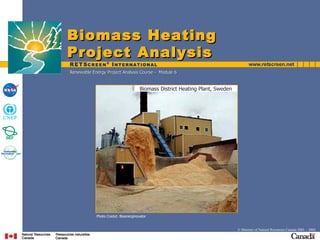
                                      Biomass District Heating Plant, Sweden


            Photo Credut: Bioenerginovator


                                                                               © Minister of Natural Resources Canada 2001 – 2002.
Objectives


• Review basics of
   Biomass Heating Systems


• Illustrate key considerations for
   Biomass Heating project analysis


• Introduce RETScreen® Biomass Heating Project Model


                                          © Minister of Natural Resources Canada 2001 – 2002.
What do biomass heating systems
provide?

• Heat for
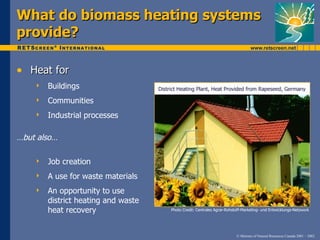
       Buildings                    District Heating Plant, Heat Provided from Rapeseed, Germany

       Communities
       Industrial processes

…but also…

       Job creation
       A use for waste materials
       An opportunity to use
        district heating and waste
        heat recovery                     Photo Credit: Centrales Agrar-Rohstoff-Marketing- und Entwicklungs-Netzwork


                                                                             © Minister of Natural Resources Canada 2001 – 2002.
Biomass Heating System
Description
• Heating Plant
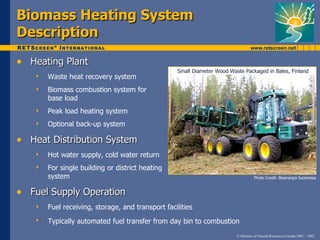
                                                  Small Diameter Wood Waste Packaged in Bales, Finland
      Waste heat recovery system
      Biomass combustion system for
       base load
      Peak load heating system
      Optional back-up system

• Heat Distribution System
      Hot water supply, cold water return
      For single building or district heating
       system                                                                       Photo Credit: Bioenergia Suomessa


• Fuel Supply Operation
      Fuel receiving, storage, and transport facilities
      Typically automated fuel transfer from day bin to combustion
                                                                         © Minister of Natural Resources Canada 2001 – 2002.
Biomass Heating System
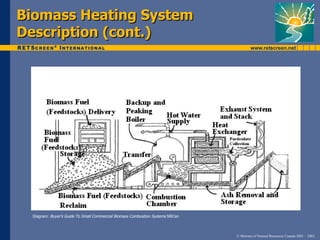
Description (cont.)


  Diagram: Buyer’s Guide To Small Commercial Biomass Combustion Systems NRCan


                                                                                © Minister of Natural Resources Canada 2001 – 2002.
Peak vs. Base Load Systems

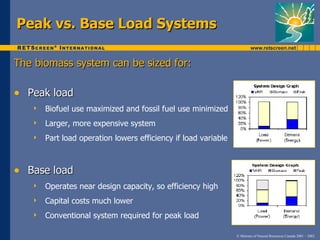
The biomass system can be sized for:

• Peak load
      Biofuel use maximized and fossil fuel use minimized
      Larger, more expensive system
      Part load operation lowers efficiency if load variable


• Base load
      Operates near design capacity, so efficiency high
      Capital costs much lower
      Conventional system required for peak load

                                                                © Minister of Natural Resources Canada 2001 – 2002.
District Heating Systems

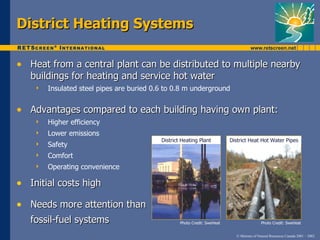
• Heat from a central plant can be distributed to multiple nearby
   buildings for heating and service hot water
       Insulated steel pipes are buried 0.6 to 0.8 m underground


• Advantages compared to each building having own plant:
       Higher efficiency
       Lower emissions
                                           District Heating Plant          District Heat Hot Water Pipes
       Safety
       Comfort
       Operating convenience

• Initial costs high
• Needs more attention than
   fossil-fuel systems                             Photo Credit: SweHeat                    Photo Credit: SweHeat


                                                                             © Minister of Natural Resources Canada 2001 – 2002.
Biomass Fuels

                                                               Wood for Biomass Combustion
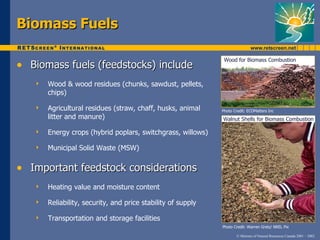
• Biomass fuels (feedstocks) include
      Wood & wood residues (chunks, sawdust, pellets,
       chips)

      Agricultural residues (straw, chaff, husks, animal     Photo Credit: ECOMatters Inc
       litter and manure)                                     Walnut Shells for Biomass Combustion

      Energy crops (hybrid poplars, switchgrass, willows)

      Municipal Solid Waste (MSW)


• Important feedstock considerations
      Heating value and moisture content

      Reliability, security, and price stability of supply

      Transportation and storage facilities
                                                              Photo Credit: Warren Gretz/ NREL Pix

                                                                     © Minister of Natural Resources Canada 2001 – 2002.
Environmental Attributes of
Biomass Fuels
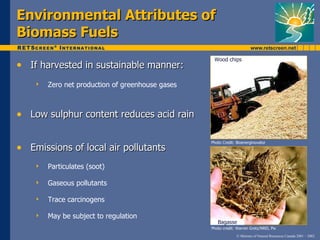
                                                   Wood chips
• If harvested in sustainable manner:
       Zero net production of greenhouse gases


• Low sulphur content reduces acid rain

                                                  Photo Credit: Bioenerginovator
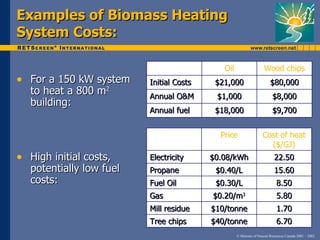
• Emissions of local air pollutants
       Particulates (soot)

       Gaseous pollutants

       Trace carcinogens

       May be subject to regulation
                                                     Bagasse
                                                  Photo credit: Warren Gretz/NREL Pix
                                                                © Minister of Natural Resources Canada 2001 – 2002.
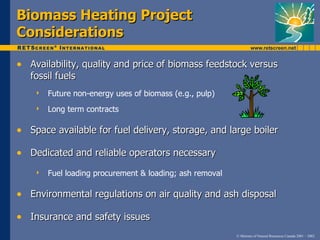
Examples of Biomass Heating
System Costs:

                                             Oil                    Wood chips
• For a 150 kW system     Initial Costs    $21,000                      $80,000
   to heat a 800 m2       Annual O&M       $1,000                         $8,000
   building:
                          Annual fuel      $18,000                        $9,700


                                            Price                  Cost of heat
                                                                     ($/GJ)
• High initial costs,     Electricity     $0.08/kWh                        22.50
   potentially low fuel   Propane          $0.40/L                         15.60
   costs:                 Fuel Oil         $0.30/L                          8.50
                          Gas             $0.20/m3                          5.80
                          Mill residue    $10/tonne                         1.70
                          Tree chips      $40/tonne                         6.70
                                                   © Minister of Natural Resources Canada 2001 – 2002.
Biomass Heating Project
Considerations

• Availability, quality and price of biomass feedstock versus
   fossil fuels
       Future non-energy uses of biomass (e.g., pulp)
       Long term contracts

• Space available for fuel delivery, storage, and large boiler

• Dedicated and reliable operators necessary
       Fuel loading procurement & loading; ash removal

• Environmental regulations on air quality and ash disposal

• Insurance and safety issues
                                                          © Minister of Natural Resources Canada 2001 – 2002.
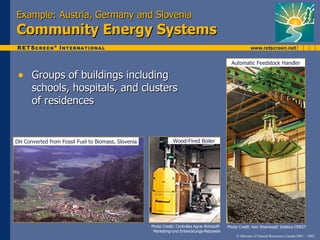
Example: Austria, Germany and Slovenia
Community Energy Systems

                                                                                                 Automatic Feedstock Handler

 • Groups of buildings including
      schools, hospitals, and clusters
      of residences


DH Converted from Fossil Fuel to Biomass, Slovenia               Wood-Fired Boiler


                                                     Photo Credit: Centrales Agrar-Rohstoff-   Photo Credit: Ken Sheinkopf/ Solstice CREST
                                                      Marketing-und Entwicklungs-Netzwerk
                                                                                                    © Minister of Natural Resources Canada 2001 – 2002.
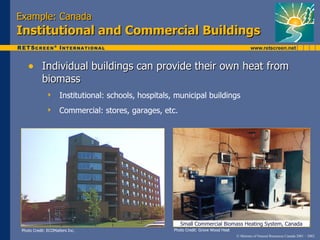
Example: Canada
Institutional and Commercial Buildings

    • Individual buildings can provide their own heat from
            biomass
                    Institutional: schools, hospitals, municipal buildings
                    Commercial: stores, garages, etc.


                                                          Small Commercial Biomass Heating System, Canada
 Photo Credit: ECOMatters Inc.                         Photo Credit: Grove Wood Heat
                                                                                       © Minister of Natural Resources Canada 2001 – 2002.
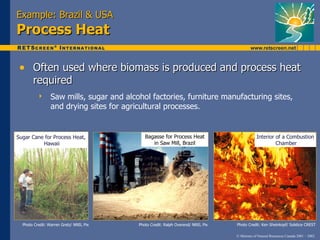
Example: Brazil & USA
Process Heat

 • Often used where biomass is produced and process heat
       required
                Saw mills, sugar and alcohol factories, furniture manufacturing sites,
                 and drying sites for agricultural processes.


Sugar Cane for Process Heat,                 Bagasse for Process Heat                         Interior of a Combustion
          Hawaii                                in Saw Mill, Brazil                                    Chamber


  Photo Credit: Warren Gretz/ NREL Pix    Photo Credit: Ralph Overend/ NREL Pix   Photo Credit: Ken Sheinkopf/ Solstice CREST

                                                                                  © Minister of Natural Resources Canada 2001 – 2002.
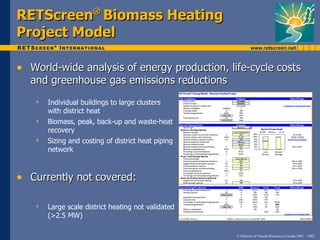
RETScreen Biomass Heating
                      ®

Project Model

• World-wide analysis of energy production, life-cycle costs
  and greenhouse gas emissions reductions
      Individual buildings to large clusters
       with district heat
      Biomass, peak, back-up and waste-heat
       recovery
      Sizing and costing of district heat piping
       network


• Currently not covered:

      Large scale district heating not validated
       (>2.5 MW)

                                                    © Minister of Natural Resources Canada 2001 – 2002.
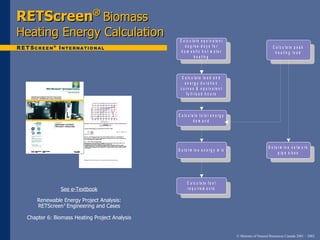
RETScreen® Biomass
Heating Energy Calculation                      C a lc u la t e e q u iv a le n t
                                                    d e g re e -d a y s fo r                                C a lc u la te p e a k
                                                 d o m e s tic h o t w a te r                                 h e a tin g lo a d
                                                          h e a tin g


                                                 C a lc u la t e lo a d a n d
                                                   e n e r g y d u r a tio n
                                                c u r v e s & e q u iv a le n t
                                                    f u ll- lo a d h o u r s


                                               C a lc u la te t o ta l e n e r g y
                                                          dem and


                                                                                                         D e te r m in e n e tw o r k
                                               D e te r m in e e n e r g y m ix
                                                                                                                p ip e s iz e s


                                                     C a lc u la te fu e l
              See e-Textbook                         r e q u ir e m e n ts

     Renewable Energy Project Analysis:
     RETScreen® Engineering and Cases

 Chapter 6: Biomass Heating Project Analysis


                                                                                     © Minister of Natural Resources Canada 2001 – 2002.
Example Validation of the
RETScreen® Biomass Heating Project Model


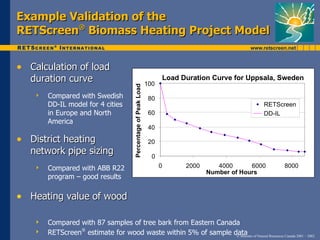
• Calculation of load
   duration curve                                                 100
                                                                            Load Duration Curve for Uppsala, Sweden


                                        Percentage of Peak Load
       Compared with Swedish                                      80
        DD-IL model for 4 cities                                                                         RETScreen
        in Europe and North                                        60                                    DD-IL
        America
                                                                   40

• District heating                                                 20
   network pipe sizing                                              0
       Compared with ABB R22                                           0         2000      4000      6000    8000
                                                                                         Number of Hours
        program – good results

• Heating value of wood

       Compared with 87 samples of tree bark from Eastern Canada
       RETScreen® estimate for wood waste within 5% of sample data of Natural Resources Canada 2001 – 2002.
                                                                © Minister
Conclusions

• Biomass heating energy costs can be much lower
  than conventional heating costs, even when
  considering higher initial capital costs of biomass
  systems


• RETScreen® calculates load duration curves, required
  biomass and peak plant capacity, and district heating
  network pipe sizes using minimal input data


• RETScreen® provides significant preliminary feasibility
  study cost savings                           © Minister of Natural Resources Canada 2001 – 2002.
Questions?

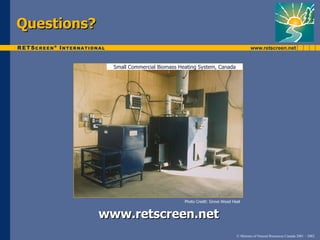
               Small Commercial Biomass Heating System, Canada


                                          Photo Credit: Grove Wood Heat


             www.retscreen.net
                                                                     © Minister of Natural Resources Canada 2001 – 2002.

06 bio

  • 1.
    Biomass Heating Project Analysis RenewableEnergy Project Analysis Course - Module 6 Biomass District Heating Plant, Sweden Photo Credut: Bioenerginovator © Minister of Natural Resources Canada 2001 – 2002.
  • 2.
    Objectives • Review basicsof Biomass Heating Systems • Illustrate key considerations for Biomass Heating project analysis • Introduce RETScreen® Biomass Heating Project Model © Minister of Natural Resources Canada 2001 – 2002.
  • 3.
    What do biomassheating systems provide? • Heat for  Buildings District Heating Plant, Heat Provided from Rapeseed, Germany  Communities  Industrial processes …but also…  Job creation  A use for waste materials  An opportunity to use district heating and waste heat recovery Photo Credit: Centrales Agrar-Rohstoff-Marketing- und Entwicklungs-Netzwork © Minister of Natural Resources Canada 2001 – 2002.
  • 4.
    Biomass Heating System Description •Heating Plant Small Diameter Wood Waste Packaged in Bales, Finland  Waste heat recovery system  Biomass combustion system for base load  Peak load heating system  Optional back-up system • Heat Distribution System  Hot water supply, cold water return  For single building or district heating system Photo Credit: Bioenergia Suomessa • Fuel Supply Operation  Fuel receiving, storage, and transport facilities  Typically automated fuel transfer from day bin to combustion © Minister of Natural Resources Canada 2001 – 2002.
  • 5.
    Biomass Heating System Description(cont.) Diagram: Buyer’s Guide To Small Commercial Biomass Combustion Systems NRCan © Minister of Natural Resources Canada 2001 – 2002.
  • 6.
    Peak vs. BaseLoad Systems The biomass system can be sized for: • Peak load  Biofuel use maximized and fossil fuel use minimized  Larger, more expensive system  Part load operation lowers efficiency if load variable • Base load  Operates near design capacity, so efficiency high  Capital costs much lower  Conventional system required for peak load © Minister of Natural Resources Canada 2001 – 2002.
  • 7.
    District Heating Systems •Heat from a central plant can be distributed to multiple nearby buildings for heating and service hot water  Insulated steel pipes are buried 0.6 to 0.8 m underground • Advantages compared to each building having own plant:  Higher efficiency  Lower emissions District Heating Plant District Heat Hot Water Pipes  Safety  Comfort  Operating convenience • Initial costs high • Needs more attention than fossil-fuel systems Photo Credit: SweHeat Photo Credit: SweHeat © Minister of Natural Resources Canada 2001 – 2002.
  • 8.
    Biomass Fuels Wood for Biomass Combustion • Biomass fuels (feedstocks) include  Wood & wood residues (chunks, sawdust, pellets, chips)  Agricultural residues (straw, chaff, husks, animal Photo Credit: ECOMatters Inc litter and manure) Walnut Shells for Biomass Combustion  Energy crops (hybrid poplars, switchgrass, willows)  Municipal Solid Waste (MSW) • Important feedstock considerations  Heating value and moisture content  Reliability, security, and price stability of supply  Transportation and storage facilities Photo Credit: Warren Gretz/ NREL Pix © Minister of Natural Resources Canada 2001 – 2002.
  • 9.
    Environmental Attributes of BiomassFuels Wood chips • If harvested in sustainable manner:  Zero net production of greenhouse gases • Low sulphur content reduces acid rain Photo Credit: Bioenerginovator • Emissions of local air pollutants  Particulates (soot)  Gaseous pollutants  Trace carcinogens  May be subject to regulation Bagasse Photo credit: Warren Gretz/NREL Pix © Minister of Natural Resources Canada 2001 – 2002.
  • 10.
    Examples of BiomassHeating System Costs: Oil Wood chips • For a 150 kW system Initial Costs $21,000 $80,000 to heat a 800 m2 Annual O&M $1,000 $8,000 building: Annual fuel $18,000 $9,700 Price Cost of heat ($/GJ) • High initial costs, Electricity $0.08/kWh 22.50 potentially low fuel Propane $0.40/L 15.60 costs: Fuel Oil $0.30/L 8.50 Gas $0.20/m3 5.80 Mill residue $10/tonne 1.70 Tree chips $40/tonne 6.70 © Minister of Natural Resources Canada 2001 – 2002.
  • 11.
    Biomass Heating Project Considerations •Availability, quality and price of biomass feedstock versus fossil fuels  Future non-energy uses of biomass (e.g., pulp)  Long term contracts • Space available for fuel delivery, storage, and large boiler • Dedicated and reliable operators necessary  Fuel loading procurement & loading; ash removal • Environmental regulations on air quality and ash disposal • Insurance and safety issues © Minister of Natural Resources Canada 2001 – 2002.
  • 12.
    Example: Austria, Germanyand Slovenia Community Energy Systems Automatic Feedstock Handler • Groups of buildings including schools, hospitals, and clusters of residences DH Converted from Fossil Fuel to Biomass, Slovenia Wood-Fired Boiler Photo Credit: Centrales Agrar-Rohstoff- Photo Credit: Ken Sheinkopf/ Solstice CREST Marketing-und Entwicklungs-Netzwerk © Minister of Natural Resources Canada 2001 – 2002.
  • 13.
    Example: Canada Institutional andCommercial Buildings • Individual buildings can provide their own heat from biomass  Institutional: schools, hospitals, municipal buildings  Commercial: stores, garages, etc. Small Commercial Biomass Heating System, Canada Photo Credit: ECOMatters Inc. Photo Credit: Grove Wood Heat © Minister of Natural Resources Canada 2001 – 2002.
  • 14.
    Example: Brazil &USA Process Heat • Often used where biomass is produced and process heat required  Saw mills, sugar and alcohol factories, furniture manufacturing sites, and drying sites for agricultural processes. Sugar Cane for Process Heat, Bagasse for Process Heat Interior of a Combustion Hawaii in Saw Mill, Brazil Chamber Photo Credit: Warren Gretz/ NREL Pix Photo Credit: Ralph Overend/ NREL Pix Photo Credit: Ken Sheinkopf/ Solstice CREST © Minister of Natural Resources Canada 2001 – 2002.
  • 15.
    RETScreen Biomass Heating ® Project Model • World-wide analysis of energy production, life-cycle costs and greenhouse gas emissions reductions  Individual buildings to large clusters with district heat  Biomass, peak, back-up and waste-heat recovery  Sizing and costing of district heat piping network • Currently not covered:  Large scale district heating not validated (>2.5 MW) © Minister of Natural Resources Canada 2001 – 2002.
  • 16.
    RETScreen® Biomass Heating EnergyCalculation C a lc u la t e e q u iv a le n t d e g re e -d a y s fo r C a lc u la te p e a k d o m e s tic h o t w a te r h e a tin g lo a d h e a tin g C a lc u la t e lo a d a n d e n e r g y d u r a tio n c u r v e s & e q u iv a le n t f u ll- lo a d h o u r s C a lc u la te t o ta l e n e r g y dem and D e te r m in e n e tw o r k D e te r m in e e n e r g y m ix p ip e s iz e s C a lc u la te fu e l See e-Textbook r e q u ir e m e n ts Renewable Energy Project Analysis: RETScreen® Engineering and Cases Chapter 6: Biomass Heating Project Analysis © Minister of Natural Resources Canada 2001 – 2002.
  • 17.
    Example Validation ofthe RETScreen® Biomass Heating Project Model • Calculation of load duration curve 100 Load Duration Curve for Uppsala, Sweden Percentage of Peak Load  Compared with Swedish 80 DD-IL model for 4 cities RETScreen in Europe and North 60 DD-IL America 40 • District heating 20 network pipe sizing 0  Compared with ABB R22 0 2000 4000 6000 8000 Number of Hours program – good results • Heating value of wood  Compared with 87 samples of tree bark from Eastern Canada  RETScreen® estimate for wood waste within 5% of sample data of Natural Resources Canada 2001 – 2002. © Minister
  • 18.
    Conclusions • Biomass heatingenergy costs can be much lower than conventional heating costs, even when considering higher initial capital costs of biomass systems • RETScreen® calculates load duration curves, required biomass and peak plant capacity, and district heating network pipe sizes using minimal input data • RETScreen® provides significant preliminary feasibility study cost savings © Minister of Natural Resources Canada 2001 – 2002.
  • 19.
    Questions? Small Commercial Biomass Heating System, Canada Photo Credit: Grove Wood Heat www.retscreen.net © Minister of Natural Resources Canada 2001 – 2002.