Topic: AIRBAG
Mechanical Engineering
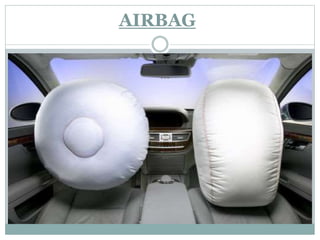
AIRBAG
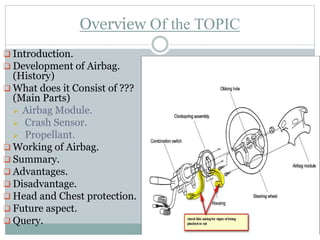
Overview Of the TOPIC
 Introduction.
 Development of Airbag.
(History)
 What does it Consist of ???
(Main Parts)
 Airbag Module.
 Crash Sensor.
 Propellant.
 Working of Airbag.
 Summary.
 Advantages.
 Disadvantage.
 Head and Chest protection.
 Future aspect.
 Query.
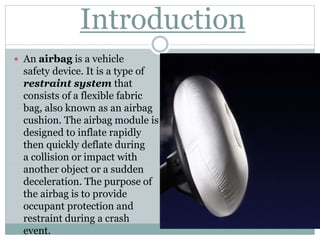
Introduction
 An airbag is a vehicle
safety device. It is a type of
restraint system that
consists of a flexible fabric
bag, also known as an airbag
cushion. The airbag module is
designed to inflate rapidly
then quickly deflate during
a collision or impact with
another object or a sudden
deceleration. The purpose of
the airbag is to provide
occupant protection and
restraint during a crash
event.
Development of Airbag (History)
 The air bag traces (air filled bladder) - as early as 1941 and first
patented in the 1950s.
 Early air bag systems were large and bulky, primarily using
tanks of compressed or heated air, compressed nitrogen gas
(N 2 ), Freon, or carbon dioxide (CO 2 ). Some of the early
systems created hazardous byproducts. One particular
system used gun-powder to heat up Freon gas, producing
PHOSGENE GAS (COCl 2 )—an extremely poisonous gas.
 One of the first patents for automobile air bags was awarded to
industrial engineer John Hetrick on August 18, 1953.
 In 1968, John Pietz, a chemist for Talley Defense Systems,
pioneered a solid propellant using sodium azide (NaN 3 )
and a metallic oxide. This was the first nitrogen-
generating solid propellant, and it soon replaced the older,
bulkier systems.
What does it consist of ??
(Main Parts)
 An air bag system consists of an air bag module, crash sensors, a
diagnostic monitoring unit, a steering wheel connecting coil, and
an indicator lamp.
 An air bag module has three main parts:
 the air bag,
 the inflator, and
 the propellant.
 The driver's-side air bag material is -- heat shield coating
to protect the fabric from scorching, especially near the
inflator assembly, during deployment. Talcum powder or corn
starch is also used to coat the air bag; either substance prevents
the fabric from sticking together and makes it easier to assemble.
 The propellant, in the form of black pellets, is primarily sodium
azide combined with an oxidizer and is typically located inside
the inflator canister between the filter assembly and the initiator.
Airbag Module
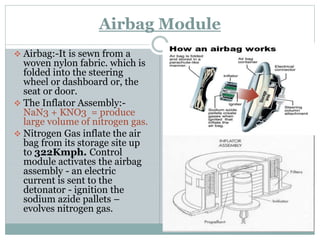
 Airbag:-It is sewn from a
woven nylon fabric. which is
folded into the steering
wheel or dashboard or, the
seat or door.
 The Inflator Assembly:-
NaN3 + KNO3 = produce
large volume of nitrogen gas.
 Nitrogen Gas inflate the air
bag from its storage site up
to 322Kmph. Control
module activates the airbag
assembly - an electric
current is sent to the
detonator - ignition the
sodium azide pallets –
evolves nitrogen gas.
Crash Sensor
 The sensor is the device
that tells the bag to inflate.
 Inflation happens when
there is a collision force
equal to running into a brick
wall at 10 to 15 miles per
hour (16 to 24 km per hour).
A mechanical switch is
flipped when there is a mass
shift that closes an electrical
contact, telling the sensors
that a crash has occurred.
 The sensors receive
information from an
accelerometer built into a
microchip.
Propellant
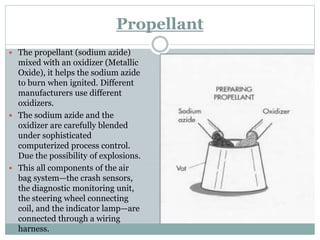
 The propellant (sodium azide)
mixed with an oxidizer (Metallic
Oxide), it helps the sodium azide
to burn when ignited. Different
manufacturers use different
oxidizers.
 The sodium azide and the
oxidizer are carefully blended
under sophisticated
computerized process control.
Due the possibility of explosions.
 This all components of the air
bag system—the crash sensors,
the diagnostic monitoring unit,
the steering wheel connecting
coil, and the indicator lamp—are
connected through a wiring
harness.
Working Of Airbag
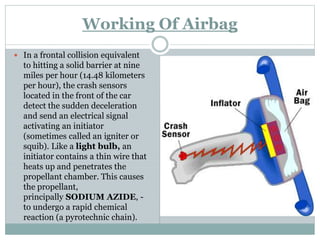
 In a frontal collision equivalent
to hitting a solid barrier at nine
miles per hour (14.48 kilometers
per hour), the crash sensors
located in the front of the car
detect the sudden deceleration
and send an electrical signal
activating an initiator
(sometimes called an igniter or
squib). Like a light bulb, an
initiator contains a thin wire that
heats up and penetrates the
propellant chamber. This causes
the propellant,
principally SODIUM AZIDE, -
to undergo a rapid chemical
reaction (a pyrotechnic chain).
Working Of Airbag
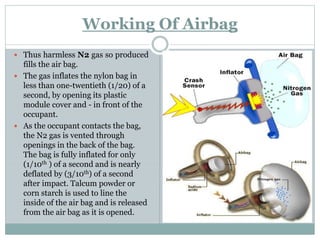
 Thus harmless N2 gas so produced
fills the air bag.
 The gas inflates the nylon bag in
less than one-twentieth (1/20) of a
second, by opening its plastic
module cover and - in front of the
occupant.
 As the occupant contacts the bag,
the N2 gas is vented through
openings in the back of the bag.
The bag is fully inflated for only
(1/10th ) of a second and is nearly
deflated by (3/10th) of a second
after impact. Talcum powder or
corn starch is used to line the
inside of the air bag and is released
from the air bag as it is opened.
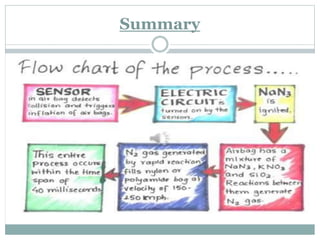
Summary
Advantages
 Inflate in front of windows to
provide passengers better head
and neck protection.
 More efficient at tipping and
side impacts .
 Reduce HIC (Head Injury
Criterion) by 80%.
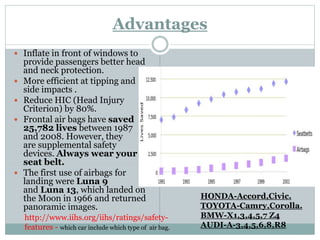
 Frontal air bags have saved
25,782 lives between 1987
and 2008. However, they
are supplemental safety
devices. Always wear your
seat belt.
 The first use of airbags for
landing were Luna 9
and Luna 13, which landed on
the Moon in 1966 and returned
panoramic images.
http://www.iihs.org/iihs/ratings/safety-
features - which car include which type of air bag.
HONDA-Accord,Civic.
TOYOTA-Camry,Corolla.
BMW-X1,3,4,5,7 Z4
AUDI-A-3,4,5,6,8,R8
Disadvantage
 Recent News 8th Oct, 2015:-A three-month-old
baby travelling in his mother’s arms as she drove to
the shop died after an airbag deployed following a
collision. (Dublin, Ireland)
 The force of an airbag can hurt those who are too
close to it.
 The one factor that is common to all who died
is NOT their height, weight, sex, or age.
Rather, it is the fact that they were too close
to the air bags when they started to deploy.
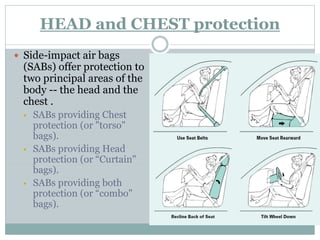
HEAD and CHEST protection
 Side-impact air bags
(SABs) offer protection to
two principal areas of the
body -- the head and the
chest .
 SABs providing Chest
protection (or "torso"
bags).
 SABs providing Head
protection (or “Curtain"
bags).
 SABs providing both
protection (or “combo"
bags).
Future Aspect
 A hybrid inflator is currently
being tested that uses a
combination of pressurized inert
gas (Argon (Ar)) and heat from a
propellant to significantly expand
the gas's volume. It would have a
cost advantage- less propellant
could be used.
 Systems that would eliminate the
sodium azide propellant, which is
toxic in its undeployed form.
 "SMART SENSORS” to check
the deployment of the air bag to
certain conditions. These
sensors- sense the size and
weight of the occupant, whether
the occupant is present.
 SMART (SENSORS) SYSTEMS
 Weight Sensors:
 determine what type of occupant is
in the seat, i.e. adult or child.
 Infrared Occupant detection:
 To detect the distance the
passenger is from the airbag .
 Capacitive Reflective Occupant
Sensing:
 Identify the distance passengers
from the dashboard.
 To discriminate between a human
occupant and inanimate objects
Airbags

Airbags

  • 1.
  • 2.
  • 3.
    Overview Of theTOPIC  Introduction.  Development of Airbag. (History)  What does it Consist of ??? (Main Parts)  Airbag Module.  Crash Sensor.  Propellant.  Working of Airbag.  Summary.  Advantages.  Disadvantage.  Head and Chest protection.  Future aspect.  Query.
  • 4.
    Introduction  An airbagis a vehicle safety device. It is a type of restraint system that consists of a flexible fabric bag, also known as an airbag cushion. The airbag module is designed to inflate rapidly then quickly deflate during a collision or impact with another object or a sudden deceleration. The purpose of the airbag is to provide occupant protection and restraint during a crash event.
  • 5.
    Development of Airbag(History)  The air bag traces (air filled bladder) - as early as 1941 and first patented in the 1950s.  Early air bag systems were large and bulky, primarily using tanks of compressed or heated air, compressed nitrogen gas (N 2 ), Freon, or carbon dioxide (CO 2 ). Some of the early systems created hazardous byproducts. One particular system used gun-powder to heat up Freon gas, producing PHOSGENE GAS (COCl 2 )—an extremely poisonous gas.  One of the first patents for automobile air bags was awarded to industrial engineer John Hetrick on August 18, 1953.  In 1968, John Pietz, a chemist for Talley Defense Systems, pioneered a solid propellant using sodium azide (NaN 3 ) and a metallic oxide. This was the first nitrogen- generating solid propellant, and it soon replaced the older, bulkier systems.
  • 6.
    What does itconsist of ?? (Main Parts)  An air bag system consists of an air bag module, crash sensors, a diagnostic monitoring unit, a steering wheel connecting coil, and an indicator lamp.  An air bag module has three main parts:  the air bag,  the inflator, and  the propellant.  The driver's-side air bag material is -- heat shield coating to protect the fabric from scorching, especially near the inflator assembly, during deployment. Talcum powder or corn starch is also used to coat the air bag; either substance prevents the fabric from sticking together and makes it easier to assemble.  The propellant, in the form of black pellets, is primarily sodium azide combined with an oxidizer and is typically located inside the inflator canister between the filter assembly and the initiator.
  • 7.
    Airbag Module  Airbag:-Itis sewn from a woven nylon fabric. which is folded into the steering wheel or dashboard or, the seat or door.  The Inflator Assembly:- NaN3 + KNO3 = produce large volume of nitrogen gas.  Nitrogen Gas inflate the air bag from its storage site up to 322Kmph. Control module activates the airbag assembly - an electric current is sent to the detonator - ignition the sodium azide pallets – evolves nitrogen gas.
  • 8.
    Crash Sensor  Thesensor is the device that tells the bag to inflate.  Inflation happens when there is a collision force equal to running into a brick wall at 10 to 15 miles per hour (16 to 24 km per hour). A mechanical switch is flipped when there is a mass shift that closes an electrical contact, telling the sensors that a crash has occurred.  The sensors receive information from an accelerometer built into a microchip.
  • 9.
    Propellant  The propellant(sodium azide) mixed with an oxidizer (Metallic Oxide), it helps the sodium azide to burn when ignited. Different manufacturers use different oxidizers.  The sodium azide and the oxidizer are carefully blended under sophisticated computerized process control. Due the possibility of explosions.  This all components of the air bag system—the crash sensors, the diagnostic monitoring unit, the steering wheel connecting coil, and the indicator lamp—are connected through a wiring harness.
  • 10.
    Working Of Airbag In a frontal collision equivalent to hitting a solid barrier at nine miles per hour (14.48 kilometers per hour), the crash sensors located in the front of the car detect the sudden deceleration and send an electrical signal activating an initiator (sometimes called an igniter or squib). Like a light bulb, an initiator contains a thin wire that heats up and penetrates the propellant chamber. This causes the propellant, principally SODIUM AZIDE, - to undergo a rapid chemical reaction (a pyrotechnic chain).
  • 11.
    Working Of Airbag Thus harmless N2 gas so produced fills the air bag.  The gas inflates the nylon bag in less than one-twentieth (1/20) of a second, by opening its plastic module cover and - in front of the occupant.  As the occupant contacts the bag, the N2 gas is vented through openings in the back of the bag. The bag is fully inflated for only (1/10th ) of a second and is nearly deflated by (3/10th) of a second after impact. Talcum powder or corn starch is used to line the inside of the air bag and is released from the air bag as it is opened.
  • 12.
  • 13.
    Advantages  Inflate infront of windows to provide passengers better head and neck protection.  More efficient at tipping and side impacts .  Reduce HIC (Head Injury Criterion) by 80%.  Frontal air bags have saved 25,782 lives between 1987 and 2008. However, they are supplemental safety devices. Always wear your seat belt.  The first use of airbags for landing were Luna 9 and Luna 13, which landed on the Moon in 1966 and returned panoramic images. http://www.iihs.org/iihs/ratings/safety- features - which car include which type of air bag. HONDA-Accord,Civic. TOYOTA-Camry,Corolla. BMW-X1,3,4,5,7 Z4 AUDI-A-3,4,5,6,8,R8
  • 14.
    Disadvantage  Recent News8th Oct, 2015:-A three-month-old baby travelling in his mother’s arms as she drove to the shop died after an airbag deployed following a collision. (Dublin, Ireland)  The force of an airbag can hurt those who are too close to it.  The one factor that is common to all who died is NOT their height, weight, sex, or age. Rather, it is the fact that they were too close to the air bags when they started to deploy.
  • 15.
    HEAD and CHESTprotection  Side-impact air bags (SABs) offer protection to two principal areas of the body -- the head and the chest .  SABs providing Chest protection (or "torso" bags).  SABs providing Head protection (or “Curtain" bags).  SABs providing both protection (or “combo" bags).
  • 16.
    Future Aspect  Ahybrid inflator is currently being tested that uses a combination of pressurized inert gas (Argon (Ar)) and heat from a propellant to significantly expand the gas's volume. It would have a cost advantage- less propellant could be used.  Systems that would eliminate the sodium azide propellant, which is toxic in its undeployed form.  "SMART SENSORS” to check the deployment of the air bag to certain conditions. These sensors- sense the size and weight of the occupant, whether the occupant is present.  SMART (SENSORS) SYSTEMS  Weight Sensors:  determine what type of occupant is in the seat, i.e. adult or child.  Infrared Occupant detection:  To detect the distance the passenger is from the airbag .  Capacitive Reflective Occupant Sensing:  Identify the distance passengers from the dashboard.  To discriminate between a human occupant and inanimate objects