Parylene Coating in Biomedical
Applications
Under the supervision of
Dr. Ramesh P
SCTIMST Trivandrum
Mohammad Ansar & Firoz khan
Contents
• Introduction
• Basic Requirements For Biomedical coating materials
• Why Parylene in Medical applications ?
• What is Parylene ?
• History of Parylene
• Coating Process
• Notable features of Parylene coating
• Types of Parylene
• Properties of Parylene
• Applications
Introduction
• Requirement of safety increases with development of new devices
• The Medical devices are getting smaller as the technology
development but requirement of coating goes up
• In order to make device very combat coatings should be denser and
thinner without compromising its functional requirement
• Coating process should be acceptable for devices
• Higher temperature integrity
Basic Requirements For Biomedical coating materials
1. Adhesion, Total coverage conformity and uniformity
2. No delamination, blistering, flaking or chemical reaction
3. Low moisture and vapor transmission rate and low water absorption
4. Protection from corrosion
5. High purity
6. No outgassing, leaching or extraction
7. Non nutrient (Resistant to micro organism)
8. Low/No stress
9. Electrical Properties(Excellent insulation resistant, dielectric constant, dissipation factor, dielectric breakdown
voltage)
10. UV and Ionizing radiation stability
11. Biocompatibility and Bio stability
Why Parylene in Medical applications
• Bio compactable
• Excellent barrier material to fluid, moisture, dielectric and drugs
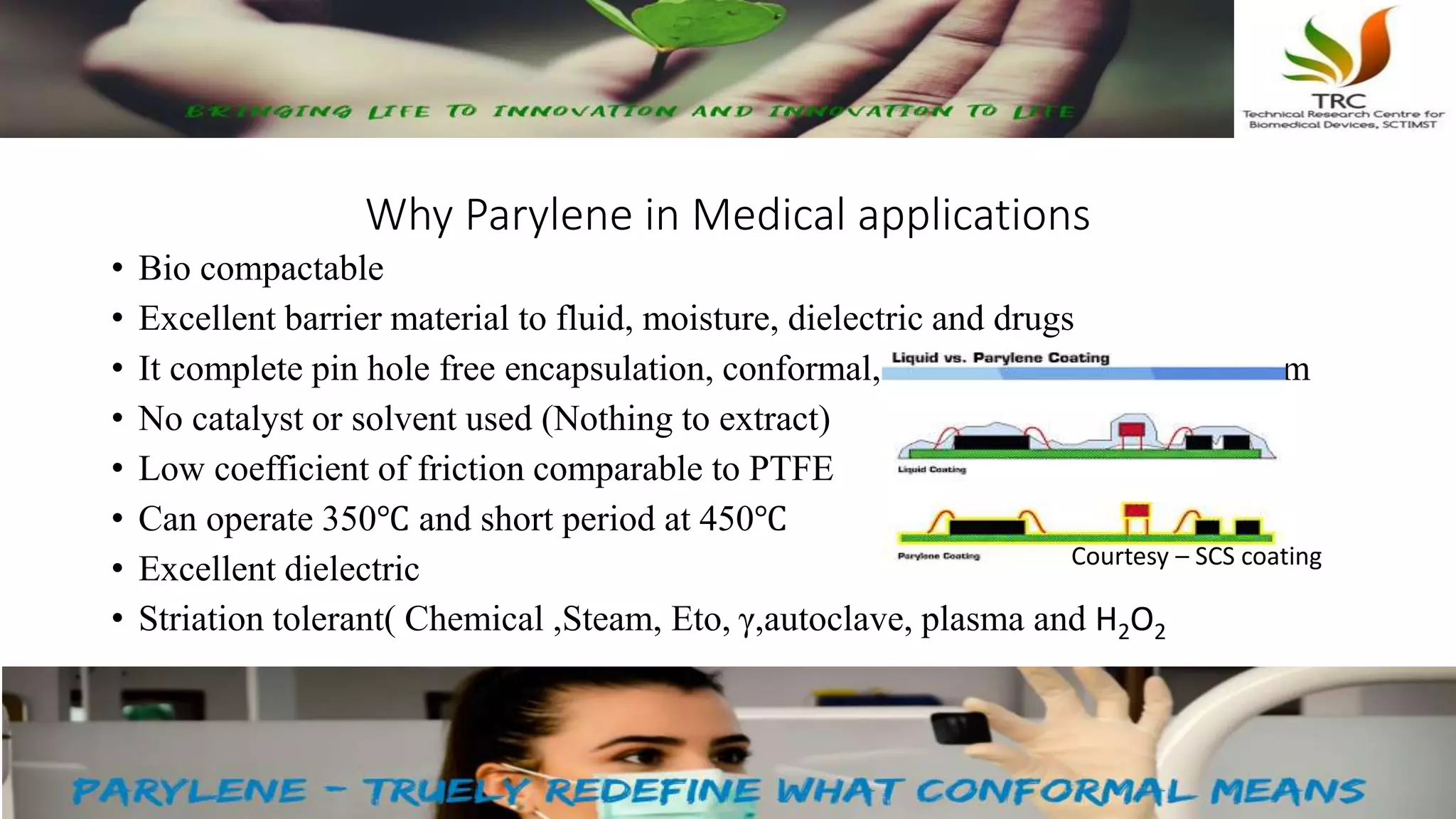
• It complete pin hole free encapsulation, conformal, uniform, inert continues film
• No catalyst or solvent used (Nothing to extract)
• Low coefficient of friction comparable to PTFE
• Can operate 350℃ and short period at 450℃
• Excellent dielectric
• Striation tolerant( Chemical ,Steam, Eto, γ,autoclave, plasma and H2O2
Courtesy – SCS coating
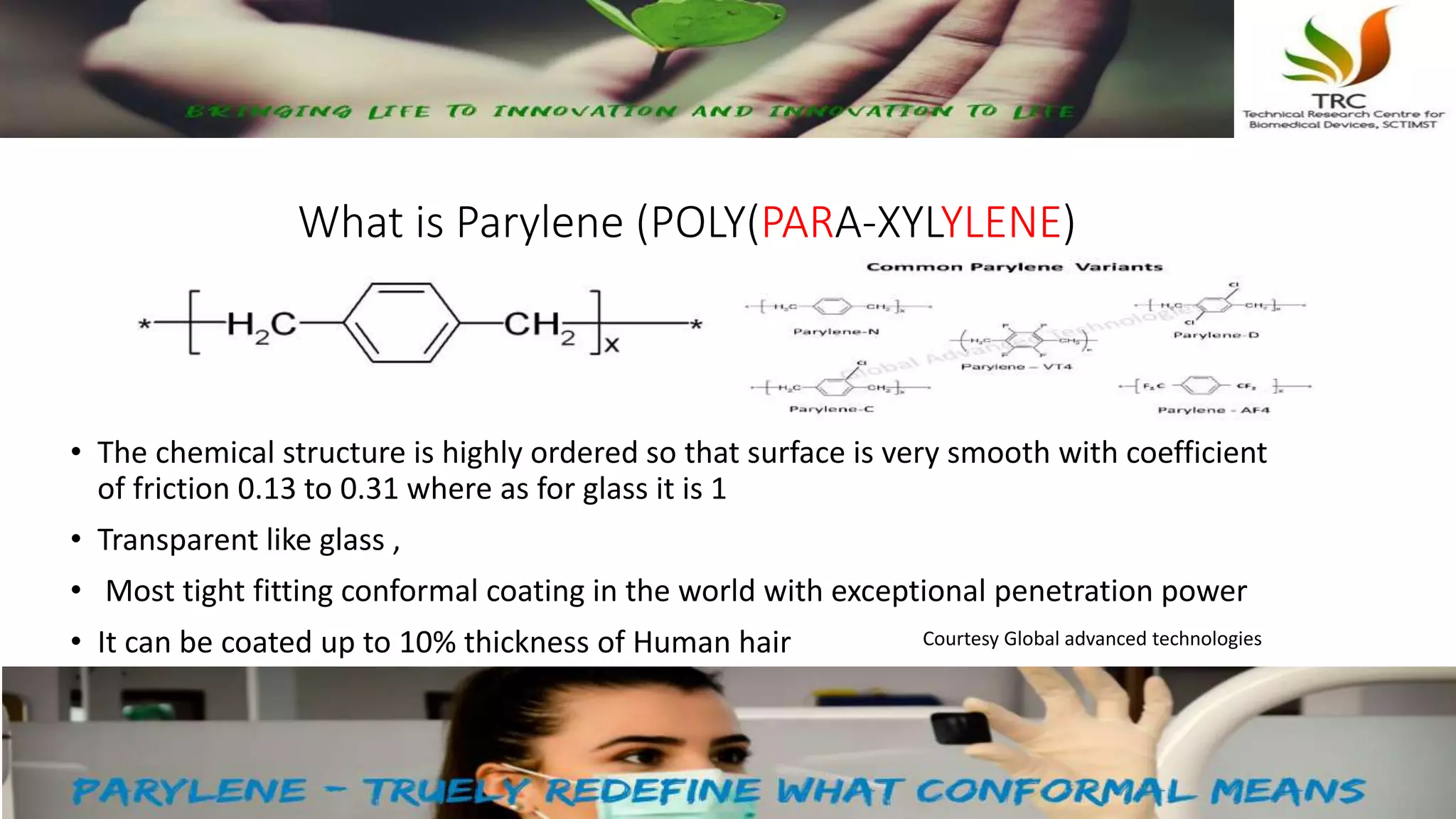
What is Parylene (POLY(PARA-XYLYLENE)
• The chemical structure is highly ordered so that surface is very smooth with coefficient
of friction 0.13 to 0.31 where as for glass it is 1
• Transparent like glass ,
• Most tight fitting conformal coating in the world with exceptional penetration power
• It can be coated up to 10% thickness of Human hair Courtesy Global advanced technologies
History of Parylene
• First synthesized by Michael Szwarc from simple groups containing
toluene and xylene in 1947
• In 1967 Dr. Gorham synthesized Parylene from Dimer by chemical
Vapor Deposition Technique
• First Commercialization done by Nova Tran Corp. in 1971 and Now
they known as Specialty Coating systems
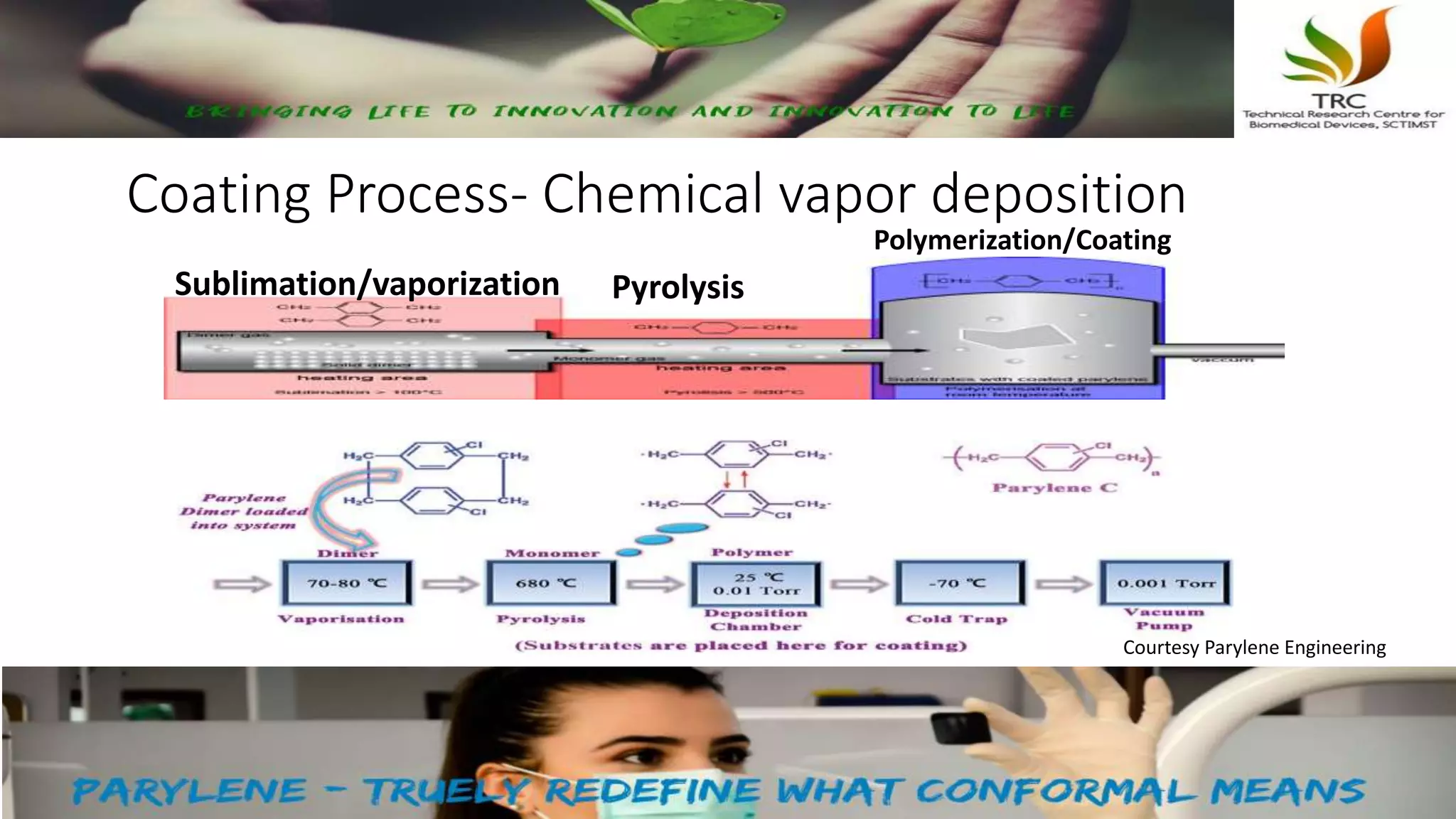
Coating Process- Chemical vapor deposition
Courtesy center for micro Nano technology
Sublimation/vaporization Pyrolysis
Polymerization/Coating
Courtesy Parylene Engineering
Types of Parylene
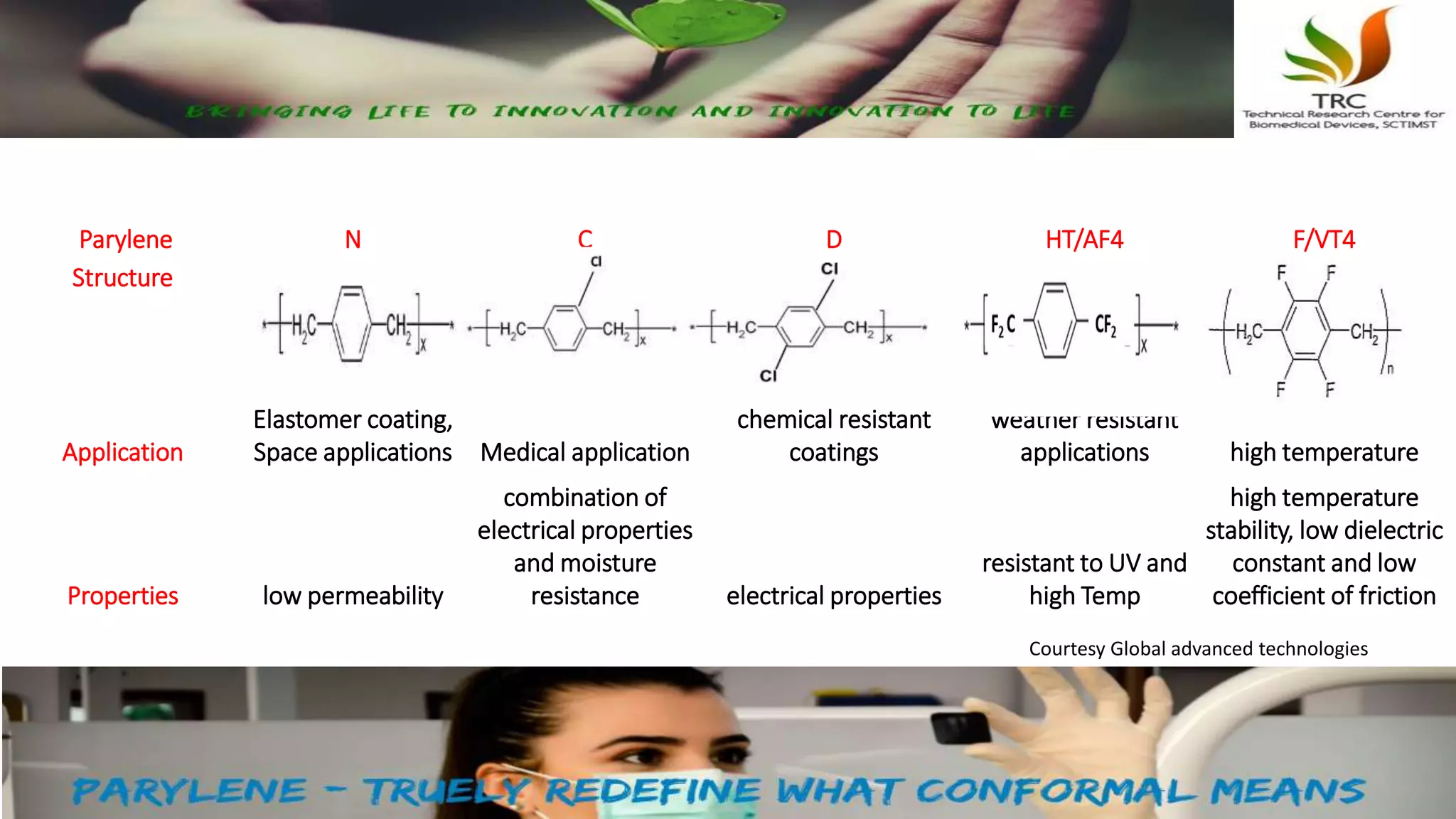
Parylene N C D HT/AF4 F/VT4
Structure
Application
Elastomer coating,
Space applications Medical application
chemical resistant
coatings
weather resistant
applications high temperature
Properties low permeability
combination of
electrical properties
and moisture
resistance electrical properties
resistant to UV and
high Temp
high temperature
stability, low dielectric
constant and low
coefficient of friction
Courtesy Global advanced technologies
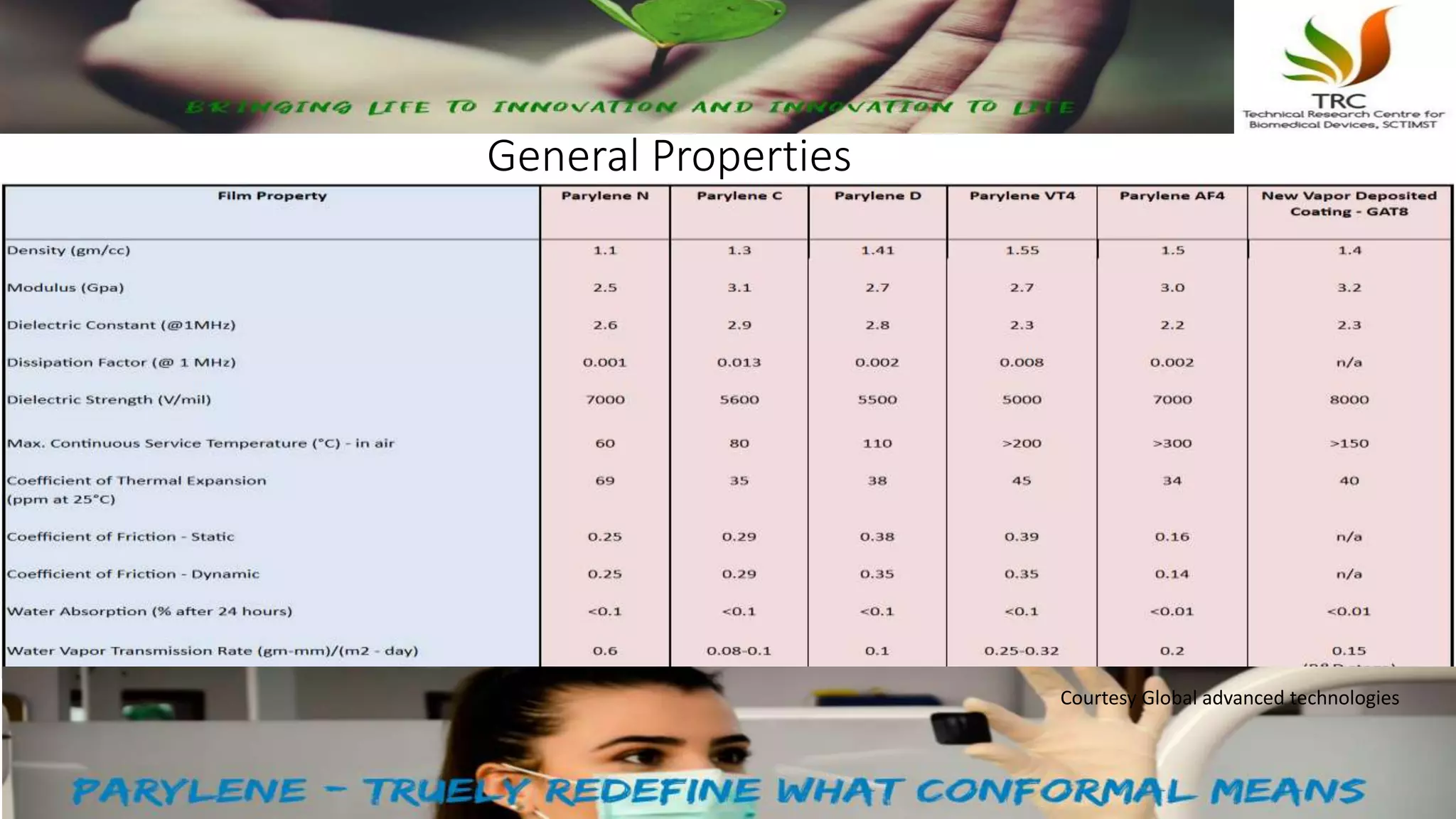
General Properties
Courtesy Global advanced technologies
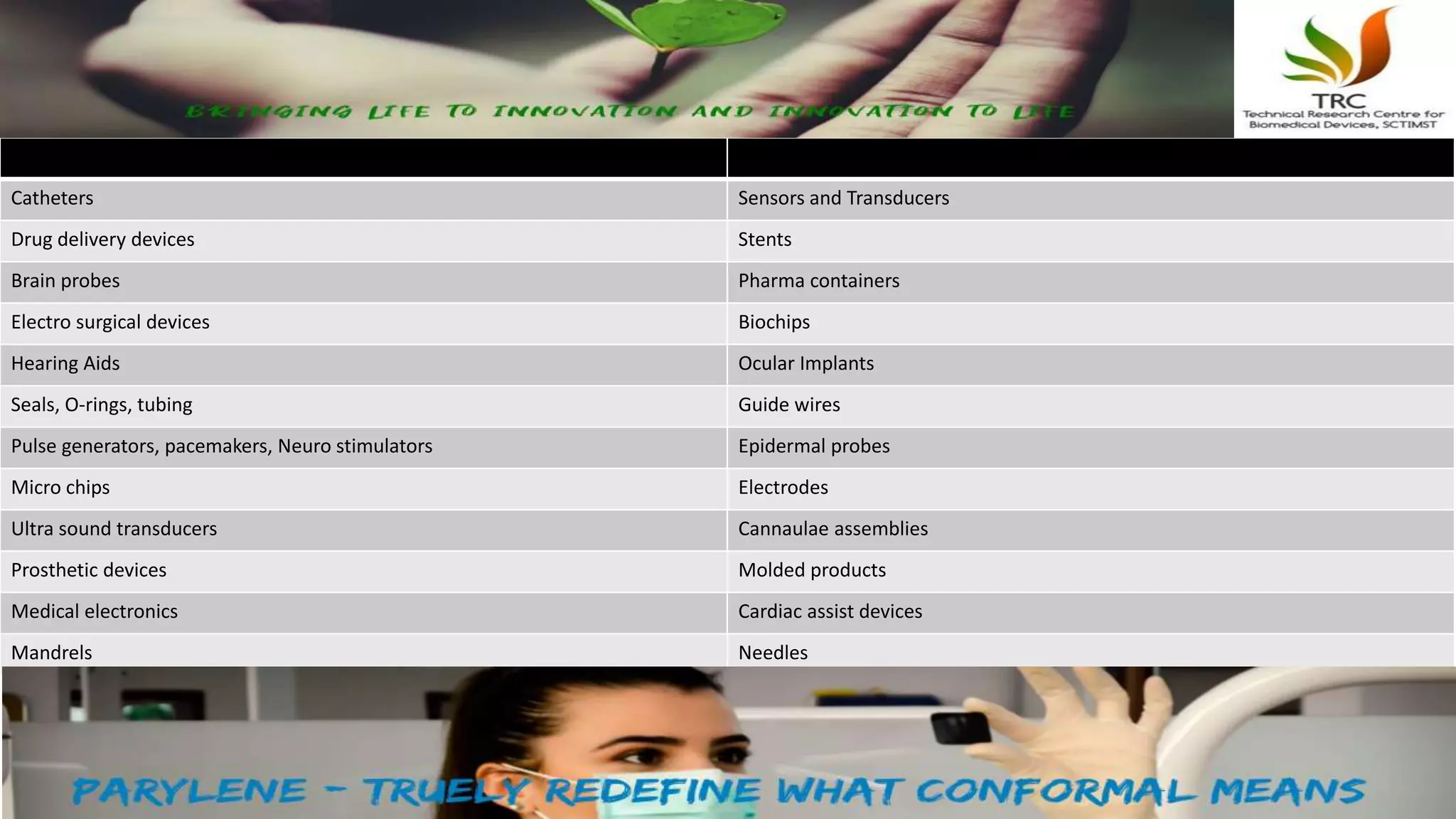
Applications
Catheters Sensors and Transducers
Drug delivery devices Stents
Brain probes Pharma containers
Electro surgical devices Biochips
Hearing Aids Ocular Implants
Seals, O-rings, tubing Guide wires
Pulse generators, pacemakers, Neuro stimulators Epidermal probes
Micro chips Electrodes
Ultra sound transducers Cannaulae assemblies
Prosthetic devices Molded products
Medical electronics Cardiac assist devices
Mandrels Needles
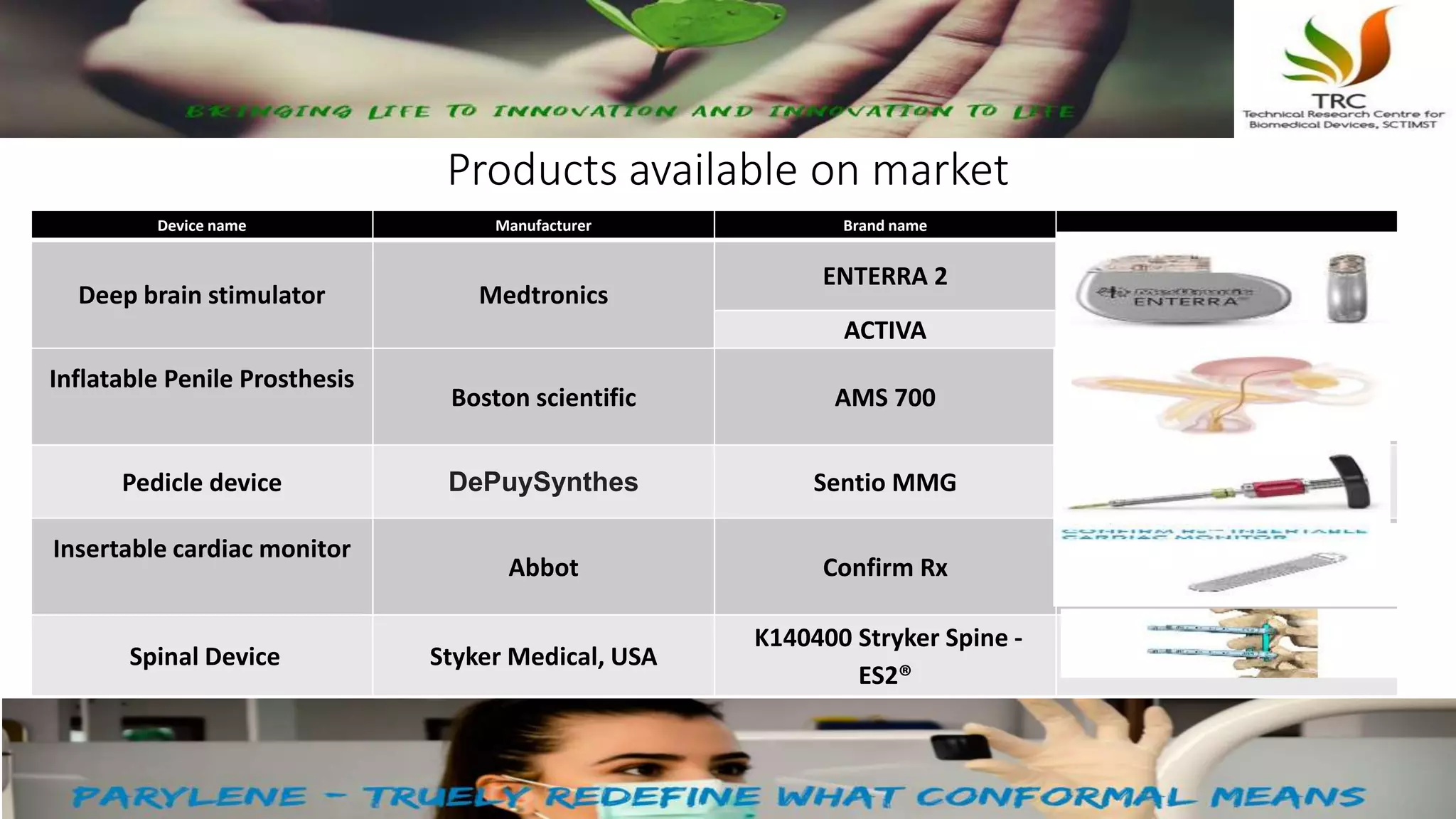
Products available on market
Device name Manufacturer Brand name
Deep brain stimulator Medtronics
ENTERRA 2
ACTIVA
Inflatable Penile Prosthesis
Boston scientific AMS 700
Pedicle device DePuySynthes Sentio MMG
Insertable cardiac monitor
Abbot Confirm Rx
Spinal Device Styker Medical, USA
K140400 Stryker Spine -
ES2®
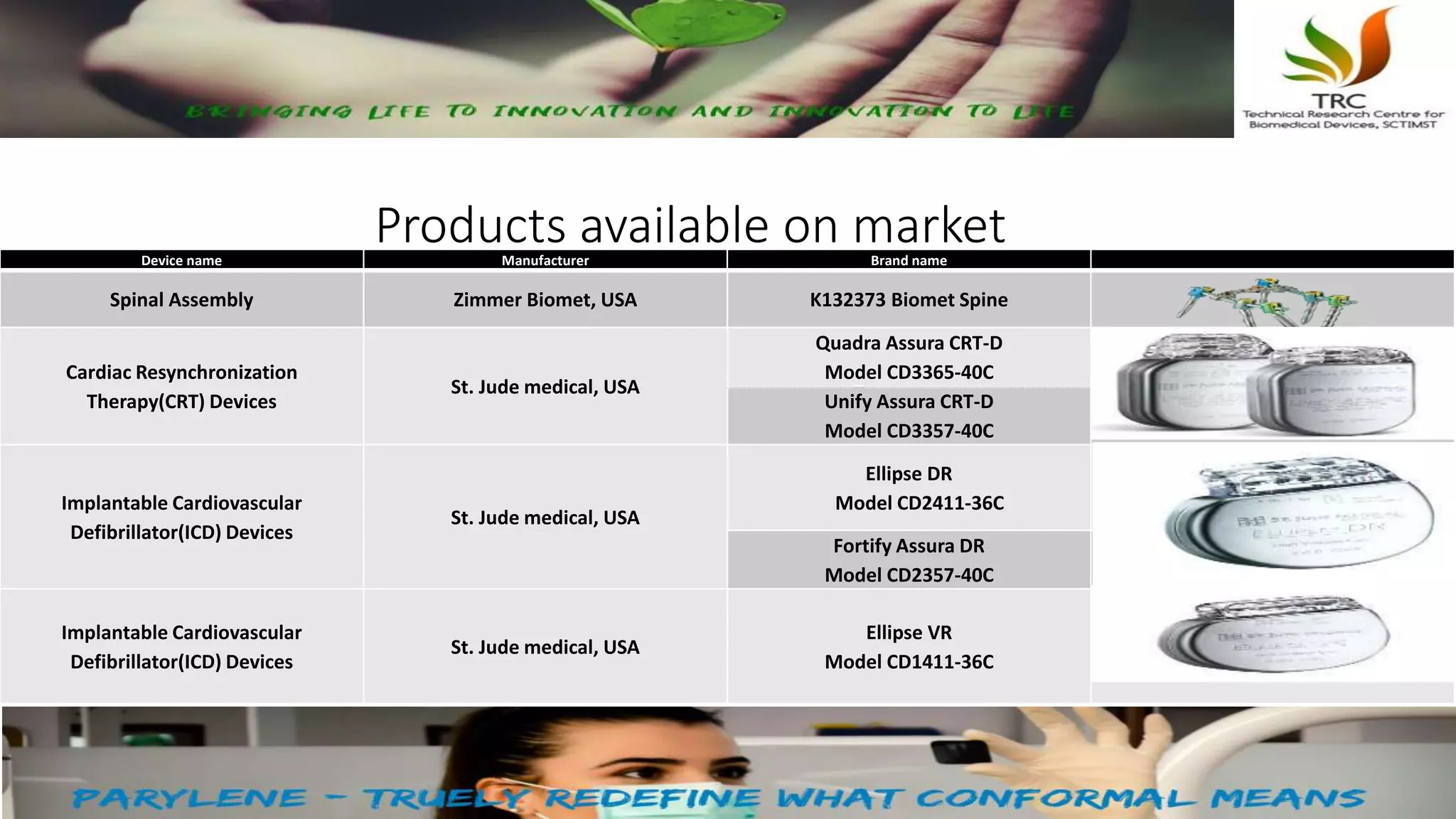
Products available on marketDevice name Manufacturer Brand name
Spinal Assembly Zimmer Biomet, USA K132373 Biomet Spine
Cardiac Resynchronization
Therapy(CRT) Devices
St. Jude medical, USA
Quadra Assura CRT-D
Model CD3365-40C
Unify Assura CRT-D
Model CD3357-40C
Implantable Cardiovascular
Defibrillator(ICD) Devices
St. Jude medical, USA
Ellipse DR
Model CD2411-36C
Fortify Assura DR
Model CD2357-40C
Implantable Cardiovascular
Defibrillator(ICD) Devices
St. Jude medical, USA
Ellipse VR
Model CD1411-36C
Thank you

Parylene coating in biomedical applications

  • 1.
    Parylene Coating inBiomedical Applications Under the supervision of Dr. Ramesh P SCTIMST Trivandrum Mohammad Ansar & Firoz khan
  • 2.
    Contents • Introduction • BasicRequirements For Biomedical coating materials • Why Parylene in Medical applications ? • What is Parylene ? • History of Parylene • Coating Process • Notable features of Parylene coating • Types of Parylene • Properties of Parylene • Applications
  • 3.
    Introduction • Requirement ofsafety increases with development of new devices • The Medical devices are getting smaller as the technology development but requirement of coating goes up • In order to make device very combat coatings should be denser and thinner without compromising its functional requirement • Coating process should be acceptable for devices • Higher temperature integrity
  • 4.
    Basic Requirements ForBiomedical coating materials 1. Adhesion, Total coverage conformity and uniformity 2. No delamination, blistering, flaking or chemical reaction 3. Low moisture and vapor transmission rate and low water absorption 4. Protection from corrosion 5. High purity 6. No outgassing, leaching or extraction 7. Non nutrient (Resistant to micro organism) 8. Low/No stress 9. Electrical Properties(Excellent insulation resistant, dielectric constant, dissipation factor, dielectric breakdown voltage) 10. UV and Ionizing radiation stability 11. Biocompatibility and Bio stability
  • 5.
    Why Parylene inMedical applications • Bio compactable • Excellent barrier material to fluid, moisture, dielectric and drugs • It complete pin hole free encapsulation, conformal, uniform, inert continues film • No catalyst or solvent used (Nothing to extract) • Low coefficient of friction comparable to PTFE • Can operate 350℃ and short period at 450℃ • Excellent dielectric • Striation tolerant( Chemical ,Steam, Eto, γ,autoclave, plasma and H2O2 Courtesy – SCS coating
  • 6.
    What is Parylene(POLY(PARA-XYLYLENE) • The chemical structure is highly ordered so that surface is very smooth with coefficient of friction 0.13 to 0.31 where as for glass it is 1 • Transparent like glass , • Most tight fitting conformal coating in the world with exceptional penetration power • It can be coated up to 10% thickness of Human hair Courtesy Global advanced technologies
  • 7.
    History of Parylene •First synthesized by Michael Szwarc from simple groups containing toluene and xylene in 1947 • In 1967 Dr. Gorham synthesized Parylene from Dimer by chemical Vapor Deposition Technique • First Commercialization done by Nova Tran Corp. in 1971 and Now they known as Specialty Coating systems
  • 8.
    Coating Process- Chemicalvapor deposition Courtesy center for micro Nano technology Sublimation/vaporization Pyrolysis Polymerization/Coating Courtesy Parylene Engineering
  • 9.
    Types of Parylene ParyleneN C D HT/AF4 F/VT4 Structure Application Elastomer coating, Space applications Medical application chemical resistant coatings weather resistant applications high temperature Properties low permeability combination of electrical properties and moisture resistance electrical properties resistant to UV and high Temp high temperature stability, low dielectric constant and low coefficient of friction Courtesy Global advanced technologies
  • 10.
  • 11.
    Applications Catheters Sensors andTransducers Drug delivery devices Stents Brain probes Pharma containers Electro surgical devices Biochips Hearing Aids Ocular Implants Seals, O-rings, tubing Guide wires Pulse generators, pacemakers, Neuro stimulators Epidermal probes Micro chips Electrodes Ultra sound transducers Cannaulae assemblies Prosthetic devices Molded products Medical electronics Cardiac assist devices Mandrels Needles
  • 12.
    Products available onmarket Device name Manufacturer Brand name Deep brain stimulator Medtronics ENTERRA 2 ACTIVA Inflatable Penile Prosthesis Boston scientific AMS 700 Pedicle device DePuySynthes Sentio MMG Insertable cardiac monitor Abbot Confirm Rx Spinal Device Styker Medical, USA K140400 Stryker Spine - ES2®
  • 13.
    Products available onmarketDevice name Manufacturer Brand name Spinal Assembly Zimmer Biomet, USA K132373 Biomet Spine Cardiac Resynchronization Therapy(CRT) Devices St. Jude medical, USA Quadra Assura CRT-D Model CD3365-40C Unify Assura CRT-D Model CD3357-40C Implantable Cardiovascular Defibrillator(ICD) Devices St. Jude medical, USA Ellipse DR Model CD2411-36C Fortify Assura DR Model CD2357-40C Implantable Cardiovascular Defibrillator(ICD) Devices St. Jude medical, USA Ellipse VR Model CD1411-36C
  • 14.