Dr Sumitha J
Associate Professor
JBAS College for Women,Chennai-18
VIRUS STRUCTURE &
CLASSIFICATION
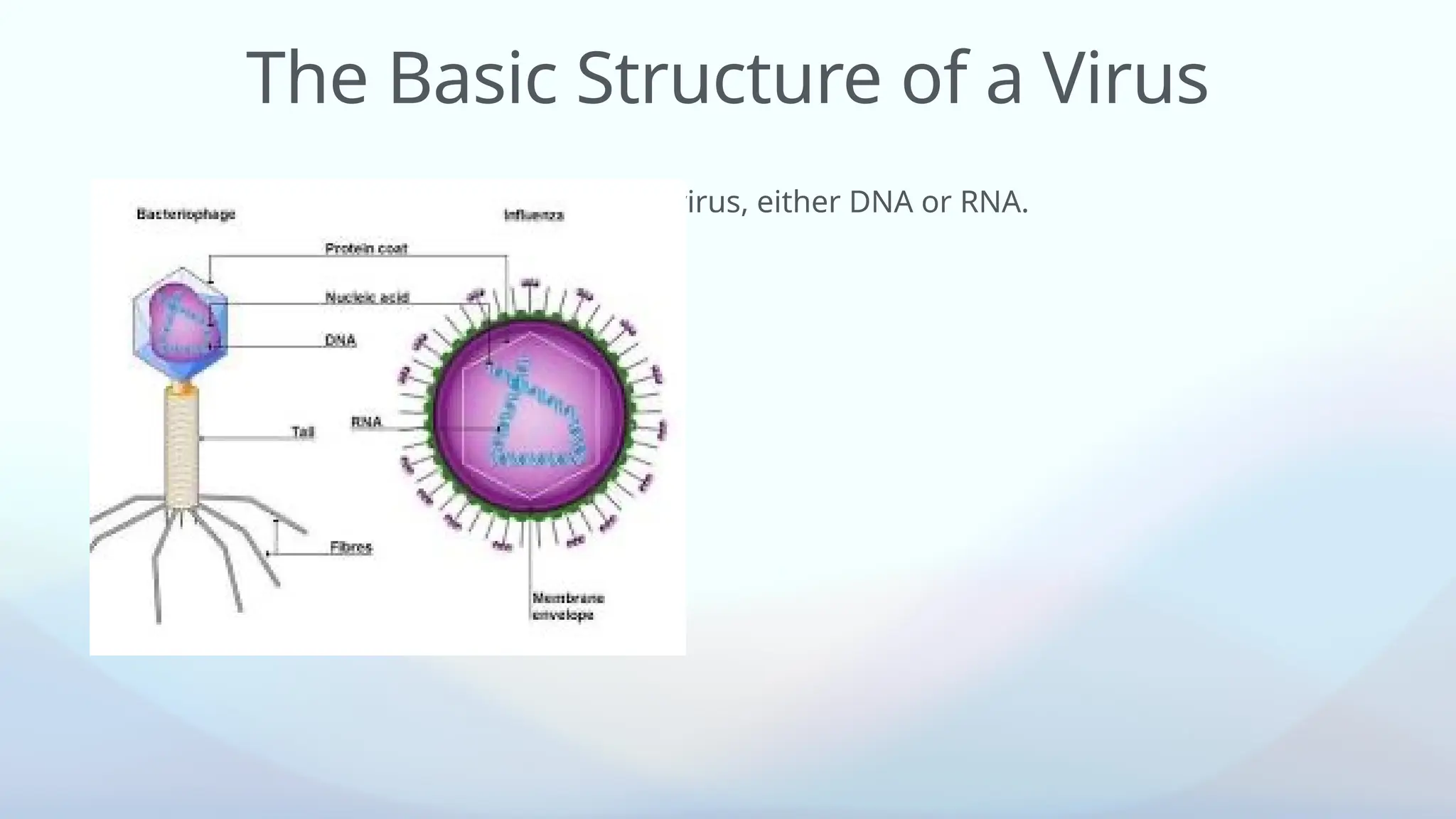
Nucleic Acid: The genetic material of the virus, either DNA or RNA.
•Single-stranded or double-stranded
•Linear or circular.
The Basic Structure of a Virus
•Capsid: The protein coat that encloses and protects the nucleic acid.
◦Made up of capsomeres (protein subunits)
◦Provides structural stability and aids in attachment to host cells
The Basic Structure of a Virus
Icosahedral Symmetry:
Viral Symmetry
Most common type of symmetry
•Spherical shape with 20 triangular faces
•Example: Poliovirus, Adenovirus
Click here for 3D model
• Nucleic acid wound around a protein core
• Example: Tobacco Mosaic Virus
Helical Symmetry
Helical viruses have a
rod-shaped or
filamentous structure.
The genetic material,
usually RNA, is wound
around a protein core in
a helical pattern.
This structure is less
common than
icosahedral but is found
in viruses like the
Tobacco Mosaic Virus
(TMV).
Complex Symmetry:
Irregular shape with multiple structures
Example: Bacteriophages, Poxviruses
Complex viruses have a more intricate structure than
icosahedral or helical viruses.
They often have multiple protein shells and may possess
additional structures like tails or fibers.
Bacteriophages are a classic example of complex
viruses, with their head, tail, and tail fibers. These
complex structures allow them to interact with host cells
in specific ways and inject their genetic material
efficiently.
Click here for 3D view of Complex model
The Viral Envelope
Lipid bilayer derived from the host cell
membrane
• Contains viral glycoproteins (spikes)
• Enveloped viruses are more fragile than
non-enveloped viruses
Functions of the envelope:
• Attachment to host cells
• Protection from the immune system
• Fusion with the host cell membrane
Baltimore classification
The Baltimore Classification of viruses is based on the
method of viral mRNA synthesis..
The Nobel Prize-winning biologist David Baltimore
devised the Baltimore classification system.
The ICTV classification system is used in conjunction
with the Baltimore classification system in modern
virus classification.
As per Baltimore classification there are 7 classes of
viruses
INTERNATIONAL COMMITTEE ON TAXONOMY
OF VIRUSES (ICTV) CLASSIFICATION
Established in 1966
Only body takes the task of developing refining
and maintaining the Universal viruses
taxonomy
Governed by the Virology Division of the
International Union of Microbiological
Societies.
Classification of Viruses
The Baltimore classification system categorizes viruses into seven groups:
• Group I: Double-stranded DNA viruses
• Group II: Single-stranded DNA viruses
• Group III: Double-stranded RNA viruses
• Group IV: Positive single-stranded RNA viruses
• Group V: Negative single-stranded RNA viruses
• Group VI: RNA viruses that reverse transcribe
• Group VII: DNA viruses that reverse transcribe
LHT CLASSIFICATION
The LHT System of Virus Classification is based on chemical and physical
characters like
Nucleic acid (DNA or RNA),
Symmetry (Helical or Icosahedral or Complex),
Presence of envelope,
Diameter of capsid,
Number of capsomers.
Andre Loff, Robert Horne, and Paul Tournier (1962)
This classification was approved by the Provisional Committee on
Nomenclature of Virus (PNVC) of the International Association of
Microbiological Societies (1962).
BASED ON NUCLEIC ACID
Cultivation of viruses
• Animal inoculation Inoculation into
• embryonated egg
• Susceptible experimental animals
• like Mice, Monkey, Rabbits,
• Woodruff and Goodpasture
• (1931 )used fertilized chicken egg for Guinea Pigs etc. are used for the viral cultivation. This is a simpler cultivation of
viruses. Virus sample technique than animal inoculation, are to be cultivated should be injected inexpensive and easily
available.
• into the experimental animal.
• Eggs usually not interfere with virus
• Intracerebral, subcutaneous,
• multiplication due to absence of
• intraperitoneal, or intranasal routes immune response. Suitable cells for
• the growth of viruses are available in
• are various routes of inoculation.
• embryo and its membrane, which may After inoculation, the animals are facilitate the growth of virus. observed for signs
of disease or
• death.
• Tissue Culture Cultivation of tissue or organ for the
• growth of viruses. Cell culture is most widely used in diagnostic virology for cultivation and assays
• of viruses.
Embryonated eggs
Woodruff and Goodpasture in 1931 first used the embryonated hen's
egg for the cultivation of virus. The method further developed by Burnet
was used for cultivation of viruses in different sites of the egg.
Many of these viruses cause well-defined and characteristic foci,
providing a method for identification, quantification, or assessing virus
pathogenicity.
The embryonated egg is also used for growing higher stocks of some
viruses in research laboratories and for vaccine production. Viruses can
be cultivated in various parts of egg like Chorioallantoic membrane,
Allantoic cavity, Amniotic sac and Yolk sac.
Embryonated eggs
Viruses are inoculated into chick embryo of 7-12 days old.
For inoculation, eggs are first prepared for cultivation, the shell surface is first
disinfected with iodine, checked in ovoscope if it is alive and penetrated with a
small sterile drill.
After inoculation, the opening is sealed with gelatin or paraffin and incubated
at 36°c for 2-3 days.
After incubation, the egg is broken and virus is isolated from tissue of egg:
Viral growth and multiplication in the egg embryo is indicated by the death of
the embryo, by embryo cell damage, or by the formation of typical pocks or
lesions on the egg membranes
Chorioallantoic Membrane (CAM)
Inoculation is mainly for growing poxvirus.
After incubation, visible lesions called pocks are observed,
which is grey white area in transparent CAM.
Each infectious virus particle produces one pock.
The morphology of the pocks may vary depending on the
nature of the virus. The pox viruses, such as variola or
vaccinia are identified by demonstration of typical pocks
on the CAM inoculated with the pox virus.
Herpes simplex virus is also grown.
This method is suitable for plaque studies.
Allantoic cavity
Is the most popular and simple method for viral inoculation.
Inoculation in the allantoic cavity is used for serial passages and for
obtaining large quantities of virus, such as influenza virus, yellow
fever, and rabies viruses for preparation of vaccines.
For production of rabies virus, duck eggs were used due to their
bigger size than that of hen's egg. This helped in production of large
quantities of rabies virus, which are used for preparation of the
inactivated non-neural rabies vaccine. But they need a longer
incubation period than embryonated hen's egg.
Most of avian viruses can be isolated using this method.
Amniotic sac
Inoculation is mainly done for primary isolation of influenza virus and the
mumps virus.
Growth and replication of virus in egg embryo can be detected by
haemagglutination assay.
Yolk sac inoculation:
It is also a simplest method for growth and multiplication of virus.
Mostly mammalian viruses are isolated using this method.
Yolk sac inoculation is used for cultivation of Japanese encephalitis, Saint
Louis encephalitis, and West Nile virus.
It is inoculated for cultivation of some viruses and some bacteria
(Chlamydia, Rickettsiae)
Immune interference mechanism can be detected in most of avian viruses.
Embroyonated eggs-Advantages
• Widely used method for the isolation of virus and growth.
• Ideal substrate for the viral growth and replication.
• Isolation and cultivation of many avian and few mammalian
viruses.
• Cost effective and maintenance is much easier.
• Less labor is needed.
• The embryonated eggs are readily available.
• They are free from contaminating bacteria and many
viruses.
• Widely used method to grow virus for some vaccine
production
Animal Inoculation
Viruses which are not cultivated in embryonated egg and
tissue culture are cultivated in laboratory animals such as
mice, guinea pig, hamster and rabbits are used.
The selected animals should be healthy and free from any
communicable diseases.
Mice(less than 48 hours old) are most commonly used.
Mice are susceptible to togavirus and coxsackie virues, which
are inoculated by intracerebral and intranasal route.
Animal Inoculation
After inoculation, virus multiply in host and develops
disease. The animals are observed for symptoms of
disease and death.
Then the virus is isolated and purified from the tissue of
these animals.
Live inoculation was first used on human volunteers for
the study of yellow fever virus
Animal Inoculation-Advantages
• Diagnosis, Pathogenesis and clinical symptoms
are determined.
• Production of antibodies can be identified.
• Primary isolation of certain viruses.
• Mice provide a reliable model for studying viral
replication.
• Used for the study of immune responses,
epidemiology and oncogenesis
Animal Inoculation-DisAdvantages
• Expensive and difficulties in maintenance of
animals.
• Difficulty in choosing of animals for particular
virus
• Some human viruses cannot be grown in animals,
or can be grown but do not cause disease.
• Mice do not provide models for vaccine
development.
• Issues related to animal welfare systems
Tissue Culture
Cultivation of tissue or organ for the growth of viruses
Three types of tissue culture.
• Organ cultures - are mainly done for highly
specialized parasites of certain organs e.g. tracheal
ring culture is done for isolation of coronavirus.
• Explant culture - Fragments of tissue can be grown
as explant in plasma clot. This method is rarely used.
• Cell culture - it is mostly used for cultivation of
viruses.
• Cell culture is mostly used for identification and
cultivation of viruses.
• Cell culture is the process by which cells are grown under
controlled conditions.
• Cells are grown in vitro on glass or a treated plastic
surface in a suitable growth medium.
• At first growth medium, usually balanced salt solution
containing 13 amino acids, sugar, proteins, salts, calf
serum, buffer, antibiotics and phenol red are taken and
the host tissue or cell is inoculated.
• On incubation the cell divide and spread out on the glass
surface to form a confluent monolayer
Types of cell culture Based on the origin and the
chromosome property the tissue culture are
classified into 3 types.
1. Primary cell culture: These are normal cells
freshly taken from animal or human body. They
are able to grow only for limited time and
cannotbe maintained in serial culture. They are
used for the primary isolation of viruses
andproduction of vaccine. Examples: Monkey
kidney, cell culture, Human embryonic kidney,
chick embryo cell culture.
2. Diploid cell culture (Semi-continuous cell lines)
They are diploid and contain the same number of
chromosomes as the parent cells.
They can be sub-cultured up to 50 times by serial
transfer following senescence and the cell strain is
lost.
They are used for the isolation of some fastidious
viruses and production of viral vaccines.
Examples: Human embryonic lung strain, Rhesus
embryo cell strain.
3. Continuous cell lines
They are derived from cancer cells.
They can be serially cultured so named as continuous
cell lines
They can be maintained either by serial subculture or
by storing in deep freeze at -70°c.
Due to derivation from cancer cells they are not useful
for vaccine production.
Examples: HeLa (Human Carcinoma of cervix cell line),
HEP-2 (Human Epithelioma of larynx cell line), BHK-21
(Baby Hamster Kidney cell line).
Detection of virus growth in cell culture • Cytopathic
effects - Many viruses causes morphological changes in
cultured cells in which they grow. These changes can be
observed microscopically and are known as cytopathic
effects.
The cytopathic effect are characteristic for a particular
group of viruses and helps in the presumptive
identification
of viruses.
ex- entroviruses causes orientation of cells.
Metabolic inhibition - In normal cell cultures the
medium turns acidic due to cellular metabolism.
Growth of viruses inhibits metabolism and hence
no acidic production. This can be made out by the
colour of the indicator (phenol red).
Haemadsorption - When Haemogglutinating
viruses (influenza and Para influenza) grow in cell
culture. They adsorb Guinea pig RBCs onto the
surface of cell cultures

Virus - Structure,classification and Cultivation.pptx

  • 1.
    Dr Sumitha J AssociateProfessor JBAS College for Women,Chennai-18 VIRUS STRUCTURE & CLASSIFICATION
  • 2.
    Nucleic Acid: Thegenetic material of the virus, either DNA or RNA. •Single-stranded or double-stranded •Linear or circular. The Basic Structure of a Virus
  • 3.
    •Capsid: The proteincoat that encloses and protects the nucleic acid. ◦Made up of capsomeres (protein subunits) ◦Provides structural stability and aids in attachment to host cells The Basic Structure of a Virus
  • 4.
    Icosahedral Symmetry: Viral Symmetry Mostcommon type of symmetry •Spherical shape with 20 triangular faces •Example: Poliovirus, Adenovirus Click here for 3D model
  • 5.
    • Nucleic acidwound around a protein core • Example: Tobacco Mosaic Virus Helical Symmetry Helical viruses have a rod-shaped or filamentous structure. The genetic material, usually RNA, is wound around a protein core in a helical pattern. This structure is less common than icosahedral but is found in viruses like the Tobacco Mosaic Virus (TMV).
  • 6.
    Complex Symmetry: Irregular shapewith multiple structures Example: Bacteriophages, Poxviruses Complex viruses have a more intricate structure than icosahedral or helical viruses. They often have multiple protein shells and may possess additional structures like tails or fibers. Bacteriophages are a classic example of complex viruses, with their head, tail, and tail fibers. These complex structures allow them to interact with host cells in specific ways and inject their genetic material efficiently. Click here for 3D view of Complex model
  • 8.
    The Viral Envelope Lipidbilayer derived from the host cell membrane • Contains viral glycoproteins (spikes) • Enveloped viruses are more fragile than non-enveloped viruses Functions of the envelope: • Attachment to host cells • Protection from the immune system • Fusion with the host cell membrane
  • 10.
    Baltimore classification The BaltimoreClassification of viruses is based on the method of viral mRNA synthesis.. The Nobel Prize-winning biologist David Baltimore devised the Baltimore classification system. The ICTV classification system is used in conjunction with the Baltimore classification system in modern virus classification. As per Baltimore classification there are 7 classes of viruses
  • 11.
    INTERNATIONAL COMMITTEE ONTAXONOMY OF VIRUSES (ICTV) CLASSIFICATION Established in 1966 Only body takes the task of developing refining and maintaining the Universal viruses taxonomy Governed by the Virology Division of the International Union of Microbiological Societies.
  • 12.
    Classification of Viruses TheBaltimore classification system categorizes viruses into seven groups: • Group I: Double-stranded DNA viruses • Group II: Single-stranded DNA viruses • Group III: Double-stranded RNA viruses • Group IV: Positive single-stranded RNA viruses • Group V: Negative single-stranded RNA viruses • Group VI: RNA viruses that reverse transcribe • Group VII: DNA viruses that reverse transcribe
  • 15.
    LHT CLASSIFICATION The LHTSystem of Virus Classification is based on chemical and physical characters like Nucleic acid (DNA or RNA), Symmetry (Helical or Icosahedral or Complex), Presence of envelope, Diameter of capsid, Number of capsomers. Andre Loff, Robert Horne, and Paul Tournier (1962) This classification was approved by the Provisional Committee on Nomenclature of Virus (PNVC) of the International Association of Microbiological Societies (1962).
  • 16.
  • 17.
    Cultivation of viruses •Animal inoculation Inoculation into • embryonated egg • Susceptible experimental animals • like Mice, Monkey, Rabbits, • Woodruff and Goodpasture • (1931 )used fertilized chicken egg for Guinea Pigs etc. are used for the viral cultivation. This is a simpler cultivation of viruses. Virus sample technique than animal inoculation, are to be cultivated should be injected inexpensive and easily available. • into the experimental animal. • Eggs usually not interfere with virus • Intracerebral, subcutaneous, • multiplication due to absence of • intraperitoneal, or intranasal routes immune response. Suitable cells for • the growth of viruses are available in • are various routes of inoculation. • embryo and its membrane, which may After inoculation, the animals are facilitate the growth of virus. observed for signs of disease or • death. • Tissue Culture Cultivation of tissue or organ for the • growth of viruses. Cell culture is most widely used in diagnostic virology for cultivation and assays • of viruses.
  • 18.
    Embryonated eggs Woodruff andGoodpasture in 1931 first used the embryonated hen's egg for the cultivation of virus. The method further developed by Burnet was used for cultivation of viruses in different sites of the egg. Many of these viruses cause well-defined and characteristic foci, providing a method for identification, quantification, or assessing virus pathogenicity. The embryonated egg is also used for growing higher stocks of some viruses in research laboratories and for vaccine production. Viruses can be cultivated in various parts of egg like Chorioallantoic membrane, Allantoic cavity, Amniotic sac and Yolk sac.
  • 19.
    Embryonated eggs Viruses areinoculated into chick embryo of 7-12 days old. For inoculation, eggs are first prepared for cultivation, the shell surface is first disinfected with iodine, checked in ovoscope if it is alive and penetrated with a small sterile drill. After inoculation, the opening is sealed with gelatin or paraffin and incubated at 36°c for 2-3 days. After incubation, the egg is broken and virus is isolated from tissue of egg: Viral growth and multiplication in the egg embryo is indicated by the death of the embryo, by embryo cell damage, or by the formation of typical pocks or lesions on the egg membranes
  • 20.
    Chorioallantoic Membrane (CAM) Inoculationis mainly for growing poxvirus. After incubation, visible lesions called pocks are observed, which is grey white area in transparent CAM. Each infectious virus particle produces one pock. The morphology of the pocks may vary depending on the nature of the virus. The pox viruses, such as variola or vaccinia are identified by demonstration of typical pocks on the CAM inoculated with the pox virus. Herpes simplex virus is also grown. This method is suitable for plaque studies.
  • 21.
    Allantoic cavity Is themost popular and simple method for viral inoculation. Inoculation in the allantoic cavity is used for serial passages and for obtaining large quantities of virus, such as influenza virus, yellow fever, and rabies viruses for preparation of vaccines. For production of rabies virus, duck eggs were used due to their bigger size than that of hen's egg. This helped in production of large quantities of rabies virus, which are used for preparation of the inactivated non-neural rabies vaccine. But they need a longer incubation period than embryonated hen's egg. Most of avian viruses can be isolated using this method.
  • 22.
    Amniotic sac Inoculation ismainly done for primary isolation of influenza virus and the mumps virus. Growth and replication of virus in egg embryo can be detected by haemagglutination assay. Yolk sac inoculation: It is also a simplest method for growth and multiplication of virus. Mostly mammalian viruses are isolated using this method. Yolk sac inoculation is used for cultivation of Japanese encephalitis, Saint Louis encephalitis, and West Nile virus. It is inoculated for cultivation of some viruses and some bacteria (Chlamydia, Rickettsiae) Immune interference mechanism can be detected in most of avian viruses.
  • 23.
    Embroyonated eggs-Advantages • Widelyused method for the isolation of virus and growth. • Ideal substrate for the viral growth and replication. • Isolation and cultivation of many avian and few mammalian viruses. • Cost effective and maintenance is much easier. • Less labor is needed. • The embryonated eggs are readily available. • They are free from contaminating bacteria and many viruses. • Widely used method to grow virus for some vaccine production
  • 24.
    Animal Inoculation Viruses whichare not cultivated in embryonated egg and tissue culture are cultivated in laboratory animals such as mice, guinea pig, hamster and rabbits are used. The selected animals should be healthy and free from any communicable diseases. Mice(less than 48 hours old) are most commonly used. Mice are susceptible to togavirus and coxsackie virues, which are inoculated by intracerebral and intranasal route.
  • 25.
    Animal Inoculation After inoculation,virus multiply in host and develops disease. The animals are observed for symptoms of disease and death. Then the virus is isolated and purified from the tissue of these animals. Live inoculation was first used on human volunteers for the study of yellow fever virus
  • 26.
    Animal Inoculation-Advantages • Diagnosis,Pathogenesis and clinical symptoms are determined. • Production of antibodies can be identified. • Primary isolation of certain viruses. • Mice provide a reliable model for studying viral replication. • Used for the study of immune responses, epidemiology and oncogenesis
  • 27.
    Animal Inoculation-DisAdvantages • Expensiveand difficulties in maintenance of animals. • Difficulty in choosing of animals for particular virus • Some human viruses cannot be grown in animals, or can be grown but do not cause disease. • Mice do not provide models for vaccine development. • Issues related to animal welfare systems
  • 28.
    Tissue Culture Cultivation oftissue or organ for the growth of viruses Three types of tissue culture. • Organ cultures - are mainly done for highly specialized parasites of certain organs e.g. tracheal ring culture is done for isolation of coronavirus. • Explant culture - Fragments of tissue can be grown as explant in plasma clot. This method is rarely used. • Cell culture - it is mostly used for cultivation of viruses.
  • 29.
    • Cell cultureis mostly used for identification and cultivation of viruses. • Cell culture is the process by which cells are grown under controlled conditions. • Cells are grown in vitro on glass or a treated plastic surface in a suitable growth medium. • At first growth medium, usually balanced salt solution containing 13 amino acids, sugar, proteins, salts, calf serum, buffer, antibiotics and phenol red are taken and the host tissue or cell is inoculated. • On incubation the cell divide and spread out on the glass surface to form a confluent monolayer
  • 30.
    Types of cellculture Based on the origin and the chromosome property the tissue culture are classified into 3 types. 1. Primary cell culture: These are normal cells freshly taken from animal or human body. They are able to grow only for limited time and cannotbe maintained in serial culture. They are used for the primary isolation of viruses andproduction of vaccine. Examples: Monkey kidney, cell culture, Human embryonic kidney, chick embryo cell culture.
  • 31.
    2. Diploid cellculture (Semi-continuous cell lines) They are diploid and contain the same number of chromosomes as the parent cells. They can be sub-cultured up to 50 times by serial transfer following senescence and the cell strain is lost. They are used for the isolation of some fastidious viruses and production of viral vaccines. Examples: Human embryonic lung strain, Rhesus embryo cell strain.
  • 32.
    3. Continuous celllines They are derived from cancer cells. They can be serially cultured so named as continuous cell lines They can be maintained either by serial subculture or by storing in deep freeze at -70°c. Due to derivation from cancer cells they are not useful for vaccine production. Examples: HeLa (Human Carcinoma of cervix cell line), HEP-2 (Human Epithelioma of larynx cell line), BHK-21 (Baby Hamster Kidney cell line).
  • 33.
    Detection of virusgrowth in cell culture • Cytopathic effects - Many viruses causes morphological changes in cultured cells in which they grow. These changes can be observed microscopically and are known as cytopathic effects. The cytopathic effect are characteristic for a particular group of viruses and helps in the presumptive identification of viruses. ex- entroviruses causes orientation of cells.
  • 34.
    Metabolic inhibition -In normal cell cultures the medium turns acidic due to cellular metabolism. Growth of viruses inhibits metabolism and hence no acidic production. This can be made out by the colour of the indicator (phenol red). Haemadsorption - When Haemogglutinating viruses (influenza and Para influenza) grow in cell culture. They adsorb Guinea pig RBCs onto the surface of cell cultures