FINANCIAL MARKETS AND
INSTITUTIONS
BY A . ARULDOS S VITHAKAN
1/30/2015
1
INDIAN FINANCIAL SYSTEN-AN
OVERVIEW
o Financial System of any country consists of financial markets,
financial intermediation and financial instruments or financial
products.
o The term "finance" in our simple understanding it is perceived
as equivalent to 'Money‘. But finance exactly is not money, it is
the source of providing funds for a particular activity.
o Finance refers to assessing the requirements of funds, identify
sources , sourcing, deployment and evaluating the results of
such investment with a view to improve performance in the
future.
o The economic development of a nation is reflected by the
progress of the various economic units, broadly classified into
corporate sector, government and household sector. While
performing their activities these units will be placed in a
surplus/deficit/balanced budgetary situations.
1/30/2015
2
o There are areas or people with surplus funds and there are
those with a deficit. A financial system or financial sector
functions as an intermediary and facilitates the flow of funds
from the areas of surplus to the areas of deficit. A Financial
System is a composition of various institutions, markets,
regulations and laws, practices, money manager, analysts,
transactions and claims and liabilities.
o The word "system", in the term "financial system", implies a
set of complex and closely connected or interlined institutions,
agents, practices, markets, transactions, claims, and liabilities
in the economy. The financial system is concerned about
money, credit and finance-the three terms are intimately
related yet are somewhat different from each other. Indian
financial system consists of financial market, financial
instruments and financial intermediation.
1/30/2015
3
FINANCIAL MARKETS
o Money Market- The money market ifs a wholesale debt
market for low-risk, highly-liquid, short-term
instrument. Funds are available in this market for periods
ranging from a single day up to a year. This market is
dominated mostly by government, banks and financial
institutions.
o Capital Market - The capital market is designed to finance
the long-term investments. The transactions taking place in
this market will be for periods over a year.
o Forex Market - The Forex market deals with the multicurrency
requirements, which are met by the exchange of
currencies. Depending on the exchange rate that is
applicable, the transfer of funds takes place in this
market. This is one of the most developed and integrated
market across the globe.
o Credit Market- Credit market is a place where banks, FIs and
NBFCs purvey short, medium and long-term loans to
corporate and individuals.
1/30/2015
4
FINANCIAL INTERMEDIATION
o To ensure that financial assets reach the ultimate investor in
order to garner the requisite amount. When the borrower of
funds approaches the financial market to raise funds, mere
issue of securities will not suffice. Adequate information of the
issue, issuer and the security should be passed on to take
place. There should be a proper channel within the financial
system to ensure such transfer.
o To serve this purpose, Financial intermediaries came into
existence.
o In the initial stages, the role of the intermediary was mostly
related to ensure transfer of funds from the lender to the
borrower. This service was offered by banks, FIs, brokers,
and dealers. However, as the financial system widened along
with the developments taking place in the financial markets,
the scope of its operations also widened.
1/30/2015
5
FINANCIAL INTERMEDIARIES
o Some of the important intermediaries operating ink
the financial markets include; investment bankers,
underwriters, stock exchanges, registrars,
depositories, custodians, portfolio managers,
mutual funds, financial advertisers financial
consultants, primary dealers, satellite dealers, self
regulatory organizations, etc. Though the markets
are different, there may be a few intermediaries
offering their services in move than one market e.g.
underwriter. However, the services offered by them
vary from one market to another.
1/30/2015
6
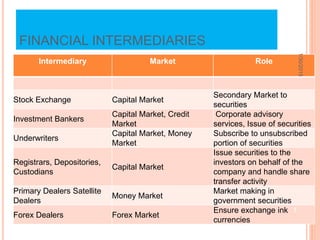
FINANCIAL INTERMEDIARIES
Intermediary Market Role
Stock Exchange Capital Market
Secondary Market to
securities
Investment Bankers
Capital Market, Credit
Market
Corporate advisory
services, Issue of securities
Underwriters
Capital Market, Money
Market
Subscribe to unsubscribed
portion of securities
Registrars, Depositories,
Custodians
Capital Market
Issue securities to the
investors on behalf of the
company and handle share
transfer activity
Primary Dealers Satellite
Dealers
Money Market
Market making in
government securities
Forex Dealers Forex Market
Ensure exchange ink
currencies
1/30/2015
7
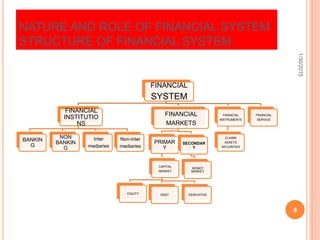
NATURE AND ROLE OF FINANCIAL SYSTEM
STRUCTURE OF FINANCIAL SYSTEM
FINANCIAL
SYSTEM
FINANCIAL
INSTITUTIO
NS
BANKIN
G
NON
BANKIN
G
Inter
mediaries
Non-inter
mediaries
FINANCIAL
MARKETS
PRIMAR
Y
CAPITAL
MARKET
EQUITY DEBT DERIVATIVE
SECONDAR
Y
MONEY
MARKET
FINANCIAL
INSTRUMENTS
CLAIMS
ASSETS
SECURITIES
FINANCIAL
SERVICE
1/30/2015
8
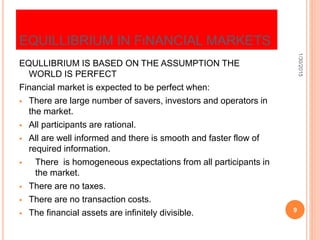
EQUILLIBRIUM IN FINANCIAL MARKETS
EQULLIBRIUM IS BASED ON THE ASSUMPTION THE
WORLD IS PERFECT
Financial market is expected to be perfect when:
 There are large number of savers, investors and operators in
the market.
 All participants are rational.
 All are well informed and there is smooth and faster flow of
required information.
 There is homogeneous expectations from all participants in
the market.
 There are no taxes.
 There are no transaction costs.
 The financial assets are infinitely divisible.
1/30/2015
9
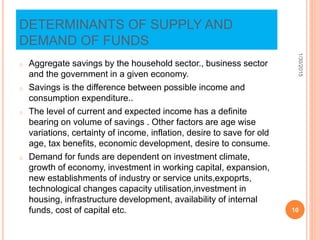
DETERMINANTS OF SUPPLY AND
DEMAND OF FUNDS
o Aggregate savings by the household sector., business sector
and the government in a given economy.
o Savings is the difference between possible income and
consumption expenditure..
o The level of current and expected income has a definite
bearing on volume of savings . Other factors are age wise
variations, certainty of income, inflation, desire to save for old
age, tax benefits, economic development, desire to consume.
o Demand for funds are dependent on investment climate,
growth of economy, investment in working capital, expansion,
new establishments of industry or service units,expoprts,
technological changes capacity utilisation,investment in
housing, infrastructure development, availability of internal
funds, cost of capital etc.
1/30/2015
10
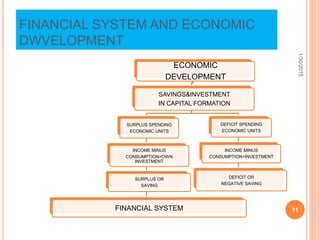
FINANCIAL SYSTEM AND ECONOMIC
DWVELOPMENT
ECONOMIC
DEVELOPMENT
SAVINGS&INVESTMENT
IN CAPITAL FORMATION
SURPLUS SPENDING
ECONOMIC UNITS
INCOME MINUS
CONSUMPTION+OWN
INVESTMENT
SURPLUS OR
SAVING
FINANCIAL SYSTEM
DEFICIT SPENDING
ECONOMIC UNITS
INCOME MINUS
CONSUMPTION+INVESTMENT
DEFICIT OR
NEGATIVE SAVING
1/30/2015
11
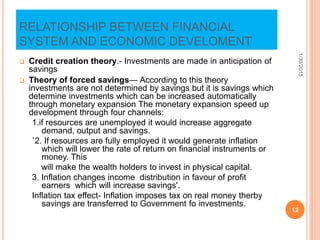
RELATIONSHIP BETWEEN FINANCIAL
SYSTEM AND ECONOMIC DEVELOMENT
 Credit creation theory.- Investments are made in anticipation of
savings
 Theory of forced savings— According to this theory
investments are not determined by savings but it is savings which
determine investments which can be increased automatically
through monetary expansion The monetary expansion speed up
development through four channels:
1.if resources are unemployed it would increase aggregate
demand, output and savings.
`2. If resources are fully employed it would generate inflation
which will lower the rate of return on financial instruments or
money. This
will make the wealth holders to invest in physical capital.
3. Inflation changes income distribution in favour of profit
earners which will increase savings'.
Inflation tax effect- Inflation imposes tax on real money therby
savings are transferred to Government fo investments.
1/30/2015
12
 Financial market Regulation Theory- According to this
theory fincial market are prone to market failures and that
government intervention make them to function better like
RBI’s interest rate and monetary policy, SEBI guidelines.
 Financial Liberalisation Theory- It is argued tha the
Government intervention and control of financial sector
not only lower the quantum of investments but also tne
quality as finacial institutions are forced to have directed
investments in government specified priority sectors
which normally non productive assets . Also they are
primarily in l sectors which do not contribute to economic
development/GDP growthh
1/30/2015
13
RBI AND INDIAN FINANCIAL SYSTEM
 Until 1994, different departments in Reserve Bank of
India were exercising supervision over banks, non-
banking financial companies and financial institutions.
 Board for Financial Supervision was set up under the
aegis Reserve Bank under Reserve Bank of India
(Board for Financial Supervision) Regulations, 1994 with
the objective of paying undivided attention to the
supervision of the institutions in the financial sector.
 Prior to 1993, the supervision and regulation of
commercial banks was handled by the Department of
Banking Operations & Development (DBOD). In
December 1993 the Department of Supervision was
carved out of the DBOD with the objective of
segregating the supervisory role from the regulatory
functions of RBI.
1/30/2015
14
 Department of Banking Supervision (DBS)
 The Department of Banking Supervision at present exercises
the supervisory role relating to commercial banks in the
following forms:
 Preparing of independent inspection programmes for different
institutions.
 Undertaking scheduled and special on-site inspections, off-
site surveillance, ensuring follow-up and compliance.
 Determining the criteria for the appointment of statutory
auditors and special auditors and assessing audit
performance and disclosure standards.
 Dealing with financial sector frauds.
 Exercising supervisory intervention in the implementation of
regulations which includes – recommendation for removal of
managerial and other persons, suspension of business,
amalgamation, merger/winding up, issuance of directives and
imposition of penalties.
1/30/2015
15
 Department of Non-Banking Supervision(DNBS)
 Department of Non-Banking Supervision has following
responsibilities:
 Administration of Chapter IIIB of the RBI Act, formulating
regulatory framework and issuing directions to the NBFCs
(including residuary non-banking companies, mutual benefit
companies, chit fund companies);
 Administration of Chapter III-C of the RBI Act in respect of
unincorporated bodies, Chit Funds Act in respect of chit fund
companies, Prize Chits and Moneys Circulation Schemes
(Banning) Act in respect of prize chits;
 Identification and classification of NBFCs;
 Registration of NBFCs under section 45-IA of the RBI Act;
 On-site inspection and follow up;
 Off-site surveillance and scrutiny of various returns;
 Attending to complaints relating to NBFC sector; and
 Initiating deterrent action against the errant companies
1/30/2015
16
SUPERVISORY PROCESS
 On-site inspection
 Supervision of overseas branches of Indian
banks
 Financial Institutions
 Non-Banking Financial Companies
 Off-site Monitoring & Surveillance System-
Banks, All India Development Financial
Institutions, Non-Banking Financial Companies
1/30/2015
17
BOARD FOR FINANCIAL SUPERVISION:
CONSTITUTION
 Board for Financial Supervision (BFS) was constituted
on November 16, 1994 by the Governor as a committee
of the Central Board of Directors of the Reserve Bank of
India (RBI). It functions under the RBI (BFS)
Regulations, 1994 exclusively framed for the purpose in
consultation with the Government of India.
 Advisory Council to BFS was constituted on
November 16, 1994 and was in place till March 27,
1998.
 The BFS also constituted an Audit Sub-Committee in
January 1995
 The supervision by BFS at present covers commercial
banks, all India development financial institutions and
non-banking finance companies.
1/30/2015
18
 Corporate Governance and Management
Guidance
 Transparency and Disclosure
 Internal controls and housekeeping in banks
 Reconciliation of inter-branch accounts
 Balancing of books
 Reconciliation of Nostro accounts
 Strengthening of internal audit /control system
 Audit system in banks
 Fraud monitoring
 Core Principles for Effective Banking
Supervision
1/30/2015
19
ASSIGNMENT -1
Discuss in brief the role, responsibilities and functions
of various financial intermediaries in Indian
Financial System
Note: 1. Assignment must be in your own language,
data / information can be gathered from text books
and the net.
2. Assignment to be submitted lates by
29.06.2009
1/30/2015
20
SAVINGS AND INVESTMENTS
Consumption and saving decisions
 Desired consumption is the consumption
amount desired by households
 Desired national saving is the level of national
saving when consumption is at its desired level:
1/30/2015
21
Consumption and saving decisions:
 A person can consume less than current income,
i.e., saving is positive.
 A person can consume more than current income
i.e., saving is negative
1/30/2015
22
 Consumption and saving decisions:
 There is a trade-off between current and future
consumption:
 •The price of 1 unit of current consumption is 1 + r
units of future consumption, where r is the real
interest rate.
 Consumption-smoothing motive: the desire to
have a relatively even pattern of consumption over
time.
1/30/2015
23
 Effect of changes in current income:
 Increases in current income increase both
 consumption and saving.
 • Because the marginal propensity to consume—
the fraction of additional income consumed—is less
than 1.
 When current income (Y) rises, Cd rises, but not by
as much as Y, so Sd also rises.
1/30/2015
24
 Effect of changes in expected future income:
 􀂾 Higher expected future income raises current
 consumption even at the same current income
level, so current saving declines.
 Effect of changes in wealth:
 Increase in wealth raises current consumption
even at the same current income level, so current
saving declines
1/30/2015
25
 Effect of changes in the real interest rate:
A higher real interest rate has 2 effects.
 • The Substitution effect on saving is positive
because a higher rate of return is a greater reward
for saving
 .• The Income effect on saving is mixed:
– It is negative for a net saver because it takes less
saving toachieve a given amount in the future
(target saving).
– It is positive for a net borrower because a higher
real interest rate represents a loss of wealth.
1/30/2015
26
 Effect of changes in the real interest rate:
 Taxes and the real return to saving.
 • The expected after-tax real interest rate is given
by:
- Effect of changes in fiscal policy:
-Changes in fiscal policy affects desired
 consumption through changes in both current and
expected future income.
 They directly affect desired national saving:
1/30/2015
27
 Effect of changes in fiscal policy:
Government purchases:
 Higher G financed by higher current taxes
reduces after-tax income, lowering desired
consumption.
 • Higher G financed by higher future taxes also
lowers desired consumption if people realize that
future after-tax income will be lower.
1/30/2015
28
 Effect of changes in fiscal policy:
 Taxes:
 • A reduction in current taxes will increase current
(disposable) income and desired consumption.
 • However, consumers may realize that a tax cut
today will result in higher taxes in the future, which
willreduce future expected income.
1/30/2015
29
Effect of changes in fiscal policy:
 􀂾 Taxes—3 possible situations:
 • If the decline in future expected income is less
than the
increase in current income, desired consumption
will rise.
1/30/2015
30
Effect of changes in fiscal policy:
Taxes—3 possible situations:
 • If the decline in future expected income exactly
offsets the increase in current income, desired
consumption will not change.
 tax change affects only the timing of taxes, not
their ultimate (present value) amount
1/30/2015
31
 Effect of changes in fiscal policy:
Taxes:
 • In practice, people do not fully see that future
taxes will rise if taxes are cut today.
 • Consequently, a tax cut today leads to increased
desired consumption and reduced desired national
saving.
1/30/2015
32
DETERMINANTS OF DESIRED NATIONAL
SAVING
 Rise in current income.
 Increase in expected future income.
 Increase in wealth.
 Increase in real (after tax) interest rates
1/30/2015
33
INVESTMENT
 Why is investment important?
 􀂾 Investment fluctuates sharply over the business
cycle.
 • Need to understand investment to understand the
business cycle.
Investment plays a crucial role in long-term growth.
1/30/2015
34
 Investment is determined by changes in the
 desired capital stock.
 The desired capital stock is the amount of
capital that allows firms to earn the largest
expected profit.
 • Depends on benefits and costs of additional
capital.
1/30/2015
35
 The desired capital stock:
The benefit associated with additional capital
 depends on the future marginal product of capital,
 • Because the marginal productivity of capital falls a
K increase, the MPKf also falls as K increases.
1/30/2015
36
 The desired capital stock:
The cost associated with additional capital is the
real cost of using a unit of capital per year.
 • This is called the user cost of capital, uc, which
equals the sum of the real interest cost and
depreciation.
1/30/2015
37
 Changes in the desired capital stock:
 Any factor that changes the user cost of capital
willalso cause a change in the desired capital stock:
 The real interest rate,
 • The depreciation rate, or
 • The price of capital.
1/30/2015
38
 Changes in the desired capital stock:
 Any factor that shift the MPKf curve will also
cause a change in the desired capital stock:
 Technology, or
 • The labor force.
1/30/2015
39
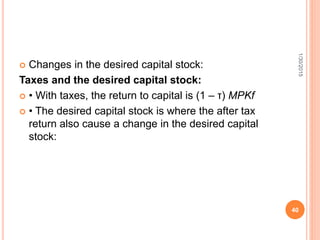
 Changes in the desired capital stock:
Taxes and the desired capital stock:
 • With taxes, the return to capital is (1 – τ) MPKf
 • The desired capital stock is where the after tax
return also cause a change in the desired capital
stock:
1/30/2015
40
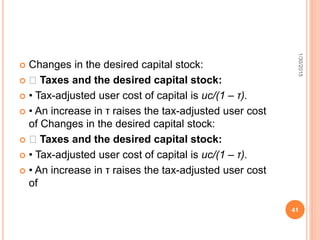
 Changes in the desired capital stock:
 􀂾 Taxes and the desired capital stock:
 • Tax-adjusted user cost of capital is uc/(1 – τ).
 • An increase in τ raises the tax-adjusted user cost
of Changes in the desired capital stock:
 􀂾 Taxes and the desired capital stock:
 • Tax-adjusted user cost of capital is uc/(1 – τ).
 • An increase in τ raises the tax-adjusted user cost
of
1/30/2015
41
INTEREST RATE STRUCTURE
 Impact of interest rate is both in savings and
investment in the economy- borrowing and lending
decisions are primarily based on interest rate.
 In the macro sense interest rate and interest
income has vital role in the economy.
 Savings and investments which are influenced by
interest rates are the economic variables.
1/30/2015
42
ROLE OF INTEREST RATES
 Reward to capital-a factor of production.
 A return on savings
 Cost to investments.
 An instrument of monetary policy in credit control.
In addition to influencing the cost and availability of
funds from the supply side, interest rate also
influence the quantum of investments from the
demand side and thus determine the income and
the employment in the economy.
1/30/2015
43
THEORIES OF INTEREST RATE
 Keynes considered interest rate as monetary
phenomenon.
 He took money as an asset with opportunity cost ,
namely return on short term bonds.
 In a partial equilibrium approach, we can assume
that the forces in the real economic system remain
constant and analyzed the financial factors which
explain the interest rate.
 Under this theory interest is the function of supply
and demand in the economy
 Transactions are generally pre cautionary or
specuklative and the late is known as aset
approach.
1/30/2015
44
NEO-CLASSICAL THEORY
 According to this theory interest rate is also based
on the expectations of the public and the rate of
inflation in the economy.
 According to Irwing Fisher interest rate is also a
function of inflation as the nominal rate is affected
by expected rate of inflation.
 During inflationary periods the gap in the rates
between organised financial system and the
unorganised financial system widens.
 Funds flow from organised to unorganised and vice
versa inluence thecrates in both the sectors.
1/30/2015
45
INTEREST RATE STRUCTURE- FACTORS
INFLUENCING INTEREST RATES
 Since the risk for an investor is greater than a
lender, interest on ownership capital must be more
than on loan capital.
 Difference in maturity periods.
 Degree of default risk.
 Tax provisions-incentives or disincentives.
 Marketability-liquidity.
 Sfety of funds.
1/30/2015
46
INTEREST RATES IN INDIA
 Bank rate- the rate fixed by the central bank-RBI
rate for advances to commercial and co-operative
banks.
 Normally bank rate is for discounting bills of
exchanges etc,
 In view if limited money and bills market bank rate
is not the leader for interest rate and the refinance
rate is the rate at which various windows of RBI
provides refinance to banks. These rates are known
as reference rates.
 Bank rate is made active indicator of f bank funds.
 Bank rate is revised by RBI under the RBI Act as
needed
1/30/2015
47
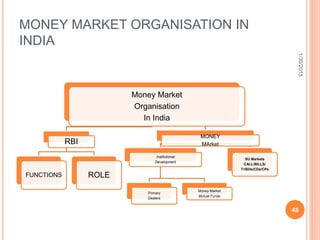
MONEY MARKET ORGANISATION IN
INDIA
Money Market
Organisation
In India
RBI
FUNCTIONS ROLE
MONEY
MArket
Institutional
Development
Primary
Dealers
Money Market
Mutual Funds
SU Markets
CALL/BILLS/
T>Bills/CDs/CPs
1/30/2015
48
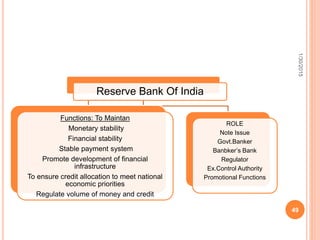
Reserve Bank Of India
Functions: To Maintan
Monetary stability
Financial stability
Stable payment system
Promote development of financial
infrastructure
To ensure credit allocation to meet national
economic priorities
Regulate volume of money and credit
ROLE
Note Issue
Govt.Banker
Banbker’s Bank
Regulator
Ex.Control Authority
Promotional Functions
1/30/2015
49
1. Regulator of money and credit/ Monetary authority.
2. Open market operations- sale and purchase of central and
stae securities and Treasury Bills.
3. Bank Rate-Rate at which the RBI buy or rediscount bills
4. Refinance – to ease the liquidity issues in the system.
5. CRR-Cash which the banks has to keep with RBI as a
percentage of their demand and time liabilities to ensure safety
and liquidity of bank deposits.
6. SLR-Secondary and supplementary requirements to (i) restrict
expansion of bank credit; (ii)ensure solvency of banks and (iii)
augment bank’s investment in government securities.
7. Liquidity Adjustment Faculty- RBI was providing specific and
sector based refinance like Export credit refinance,
Collateralized Lending Faculty
8. i.e advance against excess (over SLR requirements) holdings
of Government securities, T- Bills .
1/30/2015
50
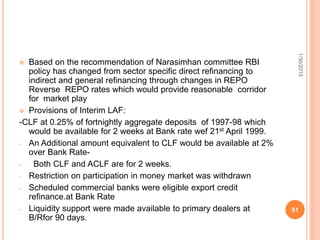
 Based on the recommendation of Narasimhan committee RBI
policy has changed from sector specific direct refinancing to
indirect and general refinancing through changes in REPO
Reverse REPO rates which would provide reasonable corridor
for market play
 Provisions of Interim LAF:
-CLF at 0.25% of fortnightly aggregate deposits of 1997-98 which
would be available for 2 weeks at Bank rate wef 21st April 1999.
- An Additional amount equivalent to CLF would be available at 2%
over Bank Rate-
- Both CLF and ACLF are for 2 weeks.
- Restriction on participation in money market was withdrawn
- Scheduled commercial banks were eligible export credit
refinance.at Bank Rate
- Liquidity support were made available to primary dealers at
B/Rfor 90 days.
1/30/2015
51
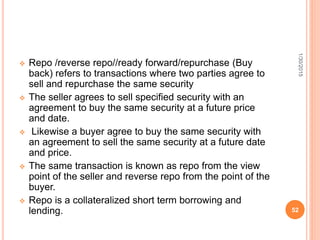
 Repo /reverse repo//ready forward/repurchase (Buy
back) refers to transactions where two parties agree to
sell and repurchase the same security
 The seller agrees to sell specified security with an
agreement to buy the same security at a future price
and date.
 Likewise a buyer agree to buy the same security with
an agreement to sell the same security at a future date
and price.
 The same transaction is known as repo from the view
point of the seller and reverse repo from the point of the
buyer.
 Repo is a collateralized short term borrowing and
lending.
1/30/2015
52
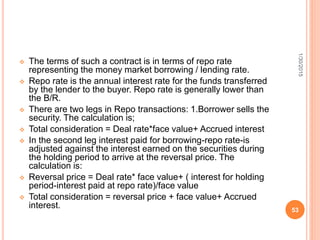
 The terms of such a contract is in terms of repo rate
representing the money market borrowing / lending rate.
 Repo rate is the annual interest rate for the funds transferred
by the lender to the buyer. Repo rate is generally lower than
the B/R.
 There are two legs in Repo transactions: 1.Borrower sells the
security. The calculation is;
 Total consideration = Deal rate*face value+ Accrued interest
 In the second leg interest paid for borrowing-repo rate-is
adjusted against the interest earned on the securities during
the holding period to arrive at the reversal price. The
calculation is:
 Reversal price = Deal rate* face value+ ( interest for holding
period-interest paid at repo rate)/face value
 Total consideration = reversal price + face value+ Accrued
interest.
1/30/2015
53
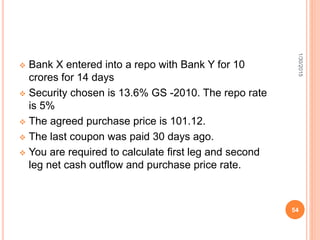
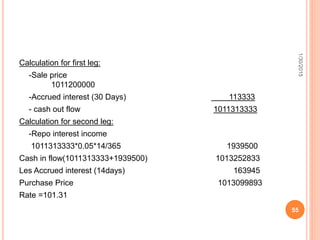
 Bank X entered into a repo with Bank Y for 10
crores for 14 days
 Security chosen is 13.6% GS -2010. The repo rate
is 5%
 The agreed purchase price is 101.12.
 The last coupon was paid 30 days ago.
 You are required to calculate first leg and second
leg net cash outflow and purchase price rate.
1/30/2015
54
Calculation for first leg:
-Sale price
1011200000
-Accrued interest (30 Days) 113333
- cash out flow 1011313333
Calculation for second leg:
-Repo interest income
1011313333*0.05*14/365 1939500
Cash in flow(1011313333+1939500) 1013252833
Les Accrued interest (14days) 163945
Purchase Price 1013099893
Rate =101.31
1/30/2015
55
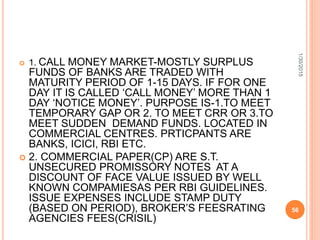
 1. CALL MONEY MARKET-MOSTLY SURPLUS
FUNDS OF BANKS ARE TRADED WITH
MATURITY PERIOD OF 1-15 DAYS. IF FOR ONE
DAY IT IS CALLED ‘CALL MONEY’ MORE THAN 1
DAY ‘NOTICE MONEY’. PURPOSE IS-1.TO MEET
TEMPORARY GAP OR 2. TO MEET CRR OR 3.TO
MEET SUDDEN DEMAND FUNDS. LOCATED IN
COMMERCIAL CENTRES. PRTICPANTS ARE
BANKS, ICICI, RBI ETC.
 2. COMMERCIAL PAPER(CP) ARE S.T.
UNSECURED PROMISSORY NOTES AT A
DISCOUNT OF FACE VALUE ISSUED BY WELL
KNOWN COMPAMIESAS PER RBI GUIDELINES.
ISSUE EXPENSES INCLUDE STAMP DUTY
(BASED ON PERIOD), BROKER’S FEESRATING
AGENCIES FEES(CRISIL)
1/30/2015
56
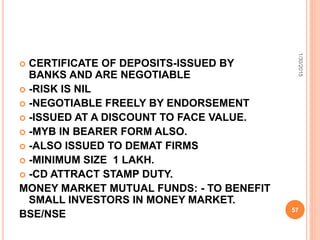
 CERTIFICATE OF DEPOSITS-ISSUED BY
BANKS AND ARE NEGOTIABLE
 -RISK IS NIL
 -NEGOTIABLE FREELY BY ENDORSEMENT
 -ISSUED AT A DISCOUNT TO FACE VALUE.
 -MYB IN BEARER FORM ALSO.
 -ALSO ISSUED TO DEMAT FIRMS
 -MINIMUM SIZE 1 LAKH.
 -CD ATTRACT STAMP DUTY.
MONEY MARKET MUTUAL FUNDS: - TO BENEFIT
SMALL INVESTORS IN MONEY MARKET.
BSE/NSE
1/30/2015
57
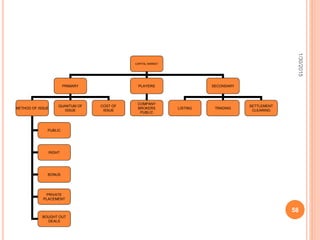
CAPITAL MARKET
PRIMARY PLAYERS SECONDARY
METHOD OF ISSUE
QUANTUM OF
ISSUE
COST OF
ISSUE
LISTING TRADING
SETTLEMENT
CLEARING
PUBLIC
RIGHT
BONUS
PRIVATE
PLACEMENT
COMPANY
BROKERS
PUBLIC
BOUGHT OUT
DEALS
1/30/2015
58
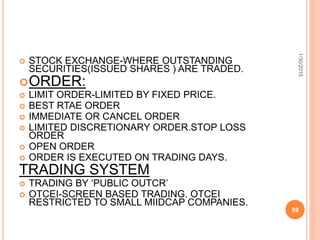
 STOCK EXCHANGE-WHERE OUTSTANDING
SECURITIES(ISSUED SHARES ) ARE TRADED.
ORDER:
 LIMIT ORDER-LIMITED BY FIXED PRICE.
 BEST RTAE ORDER
 IMMEDIATE OR CANCEL ORDER
 LIMITED DISCRETIONARY ORDER.STOP LOSS
ORDER
 OPEN ORDER
 ORDER IS EXECUTED ON TRADING DAYS.
TRADING SYSTEM
 TRADING BY ‘PUBLIC OUTCR’
 OTCEI-SCREEN BASED TRADING. OTCEI
RESTRICTED TO SMALL MIIDCAP COMPANIES.
1/30/2015
59
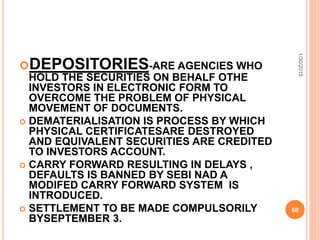
DEPOSITORIES-ARE AGENCIES WHO
HOLD THE SECURITIES ON BEHALF OTHE
INVESTORS IN ELECTRONIC FORM TO
OVERCOME THE PROBLEM OF PHYSICAL
MOVEMENT OF DOCUMENTS.
 DEMATERIALISATION IS PROCESS BY WHICH
PHYSICAL CERTIFICATESARE DESTROYED
AND EQUIVALENT SECURITIES ARE CREDITED
TO INVESTORS ACCOUNT.
 CARRY FORWARD RESULTING IN DELAYS ,
DEFAULTS IS BANNED BY SEBI NAD A
MODIFED CARRY FORWARD SYSTEM IS
INTRODUCED.
 SETTLEMENT TO BE MADE COMPULSORILY
BYSEPTEMBER 3.
1/30/2015
60
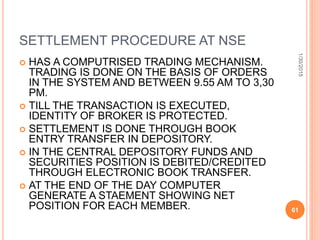
SETTLEMENT PROCEDURE AT NSE
 HAS A COMPUTRISED TRADING MECHANISM.
TRADING IS DONE ON THE BASIS OF ORDERS
IN THE SYSTEM AND BETWEEN 9.55 AM TO 3,30
PM.
 TILL THE TRANSACTION IS EXECUTED,
IDENTITY OF BROKER IS PROTECTED.
 SETTLEMENT IS DONE THROUGH BOOK
ENTRY TRANSFER IN DEPOSITORY.
 IN THE CENTRAL DEPOSITORY FUNDS AND
SECURITIES POSITION IS DEBITED/CREDITED
THROUGH ELECTRONIC BOOK TRANSFER.
 AT THE END OF THE DAY COMPUTER
GENERATE A STAEMENT SHOWING NET
POSITION FOR EACH MEMBER.
1/30/2015
61
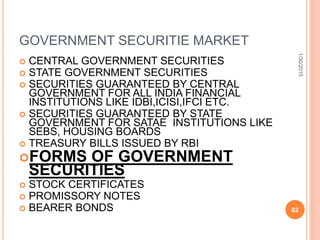
GOVERNMENT SECURITIE MARKET
 CENTRAL GOVERNMENT SECURITIES
 STATE GOVERNMENT SECURITIES
 SECURITIES GUARANTEED BY CENTRAL
GOVERNMENT FOR ALL INDIA FINANCIAL
INSTITUTIONS LIKE IDBI,ICISI,IFCI ETC.
 SECURITIES GUARANTEED BY STATE
GOVERNMENT FOR SATAE INSTITUTIONS LIKE
SEBS, HOUSING BOARDS
 TREASURY BILLS ISSUED BY RBI
FORMS OF GOVERNMENT
SECURITIES
 STOCK CERTIFICATES
 PROMISSORY NOTES
 BEARER BONDS
1/30/2015
62
MARKET FOR GOVERNMENT
SECURITIES
 PRIMARY MARKET- RBI IS GIVEN THE TASK OF
MANAJING THE PUBLIC DEBTIN THE ECONOMY
 QUANTUM OF BORROWING IS SPECIFIED IN
BUDGET.
 AUCTION IS TIMED DURING HIGH LIQUIDITY
PERIODS TO RAISE MAXI,UM AMOUNT AT BEST
PRICE.
 TERMS OF ISSUE INVOLVE COUPON,
MATURITY TERMS AND NORMALL LONG TERM
YIELD CURVE DRAWN BY RBI IS FOLLOWED.
 INVESTORS-COMMERCIAL BANKS, FIs, LARGE
CORPORATE BODIES, RBI, AND FIIs.
 SECONDARY MARKET IS ACTIVE AFTER 1990s
1/30/2015
63
SETTLEMET PROCEDURE
 RBI IS ACTING AS DEPOSITORY AND SETTLEMENTS
ARE DONE BY THEM THROUGH SGL ACCOUNT.
 IF INVESTOR DOES NOT HAVE SGL ACCOUNTTHEN IT
NEEDS TO OPEN WITH ANY REGISTERED BANK .
 TRANSHER IS THROUGH BOOK ENTRY.
 SECURITY DEALS ARE CARRIED OUT ON EX-INTEREST
BASIS AS PER THE BYE-LAWS OF THE STOCK
EXCHANGES.
 THIS ALSO LED TO ‘VOUCHER TRADING’-AMOUNT OF
INCOME TAX DEDUCTIBLE AT SOURCEON THE
ACCRUED INTEREST INCOMEOF GOVERNMENT
SECURITIES ID KNOWN AS ‘VOCHER’
 THUS SELLER IS TO GET=PRICE+INTEREST-TDS.
 BUYER GETS TDS CERTIFICATE.
1/30/2015
64
TREASURY BILLS
 TBs ARE ISSUED TO MEET SHORT TERM NEED
OF THE GOVT. REVENUE COLLECTIONS ARE
BUNCHED BUT EXPENDITURE IS DISPERSED.
HENCE THIS NEED.
 TBs ARE ISSUED IN THE FORM OF
PROMISSORY NOTES OR SCRIP AND
CREDITED TO INVESTORS SGL ACCOUNT
 TBs ARE ISSUED IN FOUR TYPES 91-DAY,182
DAT, 14/28 DAY AND 364 DAY BILLS.
 RBI DO OPEN MARKET OPERATIONS AND THE
ECONOMY IS GRAETLY INFLUENCED BYGOVT.
SECURITIES.
 T-BILL YIELD CALCULATION:
 FACE VALUE=100
 BID RECEIVED BY RBI=88.24 FOR 364 DAY
1/30/2015
65
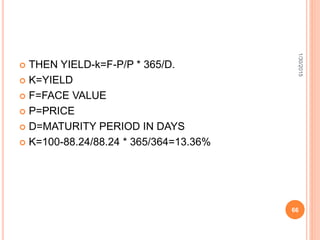
 THEN YIELD-k=F-P/P * 365/D.
 K=YIELD
 F=FACE VALUE
 P=PRICE
 D=MATURITY PERIOD IN DAYS
 K=100-88.24/88.24 * 365/364=13.36%
1/30/2015
66
DISCOUNT AND FINANCE HOUSE OF
INDIA(DHFI)
 Role and Functions: (Ghore committee
recommendations)
-It should be the sole depositor of surplus funds of the banking
system and Non-banking financial institutions.
-It should use the surplus funds to even out the liquidity
imabalances in the banking system subject to RBI guidelines.
- It should create ready market for commercial bills, treasury
bills , government guaranteed securities by being ready to
purchase from banks or sell to banks such securities.
The committee also recommended that this discount house is to
be sponsored by commercial banks,LIC,UTI,GIC with
participation by IDBI, ICICI, SFCs.
1/30/2015
67
 Till Vaghul committee reviewed and recommended no action was
taken on this.
 Eventually in April 1988 Discount and Finance House of India
was set up with an authorised capital of Rs.250 crores. In a ratio
of %:3:2 RBI, Psbs and Indian Financial Institutions have
contributed Rs. 200 crores as paid up capita. In addition
refinance facility with RBI and a line of credit of RS.100 crores
from 28 PSBs on a consortium basis is the source of funds.
 The role of the DHFI is both developmental and stabilizing
 By developing active primary and secondary money markets it
facilitates smoothening of short term liquidity imbalances.
 It discounts and deals in not only commercial bills but a;so in
TBs, and money market instruments.
 It acts as a specialised money market intermediary
 It undertakes short term buy back in Government and approved-
dated securities
1/30/2015
68
 Role of DHFI is both developmental and stabilising.
 It helps in smoothening of short term liquidity imbalances by
devloping primary and secondary money markets.
 It acts a s a specialised money market intermediary for
stimulating activity in the money market instruments and
developing secondary market for those instruments.
 It not only deals in commercial bills but also in Treasury
billsand other money market instruments.
 It undertakes buy-back of governments and approved
dated securities.
 RBI provides re-finance facility to DHFI
1/30/2015
69
SECURITIES TRADING CORPORATION
OF INDIA
 STCI wa sset up in 1994 with the objective of
providing good secondary market for debt
instruments
 It function as market maker at the long end of the
market which means that it along with otherPDs
has to take up part or whole of the auction of
government securities.
 It primarily concentrate on government securities..
 DHFI was set up for Shoer term –TBs –
government securities and STCE was set up for
long-dated government securities.
1/30/2015
70
CAPITAL MARKET STRUCTURE
• Stock market volatility touches every participant
directly/indirectly in the capital market. General
feeling is that the stock markets worldwide have
become very fragile in the recent past on
account of various developments such as Asian
crisis. Brazil Real fall and Russian
debacle. Many far-reaching stock reforms
have been introduced in the Indian market for
the last few years. These reforms, in turn,
changed market structure. Changing
market structure influences nature of stock
price behavior.
1/30/2015
71
 PRIMARY SECURITIES MARKET
 The primary capital market (PCM) plays an important role in
the overall functioning of securities market. Despite several
measures the primary market remained lackluster till recently
and the pick up is gradual. According to the SEBI annual
report fewer number of issues accessed the primary market
during the year and the significantly lower than that of the
Previous financial year. Share of the equity issues, in terms of
number and amount Mobilized, however, was higher in this
financial year compared to the previous one. More than three-
fourths of the total amount was occupied second and no
resourced were in the previous years, banks and financial
institutions continued for 84.5% of the resourced mobilized
compared to 68.1% in 2001-02. All other industries shared
the remaining portion.
1/30/2015
72
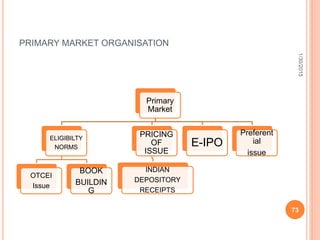
PRIMARY MARKET ORGANISATION
Primary
Market
ELIGIBILTY
NORMS
OTCEI
Issue
BOOK
BUILDIN
G
PRICING
OF
ISSUE
INDIAN
DEPOSITORY
RECEIPTS
E-IPO
Preferent
ial
issue
1/30/2015
73
o Eligibility Norms:
o Should offer through offer documents-Prospectus or
statement in lieu of prospectus; letter of offer in case of rights
issue.
o Draft Offer documents are to be filed with SEBI- through a
merchant Banker in case of rights issue in exces ofRs.50 lakh
o Fast track issues- In case of listed company filing of offer
documents in case of public/rights issue provided certain
conditions are fulfilled
o Separate conditions are to be complied with in case of
unlisted companies.
1/30/2015
74
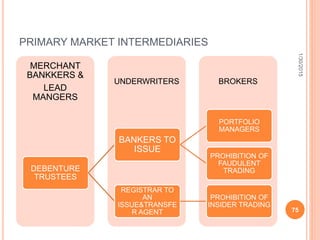
PRIMARY MARKET INTERMEDIARIES
BROKERSUNDERWRITERS
MERCHANT
BANKKERS &
LEAD
MANGERS
DEBENTURE
TRUSTEES
BANKERS TO
ISSUE
PORTFOLIO
MANAGERS
PROHIBITION OF
FAUDULENT
TRADING
REGISTRAR TO
AN
ISSUE&TRANSFE
R AGENT
PROHIBITION OF
INSIDER TRADING
1/30/2015
75
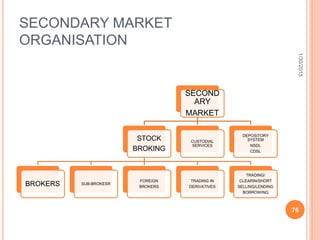
SECONDARY MARKET
ORGANISATION
SECOND
ARY
MARKET
STOCK
BROKING
BROKERS SUB-BROKESR
FOREIGN
BROKERS
TRADING IN
DERIVATIVES
TRADING/
CLEARIN/SHORT
SELLING/LENDING
BORROWING
CUSTODIAL
SERVICES
DEPOSITORY
SYSTEM
NSDL
CDSL
1/30/2015
76
 CAPITAL RAISED DURING 2002-03
 During the financial year 2002-03, primary market
witnessed a decrease of 46.0% in the amount
raised and also a decrease of 25.7% in the number
of issues launched compared to the same period in
2001-02. A total of 26 issues (14 public issues and
12 rights issues) opened during the financial year
2002-03 raising Rs. 4070.29 crore (Rs. 3638.6
crore through public issues and 431.6 crore through
rights issues). In 2001-02 a total of 35 issues
opened for raising Rs. 7543.0 crore (20 public
issues – Rs. 6501.8 crore and 15 rights issues –
Rs. 1041.2).
1/30/2015
77
 INDUSTRY WISE CAPITAL MOBILIZATION
 Three industries ciz. Banks / Fls, Engineering and
Telecommunications accounted for 93.2 per cent of
the resourced mobilized in 2001-02. In the current
year, the same three industries accounted for 84.7
per cent of the funds raised. With the banks and
Fls, increasing their share from 68.3 per cent to
84.5 per cent and companies in the
Telecommunications sector and raising any
resourced. In 2002-03 the three industries which
accounted for 95.3 per cent of the resources where
Banking / Fls, Information Technology, Paper and
Pulp.
1/30/2015
78
 SECONDARY MARKET
 During 2002-03, performance of Indian Stock
market was, by and large, a lackluster one, S&P
CNX NIFTY and BSE Sensex both registered
 negative returns of 13.4 percent and 12.1 percent
respectively over the previous year. Other board
indicators also fell down.
 Fall in the market in not specific too India alone
and it appears a global phenomena. Turnover has
been increasing and its reached peak in the month
of December 2002.
1/30/2015
79
 DEVELOPMENT IN GOVERNMENT DEBT
MARKET
 Government securities market during the past
financial year witnesses significant upturns in pries
until mid-January 2003 when the trend was
reversed. The pattern of downturn in yields was
halted due to the war tensions and consequent
uncertainly leading to a heavy selling
pressure. According to the report on Macro
Economic and Monetary Developments in 2002-03
published by the RBI Major developments in
government securities market in 2002-03 were:
1/30/2015
80
 Introduction of the system of publishing a calendar by RBI that
outlines the issue of date government securities every half-year.
The calendar for the financial year 2002-03 was issued in March
2003.
 Screen based order driven trading in government securities on
the stock exchanges introduced on January 16, 2003.
 CSGL account holders permitted to enter into repo transactions
in government securities effective from March 3, 2003.
 Guidelines for uniform accounting for repo/reverse repo
transactions were issued by RBI.
 Under the securities lending scheme, the clearing corporation of
India limited (CCIL) has government securities from select
members
1/30/2015
81
 FII INVESTMENT
 Foreign institutional Investors (FIIS) were net buyers in
equities at Rs. 1 56bn on January 07, 2004. According to data
available from the Securities and Exchange Board of India
(SEBI) web site, their purchases for the day stood at Rs.
8.0.16bn.
 With this, they have poured in Rs. 15.19bn or US$333.7mn in
Indian equities so far in January. Their cumulative investment
in Indian equities in July stood Rs. 23.46bn or
US$501.7mn. They have pumped in a net of Rs. 15.45mn or
so far in the 2004. In the entire 2002, FIIs had poured in a net
ot Rs36.77bn, or US$763.5mn.
 The stock markets continue its upward surge. By the end of
the September 2003 the BSE Sensex has added more than
1300 points and climbed up to 4302. In fact the pick up in
stock prices in August 2003 has been the highest over the
previous four months of the bull run. The trend continues into
September except for a minor correction
1/30/2015
82
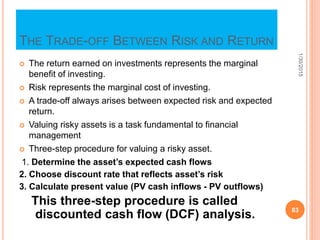
THE TRADE-OFF BETWEEN RISK AND RETURN
 The return earned on investments represents the marginal
benefit of investing.
 Risk represents the marginal cost of investing.
 A trade-off always arises between expected risk and expected
return.
 Valuing risky assets is a task fundamental to financial
management
 Three-step procedure for valuing a risky asset.
1. Determine the asset’s expected cash flows
2. Choose discount rate that reflects asset’s risk
3. Calculate present value (PV cash inflows - PV outflows)
This three-step procedure is called
discounted cash flow (DCF) analysis.
1/30/2015
83
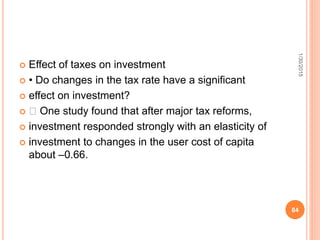
 Effect of taxes on investment
 • Do changes in the tax rate have a significant
 effect on investment?
 􀂾 One study found that after major tax reforms,
 investment responded strongly with an elasticity of
 investment to changes in the user cost of capita
about –0.66.
1/30/2015
84
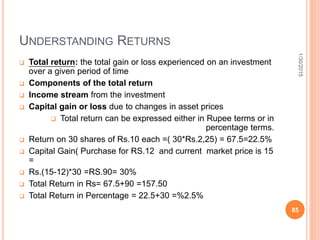
UNDERSTANDING RETURNS
 Total return: the total gain or loss experienced on an investment
over a given period of time
 Components of the total return
 Income stream from the investment
 Capital gain or loss due to changes in asset prices
 Total return can be expressed either in Rupee terms or in
percentage terms.
 Return on 30 shares of Rs.10 each =( 30*Rs.2,25) = 67.5=22.5%
 Capital Gain( Purchase for RS.12 and current market price is 15
=
 Rs.(15-12)*30 =RS.90= 30%
 Total Return in Rs= 67.5+90 =157.50
 Total Return in Percentage = 22.5+30 =%2.5%
1/30/2015
85
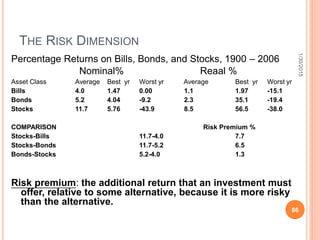
THE RISK DIMENSION
Percentage Returns on Bills, Bonds, and Stocks, 1900 – 2006
Nominal% Reaal %
Asset Class Average Best yr Worst yr Average Best yr Worst yr
Bills 4.0 1.47 0.00 1.1 1.97 -15.1
Bonds 5.2 4.04 -9.2 2.3 35.1 -19.4
Stocks 11.7 5.76 -43.9 8.5 56.5 -38.0
COMPARISON Risk Premium %
Stocks-Bills 11.7-4.0 7.7
Stocks-Bonds 11.7-5.2 6.5
Bonds-Stocks 5.2-4.0 1.3
Risk premium: the additional return that an investment must
offer, relative to some alternative, because it is more risky
than the alternative.
1/30/2015
86
WHY STUDY FINANCIAL MARKETS AND
INSTITUTIONS?
• They are the cornerstones of the overall financial
system in which financial managers operate
• Individuals use both for investing
• Corporations and governments use both for
financing
1/30/2015
87
OVERVIEW OF FINANCIAL MARKETS
Primary Markets versus Secondary
Markets
Money Markets versus Capital
Markets
Foreign Exchange Markets
1/30/2015
88
MONEY MARKETS VERSUS CAPITAL
MARKETS
 Money Markets
 markets that trade debt securities with maturities of one
year or less (e.g. CD’s, Treasury bills)
 Capital Markets
 markets that trade debt (bonds) and equity (stock)
instruments with maturities of more than one year
1/30/2015
89
FOREIGN EXCHANGE MARKETS
 “FX” markets deal in trading one currency for
another (e.g. dollar for yen)
 The “spot” FX transaction involves the immediate
exchange of currencies at the current exchange
rate
 The “forward” FX transaction involves the exchange
of currencies at a specified date in the future and at
a specified exchange rate
1/30/2015
90
OVERVIEW OF FINANCIAL INSTITUTIONS
Institutions that perform the essential
function of channeling funds from
those with surplus funds to those with
shortages of funds (e.g. banks, thrifts,
insurance companies, securities firms
and investment banks, finance
companies, mutual funds, pension
funds)
1/30/2015
91
TYPES OF FIS
 Commercial banks
 depository institutions whose major assets are loans
and major liabilities are deposits
 Thrifts
 depository institutions in the form of savings and loans,
credit unions
 Insurance companies
 financial institutions that protect individuals and
corporations from adverse events
1/30/2015
92
 Securities firms and investment banks
 financial institutions that underwrite securities and
engage in securities brokerage and trading
 Finance companies
 financial institutions that make loans to individuals and
businesses
 Mutual Funds
 financial institutions that pool financial resources and
invest in diversified portfolios
 Pension Funds
 financial institutions that offer savings plans for
retirement
1/30/2015
93
SERVICES PERFORMED BY FINANCIAL
INTERMEDIARIES
 Monitoring Costs
 aggregation of funds provides greater incentive to collect a
firm’s information and monitor actions
 Liquidity and Price Risk
 provide financial claims to savers with superior liquidity and
lower price risk
 Transaction Cost Services
 transaction costs are reduced through economies of scale
 Maturity Intermediation
 greater ability to bear risk of mismatching maturities of assets
and liabilities
 Denomination Intermediation
 allow small investors to overcome constraints imposed to
buying assets imposed by large minimum denomination size
1/30/2015
94
SERVICES PROVIDED BY FIS BENEFITING
THE OVERALL ECONOMY
 Money Supply Transmission
 Depository institutions are the conduit through which
monetary policy actions impact the economy in general
 Credit Allocation
 often viewed as the major source of financing for a
particular sector of the economy (e.g. farming and real
estate)
1/30/2015
95
 Intergenerational Wealth Transfers
 life insurance companies and pension funds provide
savers with the ability to transfer wealth from one
generation to the next
 Payment Services
 efficiency with which depository institutions provide
payment services directly benefits the economy
1/30/2015
96
RISKS FACED BY FINANCIAL INSTITUTIONS
Interest Rate Risk
Foreign Exchange Risk
Market Risk
Credit Risk
Liquidity Risk
Off-Balance-Sheet Risk
Technology Risk
Operation Risk
Country or Sovereign Risk
Insolvency Risk
1/30/2015
97
REGULATION OF FINANCIAL INSTITUTIONS
FIs provide vital financial services to
all sectors of the economy; therefore,
their regulation is in the public interest
In an attempt to prevent their failure
and the failure of financial markets
overall
1/30/2015
98
GLOBALIZATION OF FINANCIAL MARKETS
AND INSTITUTIONS
 Financial Markets became more global as the value
of stocks traded in foreign markets soared
 Foreign bond markets have served as a major
source of international capital
 Globalization also evident in the derivative
securities market
1/30/2015
99
FACTORS LEADING TO SIGNIFICANT
GROWTH IN FOREIGN MARKETS
 The pool of savings from foreign investors
has increased
 International investors have turned to U.S.
and other markets to expand their investment
opportunities
 Information on foreign investments and
markets is now more accessible (e.g. internet)
 Some mutual funds allow ability to invest in
foreign securities with low transaction costs
 Deregulation has enhanced globalization of
capital flows
1/30/2015
100