PARTNERSHIP ACCOUNTS                                                                   Page |1

CHAPTER:1 FUNDAMENTALS

Special Aspects of Final Accounts of Partnership

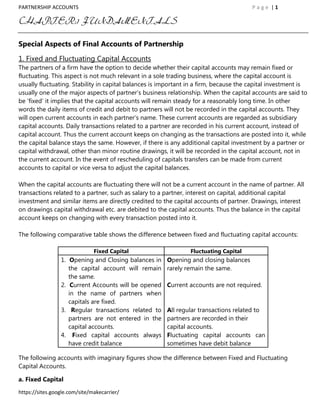
1. Fixed and Fluctuating Capital Accounts
The partners of a firm have the option to decide whether their capital accounts may remain fixed or
fluctuating. This aspect is not much relevant in a sole trading business, where the capital account is
usually fluctuating. Stability in capital balances is important in a firm, because the capital investment is
usually one of the major aspects of partner‟s business relationship. When the capital accounts are said to
be „fixed‟ it implies that the capital accounts will remain steady for a reasonably long time. In other
words the daily items of credit and debit to partners will not be recorded in the capital accounts. They
will open current accounts in each partner‟s name. These current accounts are regarded as subsidiary
capital accounts. Daily transactions related to a partner are recorded in his current account, instead of
capital account. Thus the current account keeps on changing as the transactions are posted into it, while
the capital balance stays the same. However, if there is any additional capital investment by a partner or
capital withdrawal, other than minor routine drawings, it will be recorded in the capital account, not in
the current account. In the event of rescheduling of capitals transfers can be made from current
accounts to capital or vice versa to adjust the capital balances.

When the capital accounts are fluctuating there will not be a current account in the name of partner. All
transactions related to a partner, such as salary to a partner, interest on capital, additional capital
investment and similar items are directly credited to the capital accounts of partner. Drawings, interest
on drawings capital withdrawal etc. are debited to the capital accounts. Thus the balance in the capital
account keeps on changing with every transaction posted into it.

The following comparative table shows the difference between fixed and fluctuating capital accounts:

                               Fixed Capital                    Fluctuating Capital
                 1. Opening and Closing balances in    Opening and closing balances
                    the capital account will remain    rarely remain the same.
                    the same.
                 2. Current Accounts will be opened    Current accounts are not required.
                    in the name of partners when
                    capitals are fixed.
                 3. Regular transactions related to    All regular transactions related to
                    partners are not entered in the    partners are recorded in their
                    capital accounts.                  capital accounts.
                 4. Fixed capital accounts always      Fluctuating capital accounts can
                    have credit balance                sometimes have debit balance

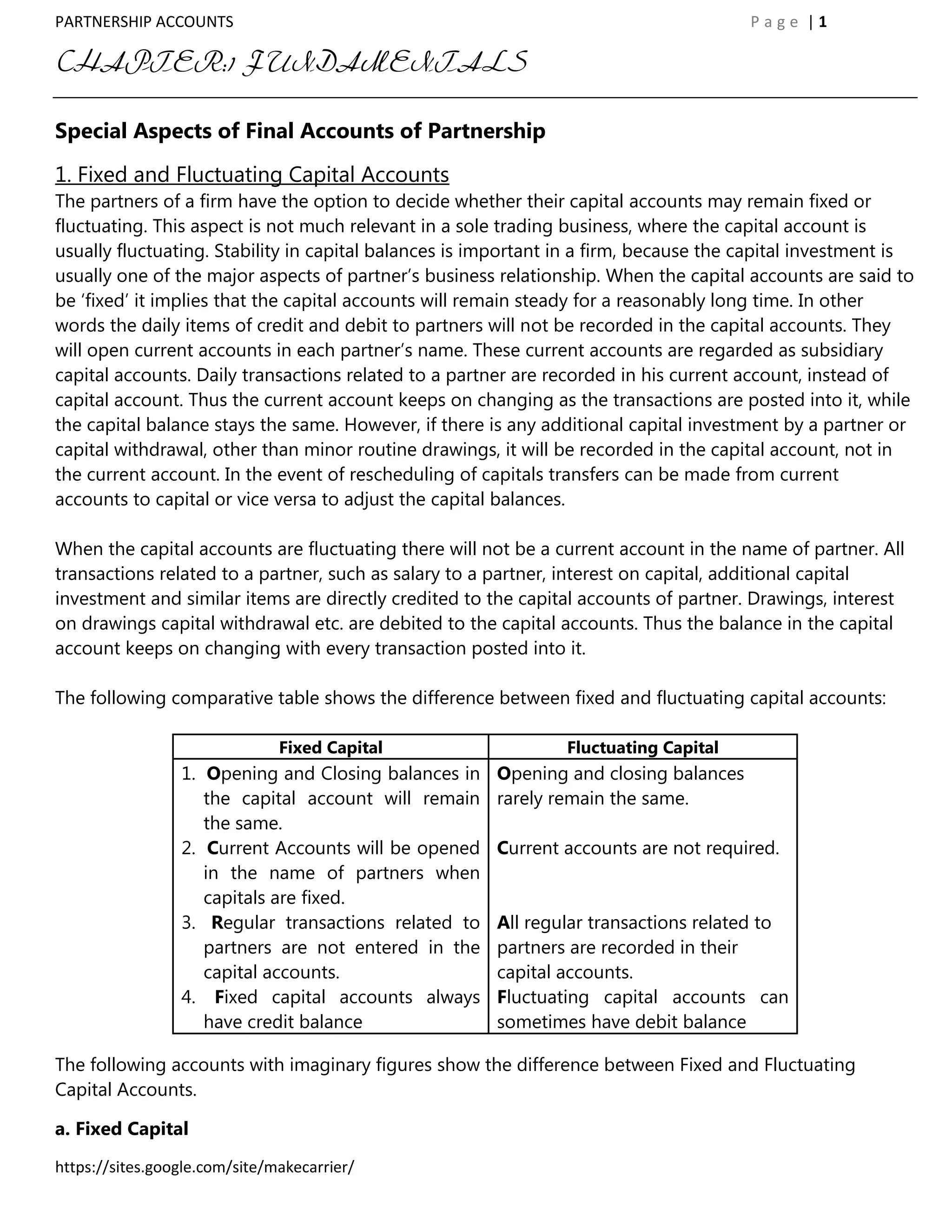
The following accounts with imaginary figures show the difference between Fixed and Fluctuating
Capital Accounts.

a. Fixed Capital

https://sites.google.com/site/makecarrier/
PARTNERSHIP ACCOUNTS                                                                      Page |2

                                                 Illustration 1.01
                                             Abraham‟s Capital Account
                Date         Particulars          Amount     Date         Particulars    Amount
               2002                                          2002   By Balance b/d        30,000
               Dec       To Balance c/d            30,000-   Jan1
               31
                                                   30,000                                 30,000


                                              Abraham‟s Current Account
                Date         Particulars          Amount     Date         Particulars    Amount
               2002                                        2002
               Dec 31    To Drawings A/c            18,100 Jan 01   By Balance b/d         2,000
               Dec 31    To interest on                200
                            drawings                       Dec 31   By Salary              6,000
                                                           Dec 31   By Commission          1,500
               Dec 31    To balance c/d              5,000 Dec 31   By     Interest on     1,800
                                                           Dec 31   capital               12,000
                                                                    By Net divisible
                                                    23,300          profit                23,300


b. Fluctuating Capital

                                              Abraham‟s Capital Account
                Date         Particulars          Amount     Date         Particulars    Amount
               2002                                        2002     By Balance b/d *      32,000
               Dec 31    To Drawings                18,100 Jan 01
                         To    Interest      on        200 Dec 31   By Salary              6,000
                         Capital                    35,000 Dec 31   By Commission          1,500
                         To Balance c/d                    Dec 31   By     Interest on     1,800
                                                                    capital               12,000
                                                    53,300          By Net divisible      53,300
                                                                    profit


* Note: Opening balance of capital account in part (b) includes current account balance also.


2. Division of Profit among Partners
Profit making and profit sharing are the main objectives of partnership business. When the partners do
not have any special conditions regarding the profit distribution the task of profit sharing is a simple,
one-step operation of dividing the profit in the given ratio. But in actual practice the partners are
compelled to include many conditions such as interest on capital, interest on drawings, salaries,
commission on profit etc. The purpose of these special conditions is to fairly compensate extra capital,
https://sites.google.com/site/makecarrier/
PARTNERSHIP ACCOUNTS                                                                       Page |3

extra effort or similar additional factors contributing to the profitability of the firm. Thus the profit
distribution becomes little more complex. A profit and loss appropriation account is prepared with full
details of profit distribution. This is prepared as a supplementary account to the profit and loss account,
prior to preparing the balance sheet.

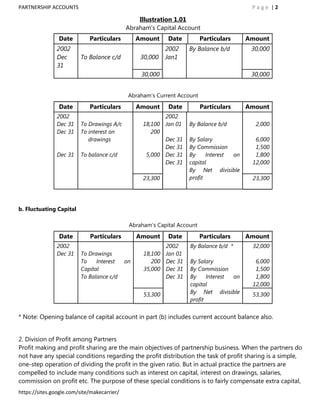
 https://sites.google.com/site/makecarrier/ Illustration 1.02
A & B are equal partners in a firm with capitals of Rs.75,000 and Rs.50,000 on 1st January 2002. A is
entitled to a salary of Rs.24,000 per annum and B is entitled to a salary of Rs.18,000 per annum. They
have withdrawn 50% of their salaries during the year. A and B are entitled to commissions at the rate of
5% and 3% respectively on the net profit after salary.
Net profit during the year 2002 before partner‟s salary amounted to Rs.84,000. Prepare:
a. Profit and Loss Appropriation Account
b. Capital Accounts of partners (assuming capitals are fluctuating)
c. Capital Accounts and Current Accounts of partners (assuming capitals are fixed)

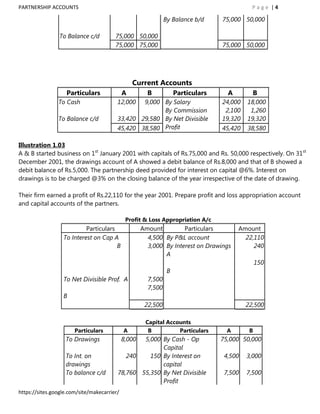
                                     Profit & Loss Appropriation A/c
                              Particulars          Amount      Particulars      Amount
                          To Salary – A             24,000 By P & L Account-     84,000
                                                           profit
                          To Salary – B             18,000
                          Commission to A            2,100
                          (42,000x5/100)
                          Commission to B            1,260
                          (42,000x3/100)
                          Net Divisible Profit      19,320
                          A
                                                    19,320
                                     B              84,000                        84,000
Note: when profit sharing ratio is not given in the question; it should be shared equally.

a. When capital accounts are fluctuating.

                                                  Capital Accounts
                   Particulars            A          B       Particulars         A         B
                  To Cash                12,000     9,000 By Balance b/d        75,000   50,000
                                                          By Salary             24,000   18,000
                  To Balance c/d      108,420      79,580 By Commission          2,100    1,260
                                                          By Net Divisible      19,320   19,320
                                      120,420      88,580 Profit               120,420   88,580

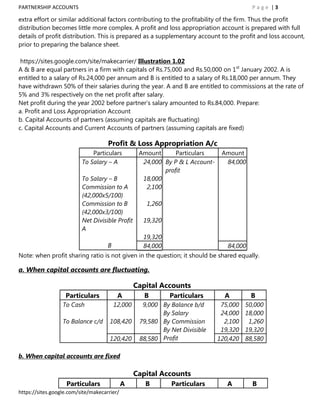
b. When capital accounts are fixed

                                                  Capital Accounts
                    Particulars              A       B        Particulars         A        B
https://sites.google.com/site/makecarrier/
PARTNERSHIP ACCOUNTS                                                                         Page |4

                                                               By Balance b/d     75,000 50,000

                 To Balance c/d         75,000 50,000
                                        75,000 75,000                             75,000 50,000


                                                 Current Accounts
                    Particulars              A         B            Particulars     A        B
                To Cash                  12,000  9,000 By Salary                  24,000   18,000
                                                       By Commission               2,100    1,260
                To Balance c/d           33,420 29,580 By Net Divisible           19,320   19,320
                                         45,420 38,580 Profit                     45,420   38,580

Illustration 1.03
A & B started business on 1st January 2001 with capitals of Rs.75,000 and Rs. 50,000 respectively. On 31st
December 2001, the drawings account of A showed a debit balance of Rs.8,000 and that of B showed a
debit balance of Rs.5,000. The partnership deed provided for interest on capital @6%. Interest on
drawings is to be charged @3% on the closing balance of the year irrespective of the date of drawing.

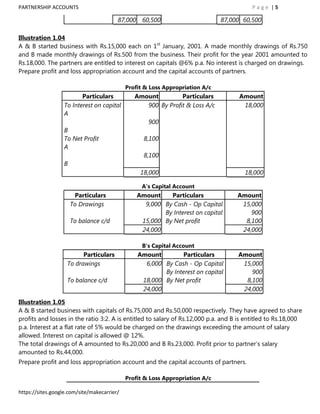
Their firm earned a profit of Rs.22,110 for the year 2001. Prepare profit and loss appropriation account
and capital accounts of the partners.

                                              Profit & Loss Appropriation A/c
                           Particulars               Amount         Particulars         Amount
                  To Interest on Cap A                 4,500 By P&L account               22,110
                                       B               3,000 By Interest on Drawings         240
                                                             A
                                                                                                150
                                                                B
                  To Net Divisible Prof. A             7,500
                                                       7,500
                  B
                                                      22,500                               22,500

                                                      Capital Accounts
                       Particulars           A         B          Particulars      A        B
                   To Drawings               8,000
                                                 5,000 By Cash - Op               75,000 50,000
                                                       Capital
                   To Int. on               240    150 By Interest on              4,500   3,000
                   drawings                            capital
                   To balance c/d        78,760 55,350 By Net Divisible            7,500   7,500
                                                       Profit
https://sites.google.com/site/makecarrier/
PARTNERSHIP ACCOUNTS                                                                     Page |5

                                         87,000 60,500                         87,000 60,500

Illustration 1.04
A & B started business with Rs.15,000 each on 1st January, 2001. A made monthly drawings of Rs.750
and B made monthly drawings of Rs.500 from the business. Their profit for the year 2001 amounted to
Rs.18,000. The partners are entitled to interest on capitals @6% p.a. No interest is charged on drawings.
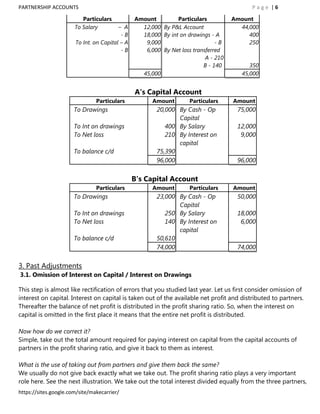
Prepare profit and loss appropriation account and the capital accounts of partners.

                                             Profit & Loss Appropriation A/c
                          Particulars           Amount         Particulars          Amount
                   To Interest on capital          900 By Profit & Loss A/c          18,000
                   A
                                                     900
                   B
                   To Net Profit                   8,100
                   A
                                                   8,100
                   B
                                                  18,000                               18,000

                                                   A's Capital Account
                        Particulars              Amount    Particulars              Amount
                       To Drawings                 9,000 By Cash - Op Capital        15,000
                                                         By Interest on capital         900
                       To balance c/d             15,000 By Net profit                8,100
                                                  24,000                             24,000

                                                   B's Capital Account
                          Particulars            Amount        Particulars          Amount
                    To drawings                    6,000 By Cash - Op Capital        15,000
                                                         By Interest on capital         900
                    To balance c/d                18,000 By Net profit                8,100
                                                  24,000                             24,000

Illustration 1.05
A & B started business with capitals of Rs.75,000 and Rs.50,000 respectively. They have agreed to share
profits and losses in the ratio 3:2. A is entitled to salary of Rs.12,000 p.a. and B is entitled to Rs.18,000
p.a. Interest at a flat rate of 5% would be charged on the drawings exceeding the amount of salary
allowed. Interest on capital is allowed @ 12%.
The total drawings of A amounted to Rs.20,000 and B Rs.23,000. Profit prior to partner‟s salary
amounted to Rs.44,000.
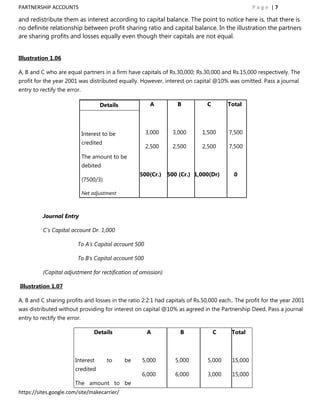
Prepare profit and loss appropriation account and the capital accounts of partners.

                                             Profit & Loss Appropriation A/c

https://sites.google.com/site/makecarrier/
PARTNERSHIP ACCOUNTS                                                                      Page |6

                          Particulars           Amount         Particulars          Amount
                       To Salary         – A      12,000 By P&L Account               44,000
                                          -B      18,000 By int on drawings - A          400
                       To Int. on Capital – A      9,000                      -B         250
                                          -B       6,000 By Net loss transferred
                                                                          A - 210
                                                                         B - 140          350
                                                  45,000                               45,000


                                                A's Capital Account
                                Particulars           Amount        Particulars     Amount
                       To Drawings                      20,000 By Cash - Op          75,000
                                                               Capital
                       To Int on drawings                  400 By Salary             12,000
                       To Net loss                         210 By Interest on         9,000
                                                               capital
                       To balance c/d                   75,390
                                                        96,000                       96,000


                                                B's Capital Account
                                Particulars           Amount        Particulars     Amount
                       To Drawings                      23,000 By Cash - Op          50,000
                                                               Capital
                       To Int on drawings                  250 By Salary             18,000
                       To Net loss                         140 By Interest on         6,000
                                                               capital
                       To balance c/d                   50,610
                                                        74,000                       74,000


3. Past Adjustments
3.1. Omission of Interest on Capital / Interest on Drawings

This step is almost like rectification of errors that you studied last year. Let us first consider omission of
interest on capital. Interest on capital is taken out of the available net profit and distributed to partners.
Thereafter the balance of net profit is distributed in the profit sharing ratio. So, when the interest on
capital is omitted in the first place it means that the entire net profit is distributed.

Now how do we correct it?
Simple, take out the total amount required for paying interest on capital from the capital accounts of
partners in the profit sharing ratio, and give it back to them as interest.

What is the use of taking out from partners and give them back the same?
We usually do not give back exactly what we take out. The profit sharing ratio plays a very important
role here. See the next illustration. We take out the total interest divided equally from the three partners,
https://sites.google.com/site/makecarrier/
PARTNERSHIP ACCOUNTS                                                                             Page |7

and redistribute them as interest according to capital balance. The point to notice here is, that there is
no definite relationship between profit sharing ratio and capital balance. In the illustration the partners
are sharing profits and losses equally even though their capitals are not equal.


Illustration 1.06

A, B and C who are equal partners in a firm have capitals of Rs.30,000; Rs.30,000 and Rs.15,000 respectively. The
profit for the year 2001 was distributed equally. However, interest on capital @10% was omitted. Pass a journal
entry to rectify the error.

                                     Details           A         B           C        Total


                              Interest to be          3,000    3,000       1,500      7,500
                              credited
                                                      2,500    2,500       2,500      7,500
                              The amount to be
                              debited
                                                    500(Cr.) 500 (Cr.) 1,000(Dr)         0
                              (7500/3)

                              Net adjustment


          Journal Entry

          C‟s Capital account Dr. 1,000

                         To A‟s Capital account 500

                         To B‟s Capital account 500

          (Capital adjustment for rectification of omission)

Illustration 1.07

A, B and C sharing profits and losses in the ratio 2:2:1 had capitals of Rs.50,000 each.. The profit for the year 2001
was distributed without providing for interest on capital @10% as agreed in the Partnership Deed. Pass a journal
entry to rectify the error.

                                   Details            A           B              C      Total


                        Interest         to    be   5,000       5,000         5,000     15,000
                        credited
                                                    6,000       6,000         3,000     15,000
                        The amount to be
https://sites.google.com/site/makecarrier/
PARTNERSHIP ACCOUNTS                                                                               Page |8

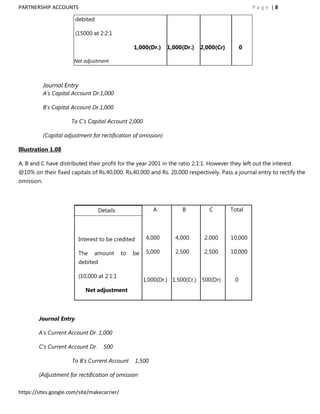
                         debited

                         (15000 at 2:2:1

                                                  1,000(Dr.)     1,000(Dr.)   2,000(Cr)        0

                        Net adjustment


            Journal Entry
            A‟s Capital Account Dr.1,000

            B‟s Capital Account Dr.1,000

                       To C‟s Capital Account 2,000

            (Capital adjustment for rectification of omission)

Illustration 1.08

A, B and C have distributed their profit for the year 2001 in the ratio 2:1:1. However they left out the interest
@10% on their fixed capitals of Rs.40,000, Rs,40,000 and Rs. 20,000 respectively. Pass a journal entry to rectify the
omission.


                                   Details                  A         B          C        Total


                          Interest to be credited       4,000       4,000      2,000      10,000

                          The    amount      to   be    5,000       2,500      2,500      10,000
                          debited

                          (10,000 at 2:1:1
                                                       1,000(Dr.) 1,500(Cr.) 500(Dr)       0
                             Net adjustment


        Journal Entry

        A‟s Current Account Dr. 1,000

        C‟s Current Account Dr.      500

                        To B‟s Current Account      1,500

        (Adjustment for rectification of omission

https://sites.google.com/site/makecarrier/
PARTNERSHIP ACCOUNTS                                                                                       Page |9


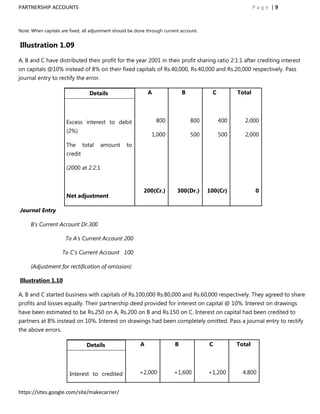
Note: When capitals are fixed, all adjustment should be done through current account.


Illustration 1.09

A, B and C have distributed their profit for the year 2001 in their profit sharing ratio 2:1:1 after crediting interest
on capitals @10% instead of 8% on their fixed capitals of Rs.40,000, Rs.40,000 and Rs.20,000 respectively. Pass
journal entry to rectify the error.

                                  Details                    A                B          C         Total


                      Excess interest to debit                   800              800        400      2,000
                      (2%)
                                                               1,000              500        500      2,000
                      The      total   amount      to
                      credit

                      (2000 at 2:2:1


                                                           200(Cr.)        300(Dr.)     100(Cr)            0
                      Net adjustment

Journal Entry

     B‟s Current Account Dr.300

                      To A‟s Current Account 200

                    To C‟s Current Account 100

     (Adjustment for rectification of omission)

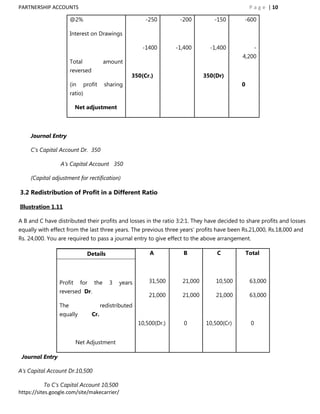
Illustration 1.10

A, B and C started business with capitals of Rs.100,000 Rs.80,000 and Rs.60,000 respectively. They agreed to share
profits and losses equally. Their partnership deed provided for interest on capital @ 10%. Interest on drawings
have been estimated to be Rs.250 on A, Rs.200 on B and Rs.150 on C. Interest on capital had been credited to
partners at 8% instead on 10%. Interest on drawings had been completely omitted. Pass a journal entry to rectify
the above errors.

                                Details                  A                B             C          Total


                        Interest to credited             +2,000          +1,600         +1,200       4,800


https://sites.google.com/site/makecarrier/
PARTNERSHIP ACCOUNTS                                                                                P a g e | 10

                       @2%                                 -250         -200         -150      -600

                       Interest on Drawings

                                                          -1400        -1,400       -1,400              -
                                                                                               4,200
                       Total              amount
                       reversed
                                                     350(Cr.)                     350(Dr)
                       (in      profit    sharing                                              0
                       ratio)

                          Net adjustment


     Journal Entry

     C‟s Capital Account Dr. 350

                 A‟s Capital Account 350

     (Capital adjustment for rectification)

3.2 Redistribution of Profit in a Different Ratio

Illustration 1.11

A B and C have distributed their profits and losses in the ratio 3:2:1. They have decided to share profits and losses
equally with effect from the last three years. The previous three years‟ profits have been Rs.21,000, Rs.18,000 and
Rs. 24,000. You are required to pass a journal entry to give effect to the above arrangement.

                                 Details                     A           B            C            Total


                 Profit      for    the     3   years        31,500      21,000       10,500        63,000
                 reversed Dr.
                                                             21,000      21,000       21,000        63,000
                 The                     redistributed
                 equally           Cr.
                                                         10,500(Dr.)      0       10,500(Cr)        0


                          Net Adjustment

 Journal Entry

A‟s Capital Account Dr.10,500

            To C‟s Capital Account 10,500
https://sites.google.com/site/makecarrier/
PARTNERSHIP ACCOUNTS                                                                              P a g e | 11

 (Adjustment to effect redistribution of profit)


 3.3 Omission of Outstanding Expenses and Incomes
 Outstanding expenses and outstanding incomes have direct effect on the net profit. Outstanding expense is an
 expense in the first place and a liability as well. When it is omitted it means a higher profit is distributed to
 partners and a liability is not provided in the books. Outstanding income has the opposite effect. Rectification of
 these errors is a simple procedure.


i)       If the number of items is less, correct it by passing simple rectification entry, by debiting outstanding income,
        crediting outstanding expense and passing the difference into capital account. This way you are creating asset
        account in the books for the outstanding income, creating liability account for the outstanding expense, and
        transferring the net loss or gain into capital accounts.

ii)      When the number of items involved is more or when it is specifically asked in the question, you should open
        a profit and loss adjustment account.

iii)    P&L adjustment account can be safely assumed as a combined capital account of partners. When you want
        debit partner‟s capital account you can debit P&L adjustment account instead.

iv)     When there is an outstanding expense, we usually debit capital accounts and credit outstanding expense
        account. Now you debit P&L adjustment account for any outstanding expense and credit it for the
        outstanding income.

v)       The net balance of profit and loss adjustment account is transferred to the capital accounts of partners in the
        profit sharing ratio.

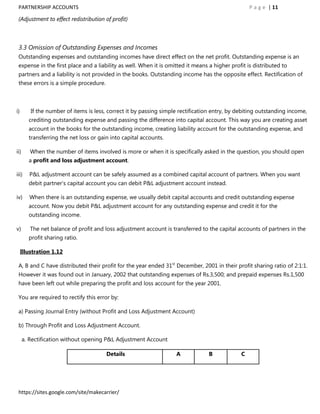
     Illustration 1.12

 A, B and C have distributed their profit for the year ended 31st December, 2001 in their profit sharing ratio of 2:1:1.
 However it was found out in January, 2002 that outstanding expenses of Rs.3,500; and prepaid expenses Rs.1,500
 have been left out while preparing the profit and loss account for the year 2001.

 You are required to rectify this error by:

 a) Passing Journal Entry (without Profit and Loss Adjustment Account)

 b) Through Profit and Loss Adjustment Account.

      a. Rectification without opening P&L Adjustment Account

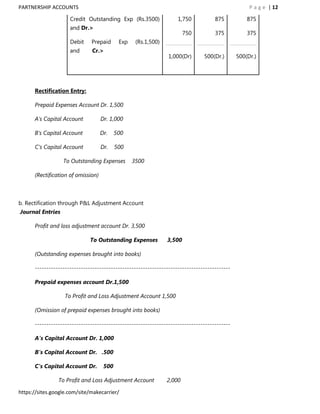
                                        Details                     A            B             C


 https://sites.google.com/site/makecarrier/
PARTNERSHIP ACCOUNTS                                                                                                                       P a g e | 12

                     Credit Outstanding Exp (Rs.3500)                      1,750                             875                         875
                     and Dr.>
                                                                                750                          375                         375
                     Debit    Prepaid       Exp    (Rs.1,500)   -------------------------   --------------------------   -------------------------

                     and      Cr.>
                                                                  1,000(Dr)                       500(Dr.)                    500(Dr.)


      Rectification Entry:

      Prepaid Expenses Account Dr. 1,500

      A‟s Capital Account           Dr. 1,000

      B‟s Capital Account           Dr.    500

      C‟s Capital Account           Dr.    500

                  To Outstanding Expenses         3500

      (Rectification of omission)


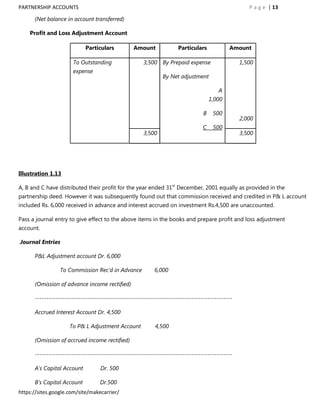
b. Rectification through P&L Adjustment Account
Journal Entries

      Profit and loss adjustment account Dr. 3,500

                              To Outstanding Expenses            3,500

      (Outstanding expenses brought into books)

      -------------------------------------------------------------------------------------

      Prepaid expenses account Dr.1,500

                   To Profit and Loss Adjustment Account 1,500

      (Omission of prepaid expenses brought into books)

      -------------------------------------------------------------------------------------

      A’s Capital Account Dr. 1,000

      B’s Capital Account Dr. .500

      C’s Capital Account Dr.        500

                To Profit and Loss Adjustment Account            2,000

https://sites.google.com/site/makecarrier/
PARTNERSHIP ACCOUNTS                                                                              P a g e | 13

      (Net balance in account transferred)

    Profit and Loss Adjustment Account

                            Particulars         Amount              Particulars            Amount

                      To Outstanding                 3,500 By Prepaid expense                  1,500
                      expense
                                                             By Net adjustment

                                                                                      A
                                                                                   1,000

                                                                               B    500
                                                                                               2,000
                                                                               C    500
                                                     3,500                                     3,500


Illustration 1.13

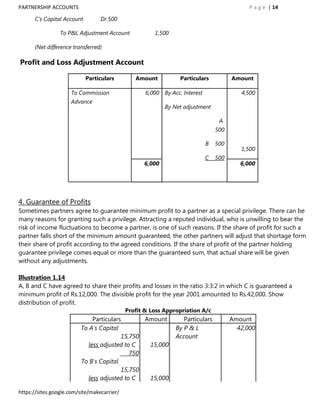
A, B and C have distributed their profit for the year ended 31st December, 2001 equally as provided in the
partnership deed. However it was subsequently found out that commission received and credited in P& L account
included Rs. 6,000 received in advance and interest accrued on investment Rs.4,500 are unaccounted.

Pass a journal entry to give effect to the above items in the books and prepare profit and loss adjustment
account.

Journal Entries

      P&L Adjustment account Dr. 6,000

                 To Commission Rec‟d in Advance           6,000

      (Omission of advance income rectified)

      --------------------------------------------------------------------------------------

      Accrued Interest Account Dr. 4,500

                     To P& L Adjustment Account           4,500

      (Omission of accrued income rectified)

      --------------------------------------------------------------------------------------

      A‟s Capital Account         Dr. 500

      B‟s Capital Account         Dr.500
https://sites.google.com/site/makecarrier/
PARTNERSHIP ACCOUNTS                                                                         P a g e | 14

      C‟s Capital Account         Dr.500

                 To P&L Adjustment Account             1,500

      (Net difference transferred)

Profit and Loss Adjustment Account

                            Particulars         Amount           Particulars           Amount

                     To Commission                  6,000 By Acc. Interest                4,500
                     Advance
                                                           By Net adjustment

                                                                                  A
                                                                                 500

                                                                             B   500
                                                                                          1,500
                                                                             C   500
                                                   6,000                                  6,000


4. Guarantee of Profits
Sometimes partners agree to guarantee minimum profit to a partner as a special privilege. There can be
many reasons for granting such a privilege. Attracting a reputed individual, who is unwilling to bear the
risk of income fluctuations to become a partner, is one of such reasons. If the share of profit for such a
partner falls short of the minimum amount guaranteed, the other partners will adjust that shortage form
their share of profit according to the agreed conditions. If the share of profit of the partner holding
guarantee privilege comes equal or more than the guaranteed sum, that actual share will be given
without any adjustments.

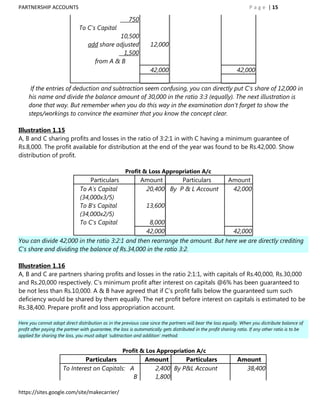
Illustration 1.14
A, B and C have agreed to share their profits and losses in the ratio 3:3:2 in which C is guaranteed a
minimum profit of Rs.12,000. The divisible profit for the year 2001 amounted to Rs.42,000. Show
distribution of profit.
                                             Profit & Loss Appropriation A/c
                               Particulars       Amount           Particulars          Amount
                          To A's Capital                       By P & L                  42,000
                                          15,750               Account
                             less adjusted to C   15,000
                                             750
                          To B's Capital
                                          15,750
                             less adjusted to C   15,000

https://sites.google.com/site/makecarrier/
PARTNERSHIP ACCOUNTS                                                                                                   P a g e | 15

                                                        750
                               To C's Capital
                                              10,500
                                   add share adjusted               12,000
                                                1,500
                                     from A & B
                                                                    42,000                                      42,000

      If the entries of deduction and subtraction seem confusing, you can directly put C's share of 12,000 in
     his name and divide the balance amount of 30,000 in the ratio 3:3 (equally). The next illustration is
     done that way. But remember when you do this way in the examination don't forget to show the
     steps/workings to convince the examiner that you know the concept clear.

Illustration 1.15
A, B and C sharing profits and losses in the ratio of 3:2:1 in with C having a minimum guarantee of
Rs.8,000. The profit available for distribution at the end of the year was found to be Rs.42,000. Show
distribution of profit.

                                                       Profit & Loss Appropriation A/c
                                   Particulars                Amount      Particulars                       Amount
                               To A's Capital                  20,400 By P & L Account                       42,000
                               (34,000x3/5)
                               To B's Capital                     13,600
                               (34,000x2/5)
                               To C's Capital                      8,000
                                                                  42,000                                       42,000
You can divide 42,000 in the ratio 3:2:1 and then rearrange the amount. But here we are directly crediting
C's share and dividing the balance of Rs.34,000 in the ratio 3:2.

Illustration 1.16
A, B and C are partners sharing profits and losses in the ratio 2:1:1, with capitals of Rs.40,000, Rs.30,000
and Rs.20,000 respectively. C‟s minimum profit after interest on capitals @6% has been guaranteed to
be not less than Rs.10,000. A & B have agreed that if C‟s profit falls below the guaranteed sum such
deficiency would be shared by them equally. The net profit before interest on capitals is estimated to be
Rs.38,400. Prepare profit and loss appropriation account.

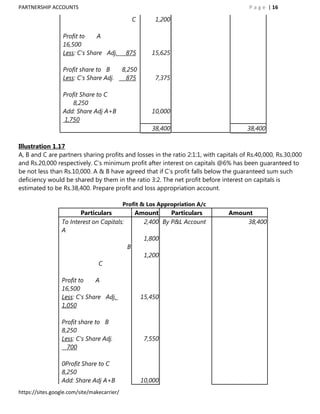
Here you cannot adopt direct distribution as in the previous case since the partners will bear the loss equally. When you distribute balance of
profit after paying the partner with guarantee, the loss is automatically gets distributed in the profit sharing ratio. If any other ratio is to be
applied for sharing the loss, you must adopt 'subtraction and addition' method.


                                                     Profit & Los Appropriation A/c
                               Particulars                       Amount      Particulars                        Amount
                      To Interest on Capitals: A                   2,400 By P&L Account                           38,400
                                                B                  1,800

https://sites.google.com/site/makecarrier/
PARTNERSHIP ACCOUNTS                                                                   P a g e | 16

                                                  C       1,200

                  Profit to    A
                  16,500
                  Less: C's Share Adj.        875        15,625

                  Profit share to B          8,250
                  Less: C's Share Adj.        875         7,375

                  Profit Share to C
                      8,250
                  Add: Share Adj A+B                     10,000
                  1,750
                                                         38,400                        38,400

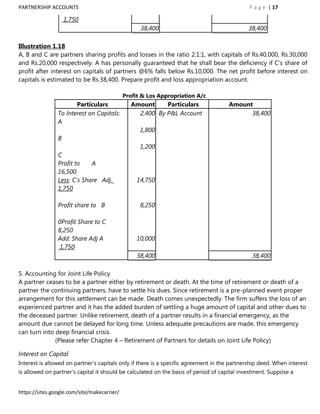
Illustration 1.17
A, B and C are partners sharing profits and losses in the ratio 2:1:1, with capitals of Rs.40,000, Rs.30,000
and Rs.20,000 respectively. C‟s minimum profit after interest on capitals @6% has been guaranteed to
be not less than Rs.10,000. A & B have agreed that if C‟s profit falls below the guaranteed sum such
deficiency would be shared by them in the ratio 3:2. The net profit before interest on capitals is
estimated to be Rs.38,400. Prepare profit and loss appropriation account.

                                             Profit & Los Appropriation A/c
                         Particulars              Amount     Particulars        Amount
                  To Interest on Capitals:          2,400 By P&L Account             38,400
                  A
                                                       1,800
                                              B
                                                       1,200
                                 C

                  Profit to    A
                  16,500
                  Less: C's Share Adj.                15,450
                  1,050

                  Profit share to B
                  8,250
                  Less: C's Share Adj.                 7,550
                    700

                  0Profit Share to C
                  8,250
                  Add: Share Adj A+B                  10,000
https://sites.google.com/site/makecarrier/
PARTNERSHIP ACCOUNTS                                                                          P a g e | 17

                    1,750
                                                   38,400                                    38,400

Illustration 1.18
A, B and C are partners sharing profits and losses in the ratio 2:1:1, with capitals of Rs.40,000, Rs.30,000
and Rs.20,000 respectively. A has personally guaranteed that he shall bear the deficiency if C‟s share of
profit after interest on capitals of partners @6% falls below Rs.10,000. The net profit before interest on
capitals is estimated to be Rs.38,400. Prepare profit and loss appropriation account.

                                             Profit & Los Appropriation A/c
                       Particulars             Amount     Particulars                Amount
                To Interest on Capitals:         2,400 By P&L Account                      38,400
                A
                                                   1,800
                B
                                                   1,200
                C
                Profit to    A
                16,500
                Less: C's Share Adj.              14,750
                1,750

                Profit share to B                  8,250

                0Profit Share to C
                8,250
                Add: Share Adj A                  10,000
                 1,750
                                                  38,400                                       38,400

5. Accounting for Joint Life Policy
A partner ceases to be a partner either by retirement or death. At the time of retirement or death of a
partner the continuing partners, have to settle his dues. Since retirement is a pre-planned event proper
arrangement for this settlement can be made. Death comes unexpectedly. The firm suffers the loss of an
experienced partner and it has the added burden of settling a huge amount of capital and other dues to
the deceased partner. Unlike retirement, death of a partner results in a financial emergency, as the
amount due cannot be delayed for long time. Unless adequate precautions are made, this emergency
can turn into deep financial crisis.
              (Please refer Chapter 4 – Retirement of Partners for details on Joint Life Policy)

Interest on Capital
Interest is allowed on partner‟s capitals only if there is a specific agreement in the partnership deed. When interest
is allowed on partner‟s capital it should be calculated on the basis of period of capital investment. Suppose a


https://sites.google.com/site/makecarrier/
PARTNERSHIP ACCOUNTS                                                                         P a g e | 18

partner makes additional investment after three months from the starting of a year, interest on this additional
capital is allowed for nine months only, not for the full year.

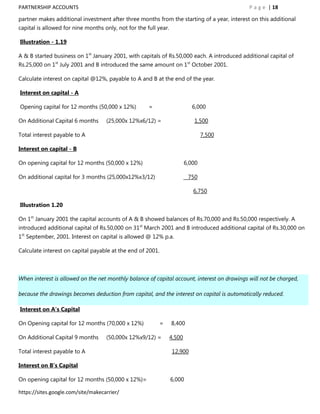
Illustration - 1.19

A & B started business on 1st January 2001, with capitals of Rs.50,000 each. A introduced additional capital of
Rs.25,000 on 1st July 2001 and B introduced the same amount on 1st October 2001.

Calculate interest on capital @12%, payable to A and B at the end of the year.

Interest on capital - A

Opening capital for 12 months (50,000 x 12%)          =                      6,000

On Additional Capital 6 months      (25,000x 12%x6/12) =                     1,500

Total interest payable to A                                                       7,500

Interest on capital - B

On opening capital for 12 months (50,000 x 12%)                           6,000

On additional capital for 3 months (25,000x12%x3/12)                       750

                                                                             6,750

Illustration 1.20

On 1st January 2001 the capital accounts of A & B showed balances of Rs.70,000 and Rs.50,000 respectively. A
introduced additional capital of Rs.50,000 on 31st March 2001 and B introduced additional capital of Rs.30,000 on
1st September, 2001. Interest on capital is allowed @ 12% p.a.

Calculate interest on capital payable at the end of 2001.


When interest is allowed on the net monthly balance of capital account, interest on drawings will not be charged,

because the drawings becomes deduction from capital, and the interest on capital is automatically reduced.

Interest on A’s Capital

On Opening capital for 12 months (70,000 x 12%)           =       8,400

On Additional Capital 9 months      (50,000x 12%x9/12) =          4,500

Total interest payable to A                                       12,900

Interest on B’s Capital

On opening capital for 12 months (50,000 x 12%)=                  6,000

https://sites.google.com/site/makecarrier/
PARTNERSHIP ACCOUNTS                                                                       P a g e | 19

On additional capital for 4 months (30,000x12%x 4/12) =      1,200

                                                               7,200

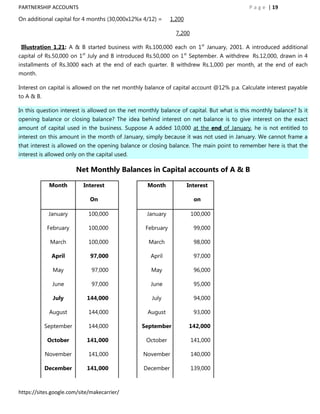
 Illustration 1.21: A & B started business with Rs.100,000 each on 1st January, 2001. A introduced additional
capital of Rs.50,000 on 1st July and B introduced Rs.50,000 on 1st September. A withdrew Rs.12,000, drawn in 4
installments of Rs.3000 each at the end of each quarter. B withdrew Rs.1,000 per month, at the end of each
month.

Interest on capital is allowed on the net monthly balance of capital account @12% p.a. Calculate interest payable
to A & B.

In this question interest is allowed on the net monthly balance of capital. But what is this monthly balance? Is it
opening balance or closing balance? The idea behind interest on net balance is to give interest on the exact
amount of capital used in the business. Suppose A added 10,000 at the end of January, he is not entitled to
interest on this amount in the month of January, simply because it was not used in January. We cannot frame a
that interest is allowed on the opening balance or closing balance. The main point to remember here is that the
interest is allowed only on the capital used.

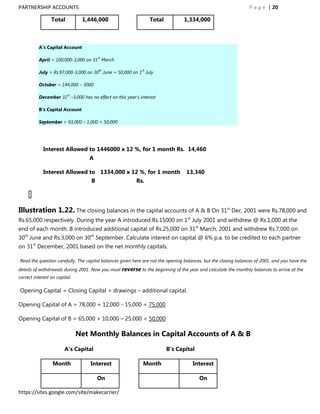
                        Net Monthly Balances in Capital accounts of A & B

             Month         Interest                Month             Interest

                             On                                         on

             January         100,000               January             100,000

            February         100,000              February              99,000

             March           100,000               March                98,000

              April          97,000                 April               97,000

              May             97,000                May                 96,000

              June            97,000                June                95,000

              July          144,000                  July               94,000

             August          144,000               August               93,000

            September        144,000             September           142,000

            October         141,000               October              141,000

            November         141,000             November              140,000

            December        141,000              December              139,000


https://sites.google.com/site/makecarrier/
PARTNERSHIP ACCOUNTS                                                                                            P a g e | 20

                 Total          1,446,000                       Total           1,334,000


          A’s Capital Account

                                       st
          April = 100,000-3,000 on 31 March

                                       th                  st
          July = Rs.97,000-3,000 on 30 June + 50,000 on 1 July

          October = 144,000 – 3000

                         st
          December 31 –3,000 has no effect on this year‟s interest

          B’s Capital Account

          September = 93,000 – 1,000 + 50,000


             Interest Allowed to 1446000 x 12 %, for 1 month Rs. 14,460
                                  A

             Interest Allowed to 1334,000 x 12 %, for 1 month                    13,340
                                   B                     Rs.


Illustration 1.22. The closing balances in the capital accounts of A & B On 31st Dec. 2001 were Rs.78,000 and
Rs.65,000 respectively. During the year A introduced Rs.15000 on 1st July 2001 and withdrew @ Rs.1,000 at the
end of each month. B introduced additional capital of Rs.25,000 on 31st March, 2001 and withdrew Rs.7,000 on
30th June and Rs.3,000 on 30th September. Calculate interest on capital @ 6% p.a. to be credited to each partner
on 31st December, 2001 based on the net monthly capitals.

Read the question carefully. The capital balances given here are not the opening balances, but the closing balances of 2001, and you have the
details of withdrawals during 2001. Now you must reverse to the beginning of the year and calculate the monthly balances to arrive at the
correct interest on capital.

Opening Capital = Closing Capital + drawings – additional capital.

Opening Capital of A = 78,000 + 12,000 - 15,000 = 75,000

Opening Capital of B = 65,000 + 10,000 – 25,000 = 50,000

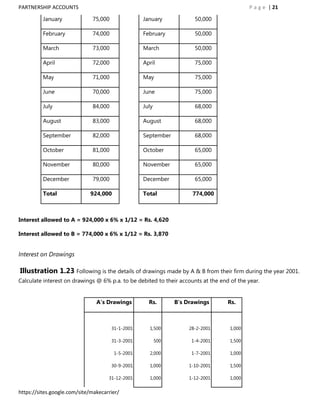
                               Net Monthly Balances in Capital Accounts of A & B

                        A’s Capital                                     B’s Capital

                  Month            Interest                 Month                   Interest

                                       On                                               On

https://sites.google.com/site/makecarrier/
PARTNERSHIP ACCOUNTS                                                                        P a g e | 21

          January             75,000               January             50,000

          February            74,000               February            50,000

          March               73,000               March               50,000

          April               72,000               April               75,000

          May                 71,000               May                 75,000

          June                70,000               June                75,000

          July                84,000               July                68,000

          August              83,000               August              68,000

          September           82,000               September           68,000

          October             81,000               October             65,000

          November            80,000               November            65,000

          December            79,000               December            65,000

          Total              924,000               Total              774,000


Interest allowed to A = 924,000 x 6% x 1/12 = Rs. 4,620

Interest allowed to B = 774,000 x 6% x 1/12 = Rs. 3,870


Interest on Drawings

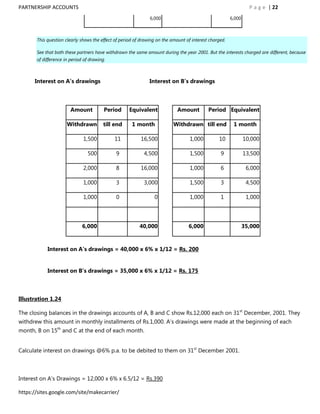
Illustration 1.23 Following is the details of drawings made by A & B from their firm during the year 2001.
Calculate interest on drawings @ 6% p.a. to be debited to their accounts at the end of the year.


                                A's Drawings         Rs.        B's Drawings       Rs.


                                       31-1-2001     1,500           28-2-2001      1,000

                                       31-3-2001          500         1-4-2001      1,500

                                        1-5-2001     2,000            1-7-2001      1,000

                                       30-9-2001     1,000           1-10-2001      1,500

                                     31-12-2001      1,000           1-12-2001      1,000


https://sites.google.com/site/makecarrier/
PARTNERSHIP ACCOUNTS                                                                                              P a g e | 22
                                                               6,000                                    6,000


       This question clearly shows the effect of period of drawing on the amount of interest charged.

       See that both these partners have withdrawn the same amount during the year 2001. But the interests charged are different, because
       of difference in period of drawing.


      Interest on A’s drawings                                 Interest on B’s drawings


                        Amount           Period      Equivalent              Amount         Period Equivalent

                      Withdrawn         till end      1 month              Withdrawn till end            1 month

                              1,500          11           16,500                   1,000         10             10,000

                                 500          9             4,500                  1,500          9             13,500

                              2,000           8           16,000                   1,000          6              6,000

                              1,000           3             3,000                  1,500          3              4,500

                              1,000           0                  0                 1,000          1              1,000


                              6,000                       40,000                  6,000                         35,000


            Interest on A’s drawings = 40,000 x 6% x 1/12 = Rs. 200


            Interest on B’s drawings = 35,000 x 6% x 1/12 = Rs. 175


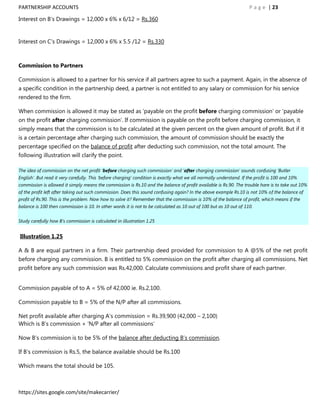
Illustration 1.24

The closing balances in the drawings accounts of A, B and C show Rs.12,000 each on 31st December, 2001. They
withdrew this amount in monthly installments of Rs.1,000. A‟s drawings were made at the beginning of each
month, B on 15th and C at the end of each month.


Calculate interest on drawings @6% p.a. to be debited to them on 31st December 2001.


Interest on A‟s Drawings = 12,000 x 6% x 6.5/12 = Rs.390

https://sites.google.com/site/makecarrier/
PARTNERSHIP ACCOUNTS                                                                                                  P a g e | 23

Interest on B‟s Drawings = 12,000 x 6% x 6/12 = Rs.360


Interest on C‟s Drawings = 12,000 x 6% x 5.5 /12 = Rs.330


Commission to Partners

Commission is allowed to a partner for his service if all partners agree to such a payment. Again, in the absence of
a specific condition in the partnership deed, a partner is not entitled to any salary or commission for his service
rendered to the firm.

When commission is allowed it may be stated as „payable on the profit before charging commission‟ or „payable
on the profit after charging commission‟. If commission is payable on the profit before charging commission, it
simply means that the commission is to be calculated at the given percent on the given amount of profit. But if it
is a certain percentage after charging such commission, the amount of commission should be exactly the
percentage specified on the balance of profit after deducting such commission, not the total amount. The
following illustration will clarify the point.

The idea of commission on the net profit „before charging such commission‟ and „after charging commission‟ sounds confusing „Butler
English‟. But read it very carefully. This „before charging‟ condition is exactly what we all normally understand. If the profit is 100 and 10%
commission is allowed it simply means the commission is Rs.10 and the balance of profit available is Rs.90. The trouble hare is to take out 10%
of the profit left after taking out such commission. Does this sound confusing again? In the above example Rs.10 is not 10% of the balance of
profit of Rs.90. This is the problem. Now how to solve it? Remember that the commission is 10% of the balance of profit, which means if the
balance is 100 then commission is 10. In other words it is not to be calculated as 10 out of 100 but as 10 out of 110.


Study carefully how B‟s commission is calculated in illustration 1.25


Illustration 1.25

A & B are equal partners in a firm. Their partnership deed provided for commission to A @5% of the net profit
before charging any commission. B is entitled to 5% commission on the profit after charging all commissions. Net
profit before any such commission was Rs.42,000. Calculate commissions and profit share of each partner.


Commission payable of to A = 5% of 42,000 ie. Rs.2,100.

Commission payable to B = 5% of the N/P after all commissions.

Net profit available after charging A‟s commission = Rs.39,900 (42,000 – 2,100)
Which is B‟s commission + „N/P after all commissions‟

Now B‟s commission is to be 5% of the balance after deducting B‟s commission.

If B‟s commission is Rs.5, the balance available should be Rs.100

Which means the total should be 105.


https://sites.google.com/site/makecarrier/
PARTNERSHIP ACCOUNTS                                                                           P a g e | 24

Again, if the total available is 105, B will get a commission of 5 and the balance of Rs.100 will remain. ie. for every
105, B will get a commission of Rs.5.

Therefore B‟s commission is Rs.39,900 x 5/105 = Rs.1,900

Notice that the balance available is Rs.38,000 and B‟s commission of Rs.1,900 is exactly 5% of Rs.38,000.

Calculation of Capital Ratio
Capital ratio should be understood as investment ratio. Money is considered an important working factor in the
business. When the capital contribution of a partner is higher, it also means that his money worked more in
making the profit. In calculating the capital ratio the amount and the period of investment are to be considered.
Suppose A contributes 10,000 in January and B contributes the same amount on 1st July, A's capital has worked
double that of B due to earlier investment, even though both the amounts are the same at the end of the year.
Therefore, capital ratio should be based on the amount of capital multiplied by the number of months the
investment remained with the firm.

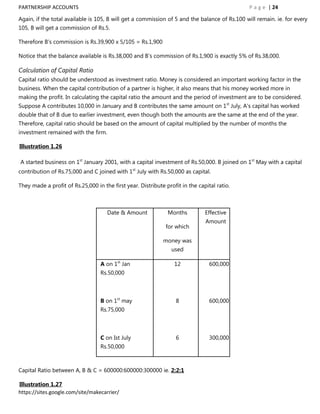
Illustration 1.26

A started business on 1st January 2001, with a capital investment of Rs.50,000. B joined on 1st May with a capital
contribution of Rs.75,000 and C joined with 1st July with Rs.50,000 as capital.

They made a profit of Rs.25,000 in the first year. Distribute profit in the capital ratio.


                                     Date & Amount             Months          Effective
                                                                               Amount
                                                              for which

                                                             money was
                                                                 used

                                  A on 1st Jan                    12             600,000
                                  Rs.50,000


                                  B on 1st may                     8             600,000
                                  Rs.75,000


                                  C on Ist July                    6             300,000
                                  Rs.50,000


Capital Ratio between A, B & C = 600000:600000:300000 ie. 2:2:1

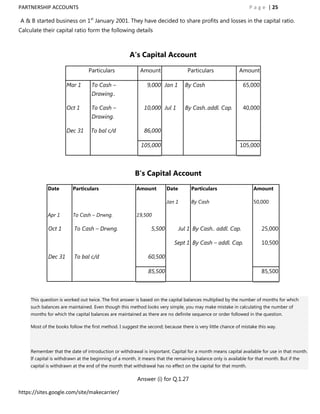
Illustration 1.27
https://sites.google.com/site/makecarrier/
PARTNERSHIP ACCOUNTS                                                                                             P a g e | 25

A & B started business on 1st January 2001. They have decided to share profits and losses in the capital ratio.
Calculate their capital ratio form the following details


                                                     A's Capital Account

                                 Particulars               Amount                 Particulars               Amount

                      Mar 1        To Cash –                  9,000 Jan 1        By Cash                      65,000
                                   Drawing..

                      Oct 1        To Cash –                 10,000 Jul 1        By Cash..addl. Cap.          40,000
                                   Drawing.

                      Dec 31      To bal c/d                 86,000

                                                           105,000                                          105,000


                                                        B's Capital Account
             Date        Particulars                     Amount         Date        Particulars                    Amount

                                                                        Jan 1       By Cash                        50,000

             Apr 1       To Cash – Drwng.                19,500

             Oct 1        To Cash – Drwng.                      5,500          Jul 1 By Cash.. addl. Cap.              25,000

                                                                            Sept 1 By Cash – addl. Cap.                10,500

             Dec 31       To bal c/d                           60,500

                                                               85,500                                                  85,500


     This question is worked out twice. The first answer is based on the capital balances multiplied by the number of months for which
     such balances are maintained. Even though this method looks very simple, you may make mistake in calculating the number of
     months for which the capital balances are maintained as there are no definite sequence or order followed in the question.

     Most of the books follow the first method. I suggest the second; because there is very little chance of mistake this way.


     Remember that the date of introduction or withdrawal is important. Capital for a month means capital available for use in that month.
     If capital is withdrawn at the beginning of a month, it means that the remaining balance only is available for that month. But if the
     capital is withdrawn at the end of the month that withdrawal has no effect on the capital for that month.

                                                         Answer (i) for Q.1.27

https://sites.google.com/site/makecarrier/
PARTNERSHIP ACCOUNTS                                                                                P a g e | 26

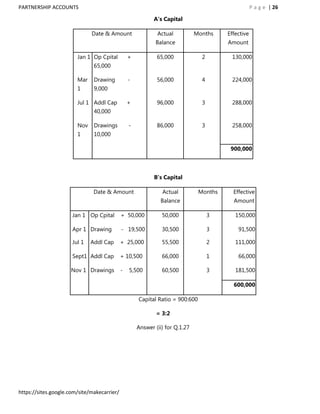
                                                            A's Capital

                              Date & Amount                  Actual           Months    Effective
                                                            Balance                     Amount

                        Jan 1 Op Cpital          +           65,000             2        130,000
                               65,000

                        Mar    Drawing           -           56,000             4        224,000
                        1      9,000

                        Jul 1 Addl Cap           +           96,000             3        288,000
                               40,000

                        Nov    Drawings          -           86,000             3        258,000
                        1      10,000

                                                                                         900,000


                                                            B's Capital

                               Date & Amount                   Actual          Months     Effective
                                                              Balance                     Amount

                      Jan 1 Op Cpital        + 50,000          50,000               3      150,000

                      Apr 1 Drawing          - 19,500          30,500               3       91,500

                      Jul 1   Addl Cap       + 25,000          55,500               2      111,000

                      Sept1 Addl Cap         + 10,500          66,000               1       66,000

                     Nov 1 Drawings          -   5,500         60,500               3      181,500

                                                                                          600,000

                                                     Capital Ratio = 900:600

                                                             = 3:2

                                                     Answer (ii) for Q.1.27


https://sites.google.com/site/makecarrier/
PARTNERSHIP ACCOUNTS                                                                                  P a g e | 27

                                                                 Bal.- A            Bal – B
                                          Month
                                             Jan                 65,000             50,000

                                             Feb                 65,000             50,000

                                             Mar                 56,000             50,000

                                             Apr                 56,000             30,500

                                             May                 56,000             30,500

                                             Jun                 56,000             30,500

                                             Jul                 96,000             55,500

                                             Aug                 96,000             55,500

                                             Sep                 96,000             66,000

                                             Oct                 86,000             60,500

                                             Nov                 86,000             60,500

                                             Dec                 86,000             60,500


                                                              900,000              600,000
                                          Total


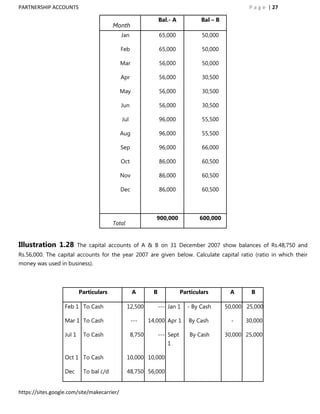
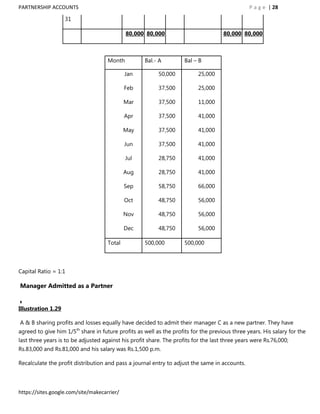
Illustration 1.28          The capital accounts of A & B on 31 December 2007 show balances of Rs.48,750 and
Rs.56,000. The capital accounts for the year 2007 are given below. Calculate capital ratio (ratio in which their
money was used in business).


                           Particulars             A         B              Particulars        A       B

                   Feb 1 To Cash                  12,500         --- Jan 1    - By Cash       50,000 25,000

                   Mar 1 To Cash                   ---     14,000 Apr 1        By Cash          -    30,000

                   Jul 1     To Cash               8,750         --- Sept      By Cash        30,000 25,000
                                                                    1

                   Oct 1 To Cash                  10,000 10,000

                   Dec       To bal c/d           48,750 56,000


https://sites.google.com/site/makecarrier/
PARTNERSHIP ACCOUNTS                                                                            P a g e | 28

                    31

                                             80,000 80,000                           80,000 80,000


                                     Month          Bal.- A          Bal – B

                                             Jan          50,000           25,000

                                             Feb          37,500           25,000

                                             Mar          37,500           11,000

                                             Apr          37,500           41,000

                                             May          37,500           41,000

                                             Jun          37,500           41,000

                                             Jul          28,750           41,000

                                             Aug          28,750           41,000

                                             Sep          58,750           66,000

                                             Oct          48,750           56,000

                                             Nov          48,750           56,000

                                             Dec          48,750           56,000

                                     Total          500,000          500,000


Capital Ratio = 1:1

Manager Admitted as a Partner


Illustration 1.29

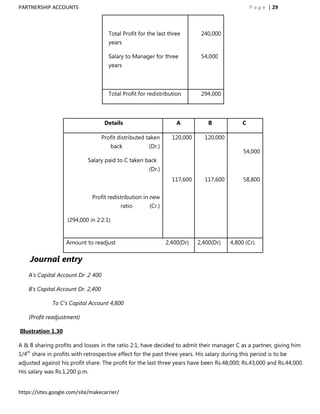
A & B sharing profits and losses equally have decided to admit their manager C as a new partner. They have
agreed to give him 1/5th share in future profits as well as the profits for the previous three years. His salary for the
last three years is to be adjusted against his profit share. The profits for the last three years were Rs.76,000;
Rs.83,000 and Rs.81,000 and his salary was Rs.1,500 p.m.

Recalculate the profit distribution and pass a journal entry to adjust the same in accounts.


https://sites.google.com/site/makecarrier/
PARTNERSHIP ACCOUNTS                                                                              P a g e | 29


                                      Total Profit for the last three       240,000
                                      years

                                      Salary to Manager for three           54,000
                                      years


                                      Total Profit for redistribution       294,000


                                     Details                       A           B              C

                                    Profit distributed taken     120,000      120,000
                                         back          (Dr.)
                                                                                              54,000
                             Salary paid to C taken back
                                                       (Dr.)
                                                                 117,600      117,600         58,800


                               Profit redistribution in new
                                             ratio     (Cr.)

                    (294,000 in 2:2:1)


                    Amount to readjust                         2,400(Dr)   2,400(Dr)     4,800 (Cr).


    Journal entry
    A‟s Capital Account Dr .2 400

    B‟s Capital Account Dr. 2,400

              To C‟s Capital Account 4,800

    (Profit readjustment)

Illustration 1.30

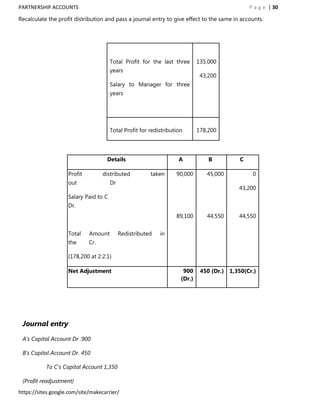
A & B sharing profits and losses in the ratio 2:1, have decided to admit their manager C as a partner, giving him
1/4th share in profits with retrospective effect for the past three years. His salary during this period is to be
adjusted against his profit share. The profit for the last three years have been Rs.48,000; Rs.43,000 and Rs.44,000.
His salary was Rs.1,200 p.m.


https://sites.google.com/site/makecarrier/
PARTNERSHIP ACCOUNTS                                                                            P a g e | 30

Recalculate the profit distribution and pass a journal entry to give effect to the same in accounts.


                                       Total Profit for the last three       135,000
                                       years
                                                                              43,200
                                       Salary to Manager for three
                                       years


                                       Total Profit for redistribution       178,200


                                    Details                         A            B          C

                    Profit         distributed          taken      90,000       45,000           0
                    out                Dr
                                                                                            43,200
                    Salary Paid to C
                    Dr.
                                                                   89,100       44,550      44,550


                    Total    Amount         Redistributed   in
                    the      Cr.

                    (178,200 at 2:2:1)

                    Net Adjustment                                    900     450 (Dr.) 1,350(Cr.)
                                                                     (Dr.)


 Journal entry

 A‟s Capital Account Dr .900

 B‟s Capital Account Dr. 450

           To C‟s Capital Account 1,350

 (Profit readjustment)
https://sites.google.com/site/makecarrier/
PARTNERSHIP ACCOUNTS                                                                                      P a g e | 31


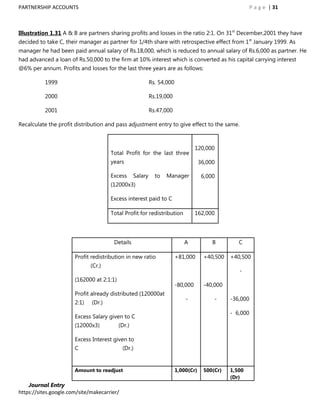
Illustration 1.31 A & B are partners sharing profits and losses in the ratio 2:1. On 31st December,2001 they have
decided to take C, their manager as partner for 1/4th share with retrospective effect from 1st January 1999. As
manager he had been paid annual salary of Rs.18,000, which is reduced to annual salary of Rs.6,000 as partner. He
had advanced a loan of Rs.50,000 to the firm at 10% interest which is converted as his capital carrying interest
@6% per annum. Profits and losses for the last three years are as follows:

           1999                                             Rs. 54,000

           2000                                             Rs.19,000

           2001                                             Rs.47,000

Recalculate the profit distribution and pass adjustment entry to give effect to the same.


                                                                                   120,000
                                      Total Profit for the last three
                                      years                                          36,000

                                      Excess       Salary     to   Manager            6,000
                                      (12000x3)

                                      Excess interest paid to C

                                      Total Profit for redistribution              162,000


                                       Details                              A             B        C

                       Profit redistribution in new ratio                +81,000      +40,500   +40,500
                              (Cr.)
                                                                                                   -
                       (162000 at 2:1:1)
                                                                         -80,000      -40,000
                       Profit already distributed (120000at
                                                                             -            -     -36,000
                       2:1)   (Dr.)
                                                                                                - 6,000
                       Excess Salary given to C
                       (12000x3)           (Dr.)

                       Excess Interest given to
                       C                     (Dr.)


                       Amount to readjust                                1,000(Cr)    500(Cr)   1,500
                                                                                                (Dr)
    Journal Entry
https://sites.google.com/site/makecarrier/
PARTNERSHIP ACCOUNTS                                                                        P a g e | 32

    C‟s Capital Account Dr.1,500

    To A‟s Capital Account 1,000

    To B‟s Capital Account 500

    (Profit readjustment)


Calculation of Capital Contribution
Illustration 1.32

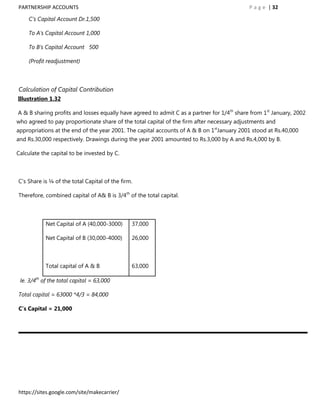
A & B sharing profits and losses equally have agreed to admit C as a partner for 1/4th share from 1st January, 2002
who agreed to pay proportionate share of the total capital of the firm after necessary adjustments and
appropriations at the end of the year 2001. The capital accounts of A & B on 1stJanuary 2001 stood at Rs.40,000
and Rs.30,000 respectively. Drawings during the year 2001 amounted to Rs.3,000 by A and Rs.4,000 by B.

Calculate the capital to be invested by C.


C‟s Share is ¼ of the total Capital of the firm.

Therefore, combined capital of A& B is 3/4th of the total capital.


            Net Capital of A (40,000-3000)     37,000

            Net Capital of B (30,000-4000)     26,000


            Total capital of A & B             63,000

 Ie. 3/4th of the total capital = 63,000

Total capital = 63000 *4/3 = 84,000

C’s Capital = 21,000


https://sites.google.com/site/makecarrier/
PARTNERSHIP ACCOUNTS                                                                           P a g e | 33

Chapter:2 Reconstitution Of Partnership
                       (Changing Ratio or Admission of a New Partner)

    A partnership business may undergo several structural changes during its lifetime. New partners
    may join or existing ones may leave the business. While making such major changes in the
    structure of business, partners carefully evaluate their accounts. They have to reset the system on a
    correct starting point. They check the values of assets and liabilities appearing in the books. If there
    are discrepancies they have to be rectified before introducing a major change. Reconstitution of a
    partnership business can take place under the following situations:

            Admission of a new partner
            Changing profit sharing ratio among existing partners
            Retirement / death of a partner
            Amalgamation of two partnership firms
    The most important accounting adjustment is resetting of old accounts. It is a common adjustment
    in all cases of reconstitution. In this chapter you will find reconstitution by admission and
    reconstitution by changing ratios. Reconstitution by admission is more important on examination
    point of view. The following are the common adjustments at the time of reconstitution of a
    partnership business.

      1. Revaluation of assets and liabilities

      2. Distribution of reserves and accumulated profits

      3. Calculation of new ratio, sacrificing ratio and gaining ratio

      4. Treatment of goodwill

      5. Readjustment of capital accounts


    1. Revaluation of Assets and Liabilities

    Assets and liabilities are often shown in the accounts at their historical value rather than realisable
    value. Due to conservatism the partners usually do not revise the values of assets even when their
    actual market values are much higher than book values. Similarly inadequate depreciation, change
    in technology etc. make the book values of certain assets more than their realisable value. It is not
    practical for the partners to keep on changing the book values of their assets every time there is a
    change in their market values. The difference between book value and market value is not a
    problem as long as the partnership business goes on normally. But when they change the structure
    of the partnership in the form of revision in profit sharing ratio, admission of a new partner,
    retirement or death of a partner, amalgamation of two partnership firms or absorption of a firm by
    another, the values of assets and liabilities are to be reassessed and difference if any, should be


https://sites.google.com/site/makecarrier/
PARTNERSHIP ACCOUNTS                                                                            P a g e | 34

    accounted.


    What is the purpose of revaluation?

    When the realisable value of asset or liability is different from the book value there is a profit or loss
    hidden in the difference in value. The partners should distribute all the profits and losses in the
    existing profit sharing ratio before changing the ratio. If the ratio remains unchanged there is
    practically no use in estimating the hidden profit or loss. However, if this profit or loss is not
    distributed prior to changing profit sharing ratio some partners will lose and others gain due to the
    change in ratio.

     For example: A&B, who were equal partners purchased land for Rs.10,000 in Jan 1975. They
    decided to share profits and losses in the ratio 2:1 from 1st January 2001. The actual market value of
    land on 1st January was Rs.70,000; whereas the book value remains at the purchase price of
    Rs.10,000. There is a hidden profit of Rs.60,000 in the value of land which A & B are entitled to
    share equally. Suppose they just ignored this factor and changed the profit sharing ratio to 2:1 and
    sold the land for Rs.70,000 next day, the profit on sale of land Rs.60,000 will go to A and B in the
    new ratio 2:1, which means A will get 40,000 and B will get only 20,000. In other words Rs.10,000
    belonging to B will go to A. Vice versa can happen in case of a hidden loss. To prevent such
    problems the partners revalue the assets and liabilities and transfer the profit or loss into their
    capital accounts in the existing ratio before making a change.

     Revaluation Account

    When the value of one asset is to be increased in the books it can be easily done by debiting the
    asset and crediting the profit to partners‟ capital accounts in the profit sharing ratio. But when there
    is a major shake up, values of almost every asset and liability have to be revised. Distributing each
    change to the partners would be a lengthily process. For the sake of convenience, all those profits
    and losses on change in values of assets and liabilities are brought into a temporary account called
    „revaluation account‟. The revaluation account summarises the effect of revaluation of assets and
    liabilities.

     Revaluation account is a special profit & loss account representing the combined capital accounts
    of partners. Any gain on revaluation of asset or liability, to be credited to partners, will be credited
    in the revaluation account. Similarly any loss on revaluation will be debited in revaluation account
    instead of debiting the capital accounts. The final balance in revaluation account indicates the profit
    or loss on the entire revaluation process. The revaluation account is closed by transferring this
    profit or loss to partner‟s capital accounts in the ratio before revision (old profit sharing ratio). All
    assets and liabilities will appear at their revised values in the books and in all future balance sheets.

     When the partners want to adjust the profit or loss on revaluation process without actually
    changing the values of assets and liabilities in the books they can do so by opening a

https://sites.google.com/site/makecarrier/
PARTNERSHIP ACCOUNTS                                                                             P a g e | 35

    memorandum revaluation account. This revaluation account has two parts. The first part is a
    normal revaluation account and the profit or loss on this part is transferred in the old profit sharing
    ratio. The second part of memorandum revaluation account is almost a mirror image of the first
    part. Whatever debited in the first section is credited in the second and whatever credited is
    debited. Naturally if there was profit in the first section, there will be loss in the second and vice
    versa. The profit or loss in the first part is transferred to capital accounts in the old ratio, and that at
    the second part will be transferred to capital accounts new profit sharing ratio. As a result of this
    exercise the effect of profit or loss on revaluation will be fairly embedded in the capital accounts of
    partners.


2. Distribution of Reserves and Accumulated Profits
Distribution of reserves and accumulated profits is the first step in any reorganisation process. They
include general reserves, credit balance in P & L accounts or any other fund that are retained in the
business. These are profits earned in the past, but not taken out by the partners, or profits kept aside.
Therefore, when the partners decide to change their future profit sharing ratio, the past profits retained
in the above accounts should be distributed to partners in the old ratio as a first step.

3. Calculating new ratio, sacrificing ratio and gaining ratio
When a new partner comes into the business, old partners have to give him his profit share from their
portion. Thus change in profit sharing ratio is an important aspect to be considered on reconstitution by
admission. In academic accounting, change in profit sharing ratio can be presented in various ways. The
existing partners may decide to change their profit sharing ratio for various reasons. When the profit
sharing ratio is revised among existing partners, there ought to be a partial sacrifice of profit share by
some partners in favour of others. The sacrifice of one or a group of partners becomes the gain of the
remaining partners. Following is the formula for calculating sacrificing ratio:

Sacrificing ratio = Old ratio – new ratio

When the profit sharing ratio is revised it is important to calculate the sacrificing ratio and gaining ratio.
These ratios are required to adjust the value of goodwill of a firm without raising goodwill account in the
books.

Gaining ratio is the opposite of sacrificing ratio. This is the ratio gain to the existing partners of a firm
when they revise the profit sharing ratio, or when the profit share of the deceased or retired partner is
shared by the other partners. This ratio is calculated by deducting the old ratio from the new ratio. The
new share will be higher than the old when there is a gain.

Gaining ratio = New ratio – old ratio

                Examples of ratio calculations on reconstitution by admission

a. The new partner’s share is mentioned without specifying the old partner’s profit sharing
   arrangement.
https://sites.google.com/site/makecarrier/
PARTNERSHIP ACCOUNTS                                                                  P a g e | 36

   In this case it is to be assumed that the profit available after paying the new partner‟s share is to be
       divided by the old partners in their old profit sharing ratio. In other words the even though the
       overall profit sharing ratio changes, the old ratio is still maintained between the old partners,
       within the new ratio.

   Illustration 2.1
   Calculate new profit sharing ratio in the following cases:

   i) A & B sharing profits and losses equally admit C for 1/5th share in future profits
   C‟s Share of profit = 1/5th of the profit of the firm.
   Balance of profit available for A & B = 4/5th of the profit, which is shared by them equally.
    A‟s New share = 4/5 x 1/2 = 4/10
   B‟s New share = 4/5 x ½ = 4/10
   Ratio between ABC = 4/10:4/10:1/5
                          = 2:2:1

   ii) A & B sharing profits and losses in the ratio 3:1 admit C for 1/5th share in future profits.
   C‟s share of profit = 1/5
   Balance available for A & B = 1-1/5 = 4/5 of the profit which is shared by them in the ratio 3:1
   A‟s New share = 4/5 x 3/4 = 3/5
   B‟s New share = 4/5 x ¼ = 1/5
   New Ratio = 3/5 : 1/5 : 1/5
                           = 3:1:1

   iii) A &B sharing profits and losses in the ratio 3:2 admit C for 1/5th share in future profits.
   C‟s Share = 1/5
   Balance available for A & B = 4/5 which is shared by them in the ratio 3:2
   A‟s new share = 4/5 x 3/5 = 12/25
   B‟s new share = 4/5 x 2/5 = 8/25
   C‟s share     = 1/5
   New profit sharing ratio = 12/25 : 8/25 : 1/5
                            12:8:5

   iv) A & B sharing profits and losses in the ratio 2/3 and 1/3 admit C into partnership giving
       him 1/4th share in future profits
   C‟s share of profit = 1/4
   Balance available for A & B = 3/4
   A‟s new share = 3/4 x 2/3 = 2/4
   B‟s new share = 3/4 x 1/3 = 1/4
   New profit sharing ratio = 2/4:1/4:1/4 ie. 2:1:1


   v) A & B who are equal partners admit C for 1/6th share in future profits
   C‟s share of profits = 1/6
   Balance available to A & B = 5/6

https://sites.google.com/site/makecarrier/
PARTNERSHIP ACCOUNTS                                                                      P a g e | 37

   A‟s new share = 5/6 x 1/2 = 5/12
   B‟s new share = 5/6 x 1/2 = 5/12
   New profit sharing ratio = 5/12: 5/12: 1/6
                            = 5:5:2
The old partners give part of their share to the new partner (focus on the old partner)


   Illustration .2.2
   Calculate profit sharing ratio and sacrificing ratios in the following cases:


   i) A & B who are equal partners admit C for which A surrenders ½ of his share and B surrenders 1/4 th
     of his share in favour of C

   a. A‟s Old share = 1/2

   b. Portion surrendered for C 1/2 of 1/2

      i.e. 1/2x1/2 = 1/4

   c. Balance available for A = 1/4 (a-b)

   d. B‟s old share = 1/2

   e. Portion surrendered for C = 1/4th of 1/2

      i.e. 1/2x1/ 4 = 1/8

   f. Balance available for B = 3/8 (1/2-1/8)

   g. C‟s share = A‟s contribution + B‟s contribution

   i.e. 1/4 +1/8 = 3/8

   g. New profit sharing ratio = 1/4:3/8:3/8

                                            i.e. 2:3:3

    ii) A & B sharing profits and losses in the ration 3:2 admit C for which each partner surrenders ½ of his
     respective share.

   a. A‟s Old share = 3/5

   b. Portion surrendered for C 1/2 of 3/5

      i.e. 3/5x1/2 = 3/10

   c. Balance available for A = 3/10(a-b)

   d. B‟s old share = 2/5

https://sites.google.com/site/makecarrier/
PARTNERSHIP ACCOUNTS                                                                   P a g e | 38

   e. Portion surrendered for C = 1/2 of 2/5

      ie. 2/5x1/2 = 2/10

   f. Balance available for B = 2/10(d-e)

   g. C‟s share = A‟s contribution + B‟s contribution

   i.e. 3/10+2/10= 5/10

   h. New profit sharing ratio = 3/10:2/10:5/10

                                  i.e. 3:2:5


   iii) A & b sharing profits and losses in the ratio 3:2 admit C into partnership for which A surrenders
     1/4th of his share and B surrenders 1/2 of his share.

   a. A‟s Old share = 3/5

   b. Portion surrendered for C 1/4th of 3/5

      i.e. 3/5x1/4 = 3/20

   c. Balance available for A = 9/20(a-b)

   d. B‟s old share = 2/5

   e. Portion surrendered for C = 1/2 of 2/5

      i.e. 2/5x1/2 = 2/10

   f. Balance available for B = 2/10(d-e)

   g. C‟s share = A‟s contribution + B‟s contribution

      i.e. 3/20+2/10= 7/20

   h. New profit sharing ratio =9/20:2/10:7/20     i.e. 9:4:7


   iv) A & B sharing profits and losses in the ratio 4:1 have admitted C by surrendering 1/2 of their
     respective shares.

   a. A‟s Old share = 4/5

   b. Portion surrendered for C 1/2 of 4/5

      i.e. 4/5x1/2 = 4/10


https://sites.google.com/site/makecarrier/
PARTNERSHIP ACCOUNTS                                                             P a g e | 39

   c. Balance available for A = 4/10(a-b)

   d. B‟s old share = 1/5

   e. Portion surrendered for C = 1/2 of 1/5

      i.e. 1/5x1/2 = 1/10

   f. Balance available for B = 1/10(d-e)

   g. C‟s share = A‟s contribution + B‟s contribution

      i.e. 4/10+1/10= 5/10

   h. New profit sharing ratio = 4/10:1/10:5/10

                i.e. 4:1:5


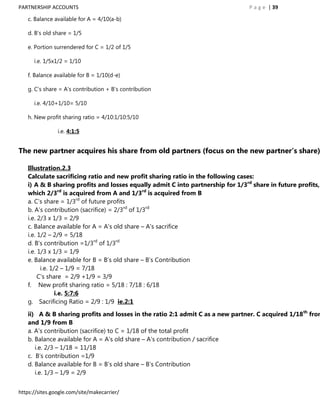
The new partner acquires his share from old partners (focus on the new partner’s share)

   Illustration.2.3
   Calculate sacrificing ratio and new profit sharing ratio in the following cases:
   i) A & B sharing profits and losses equally admit C into partnership for 1/3rd share in future profits,
   which 2/3rd is acquired from A and 1/3rd is acquired from B
   a. C‟s share = 1/3rd of future profits
   b. A‟s contribution (sacrifice) = 2/3rd of 1/3rd
   i.e. 2/3 x 1/3 = 2/9
   c. Balance available for A = A‟s old share – A‟s sacrifice
   i.e. 1/2 – 2/9 = 5/18
   d. B‟s contribution =1/3rd of 1/3rd
   i.e. 1/3 x 1/3 = 1/9
   e. Balance available for B = B‟s old share – B‟s Contribution
         i.e. 1/2 – 1/9 = 7/18
        C‟s share = 2/9 +1/9 = 3/9
   f. New profit sharing ratio = 5/18 : 7/18 : 6/18
                i.e. 5:7:6
   g. Sacrificing Ratio = 2/9 : 1/9 ie.2:1

   ii) A & B sharing profits and losses in the ratio 2:1 admit C as a new partner. C acquired 1/18th from
   and 1/9 from B
   a. A‟s contribution (sacrifice) to C = 1/18 of the total profit
   b. Balance available for A = A‟s old share – A‟s contribution / sacrifice
      i.e. 2/3 – 1/18 = 11/18
   c. B‟s contribution =1/9
   d. Balance available for B = B‟s old share – B‟s Contribution
      i.e. 1/3 – 1/9 = 2/9


https://sites.google.com/site/makecarrier/
PARTNERSHIP ACCOUNTS                                                                   P a g e | 40

   e. C‟s share = 1/18 +1/9 = 3/18
   f. New profit sharing ratio = 5/18 : 7/18 : 6/18
              i.e. 11:4:3
   g. Sacrificing ratio = 1/18:1/9 i.e.1:2
   iii) A & B sharing profits and losses in the ratio 3:2 admit C for 1/4th share which is acquired equally
   A and B
   A‟s Contribution (sacrifice) to C = ½ of ¼ =1/8
   B‟s Contribution (sacrifice) to C = ½ of ¼ = 1/8
   A‟s new share = 3/5 –1/8 = 19/40
   B‟s new share = 2/5 –1/8 = 11/40
   New ratio = 19/40:11/40:10/40
   Sacrificing ratio = 1/8 :1/8 ie. 1:1
   iv) A & B sharing profits in the ratio 3:1 admit C for 1/5th share in future profits. C acquires 7/8th of
   share from a and 1/8th from B
   A‟s contribution to C = 7/8th of 1/5
   ie. 7/40
   B‟s Contribution to C = 1/8th of 1/5
   ie. 1/40
   A‟s new share = 3/4-7/40 = 23/40
   B's new share = 1/4 – 1/40 = 9/40
   C‟s share = 7/40+1/40 =8/40
   New ratio = 23:9:8
   Sacrificing ratio 7:1
   v) A & B who are equal partners admit C for 1/3rd share in future profits. C acquired 1/3rd of his sh
   from A and 2/3rd of his share form B.
   A‟s sacrifice 1/3rd of 1/3rd = 1/9
   B‟s sacrifice 2/3rd of 1/3rd = 2/9
   A‟s new share = 1/2 – 1/9 = 7/18
   B‟s new share = 1/2 – 2/9 = 5/18
   C‟s share       = 1/9+2/9 = 6/18
   New ratio = 7:5:6


The entire sacrifice is made by one partner
   Illustration.2.4
   Calculate new profit sharing ratio in the following cases:
   i) A & B sharing profits and losses equally admit C for 1/4th share. B has made the entire sacrifice
   for C‟s share of profit.
   B‟s new share = 1/2 – 1/4 = 1/4
   New profit sharing ratio = 1/2:1/4:1/4
   ii) A & B sharing profits and losses in the ratio 3:2 admit C for 1/5th share in future profit which is
   fully contributed by A.
https://sites.google.com/site/makecarrier/
PARTNERSHIP ACCOUNTS                                                                P a g e | 41

   A‟s contribution = 1/5
   A‟s new share = 3/5 –1/5 = 2/5
   New profit sharing ratio = 2/5:2/5:1/5
   iii) A & B who are equal partners admit C into partnership. B has contributed ½ of his share in
   favour of C
   New profit sharing ratio = 2:1:1
   iv) A & B who are sharing profits and losses in the ratio 3:1 admit c by contributing ½ of A‟s share
   in favour of C.
   A‟s contribution for C = ½ of ¾ = 3/8
   New profit sharing ratio = 3/8 : 1/4: 3/8 = 3:2:3

   v) A & B sharing profits and losses in the ratio 2:1 admit C by contributing 1/3rd portion of A‟s
   share of profits.
   A‟s contribution (C‟s share) = 1/3rd of 2/3rd = 2/9
   A‟s new share = 2/3 – 2/9 = 4/9
   New profit sharing ratio = 4:3:2

c. An entirely new profit sharing ratio is given

   Illustration.2.5:
   Calculate sacrificing ratio in the following cases
   i) A & B sharing profits and losses equally admit C into partnership and decide to share future
   profits and losses in the ratio 3:2:2
   A‟s sacrifice = 1/2 – 3/7 =7/14 - 6/14 = 1/14
   B‟s sacrifice = 1/2 –2/7 = 7/14 – 4/14 = 3/14
   Sacrificing ratio = 1:3

   ii) A & B sharing profits and losses in the ratio 3:1 admit C and decide to share future profits
   and losses in the ratio 3:2:4
   A‟s sacrifice = 3/4 - 3/9 = 27/36 – 12/36 = 15/36
   B‟s sacrifice = 1/4 – 2/9 = 9/36 – 8/36 = 1/36
   Sacrificing ratio = 15:1
   iii) A & B sharing profits and losses in the ratio 3:2 admit C and change their profit sharing as
   3:2:3.
   A‟s sacrifice = 3/5-3/8 = 24/40-15/40 = 9/40
   B‟s sacrifice = 2/5 – 2/8 = 16/40 – 10/40 = 6/40
   Sacrificing ratio = 9:6 ie.3:2

   iv) A &B having equal partnership admit C and change their profit sharing as 4:3:2
   A‟s sacrifice = 1/2 - 4/9 = 9/18 – 8/18 = 1/18
   B‟s sacrifice = 1/2 – 3/9 = 9/18 – 6/18 = 3/18
   Sacrificing ratio = 1:3

   v)                A & B sharing profits and losses in the ratio 4:3 admit C and decide to share future
   profits and losses equally.

https://sites.google.com/site/makecarrier/
PARTNERSHIP ACCOUNTS                                                                                P a g e | 42

   A‟s sacrifice = 4/7 – 1/3 = 12/21 – 7/21 = 5/21
   B‟s sacrifice = 3/7 – 1/3 = 9/21 – 7/21 = 2/21
   Sacrificing ratio = 5:2

At the time of reconstitution by admission, the old partners generally sacrifice for the new partner. In
other words, new partner is the gaining partner and the old partners are the sacrificing partners.
However when the partners restructure the entire profit sharing arrangement even some of the old
partners could turn out to be gaining partners. When reconstitution takes place by changing ratio among
existing partners (without any admission or retirement) sacrifice by one or more partners will match with
the gain of other partners.
Calculation of sacrifice and gain are significant for several other adjustments on reconstitution.

What about a situation where there is sacrifice as well as gain. If you simply apply the formula without knowing
what exactly is sacrifice or gain there will be lot of confusion while working out the problems. In many cases your
common sense is more useful than the text book principles. For example if you find the new share of a partner is less
than his old share for whatever reason, it is called SACRIFICE and if the new share is higher than the old it is called
GAIN. Now you decide how to find out sacrificing ratio or gaining ratio.

Shortcut to calculate sacrificing ratio and gaining ratio
When there is a revision of profit sharing ratio by existing partners, there will be sacrifice as well as gain
within the same partnership. Therefore it is easier to stick to one formula. Take the result of new ratio
minus old ratio. If the result is negative it is sacrifice; and positive it is gain.

Notice the steps once again:
  a. Write the new ratio in the first line (because I like to see sacrifice as negative and gain as positive
      number)
  b. Write the old ratio in the second line (remember to adjust the ratios to add up to the a
      convenient total)
  c. Deduct the old from new
  d. Negatives result indicates sacrifice; positive result indicates gain
a. Old and new ratios are given
   Illustration 2.06
   A,B,C and D sharing profits and losses in the ratio 4:3:2:1 have decided to share future profits and
   losses in the ratio 2:1:1:1. Find out the sacrifice or gain in the arrangement.
   (Note: When you have to compare two different ratios, it will be easier if both add up to the same total)

                                             A       B           C          D        Total
     New Ratio(adjusted out of
     10)                                     4        2          2          2          10
     Old Ratio                               4        3          2          1          10
     (Sac) /Gain                             0       -1          0          1

   B‟s Sacrifice 1/10; A‟s Gain 1/10

https://sites.google.com/site/makecarrier/
PARTNERSHIP ACCOUNTS                                                                                          P a g e | 43

   Illustration 2.07
   A, B, C and D sharing profits and losses in the ratio 3:3:2:2 have decided to share future profits and
   losses in the ratio 4:3:2:1. Find out the sacrifice or gain in the arrangement.

                                             A            B            C            D        Total
    New Ratio(revised to add up to
    10)                                      4            3            2            1            10
    Old Ratio                                3            3            2            2            10
    Sac /Gain                                1            0            0            -1
   A‟s Gain 1/10; D‟s Sacrifice 1/10

   Illustration 2.08
   A, B, C and D sharing profits and losses in the ratio 2:1:1:1 have decided to share future profits and
   losses in the ratio 3:3:3:1. Find out the sacrifice or gain in the arrangement.

                                             A            B            C             D           Total
     New Ratio                               3            3            3             1            10
     Old Ratio(converted to add up to        3            3            2             2            10
     10)
     Sac /Gain                               0            0            1             -1

   C‟s gain 1/10; D‟s sacrifice 1/10

   Illustration 2.09
   A, B, C and D sharing profits and losses in the ratio 2:1:2:1 have decided to share future profits and
   losses in the ratio 2:2:1:1. Find out the sacrifice or gain in the arrangement.

                                                      A            B           C             D        Total
                          New Ratio                   2            2            1            1          6
                          Old Ratio                   2            1            2            1          6
                          Sac /Gain                   0            1           -1            0

   B‟s Gain 1/6; C‟s sacrifice 1/6

   Illustration 2.10
   A, B, C and D sharing profits and losses in the ratio 4:3:2:1 have decided to share future profits and
   losses equally. Find out the sacrifice or gain in this arrangement.

                                                 A            B            C             D            Total
                          New Ratio              5            5            5             5            20
                          Old Ratio              8            6            4             2            20
                          Sac /Gain              -3           -1           1             3


https://sites.google.com/site/makecarrier/
PARTNERSHIP ACCOUNTS                                                                    P a g e | 44

   A‟s Sacrifice 3/20; B‟s Sacrifice 1/20; C‟s Gain 1/20; D‟s Gain 3/20

   Illustration 2.11
   A, B, C and D sharing profits and losses equally have decided to share future profits and losses in the
   ratio 2:2:1:1. Find out the sacrifice or gain in the arrangement.

                                                  A       B       C       D     Total
                         New Ratio                4       4        2      2      12
                         Old Ratio                3       3        3      3      12
                         Sac /Gain                1       1       -1      -1

   A‟s Gain 1/12; B‟s gain 1/12; C‟s sacrifice 1/12; D‟s sacrifice 1/12

    Illustration 2.12
   A, B and C sharing profits and losses in the ratio 4:3:3 have decided to share future profits and losses
   in the ratio 2:2:1. Find out the sacrifice or gain in the arrangement.

                                             A   B        C       Total
            New Ratio                        4   4        2        10
            Old Ratio                        4   3        3        10
            Sac /Gain                        0   1        -1

   B‟s gain 1/10; C‟s sacrifice 1/10
Partners’ sacrifice is specified

   Illustration 2.13
   A, B and C sharing profits and losses in the ratio 3:2:1 have decided to change their ratios, to give
   more profit share to C who has agreed to work as managing partner. Both A and B have agreed to
   sacrifice 1/4th of their respective share in favour of C. work out the new ratio and the sacrificing ratio.

   A‟s old share 3/6
   A‟s sacrifice = 1/4th of 3/6
                = 3/6 x 1/4 = 1/8
   A‟s new ratio = 3/6 – 1/8 = 3/8

   B‟s old share = 2/6
   B‟s sacrifice = 1/4th of 2/6
                  = 2/6 x 1/4 = 1/12
   B‟s new share= 2/6 – 1/12 = 3/12

   C‟s new share = 1/6 +1/8 +1/12
                 = 4/24 + 3/24 + 2/24
                 = 9/24

https://sites.google.com/site/makecarrier/
PARTNERSHIP ACCOUNTS                                                                P a g e | 45

   New profit sharing ratio of AB and C = 3/8 : 3/12 : 9/24
                                         =9:6:9

   Sacrificing ratio of A & B = 1/8 : 1/12 = 3/24 : 2 / 24 = 3:2

   C‟s Gain = 3/24 + 2/24 = 5/24

   Illustration 2.14
   A, B and C sharing profits and losses in the ratio 3:2:1 have decided to rearrange their profit sharing
   ratio. A & B have agreed to contribute 1/5th of their respective shares in favour of C. Find out the
   sacrifice or gain the arrangement.

   A‟s old share 3/6
   A‟s sacrifice = 1/5th of 3/6
                = 3/6 x 1/5 = 3/30
   A‟s new ratio = 3/6 – 3/30 = 12/30
   B‟s old share = 2/6
   B‟s sacrifice = 1/5th of 2/6
                  = 2/6 x 1/5 = 2/30
   B‟s new share= 2/6 – 2/30 = 8/30
   C‟s new share = 1/6 +3/30 +2/30
                    = 5/30 + 3/30 + 2/30
                    = 10/30
   New profit sharing ratio of AB and C = 12 : 8 : 10
                                         =6:4:5

   Sacrificing ratio of A & B = 3 : 2
   C‟s Gain = the total sacrifice made by A & B; ie. 3/30 + 2/30 = 5/30

   Illustration 2.15
   A, B and C sharing profits and losses in the ratio 3:2:1 have decided that C‟s future share of profit
   shall be doubled. A & B have agreed to sacrifice this portion equally. Work out the details of new
   profit sharing arrangement.
   A‟s old share 3/6
   A‟s sacrifice = 1/2 of 1/6 = 1/12
   A‟s new ratio = 3/6 – 1/12 = 5/12
   B‟s old share = 2/6
   B‟s sacrifice = 1/2 of 1/6 = 1/12
   B‟s new share= 2/6 – 1/12 = 3/12
   C‟s new share = 1/6 +1/12 +1/12 = 2/6
   New profit sharing ratio of AB and C = 5/12 : 3/12 : 2/6
https://sites.google.com/site/makecarrier/
PARTNERSHIP ACCOUNTS                                                                                           P a g e | 46

                                                      =5:3:4
   Sacrificing ratio of A & B = 1/12 : 1/12
   Illustration 2.16
   A, B & C sharing profits and losses in the ratio 2:1:1 have decided to share future profits and losses
   equally. Their goodwill was estimated to be worth Rs.18,000. Pass adjustment entry for treating
   goodwill.

   Answer i (using ratios)
   Sacrifice / Gain
                                                               A          B           C       Total
                                       Old Ratio               6          3           3        12
                                       New Ratio               4          4           4        12
                                       Sac /Gain               2          1           1

   A has a sacrifice of 2/12 portion of goodwill or which is Rs.3,000 (18,000 x2/12)
   This is becomes the gain of B and C equally.


     Adjustment entry:
     B‟s Capital Account Dr. 1,500
     C‟s Capital Account Dr.1,500
            To A‟s Capital Account 3,000.
     (The gaining partner‟s margin of gain is adjusted to sacrificing partner)


   Answer ii (using the value of goodwill directly, in place of ratios)

                                                              A               B               C        Total
                          Goodwill in old ratio cr.         9000            4500           4500        18000
                          Goodwill in new ratio dr.         6000            6000           6000        18000
                                   Dr./cr.                Cr. 3000.        Dr. 1500       Dr. 1500       0

   I think the second method is easier. You need not worry about finding out the ratios and distributing them. But if the question wants
   you to write the ratios as part of answer, you have no choice other than the first. So learn both.


   Illustration 2.17
   A & B sharing profits and losses in the ratio 2:2:1 have decided to share future profits and losses
   equally. Their goodwill was estimated to be worth Rs.30,000 and which they do not want to remain in
   the books. Pass necessary Journal entries.

                                                                  A           B           C       Total
                              Old Ratio                           6           6           3        15

https://sites.google.com/site/makecarrier/
PARTNERSHIP ACCOUNTS                                                                        P a g e | 47

                           New Ratio                   5         5         5        15
                           Sac /Gain                   1         1         2


   Adjustment entry:
   C‟s Capital Account Dr.4,000
          To A‟s Capital Account 2,000
          To B‟s Capital Account 2,000
   (The gaining partner‟s margin of gain is adjusted to sacrificing partners)


   Illustration 2.18
   A & B sharing profits and losses in the ratio equally have decided to share future profits and losses in
   the ratio 2:2:1. Their goodwill was estimated to be worth Rs.18,000. Pass necessary Journal entries.

                                                      A         B         C       Total
                          Old Ratio                   5         5         5        15
                          New Ratio                   6         6         3        15
                          Sac /Gain                   1         1         2

   Adjustment entry:
   A‟s Capital Account Dr.1,200
   B‟s Capital Account Dr 1,200
          To C‟s Capital Account 2,400

   (The gaining partner‟s margin of gain is adjusted to sacrificing partners)

4. Accounting for Goodwill

Meaning of Goodwill


Goodwill is the monetary value assigned to the advantages of a reputed business in comparison with a
new one. It indicates the extra earning capacity of the business. Goodwill is an intangible asset. But it is not a
fictitious asset. Goodwill has a realisable value. It is acquired in a gradual consistent process of good business.
Ideal location, experience of staff, reputation of owners, faithful customers etc. contribute to the creation of
goodwill.

Usually goodwill is not shown in books due to conservatism. However, it is essential to assess the value of
goodwill and pass appropriate entries in the books prior to any change in profit sharing or ownership structure. If
this step is ignored while making any rearrangement in profit sharing or ownership structure, some partners will
lose and some others will make undue gain, since goodwill is a valuable hidden asset of the business.

                                               Nature of Goodwill

https://sites.google.com/site/makecarrier/
PARTNERSHIP ACCOUNTS                                                                               P a g e | 48

1.        Goodwill is an intangible asset

2.        Goodwill is a valuable asset.

3.        Goodwill generates extra income for the business

4.        It is acquired in a gradual process

Following are the major situations in which the goodwill of the firm is to be estimated.

a. Change in profit sharing ratio

b. Admission of a new partner

c. Retirement or death of a partner

d. Amalgamation of two partnership firms

                                                Factors Influencing Goodwill

There are several factors that influence the formation of goodwill. The following are some of the important factors
helping the formation of goodwill in a business.

     1.    Honest business dealings

           A firm builds up its reputation over a long period by consistent good dealing with the customers. Once the
           customers start identifying a business for clean and honest dealings they would prefer to stay with the firm,
           which in turn help the firm to earn higher profits.

     2.     Good quality of products

           A manufacturing concern maintaining a very good quality in their production will gradually build up
           reputation, which will help them while launching new products. Similarly trading concerns dealing only in
           good quality products will gradually build up their reputation.

     3.     Ideal Location

           Good location of the business is another favourable factor enhancing the profitability and thereby goodwill
           of the business. A business which is centrally located will naturally attract more business and more profit.

     4.     Special skill or Technical Know-how

           The business builds up skill in dealing with their product line, dealing with the clients‟
           specific requirements, problems associated with the geographical location of their business
           etc. through experience. The problems are wide and varied, and solutions are also equally
           diverse. Thus the actual experience help develop skill in dealing with similar situations in
           future, which is naturally promote efficiency and goodwill of the business.

     5.     Monopoly of Business
https://sites.google.com/site/makecarrier/
PARTNERSHIP ACCOUNTS                                                                           P a g e | 49

      Some established business concerns manage to build up their monopoly simply by being
      the first one in the market. This enables them to establish its position in and to some
      extent, restrict future competition. Even though, monopolies are undesirable from the
      customer‟s point of view, they are unavoidable and harmless at a limited scale.


Methods of Valuation of Goodwill
Following are the most commonS methods adopted for valuation of Goodwill.

a. Average Profit Method

Average profit method, as the name suggests, is based on the average profit of the business. Under this method,
average profits for the past three or four years as agreed by the partners will be taken. Goodwill is estimated as
twice or thrice of this average profit.

Illustration 2.19

ABC earned profits of Rs.20, 000, Rs.15,000 and Rs.25,000 in the past three years. They have decided that the
Goodwill to be estimated at twice the average profit for the past three years. Estimate Goodwill.


Average profits = 45000

Value of Goodwill being twice the average = 45000 x2 = 90,000

b. Super Profit Method

The existence of Goodwill is recognised in a firm only when its profitability is beyond the level of a new firm. Such
excess profit earned by the firm is termed as super profit. Goodwill under super profit method is calculated in one
of the following ways:

i. Simple Super Profit


Illustration 2.20

The net profit earned by ABC in the previous year was Rs.50,000. The capital employed by the firm is Rs.400,000. The
normal rate of return for similar business is 10% on capital. Goodwill is considered to be the value of 3 years
purchase of Super Profit.

Calculate Goodwill.

Capital Employed = 400,000

Normal rate of return = 10%

Normal profit on the capital employed = 400,000 x 10% = Rs. 40,000

https://sites.google.com/site/makecarrier/
PARTNERSHIP ACCOUNTS                                                                           P a g e | 50

Actual profit = Rs.50,000

Super profit = 50000 – 40000 = 10,000

Goodwill being 3 years purchase of super profit = Rs.30,000

ii. Average Super Profit


Illustration 2.21

The firm ABC earned R.17,500, Rs.22,500 and Rs.20,000 in the last three years. The mount of capital employed by
the firm was Rs.150,000 and the normal rate of return for similar business is 10%.

Goodwill is considered 5 times the value of average super profits.
Calculate goodwill.


Average profit for the last three years = Rs.20,000

Normal profit on the capital employed = Rs.15,000

Average super profit = Rs.5,000

Value of Goodwill = 5000 x 5 = Rs. 25, 000

iii. Capitalisation of Simple Super Profit


Illustration 2.22

ABC earned a profit of Rs.20,000 during the year 2001. The capital employed by the firm was Rs.120,000 and the
normal rate of return on similar business is 10%. Calculate goodwill by capitalising super profit.

Actual Profit = Rs.20,000

Normal profit on capital investment = 120000 x 10% = Rs.12,000

Super profit = 20,000 –12,000 = Rs.8,000

Capitalised value of super profit =80000 x 100 / 10 = Rs.80,000

c. Capitalisation Method (Goodwill based on capital saved)
Capitalisation method considers goodwill as the value of capital saved due to higher profitability. Under this
method the amount of effective capital is estimated on the basis of market condition. This effective capital is
always higher than the actual capital due to better profitability. The excess of effective capital over the actual
capital is regarded as capital saved which is considered the goodwill of the firm. Capitalisation of super profit and
capitalisation of actual profit and estimation of capital saved as goodwill are practically the same.

https://sites.google.com/site/makecarrier/
PARTNERSHIP ACCOUNTS                                                                        P a g e | 51


Illustration 2.23

ABC earned a profit of Rs.20,000 on a capital investment of Rs.175,000. Normal rate of return is 10%. Goodwill is
considered the value of capital saved based on normal rate of return.

Estimate the value of Goodwill.

(This sum is worked out in two ways to illustrate that both the methods are same)

Estimation of Capital Saved

Actual profit = Rs.20,000

Estimated capital for earning this profit = Rs.200,000

Actual capital employed = Rs.175,000

Capital saved = 200,000 – 175,000 = Rs.25,000

Capitalisation of Super Profit

Actual profit = Rs.20,000

Normal profit on capital employed = 175,000 x 10% = Rs. 17,500

Super profit = 20,000-17,500 = Rs.2,500

Capitalised value of super profit = Rs.25,000

Accounting Treatment of Goodwill on Admission
Once the value of goodwill is estimated it should be properly accounted prior to the admission of a new partner.
There are basically three methods of treatment of goodwill on admission, which are:

Premium method

Margin Adjustment

Revaluation method

Memorandum revaluation method

Premium Method

Under premium method the new partner pays cash for his share goodwill along with his capital. Cash account is
debited for both these payments. The total amount brought in by the new partner (Capital + Goodwill) is credited
to his capital account. The goodwill part of this payment belongs to the old partners. This amount is transferred to
their capital accounts IN THE SACRIFICING RATIO. Since goodwill account is not opened in the book of the firm
it will not appear in the balance sheet.

https://sites.google.com/site/makecarrier/
PARTNERSHIP ACCOUNTS                                                                                               P a g e | 52

If there is any goodwill partly appearing in the balance sheet of the firm and the new partner is willing to
contribute for his share, there are two options available for its treatment.


First, the existing goodwill may be left intact, and collect the new partner‟s share of the remaining value of
goodwill only.

Alternatively, write off the existing goodwill against the capital accounts of old partners in their old profit sharing
ratio and collect the share for full value of goodwill from the new partner.

Margin Adjustment Method

This method is practically a variation of premium method. Here the new partner does not bring in money
specifically for his share of goodwill. The best option in this situation is to raise goodwill. For unreasonable
reasons, raising goodwill is not allowed. The last resort is margin adjustment. Here the goodwill is adjusted only
through the capital accounts. This method will work fine for all cases of reconstitution. When profit sharing ratio is
changed at reconstruction something is added or deducted from their old profit share. In other words the
partners retain a major part of their old profit share for which no adjustment is required. Goodwill under this
method is adjusted on the basis of marginal increase or decrease of profit share. The basic rule is that the gaining
partner shall compensate the sacrificing partner.

Following are the steps involved in goodwill adjustment.

i) Find out the partner‟s sacrifice / gain

ii) Debit gaining partner and credit the sacrificing partner with the proportionate value of goodwill.


If you find the ratios bit difficult, you can arrive at the margin values by following memorandum revaluation in a different format in the
workings. This is basically crediting full value of goodwill to partners‟ capital accounts in the old ratio and debiting it in the new ratio. The
net result is premium being adjusted in the account. You are not allowed to show these entries in the capital account. But the examiner has
no problem if you do it in the workings.

Revaluation Method

When the new partner does not pay cash for his share of goodwill the old partners will RAISE full value of
goodwill in the books, by debiting goodwill account and crediting the capital accounts of old partners in the OLD
PROFIT SHARING ratio. This method is termed as revaluation method. As a new goodwill account is opened in
the books it will appear in the balance sheet of the firm.

If a part of the goodwill is already appearing in the books of the firm the old partners are allowed to raise the only
the remaining balance of goodwill to bring it to the full value. In other words, the value of goodwill the books
should not exceed its estimated full value. (This method is explained in the previous chapter also)

                                                       Difference between


https://sites.google.com/site/makecarrier/
PARTNERSHIP ACCOUNTS                                                                            P a g e | 53

                             Premium Method and Revaluation Method

Premium Method

1. The new partner pays for his share of goodwill

2. Only the share of goodwill not the full value taken for distribution

3. Cash account, not the good will account is debited upon receiving the goodwill payment

4. Sacrificing ratio is applied for distribution of goodwill money.

5. Goodwill will not appear in the balance sheet after admission.

Revaluation Method

1. The new partner does not pay for his share of goodwill

2. Full value of goodwill is taken for distribution to old partners

3. Goodwill account is debited for raising the goodwill. Cash is not affected by goodwill.

4. Old profit sharing ratio is applied of distribution of full value of goodwill
5. Full value goodwill will appear in the balance sheet after admission.

                                    Memorandum Revaluation Method
Memorandum revaluation method is basically same as revaluation method with a minute variation. Under this
method the goodwill is raised in the books of the firm by debiting goodwill account and crediting the old
partner‟s capital accounts in the old profit sharing ratio same as the revaluation method. Thereafter the goodwill
is written off against capital accounts of all partners (including the new partner), in the new profit sharing ratio. In
this case goodwill will not appear in the balance sheet after admission.

Illustration 2.24

A, B & C sharing profits and losses in the ratio 2:1:1 have decided to share future profits equally from 1 st January
2003. Their Balance Sheet on that date stood as follows:


                                                    Balance Sheet

                              Liabilities           Amount             Assets            Amount

                     Capital A                        14,000 Machinery                      20,000

                     Capital B                        10,000 Furniture                      11,000

                     Capital C                        10,000 Cash                            9,000

https://sites.google.com/site/makecarrier/
PARTNERSHIP ACCOUNTS                                                                                  P a g e | 54

                      General reserve                     2,000

                      Creditors                           4,000

                                                        40,000                                 40,000


The assets and liabilities have been revalued as follows:

Machinery 10% less; Furniture valued at Rs.13,000; Creditors include Rs.400 not to be paid. Pass necessary
adjustment entries, make revaluation account and prepare new balance sheet of the firm.

                                                  Journal Entries:
General Reserve a/c Dr. 2000

             A‟s Capital Account 1,000

             B‟s Capital Account      500

             C‟s Capital Account          500

(General reserve account transferred to partner‟s capital account in the old ratio)

---------------------------------------------------------------------------------------------------

Revaluation Account Dr. 2,000

          To Machinery Account        2,000

(Value of machinery reduced)

---------------------------------------------------------------------------------------------------

Furniture Account Dr.2,000

          To Revaluation          2,000

(Value of furniture raised)

---------------------------------------------------------------------------------------------------

Creditors Dr. 400

       To Revaluation 400

(Value of Creditors reduced)


https://sites.google.com/site/makecarrier/
PARTNERSHIP ACCOUNTS                                                                                       P a g e | 55

                                                 Revaluation Account

                               Particulars              Amount            Particulars            Amount

                     To machinery                          2,000 By Furniture                         2,000

                     To Profit                                      Creditors                              400

                                               A-200

                                                B-100

                                               C-100          400

                                                          2,400                                       2,400


                                                    Capital Accounts

                 Particulars          A         B         C        Particulars        A          B               C

                To balance c/d       15,200    12,600    10,600 By Balance b/d     14,000       12,000       10,000

                                                                  By General Res      1,000          500             500

                                                                  By Revaluation          200        100             100


                                     15,200    12,600    10,600                    15,200       12,600      10,600


                                                        Balance Sheet

                                 Liabilities            Amount               Assets              Amount

                     Capital A                            15,200 Machinery                           18,000

                                 B                        12,600 Furniture                           13,000

                                 C                        10,600 Cash                                 9,000

                     Creditors                             3,600

                                                          40,000                                     40,000


Illustration 2.25
https://sites.google.com/site/makecarrier/
PARTNERSHIP ACCOUNTS                                                                                   P a g e | 56

The following is the balance sheet of A & B. They have decided to revalue the machinery 10% more and furniture
Rs.1,000 less for the purpose of admitting C as a new partner. Revise the balance sheet prior to admission.

                                   Balance Sheet

              Liabilities         Amount               Assets          Amount

       Capital A                    10,000 Machinery                       15,000

       Capital B                    10,000 Furniture                          6,000

       Creditors                        2,500 Cash                            1,500

                                    22,500                               22,500


Here we have to do three things.

1. Prepare a revaluation account to summarise the effect of revaluation.

ii. Prepare capital accounts

iii. Prepare new balance sheet.


                                                     Revaluation Account

                               Particulars      Amount          Particulars           Amount

                         To Furniture                 1,000 By Machinery                       1,500

                         To Revaluation
                         Profit

                                           A
                         250

                                           B            500
                         250

                                                      1,500                                1,500


                                                     A’s Capital Account

                               Particulars      Amount          Particulars           Amount


https://sites.google.com/site/makecarrier/
PARTNERSHIP ACCOUNTS                                                                            P a g e | 57

                                                         By Balance b/d               10,000

                                                         By Revaluation                   250
                                                         a/c
                         To balance c/d         10,250

                                               10,250                                 10,250


                                                B’s Capital Account

                             Particulars      Amount       Particulars         Amount

                                                         By Balance b/d               10,000

                                                         By Revaluation                   250
                                                         a/c
                         To balance c/d         10,250

                                               10,250                                 10,250


                                                   Balance Sheet

                              Liabilities     Amount           Assets          Amount

                         Capital A              10,500 Machinery                      16,500

                         Capital B              10,500 Furniture                        5,000

                         Creditors               2,500 Cash                             1,500

                                               23,000                                 23,000


Notice that the values of the two assets have changed and the effect is transferred to the capital account in the form
of revaluation profit]


Illustration 2.26

A, B & C sharing profits and losses in the ratio 2:2:1 have decided to share future profits equally 1 st January 2003.
Their Balance Sheet on that date stood as follows:


                                                 Balance Sheet

https://sites.google.com/site/makecarrier/
PARTNERSHIP ACCOUNTS                                                                               P a g e | 58

                                Liabilities            Amount           Assets           Amount

                      Capital A                          15,000 Machinery                    20,000

                      Capital B                          10,000 Furniture                    15,000

                      Capital C                          10,000 Cash                           9,000

                      General reserve                     5,000

                      Creditors                           4,000

                                                         44,000                              44,000


The assets and liabilities have been revalued as follows:

Machinery 10% less

Furniture valued at Rs.13,000

Creditors should include an additional bill for Rs.500.


Pass necessary adjustment entries and prepare new balance sheet of the firm.


       Journal Entries:


       General Reserve a/c Dr. 5,000

                    A‟s Capital Account       2,000

                    B‟s Capital Account       2,000

                    C‟s Capital Account       1,000

       (General reserve account transferred to partner‟s capital account in the old ratio)

       ---------------------------------------------------------------------------------------------

       Revaluation Account Dr. 2,000

                  To Machinery Account         2,000

       (Value of machinery reduced and the loss debited to revaluation)


https://sites.google.com/site/makecarrier/
PARTNERSHIP ACCOUNTS                                                                                    P a g e | 59

       ---------------------------------------------------------------------------------------------

       Revaluation Account Dr.2,000

                  To Furniture Account        2,000

       (Value of furniture reduced and the loss debited to the revaluation account)

       ---------------------------------------------------------------------------------------------

       Revaluation Account Dr. 500

                  To Creditors               500

       (Creditors raised and loss transferred)

       --------------------------------------------------------------------------------------------

       A‟s Capital Account Dr.1,800

       B‟s Capital Account Dr.1,800

       C‟s Capital Account Dr. 900

                 To Revaluation Account 4,500

       (Revaluation loss transferred to capital accounts)


                                               Revaluation Account

                           Particulars             Amount       Particulars              Amount

                     To machinery                     2,000 By Loss transferred

                     To Furniture                     2,000             A 1,800

                     To Creditors                      500              B 1,800

                                                                        C     900                     4,500

                                                      4,500                                           4,500


                                                   Capital Accounts

                  Particulars       A          B         C      Particulars          A        B          C

                 To Revaluation     1,800      1,800       900 By Balance b/d       15,000   10,000     10,000


https://sites.google.com/site/makecarrier/
PARTNERSHIP ACCOUNTS                                                                                    P a g e | 60
                                                                 By General Res       2,000   2,000      1,000

                 Balance c/d         15,200    10,200   10,100

                                     17,000 12,000 11,000                         17,000 12,000 11,000


                                                        Balance Sheet

                                 Liabilities            Amount               Assets           Amount

                     Capital A                           15,200 Machinery                        18,000

                                 B                       10,200 Furniture                        13,000

                               C                         10,100 Cash                              9,000

                     Creditors                            4,500

                                                         40,000                                  40,000


Illustration 2.27 (Memorandum Revaluation)

A, B & C sharing profits and losses in the ratio 2:2:1 have decided to share future profits equally 1st January 2003.
Their Balance Sheet on that date stood as follows:


                                                        Balance Sheet

                            Liabilities          Amount             Assets                Amount

                     Capital A                     25,000 Buildings                              40,000

                     Capital B                     20,000 Machinery                              25,000

                     Capital C                     20,000 Debtors                                14,000

                     General reserve               15,000 Stock                                       7,000

                     Creditors                     14,000 Cash                                        8,000

                                                   94,000                                        94,000


The assets and liabilities have been revalued as follows:

Buildings appreciated to Rs.50,000

https://sites.google.com/site/makecarrier/
PARTNERSHIP ACCOUNTS                                                                            P a g e | 61

Machinery appreciated by Rs.4,000

Create provision for bad debts @10% on debtors.

Stock to be valued at Rs.9,400.

The partners want the values of assets and liabilities to remain the same.

Prepare Memorandum Revaluation Account; Capital Accounts of Partners and the Balance Sheet of the firm after
the necessary adjustments are carried out.


                                  Memorandum Revaluation Account

                          Particulars            Amount            Particulars            Amount

                    To Prov. For bad debts           1,400 By Buildings                     10,000

                    To profit Transferred                     By Machinery                   4,000

                                      A 6,000                 By Stock                       2,400

                                      B 6,000

                                      C 3,000       16,000

                                                    16,400                                  16,400


                                                                                             1,400
                                                    10,000 By provision– reversed
                    To Buildings –reversed
                                                     4,000 By Loss Transferred
                    To Machinery – reverse
                                                     2,400                    A 5,000
                    To Stock - reversed
                                                                              B 5,000
                                                                                            15,000
                                                                              C 5,000
                                                    16,400                                  16,400


                                                 Capital Accounts

            Particulars           A          B       C        Particulars         A         B          C

                                                             By Balance b/d      25,000    20,000    20,000


https://sites.google.com/site/makecarrier/
PARTNERSHIP ACCOUNTS                                                                                             P a g e | 62
               To Mem Reval.           5,000        5,000      5,000    By General Reserve        6,000       6,000      3,000

               To balance c/d        32,000        27,000     21,000    ByMem.                   6,000        6,000      3,000
                                                                        Revaluation

                                     37,000        32,000    26,000                             37,000       32,000     26,000


                                                            Balance Sheet


                       Liabilities                   Amount Assets                                        Amount

                       Capital Accounts A                   32,000 Buildings                                  40,000

                                               B            27,000 Machinery                                  25,000

                                               C            21,000 Debtors                                    14,000

                                                                       Stock                                    7,000

                       Creditors                            14,000 Cash                                         8,000

                                                            94,000                                            94,000


5. Adjustment of Capital Accounts
When the partners change their profit sharing ratio, they may also change their capitals. Contribution of capital is
not essentially the basis of profit sharing. But in most cases capital contribution is considered the most important
factor in determining profit sharing ratio. Capital balances are usually adjusted by bringing in or taking out cash.
However as a temporary measure capital balances can be adjusted by transferring the differences through current
accounts.


Reconstitution by admission

The illustrations given below are carefully planned to explain each concept we discussed before. Work out each one of them. They will help
you focus on each aspect of this chapter. They will also help you have a fresh look at the theory section.


Illustration 2.28

The following Balance Sheet shows the financial position of A & B sharing profits and losses equally before
admission of C.


https://sites.google.com/site/makecarrier/
PARTNERSHIP ACCOUNTS                                                                            P a g e | 63


                                                   Balance Sheet

                         Liabilities         Amount             Assets                 Amount

                  Capital A                       10,000 Machinery                         15,000

                 Capital B                        10,000 Furniture                          6,000

                  Creditors                        2,500 Cash                               1,500

                                                  22,500                         =SUM(ABOVE)
                                                                                          22,500


C paid Rs.12,000 as his capital and Rs.3,500 as his share of goodwill for equal partnership in future.

Pass necessary journal entries; Prepare revaluation account, capital accounts of partners and the new balance
sheet of the firm after C‟s admission.


                                                     Journal Entries

       1.. Cash Account Dr. Rs.12,000

               To C‟s Capital Account Rs.12,000

       ( C‟s share of capital credited to his account)

       ----------------------------------------------------------------------------

       2. Cash Account Dr. Rs.3,500

               To A‟s Capital Account Rs.1,750

              B‟s Capital Account      Rs.1,750

       (C‟s goodwill contribution credited to old partners in the sacrificing ratio)


                                                   A’s Capital Account

                               Particulars           Amount            Particulars        Amount

https://sites.google.com/site/makecarrier/
PARTNERSHIP ACCOUNTS                                                                       P a g e | 64

                                                             By Balance b/d            10,000

                      To balance c/d                 11,750 By Cash – G/w prem          1,750

                                                    11,750                             11,750


                                                B’s Capital Account

                              Particulars          Amount           Particulars       Amount

                                                               By Balance b/d          10,000

                      To balance c/d                  11,750 By Cash – G/s prem         1,750

                                                     11,750                            11,750


                                                C’s Capital Account

                              Particulars          Amount           Particulars       Amount

                      To balance c/d                  12,000 By Cash Account            12,000


                                                     12,000                            12,000


                                                   Balance Sheet

                              Liabilities          Amount             Assets          Amount

                      Capital A                       11,750 Machinery                  15,000

                      Capital B                       11,750 Furniture                   6,000

                      Capital C                       12,000 Cash                       17,000

                      Creditors                        2,500

                                                     38,000                            38,000


Nothing is mentioned about the future profit sharing arrangement between A & B. Therefore it should be
understood that they will continue to remain equal partners for the future as well.


https://sites.google.com/site/makecarrier/
PARTNERSHIP ACCOUNTS                                                                                P a g e | 65

Here C pays for his share of goodwill which has to be given to A & B in their sacrificing ratio. When the ratio
between old partners remains the same for future; the old ratio itself will be the sacrificing ratio. (A‟s Sac 1/2 –
1/3; B‟s sacrifice is also the same. which means their sacrifice is equal]


Goodwill account will not appear in the books after admission.


Illustration 2.29

The following Balance Sheet shows the financial position of A and B sharing profits and losses in the ratio 2:1.


                                                      Balance Sheet

                                   Liabilities       Amount           Assets         Amount

                             Capital A                  10,000 Machinery                16,000

                             Capital B                  10,000 Furniture                 5,000

                             Creditors                   2,500 Cash                      1,500

                                                        22,500                         22,500


They have decided to admit C and to share future profits and losses equally. C agreed to contribute Rs. 10,000 as
his capital and Rs.2,500 as his share of goodwill. Pass necessary journal entries and prepare the new balance sheet
after admission.


Here new partners‟ share of goodwill is given to the old partners in the sacrificing ratio. This aspect is repeated
because of its importance. Here you have a new ratio. Whenever there is a new ratio given in the question you
must check if the ratio between old partners is still the same. For example suppose the old ratio was equal (1:1)
and the new ratio is 2:2:1 here the ratio between old partners remains the same, even though 2/5 is smaller than
their old 1/2. If the old partners continue to remain in the same ratio as before you need not calculate the
sacrificing ratio, See the previous illustration, There you find the old partners were equal, getting ½ each before
admission and after admission they are getting 1/3rd each. Therefore we say their sacrifice also is same.


Here in this illustration you will really see the effect of sacrificing ratio. The old ratio was 2:1. This means A‟s share
was 2/3 and B‟s share 1/3. The future profit sharing arrangement is agreed to be equal; which means all will get


https://sites.google.com/site/makecarrier/
PARTNERSHIP ACCOUNTS                                                                            P a g e | 66

1/3rd share. Now notice that A is the only loser in this arrangement. B continues to get his old 1/3rd. Therefore,
goodwill is given only to A.


                                                   Journal Entries


   1. Cash account Dr.12,500

              To C‟s Capital Account 12,500

   (Cash contribution for Capital and Goodwill by C)

                                                     --------------

   2. C‟s Capital account Dr. 2,500

                 To A‟s Capital      2,500

   (Goodwill contribution transferred to the sacrificing partner)


   ·    You can credit the full contribution of the new partner to his capital and transfer it to the sacrificing
       partners afterwards.

                                              A’s Capital Account
                               Particulars        Amount              Particulars         Amount

                                                             By Balance b/d                  10,000

                    To Balance C/d                   12,500 By C‟s Capital – goodwill          2,500

                                                    12,500                                   12,500


                                              B’s Capital Account

                               Particulars         Amount             Particulars         Amount

                                                               By Balance b/d                10,000

                    To balance c/d                    10,000

                                                     10,000                                  10,000


https://sites.google.com/site/makecarrier/
PARTNERSHIP ACCOUNTS                                                                         P a g e | 67


                                                  C’s Capital Account

                            Particulars           Amount           Particulars         Amount

                    To A‟s Capital –Goodwill          2,500 By Cash                       12,500

                    To balance c/d                   10,000

                                                    12,500                                12,500


                                                 Balance Sheet

                           Liabilities         Amount         Assets              Amount

                    Capital A                   12,500 Machinery                          16,000

                    Capital B                   10,000 Furniture                            5,000

                    Capital C                   10,000 Cash                               14,000

                    Creditors                    2,500

                                                35,000                                    35,000


Illustration 2.30

Following balance sheet shows the financial position of A & B sharing profits and losses in the ratio 3:2.


                                                   Balance Sheet

                           Liabilities         Amount         Assets              Amount

                    Capital A                   10,000 Machinery                          15,000

                    Capital B                   10,000 Furniture                            6,000

                    Creditors                    2,500 Cash                                 1,500

                                                22,500                                    22,500


https://sites.google.com/site/makecarrier/
PARTNERSHIP ACCOUNTS                                                                                 P a g e | 68

They have decided to admit C for 1/6th share in the future profits for which C brings in Rs.10,000 as his capital and
Rs.2,500 as his share of goodwill.


Pass necessary journal entries and present the balance sheet of the firm after C‟s admission.

You know this is also premium method of goodwill. The old partner‟s share after admission is not specifically
mentioned. You must understand the portion of profit left after paying C‟s share will be divided in the old ratio. Here
C‟s share is 1/6th. The balance available for A & B is 5/6th. This portion will be shared in the ratio 3:2 which makes
the new ratio 3:2:1. As the ratio between old partners continues to be 3:2, the sacrificing ratio also will be the same.
Study the small illustrations on ratios carefully.

Journal Entries


      1. Cash Account Dr.12,500

            To C‟s Capital Account 12,500

      (Capital and goodwill contribution by C is credited to his account)

      -----------------------------------------------------------------------------------------

      2.    C‟s Capital account Dr. 2,500

                  To A‟s Capital Account 1,500

                  To B‟s Capital Account 1,000

      (Goodwill contribution is transferred to old partners in sacrificing ratio)


                                                A’s Capital Account

                             Particulars        Amount          Particulars           Amount

                                                            By Balance b/d                    10,000

                       To balance c/d                11,500 By C‟s Capital-                       1,500
                                                            Goodwill

                                                  11,500                                      11,500


                                                B’s Capital Account


https://sites.google.com/site/makecarrier/
PARTNERSHIP ACCOUNTS                                                                         P a g e | 69

                            Particulars      Amount        Particulars          Amount

                                                        By Balance b/d                  10,000

                      To balance c/d           11,000 By C‟s Capital –                   1,000
                                                        goodwill

                                              11,000                                   11,000


                                             C’s Capital Account

                            Particulars      Amount        Particulars          Amount

                      To A‟s Capital            1,500 By Cash                           12,500

                      To B‟s Capital            1,000

                      To balance c/d           10,000

                                              12,500                                   12,500


                                                Balance Sheet

                            Particulars      Amount        Particulars          Amount

                      A‟s Capital              11,500 Machinery                         15,000

                      B‟s Capital              11,000 Furniture                          6,000

                      C‟s Capital              10,000 Cash                              14,000

                      Creditors                 2,500

                                              35,000                                   35,000

Illustration 2.31

The following balance sheet shows the financial position of A & B sharing profits and losses in the ratio 3:2.


                                  Balance Sheet

             Liabilities       Amount           Assets             Amount


https://sites.google.com/site/makecarrier/
PARTNERSHIP ACCOUNTS                                                                               P a g e | 70

        Capital A                  10,000 Machinery                    15,000

        Capital B                  10,000 Furniture                     6,000

        Creditors                   2,500 Cash                          1,500

                                  22,500                              22,500


They have decided to admit C into partnership, who agreed to pay Rs.15,000 as his share of capital for 1/4 share
in future profits. He also paid premium for his share of goodwill Rs.2,500.


Pass necessary journal entries, open ledger accounts and prepare balance sheet after admission.


         Journal Entries

         1. Cash Account Dr.15,000

                    To C‟s Capital Account 15,000

         (Capital contribution by the new partner)

         -----------------------------------------------------------------------------

         2. Cash Account Dr.2,500

               To A‟s Capital           1,500

               To B‟s Capital           1,000

         (Full value of goodwill raised in the books on admission)


                                                A’s Capital Account

                                Particulars         Amount         Particulars           Amount

                                                               By Balance b/d             10,000

                           To balance c/d             11,500 By Cash –goodwill             1,500

                                                      11,500                              11,500

https://sites.google.com/site/makecarrier/
PARTNERSHIP ACCOUNTS                                                                    P a g e | 71


                                              B’s Capital Account

                               Particulars      Amount          Particulars   Amount

                                                           By Balance b/d      10,000

                         To Balance c/d           11,000 By Cash –goodwill      1,000

                                                  11,000                       11,000


                                              C’s Capital Account

                               Particulars      Amount          Particulars   Amount

                                                           By Cash a/c         15,000

                         To Balance c/d           15,000

                                                  15,000                       15,000


                                                Balance Sheet

                                Liabilities     Amount            Assets      Amount

                         Capital A                11,500 Machinery             15,000

                         Capital B                11,000 Furniture              6,000

                         Capital C                15,000 Cash                  19,000

                         Creditors                 2,500

                                                  40,000                       40,000


Illustration 2.32

The following balance sheet shows the financial position of A & B.


https://sites.google.com/site/makecarrier/
PARTNERSHIP ACCOUNTS                                                                           P a g e | 72

                                                     Balance Sheet

                               Liabilities           Amount             Assets      Amount

                         Capital A                     10,000 Machinery               15,000

                         Capital B                     10,000 Furniture                6,000

                         Creditors                      2,500 Cash                     1,500

                                                       22,500                        22,500


They have decided to admit C for 1/4th share in future profits. C pays Rs.15,000 as his capital. The goodwill of the
firm is estimated to be worth Rs.12,000, C contributes for his share of goodwill.

Pass journal entries; prepare ledger and present balance sheet after admission.


                                                      Journal Entries


       1. Cash account Dr. 15,000

             To C‟s Capital Account 15,000

       (Being capital contribution of new partner credited to his account)


       2. Cash Account Dr. 3,000

               To Premium Account             3,000

       (C‟s share of goodwill contribution)


       3. Premium account Dr. 3000

              To A‟s Capital Account         1,500

              To B‟s Capital Account         1,500


https://sites.google.com/site/makecarrier/
PARTNERSHIP ACCOUNTS                                                                       P a g e | 73


                                              A’s Capital Account

                               Particulars        Amount           Particulars    Amount

                                                             By Balance b/d          10,000

                        To Balance c/d               11,500 By Premium g/w a/c        1,500

                                                    11,500                          11,500


                                              B’s Capital Account

                               Particulars         Amount           Particulars   Amount

                                                                By Balance b/d       10,000

                        To balance c/d                11,500 By Prem G/w a/c          1,500

                                                      11,500                        11,500


                                                 Balance Sheet

                                Liabilities        Amount             Assets      Amount

                        Capital A                     11,500 Machinery               15,000

                        Capital B                     11,500 Furniture                6,000

                        Capital C                     15,000 Cash                    19,500

                        Creditors                       2,500

                                                      40,500                        40,500


Illustration 2.33

The following balance sheet shows the financial position of A & B sharing profits and losses in the ratio 3:2. They
have decided to admit C into partnership for 1/4th share in future profits.


https://sites.google.com/site/makecarrier/
PARTNERSHIP ACCOUNTS                                                                               P a g e | 74

                                                A’s Capital Account

                                 Particulars           Amount             Particulars   Amount

                         Capital A                       11,500 Machinery                 15,000

                         Capital B                           11,500 Furniture              6,000

                         Creditors                            2,500 Equipment              3,000

                                                                      Cash                 1,500

                                                             25,500                       25,500


C has agreed to pay Rs.15,000 as his share of capital. He also agreed to pay for his share of goodwill Rs.2000. A
and B agreed that they will divide their portion of profit equally.


Show the ledger accounts and the balance sheet after admission.


Note: Here the old partners are not continuing in the old ratio. The old partners are sharing their portion equally,
which means they will give ¼ to C and the remaining ¾ will be shared equally. Their new profit sharing ration will
be 3/8:3/8:1/4 ie.3:3:2. The sacrificing ratio here is 9:1


                                                A’s Capital Account

                                 Particulars           Amount             Particulars   Amount

                                                                      By Balance b/d      11,500

                         To Balance c/d                      13,300 By cash g/w            1,800

                                                             13,300                      13,300


                                                B’s Capital Account

                                 Particulars           Amount             Particulars   Amount

                                                                      By Balance b/d      11,500

                         To Balance c/d                      11,700 By Cash- Goodwill       200


https://sites.google.com/site/makecarrier/
PARTNERSHIP ACCOUNTS                                                                            P a g e | 75

                                                        11,700                         11,700


                                                    Balance Sheet

                                Liabilities            Amount           Assets       Amount

                        Capital A                        13,300 Machinery               15,000

                        Capital B                        11,700 Furniture                6,000

                        Capital C                        15,000 Equipment                3,000

                        Creditors                         2,500 Cash                    18,500

                                                        42,500                         42,500


Illustration 2.34
The following balance sheet shows the financial position of A & B sharing profits and losses equally.


                                Balance Sheet

              Liabilities       Amount              Assets         Amount

       Capital A                    11,500 Machinery                   15,000

       Capital B                    11,500 Furniture                    6,000

       Creditors                     2,500 Equipment                    3,000

                                             Cash                       1,500

                                    25,500                             25,500


They have decided to admit C as a partner and to share future profits and losses in the ratio 2:1:1. C agreed to pay
Rs.15000 as his share of capital. The full value of goodwill is estimated to be worth Rs.8,000. C paid for his share of
goodwill.


Pass journal entries and prepare capital accounts and the balance sheet of the firm after C‟s admission.


https://sites.google.com/site/makecarrier/
PARTNERSHIP ACCOUNTS                                                                                P a g e | 76


     Journal Entries

     Cash Account Dr. 15,000

                 To C‟s Capital 15,000

     (C‟s capital contribution)

     --------------------------------------------------------------------------------------

     2. Cash Account Dr.2,000

                     To B‟s Capital      2,000

     (C‟s goodwill contribution credited to B)


     Note: B is the only sacrificing partner


                                                  A’s Capital Account

                              Particulars          Amount            Particulars         Amount

                                                               By Balance b/d                  11,500

                       To balance c/d                 11,500

                                                      11,500                                  `11,500


                                                 B’s Capital Account

                              Particulars          Amount            Particulars         Amount

                                                               By Balance b/d                  11,500

                       To Balance c/d                 13,500 By Cash– goodwill                  2,000

                                                      13,500                                  13,500


                                                 C’s Capital Account

                              Particulars          Amount            Particulars         Amount

https://sites.google.com/site/makecarrier/
PARTNERSHIP ACCOUNTS                                                                           P a g e | 77

                                                              By Cash Account          15,000

                       To Balance c/d                15,000

                                                     15,000                           15,000


                                    Balance Sheet

               Liabilities          Amount           Assets           Amount

        Capital A                     11,500 Machinery                   15,000

        Capital B                     13,500 Furniture                    6,000

        Capital C                     15,000 Equipment                    3,000

        Creditors                       2,500 Cash                       18,500

                                     42,500                              42,500


Illustration 2.35

The balance sheet of A & B sharing profits and losses equally is given below.


                                                 Balance Sheet

                                Liabilities       Amount             Assets        Amount

                        Capital A                    11,500 Machinery                 15,000

                        Capital B                    11,500 Furniture                  6,000

                        Creditors                     2,500 Goodwill                   3,000

                                                              Cash                     1,500

                                                     25,500                          25,500


They have decided to admit C for 1/4th share in the future profits. C has agreed to pay Rs.15,000 as his capital. The
goodwill is valued at Rs.8000 and C pays Rs.2,000 for his share of goodwill. The old partners want the value of
goodwill shown in the books shall remain unchanged.


Pass necessary journal entries, open ledger accounts and the new balance sheet after admission.
https://sites.google.com/site/makecarrier/
PARTNERSHIP ACCOUNTS                                                                                  P a g e | 78


This is a complicated arrangement. C‟s 1/4th share of goodwill is estimated at Rs.2,000. The new partner pays for
goodwill on condition that the old partners do not raise their goodwill in the books. In fact the new partner is buying
his share of that hidden asset of goodwill. Here the goodwill is appearing at Rs.3000 which means the old partners
have already added that portion into their capital accounts. The new partner is required to pay only for the portion
that is still hidden. If the new partner pays for his full share of goodwill, the old partners must remove the goodwill
from accounts. If they insist on keeping it, the next option is to give them what is due for the hidden portion only. In
this illustration, C‟s contribution of Rs2000 is credited to his capital account and from there Rs.1,250 representing
Rs.5000 of the goodwill not raised is transferred to old partners in their sacrificing ratio.


Is this explanation enough? Please read this slowly, carefully. Write down all the numbers above, and study the
relation between them.


                                                     Journal Entries

          1. Cash account Dr. 17,000

                  To C‟s Capital account 17,000

          (C‟s share of capital and goodwill contribution credited to his capital account)

          ------------------------------------------------------------------------------

          3. C‟s Capital account Dr.1,250

                  A‟s Capital Account         675

                 B‟s Capital Account          675

          (Proportionate amount for the hidden part of goodwill transferred in the sacrificing ratio)


                                                A’s Capital Account

                                Particulars         Amount          Particulars            Amount

                                                               By Balance b/d               11,500

                          To balance c/d               12,175 By C‟s Capital a/c                675

                                                      12,175                                12,175


https://sites.google.com/site/makecarrier/
PARTNERSHIP ACCOUNTS                                                                    P a g e | 79

                                              B’s Capital Account

                               Particulars      Amount          Particulars   Amount

                                                           By Balance b/d      11,500

                         To balance c/d           12,175 By C‟s Capital a/c      675

                                                  12,175                       12,175


                                              C’s Capital Account

                               Particulars      Amount          Particulars   Amount

                         To A‟s Capital              675 By Cash a/c           15,000

                         To B‟s Capital              675 By Cash a/c            2,000

                         To Balance c/d           15,650

                                                  17,000                       17,000


                                                Balance Sheet

                                Liabilities     Amount            Assets      Amount

                         Capital A                12,175 Machinery             15,000

                         Capital B                12,175 Furniture              6,000

                         Capital C                15,650 Goodwill               3,000

                         Creditors                 2,500 Cash                  18,500

                                                  42,500                       42,500


CHAPTER:3 retirement or death of a partner


1. Change in profit sharing ratio

2. Treatment of goodwill

https://sites.google.com/site/makecarrier/
PARTNERSHIP ACCOUNTS                                                                           P a g e | 80

3. Revaluation of assets and liabilities

4. Accumulated profits; reserves; losses etc.

5. Adjustment of Joint Life Policy

6. Adjustment of capital

                                   1. Change in profit sharing ratio
Retirement or death reduces the number of partners to share future profits or losses. Naturally the share of profit
for the continuing partners will increase by the retirement or death of a partner. Recalculation of ratios is the first
step in for further accounting procedures. Revision in ratio may be indicated in any of the following ways in a
question:


a.      Old ratio is given and nothing is mentioned about the new arrangement after
  retirement.

  This is practically the easiest way of presenting new profit sharing arrangement. The new ratio under this
  method is found out simply by canceling the outgoing partner‟s share of profit assuming that the ratio between
  the continuing partners does not change. When this method is followed the outgoing partner‟s share merges
  into the continuing partners share in their profit sharing ratio.


  Example: A, B and C have been sharing profits and losses in the ratio 3:2:1. B has retired from the business. Find
  out new ratio between A & C.


  Here B is retired and nothing is mentioned about the arrangement between A & C. The new ratio is found out
  by simply canceling the B‟s share of profit.

  New ratio = 3:1

  Here B‟s share of 2/3 of profit is merged in the shares of A and C in the ratio 3:1.


b.      The outgoing partner’s share is taken over by the continuing partners in a
  certain ratio.

  A & B have been sharing profits and losses in the ratio 3:2:1. B retired from the firm. His share of profit is divided
  equally between A & C. Find out new ratio.


https://sites.google.com/site/makecarrier/
PARTNERSHIP ACCOUNTS                                                                                           P a g e | 81

   Here B‟s share of 2/6 is shared between A & C equally. The new share of A is his old share of 3/6 + 1/6 from B.
   Thus his new share is 4/6. C‟s new share is his old share of 1/6 + 1/6 from B. Thus his new share is 2/6. New
   profit sharing ratio is 4:2 that is 2:1.


c. The new ratio is directly given.

   When the new ratio is directly given, the need for calculating it is taken away. But it is important to remember
   that new ratio is only a first step for further adjustments in accounts on retirement or death.


                                      2. Accounting Treatment of goodwill
Accounting treatment of goodwill on retirement and death is very close to that in admission Following are the
different methods followed:


1. The outgoing partner‟s share adjusted in the books
   (Margin Adjustment)

This method is similar to the premium method adopted in admission of partners. Under this method the outgoing
partner‟s share of goodwill is credited to his capital account and the continuing partner‟s capital accounts are
debited for the same in the “gaining ratio.”


Gaining ratio

Gaining ratio is the ratio of gain. You have seen this in the earlier chapters. Retirement or death of partners is one
situation where gaining ratio is applied for adjusting goodwill. When a partner leaves the firm the ratio is revised
and the continuing partners will share the outgoing partner‟s portion of profit in addition to their old ratio. It is
calculated by deducting the old ratio from the new.


Calculation of gaining ratio is important when the partners decide to adjust the outgoing partner‟s share of
goodwill without raising the goodwill account in the firm.


[Notice that we use sacrificing ratio when the new partner brings in cash for the share of goodwill on admission. Compare the two situations
carefully learn thoroughly the difference in accounting treatment.]


https://sites.google.com/site/makecarrier/
PARTNERSHIP ACCOUNTS                                                                           P a g e | 82

2. Goodwill raised in the books
This is the revaluation method of treatment of goodwill. Goodwill is raised in the books of the firm by debiting
goodwill account and crediting “all partners‟ capital accounts” in the old ratio.

With this journal entry goodwill account is actually opened in the books and will appear in the future balance
sheets at its full value. The outgoing partner gets his share of goodwill along with the continuing partners.

If the continuing partners decide to reduce the value of goodwill or to write it off completely they can do so by
debiting their capital accounts in the new ratio and crediting the goodwill account with the amount to be
reduced. The outgoing partners share or his position is in no way affected due to this step.

                                3. Revaluation of assets and liabilities
Revaluation of assets and liabilities are done exactly the same way it is done on admission of a partner. The
reason behind revaluation in admission or retirement is to make the balance sheet reflect a true and fair view of
the assets and liabilities of the firm, prior to making any other major changes in the ownership structure of the
business. Any loss or gain in this rearrangement should go to those persons, only to those persons, who are
responsible. In other words the incoming new partner in admission or the outgoing partner in retirement or death
shall not lose or gain due to wrong valuation of assets and liabilities.

Revaluation is done in the books through a revaluation account. Profit or loss on revaluation is transferred to the
capital accounts of all partners (including the outgoing partner) in the old profit sharing ratio.

Remember the rule we follow in admission; “old partners in old ratio”. Here also we apply the same rule. We don‟t
call them old partners just because we don‟t have any “new partner in retirement”. Also notice that the expression
“outgoing partner” is used in this book as a convenient term to refer the “retiring partner” as well as the “deceased
partner”. Again deceased partner means dead partner. The term deceased sounds less deadly.

                         4. Reserves and Accumulated profits losses etc.
Accumulated profits, reserves, losses etc. are treated on retirement or death exactly the way they were done in
admission. The profits or reserves are transferred to the credit of capital accounts of all partners in the old profit
sharing ratio. As a result these items will disappear from the books and from future balance sheets as well.
Accumulated losses that are appearing on the asset side of the balance sheet are transferred to the debit side of
all partners in the old profit sharing ratio.

                                    5. Adjustment of Joint Life Policy
Joint life policy is a precautionary measure to protect the firm from financial crisis, on account of death of a
partner. This is a life insurance policy by which more than one life is insured. In case of a partnership firm all
partners are covered usually by a single life insurance policy. The firm, not the partner, pays the premium on
this policy. In the event of death of any one of the partners, the insurance company will
pay the full amount assured sum to the firm. This amount will be regarded as a special income
to the firm and credited to capital accounts of all partners in the profit sharing ratio.
https://sites.google.com/site/makecarrier/
PARTNERSHIP ACCOUNTS                                                                              P a g e | 83


     Does it sound little unfair on the part of the continuing partners to share the insurance amount in the profit
     sharing ratio? How can someone share the life insurance money on the death of another man? This doubt is
     quite natural.

     A person is allowed to take any number of policies on his own life and pay from his private income. Nobody
     except the legal heirs will get the insurance amount. But the joint life policy discussed here is different. The
     main aim of this policy is not supporting the family of the partner, but to save the firm from landing into
     financial crisis due to death of a partner. However this indirectly helps the family of the deceased by quick
     settlement of dues. Here all the partners (including the deceased one) decided together to insure their lives
     jointly and pay the premium from the firm‟s funds. There is another aspect also to this problem. Suppose the
     entire insurance claim is credited only to the deceased partner. This will defeat the very purpose for which
     the policy is taken. The capital account or the amount payable to the executors will directly increase to the
     extent of the insurance claim. Now firm has to find out other sources of finance to settle original capital
     investment and reserves. Therefore it is perfectly logical to consider the insurance amount as a business
     income and share the amount in the normal profit sharing ratio.


Sometimes the partners insure their lives separately and pay the premium from the firm. This will help the
continuing partners to keep their life insurance policy valid even after the death of a partner. When there are
separate life insurance policies, the full amount due on the policy of deceased partner and the surrender values of
the policies of the continuing partners will be credited to all partners in their profit sharing ratio. The surrender
values will appear in the subsequent balance sheets.

 The following are the three methods of accounting treatment of joint life policies:

 i. The insurance premium treated as normal business expense

      When insurance premium is treated as normal business expense, the premium paid will be initially debited to
      the premium account and later on transferred to the profit and loss account just like any other business
      expense.

 Journal entries

a)     For payment of premium:

      Joint life insurance premium account Dr.

            To Cash


b)    For Transfer of expense to P & L account

      P & L account Dr.

https://sites.google.com/site/makecarrier/
PARTNERSHIP ACCOUNTS                                                                            P a g e | 84

         To Joint Life Premium Account

c)   At the time of maturity (claim due to death)

     Insurance Claim Account Dr. (full amount of insurance policy)

              To All Partner‟s Capital Accounts (in the profit sharing ratio)


d) For cash received

     Cash / Bank account Dr.

           To Insurance Claim


Illustration 3.01

A, B, and C sharing profits and losses in the ratio 2:1:1 have taken a joint life policy for Rs.100,000 with an annual
premium of Rs.1,000 on 1st January 2000. C died on 10th February 2002. The Insurance Company settled the claim
on 15th Feb 2002..Pass necessary journal entries in the books of the firm and show the Joint Life Premium and
Insurance Claim accounts.

 First Year

     Jan 1, 2000

     JLP Premium account Dr.1,000

                 To Cash Account           1,000

     (JLP premium paid)

     ----------------------------------------------------------------------------------------

     Dec.31, 2000

     Profit and Loss Account Dr.1,000

         To JLP premium Account          1,000

     (JLP Premium written off as expense)


     Second Year

     Jan1, 2001

     JLP Premium Account Dr.1,000

https://sites.google.com/site/makecarrier/
PARTNERSHIP ACCOUNTS                                                                           P a g e | 85

               To Cash                  1,000

    (JLP Premium paid)

    ----------------------------------------------------------------------------------------

    Dec.31, 2001

    Profit and Los Account Dr.1,000

                   To JLP Premium       1,000

    (JLP Premium written off)


    Third Year

    Jan1st, 2002

    JLP Premium Account Dr.1,000

                   To Cash              1,000

    (JLP Premium paid)

    ----------------------------------------------------------------------------------------

    Feb10, 2002

    Insurance Claim Account Dr.100,00

                   To A‟s Capital Account     40,000

                   To B‟s Capital Account     40,000

                   To C‟s Capital Account 20,000

    (Insurance claim/policy maturity due to C‟s death)

    ----------------------------------------------------------------------------------------

    Feb 15, 2002

    Bank Account Dr.100,000

          To Insurance Claim        100,000

    (Insurance claim settled)


https://sites.google.com/site/makecarrier/
PARTNERSHIP ACCOUNTS                                                                     P a g e | 86

                                              JLP Premium Account

                    Date        Particulars      Amount        Date     Particulars    Amount

                 1Jan,2000 To Cash                   1,000 31 Dec2000 By P&L              1,000
                                                                       Account

                                                    1,000                                1,000


                 1 Jan      To Cash                  1,000 31 Dec,     By P&L             1,000
                 2001                                        2001      Account

                                                    1,000                                1,000


                 1 Jan      To Cash                  1,000 31 Dec      By P &L            1,000
                 2002                                        2002      Account


                                                    1,000                                1,000


                                             Insurance Claim Account

                    Date         Particulars      Amount        Date     Particulars   Amount

                 Feb          To A‟s Cap                     Feb 10,   By Bank          100,000
                 10,2002      40,000                         2002

                              To B‟s Cap
                              40,000

                              To C‟s Cap           100,000
                              20,000


                                                   100,000                             100,000

ii. The surrender value is retained as asset.
Surrender value of an insurance policy is the amount which the insurance company will pay back to the
insured if he decides to cancel the policy before maturity. The insurance company usually would not pay
anything if the policy is cancelled in the first year. But thereafter, they company will agree to refund a
small portion of the premium paid if the customer decides to discontinue the policy. With each payment
https://sites.google.com/site/makecarrier/
PARTNERSHIP ACCOUNTS                                                                       P a g e | 87

of premium some portion it is added to the surrender value of the policy. The portion thus added into
the surrender value is not considered a capital expense. Only the remaining part is written off to Profit
and Loss account as expense.

                                              Journal entries:
a. For Payment of Premium
Joint life policy account Dr.
           To cash
(Notice that the joint life policy (asset) account, not the premium (expense) account is debited)
------------------------------------------------------------------------------------------------
b. For the premium above surrender value is transferred:
P & L account Dr.
          To Joint Life Policy Account
------------------------------------------------------------------------------------------------
c. At the time of maturity (claim due to death)
Insurance Claim Account Dr. (full value insured)
    To Joint Life Policy
------------------------------------------------------------------------------------------------
d. For the Claim Settlement
Bank/cash Account Dr.
     To Insurance Claim
------------------------------------------------------------------------------------------------
e. For Closing JLP account
JLP account Dr. (balance amount)
    To All Partner‟s Capital Accounts (Profit sharing ratio)


 Illustration 3.02
A,B, and C sharing profits and losses in the ratio 2:1:1 have taken a joint life policy for Rs.100,000 with an
annual premium of Rs.1,000 on 1st January 2000.The surrender values for the policy were:
31st Dec. 2000-nil;
31st Dec. 2001-Rs.300;
31st Dec. 2002- Rs.750
31st Dec. 2003- Rs.1,250
C died on 10th February 2003. The Insurance Company settled the claim on 15th Feb, 2003. Pass
necessary journal entries in the books of the firm and show the Joint Life Policy and Insurance Claim
accounts.

The full amount of premium paid in the first year Rs. 1,000 would be regarded an expense in that year. The
premium paid in the second year resulted in surrender value of Rs300, and therefore only Rs. 700 will be
considered an expense in the second year. The third premium payment resulted in an addition of Rs. 450
to the surrender value and therefore only Rs.550 is considered to be the expense.
                                              Journal Entries

https://sites.google.com/site/makecarrier/
PARTNERSHIP ACCOUNTS                                                                                                                    P a g e | 88

   First Year
   Jan1, 2000
   Joint life policy account Dr.1,000
       To Cash                             1,000
   (Premium paid on the joint life policy)
   --------------------------------------------------------------------------------------
   31 Dec.,2000
   P&L account Dr. Rs.1000
       To Joint life policy account Rs.1,000
   (Premium paid transferred to the P&L)
   Note: There is no surrender value in the first year in the above example.

   Second Year
   Jan1, 2001
   Joint Life Policy account Dr.1,000
      To Cash                             1,000
   (Premium paid on the policy)
   --------------------------------------------------------------------------------------------
   31 Dec. 2001
   P&L account Dr.700
       To Joint Life policy 700
   (The premium payment above the surrender value transferred to P&L)
   (Note: Here the premium payment is Rs.1,000 out of which only Rs.700 is considered expense
   surrender due to value of Rs.300. The joint life policy will appear as asset in the balance sheet.)

   Third Year
   Jan 1 2002
   Joint Life Policy account Dr.1,000
      To Cash                                                1,000
   (Premium paid on the policy)
   -------------------------------------------------------------------------------------------------------------------------------------------
   31 Dec.2002
   P&L account Dr.550
       To Joint Life policy 550
   (The premium payment above the surrender value transferred to P&L)

   Fourth Year
   10 Feb 2003
   Insurance Claim Account Dr.100,000
        To Joint Life Policy        100,000
   (Insurance Claim credited to policy account)
   --------------------------------------------------------------------------------------------------------------------------------------------
   Joint Life Policy Account Dr. 98,250
               To A‟s Capital                                   39,300
               To B‟s Capital                                  39,300
               To C‟s Capital                                  19,650
https://sites.google.com/site/makecarrier/
PARTNERSHIP ACCOUNTS                                                                                                                                                                                                    P a g e | 89

   (Joint Life policy balance transferred to capital accounts)
   15 Feb 2003
   ----------------------------------------------------------------------------------------------------------------------------------------------------------------------------------------------------------------------------------

   Bank Account Dr. 100,000
        To Insurance Claim 100,000
   (Insurance claim settled)

                                                                                             Joint Life Policy Account
                                    Date      Particulars                                                    Amount    Date                                           Particulars  Amount
                                  1Jan,2000 To Cash                                                            1,000 31                                             By P&L Account   1,000
                                                                                                                     Dec2000
                                                                                                               1,000                                                                                                     1,000
                                  1 Jan                        To Cash                                         1,000 31 Dec,                                        By P&L Account                                         700
                                  2001                                                                               2001                                           By Balance c/d                                         300
                                                                                                               1,000                                                                                                     1,000
                                  1 Jan                        To balance b/d                                    300 31                                             By P& L                                                550
                                  2002                         To Cash                                         1,000 Dec.2002                                       Account                                                750
                                                                                                                                                                    By Balance c/d
                                                                                                                    1,300                                                                                             1,300
                                  1 Jan                        To balance b/d                                         750 10 Feb                                    By Insurance                                    100,000
                                  2003                         To cash                                              1,000 2003                                      Claim
                                                               To A‟s Cap
                                  10 Feb                       39,300
                                  2003                         To B‟s Cap                                         98,250
                                                               39,300
                                                               To C‟s Cap
                                                               19,650
                                                                                                             100,000                                                                                              100,000


                                                                                            Insurance Claim Account
                                        Date                           Particulars                                 Amount      Date                                        Particulars Amount
                                      10 Feb                         To Joint Life                                  100,000 15 Feb                                         ByBank       100,000
                                      2003                           Policy                                                 2003
                                                                                                                   100,000                                                                                     100,000

iii. Joint life policy reserve account is maintained.
Under this method surrender value of Joint life policy is shown as asset (same as the second method). A
joint life policy reserve equivalent to the surrender value is maintained in the books. There are three
steps involved in the accounting.

   Journal Entries
   Step 1: Debit Join Life Policy and Credit Cash for payment of Premium
https://sites.google.com/site/makecarrier/
PARTNERSHIP ACCOUNTS                                                                 P a g e | 90


   Joint Life Policy Account Dr.
              To Cash
   -------------------------------------------------------------------------------------------------
   Step 2 Debit P&L Appropriation account and Credit Joint Life policy reserve to create reserve
            equivalent to that of policy.

   P& L Appropriation Account Dr.
             To Joint Life Policy Reserve Account
   -------------------------------------------------------------------------------------------------
   Step 3 Debit Joint life policy reserve and Credit Joint life policy account, to adjust the amounts in
          both the accounts to the actual surrender value.

   Joint Life Policy Reserve Account Dr.
                To Joint Life Policy Account


At the time of death of a partner the insurance related accounts are closed in the following way:

    Journal Entries
    1. Insurance Claim
    Insurance Claim account Dr.
       To Joint Life policy Account
    -------------------------------------------------------------------------------------------------
    2. Closing of Reserve
    Joint Life Policy Reserve Account Dr.
         To Joint Life Policy Account
    (There is no strict rule that you must transfer the reserve into the policy account only. You can
    transfer this account directly to the capital accounts of partners)
    -------------------------------------------------------------------------------------------------
    3. Closing the Policy Account
    Joint Life Policy Account Dr.
         To All Partner‟s Capital Accounts
    -------------------------------------------------------------------------------------------------
    4. Receiving Claim Amount
    Bank/Cash Account Dr.
       Insurance Claim

Note: The above section may sound a complicated accounting treatment. More formal explanation will
make more confusion. Just notice that you are creating a joint life policy account on the asset side (first
entry), creating the same amount on the liability side as reserve (second entry), and trim down both the
asset and liability by mutual transfer / elimination (third entry).

Illustration 3.03

https://sites.google.com/site/makecarrier/
PARTNERSHIP ACCOUNTS                                                                   P a g e | 91

A,B, and C sharing profits and losses in the ratio 2:1:1 have taken a joint life policy for Rs.100,000 with an
annual premium of Rs.1,000 on 1st January 2000.The surrender values estimated for the policy were:
31st Dec. 2000-nil;
31st Dec. 2001-Rs.300;
31st Dec. 2002- Rs.750
31st Dec. 2003- Rs.1,250
C died on on 10th February 2003. The Insurance Company settled the claim on 15th Feb, 2003. Pass
necessary journal entries and related ledger accounts keeping treating the surrender value of the
insurance policy as asset and maintaining a reserve against the policy.

 First Year
 Jan1, 2000
 Joint life policy account Dr.1,000
     To Cash                            1,000
 (Premium paid on the joint life policy)
 31 Dec.,2000
 P&L Appropriation Account Dr. Rs.1000
     To Joint Life Policy Reserve Account Rs.1,000
 (Reserve created for the premium payment)
 31st Dec, 200
 Joint Life Policy Reserve Account Dr.1,000
           To Joint Life Policy Account    1,000
 (Balances in reserve and policy accounts eliminated by mutual transfer)


 Note: There is no surrender value in the first year in the above example.

 Second Year
 Jan1, 2001
 Joint Life Policy account Dr.1,000
    To Cash                              1,000
 (Premium paid on the policy)

 31 Dec. 2001
 P&L Appropriation Account Dr 1,000
        To Joint Life Policy Reserve Account 1,000
 (Reserve created for the premium payment)

 31st Dec.2001
 Joint Life Policy Reserve Account Dr.700
               Joint Life Policy Account   700
 (Both JLP and Reserve reduced to the surrender value by mutual elimination)


https://sites.google.com/site/makecarrier/
PARTNERSHIP ACCOUNTS                                                          P a g e | 92

(Note: Here the premium payment is Rs.1,000, but Joint life policy and
JLP reserve accounts will appear at Rs.300 on the either side of the
Balance Sheet.)
 Third Year
 Jan 1 2002
 Joint Life Policy account Dr.1,000
    To Cash                         1,000
 (Premium paid on the policy)

31 Dec. 2002
P&L Appropriation account Dr.1,000
    To Joint Life policy Reserve Account 1,000
(The reserve created against premium payment)

31st Dec.2001
Joint Life Policy Reserve Account Dr.550
              Joint Life Policy Account   550
(Both JLP and Reserve reduced to the surrender value by mutual elimination)

Fourth Year
1st January 2003
Joint Life Policy account Dr.1,000
    To Cash                              1,000
(Premium paid on the policy

10 Feb 2003
Insurance Claim Account Dr.100,000
     To Joint Life Policy        100,000
(Insurance Claim credited to policy account)

10 Feb 2003

Joint Life Policy Reserve Account Dr. 750
          To Joint Life Policy Account        750
(Reserve account closed by transfer to policy account)
Note: You can transfer the reserve directly to the capital accounts of
partners.

10 Feb 2003
Joint Life Policy Account Dr.100,000
            To A‟s Capital                39,600
            To B‟s Capital                39,600
            To C‟s Capital               19,800
(Joint Life policy closed by transfer to capital accounts)
https://sites.google.com/site/makecarrier/
PARTNERSHIP ACCOUNTS                                                                     P a g e | 93

15 Feb 2003
Bank Account Dr. 100,000
     To Insurance Claim 100,000
(Insurance claim settled)

                                             Joint Life Policy Account
                  Date      Particulars           Amount     Date       Particulars    Amount
               1Jan,2000 To Cash                    1,000 31        By JLP Reserve a/c   1,000
                                                          Dec2000
                                                    1,000                                   1,000
               1 Jan 2001 To Cash                   1,000 31 Dec,   By JLP Reserve a/c        700
                                                          2001      By Balance c/d            300
                                                    1,000                                   1,000
               1 Jan 2002 To balance b/d              300 31 Dec,   By JLP Reserve a/c        550
               31 Dec     To Cash                   1,000 2002      By Balance c/d            750
               2002
                                                     1,300                                  1,300
              1 Jan 2003 To balance b/d                750 10 Feb   By JLP Reserve           750
                         To Cash                     1,000 2003     By Insurance         100,000
              10 Feb     To A‟s Capital                             Claim
              2003       39,600
                         To B‟s Capital             99,000
                         39,600
                         To C‟s Capital
                         19,800
                                                   100,750                               100,750


                                               JLP Reserve Account
                 Date          Particulars        Amount     Date       Particulars      Amount
              31 Dec       To JLP Account           1,000 31        By P&L                 1,000
              2000                                        Dec2000   Appropriation
                                                    1,000                                   1,000
              31 Dec       To JLP Account             700 31 Dec,   By P&L                  1,000
              2001         To Balance c/d             300 2001      Appropriation
                                                    1,000                                   1,000
              31 Dec       To JLP Account             550 1 Jan,    By Balance b/d            300
              2002         To Balance c/d             750 2002      By P&L                  1,000
                                                          31 Dec,   Appropriation
                                                          2002
                                                    1,300                                   1,300
              10 Feb       To JLP Account             750 1 Jan,    By Balance b/d            750
              2003                                        2003

https://sites.google.com/site/makecarrier/
PARTNERSHIP ACCOUNTS                                                                                      P a g e | 94

                                                             750                                                750


                                  6. Adjustment of Capital Accounts
Capital accounts of the continuing partners may be readjusted on the basis of new profit sharing ratio.
Generally partners bring in or take out cash to adjust the capital balances. They can even do this
adjustment by opening current accounts and passing the surplus or deficiency there, without bringing in
or taking out cash.


Chapter:4 dissolution of the partnership


Meaning of Dissolution
Dissolution of a partnership firm is the process by which the existence of a partnership firm comes to an end. This involves
the sale or disposal of assets, settlement of liabilities and closing of books of accounts. Once the outside liabilities of the firm
are settled, the partners take away their capital investment. If there is any surplus or deficit in this process it will be shared by
the partners in their profit sharing ratio.

Dissolution of a partnership firm can take place on account of any of the following reasons:

a. Dissolution by Agreement: When the partners themselves reach an agreement to discontinue their business for whatever
   reason, it is known as dissolution by agreement.

b. Compulsory Dissolution: Compulsory dissolution takes place when the business of the firm is declared illegal, or the
   partners become insolvent or the citizen of an enemy country happens to be partner of the firm.

c. Dissolution by notice: A partner can demand dissolution of a partnership at will, by serving a notice to the firm.

d. Dissolution by Court: Court may initiate dissolution of a firm under the following circumstances:
    i) When one of the partners has become of unsound mind
    ii) When a partner is guilty of misconduct which may affect the business
    iii) When a partner commits wilful breach of contract
    iv) Any other reason which the court may find adequate

e. Dissolution by the expiry of a pre determined period or completion of event: This dissolution takes place in case of
   particular partnerships which are formed for a specific period or the completion of a specific project. Such partnerships will
   be dissolved at the completion of the specific period of or the project as the case may be.

Dissolution of Partnership and Dissolution of Partnership Firm
The term dissolution, referred in relation to a partnership business generally denotes the winding up of the business.
However, there is a difference between „dissolution of partnership‟ and „dissolution of the partnership firm‟. The former
indicates ending of agreement only to replace it with a new one, but the latter indicates the ending of partnership business
altogether. The following points may be noted in comparison between the two:

                        Dissolution of Partnership                    Dissolution of Partnership Firm

                  Only the agreement is dissolved, no                The Firm is dissolved, by selling off
                  physical disposal takes place.                     assets and settling liabilities.

https://sites.google.com/site/makecarrier/
PARTNERSHIP ACCOUNTS                                                                                      P a g e | 95

                  The partners will continue to run the              The partners will discontinue the
                  business with a new agreement.                     business

                  Limited effect on employees or                     Since the business is closed down
                  debtors and creditors of the business              it affects the workers, debtors and
                                                                     creditors of the firm

                  Many dissolutions of agreement can                 Dissolution of firm can take place
                  take place during the life of a                    only once in the lifetime of a
                  partnership business.                              partnership business.

                  Admission, retirement and or death                 None of these events can lead to a
                  of a partner can result in compulsory              compulsory dissolution of the firm.
                  dissolution of existing agreement.

Settlement of Accounts on Dissolution
The first step in dissolution is the realisation of assets followed by the settlement of outside liabilities. All individual accounts
for assets and liabilities, except cash, are closed by transferring their balances to a Realisation Account. Realisation account is
the temporary account for accumulating all assets and liabilities for convenient accounting treatment. All ledger accounts
except partner‟s capital accounts and cash account are closed prior to realisation procedure. Accumulated profits or losses
are directly transferred into the capital accounts in the profit sharing ratio. The following is the order of priority in settlement
of liabilities and capital upon dissolution:
   i) Expense incurred on realisation of assets such as commission, cartage, brokerage etc.
   ii) All outside creditors
   iii) Partner‟s Loan accounts
   iv) Balances in Capital Accounts of partners


Special Items in Accounting for Dissolution

1. Realisation Account: This is the most important account prepared to facilitate dissolution of firms. This is equal in
   importance to Revaluation Account in Reconstitution. There is no scope of revaluation of assets and liabilities of a firm
   under liquidation. Realisation account is used to accumulate all assets and liabilities in one place for convenient accounting
   steps for disposal and settlement of liabilities.

2. Treatment of Goodwill: Goodwill is the most prominent item in Reconstitution of partnership. But goodwill does not have
   any special treatment in dissolution. If it appears in the books it has to be transferred into Realisation Account. This will
   automatically gets transferred into the Capital Accounts of Partners, by way of realisation profit or loss. If goodwill does
   not appear in the books it is just ignored. There is no meaning in raising it or treating it in any way when the firm is being
   dissolved.

3. Realisation Expenses: Expenses of realisation such as commission paid to brokers for the disposal of assets, expenses on
   transportation of items, registration documentation charges for the assets sold etc. are debited to Realisation Account and
   credited to Cash Account. However if any partner agrees to bear the expense for a certain fees, the fees charged by the
   partner becomes the common expense which is debited in Realisation Account; whereas the actual realisation expense, if
   mentioned, should be treated as personal drawing of the partner concerned.

4. Wife’s Loan: Loans from a partners‟ wife is to be treated as normal creditor. The basic aim of providing a loan in the name
   of partner‟s wife is to by-pass the legal restrictions on the Loan from a Partner to the firm.


https://sites.google.com/site/makecarrier/
PARTNERSHIP ACCOUNTS                                                                                      P a g e | 96
5. Provident Fund: Provident fund should be understood as a liability payable to the employees. It should be paid off even
   when the question is silent about its treatment. Same rule applies to all other outside liabilities, such as creditors, bills
   payable etc.

6. Specific Funds: Specific funds such as Investment Fluctuation Funds are preferably credited to Realisation account along
   with the transfer of related asset, which will get transferred to capital accounts by way of profit of loss on Realisation.
   Provision for doubtful debts, accumulated depreciation etc. must be credited to Realisation Account along with the
   transfer of assets.

7. Profits Kept Aside: General Reserve; credit balance in P& L Account etc should be directly transferred into the Capital
   Accounts of Partners, in the profit sharing ratio.

8. Unrecorded Assets: Unrecorded assets or assets which are completely written off may fetch some cash at the time of
   dissolution. There is no need of bringing them into books and selling them afterwards. It can be directly treated by
   crediting realisation account and debiting cash account.

9. Creditors Purchasing Some Assets in Part Settlement of Claim: When creditors purchase some of the assets in part
   settlement, this is not specifically recorded by way of a journal entry, since the asset and liability are appearing in the same
   Realisation Account. The balance amount due to the creditors is aid in full satisfaction of the claim. If the value of asset
   taken over is more than the amount due, the creditors will pay the excess amount to the firm.

  Please note: The treatment of creditors taking over part of the assets mentioned above is a questionable accounting
  treatment. What I mentioned above is only on „examination point of view‟. The correct account treatment is to debit the
  Creditors account in the Ledger by passing a journal entry and transferring the balance of creditors into Realisation Account

Profit or loss on realization will be transferred to the Capital Accounts of partners in the profit sharing ratio. At the final stage
of the realization process, only Cash Account and Capital Accounts will be left. The final balances of each other will match
exactly, and the cash will be paid off to capital accounts to close both the accounts. This is the last transaction in the books of
the firm.

The entire accounting steps in realization can be summarized as follows:

Step 1: Reduce the Number of Accounts into THREE: As you are aware each item in a detailed Balance Sheet represents
          an account in the Ledger. You have to reduce them into just three accounts, namely
        i) Realisation Account
        ii) Capital Accounts of Partners (considered one account)
        iii) Cash Account
Step 2: Reduce the Number of Accounts into TWO: Major activities of realisation process take place at this stage. Sell
          assets one by one and add it to (debit) Cash and reduce it from (credit) Realisation Account. Take out cash and pay
          to liabilities placed in the Realisation Account. Now the Realisation Account is reduced to a residue, without any
          active accounts inside. This balance is transferred into capital accounts as realisation profit or loss. Now you have
          only two accounts, the Cash Account and the Capital Account.

Step 3: Reduce the Number of Accounts to NIL: This is the most interesting step. Here the cash balance has to be exactly
        equal to the credit balance in capital account. Take out cash (cr); Pay off Capital (Dr.), and there ends the
        Partnership Business.

  Journal Entries in Dissolution

  Accounting for dissolution begins with the closing of assets and liabilities accounts by transferring them to Realisation
  Account.

  i) For transfer of assets
https://sites.google.com/site/makecarrier/
PARTNERSHIP ACCOUNTS                                                                                   P a g e | 97
  Realisation Account Dr.
     To Asset Account

  ii) For Transfer of liabilities
  Liability Account Dr.
      To Realisation Account

  Accumulated profits such as General Reserves, Profit and Loss Account Credit Balance etc. are transferred to capital Accounts
  in the profit sharing ratio.

  iii) For transfer of accumulated profits
  Accumulated Profit Account (General Reserve; P&L etc.) Dr.
         To Realisation Account

Note: Provision for doubtful debts; Investment fluctuation fund etc. are credited to realization account and ignored thereafter.
These are internal provisions having no claim against the firm and therefore these amounts will merge into realization profit or
loss and finally get transferred to Capital Accounts of partners.

  iv) For assets realized
  Cash/Bank account Dr
       To Realisation Account
  Note: We do not have separate asset account anymore. Realisation account is the common account representing all assets
  and liabilities transferred into it. Please check the next entry also.

  v) For Liabilities paid off
  Realisation Account Dr.
        To Cash Account

  vi) For asset taken over by a partner
  Partner‟s Capital Account Dr.
          To Realisation Account

  vii) For Liability taken up by the partner
  Realisation Account Dr.
        To Partner‟s Capital Account

  viii) For unrecorded asset taken over by a partner
  Partner‟s Capital Account Dr.
         To Realisation Account

  ix) Unrecorded Liability settled by the firm
  Realisation Account Dr.
       To Cash account

  x) Realisation expense
  Realisation Account Dr.
      To Cash

  xi) Asset taken over by creditors
  No entry; Only settlement of balance amount is shown in the books.

                                                      Author’s Comment


https://sites.google.com/site/makecarrier/
PARTNERSHIP ACCOUNTS                                                                                        P a g e | 98
This is the easiest chapter in Partnership accounts. You have 10 marks for this chapter under revised syllabus. Here you need
not remember different methods of treatment of goodwill, no ratio calculations etc. Everything is plain and simple. Pay
serious attention to this chapter to secure full 10 marks. Look at some of the important adjustments in the previous chapters
becoming very simple here.

1. Goodwill
You must have spent maximum time in understanding various ways of treatment of goodwill in the earlier chapters. Here it is
very simple; if there is goodwill given in the Balance Sheet, just debit it in the realisation account and forget it, yes, forget it. If
it does not appear in the Balance Sheet, just ignore it; who cares about the goodwill of a firm under liquidation anyway?
Simple, simple indeed!

2. Old Ratio, New Ratio, Sacrificing Ratio, Gaining Ratio, any other ratio? See the long list of ratios you need NOT apply here.
You have just one profit sharing ratio, to transfer the profit or loss on realisation.

3. Revaluation: You need not struggle with the revaluation of assets and liabilities. There are no provisions to be kept. Here
you just have a Realisation Account to move your ledger account items for the time being to help you transfer them to cash
as and when realised.

4. Balance Sheet In dissolution you have to prepare NO Balance Sheet at all. Instead you have to destroy one Balance Sheet
given in the question. Too good to be true, but it is very true. What you have to do here is to break up old Balance Sheet,
extract cash out of it, pay to creditors and finally to owners. Remember how funny it looked when you played video cassettes
in reverse mode, cars running backwards at full speed, food taken out of mouth and put back into plate and all those funny
stuff. Dissolution is the action replay of partnership formation in the „reverse mode‟. The process of forming cash and other
assets and liabilities in a business forming a Balance Sheet in the beginning of a business is now reversed to show how a
Balance Sheet melts into cash, finally goes from the cash box to the owners‟ pockets as return of capital.


https://sites.google.com/site/makecarrier/

Partnership accounts

  • 1.
    PARTNERSHIP ACCOUNTS Page |1 CHAPTER:1 FUNDAMENTALS Special Aspects of Final Accounts of Partnership 1. Fixed and Fluctuating Capital Accounts The partners of a firm have the option to decide whether their capital accounts may remain fixed or fluctuating. This aspect is not much relevant in a sole trading business, where the capital account is usually fluctuating. Stability in capital balances is important in a firm, because the capital investment is usually one of the major aspects of partner‟s business relationship. When the capital accounts are said to be „fixed‟ it implies that the capital accounts will remain steady for a reasonably long time. In other words the daily items of credit and debit to partners will not be recorded in the capital accounts. They will open current accounts in each partner‟s name. These current accounts are regarded as subsidiary capital accounts. Daily transactions related to a partner are recorded in his current account, instead of capital account. Thus the current account keeps on changing as the transactions are posted into it, while the capital balance stays the same. However, if there is any additional capital investment by a partner or capital withdrawal, other than minor routine drawings, it will be recorded in the capital account, not in the current account. In the event of rescheduling of capitals transfers can be made from current accounts to capital or vice versa to adjust the capital balances. When the capital accounts are fluctuating there will not be a current account in the name of partner. All transactions related to a partner, such as salary to a partner, interest on capital, additional capital investment and similar items are directly credited to the capital accounts of partner. Drawings, interest on drawings capital withdrawal etc. are debited to the capital accounts. Thus the balance in the capital account keeps on changing with every transaction posted into it. The following comparative table shows the difference between fixed and fluctuating capital accounts: Fixed Capital Fluctuating Capital 1. Opening and Closing balances in Opening and closing balances the capital account will remain rarely remain the same. the same. 2. Current Accounts will be opened Current accounts are not required. in the name of partners when capitals are fixed. 3. Regular transactions related to All regular transactions related to partners are not entered in the partners are recorded in their capital accounts. capital accounts. 4. Fixed capital accounts always Fluctuating capital accounts can have credit balance sometimes have debit balance The following accounts with imaginary figures show the difference between Fixed and Fluctuating Capital Accounts. a. Fixed Capital https://sites.google.com/site/makecarrier/
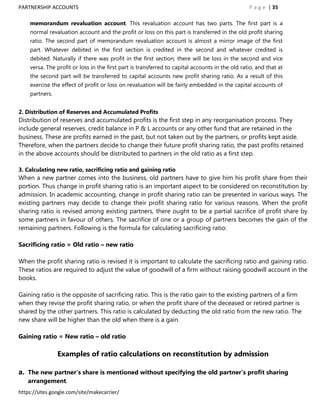
  • 2.
    PARTNERSHIP ACCOUNTS Page |2 Illustration 1.01 Abraham‟s Capital Account Date Particulars Amount Date Particulars Amount 2002 2002 By Balance b/d 30,000 Dec To Balance c/d 30,000- Jan1 31 30,000 30,000 Abraham‟s Current Account Date Particulars Amount Date Particulars Amount 2002 2002 Dec 31 To Drawings A/c 18,100 Jan 01 By Balance b/d 2,000 Dec 31 To interest on 200 drawings Dec 31 By Salary 6,000 Dec 31 By Commission 1,500 Dec 31 To balance c/d 5,000 Dec 31 By Interest on 1,800 Dec 31 capital 12,000 By Net divisible 23,300 profit 23,300 b. Fluctuating Capital Abraham‟s Capital Account Date Particulars Amount Date Particulars Amount 2002 2002 By Balance b/d * 32,000 Dec 31 To Drawings 18,100 Jan 01 To Interest on 200 Dec 31 By Salary 6,000 Capital 35,000 Dec 31 By Commission 1,500 To Balance c/d Dec 31 By Interest on 1,800 capital 12,000 53,300 By Net divisible 53,300 profit * Note: Opening balance of capital account in part (b) includes current account balance also. 2. Division of Profit among Partners Profit making and profit sharing are the main objectives of partnership business. When the partners do not have any special conditions regarding the profit distribution the task of profit sharing is a simple, one-step operation of dividing the profit in the given ratio. But in actual practice the partners are compelled to include many conditions such as interest on capital, interest on drawings, salaries, commission on profit etc. The purpose of these special conditions is to fairly compensate extra capital, https://sites.google.com/site/makecarrier/
  • 3.
    PARTNERSHIP ACCOUNTS Page |3 extra effort or similar additional factors contributing to the profitability of the firm. Thus the profit distribution becomes little more complex. A profit and loss appropriation account is prepared with full details of profit distribution. This is prepared as a supplementary account to the profit and loss account, prior to preparing the balance sheet. https://sites.google.com/site/makecarrier/ Illustration 1.02 A & B are equal partners in a firm with capitals of Rs.75,000 and Rs.50,000 on 1st January 2002. A is entitled to a salary of Rs.24,000 per annum and B is entitled to a salary of Rs.18,000 per annum. They have withdrawn 50% of their salaries during the year. A and B are entitled to commissions at the rate of 5% and 3% respectively on the net profit after salary. Net profit during the year 2002 before partner‟s salary amounted to Rs.84,000. Prepare: a. Profit and Loss Appropriation Account b. Capital Accounts of partners (assuming capitals are fluctuating) c. Capital Accounts and Current Accounts of partners (assuming capitals are fixed) Profit & Loss Appropriation A/c Particulars Amount Particulars Amount To Salary – A 24,000 By P & L Account- 84,000 profit To Salary – B 18,000 Commission to A 2,100 (42,000x5/100) Commission to B 1,260 (42,000x3/100) Net Divisible Profit 19,320 A 19,320 B 84,000 84,000 Note: when profit sharing ratio is not given in the question; it should be shared equally. a. When capital accounts are fluctuating. Capital Accounts Particulars A B Particulars A B To Cash 12,000 9,000 By Balance b/d 75,000 50,000 By Salary 24,000 18,000 To Balance c/d 108,420 79,580 By Commission 2,100 1,260 By Net Divisible 19,320 19,320 120,420 88,580 Profit 120,420 88,580 b. When capital accounts are fixed Capital Accounts Particulars A B Particulars A B https://sites.google.com/site/makecarrier/
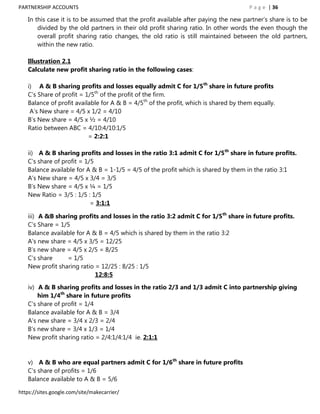
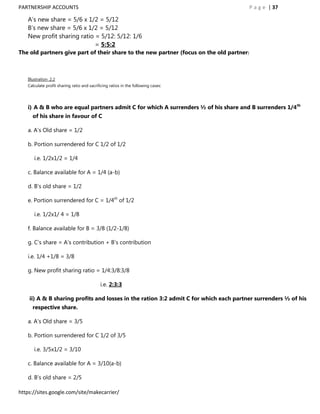
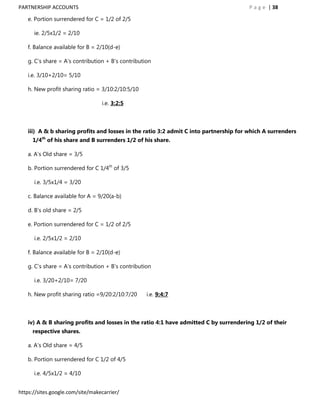
  • 4.
    PARTNERSHIP ACCOUNTS Page |4 By Balance b/d 75,000 50,000 To Balance c/d 75,000 50,000 75,000 75,000 75,000 50,000 Current Accounts Particulars A B Particulars A B To Cash 12,000 9,000 By Salary 24,000 18,000 By Commission 2,100 1,260 To Balance c/d 33,420 29,580 By Net Divisible 19,320 19,320 45,420 38,580 Profit 45,420 38,580 Illustration 1.03 A & B started business on 1st January 2001 with capitals of Rs.75,000 and Rs. 50,000 respectively. On 31st December 2001, the drawings account of A showed a debit balance of Rs.8,000 and that of B showed a debit balance of Rs.5,000. The partnership deed provided for interest on capital @6%. Interest on drawings is to be charged @3% on the closing balance of the year irrespective of the date of drawing. Their firm earned a profit of Rs.22,110 for the year 2001. Prepare profit and loss appropriation account and capital accounts of the partners. Profit & Loss Appropriation A/c Particulars Amount Particulars Amount To Interest on Cap A 4,500 By P&L account 22,110 B 3,000 By Interest on Drawings 240 A 150 B To Net Divisible Prof. A 7,500 7,500 B 22,500 22,500 Capital Accounts Particulars A B Particulars A B To Drawings 8,000 5,000 By Cash - Op 75,000 50,000 Capital To Int. on 240 150 By Interest on 4,500 3,000 drawings capital To balance c/d 78,760 55,350 By Net Divisible 7,500 7,500 Profit https://sites.google.com/site/makecarrier/
  • 5.
    PARTNERSHIP ACCOUNTS Page |5 87,000 60,500 87,000 60,500 Illustration 1.04 A & B started business with Rs.15,000 each on 1st January, 2001. A made monthly drawings of Rs.750 and B made monthly drawings of Rs.500 from the business. Their profit for the year 2001 amounted to Rs.18,000. The partners are entitled to interest on capitals @6% p.a. No interest is charged on drawings. Prepare profit and loss appropriation account and the capital accounts of partners. Profit & Loss Appropriation A/c Particulars Amount Particulars Amount To Interest on capital 900 By Profit & Loss A/c 18,000 A 900 B To Net Profit 8,100 A 8,100 B 18,000 18,000 A's Capital Account Particulars Amount Particulars Amount To Drawings 9,000 By Cash - Op Capital 15,000 By Interest on capital 900 To balance c/d 15,000 By Net profit 8,100 24,000 24,000 B's Capital Account Particulars Amount Particulars Amount To drawings 6,000 By Cash - Op Capital 15,000 By Interest on capital 900 To balance c/d 18,000 By Net profit 8,100 24,000 24,000 Illustration 1.05 A & B started business with capitals of Rs.75,000 and Rs.50,000 respectively. They have agreed to share profits and losses in the ratio 3:2. A is entitled to salary of Rs.12,000 p.a. and B is entitled to Rs.18,000 p.a. Interest at a flat rate of 5% would be charged on the drawings exceeding the amount of salary allowed. Interest on capital is allowed @ 12%. The total drawings of A amounted to Rs.20,000 and B Rs.23,000. Profit prior to partner‟s salary amounted to Rs.44,000. Prepare profit and loss appropriation account and the capital accounts of partners. Profit & Loss Appropriation A/c https://sites.google.com/site/makecarrier/
  • 6.
    PARTNERSHIP ACCOUNTS Page |6 Particulars Amount Particulars Amount To Salary – A 12,000 By P&L Account 44,000 -B 18,000 By int on drawings - A 400 To Int. on Capital – A 9,000 -B 250 -B 6,000 By Net loss transferred A - 210 B - 140 350 45,000 45,000 A's Capital Account Particulars Amount Particulars Amount To Drawings 20,000 By Cash - Op 75,000 Capital To Int on drawings 400 By Salary 12,000 To Net loss 210 By Interest on 9,000 capital To balance c/d 75,390 96,000 96,000 B's Capital Account Particulars Amount Particulars Amount To Drawings 23,000 By Cash - Op 50,000 Capital To Int on drawings 250 By Salary 18,000 To Net loss 140 By Interest on 6,000 capital To balance c/d 50,610 74,000 74,000 3. Past Adjustments 3.1. Omission of Interest on Capital / Interest on Drawings This step is almost like rectification of errors that you studied last year. Let us first consider omission of interest on capital. Interest on capital is taken out of the available net profit and distributed to partners. Thereafter the balance of net profit is distributed in the profit sharing ratio. So, when the interest on capital is omitted in the first place it means that the entire net profit is distributed. Now how do we correct it? Simple, take out the total amount required for paying interest on capital from the capital accounts of partners in the profit sharing ratio, and give it back to them as interest. What is the use of taking out from partners and give them back the same? We usually do not give back exactly what we take out. The profit sharing ratio plays a very important role here. See the next illustration. We take out the total interest divided equally from the three partners, https://sites.google.com/site/makecarrier/
  • 7.
    PARTNERSHIP ACCOUNTS Page |7 and redistribute them as interest according to capital balance. The point to notice here is, that there is no definite relationship between profit sharing ratio and capital balance. In the illustration the partners are sharing profits and losses equally even though their capitals are not equal. Illustration 1.06 A, B and C who are equal partners in a firm have capitals of Rs.30,000; Rs.30,000 and Rs.15,000 respectively. The profit for the year 2001 was distributed equally. However, interest on capital @10% was omitted. Pass a journal entry to rectify the error. Details A B C Total Interest to be 3,000 3,000 1,500 7,500 credited 2,500 2,500 2,500 7,500 The amount to be debited 500(Cr.) 500 (Cr.) 1,000(Dr) 0 (7500/3) Net adjustment Journal Entry C‟s Capital account Dr. 1,000 To A‟s Capital account 500 To B‟s Capital account 500 (Capital adjustment for rectification of omission) Illustration 1.07 A, B and C sharing profits and losses in the ratio 2:2:1 had capitals of Rs.50,000 each.. The profit for the year 2001 was distributed without providing for interest on capital @10% as agreed in the Partnership Deed. Pass a journal entry to rectify the error. Details A B C Total Interest to be 5,000 5,000 5,000 15,000 credited 6,000 6,000 3,000 15,000 The amount to be https://sites.google.com/site/makecarrier/
  • 8.
    PARTNERSHIP ACCOUNTS Page |8 debited (15000 at 2:2:1 1,000(Dr.) 1,000(Dr.) 2,000(Cr) 0 Net adjustment Journal Entry A‟s Capital Account Dr.1,000 B‟s Capital Account Dr.1,000 To C‟s Capital Account 2,000 (Capital adjustment for rectification of omission) Illustration 1.08 A, B and C have distributed their profit for the year 2001 in the ratio 2:1:1. However they left out the interest @10% on their fixed capitals of Rs.40,000, Rs,40,000 and Rs. 20,000 respectively. Pass a journal entry to rectify the omission. Details A B C Total Interest to be credited 4,000 4,000 2,000 10,000 The amount to be 5,000 2,500 2,500 10,000 debited (10,000 at 2:1:1 1,000(Dr.) 1,500(Cr.) 500(Dr) 0 Net adjustment Journal Entry A‟s Current Account Dr. 1,000 C‟s Current Account Dr. 500 To B‟s Current Account 1,500 (Adjustment for rectification of omission https://sites.google.com/site/makecarrier/
  • 9.
    PARTNERSHIP ACCOUNTS Page |9 Note: When capitals are fixed, all adjustment should be done through current account. Illustration 1.09 A, B and C have distributed their profit for the year 2001 in their profit sharing ratio 2:1:1 after crediting interest on capitals @10% instead of 8% on their fixed capitals of Rs.40,000, Rs.40,000 and Rs.20,000 respectively. Pass journal entry to rectify the error. Details A B C Total Excess interest to debit 800 800 400 2,000 (2%) 1,000 500 500 2,000 The total amount to credit (2000 at 2:2:1 200(Cr.) 300(Dr.) 100(Cr) 0 Net adjustment Journal Entry B‟s Current Account Dr.300 To A‟s Current Account 200 To C‟s Current Account 100 (Adjustment for rectification of omission) Illustration 1.10 A, B and C started business with capitals of Rs.100,000 Rs.80,000 and Rs.60,000 respectively. They agreed to share profits and losses equally. Their partnership deed provided for interest on capital @ 10%. Interest on drawings have been estimated to be Rs.250 on A, Rs.200 on B and Rs.150 on C. Interest on capital had been credited to partners at 8% instead on 10%. Interest on drawings had been completely omitted. Pass a journal entry to rectify the above errors. Details A B C Total Interest to credited +2,000 +1,600 +1,200 4,800 https://sites.google.com/site/makecarrier/
  • 10.
    PARTNERSHIP ACCOUNTS P a g e | 10 @2% -250 -200 -150 -600 Interest on Drawings -1400 -1,400 -1,400 - 4,200 Total amount reversed 350(Cr.) 350(Dr) (in profit sharing 0 ratio) Net adjustment Journal Entry C‟s Capital Account Dr. 350 A‟s Capital Account 350 (Capital adjustment for rectification) 3.2 Redistribution of Profit in a Different Ratio Illustration 1.11 A B and C have distributed their profits and losses in the ratio 3:2:1. They have decided to share profits and losses equally with effect from the last three years. The previous three years‟ profits have been Rs.21,000, Rs.18,000 and Rs. 24,000. You are required to pass a journal entry to give effect to the above arrangement. Details A B C Total Profit for the 3 years 31,500 21,000 10,500 63,000 reversed Dr. 21,000 21,000 21,000 63,000 The redistributed equally Cr. 10,500(Dr.) 0 10,500(Cr) 0 Net Adjustment Journal Entry A‟s Capital Account Dr.10,500 To C‟s Capital Account 10,500 https://sites.google.com/site/makecarrier/
  • 11.
    PARTNERSHIP ACCOUNTS P a g e | 11 (Adjustment to effect redistribution of profit) 3.3 Omission of Outstanding Expenses and Incomes Outstanding expenses and outstanding incomes have direct effect on the net profit. Outstanding expense is an expense in the first place and a liability as well. When it is omitted it means a higher profit is distributed to partners and a liability is not provided in the books. Outstanding income has the opposite effect. Rectification of these errors is a simple procedure. i) If the number of items is less, correct it by passing simple rectification entry, by debiting outstanding income, crediting outstanding expense and passing the difference into capital account. This way you are creating asset account in the books for the outstanding income, creating liability account for the outstanding expense, and transferring the net loss or gain into capital accounts. ii) When the number of items involved is more or when it is specifically asked in the question, you should open a profit and loss adjustment account. iii) P&L adjustment account can be safely assumed as a combined capital account of partners. When you want debit partner‟s capital account you can debit P&L adjustment account instead. iv) When there is an outstanding expense, we usually debit capital accounts and credit outstanding expense account. Now you debit P&L adjustment account for any outstanding expense and credit it for the outstanding income. v) The net balance of profit and loss adjustment account is transferred to the capital accounts of partners in the profit sharing ratio. Illustration 1.12 A, B and C have distributed their profit for the year ended 31st December, 2001 in their profit sharing ratio of 2:1:1. However it was found out in January, 2002 that outstanding expenses of Rs.3,500; and prepaid expenses Rs.1,500 have been left out while preparing the profit and loss account for the year 2001. You are required to rectify this error by: a) Passing Journal Entry (without Profit and Loss Adjustment Account) b) Through Profit and Loss Adjustment Account. a. Rectification without opening P&L Adjustment Account Details A B C https://sites.google.com/site/makecarrier/
  • 12.
    PARTNERSHIP ACCOUNTS P a g e | 12 Credit Outstanding Exp (Rs.3500) 1,750 875 875 and Dr.> 750 375 375 Debit Prepaid Exp (Rs.1,500) ------------------------- -------------------------- ------------------------- and Cr.> 1,000(Dr) 500(Dr.) 500(Dr.) Rectification Entry: Prepaid Expenses Account Dr. 1,500 A‟s Capital Account Dr. 1,000 B‟s Capital Account Dr. 500 C‟s Capital Account Dr. 500 To Outstanding Expenses 3500 (Rectification of omission) b. Rectification through P&L Adjustment Account Journal Entries Profit and loss adjustment account Dr. 3,500 To Outstanding Expenses 3,500 (Outstanding expenses brought into books) ------------------------------------------------------------------------------------- Prepaid expenses account Dr.1,500 To Profit and Loss Adjustment Account 1,500 (Omission of prepaid expenses brought into books) ------------------------------------------------------------------------------------- A’s Capital Account Dr. 1,000 B’s Capital Account Dr. .500 C’s Capital Account Dr. 500 To Profit and Loss Adjustment Account 2,000 https://sites.google.com/site/makecarrier/
  • 13.
    PARTNERSHIP ACCOUNTS P a g e | 13 (Net balance in account transferred) Profit and Loss Adjustment Account Particulars Amount Particulars Amount To Outstanding 3,500 By Prepaid expense 1,500 expense By Net adjustment A 1,000 B 500 2,000 C 500 3,500 3,500 Illustration 1.13 A, B and C have distributed their profit for the year ended 31st December, 2001 equally as provided in the partnership deed. However it was subsequently found out that commission received and credited in P& L account included Rs. 6,000 received in advance and interest accrued on investment Rs.4,500 are unaccounted. Pass a journal entry to give effect to the above items in the books and prepare profit and loss adjustment account. Journal Entries P&L Adjustment account Dr. 6,000 To Commission Rec‟d in Advance 6,000 (Omission of advance income rectified) -------------------------------------------------------------------------------------- Accrued Interest Account Dr. 4,500 To P& L Adjustment Account 4,500 (Omission of accrued income rectified) -------------------------------------------------------------------------------------- A‟s Capital Account Dr. 500 B‟s Capital Account Dr.500 https://sites.google.com/site/makecarrier/
  • 14.
    PARTNERSHIP ACCOUNTS P a g e | 14 C‟s Capital Account Dr.500 To P&L Adjustment Account 1,500 (Net difference transferred) Profit and Loss Adjustment Account Particulars Amount Particulars Amount To Commission 6,000 By Acc. Interest 4,500 Advance By Net adjustment A 500 B 500 1,500 C 500 6,000 6,000 4. Guarantee of Profits Sometimes partners agree to guarantee minimum profit to a partner as a special privilege. There can be many reasons for granting such a privilege. Attracting a reputed individual, who is unwilling to bear the risk of income fluctuations to become a partner, is one of such reasons. If the share of profit for such a partner falls short of the minimum amount guaranteed, the other partners will adjust that shortage form their share of profit according to the agreed conditions. If the share of profit of the partner holding guarantee privilege comes equal or more than the guaranteed sum, that actual share will be given without any adjustments. Illustration 1.14 A, B and C have agreed to share their profits and losses in the ratio 3:3:2 in which C is guaranteed a minimum profit of Rs.12,000. The divisible profit for the year 2001 amounted to Rs.42,000. Show distribution of profit. Profit & Loss Appropriation A/c Particulars Amount Particulars Amount To A's Capital By P & L 42,000 15,750 Account less adjusted to C 15,000 750 To B's Capital 15,750 less adjusted to C 15,000 https://sites.google.com/site/makecarrier/
  • 15.
    PARTNERSHIP ACCOUNTS P a g e | 15 750 To C's Capital 10,500 add share adjusted 12,000 1,500 from A & B 42,000 42,000 If the entries of deduction and subtraction seem confusing, you can directly put C's share of 12,000 in his name and divide the balance amount of 30,000 in the ratio 3:3 (equally). The next illustration is done that way. But remember when you do this way in the examination don't forget to show the steps/workings to convince the examiner that you know the concept clear. Illustration 1.15 A, B and C sharing profits and losses in the ratio of 3:2:1 in with C having a minimum guarantee of Rs.8,000. The profit available for distribution at the end of the year was found to be Rs.42,000. Show distribution of profit. Profit & Loss Appropriation A/c Particulars Amount Particulars Amount To A's Capital 20,400 By P & L Account 42,000 (34,000x3/5) To B's Capital 13,600 (34,000x2/5) To C's Capital 8,000 42,000 42,000 You can divide 42,000 in the ratio 3:2:1 and then rearrange the amount. But here we are directly crediting C's share and dividing the balance of Rs.34,000 in the ratio 3:2. Illustration 1.16 A, B and C are partners sharing profits and losses in the ratio 2:1:1, with capitals of Rs.40,000, Rs.30,000 and Rs.20,000 respectively. C‟s minimum profit after interest on capitals @6% has been guaranteed to be not less than Rs.10,000. A & B have agreed that if C‟s profit falls below the guaranteed sum such deficiency would be shared by them equally. The net profit before interest on capitals is estimated to be Rs.38,400. Prepare profit and loss appropriation account. Here you cannot adopt direct distribution as in the previous case since the partners will bear the loss equally. When you distribute balance of profit after paying the partner with guarantee, the loss is automatically gets distributed in the profit sharing ratio. If any other ratio is to be applied for sharing the loss, you must adopt 'subtraction and addition' method. Profit & Los Appropriation A/c Particulars Amount Particulars Amount To Interest on Capitals: A 2,400 By P&L Account 38,400 B 1,800 https://sites.google.com/site/makecarrier/
  • 16.
    PARTNERSHIP ACCOUNTS P a g e | 16 C 1,200 Profit to A 16,500 Less: C's Share Adj. 875 15,625 Profit share to B 8,250 Less: C's Share Adj. 875 7,375 Profit Share to C 8,250 Add: Share Adj A+B 10,000 1,750 38,400 38,400 Illustration 1.17 A, B and C are partners sharing profits and losses in the ratio 2:1:1, with capitals of Rs.40,000, Rs.30,000 and Rs.20,000 respectively. C‟s minimum profit after interest on capitals @6% has been guaranteed to be not less than Rs.10,000. A & B have agreed that if C‟s profit falls below the guaranteed sum such deficiency would be shared by them in the ratio 3:2. The net profit before interest on capitals is estimated to be Rs.38,400. Prepare profit and loss appropriation account. Profit & Los Appropriation A/c Particulars Amount Particulars Amount To Interest on Capitals: 2,400 By P&L Account 38,400 A 1,800 B 1,200 C Profit to A 16,500 Less: C's Share Adj. 15,450 1,050 Profit share to B 8,250 Less: C's Share Adj. 7,550 700 0Profit Share to C 8,250 Add: Share Adj A+B 10,000 https://sites.google.com/site/makecarrier/
  • 17.
    PARTNERSHIP ACCOUNTS P a g e | 17 1,750 38,400 38,400 Illustration 1.18 A, B and C are partners sharing profits and losses in the ratio 2:1:1, with capitals of Rs.40,000, Rs.30,000 and Rs.20,000 respectively. A has personally guaranteed that he shall bear the deficiency if C‟s share of profit after interest on capitals of partners @6% falls below Rs.10,000. The net profit before interest on capitals is estimated to be Rs.38,400. Prepare profit and loss appropriation account. Profit & Los Appropriation A/c Particulars Amount Particulars Amount To Interest on Capitals: 2,400 By P&L Account 38,400 A 1,800 B 1,200 C Profit to A 16,500 Less: C's Share Adj. 14,750 1,750 Profit share to B 8,250 0Profit Share to C 8,250 Add: Share Adj A 10,000 1,750 38,400 38,400 5. Accounting for Joint Life Policy A partner ceases to be a partner either by retirement or death. At the time of retirement or death of a partner the continuing partners, have to settle his dues. Since retirement is a pre-planned event proper arrangement for this settlement can be made. Death comes unexpectedly. The firm suffers the loss of an experienced partner and it has the added burden of settling a huge amount of capital and other dues to the deceased partner. Unlike retirement, death of a partner results in a financial emergency, as the amount due cannot be delayed for long time. Unless adequate precautions are made, this emergency can turn into deep financial crisis. (Please refer Chapter 4 – Retirement of Partners for details on Joint Life Policy) Interest on Capital Interest is allowed on partner‟s capitals only if there is a specific agreement in the partnership deed. When interest is allowed on partner‟s capital it should be calculated on the basis of period of capital investment. Suppose a https://sites.google.com/site/makecarrier/
  • 18.
    PARTNERSHIP ACCOUNTS P a g e | 18 partner makes additional investment after three months from the starting of a year, interest on this additional capital is allowed for nine months only, not for the full year. Illustration - 1.19 A & B started business on 1st January 2001, with capitals of Rs.50,000 each. A introduced additional capital of Rs.25,000 on 1st July 2001 and B introduced the same amount on 1st October 2001. Calculate interest on capital @12%, payable to A and B at the end of the year. Interest on capital - A Opening capital for 12 months (50,000 x 12%) = 6,000 On Additional Capital 6 months (25,000x 12%x6/12) = 1,500 Total interest payable to A 7,500 Interest on capital - B On opening capital for 12 months (50,000 x 12%) 6,000 On additional capital for 3 months (25,000x12%x3/12) 750 6,750 Illustration 1.20 On 1st January 2001 the capital accounts of A & B showed balances of Rs.70,000 and Rs.50,000 respectively. A introduced additional capital of Rs.50,000 on 31st March 2001 and B introduced additional capital of Rs.30,000 on 1st September, 2001. Interest on capital is allowed @ 12% p.a. Calculate interest on capital payable at the end of 2001. When interest is allowed on the net monthly balance of capital account, interest on drawings will not be charged, because the drawings becomes deduction from capital, and the interest on capital is automatically reduced. Interest on A’s Capital On Opening capital for 12 months (70,000 x 12%) = 8,400 On Additional Capital 9 months (50,000x 12%x9/12) = 4,500 Total interest payable to A 12,900 Interest on B’s Capital On opening capital for 12 months (50,000 x 12%)= 6,000 https://sites.google.com/site/makecarrier/
  • 19.
    PARTNERSHIP ACCOUNTS P a g e | 19 On additional capital for 4 months (30,000x12%x 4/12) = 1,200 7,200 Illustration 1.21: A & B started business with Rs.100,000 each on 1st January, 2001. A introduced additional capital of Rs.50,000 on 1st July and B introduced Rs.50,000 on 1st September. A withdrew Rs.12,000, drawn in 4 installments of Rs.3000 each at the end of each quarter. B withdrew Rs.1,000 per month, at the end of each month. Interest on capital is allowed on the net monthly balance of capital account @12% p.a. Calculate interest payable to A & B. In this question interest is allowed on the net monthly balance of capital. But what is this monthly balance? Is it opening balance or closing balance? The idea behind interest on net balance is to give interest on the exact amount of capital used in the business. Suppose A added 10,000 at the end of January, he is not entitled to interest on this amount in the month of January, simply because it was not used in January. We cannot frame a that interest is allowed on the opening balance or closing balance. The main point to remember here is that the interest is allowed only on the capital used. Net Monthly Balances in Capital accounts of A & B Month Interest Month Interest On on January 100,000 January 100,000 February 100,000 February 99,000 March 100,000 March 98,000 April 97,000 April 97,000 May 97,000 May 96,000 June 97,000 June 95,000 July 144,000 July 94,000 August 144,000 August 93,000 September 144,000 September 142,000 October 141,000 October 141,000 November 141,000 November 140,000 December 141,000 December 139,000 https://sites.google.com/site/makecarrier/
  • 20.
    PARTNERSHIP ACCOUNTS P a g e | 20 Total 1,446,000 Total 1,334,000 A’s Capital Account st April = 100,000-3,000 on 31 March th st July = Rs.97,000-3,000 on 30 June + 50,000 on 1 July October = 144,000 – 3000 st December 31 –3,000 has no effect on this year‟s interest B’s Capital Account September = 93,000 – 1,000 + 50,000 Interest Allowed to 1446000 x 12 %, for 1 month Rs. 14,460 A Interest Allowed to 1334,000 x 12 %, for 1 month 13,340 B Rs. Illustration 1.22. The closing balances in the capital accounts of A & B On 31st Dec. 2001 were Rs.78,000 and Rs.65,000 respectively. During the year A introduced Rs.15000 on 1st July 2001 and withdrew @ Rs.1,000 at the end of each month. B introduced additional capital of Rs.25,000 on 31st March, 2001 and withdrew Rs.7,000 on 30th June and Rs.3,000 on 30th September. Calculate interest on capital @ 6% p.a. to be credited to each partner on 31st December, 2001 based on the net monthly capitals. Read the question carefully. The capital balances given here are not the opening balances, but the closing balances of 2001, and you have the details of withdrawals during 2001. Now you must reverse to the beginning of the year and calculate the monthly balances to arrive at the correct interest on capital. Opening Capital = Closing Capital + drawings – additional capital. Opening Capital of A = 78,000 + 12,000 - 15,000 = 75,000 Opening Capital of B = 65,000 + 10,000 – 25,000 = 50,000 Net Monthly Balances in Capital Accounts of A & B A’s Capital B’s Capital Month Interest Month Interest On On https://sites.google.com/site/makecarrier/
  • 21.
    PARTNERSHIP ACCOUNTS P a g e | 21 January 75,000 January 50,000 February 74,000 February 50,000 March 73,000 March 50,000 April 72,000 April 75,000 May 71,000 May 75,000 June 70,000 June 75,000 July 84,000 July 68,000 August 83,000 August 68,000 September 82,000 September 68,000 October 81,000 October 65,000 November 80,000 November 65,000 December 79,000 December 65,000 Total 924,000 Total 774,000 Interest allowed to A = 924,000 x 6% x 1/12 = Rs. 4,620 Interest allowed to B = 774,000 x 6% x 1/12 = Rs. 3,870 Interest on Drawings Illustration 1.23 Following is the details of drawings made by A & B from their firm during the year 2001. Calculate interest on drawings @ 6% p.a. to be debited to their accounts at the end of the year. A's Drawings Rs. B's Drawings Rs. 31-1-2001 1,500 28-2-2001 1,000 31-3-2001 500 1-4-2001 1,500 1-5-2001 2,000 1-7-2001 1,000 30-9-2001 1,000 1-10-2001 1,500 31-12-2001 1,000 1-12-2001 1,000 https://sites.google.com/site/makecarrier/
  • 22.
    PARTNERSHIP ACCOUNTS P a g e | 22 6,000 6,000 This question clearly shows the effect of period of drawing on the amount of interest charged. See that both these partners have withdrawn the same amount during the year 2001. But the interests charged are different, because of difference in period of drawing. Interest on A’s drawings Interest on B’s drawings Amount Period Equivalent Amount Period Equivalent Withdrawn till end 1 month Withdrawn till end 1 month 1,500 11 16,500 1,000 10 10,000 500 9 4,500 1,500 9 13,500 2,000 8 16,000 1,000 6 6,000 1,000 3 3,000 1,500 3 4,500 1,000 0 0 1,000 1 1,000 6,000 40,000 6,000 35,000 Interest on A’s drawings = 40,000 x 6% x 1/12 = Rs. 200 Interest on B’s drawings = 35,000 x 6% x 1/12 = Rs. 175 Illustration 1.24 The closing balances in the drawings accounts of A, B and C show Rs.12,000 each on 31st December, 2001. They withdrew this amount in monthly installments of Rs.1,000. A‟s drawings were made at the beginning of each month, B on 15th and C at the end of each month. Calculate interest on drawings @6% p.a. to be debited to them on 31st December 2001. Interest on A‟s Drawings = 12,000 x 6% x 6.5/12 = Rs.390 https://sites.google.com/site/makecarrier/
  • 23.
    PARTNERSHIP ACCOUNTS P a g e | 23 Interest on B‟s Drawings = 12,000 x 6% x 6/12 = Rs.360 Interest on C‟s Drawings = 12,000 x 6% x 5.5 /12 = Rs.330 Commission to Partners Commission is allowed to a partner for his service if all partners agree to such a payment. Again, in the absence of a specific condition in the partnership deed, a partner is not entitled to any salary or commission for his service rendered to the firm. When commission is allowed it may be stated as „payable on the profit before charging commission‟ or „payable on the profit after charging commission‟. If commission is payable on the profit before charging commission, it simply means that the commission is to be calculated at the given percent on the given amount of profit. But if it is a certain percentage after charging such commission, the amount of commission should be exactly the percentage specified on the balance of profit after deducting such commission, not the total amount. The following illustration will clarify the point. The idea of commission on the net profit „before charging such commission‟ and „after charging commission‟ sounds confusing „Butler English‟. But read it very carefully. This „before charging‟ condition is exactly what we all normally understand. If the profit is 100 and 10% commission is allowed it simply means the commission is Rs.10 and the balance of profit available is Rs.90. The trouble hare is to take out 10% of the profit left after taking out such commission. Does this sound confusing again? In the above example Rs.10 is not 10% of the balance of profit of Rs.90. This is the problem. Now how to solve it? Remember that the commission is 10% of the balance of profit, which means if the balance is 100 then commission is 10. In other words it is not to be calculated as 10 out of 100 but as 10 out of 110. Study carefully how B‟s commission is calculated in illustration 1.25 Illustration 1.25 A & B are equal partners in a firm. Their partnership deed provided for commission to A @5% of the net profit before charging any commission. B is entitled to 5% commission on the profit after charging all commissions. Net profit before any such commission was Rs.42,000. Calculate commissions and profit share of each partner. Commission payable of to A = 5% of 42,000 ie. Rs.2,100. Commission payable to B = 5% of the N/P after all commissions. Net profit available after charging A‟s commission = Rs.39,900 (42,000 – 2,100) Which is B‟s commission + „N/P after all commissions‟ Now B‟s commission is to be 5% of the balance after deducting B‟s commission. If B‟s commission is Rs.5, the balance available should be Rs.100 Which means the total should be 105. https://sites.google.com/site/makecarrier/
  • 24.
    PARTNERSHIP ACCOUNTS P a g e | 24 Again, if the total available is 105, B will get a commission of 5 and the balance of Rs.100 will remain. ie. for every 105, B will get a commission of Rs.5. Therefore B‟s commission is Rs.39,900 x 5/105 = Rs.1,900 Notice that the balance available is Rs.38,000 and B‟s commission of Rs.1,900 is exactly 5% of Rs.38,000. Calculation of Capital Ratio Capital ratio should be understood as investment ratio. Money is considered an important working factor in the business. When the capital contribution of a partner is higher, it also means that his money worked more in making the profit. In calculating the capital ratio the amount and the period of investment are to be considered. Suppose A contributes 10,000 in January and B contributes the same amount on 1st July, A's capital has worked double that of B due to earlier investment, even though both the amounts are the same at the end of the year. Therefore, capital ratio should be based on the amount of capital multiplied by the number of months the investment remained with the firm. Illustration 1.26 A started business on 1st January 2001, with a capital investment of Rs.50,000. B joined on 1st May with a capital contribution of Rs.75,000 and C joined with 1st July with Rs.50,000 as capital. They made a profit of Rs.25,000 in the first year. Distribute profit in the capital ratio. Date & Amount Months Effective Amount for which money was used A on 1st Jan 12 600,000 Rs.50,000 B on 1st may 8 600,000 Rs.75,000 C on Ist July 6 300,000 Rs.50,000 Capital Ratio between A, B & C = 600000:600000:300000 ie. 2:2:1 Illustration 1.27 https://sites.google.com/site/makecarrier/
  • 25.
    PARTNERSHIP ACCOUNTS P a g e | 25 A & B started business on 1st January 2001. They have decided to share profits and losses in the capital ratio. Calculate their capital ratio form the following details A's Capital Account Particulars Amount Particulars Amount Mar 1 To Cash – 9,000 Jan 1 By Cash 65,000 Drawing.. Oct 1 To Cash – 10,000 Jul 1 By Cash..addl. Cap. 40,000 Drawing. Dec 31 To bal c/d 86,000 105,000 105,000 B's Capital Account Date Particulars Amount Date Particulars Amount Jan 1 By Cash 50,000 Apr 1 To Cash – Drwng. 19,500 Oct 1 To Cash – Drwng. 5,500 Jul 1 By Cash.. addl. Cap. 25,000 Sept 1 By Cash – addl. Cap. 10,500 Dec 31 To bal c/d 60,500 85,500 85,500 This question is worked out twice. The first answer is based on the capital balances multiplied by the number of months for which such balances are maintained. Even though this method looks very simple, you may make mistake in calculating the number of months for which the capital balances are maintained as there are no definite sequence or order followed in the question. Most of the books follow the first method. I suggest the second; because there is very little chance of mistake this way. Remember that the date of introduction or withdrawal is important. Capital for a month means capital available for use in that month. If capital is withdrawn at the beginning of a month, it means that the remaining balance only is available for that month. But if the capital is withdrawn at the end of the month that withdrawal has no effect on the capital for that month. Answer (i) for Q.1.27 https://sites.google.com/site/makecarrier/
  • 26.
    PARTNERSHIP ACCOUNTS P a g e | 26 A's Capital Date & Amount Actual Months Effective Balance Amount Jan 1 Op Cpital + 65,000 2 130,000 65,000 Mar Drawing - 56,000 4 224,000 1 9,000 Jul 1 Addl Cap + 96,000 3 288,000 40,000 Nov Drawings - 86,000 3 258,000 1 10,000 900,000 B's Capital Date & Amount Actual Months Effective Balance Amount Jan 1 Op Cpital + 50,000 50,000 3 150,000 Apr 1 Drawing - 19,500 30,500 3 91,500 Jul 1 Addl Cap + 25,000 55,500 2 111,000 Sept1 Addl Cap + 10,500 66,000 1 66,000 Nov 1 Drawings - 5,500 60,500 3 181,500 600,000 Capital Ratio = 900:600 = 3:2 Answer (ii) for Q.1.27 https://sites.google.com/site/makecarrier/
  • 27.
    PARTNERSHIP ACCOUNTS P a g e | 27 Bal.- A Bal – B Month Jan 65,000 50,000 Feb 65,000 50,000 Mar 56,000 50,000 Apr 56,000 30,500 May 56,000 30,500 Jun 56,000 30,500 Jul 96,000 55,500 Aug 96,000 55,500 Sep 96,000 66,000 Oct 86,000 60,500 Nov 86,000 60,500 Dec 86,000 60,500 900,000 600,000 Total Illustration 1.28 The capital accounts of A & B on 31 December 2007 show balances of Rs.48,750 and Rs.56,000. The capital accounts for the year 2007 are given below. Calculate capital ratio (ratio in which their money was used in business). Particulars A B Particulars A B Feb 1 To Cash 12,500 --- Jan 1 - By Cash 50,000 25,000 Mar 1 To Cash --- 14,000 Apr 1 By Cash - 30,000 Jul 1 To Cash 8,750 --- Sept By Cash 30,000 25,000 1 Oct 1 To Cash 10,000 10,000 Dec To bal c/d 48,750 56,000 https://sites.google.com/site/makecarrier/
  • 28.
    PARTNERSHIP ACCOUNTS P a g e | 28 31 80,000 80,000 80,000 80,000 Month Bal.- A Bal – B Jan 50,000 25,000 Feb 37,500 25,000 Mar 37,500 11,000 Apr 37,500 41,000 May 37,500 41,000 Jun 37,500 41,000 Jul 28,750 41,000 Aug 28,750 41,000 Sep 58,750 66,000 Oct 48,750 56,000 Nov 48,750 56,000 Dec 48,750 56,000 Total 500,000 500,000 Capital Ratio = 1:1 Manager Admitted as a Partner Illustration 1.29 A & B sharing profits and losses equally have decided to admit their manager C as a new partner. They have agreed to give him 1/5th share in future profits as well as the profits for the previous three years. His salary for the last three years is to be adjusted against his profit share. The profits for the last three years were Rs.76,000; Rs.83,000 and Rs.81,000 and his salary was Rs.1,500 p.m. Recalculate the profit distribution and pass a journal entry to adjust the same in accounts. https://sites.google.com/site/makecarrier/
  • 29.
    PARTNERSHIP ACCOUNTS P a g e | 29 Total Profit for the last three 240,000 years Salary to Manager for three 54,000 years Total Profit for redistribution 294,000 Details A B C Profit distributed taken 120,000 120,000 back (Dr.) 54,000 Salary paid to C taken back (Dr.) 117,600 117,600 58,800 Profit redistribution in new ratio (Cr.) (294,000 in 2:2:1) Amount to readjust 2,400(Dr) 2,400(Dr) 4,800 (Cr). Journal entry A‟s Capital Account Dr .2 400 B‟s Capital Account Dr. 2,400 To C‟s Capital Account 4,800 (Profit readjustment) Illustration 1.30 A & B sharing profits and losses in the ratio 2:1, have decided to admit their manager C as a partner, giving him 1/4th share in profits with retrospective effect for the past three years. His salary during this period is to be adjusted against his profit share. The profit for the last three years have been Rs.48,000; Rs.43,000 and Rs.44,000. His salary was Rs.1,200 p.m. https://sites.google.com/site/makecarrier/
  • 30.
    PARTNERSHIP ACCOUNTS P a g e | 30 Recalculate the profit distribution and pass a journal entry to give effect to the same in accounts. Total Profit for the last three 135,000 years 43,200 Salary to Manager for three years Total Profit for redistribution 178,200 Details A B C Profit distributed taken 90,000 45,000 0 out Dr 43,200 Salary Paid to C Dr. 89,100 44,550 44,550 Total Amount Redistributed in the Cr. (178,200 at 2:2:1) Net Adjustment 900 450 (Dr.) 1,350(Cr.) (Dr.) Journal entry A‟s Capital Account Dr .900 B‟s Capital Account Dr. 450 To C‟s Capital Account 1,350 (Profit readjustment) https://sites.google.com/site/makecarrier/
  • 31.
    PARTNERSHIP ACCOUNTS P a g e | 31 Illustration 1.31 A & B are partners sharing profits and losses in the ratio 2:1. On 31st December,2001 they have decided to take C, their manager as partner for 1/4th share with retrospective effect from 1st January 1999. As manager he had been paid annual salary of Rs.18,000, which is reduced to annual salary of Rs.6,000 as partner. He had advanced a loan of Rs.50,000 to the firm at 10% interest which is converted as his capital carrying interest @6% per annum. Profits and losses for the last three years are as follows: 1999 Rs. 54,000 2000 Rs.19,000 2001 Rs.47,000 Recalculate the profit distribution and pass adjustment entry to give effect to the same. 120,000 Total Profit for the last three years 36,000 Excess Salary to Manager 6,000 (12000x3) Excess interest paid to C Total Profit for redistribution 162,000 Details A B C Profit redistribution in new ratio +81,000 +40,500 +40,500 (Cr.) - (162000 at 2:1:1) -80,000 -40,000 Profit already distributed (120000at - - -36,000 2:1) (Dr.) - 6,000 Excess Salary given to C (12000x3) (Dr.) Excess Interest given to C (Dr.) Amount to readjust 1,000(Cr) 500(Cr) 1,500 (Dr) Journal Entry https://sites.google.com/site/makecarrier/
  • 32.
    PARTNERSHIP ACCOUNTS P a g e | 32 C‟s Capital Account Dr.1,500 To A‟s Capital Account 1,000 To B‟s Capital Account 500 (Profit readjustment) Calculation of Capital Contribution Illustration 1.32 A & B sharing profits and losses equally have agreed to admit C as a partner for 1/4th share from 1st January, 2002 who agreed to pay proportionate share of the total capital of the firm after necessary adjustments and appropriations at the end of the year 2001. The capital accounts of A & B on 1stJanuary 2001 stood at Rs.40,000 and Rs.30,000 respectively. Drawings during the year 2001 amounted to Rs.3,000 by A and Rs.4,000 by B. Calculate the capital to be invested by C. C‟s Share is ¼ of the total Capital of the firm. Therefore, combined capital of A& B is 3/4th of the total capital. Net Capital of A (40,000-3000) 37,000 Net Capital of B (30,000-4000) 26,000 Total capital of A & B 63,000 Ie. 3/4th of the total capital = 63,000 Total capital = 63000 *4/3 = 84,000 C’s Capital = 21,000 https://sites.google.com/site/makecarrier/
  • 33.
    PARTNERSHIP ACCOUNTS P a g e | 33 Chapter:2 Reconstitution Of Partnership (Changing Ratio or Admission of a New Partner) A partnership business may undergo several structural changes during its lifetime. New partners may join or existing ones may leave the business. While making such major changes in the structure of business, partners carefully evaluate their accounts. They have to reset the system on a correct starting point. They check the values of assets and liabilities appearing in the books. If there are discrepancies they have to be rectified before introducing a major change. Reconstitution of a partnership business can take place under the following situations: Admission of a new partner Changing profit sharing ratio among existing partners Retirement / death of a partner Amalgamation of two partnership firms The most important accounting adjustment is resetting of old accounts. It is a common adjustment in all cases of reconstitution. In this chapter you will find reconstitution by admission and reconstitution by changing ratios. Reconstitution by admission is more important on examination point of view. The following are the common adjustments at the time of reconstitution of a partnership business. 1. Revaluation of assets and liabilities 2. Distribution of reserves and accumulated profits 3. Calculation of new ratio, sacrificing ratio and gaining ratio 4. Treatment of goodwill 5. Readjustment of capital accounts 1. Revaluation of Assets and Liabilities Assets and liabilities are often shown in the accounts at their historical value rather than realisable value. Due to conservatism the partners usually do not revise the values of assets even when their actual market values are much higher than book values. Similarly inadequate depreciation, change in technology etc. make the book values of certain assets more than their realisable value. It is not practical for the partners to keep on changing the book values of their assets every time there is a change in their market values. The difference between book value and market value is not a problem as long as the partnership business goes on normally. But when they change the structure of the partnership in the form of revision in profit sharing ratio, admission of a new partner, retirement or death of a partner, amalgamation of two partnership firms or absorption of a firm by another, the values of assets and liabilities are to be reassessed and difference if any, should be https://sites.google.com/site/makecarrier/
  • 34.
    PARTNERSHIP ACCOUNTS P a g e | 34 accounted. What is the purpose of revaluation? When the realisable value of asset or liability is different from the book value there is a profit or loss hidden in the difference in value. The partners should distribute all the profits and losses in the existing profit sharing ratio before changing the ratio. If the ratio remains unchanged there is practically no use in estimating the hidden profit or loss. However, if this profit or loss is not distributed prior to changing profit sharing ratio some partners will lose and others gain due to the change in ratio. For example: A&B, who were equal partners purchased land for Rs.10,000 in Jan 1975. They decided to share profits and losses in the ratio 2:1 from 1st January 2001. The actual market value of land on 1st January was Rs.70,000; whereas the book value remains at the purchase price of Rs.10,000. There is a hidden profit of Rs.60,000 in the value of land which A & B are entitled to share equally. Suppose they just ignored this factor and changed the profit sharing ratio to 2:1 and sold the land for Rs.70,000 next day, the profit on sale of land Rs.60,000 will go to A and B in the new ratio 2:1, which means A will get 40,000 and B will get only 20,000. In other words Rs.10,000 belonging to B will go to A. Vice versa can happen in case of a hidden loss. To prevent such problems the partners revalue the assets and liabilities and transfer the profit or loss into their capital accounts in the existing ratio before making a change. Revaluation Account When the value of one asset is to be increased in the books it can be easily done by debiting the asset and crediting the profit to partners‟ capital accounts in the profit sharing ratio. But when there is a major shake up, values of almost every asset and liability have to be revised. Distributing each change to the partners would be a lengthily process. For the sake of convenience, all those profits and losses on change in values of assets and liabilities are brought into a temporary account called „revaluation account‟. The revaluation account summarises the effect of revaluation of assets and liabilities. Revaluation account is a special profit & loss account representing the combined capital accounts of partners. Any gain on revaluation of asset or liability, to be credited to partners, will be credited in the revaluation account. Similarly any loss on revaluation will be debited in revaluation account instead of debiting the capital accounts. The final balance in revaluation account indicates the profit or loss on the entire revaluation process. The revaluation account is closed by transferring this profit or loss to partner‟s capital accounts in the ratio before revision (old profit sharing ratio). All assets and liabilities will appear at their revised values in the books and in all future balance sheets. When the partners want to adjust the profit or loss on revaluation process without actually changing the values of assets and liabilities in the books they can do so by opening a https://sites.google.com/site/makecarrier/
  • 35.
    PARTNERSHIP ACCOUNTS P a g e | 35 memorandum revaluation account. This revaluation account has two parts. The first part is a normal revaluation account and the profit or loss on this part is transferred in the old profit sharing ratio. The second part of memorandum revaluation account is almost a mirror image of the first part. Whatever debited in the first section is credited in the second and whatever credited is debited. Naturally if there was profit in the first section, there will be loss in the second and vice versa. The profit or loss in the first part is transferred to capital accounts in the old ratio, and that at the second part will be transferred to capital accounts new profit sharing ratio. As a result of this exercise the effect of profit or loss on revaluation will be fairly embedded in the capital accounts of partners. 2. Distribution of Reserves and Accumulated Profits Distribution of reserves and accumulated profits is the first step in any reorganisation process. They include general reserves, credit balance in P & L accounts or any other fund that are retained in the business. These are profits earned in the past, but not taken out by the partners, or profits kept aside. Therefore, when the partners decide to change their future profit sharing ratio, the past profits retained in the above accounts should be distributed to partners in the old ratio as a first step. 3. Calculating new ratio, sacrificing ratio and gaining ratio When a new partner comes into the business, old partners have to give him his profit share from their portion. Thus change in profit sharing ratio is an important aspect to be considered on reconstitution by admission. In academic accounting, change in profit sharing ratio can be presented in various ways. The existing partners may decide to change their profit sharing ratio for various reasons. When the profit sharing ratio is revised among existing partners, there ought to be a partial sacrifice of profit share by some partners in favour of others. The sacrifice of one or a group of partners becomes the gain of the remaining partners. Following is the formula for calculating sacrificing ratio: Sacrificing ratio = Old ratio – new ratio When the profit sharing ratio is revised it is important to calculate the sacrificing ratio and gaining ratio. These ratios are required to adjust the value of goodwill of a firm without raising goodwill account in the books. Gaining ratio is the opposite of sacrificing ratio. This is the ratio gain to the existing partners of a firm when they revise the profit sharing ratio, or when the profit share of the deceased or retired partner is shared by the other partners. This ratio is calculated by deducting the old ratio from the new ratio. The new share will be higher than the old when there is a gain. Gaining ratio = New ratio – old ratio Examples of ratio calculations on reconstitution by admission a. The new partner’s share is mentioned without specifying the old partner’s profit sharing arrangement. https://sites.google.com/site/makecarrier/
  • 36.
    PARTNERSHIP ACCOUNTS P a g e | 36 In this case it is to be assumed that the profit available after paying the new partner‟s share is to be divided by the old partners in their old profit sharing ratio. In other words the even though the overall profit sharing ratio changes, the old ratio is still maintained between the old partners, within the new ratio. Illustration 2.1 Calculate new profit sharing ratio in the following cases: i) A & B sharing profits and losses equally admit C for 1/5th share in future profits C‟s Share of profit = 1/5th of the profit of the firm. Balance of profit available for A & B = 4/5th of the profit, which is shared by them equally. A‟s New share = 4/5 x 1/2 = 4/10 B‟s New share = 4/5 x ½ = 4/10 Ratio between ABC = 4/10:4/10:1/5 = 2:2:1 ii) A & B sharing profits and losses in the ratio 3:1 admit C for 1/5th share in future profits. C‟s share of profit = 1/5 Balance available for A & B = 1-1/5 = 4/5 of the profit which is shared by them in the ratio 3:1 A‟s New share = 4/5 x 3/4 = 3/5 B‟s New share = 4/5 x ¼ = 1/5 New Ratio = 3/5 : 1/5 : 1/5 = 3:1:1 iii) A &B sharing profits and losses in the ratio 3:2 admit C for 1/5th share in future profits. C‟s Share = 1/5 Balance available for A & B = 4/5 which is shared by them in the ratio 3:2 A‟s new share = 4/5 x 3/5 = 12/25 B‟s new share = 4/5 x 2/5 = 8/25 C‟s share = 1/5 New profit sharing ratio = 12/25 : 8/25 : 1/5 12:8:5 iv) A & B sharing profits and losses in the ratio 2/3 and 1/3 admit C into partnership giving him 1/4th share in future profits C‟s share of profit = 1/4 Balance available for A & B = 3/4 A‟s new share = 3/4 x 2/3 = 2/4 B‟s new share = 3/4 x 1/3 = 1/4 New profit sharing ratio = 2/4:1/4:1/4 ie. 2:1:1 v) A & B who are equal partners admit C for 1/6th share in future profits C‟s share of profits = 1/6 Balance available to A & B = 5/6 https://sites.google.com/site/makecarrier/
  • 37.
    PARTNERSHIP ACCOUNTS P a g e | 37 A‟s new share = 5/6 x 1/2 = 5/12 B‟s new share = 5/6 x 1/2 = 5/12 New profit sharing ratio = 5/12: 5/12: 1/6 = 5:5:2 The old partners give part of their share to the new partner (focus on the old partner) Illustration .2.2 Calculate profit sharing ratio and sacrificing ratios in the following cases: i) A & B who are equal partners admit C for which A surrenders ½ of his share and B surrenders 1/4 th of his share in favour of C a. A‟s Old share = 1/2 b. Portion surrendered for C 1/2 of 1/2 i.e. 1/2x1/2 = 1/4 c. Balance available for A = 1/4 (a-b) d. B‟s old share = 1/2 e. Portion surrendered for C = 1/4th of 1/2 i.e. 1/2x1/ 4 = 1/8 f. Balance available for B = 3/8 (1/2-1/8) g. C‟s share = A‟s contribution + B‟s contribution i.e. 1/4 +1/8 = 3/8 g. New profit sharing ratio = 1/4:3/8:3/8 i.e. 2:3:3 ii) A & B sharing profits and losses in the ration 3:2 admit C for which each partner surrenders ½ of his respective share. a. A‟s Old share = 3/5 b. Portion surrendered for C 1/2 of 3/5 i.e. 3/5x1/2 = 3/10 c. Balance available for A = 3/10(a-b) d. B‟s old share = 2/5 https://sites.google.com/site/makecarrier/
  • 38.
    PARTNERSHIP ACCOUNTS P a g e | 38 e. Portion surrendered for C = 1/2 of 2/5 ie. 2/5x1/2 = 2/10 f. Balance available for B = 2/10(d-e) g. C‟s share = A‟s contribution + B‟s contribution i.e. 3/10+2/10= 5/10 h. New profit sharing ratio = 3/10:2/10:5/10 i.e. 3:2:5 iii) A & b sharing profits and losses in the ratio 3:2 admit C into partnership for which A surrenders 1/4th of his share and B surrenders 1/2 of his share. a. A‟s Old share = 3/5 b. Portion surrendered for C 1/4th of 3/5 i.e. 3/5x1/4 = 3/20 c. Balance available for A = 9/20(a-b) d. B‟s old share = 2/5 e. Portion surrendered for C = 1/2 of 2/5 i.e. 2/5x1/2 = 2/10 f. Balance available for B = 2/10(d-e) g. C‟s share = A‟s contribution + B‟s contribution i.e. 3/20+2/10= 7/20 h. New profit sharing ratio =9/20:2/10:7/20 i.e. 9:4:7 iv) A & B sharing profits and losses in the ratio 4:1 have admitted C by surrendering 1/2 of their respective shares. a. A‟s Old share = 4/5 b. Portion surrendered for C 1/2 of 4/5 i.e. 4/5x1/2 = 4/10 https://sites.google.com/site/makecarrier/
  • 39.
    PARTNERSHIP ACCOUNTS P a g e | 39 c. Balance available for A = 4/10(a-b) d. B‟s old share = 1/5 e. Portion surrendered for C = 1/2 of 1/5 i.e. 1/5x1/2 = 1/10 f. Balance available for B = 1/10(d-e) g. C‟s share = A‟s contribution + B‟s contribution i.e. 4/10+1/10= 5/10 h. New profit sharing ratio = 4/10:1/10:5/10 i.e. 4:1:5 The new partner acquires his share from old partners (focus on the new partner’s share) Illustration.2.3 Calculate sacrificing ratio and new profit sharing ratio in the following cases: i) A & B sharing profits and losses equally admit C into partnership for 1/3rd share in future profits, which 2/3rd is acquired from A and 1/3rd is acquired from B a. C‟s share = 1/3rd of future profits b. A‟s contribution (sacrifice) = 2/3rd of 1/3rd i.e. 2/3 x 1/3 = 2/9 c. Balance available for A = A‟s old share – A‟s sacrifice i.e. 1/2 – 2/9 = 5/18 d. B‟s contribution =1/3rd of 1/3rd i.e. 1/3 x 1/3 = 1/9 e. Balance available for B = B‟s old share – B‟s Contribution i.e. 1/2 – 1/9 = 7/18 C‟s share = 2/9 +1/9 = 3/9 f. New profit sharing ratio = 5/18 : 7/18 : 6/18 i.e. 5:7:6 g. Sacrificing Ratio = 2/9 : 1/9 ie.2:1 ii) A & B sharing profits and losses in the ratio 2:1 admit C as a new partner. C acquired 1/18th from and 1/9 from B a. A‟s contribution (sacrifice) to C = 1/18 of the total profit b. Balance available for A = A‟s old share – A‟s contribution / sacrifice i.e. 2/3 – 1/18 = 11/18 c. B‟s contribution =1/9 d. Balance available for B = B‟s old share – B‟s Contribution i.e. 1/3 – 1/9 = 2/9 https://sites.google.com/site/makecarrier/
  • 40.
    PARTNERSHIP ACCOUNTS P a g e | 40 e. C‟s share = 1/18 +1/9 = 3/18 f. New profit sharing ratio = 5/18 : 7/18 : 6/18 i.e. 11:4:3 g. Sacrificing ratio = 1/18:1/9 i.e.1:2 iii) A & B sharing profits and losses in the ratio 3:2 admit C for 1/4th share which is acquired equally A and B A‟s Contribution (sacrifice) to C = ½ of ¼ =1/8 B‟s Contribution (sacrifice) to C = ½ of ¼ = 1/8 A‟s new share = 3/5 –1/8 = 19/40 B‟s new share = 2/5 –1/8 = 11/40 New ratio = 19/40:11/40:10/40 Sacrificing ratio = 1/8 :1/8 ie. 1:1 iv) A & B sharing profits in the ratio 3:1 admit C for 1/5th share in future profits. C acquires 7/8th of share from a and 1/8th from B A‟s contribution to C = 7/8th of 1/5 ie. 7/40 B‟s Contribution to C = 1/8th of 1/5 ie. 1/40 A‟s new share = 3/4-7/40 = 23/40 B's new share = 1/4 – 1/40 = 9/40 C‟s share = 7/40+1/40 =8/40 New ratio = 23:9:8 Sacrificing ratio 7:1 v) A & B who are equal partners admit C for 1/3rd share in future profits. C acquired 1/3rd of his sh from A and 2/3rd of his share form B. A‟s sacrifice 1/3rd of 1/3rd = 1/9 B‟s sacrifice 2/3rd of 1/3rd = 2/9 A‟s new share = 1/2 – 1/9 = 7/18 B‟s new share = 1/2 – 2/9 = 5/18 C‟s share = 1/9+2/9 = 6/18 New ratio = 7:5:6 The entire sacrifice is made by one partner Illustration.2.4 Calculate new profit sharing ratio in the following cases: i) A & B sharing profits and losses equally admit C for 1/4th share. B has made the entire sacrifice for C‟s share of profit. B‟s new share = 1/2 – 1/4 = 1/4 New profit sharing ratio = 1/2:1/4:1/4 ii) A & B sharing profits and losses in the ratio 3:2 admit C for 1/5th share in future profit which is fully contributed by A. https://sites.google.com/site/makecarrier/
  • 41.
    PARTNERSHIP ACCOUNTS P a g e | 41 A‟s contribution = 1/5 A‟s new share = 3/5 –1/5 = 2/5 New profit sharing ratio = 2/5:2/5:1/5 iii) A & B who are equal partners admit C into partnership. B has contributed ½ of his share in favour of C New profit sharing ratio = 2:1:1 iv) A & B who are sharing profits and losses in the ratio 3:1 admit c by contributing ½ of A‟s share in favour of C. A‟s contribution for C = ½ of ¾ = 3/8 New profit sharing ratio = 3/8 : 1/4: 3/8 = 3:2:3 v) A & B sharing profits and losses in the ratio 2:1 admit C by contributing 1/3rd portion of A‟s share of profits. A‟s contribution (C‟s share) = 1/3rd of 2/3rd = 2/9 A‟s new share = 2/3 – 2/9 = 4/9 New profit sharing ratio = 4:3:2 c. An entirely new profit sharing ratio is given Illustration.2.5: Calculate sacrificing ratio in the following cases i) A & B sharing profits and losses equally admit C into partnership and decide to share future profits and losses in the ratio 3:2:2 A‟s sacrifice = 1/2 – 3/7 =7/14 - 6/14 = 1/14 B‟s sacrifice = 1/2 –2/7 = 7/14 – 4/14 = 3/14 Sacrificing ratio = 1:3 ii) A & B sharing profits and losses in the ratio 3:1 admit C and decide to share future profits and losses in the ratio 3:2:4 A‟s sacrifice = 3/4 - 3/9 = 27/36 – 12/36 = 15/36 B‟s sacrifice = 1/4 – 2/9 = 9/36 – 8/36 = 1/36 Sacrificing ratio = 15:1 iii) A & B sharing profits and losses in the ratio 3:2 admit C and change their profit sharing as 3:2:3. A‟s sacrifice = 3/5-3/8 = 24/40-15/40 = 9/40 B‟s sacrifice = 2/5 – 2/8 = 16/40 – 10/40 = 6/40 Sacrificing ratio = 9:6 ie.3:2 iv) A &B having equal partnership admit C and change their profit sharing as 4:3:2 A‟s sacrifice = 1/2 - 4/9 = 9/18 – 8/18 = 1/18 B‟s sacrifice = 1/2 – 3/9 = 9/18 – 6/18 = 3/18 Sacrificing ratio = 1:3 v) A & B sharing profits and losses in the ratio 4:3 admit C and decide to share future profits and losses equally. https://sites.google.com/site/makecarrier/
  • 42.
    PARTNERSHIP ACCOUNTS P a g e | 42 A‟s sacrifice = 4/7 – 1/3 = 12/21 – 7/21 = 5/21 B‟s sacrifice = 3/7 – 1/3 = 9/21 – 7/21 = 2/21 Sacrificing ratio = 5:2 At the time of reconstitution by admission, the old partners generally sacrifice for the new partner. In other words, new partner is the gaining partner and the old partners are the sacrificing partners. However when the partners restructure the entire profit sharing arrangement even some of the old partners could turn out to be gaining partners. When reconstitution takes place by changing ratio among existing partners (without any admission or retirement) sacrifice by one or more partners will match with the gain of other partners. Calculation of sacrifice and gain are significant for several other adjustments on reconstitution. What about a situation where there is sacrifice as well as gain. If you simply apply the formula without knowing what exactly is sacrifice or gain there will be lot of confusion while working out the problems. In many cases your common sense is more useful than the text book principles. For example if you find the new share of a partner is less than his old share for whatever reason, it is called SACRIFICE and if the new share is higher than the old it is called GAIN. Now you decide how to find out sacrificing ratio or gaining ratio. Shortcut to calculate sacrificing ratio and gaining ratio When there is a revision of profit sharing ratio by existing partners, there will be sacrifice as well as gain within the same partnership. Therefore it is easier to stick to one formula. Take the result of new ratio minus old ratio. If the result is negative it is sacrifice; and positive it is gain. Notice the steps once again: a. Write the new ratio in the first line (because I like to see sacrifice as negative and gain as positive number) b. Write the old ratio in the second line (remember to adjust the ratios to add up to the a convenient total) c. Deduct the old from new d. Negatives result indicates sacrifice; positive result indicates gain a. Old and new ratios are given Illustration 2.06 A,B,C and D sharing profits and losses in the ratio 4:3:2:1 have decided to share future profits and losses in the ratio 2:1:1:1. Find out the sacrifice or gain in the arrangement. (Note: When you have to compare two different ratios, it will be easier if both add up to the same total) A B C D Total New Ratio(adjusted out of 10) 4 2 2 2 10 Old Ratio 4 3 2 1 10 (Sac) /Gain 0 -1 0 1 B‟s Sacrifice 1/10; A‟s Gain 1/10 https://sites.google.com/site/makecarrier/
  • 43.
    PARTNERSHIP ACCOUNTS P a g e | 43 Illustration 2.07 A, B, C and D sharing profits and losses in the ratio 3:3:2:2 have decided to share future profits and losses in the ratio 4:3:2:1. Find out the sacrifice or gain in the arrangement. A B C D Total New Ratio(revised to add up to 10) 4 3 2 1 10 Old Ratio 3 3 2 2 10 Sac /Gain 1 0 0 -1 A‟s Gain 1/10; D‟s Sacrifice 1/10 Illustration 2.08 A, B, C and D sharing profits and losses in the ratio 2:1:1:1 have decided to share future profits and losses in the ratio 3:3:3:1. Find out the sacrifice or gain in the arrangement. A B C D Total New Ratio 3 3 3 1 10 Old Ratio(converted to add up to 3 3 2 2 10 10) Sac /Gain 0 0 1 -1 C‟s gain 1/10; D‟s sacrifice 1/10 Illustration 2.09 A, B, C and D sharing profits and losses in the ratio 2:1:2:1 have decided to share future profits and losses in the ratio 2:2:1:1. Find out the sacrifice or gain in the arrangement. A B C D Total New Ratio 2 2 1 1 6 Old Ratio 2 1 2 1 6 Sac /Gain 0 1 -1 0 B‟s Gain 1/6; C‟s sacrifice 1/6 Illustration 2.10 A, B, C and D sharing profits and losses in the ratio 4:3:2:1 have decided to share future profits and losses equally. Find out the sacrifice or gain in this arrangement. A B C D Total New Ratio 5 5 5 5 20 Old Ratio 8 6 4 2 20 Sac /Gain -3 -1 1 3 https://sites.google.com/site/makecarrier/
  • 44.
    PARTNERSHIP ACCOUNTS P a g e | 44 A‟s Sacrifice 3/20; B‟s Sacrifice 1/20; C‟s Gain 1/20; D‟s Gain 3/20 Illustration 2.11 A, B, C and D sharing profits and losses equally have decided to share future profits and losses in the ratio 2:2:1:1. Find out the sacrifice or gain in the arrangement. A B C D Total New Ratio 4 4 2 2 12 Old Ratio 3 3 3 3 12 Sac /Gain 1 1 -1 -1 A‟s Gain 1/12; B‟s gain 1/12; C‟s sacrifice 1/12; D‟s sacrifice 1/12 Illustration 2.12 A, B and C sharing profits and losses in the ratio 4:3:3 have decided to share future profits and losses in the ratio 2:2:1. Find out the sacrifice or gain in the arrangement. A B C Total New Ratio 4 4 2 10 Old Ratio 4 3 3 10 Sac /Gain 0 1 -1 B‟s gain 1/10; C‟s sacrifice 1/10 Partners’ sacrifice is specified Illustration 2.13 A, B and C sharing profits and losses in the ratio 3:2:1 have decided to change their ratios, to give more profit share to C who has agreed to work as managing partner. Both A and B have agreed to sacrifice 1/4th of their respective share in favour of C. work out the new ratio and the sacrificing ratio. A‟s old share 3/6 A‟s sacrifice = 1/4th of 3/6 = 3/6 x 1/4 = 1/8 A‟s new ratio = 3/6 – 1/8 = 3/8 B‟s old share = 2/6 B‟s sacrifice = 1/4th of 2/6 = 2/6 x 1/4 = 1/12 B‟s new share= 2/6 – 1/12 = 3/12 C‟s new share = 1/6 +1/8 +1/12 = 4/24 + 3/24 + 2/24 = 9/24 https://sites.google.com/site/makecarrier/
  • 45.
    PARTNERSHIP ACCOUNTS P a g e | 45 New profit sharing ratio of AB and C = 3/8 : 3/12 : 9/24 =9:6:9 Sacrificing ratio of A & B = 1/8 : 1/12 = 3/24 : 2 / 24 = 3:2 C‟s Gain = 3/24 + 2/24 = 5/24 Illustration 2.14 A, B and C sharing profits and losses in the ratio 3:2:1 have decided to rearrange their profit sharing ratio. A & B have agreed to contribute 1/5th of their respective shares in favour of C. Find out the sacrifice or gain the arrangement. A‟s old share 3/6 A‟s sacrifice = 1/5th of 3/6 = 3/6 x 1/5 = 3/30 A‟s new ratio = 3/6 – 3/30 = 12/30 B‟s old share = 2/6 B‟s sacrifice = 1/5th of 2/6 = 2/6 x 1/5 = 2/30 B‟s new share= 2/6 – 2/30 = 8/30 C‟s new share = 1/6 +3/30 +2/30 = 5/30 + 3/30 + 2/30 = 10/30 New profit sharing ratio of AB and C = 12 : 8 : 10 =6:4:5 Sacrificing ratio of A & B = 3 : 2 C‟s Gain = the total sacrifice made by A & B; ie. 3/30 + 2/30 = 5/30 Illustration 2.15 A, B and C sharing profits and losses in the ratio 3:2:1 have decided that C‟s future share of profit shall be doubled. A & B have agreed to sacrifice this portion equally. Work out the details of new profit sharing arrangement. A‟s old share 3/6 A‟s sacrifice = 1/2 of 1/6 = 1/12 A‟s new ratio = 3/6 – 1/12 = 5/12 B‟s old share = 2/6 B‟s sacrifice = 1/2 of 1/6 = 1/12 B‟s new share= 2/6 – 1/12 = 3/12 C‟s new share = 1/6 +1/12 +1/12 = 2/6 New profit sharing ratio of AB and C = 5/12 : 3/12 : 2/6 https://sites.google.com/site/makecarrier/
  • 46.
    PARTNERSHIP ACCOUNTS P a g e | 46 =5:3:4 Sacrificing ratio of A & B = 1/12 : 1/12 Illustration 2.16 A, B & C sharing profits and losses in the ratio 2:1:1 have decided to share future profits and losses equally. Their goodwill was estimated to be worth Rs.18,000. Pass adjustment entry for treating goodwill. Answer i (using ratios) Sacrifice / Gain A B C Total Old Ratio 6 3 3 12 New Ratio 4 4 4 12 Sac /Gain 2 1 1 A has a sacrifice of 2/12 portion of goodwill or which is Rs.3,000 (18,000 x2/12) This is becomes the gain of B and C equally. Adjustment entry: B‟s Capital Account Dr. 1,500 C‟s Capital Account Dr.1,500 To A‟s Capital Account 3,000. (The gaining partner‟s margin of gain is adjusted to sacrificing partner) Answer ii (using the value of goodwill directly, in place of ratios) A B C Total Goodwill in old ratio cr. 9000 4500 4500 18000 Goodwill in new ratio dr. 6000 6000 6000 18000 Dr./cr. Cr. 3000. Dr. 1500 Dr. 1500 0 I think the second method is easier. You need not worry about finding out the ratios and distributing them. But if the question wants you to write the ratios as part of answer, you have no choice other than the first. So learn both. Illustration 2.17 A & B sharing profits and losses in the ratio 2:2:1 have decided to share future profits and losses equally. Their goodwill was estimated to be worth Rs.30,000 and which they do not want to remain in the books. Pass necessary Journal entries. A B C Total Old Ratio 6 6 3 15 https://sites.google.com/site/makecarrier/
  • 47.
    PARTNERSHIP ACCOUNTS P a g e | 47 New Ratio 5 5 5 15 Sac /Gain 1 1 2 Adjustment entry: C‟s Capital Account Dr.4,000 To A‟s Capital Account 2,000 To B‟s Capital Account 2,000 (The gaining partner‟s margin of gain is adjusted to sacrificing partners) Illustration 2.18 A & B sharing profits and losses in the ratio equally have decided to share future profits and losses in the ratio 2:2:1. Their goodwill was estimated to be worth Rs.18,000. Pass necessary Journal entries. A B C Total Old Ratio 5 5 5 15 New Ratio 6 6 3 15 Sac /Gain 1 1 2 Adjustment entry: A‟s Capital Account Dr.1,200 B‟s Capital Account Dr 1,200 To C‟s Capital Account 2,400 (The gaining partner‟s margin of gain is adjusted to sacrificing partners) 4. Accounting for Goodwill Meaning of Goodwill Goodwill is the monetary value assigned to the advantages of a reputed business in comparison with a new one. It indicates the extra earning capacity of the business. Goodwill is an intangible asset. But it is not a fictitious asset. Goodwill has a realisable value. It is acquired in a gradual consistent process of good business. Ideal location, experience of staff, reputation of owners, faithful customers etc. contribute to the creation of goodwill. Usually goodwill is not shown in books due to conservatism. However, it is essential to assess the value of goodwill and pass appropriate entries in the books prior to any change in profit sharing or ownership structure. If this step is ignored while making any rearrangement in profit sharing or ownership structure, some partners will lose and some others will make undue gain, since goodwill is a valuable hidden asset of the business. Nature of Goodwill https://sites.google.com/site/makecarrier/
  • 48.
    PARTNERSHIP ACCOUNTS P a g e | 48 1. Goodwill is an intangible asset 2. Goodwill is a valuable asset. 3. Goodwill generates extra income for the business 4. It is acquired in a gradual process Following are the major situations in which the goodwill of the firm is to be estimated. a. Change in profit sharing ratio b. Admission of a new partner c. Retirement or death of a partner d. Amalgamation of two partnership firms Factors Influencing Goodwill There are several factors that influence the formation of goodwill. The following are some of the important factors helping the formation of goodwill in a business. 1. Honest business dealings A firm builds up its reputation over a long period by consistent good dealing with the customers. Once the customers start identifying a business for clean and honest dealings they would prefer to stay with the firm, which in turn help the firm to earn higher profits. 2. Good quality of products A manufacturing concern maintaining a very good quality in their production will gradually build up reputation, which will help them while launching new products. Similarly trading concerns dealing only in good quality products will gradually build up their reputation. 3. Ideal Location Good location of the business is another favourable factor enhancing the profitability and thereby goodwill of the business. A business which is centrally located will naturally attract more business and more profit. 4. Special skill or Technical Know-how The business builds up skill in dealing with their product line, dealing with the clients‟ specific requirements, problems associated with the geographical location of their business etc. through experience. The problems are wide and varied, and solutions are also equally diverse. Thus the actual experience help develop skill in dealing with similar situations in future, which is naturally promote efficiency and goodwill of the business. 5. Monopoly of Business https://sites.google.com/site/makecarrier/
  • 49.
    PARTNERSHIP ACCOUNTS P a g e | 49 Some established business concerns manage to build up their monopoly simply by being the first one in the market. This enables them to establish its position in and to some extent, restrict future competition. Even though, monopolies are undesirable from the customer‟s point of view, they are unavoidable and harmless at a limited scale. Methods of Valuation of Goodwill Following are the most commonS methods adopted for valuation of Goodwill. a. Average Profit Method Average profit method, as the name suggests, is based on the average profit of the business. Under this method, average profits for the past three or four years as agreed by the partners will be taken. Goodwill is estimated as twice or thrice of this average profit. Illustration 2.19 ABC earned profits of Rs.20, 000, Rs.15,000 and Rs.25,000 in the past three years. They have decided that the Goodwill to be estimated at twice the average profit for the past three years. Estimate Goodwill. Average profits = 45000 Value of Goodwill being twice the average = 45000 x2 = 90,000 b. Super Profit Method The existence of Goodwill is recognised in a firm only when its profitability is beyond the level of a new firm. Such excess profit earned by the firm is termed as super profit. Goodwill under super profit method is calculated in one of the following ways: i. Simple Super Profit Illustration 2.20 The net profit earned by ABC in the previous year was Rs.50,000. The capital employed by the firm is Rs.400,000. The normal rate of return for similar business is 10% on capital. Goodwill is considered to be the value of 3 years purchase of Super Profit. Calculate Goodwill. Capital Employed = 400,000 Normal rate of return = 10% Normal profit on the capital employed = 400,000 x 10% = Rs. 40,000 https://sites.google.com/site/makecarrier/
  • 50.
    PARTNERSHIP ACCOUNTS P a g e | 50 Actual profit = Rs.50,000 Super profit = 50000 – 40000 = 10,000 Goodwill being 3 years purchase of super profit = Rs.30,000 ii. Average Super Profit Illustration 2.21 The firm ABC earned R.17,500, Rs.22,500 and Rs.20,000 in the last three years. The mount of capital employed by the firm was Rs.150,000 and the normal rate of return for similar business is 10%. Goodwill is considered 5 times the value of average super profits. Calculate goodwill. Average profit for the last three years = Rs.20,000 Normal profit on the capital employed = Rs.15,000 Average super profit = Rs.5,000 Value of Goodwill = 5000 x 5 = Rs. 25, 000 iii. Capitalisation of Simple Super Profit Illustration 2.22 ABC earned a profit of Rs.20,000 during the year 2001. The capital employed by the firm was Rs.120,000 and the normal rate of return on similar business is 10%. Calculate goodwill by capitalising super profit. Actual Profit = Rs.20,000 Normal profit on capital investment = 120000 x 10% = Rs.12,000 Super profit = 20,000 –12,000 = Rs.8,000 Capitalised value of super profit =80000 x 100 / 10 = Rs.80,000 c. Capitalisation Method (Goodwill based on capital saved) Capitalisation method considers goodwill as the value of capital saved due to higher profitability. Under this method the amount of effective capital is estimated on the basis of market condition. This effective capital is always higher than the actual capital due to better profitability. The excess of effective capital over the actual capital is regarded as capital saved which is considered the goodwill of the firm. Capitalisation of super profit and capitalisation of actual profit and estimation of capital saved as goodwill are practically the same. https://sites.google.com/site/makecarrier/
  • 51.
    PARTNERSHIP ACCOUNTS P a g e | 51 Illustration 2.23 ABC earned a profit of Rs.20,000 on a capital investment of Rs.175,000. Normal rate of return is 10%. Goodwill is considered the value of capital saved based on normal rate of return. Estimate the value of Goodwill. (This sum is worked out in two ways to illustrate that both the methods are same) Estimation of Capital Saved Actual profit = Rs.20,000 Estimated capital for earning this profit = Rs.200,000 Actual capital employed = Rs.175,000 Capital saved = 200,000 – 175,000 = Rs.25,000 Capitalisation of Super Profit Actual profit = Rs.20,000 Normal profit on capital employed = 175,000 x 10% = Rs. 17,500 Super profit = 20,000-17,500 = Rs.2,500 Capitalised value of super profit = Rs.25,000 Accounting Treatment of Goodwill on Admission Once the value of goodwill is estimated it should be properly accounted prior to the admission of a new partner. There are basically three methods of treatment of goodwill on admission, which are: Premium method Margin Adjustment Revaluation method Memorandum revaluation method Premium Method Under premium method the new partner pays cash for his share goodwill along with his capital. Cash account is debited for both these payments. The total amount brought in by the new partner (Capital + Goodwill) is credited to his capital account. The goodwill part of this payment belongs to the old partners. This amount is transferred to their capital accounts IN THE SACRIFICING RATIO. Since goodwill account is not opened in the book of the firm it will not appear in the balance sheet. https://sites.google.com/site/makecarrier/
  • 52.
    PARTNERSHIP ACCOUNTS P a g e | 52 If there is any goodwill partly appearing in the balance sheet of the firm and the new partner is willing to contribute for his share, there are two options available for its treatment. First, the existing goodwill may be left intact, and collect the new partner‟s share of the remaining value of goodwill only. Alternatively, write off the existing goodwill against the capital accounts of old partners in their old profit sharing ratio and collect the share for full value of goodwill from the new partner. Margin Adjustment Method This method is practically a variation of premium method. Here the new partner does not bring in money specifically for his share of goodwill. The best option in this situation is to raise goodwill. For unreasonable reasons, raising goodwill is not allowed. The last resort is margin adjustment. Here the goodwill is adjusted only through the capital accounts. This method will work fine for all cases of reconstitution. When profit sharing ratio is changed at reconstruction something is added or deducted from their old profit share. In other words the partners retain a major part of their old profit share for which no adjustment is required. Goodwill under this method is adjusted on the basis of marginal increase or decrease of profit share. The basic rule is that the gaining partner shall compensate the sacrificing partner. Following are the steps involved in goodwill adjustment. i) Find out the partner‟s sacrifice / gain ii) Debit gaining partner and credit the sacrificing partner with the proportionate value of goodwill. If you find the ratios bit difficult, you can arrive at the margin values by following memorandum revaluation in a different format in the workings. This is basically crediting full value of goodwill to partners‟ capital accounts in the old ratio and debiting it in the new ratio. The net result is premium being adjusted in the account. You are not allowed to show these entries in the capital account. But the examiner has no problem if you do it in the workings. Revaluation Method When the new partner does not pay cash for his share of goodwill the old partners will RAISE full value of goodwill in the books, by debiting goodwill account and crediting the capital accounts of old partners in the OLD PROFIT SHARING ratio. This method is termed as revaluation method. As a new goodwill account is opened in the books it will appear in the balance sheet of the firm. If a part of the goodwill is already appearing in the books of the firm the old partners are allowed to raise the only the remaining balance of goodwill to bring it to the full value. In other words, the value of goodwill the books should not exceed its estimated full value. (This method is explained in the previous chapter also) Difference between https://sites.google.com/site/makecarrier/
  • 53.
    PARTNERSHIP ACCOUNTS P a g e | 53 Premium Method and Revaluation Method Premium Method 1. The new partner pays for his share of goodwill 2. Only the share of goodwill not the full value taken for distribution 3. Cash account, not the good will account is debited upon receiving the goodwill payment 4. Sacrificing ratio is applied for distribution of goodwill money. 5. Goodwill will not appear in the balance sheet after admission. Revaluation Method 1. The new partner does not pay for his share of goodwill 2. Full value of goodwill is taken for distribution to old partners 3. Goodwill account is debited for raising the goodwill. Cash is not affected by goodwill. 4. Old profit sharing ratio is applied of distribution of full value of goodwill 5. Full value goodwill will appear in the balance sheet after admission. Memorandum Revaluation Method Memorandum revaluation method is basically same as revaluation method with a minute variation. Under this method the goodwill is raised in the books of the firm by debiting goodwill account and crediting the old partner‟s capital accounts in the old profit sharing ratio same as the revaluation method. Thereafter the goodwill is written off against capital accounts of all partners (including the new partner), in the new profit sharing ratio. In this case goodwill will not appear in the balance sheet after admission. Illustration 2.24 A, B & C sharing profits and losses in the ratio 2:1:1 have decided to share future profits equally from 1 st January 2003. Their Balance Sheet on that date stood as follows: Balance Sheet Liabilities Amount Assets Amount Capital A 14,000 Machinery 20,000 Capital B 10,000 Furniture 11,000 Capital C 10,000 Cash 9,000 https://sites.google.com/site/makecarrier/
  • 54.
    PARTNERSHIP ACCOUNTS P a g e | 54 General reserve 2,000 Creditors 4,000 40,000 40,000 The assets and liabilities have been revalued as follows: Machinery 10% less; Furniture valued at Rs.13,000; Creditors include Rs.400 not to be paid. Pass necessary adjustment entries, make revaluation account and prepare new balance sheet of the firm. Journal Entries: General Reserve a/c Dr. 2000 A‟s Capital Account 1,000 B‟s Capital Account 500 C‟s Capital Account 500 (General reserve account transferred to partner‟s capital account in the old ratio) --------------------------------------------------------------------------------------------------- Revaluation Account Dr. 2,000 To Machinery Account 2,000 (Value of machinery reduced) --------------------------------------------------------------------------------------------------- Furniture Account Dr.2,000 To Revaluation 2,000 (Value of furniture raised) --------------------------------------------------------------------------------------------------- Creditors Dr. 400 To Revaluation 400 (Value of Creditors reduced) https://sites.google.com/site/makecarrier/
  • 55.
    PARTNERSHIP ACCOUNTS P a g e | 55 Revaluation Account Particulars Amount Particulars Amount To machinery 2,000 By Furniture 2,000 To Profit Creditors 400 A-200 B-100 C-100 400 2,400 2,400 Capital Accounts Particulars A B C Particulars A B C To balance c/d 15,200 12,600 10,600 By Balance b/d 14,000 12,000 10,000 By General Res 1,000 500 500 By Revaluation 200 100 100 15,200 12,600 10,600 15,200 12,600 10,600 Balance Sheet Liabilities Amount Assets Amount Capital A 15,200 Machinery 18,000 B 12,600 Furniture 13,000 C 10,600 Cash 9,000 Creditors 3,600 40,000 40,000 Illustration 2.25 https://sites.google.com/site/makecarrier/
  • 56.
    PARTNERSHIP ACCOUNTS P a g e | 56 The following is the balance sheet of A & B. They have decided to revalue the machinery 10% more and furniture Rs.1,000 less for the purpose of admitting C as a new partner. Revise the balance sheet prior to admission. Balance Sheet Liabilities Amount Assets Amount Capital A 10,000 Machinery 15,000 Capital B 10,000 Furniture 6,000 Creditors 2,500 Cash 1,500 22,500 22,500 Here we have to do three things. 1. Prepare a revaluation account to summarise the effect of revaluation. ii. Prepare capital accounts iii. Prepare new balance sheet. Revaluation Account Particulars Amount Particulars Amount To Furniture 1,000 By Machinery 1,500 To Revaluation Profit A 250 B 500 250 1,500 1,500 A’s Capital Account Particulars Amount Particulars Amount https://sites.google.com/site/makecarrier/
  • 57.
    PARTNERSHIP ACCOUNTS P a g e | 57 By Balance b/d 10,000 By Revaluation 250 a/c To balance c/d 10,250 10,250 10,250 B’s Capital Account Particulars Amount Particulars Amount By Balance b/d 10,000 By Revaluation 250 a/c To balance c/d 10,250 10,250 10,250 Balance Sheet Liabilities Amount Assets Amount Capital A 10,500 Machinery 16,500 Capital B 10,500 Furniture 5,000 Creditors 2,500 Cash 1,500 23,000 23,000 Notice that the values of the two assets have changed and the effect is transferred to the capital account in the form of revaluation profit] Illustration 2.26 A, B & C sharing profits and losses in the ratio 2:2:1 have decided to share future profits equally 1 st January 2003. Their Balance Sheet on that date stood as follows: Balance Sheet https://sites.google.com/site/makecarrier/
  • 58.
    PARTNERSHIP ACCOUNTS P a g e | 58 Liabilities Amount Assets Amount Capital A 15,000 Machinery 20,000 Capital B 10,000 Furniture 15,000 Capital C 10,000 Cash 9,000 General reserve 5,000 Creditors 4,000 44,000 44,000 The assets and liabilities have been revalued as follows: Machinery 10% less Furniture valued at Rs.13,000 Creditors should include an additional bill for Rs.500. Pass necessary adjustment entries and prepare new balance sheet of the firm. Journal Entries: General Reserve a/c Dr. 5,000 A‟s Capital Account 2,000 B‟s Capital Account 2,000 C‟s Capital Account 1,000 (General reserve account transferred to partner‟s capital account in the old ratio) --------------------------------------------------------------------------------------------- Revaluation Account Dr. 2,000 To Machinery Account 2,000 (Value of machinery reduced and the loss debited to revaluation) https://sites.google.com/site/makecarrier/
  • 59.
    PARTNERSHIP ACCOUNTS P a g e | 59 --------------------------------------------------------------------------------------------- Revaluation Account Dr.2,000 To Furniture Account 2,000 (Value of furniture reduced and the loss debited to the revaluation account) --------------------------------------------------------------------------------------------- Revaluation Account Dr. 500 To Creditors 500 (Creditors raised and loss transferred) -------------------------------------------------------------------------------------------- A‟s Capital Account Dr.1,800 B‟s Capital Account Dr.1,800 C‟s Capital Account Dr. 900 To Revaluation Account 4,500 (Revaluation loss transferred to capital accounts) Revaluation Account Particulars Amount Particulars Amount To machinery 2,000 By Loss transferred To Furniture 2,000 A 1,800 To Creditors 500 B 1,800 C 900 4,500 4,500 4,500 Capital Accounts Particulars A B C Particulars A B C To Revaluation 1,800 1,800 900 By Balance b/d 15,000 10,000 10,000 https://sites.google.com/site/makecarrier/
  • 60.
    PARTNERSHIP ACCOUNTS P a g e | 60 By General Res 2,000 2,000 1,000 Balance c/d 15,200 10,200 10,100 17,000 12,000 11,000 17,000 12,000 11,000 Balance Sheet Liabilities Amount Assets Amount Capital A 15,200 Machinery 18,000 B 10,200 Furniture 13,000 C 10,100 Cash 9,000 Creditors 4,500 40,000 40,000 Illustration 2.27 (Memorandum Revaluation) A, B & C sharing profits and losses in the ratio 2:2:1 have decided to share future profits equally 1st January 2003. Their Balance Sheet on that date stood as follows: Balance Sheet Liabilities Amount Assets Amount Capital A 25,000 Buildings 40,000 Capital B 20,000 Machinery 25,000 Capital C 20,000 Debtors 14,000 General reserve 15,000 Stock 7,000 Creditors 14,000 Cash 8,000 94,000 94,000 The assets and liabilities have been revalued as follows: Buildings appreciated to Rs.50,000 https://sites.google.com/site/makecarrier/
  • 61.
    PARTNERSHIP ACCOUNTS P a g e | 61 Machinery appreciated by Rs.4,000 Create provision for bad debts @10% on debtors. Stock to be valued at Rs.9,400. The partners want the values of assets and liabilities to remain the same. Prepare Memorandum Revaluation Account; Capital Accounts of Partners and the Balance Sheet of the firm after the necessary adjustments are carried out. Memorandum Revaluation Account Particulars Amount Particulars Amount To Prov. For bad debts 1,400 By Buildings 10,000 To profit Transferred By Machinery 4,000 A 6,000 By Stock 2,400 B 6,000 C 3,000 16,000 16,400 16,400 1,400 10,000 By provision– reversed To Buildings –reversed 4,000 By Loss Transferred To Machinery – reverse 2,400 A 5,000 To Stock - reversed B 5,000 15,000 C 5,000 16,400 16,400 Capital Accounts Particulars A B C Particulars A B C By Balance b/d 25,000 20,000 20,000 https://sites.google.com/site/makecarrier/
  • 62.
    PARTNERSHIP ACCOUNTS P a g e | 62 To Mem Reval. 5,000 5,000 5,000 By General Reserve 6,000 6,000 3,000 To balance c/d 32,000 27,000 21,000 ByMem. 6,000 6,000 3,000 Revaluation 37,000 32,000 26,000 37,000 32,000 26,000 Balance Sheet Liabilities Amount Assets Amount Capital Accounts A 32,000 Buildings 40,000 B 27,000 Machinery 25,000 C 21,000 Debtors 14,000 Stock 7,000 Creditors 14,000 Cash 8,000 94,000 94,000 5. Adjustment of Capital Accounts When the partners change their profit sharing ratio, they may also change their capitals. Contribution of capital is not essentially the basis of profit sharing. But in most cases capital contribution is considered the most important factor in determining profit sharing ratio. Capital balances are usually adjusted by bringing in or taking out cash. However as a temporary measure capital balances can be adjusted by transferring the differences through current accounts. Reconstitution by admission The illustrations given below are carefully planned to explain each concept we discussed before. Work out each one of them. They will help you focus on each aspect of this chapter. They will also help you have a fresh look at the theory section. Illustration 2.28 The following Balance Sheet shows the financial position of A & B sharing profits and losses equally before admission of C. https://sites.google.com/site/makecarrier/
  • 63.
    PARTNERSHIP ACCOUNTS P a g e | 63 Balance Sheet Liabilities Amount Assets Amount Capital A 10,000 Machinery 15,000 Capital B 10,000 Furniture 6,000 Creditors 2,500 Cash 1,500 22,500 =SUM(ABOVE) 22,500 C paid Rs.12,000 as his capital and Rs.3,500 as his share of goodwill for equal partnership in future. Pass necessary journal entries; Prepare revaluation account, capital accounts of partners and the new balance sheet of the firm after C‟s admission. Journal Entries 1.. Cash Account Dr. Rs.12,000 To C‟s Capital Account Rs.12,000 ( C‟s share of capital credited to his account) ---------------------------------------------------------------------------- 2. Cash Account Dr. Rs.3,500 To A‟s Capital Account Rs.1,750 B‟s Capital Account Rs.1,750 (C‟s goodwill contribution credited to old partners in the sacrificing ratio) A’s Capital Account Particulars Amount Particulars Amount https://sites.google.com/site/makecarrier/
  • 64.
    PARTNERSHIP ACCOUNTS P a g e | 64 By Balance b/d 10,000 To balance c/d 11,750 By Cash – G/w prem 1,750 11,750 11,750 B’s Capital Account Particulars Amount Particulars Amount By Balance b/d 10,000 To balance c/d 11,750 By Cash – G/s prem 1,750 11,750 11,750 C’s Capital Account Particulars Amount Particulars Amount To balance c/d 12,000 By Cash Account 12,000 12,000 12,000 Balance Sheet Liabilities Amount Assets Amount Capital A 11,750 Machinery 15,000 Capital B 11,750 Furniture 6,000 Capital C 12,000 Cash 17,000 Creditors 2,500 38,000 38,000 Nothing is mentioned about the future profit sharing arrangement between A & B. Therefore it should be understood that they will continue to remain equal partners for the future as well. https://sites.google.com/site/makecarrier/
  • 65.
    PARTNERSHIP ACCOUNTS P a g e | 65 Here C pays for his share of goodwill which has to be given to A & B in their sacrificing ratio. When the ratio between old partners remains the same for future; the old ratio itself will be the sacrificing ratio. (A‟s Sac 1/2 – 1/3; B‟s sacrifice is also the same. which means their sacrifice is equal] Goodwill account will not appear in the books after admission. Illustration 2.29 The following Balance Sheet shows the financial position of A and B sharing profits and losses in the ratio 2:1. Balance Sheet Liabilities Amount Assets Amount Capital A 10,000 Machinery 16,000 Capital B 10,000 Furniture 5,000 Creditors 2,500 Cash 1,500 22,500 22,500 They have decided to admit C and to share future profits and losses equally. C agreed to contribute Rs. 10,000 as his capital and Rs.2,500 as his share of goodwill. Pass necessary journal entries and prepare the new balance sheet after admission. Here new partners‟ share of goodwill is given to the old partners in the sacrificing ratio. This aspect is repeated because of its importance. Here you have a new ratio. Whenever there is a new ratio given in the question you must check if the ratio between old partners is still the same. For example suppose the old ratio was equal (1:1) and the new ratio is 2:2:1 here the ratio between old partners remains the same, even though 2/5 is smaller than their old 1/2. If the old partners continue to remain in the same ratio as before you need not calculate the sacrificing ratio, See the previous illustration, There you find the old partners were equal, getting ½ each before admission and after admission they are getting 1/3rd each. Therefore we say their sacrifice also is same. Here in this illustration you will really see the effect of sacrificing ratio. The old ratio was 2:1. This means A‟s share was 2/3 and B‟s share 1/3. The future profit sharing arrangement is agreed to be equal; which means all will get https://sites.google.com/site/makecarrier/
  • 66.
    PARTNERSHIP ACCOUNTS P a g e | 66 1/3rd share. Now notice that A is the only loser in this arrangement. B continues to get his old 1/3rd. Therefore, goodwill is given only to A. Journal Entries 1. Cash account Dr.12,500 To C‟s Capital Account 12,500 (Cash contribution for Capital and Goodwill by C) -------------- 2. C‟s Capital account Dr. 2,500 To A‟s Capital 2,500 (Goodwill contribution transferred to the sacrificing partner) · You can credit the full contribution of the new partner to his capital and transfer it to the sacrificing partners afterwards. A’s Capital Account Particulars Amount Particulars Amount By Balance b/d 10,000 To Balance C/d 12,500 By C‟s Capital – goodwill 2,500 12,500 12,500 B’s Capital Account Particulars Amount Particulars Amount By Balance b/d 10,000 To balance c/d 10,000 10,000 10,000 https://sites.google.com/site/makecarrier/
  • 67.
    PARTNERSHIP ACCOUNTS P a g e | 67 C’s Capital Account Particulars Amount Particulars Amount To A‟s Capital –Goodwill 2,500 By Cash 12,500 To balance c/d 10,000 12,500 12,500 Balance Sheet Liabilities Amount Assets Amount Capital A 12,500 Machinery 16,000 Capital B 10,000 Furniture 5,000 Capital C 10,000 Cash 14,000 Creditors 2,500 35,000 35,000 Illustration 2.30 Following balance sheet shows the financial position of A & B sharing profits and losses in the ratio 3:2. Balance Sheet Liabilities Amount Assets Amount Capital A 10,000 Machinery 15,000 Capital B 10,000 Furniture 6,000 Creditors 2,500 Cash 1,500 22,500 22,500 https://sites.google.com/site/makecarrier/
  • 68.
    PARTNERSHIP ACCOUNTS P a g e | 68 They have decided to admit C for 1/6th share in the future profits for which C brings in Rs.10,000 as his capital and Rs.2,500 as his share of goodwill. Pass necessary journal entries and present the balance sheet of the firm after C‟s admission. You know this is also premium method of goodwill. The old partner‟s share after admission is not specifically mentioned. You must understand the portion of profit left after paying C‟s share will be divided in the old ratio. Here C‟s share is 1/6th. The balance available for A & B is 5/6th. This portion will be shared in the ratio 3:2 which makes the new ratio 3:2:1. As the ratio between old partners continues to be 3:2, the sacrificing ratio also will be the same. Study the small illustrations on ratios carefully. Journal Entries 1. Cash Account Dr.12,500 To C‟s Capital Account 12,500 (Capital and goodwill contribution by C is credited to his account) ----------------------------------------------------------------------------------------- 2. C‟s Capital account Dr. 2,500 To A‟s Capital Account 1,500 To B‟s Capital Account 1,000 (Goodwill contribution is transferred to old partners in sacrificing ratio) A’s Capital Account Particulars Amount Particulars Amount By Balance b/d 10,000 To balance c/d 11,500 By C‟s Capital- 1,500 Goodwill 11,500 11,500 B’s Capital Account https://sites.google.com/site/makecarrier/
  • 69.
    PARTNERSHIP ACCOUNTS P a g e | 69 Particulars Amount Particulars Amount By Balance b/d 10,000 To balance c/d 11,000 By C‟s Capital – 1,000 goodwill 11,000 11,000 C’s Capital Account Particulars Amount Particulars Amount To A‟s Capital 1,500 By Cash 12,500 To B‟s Capital 1,000 To balance c/d 10,000 12,500 12,500 Balance Sheet Particulars Amount Particulars Amount A‟s Capital 11,500 Machinery 15,000 B‟s Capital 11,000 Furniture 6,000 C‟s Capital 10,000 Cash 14,000 Creditors 2,500 35,000 35,000 Illustration 2.31 The following balance sheet shows the financial position of A & B sharing profits and losses in the ratio 3:2. Balance Sheet Liabilities Amount Assets Amount https://sites.google.com/site/makecarrier/
  • 70.
    PARTNERSHIP ACCOUNTS P a g e | 70 Capital A 10,000 Machinery 15,000 Capital B 10,000 Furniture 6,000 Creditors 2,500 Cash 1,500 22,500 22,500 They have decided to admit C into partnership, who agreed to pay Rs.15,000 as his share of capital for 1/4 share in future profits. He also paid premium for his share of goodwill Rs.2,500. Pass necessary journal entries, open ledger accounts and prepare balance sheet after admission. Journal Entries 1. Cash Account Dr.15,000 To C‟s Capital Account 15,000 (Capital contribution by the new partner) ----------------------------------------------------------------------------- 2. Cash Account Dr.2,500 To A‟s Capital 1,500 To B‟s Capital 1,000 (Full value of goodwill raised in the books on admission) A’s Capital Account Particulars Amount Particulars Amount By Balance b/d 10,000 To balance c/d 11,500 By Cash –goodwill 1,500 11,500 11,500 https://sites.google.com/site/makecarrier/
  • 71.
    PARTNERSHIP ACCOUNTS P a g e | 71 B’s Capital Account Particulars Amount Particulars Amount By Balance b/d 10,000 To Balance c/d 11,000 By Cash –goodwill 1,000 11,000 11,000 C’s Capital Account Particulars Amount Particulars Amount By Cash a/c 15,000 To Balance c/d 15,000 15,000 15,000 Balance Sheet Liabilities Amount Assets Amount Capital A 11,500 Machinery 15,000 Capital B 11,000 Furniture 6,000 Capital C 15,000 Cash 19,000 Creditors 2,500 40,000 40,000 Illustration 2.32 The following balance sheet shows the financial position of A & B. https://sites.google.com/site/makecarrier/
  • 72.
    PARTNERSHIP ACCOUNTS P a g e | 72 Balance Sheet Liabilities Amount Assets Amount Capital A 10,000 Machinery 15,000 Capital B 10,000 Furniture 6,000 Creditors 2,500 Cash 1,500 22,500 22,500 They have decided to admit C for 1/4th share in future profits. C pays Rs.15,000 as his capital. The goodwill of the firm is estimated to be worth Rs.12,000, C contributes for his share of goodwill. Pass journal entries; prepare ledger and present balance sheet after admission. Journal Entries 1. Cash account Dr. 15,000 To C‟s Capital Account 15,000 (Being capital contribution of new partner credited to his account) 2. Cash Account Dr. 3,000 To Premium Account 3,000 (C‟s share of goodwill contribution) 3. Premium account Dr. 3000 To A‟s Capital Account 1,500 To B‟s Capital Account 1,500 https://sites.google.com/site/makecarrier/
  • 73.
    PARTNERSHIP ACCOUNTS P a g e | 73 A’s Capital Account Particulars Amount Particulars Amount By Balance b/d 10,000 To Balance c/d 11,500 By Premium g/w a/c 1,500 11,500 11,500 B’s Capital Account Particulars Amount Particulars Amount By Balance b/d 10,000 To balance c/d 11,500 By Prem G/w a/c 1,500 11,500 11,500 Balance Sheet Liabilities Amount Assets Amount Capital A 11,500 Machinery 15,000 Capital B 11,500 Furniture 6,000 Capital C 15,000 Cash 19,500 Creditors 2,500 40,500 40,500 Illustration 2.33 The following balance sheet shows the financial position of A & B sharing profits and losses in the ratio 3:2. They have decided to admit C into partnership for 1/4th share in future profits. https://sites.google.com/site/makecarrier/
  • 74.
    PARTNERSHIP ACCOUNTS P a g e | 74 A’s Capital Account Particulars Amount Particulars Amount Capital A 11,500 Machinery 15,000 Capital B 11,500 Furniture 6,000 Creditors 2,500 Equipment 3,000 Cash 1,500 25,500 25,500 C has agreed to pay Rs.15,000 as his share of capital. He also agreed to pay for his share of goodwill Rs.2000. A and B agreed that they will divide their portion of profit equally. Show the ledger accounts and the balance sheet after admission. Note: Here the old partners are not continuing in the old ratio. The old partners are sharing their portion equally, which means they will give ¼ to C and the remaining ¾ will be shared equally. Their new profit sharing ration will be 3/8:3/8:1/4 ie.3:3:2. The sacrificing ratio here is 9:1 A’s Capital Account Particulars Amount Particulars Amount By Balance b/d 11,500 To Balance c/d 13,300 By cash g/w 1,800 13,300 13,300 B’s Capital Account Particulars Amount Particulars Amount By Balance b/d 11,500 To Balance c/d 11,700 By Cash- Goodwill 200 https://sites.google.com/site/makecarrier/
  • 75.
    PARTNERSHIP ACCOUNTS P a g e | 75 11,700 11,700 Balance Sheet Liabilities Amount Assets Amount Capital A 13,300 Machinery 15,000 Capital B 11,700 Furniture 6,000 Capital C 15,000 Equipment 3,000 Creditors 2,500 Cash 18,500 42,500 42,500 Illustration 2.34 The following balance sheet shows the financial position of A & B sharing profits and losses equally. Balance Sheet Liabilities Amount Assets Amount Capital A 11,500 Machinery 15,000 Capital B 11,500 Furniture 6,000 Creditors 2,500 Equipment 3,000 Cash 1,500 25,500 25,500 They have decided to admit C as a partner and to share future profits and losses in the ratio 2:1:1. C agreed to pay Rs.15000 as his share of capital. The full value of goodwill is estimated to be worth Rs.8,000. C paid for his share of goodwill. Pass journal entries and prepare capital accounts and the balance sheet of the firm after C‟s admission. https://sites.google.com/site/makecarrier/
  • 76.
    PARTNERSHIP ACCOUNTS P a g e | 76 Journal Entries Cash Account Dr. 15,000 To C‟s Capital 15,000 (C‟s capital contribution) -------------------------------------------------------------------------------------- 2. Cash Account Dr.2,000 To B‟s Capital 2,000 (C‟s goodwill contribution credited to B) Note: B is the only sacrificing partner A’s Capital Account Particulars Amount Particulars Amount By Balance b/d 11,500 To balance c/d 11,500 11,500 `11,500 B’s Capital Account Particulars Amount Particulars Amount By Balance b/d 11,500 To Balance c/d 13,500 By Cash– goodwill 2,000 13,500 13,500 C’s Capital Account Particulars Amount Particulars Amount https://sites.google.com/site/makecarrier/
  • 77.
    PARTNERSHIP ACCOUNTS P a g e | 77 By Cash Account 15,000 To Balance c/d 15,000 15,000 15,000 Balance Sheet Liabilities Amount Assets Amount Capital A 11,500 Machinery 15,000 Capital B 13,500 Furniture 6,000 Capital C 15,000 Equipment 3,000 Creditors 2,500 Cash 18,500 42,500 42,500 Illustration 2.35 The balance sheet of A & B sharing profits and losses equally is given below. Balance Sheet Liabilities Amount Assets Amount Capital A 11,500 Machinery 15,000 Capital B 11,500 Furniture 6,000 Creditors 2,500 Goodwill 3,000 Cash 1,500 25,500 25,500 They have decided to admit C for 1/4th share in the future profits. C has agreed to pay Rs.15,000 as his capital. The goodwill is valued at Rs.8000 and C pays Rs.2,000 for his share of goodwill. The old partners want the value of goodwill shown in the books shall remain unchanged. Pass necessary journal entries, open ledger accounts and the new balance sheet after admission. https://sites.google.com/site/makecarrier/
  • 78.
    PARTNERSHIP ACCOUNTS P a g e | 78 This is a complicated arrangement. C‟s 1/4th share of goodwill is estimated at Rs.2,000. The new partner pays for goodwill on condition that the old partners do not raise their goodwill in the books. In fact the new partner is buying his share of that hidden asset of goodwill. Here the goodwill is appearing at Rs.3000 which means the old partners have already added that portion into their capital accounts. The new partner is required to pay only for the portion that is still hidden. If the new partner pays for his full share of goodwill, the old partners must remove the goodwill from accounts. If they insist on keeping it, the next option is to give them what is due for the hidden portion only. In this illustration, C‟s contribution of Rs2000 is credited to his capital account and from there Rs.1,250 representing Rs.5000 of the goodwill not raised is transferred to old partners in their sacrificing ratio. Is this explanation enough? Please read this slowly, carefully. Write down all the numbers above, and study the relation between them. Journal Entries 1. Cash account Dr. 17,000 To C‟s Capital account 17,000 (C‟s share of capital and goodwill contribution credited to his capital account) ------------------------------------------------------------------------------ 3. C‟s Capital account Dr.1,250 A‟s Capital Account 675 B‟s Capital Account 675 (Proportionate amount for the hidden part of goodwill transferred in the sacrificing ratio) A’s Capital Account Particulars Amount Particulars Amount By Balance b/d 11,500 To balance c/d 12,175 By C‟s Capital a/c 675 12,175 12,175 https://sites.google.com/site/makecarrier/
  • 79.
    PARTNERSHIP ACCOUNTS P a g e | 79 B’s Capital Account Particulars Amount Particulars Amount By Balance b/d 11,500 To balance c/d 12,175 By C‟s Capital a/c 675 12,175 12,175 C’s Capital Account Particulars Amount Particulars Amount To A‟s Capital 675 By Cash a/c 15,000 To B‟s Capital 675 By Cash a/c 2,000 To Balance c/d 15,650 17,000 17,000 Balance Sheet Liabilities Amount Assets Amount Capital A 12,175 Machinery 15,000 Capital B 12,175 Furniture 6,000 Capital C 15,650 Goodwill 3,000 Creditors 2,500 Cash 18,500 42,500 42,500 CHAPTER:3 retirement or death of a partner 1. Change in profit sharing ratio 2. Treatment of goodwill https://sites.google.com/site/makecarrier/
  • 80.
    PARTNERSHIP ACCOUNTS P a g e | 80 3. Revaluation of assets and liabilities 4. Accumulated profits; reserves; losses etc. 5. Adjustment of Joint Life Policy 6. Adjustment of capital 1. Change in profit sharing ratio Retirement or death reduces the number of partners to share future profits or losses. Naturally the share of profit for the continuing partners will increase by the retirement or death of a partner. Recalculation of ratios is the first step in for further accounting procedures. Revision in ratio may be indicated in any of the following ways in a question: a. Old ratio is given and nothing is mentioned about the new arrangement after retirement. This is practically the easiest way of presenting new profit sharing arrangement. The new ratio under this method is found out simply by canceling the outgoing partner‟s share of profit assuming that the ratio between the continuing partners does not change. When this method is followed the outgoing partner‟s share merges into the continuing partners share in their profit sharing ratio. Example: A, B and C have been sharing profits and losses in the ratio 3:2:1. B has retired from the business. Find out new ratio between A & C. Here B is retired and nothing is mentioned about the arrangement between A & C. The new ratio is found out by simply canceling the B‟s share of profit. New ratio = 3:1 Here B‟s share of 2/3 of profit is merged in the shares of A and C in the ratio 3:1. b. The outgoing partner’s share is taken over by the continuing partners in a certain ratio. A & B have been sharing profits and losses in the ratio 3:2:1. B retired from the firm. His share of profit is divided equally between A & C. Find out new ratio. https://sites.google.com/site/makecarrier/
  • 81.
    PARTNERSHIP ACCOUNTS P a g e | 81 Here B‟s share of 2/6 is shared between A & C equally. The new share of A is his old share of 3/6 + 1/6 from B. Thus his new share is 4/6. C‟s new share is his old share of 1/6 + 1/6 from B. Thus his new share is 2/6. New profit sharing ratio is 4:2 that is 2:1. c. The new ratio is directly given. When the new ratio is directly given, the need for calculating it is taken away. But it is important to remember that new ratio is only a first step for further adjustments in accounts on retirement or death. 2. Accounting Treatment of goodwill Accounting treatment of goodwill on retirement and death is very close to that in admission Following are the different methods followed: 1. The outgoing partner‟s share adjusted in the books (Margin Adjustment) This method is similar to the premium method adopted in admission of partners. Under this method the outgoing partner‟s share of goodwill is credited to his capital account and the continuing partner‟s capital accounts are debited for the same in the “gaining ratio.” Gaining ratio Gaining ratio is the ratio of gain. You have seen this in the earlier chapters. Retirement or death of partners is one situation where gaining ratio is applied for adjusting goodwill. When a partner leaves the firm the ratio is revised and the continuing partners will share the outgoing partner‟s portion of profit in addition to their old ratio. It is calculated by deducting the old ratio from the new. Calculation of gaining ratio is important when the partners decide to adjust the outgoing partner‟s share of goodwill without raising the goodwill account in the firm. [Notice that we use sacrificing ratio when the new partner brings in cash for the share of goodwill on admission. Compare the two situations carefully learn thoroughly the difference in accounting treatment.] https://sites.google.com/site/makecarrier/
  • 82.
    PARTNERSHIP ACCOUNTS P a g e | 82 2. Goodwill raised in the books This is the revaluation method of treatment of goodwill. Goodwill is raised in the books of the firm by debiting goodwill account and crediting “all partners‟ capital accounts” in the old ratio. With this journal entry goodwill account is actually opened in the books and will appear in the future balance sheets at its full value. The outgoing partner gets his share of goodwill along with the continuing partners. If the continuing partners decide to reduce the value of goodwill or to write it off completely they can do so by debiting their capital accounts in the new ratio and crediting the goodwill account with the amount to be reduced. The outgoing partners share or his position is in no way affected due to this step. 3. Revaluation of assets and liabilities Revaluation of assets and liabilities are done exactly the same way it is done on admission of a partner. The reason behind revaluation in admission or retirement is to make the balance sheet reflect a true and fair view of the assets and liabilities of the firm, prior to making any other major changes in the ownership structure of the business. Any loss or gain in this rearrangement should go to those persons, only to those persons, who are responsible. In other words the incoming new partner in admission or the outgoing partner in retirement or death shall not lose or gain due to wrong valuation of assets and liabilities. Revaluation is done in the books through a revaluation account. Profit or loss on revaluation is transferred to the capital accounts of all partners (including the outgoing partner) in the old profit sharing ratio. Remember the rule we follow in admission; “old partners in old ratio”. Here also we apply the same rule. We don‟t call them old partners just because we don‟t have any “new partner in retirement”. Also notice that the expression “outgoing partner” is used in this book as a convenient term to refer the “retiring partner” as well as the “deceased partner”. Again deceased partner means dead partner. The term deceased sounds less deadly. 4. Reserves and Accumulated profits losses etc. Accumulated profits, reserves, losses etc. are treated on retirement or death exactly the way they were done in admission. The profits or reserves are transferred to the credit of capital accounts of all partners in the old profit sharing ratio. As a result these items will disappear from the books and from future balance sheets as well. Accumulated losses that are appearing on the asset side of the balance sheet are transferred to the debit side of all partners in the old profit sharing ratio. 5. Adjustment of Joint Life Policy Joint life policy is a precautionary measure to protect the firm from financial crisis, on account of death of a partner. This is a life insurance policy by which more than one life is insured. In case of a partnership firm all partners are covered usually by a single life insurance policy. The firm, not the partner, pays the premium on this policy. In the event of death of any one of the partners, the insurance company will pay the full amount assured sum to the firm. This amount will be regarded as a special income to the firm and credited to capital accounts of all partners in the profit sharing ratio. https://sites.google.com/site/makecarrier/
  • 83.
    PARTNERSHIP ACCOUNTS P a g e | 83 Does it sound little unfair on the part of the continuing partners to share the insurance amount in the profit sharing ratio? How can someone share the life insurance money on the death of another man? This doubt is quite natural. A person is allowed to take any number of policies on his own life and pay from his private income. Nobody except the legal heirs will get the insurance amount. But the joint life policy discussed here is different. The main aim of this policy is not supporting the family of the partner, but to save the firm from landing into financial crisis due to death of a partner. However this indirectly helps the family of the deceased by quick settlement of dues. Here all the partners (including the deceased one) decided together to insure their lives jointly and pay the premium from the firm‟s funds. There is another aspect also to this problem. Suppose the entire insurance claim is credited only to the deceased partner. This will defeat the very purpose for which the policy is taken. The capital account or the amount payable to the executors will directly increase to the extent of the insurance claim. Now firm has to find out other sources of finance to settle original capital investment and reserves. Therefore it is perfectly logical to consider the insurance amount as a business income and share the amount in the normal profit sharing ratio. Sometimes the partners insure their lives separately and pay the premium from the firm. This will help the continuing partners to keep their life insurance policy valid even after the death of a partner. When there are separate life insurance policies, the full amount due on the policy of deceased partner and the surrender values of the policies of the continuing partners will be credited to all partners in their profit sharing ratio. The surrender values will appear in the subsequent balance sheets. The following are the three methods of accounting treatment of joint life policies: i. The insurance premium treated as normal business expense When insurance premium is treated as normal business expense, the premium paid will be initially debited to the premium account and later on transferred to the profit and loss account just like any other business expense. Journal entries a) For payment of premium: Joint life insurance premium account Dr. To Cash b) For Transfer of expense to P & L account P & L account Dr. https://sites.google.com/site/makecarrier/
  • 84.
    PARTNERSHIP ACCOUNTS P a g e | 84 To Joint Life Premium Account c) At the time of maturity (claim due to death) Insurance Claim Account Dr. (full amount of insurance policy) To All Partner‟s Capital Accounts (in the profit sharing ratio) d) For cash received Cash / Bank account Dr. To Insurance Claim Illustration 3.01 A, B, and C sharing profits and losses in the ratio 2:1:1 have taken a joint life policy for Rs.100,000 with an annual premium of Rs.1,000 on 1st January 2000. C died on 10th February 2002. The Insurance Company settled the claim on 15th Feb 2002..Pass necessary journal entries in the books of the firm and show the Joint Life Premium and Insurance Claim accounts. First Year Jan 1, 2000 JLP Premium account Dr.1,000 To Cash Account 1,000 (JLP premium paid) ---------------------------------------------------------------------------------------- Dec.31, 2000 Profit and Loss Account Dr.1,000 To JLP premium Account 1,000 (JLP Premium written off as expense) Second Year Jan1, 2001 JLP Premium Account Dr.1,000 https://sites.google.com/site/makecarrier/
  • 85.
    PARTNERSHIP ACCOUNTS P a g e | 85 To Cash 1,000 (JLP Premium paid) ---------------------------------------------------------------------------------------- Dec.31, 2001 Profit and Los Account Dr.1,000 To JLP Premium 1,000 (JLP Premium written off) Third Year Jan1st, 2002 JLP Premium Account Dr.1,000 To Cash 1,000 (JLP Premium paid) ---------------------------------------------------------------------------------------- Feb10, 2002 Insurance Claim Account Dr.100,00 To A‟s Capital Account 40,000 To B‟s Capital Account 40,000 To C‟s Capital Account 20,000 (Insurance claim/policy maturity due to C‟s death) ---------------------------------------------------------------------------------------- Feb 15, 2002 Bank Account Dr.100,000 To Insurance Claim 100,000 (Insurance claim settled) https://sites.google.com/site/makecarrier/
  • 86.
    PARTNERSHIP ACCOUNTS P a g e | 86 JLP Premium Account Date Particulars Amount Date Particulars Amount 1Jan,2000 To Cash 1,000 31 Dec2000 By P&L 1,000 Account 1,000 1,000 1 Jan To Cash 1,000 31 Dec, By P&L 1,000 2001 2001 Account 1,000 1,000 1 Jan To Cash 1,000 31 Dec By P &L 1,000 2002 2002 Account 1,000 1,000 Insurance Claim Account Date Particulars Amount Date Particulars Amount Feb To A‟s Cap Feb 10, By Bank 100,000 10,2002 40,000 2002 To B‟s Cap 40,000 To C‟s Cap 100,000 20,000 100,000 100,000 ii. The surrender value is retained as asset. Surrender value of an insurance policy is the amount which the insurance company will pay back to the insured if he decides to cancel the policy before maturity. The insurance company usually would not pay anything if the policy is cancelled in the first year. But thereafter, they company will agree to refund a small portion of the premium paid if the customer decides to discontinue the policy. With each payment https://sites.google.com/site/makecarrier/
  • 87.
    PARTNERSHIP ACCOUNTS P a g e | 87 of premium some portion it is added to the surrender value of the policy. The portion thus added into the surrender value is not considered a capital expense. Only the remaining part is written off to Profit and Loss account as expense. Journal entries: a. For Payment of Premium Joint life policy account Dr. To cash (Notice that the joint life policy (asset) account, not the premium (expense) account is debited) ------------------------------------------------------------------------------------------------ b. For the premium above surrender value is transferred: P & L account Dr. To Joint Life Policy Account ------------------------------------------------------------------------------------------------ c. At the time of maturity (claim due to death) Insurance Claim Account Dr. (full value insured) To Joint Life Policy ------------------------------------------------------------------------------------------------ d. For the Claim Settlement Bank/cash Account Dr. To Insurance Claim ------------------------------------------------------------------------------------------------ e. For Closing JLP account JLP account Dr. (balance amount) To All Partner‟s Capital Accounts (Profit sharing ratio) Illustration 3.02 A,B, and C sharing profits and losses in the ratio 2:1:1 have taken a joint life policy for Rs.100,000 with an annual premium of Rs.1,000 on 1st January 2000.The surrender values for the policy were: 31st Dec. 2000-nil; 31st Dec. 2001-Rs.300; 31st Dec. 2002- Rs.750 31st Dec. 2003- Rs.1,250 C died on 10th February 2003. The Insurance Company settled the claim on 15th Feb, 2003. Pass necessary journal entries in the books of the firm and show the Joint Life Policy and Insurance Claim accounts. The full amount of premium paid in the first year Rs. 1,000 would be regarded an expense in that year. The premium paid in the second year resulted in surrender value of Rs300, and therefore only Rs. 700 will be considered an expense in the second year. The third premium payment resulted in an addition of Rs. 450 to the surrender value and therefore only Rs.550 is considered to be the expense. Journal Entries https://sites.google.com/site/makecarrier/
  • 88.
    PARTNERSHIP ACCOUNTS P a g e | 88 First Year Jan1, 2000 Joint life policy account Dr.1,000 To Cash 1,000 (Premium paid on the joint life policy) -------------------------------------------------------------------------------------- 31 Dec.,2000 P&L account Dr. Rs.1000 To Joint life policy account Rs.1,000 (Premium paid transferred to the P&L) Note: There is no surrender value in the first year in the above example. Second Year Jan1, 2001 Joint Life Policy account Dr.1,000 To Cash 1,000 (Premium paid on the policy) -------------------------------------------------------------------------------------------- 31 Dec. 2001 P&L account Dr.700 To Joint Life policy 700 (The premium payment above the surrender value transferred to P&L) (Note: Here the premium payment is Rs.1,000 out of which only Rs.700 is considered expense surrender due to value of Rs.300. The joint life policy will appear as asset in the balance sheet.) Third Year Jan 1 2002 Joint Life Policy account Dr.1,000 To Cash 1,000 (Premium paid on the policy) ------------------------------------------------------------------------------------------------------------------------------------------- 31 Dec.2002 P&L account Dr.550 To Joint Life policy 550 (The premium payment above the surrender value transferred to P&L) Fourth Year 10 Feb 2003 Insurance Claim Account Dr.100,000 To Joint Life Policy 100,000 (Insurance Claim credited to policy account) -------------------------------------------------------------------------------------------------------------------------------------------- Joint Life Policy Account Dr. 98,250 To A‟s Capital 39,300 To B‟s Capital 39,300 To C‟s Capital 19,650 https://sites.google.com/site/makecarrier/
  • 89.
    PARTNERSHIP ACCOUNTS P a g e | 89 (Joint Life policy balance transferred to capital accounts) 15 Feb 2003 ---------------------------------------------------------------------------------------------------------------------------------------------------------------------------------------------------------------------------------- Bank Account Dr. 100,000 To Insurance Claim 100,000 (Insurance claim settled) Joint Life Policy Account Date Particulars Amount Date Particulars Amount 1Jan,2000 To Cash 1,000 31 By P&L Account 1,000 Dec2000 1,000 1,000 1 Jan To Cash 1,000 31 Dec, By P&L Account 700 2001 2001 By Balance c/d 300 1,000 1,000 1 Jan To balance b/d 300 31 By P& L 550 2002 To Cash 1,000 Dec.2002 Account 750 By Balance c/d 1,300 1,300 1 Jan To balance b/d 750 10 Feb By Insurance 100,000 2003 To cash 1,000 2003 Claim To A‟s Cap 10 Feb 39,300 2003 To B‟s Cap 98,250 39,300 To C‟s Cap 19,650 100,000 100,000 Insurance Claim Account Date Particulars Amount Date Particulars Amount 10 Feb To Joint Life 100,000 15 Feb ByBank 100,000 2003 Policy 2003 100,000 100,000 iii. Joint life policy reserve account is maintained. Under this method surrender value of Joint life policy is shown as asset (same as the second method). A joint life policy reserve equivalent to the surrender value is maintained in the books. There are three steps involved in the accounting. Journal Entries Step 1: Debit Join Life Policy and Credit Cash for payment of Premium https://sites.google.com/site/makecarrier/
  • 90.
    PARTNERSHIP ACCOUNTS P a g e | 90 Joint Life Policy Account Dr. To Cash ------------------------------------------------------------------------------------------------- Step 2 Debit P&L Appropriation account and Credit Joint Life policy reserve to create reserve equivalent to that of policy. P& L Appropriation Account Dr. To Joint Life Policy Reserve Account ------------------------------------------------------------------------------------------------- Step 3 Debit Joint life policy reserve and Credit Joint life policy account, to adjust the amounts in both the accounts to the actual surrender value. Joint Life Policy Reserve Account Dr. To Joint Life Policy Account At the time of death of a partner the insurance related accounts are closed in the following way: Journal Entries 1. Insurance Claim Insurance Claim account Dr. To Joint Life policy Account ------------------------------------------------------------------------------------------------- 2. Closing of Reserve Joint Life Policy Reserve Account Dr. To Joint Life Policy Account (There is no strict rule that you must transfer the reserve into the policy account only. You can transfer this account directly to the capital accounts of partners) ------------------------------------------------------------------------------------------------- 3. Closing the Policy Account Joint Life Policy Account Dr. To All Partner‟s Capital Accounts ------------------------------------------------------------------------------------------------- 4. Receiving Claim Amount Bank/Cash Account Dr. Insurance Claim Note: The above section may sound a complicated accounting treatment. More formal explanation will make more confusion. Just notice that you are creating a joint life policy account on the asset side (first entry), creating the same amount on the liability side as reserve (second entry), and trim down both the asset and liability by mutual transfer / elimination (third entry). Illustration 3.03 https://sites.google.com/site/makecarrier/
  • 91.
    PARTNERSHIP ACCOUNTS P a g e | 91 A,B, and C sharing profits and losses in the ratio 2:1:1 have taken a joint life policy for Rs.100,000 with an annual premium of Rs.1,000 on 1st January 2000.The surrender values estimated for the policy were: 31st Dec. 2000-nil; 31st Dec. 2001-Rs.300; 31st Dec. 2002- Rs.750 31st Dec. 2003- Rs.1,250 C died on on 10th February 2003. The Insurance Company settled the claim on 15th Feb, 2003. Pass necessary journal entries and related ledger accounts keeping treating the surrender value of the insurance policy as asset and maintaining a reserve against the policy. First Year Jan1, 2000 Joint life policy account Dr.1,000 To Cash 1,000 (Premium paid on the joint life policy) 31 Dec.,2000 P&L Appropriation Account Dr. Rs.1000 To Joint Life Policy Reserve Account Rs.1,000 (Reserve created for the premium payment) 31st Dec, 200 Joint Life Policy Reserve Account Dr.1,000 To Joint Life Policy Account 1,000 (Balances in reserve and policy accounts eliminated by mutual transfer) Note: There is no surrender value in the first year in the above example. Second Year Jan1, 2001 Joint Life Policy account Dr.1,000 To Cash 1,000 (Premium paid on the policy) 31 Dec. 2001 P&L Appropriation Account Dr 1,000 To Joint Life Policy Reserve Account 1,000 (Reserve created for the premium payment) 31st Dec.2001 Joint Life Policy Reserve Account Dr.700 Joint Life Policy Account 700 (Both JLP and Reserve reduced to the surrender value by mutual elimination) https://sites.google.com/site/makecarrier/
  • 92.
    PARTNERSHIP ACCOUNTS P a g e | 92 (Note: Here the premium payment is Rs.1,000, but Joint life policy and JLP reserve accounts will appear at Rs.300 on the either side of the Balance Sheet.) Third Year Jan 1 2002 Joint Life Policy account Dr.1,000 To Cash 1,000 (Premium paid on the policy) 31 Dec. 2002 P&L Appropriation account Dr.1,000 To Joint Life policy Reserve Account 1,000 (The reserve created against premium payment) 31st Dec.2001 Joint Life Policy Reserve Account Dr.550 Joint Life Policy Account 550 (Both JLP and Reserve reduced to the surrender value by mutual elimination) Fourth Year 1st January 2003 Joint Life Policy account Dr.1,000 To Cash 1,000 (Premium paid on the policy 10 Feb 2003 Insurance Claim Account Dr.100,000 To Joint Life Policy 100,000 (Insurance Claim credited to policy account) 10 Feb 2003 Joint Life Policy Reserve Account Dr. 750 To Joint Life Policy Account 750 (Reserve account closed by transfer to policy account) Note: You can transfer the reserve directly to the capital accounts of partners. 10 Feb 2003 Joint Life Policy Account Dr.100,000 To A‟s Capital 39,600 To B‟s Capital 39,600 To C‟s Capital 19,800 (Joint Life policy closed by transfer to capital accounts) https://sites.google.com/site/makecarrier/
  • 93.
    PARTNERSHIP ACCOUNTS P a g e | 93 15 Feb 2003 Bank Account Dr. 100,000 To Insurance Claim 100,000 (Insurance claim settled) Joint Life Policy Account Date Particulars Amount Date Particulars Amount 1Jan,2000 To Cash 1,000 31 By JLP Reserve a/c 1,000 Dec2000 1,000 1,000 1 Jan 2001 To Cash 1,000 31 Dec, By JLP Reserve a/c 700 2001 By Balance c/d 300 1,000 1,000 1 Jan 2002 To balance b/d 300 31 Dec, By JLP Reserve a/c 550 31 Dec To Cash 1,000 2002 By Balance c/d 750 2002 1,300 1,300 1 Jan 2003 To balance b/d 750 10 Feb By JLP Reserve 750 To Cash 1,000 2003 By Insurance 100,000 10 Feb To A‟s Capital Claim 2003 39,600 To B‟s Capital 99,000 39,600 To C‟s Capital 19,800 100,750 100,750 JLP Reserve Account Date Particulars Amount Date Particulars Amount 31 Dec To JLP Account 1,000 31 By P&L 1,000 2000 Dec2000 Appropriation 1,000 1,000 31 Dec To JLP Account 700 31 Dec, By P&L 1,000 2001 To Balance c/d 300 2001 Appropriation 1,000 1,000 31 Dec To JLP Account 550 1 Jan, By Balance b/d 300 2002 To Balance c/d 750 2002 By P&L 1,000 31 Dec, Appropriation 2002 1,300 1,300 10 Feb To JLP Account 750 1 Jan, By Balance b/d 750 2003 2003 https://sites.google.com/site/makecarrier/
  • 94.
    PARTNERSHIP ACCOUNTS P a g e | 94 750 750 6. Adjustment of Capital Accounts Capital accounts of the continuing partners may be readjusted on the basis of new profit sharing ratio. Generally partners bring in or take out cash to adjust the capital balances. They can even do this adjustment by opening current accounts and passing the surplus or deficiency there, without bringing in or taking out cash. Chapter:4 dissolution of the partnership Meaning of Dissolution Dissolution of a partnership firm is the process by which the existence of a partnership firm comes to an end. This involves the sale or disposal of assets, settlement of liabilities and closing of books of accounts. Once the outside liabilities of the firm are settled, the partners take away their capital investment. If there is any surplus or deficit in this process it will be shared by the partners in their profit sharing ratio. Dissolution of a partnership firm can take place on account of any of the following reasons: a. Dissolution by Agreement: When the partners themselves reach an agreement to discontinue their business for whatever reason, it is known as dissolution by agreement. b. Compulsory Dissolution: Compulsory dissolution takes place when the business of the firm is declared illegal, or the partners become insolvent or the citizen of an enemy country happens to be partner of the firm. c. Dissolution by notice: A partner can demand dissolution of a partnership at will, by serving a notice to the firm. d. Dissolution by Court: Court may initiate dissolution of a firm under the following circumstances: i) When one of the partners has become of unsound mind ii) When a partner is guilty of misconduct which may affect the business iii) When a partner commits wilful breach of contract iv) Any other reason which the court may find adequate e. Dissolution by the expiry of a pre determined period or completion of event: This dissolution takes place in case of particular partnerships which are formed for a specific period or the completion of a specific project. Such partnerships will be dissolved at the completion of the specific period of or the project as the case may be. Dissolution of Partnership and Dissolution of Partnership Firm The term dissolution, referred in relation to a partnership business generally denotes the winding up of the business. However, there is a difference between „dissolution of partnership‟ and „dissolution of the partnership firm‟. The former indicates ending of agreement only to replace it with a new one, but the latter indicates the ending of partnership business altogether. The following points may be noted in comparison between the two: Dissolution of Partnership Dissolution of Partnership Firm Only the agreement is dissolved, no The Firm is dissolved, by selling off physical disposal takes place. assets and settling liabilities. https://sites.google.com/site/makecarrier/
  • 95.
    PARTNERSHIP ACCOUNTS P a g e | 95 The partners will continue to run the The partners will discontinue the business with a new agreement. business Limited effect on employees or Since the business is closed down debtors and creditors of the business it affects the workers, debtors and creditors of the firm Many dissolutions of agreement can Dissolution of firm can take place take place during the life of a only once in the lifetime of a partnership business. partnership business. Admission, retirement and or death None of these events can lead to a of a partner can result in compulsory compulsory dissolution of the firm. dissolution of existing agreement. Settlement of Accounts on Dissolution The first step in dissolution is the realisation of assets followed by the settlement of outside liabilities. All individual accounts for assets and liabilities, except cash, are closed by transferring their balances to a Realisation Account. Realisation account is the temporary account for accumulating all assets and liabilities for convenient accounting treatment. All ledger accounts except partner‟s capital accounts and cash account are closed prior to realisation procedure. Accumulated profits or losses are directly transferred into the capital accounts in the profit sharing ratio. The following is the order of priority in settlement of liabilities and capital upon dissolution: i) Expense incurred on realisation of assets such as commission, cartage, brokerage etc. ii) All outside creditors iii) Partner‟s Loan accounts iv) Balances in Capital Accounts of partners Special Items in Accounting for Dissolution 1. Realisation Account: This is the most important account prepared to facilitate dissolution of firms. This is equal in importance to Revaluation Account in Reconstitution. There is no scope of revaluation of assets and liabilities of a firm under liquidation. Realisation account is used to accumulate all assets and liabilities in one place for convenient accounting steps for disposal and settlement of liabilities. 2. Treatment of Goodwill: Goodwill is the most prominent item in Reconstitution of partnership. But goodwill does not have any special treatment in dissolution. If it appears in the books it has to be transferred into Realisation Account. This will automatically gets transferred into the Capital Accounts of Partners, by way of realisation profit or loss. If goodwill does not appear in the books it is just ignored. There is no meaning in raising it or treating it in any way when the firm is being dissolved. 3. Realisation Expenses: Expenses of realisation such as commission paid to brokers for the disposal of assets, expenses on transportation of items, registration documentation charges for the assets sold etc. are debited to Realisation Account and credited to Cash Account. However if any partner agrees to bear the expense for a certain fees, the fees charged by the partner becomes the common expense which is debited in Realisation Account; whereas the actual realisation expense, if mentioned, should be treated as personal drawing of the partner concerned. 4. Wife’s Loan: Loans from a partners‟ wife is to be treated as normal creditor. The basic aim of providing a loan in the name of partner‟s wife is to by-pass the legal restrictions on the Loan from a Partner to the firm. https://sites.google.com/site/makecarrier/
  • 96.
    PARTNERSHIP ACCOUNTS P a g e | 96 5. Provident Fund: Provident fund should be understood as a liability payable to the employees. It should be paid off even when the question is silent about its treatment. Same rule applies to all other outside liabilities, such as creditors, bills payable etc. 6. Specific Funds: Specific funds such as Investment Fluctuation Funds are preferably credited to Realisation account along with the transfer of related asset, which will get transferred to capital accounts by way of profit of loss on Realisation. Provision for doubtful debts, accumulated depreciation etc. must be credited to Realisation Account along with the transfer of assets. 7. Profits Kept Aside: General Reserve; credit balance in P& L Account etc should be directly transferred into the Capital Accounts of Partners, in the profit sharing ratio. 8. Unrecorded Assets: Unrecorded assets or assets which are completely written off may fetch some cash at the time of dissolution. There is no need of bringing them into books and selling them afterwards. It can be directly treated by crediting realisation account and debiting cash account. 9. Creditors Purchasing Some Assets in Part Settlement of Claim: When creditors purchase some of the assets in part settlement, this is not specifically recorded by way of a journal entry, since the asset and liability are appearing in the same Realisation Account. The balance amount due to the creditors is aid in full satisfaction of the claim. If the value of asset taken over is more than the amount due, the creditors will pay the excess amount to the firm. Please note: The treatment of creditors taking over part of the assets mentioned above is a questionable accounting treatment. What I mentioned above is only on „examination point of view‟. The correct account treatment is to debit the Creditors account in the Ledger by passing a journal entry and transferring the balance of creditors into Realisation Account Profit or loss on realization will be transferred to the Capital Accounts of partners in the profit sharing ratio. At the final stage of the realization process, only Cash Account and Capital Accounts will be left. The final balances of each other will match exactly, and the cash will be paid off to capital accounts to close both the accounts. This is the last transaction in the books of the firm. The entire accounting steps in realization can be summarized as follows: Step 1: Reduce the Number of Accounts into THREE: As you are aware each item in a detailed Balance Sheet represents an account in the Ledger. You have to reduce them into just three accounts, namely i) Realisation Account ii) Capital Accounts of Partners (considered one account) iii) Cash Account Step 2: Reduce the Number of Accounts into TWO: Major activities of realisation process take place at this stage. Sell assets one by one and add it to (debit) Cash and reduce it from (credit) Realisation Account. Take out cash and pay to liabilities placed in the Realisation Account. Now the Realisation Account is reduced to a residue, without any active accounts inside. This balance is transferred into capital accounts as realisation profit or loss. Now you have only two accounts, the Cash Account and the Capital Account. Step 3: Reduce the Number of Accounts to NIL: This is the most interesting step. Here the cash balance has to be exactly equal to the credit balance in capital account. Take out cash (cr); Pay off Capital (Dr.), and there ends the Partnership Business. Journal Entries in Dissolution Accounting for dissolution begins with the closing of assets and liabilities accounts by transferring them to Realisation Account. i) For transfer of assets https://sites.google.com/site/makecarrier/
  • 97.
    PARTNERSHIP ACCOUNTS P a g e | 97 Realisation Account Dr. To Asset Account ii) For Transfer of liabilities Liability Account Dr. To Realisation Account Accumulated profits such as General Reserves, Profit and Loss Account Credit Balance etc. are transferred to capital Accounts in the profit sharing ratio. iii) For transfer of accumulated profits Accumulated Profit Account (General Reserve; P&L etc.) Dr. To Realisation Account Note: Provision for doubtful debts; Investment fluctuation fund etc. are credited to realization account and ignored thereafter. These are internal provisions having no claim against the firm and therefore these amounts will merge into realization profit or loss and finally get transferred to Capital Accounts of partners. iv) For assets realized Cash/Bank account Dr To Realisation Account Note: We do not have separate asset account anymore. Realisation account is the common account representing all assets and liabilities transferred into it. Please check the next entry also. v) For Liabilities paid off Realisation Account Dr. To Cash Account vi) For asset taken over by a partner Partner‟s Capital Account Dr. To Realisation Account vii) For Liability taken up by the partner Realisation Account Dr. To Partner‟s Capital Account viii) For unrecorded asset taken over by a partner Partner‟s Capital Account Dr. To Realisation Account ix) Unrecorded Liability settled by the firm Realisation Account Dr. To Cash account x) Realisation expense Realisation Account Dr. To Cash xi) Asset taken over by creditors No entry; Only settlement of balance amount is shown in the books. Author’s Comment https://sites.google.com/site/makecarrier/
  • 98.
    PARTNERSHIP ACCOUNTS P a g e | 98 This is the easiest chapter in Partnership accounts. You have 10 marks for this chapter under revised syllabus. Here you need not remember different methods of treatment of goodwill, no ratio calculations etc. Everything is plain and simple. Pay serious attention to this chapter to secure full 10 marks. Look at some of the important adjustments in the previous chapters becoming very simple here. 1. Goodwill You must have spent maximum time in understanding various ways of treatment of goodwill in the earlier chapters. Here it is very simple; if there is goodwill given in the Balance Sheet, just debit it in the realisation account and forget it, yes, forget it. If it does not appear in the Balance Sheet, just ignore it; who cares about the goodwill of a firm under liquidation anyway? Simple, simple indeed! 2. Old Ratio, New Ratio, Sacrificing Ratio, Gaining Ratio, any other ratio? See the long list of ratios you need NOT apply here. You have just one profit sharing ratio, to transfer the profit or loss on realisation. 3. Revaluation: You need not struggle with the revaluation of assets and liabilities. There are no provisions to be kept. Here you just have a Realisation Account to move your ledger account items for the time being to help you transfer them to cash as and when realised. 4. Balance Sheet In dissolution you have to prepare NO Balance Sheet at all. Instead you have to destroy one Balance Sheet given in the question. Too good to be true, but it is very true. What you have to do here is to break up old Balance Sheet, extract cash out of it, pay to creditors and finally to owners. Remember how funny it looked when you played video cassettes in reverse mode, cars running backwards at full speed, food taken out of mouth and put back into plate and all those funny stuff. Dissolution is the action replay of partnership formation in the „reverse mode‟. The process of forming cash and other assets and liabilities in a business forming a Balance Sheet in the beginning of a business is now reversed to show how a Balance Sheet melts into cash, finally goes from the cash box to the owners‟ pockets as return of capital. https://sites.google.com/site/makecarrier/