ELEMENTARY PARTICLES
INTRODUCTION
HISTORY
DISCOVERY
CLASSIFICATION
DESCRIPTION
GLOSSARY
HISTORY
Idea of elementary particles first introduced by
Democritus in 460 BC
Introduced the word “atom” –indivisible particles.
Later in 1930s the protons, neutrons and
electrons were the smallest and were termed as
‘elementary particles’.
The word ‘elementary particles’ means “having no
smaller constituent parts”
FORCES
The elementary particle of matter interact with one another through
four distinct type of forces.
These are carriers of the basic forces
The 4 basic forces are
Gravitation
Electromagnetism
Forces from strong interactions
Forces from weak interactions
DISCOVERY
The first subatomic particle discovered was the
ELECTRON in 1897 by J.J. Thomson.
In 1905 photon was suggested by Einstein.
The nucleus of an tom was discovered by Ernest
Rutherford in 1911
In 1928 P.A.M.Dirac discovered a positively charged
electron, or positron,ie antiparticle of electron.
In 1932 the neutron was discovered by---------------?
In 1934 the existence of neutrino was established.
In 1947 Yukawa discovered the pi meson or pion.
By 1950s these elementary particles were observed in
laboratory through particle collisions produced by
particle accelerator.
In 1959 Antineutrino existence was announced by
Cowan and Reines
Two basic constituents of matter are
Leptons
Quarks
Each type of Leptons and Quarks has a corresponding
Anti particle (same mass but opposite electrical charge
and magnetic momentum)
Lepton
Electron
muon
tau particle
Ele.neutrino
Muon neutrino
tau neutrino
Quarks
UP
DOWN
CHARM
STRANGE
TOP (TRUTH)
BOTTOM (BEAUTY)
The quarks found in ordinary matter are up
quarks and down quarks
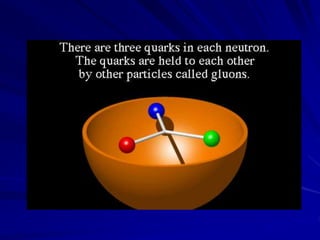
Protons ---- 2 up quarks and a down quark
Neutrons ---- 2 down quarks and a
upquark
CLASSIFICATION
BASED ON THE STATISTICS THEY OBEY
1) Fermi-Dirac statistics
a) Fermions/Matter particles
2) Bose-Einstein statistics
a) Bosons/Force particles
BASED ON THE PARTICLE BEHAVIOR
1) Mesons/Bosonic Hadrons
2) Baryons/Fermionic Hadrons.
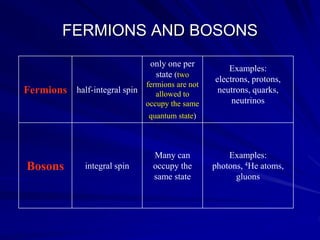
FERMIONS AND BOSONS
Fermions half-integral spin
only one per
state (two
fermions are not
allowed to
occupy the same
quantum state)
Examples:
electrons, protons,
neutrons, quarks,
neutrinos
Bosons integral spin
Many can
occupy the
same state
Examples:
photons, 4He atoms,
gluons
FERMIONS-DEFN
Fermi-Dirac statistics apply to those particles restricted by the
Pauli’s Exclusion principle( No two “e-” can have same set of all 4
quantum numbers).
These particles are known as Fermions.
Two fermions are not allowed to occupy the same quantum state.
Fermions compose nuclear and atomic structure.
Leptons and Quarks are Fermions.
These are also known as matter particles.
For each matter particle there exist an anti-matter particle.
FERMIONS-CONTD
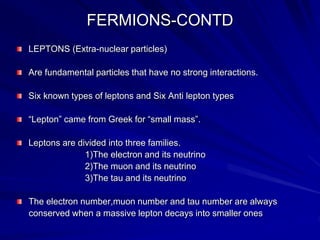
LEPTONS (Extra-nuclear particles)
Are fundamental particles that have no strong interactions.
Six known types of leptons and Six Anti lepton types
“Lepton” came from Greek for “small mass”.
Leptons are divided into three families.
1)The electron and its neutrino
2)The muon and its neutrino
3)The tau and its neutrino
The electron number,muon number and tau number are always
conserved when a massive lepton decays into smaller ones
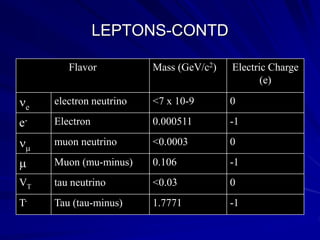
LEPTONS-CONTD
Flavor Mass (GeV/c2) Electric Charge
(e)
e
electron neutrino <7 x 10⁻⁹ 0
e- Electron 0.000511 -1

muon neutrino <0.0003 0
 Muon (mu-minus) 0.106 -1
VT tau neutrino <0.03 0
T- Tau (tau-minus) 1.7771 -1
FERMIONS CONTD…
QUARKS (NUCLEAR PARTICLES)
Matter particles that are constituents of neutrons and
protons and others hadrons.
Six different types of quarks.
Each type of quark has its own antiparticle (same mass but
opposite electrical charge and magnetic moment).
Each quark type is called a flavor.
Appears always in pairs/triplets.
Five quark particles called penta quarks.
Of the six the “top”/ “truth” quark is the heaviest
particle nature ever created.
Protons and Neutrons are made of the “up” and “down” quarks.
QUARKS-CONTD
Flavor
Mass (GeV/c2) Electric
Charge (e)
u up 0.004 +2/3
d Down 0.008 -1/3
c Charm 1.5 +2/3
s Strange 0.15 -1/3
t top 176 +2/3
b bottom 4.7 -1/3
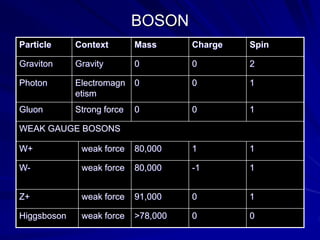
BOSON-DEF
Bose-Einstein statistics apply to all the other particles those are not
covered by the exclusion principle.
Those particles are called as bosons.
The bosons are the particles that mediate forces.
The number of bosons in a given quantum state is not restricted.
Bosons act to transmit energy between fermions.
5 categories; photon, gluon, W+,W-, Z.
BOSON
Particle Context Mass Charge Spin
Graviton Gravity 0 0 2
Photon Electromagn
etism
0 0 1
Gluon Strong force 0 0 1
WEAK GAUGE BOSONS
W+ weak force 80,000 1 1
W- weak force 80,000 -1 1
Z+ weak force 91,000 0 1
Higgsboson weak force >78,000 0 0
HADRONS
Are particles made from quarks and gluons bound together by
strong interactions.
Are nuclear particles.
Have no net strong charge.
There are two classes of hadrons: mesons and baryons.
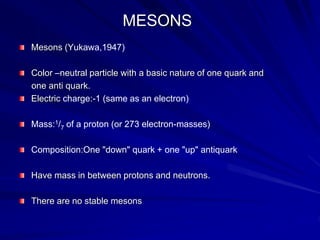
MESONS
Mesons (Yukawa,1947)
Color –neutral particle with a basic nature of one quark and
one anti quark.
Electric charge:-1 (same as an electron)
Mass:1/7 of a proton (or 273 electron-masses)
Composition:One "down" quark + one "up" antiquark
Have mass in between protons and neutrons.
There are no stable mesons
MESONS
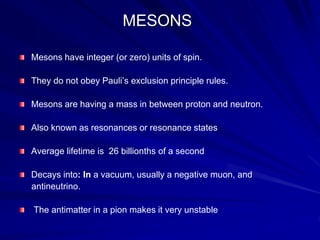
Mesons have integer (or zero) units of spin.
They do not obey Pauli’s exclusion principle rules.
Mesons are having a mass in between proton and neutron.
Also known as resonances or resonance states
Average lifetime is 26 billionths of a second
Decays into: In a vacuum, usually a negative muon, and
antineutrino.
The antimatter in a pion makes it very unstable
MESONS
p i +k -r h o +D +e t a - cp i +k -r h o +D +e t a - c
Bosonic Hadrons
Mesons
Name Electric
Charge
Mass (GeV/c2) Spin
pion +1 0.140 0
kaon -1 0.494 0
rho +1 0.770 1
D+ +1 1.869 0
eta-c 0 2.979 0
BARYONS
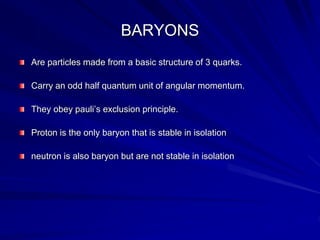
Are particles made from a basic structure of 3 quarks.
Carry an odd half quantum unit of angular momentum.
They obey pauli’s exclusion principle.
Proton is the only baryon that is stable in isolation
neutron is also baryon but are not stable in isolation
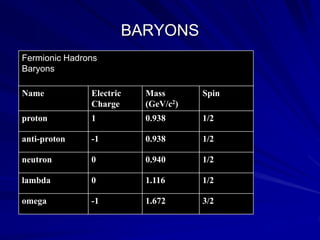
BARYONS
pp - b a rn
Fermionic Hadrons
Baryons
Name Electric
Charge
Mass
(GeV/c2)
Spin
proton 1 0.938 1/2
anti-proton -1 0.938 1/2
neutron 0 0.940 1/2
lambda 0 1.116 1/2
omega -1 1.672 3/2
NEUTRINO AND GLUE BALLS
Are one of the fundamental particles which make up the universe.
Are similar to electron but carry no charge.
Three neutrinos are known.
Glueballs are additional types of hadrons made of gluons.
They do not contain virtual quark-antiquark pairs so it is difficult to
distinguish from an ordinary meson.
GLOSSARY
Annihilation
Attenuation
Bound state
Bubble chamber
Conservation laws
Collimation
Higgs boson.
Jet
The standard model plus gravity.
S particles
Storage Ring
THE CURRENT CONCERN IN THE RESEARCH OF ELEMENTARY PARTICLES
IS THE INTERFACE BETWEEN THAT DISCIPLINE
AND COSMOLOGY
As you think so you become
As your thoughts must be your life
Improve your thoughts
Better thoughts bring better action

Elementary particles

  • 1.
  • 2.
  • 3.
    HISTORY Idea of elementaryparticles first introduced by Democritus in 460 BC Introduced the word “atom” –indivisible particles. Later in 1930s the protons, neutrons and electrons were the smallest and were termed as ‘elementary particles’. The word ‘elementary particles’ means “having no smaller constituent parts”
  • 5.
    FORCES The elementary particleof matter interact with one another through four distinct type of forces. These are carriers of the basic forces The 4 basic forces are Gravitation Electromagnetism Forces from strong interactions Forces from weak interactions
  • 6.
    DISCOVERY The first subatomicparticle discovered was the ELECTRON in 1897 by J.J. Thomson. In 1905 photon was suggested by Einstein. The nucleus of an tom was discovered by Ernest Rutherford in 1911 In 1928 P.A.M.Dirac discovered a positively charged electron, or positron,ie antiparticle of electron. In 1932 the neutron was discovered by---------------?
  • 7.
    In 1934 theexistence of neutrino was established. In 1947 Yukawa discovered the pi meson or pion. By 1950s these elementary particles were observed in laboratory through particle collisions produced by particle accelerator. In 1959 Antineutrino existence was announced by Cowan and Reines
  • 8.
    Two basic constituentsof matter are Leptons Quarks Each type of Leptons and Quarks has a corresponding Anti particle (same mass but opposite electrical charge and magnetic momentum)
  • 9.
  • 10.
  • 11.
    The quarks foundin ordinary matter are up quarks and down quarks Protons ---- 2 up quarks and a down quark Neutrons ---- 2 down quarks and a upquark
  • 13.
    CLASSIFICATION BASED ON THESTATISTICS THEY OBEY 1) Fermi-Dirac statistics a) Fermions/Matter particles 2) Bose-Einstein statistics a) Bosons/Force particles BASED ON THE PARTICLE BEHAVIOR 1) Mesons/Bosonic Hadrons 2) Baryons/Fermionic Hadrons.
  • 14.
    FERMIONS AND BOSONS Fermionshalf-integral spin only one per state (two fermions are not allowed to occupy the same quantum state) Examples: electrons, protons, neutrons, quarks, neutrinos Bosons integral spin Many can occupy the same state Examples: photons, 4He atoms, gluons
  • 15.
    FERMIONS-DEFN Fermi-Dirac statistics applyto those particles restricted by the Pauli’s Exclusion principle( No two “e-” can have same set of all 4 quantum numbers). These particles are known as Fermions. Two fermions are not allowed to occupy the same quantum state. Fermions compose nuclear and atomic structure. Leptons and Quarks are Fermions. These are also known as matter particles. For each matter particle there exist an anti-matter particle.
  • 16.
    FERMIONS-CONTD LEPTONS (Extra-nuclear particles) Arefundamental particles that have no strong interactions. Six known types of leptons and Six Anti lepton types “Lepton” came from Greek for “small mass”. Leptons are divided into three families. 1)The electron and its neutrino 2)The muon and its neutrino 3)The tau and its neutrino The electron number,muon number and tau number are always conserved when a massive lepton decays into smaller ones
  • 17.
    LEPTONS-CONTD Flavor Mass (GeV/c2)Electric Charge (e) e electron neutrino <7 x 10⁻⁹ 0 e- Electron 0.000511 -1  muon neutrino <0.0003 0  Muon (mu-minus) 0.106 -1 VT tau neutrino <0.03 0 T- Tau (tau-minus) 1.7771 -1
  • 18.
    FERMIONS CONTD… QUARKS (NUCLEARPARTICLES) Matter particles that are constituents of neutrons and protons and others hadrons. Six different types of quarks. Each type of quark has its own antiparticle (same mass but opposite electrical charge and magnetic moment). Each quark type is called a flavor. Appears always in pairs/triplets. Five quark particles called penta quarks. Of the six the “top”/ “truth” quark is the heaviest particle nature ever created. Protons and Neutrons are made of the “up” and “down” quarks.
  • 19.
    QUARKS-CONTD Flavor Mass (GeV/c2) Electric Charge(e) u up 0.004 +2/3 d Down 0.008 -1/3 c Charm 1.5 +2/3 s Strange 0.15 -1/3 t top 176 +2/3 b bottom 4.7 -1/3
  • 20.
    BOSON-DEF Bose-Einstein statistics applyto all the other particles those are not covered by the exclusion principle. Those particles are called as bosons. The bosons are the particles that mediate forces. The number of bosons in a given quantum state is not restricted. Bosons act to transmit energy between fermions. 5 categories; photon, gluon, W+,W-, Z.
  • 21.
    BOSON Particle Context MassCharge Spin Graviton Gravity 0 0 2 Photon Electromagn etism 0 0 1 Gluon Strong force 0 0 1 WEAK GAUGE BOSONS W+ weak force 80,000 1 1 W- weak force 80,000 -1 1 Z+ weak force 91,000 0 1 Higgsboson weak force >78,000 0 0
  • 22.
    HADRONS Are particles madefrom quarks and gluons bound together by strong interactions. Are nuclear particles. Have no net strong charge. There are two classes of hadrons: mesons and baryons.
  • 23.
    MESONS Mesons (Yukawa,1947) Color –neutralparticle with a basic nature of one quark and one anti quark. Electric charge:-1 (same as an electron) Mass:1/7 of a proton (or 273 electron-masses) Composition:One "down" quark + one "up" antiquark Have mass in between protons and neutrons. There are no stable mesons
  • 24.
    MESONS Mesons have integer(or zero) units of spin. They do not obey Pauli’s exclusion principle rules. Mesons are having a mass in between proton and neutron. Also known as resonances or resonance states Average lifetime is 26 billionths of a second Decays into: In a vacuum, usually a negative muon, and antineutrino. The antimatter in a pion makes it very unstable
  • 25.
    MESONS p i +k-r h o +D +e t a - cp i +k -r h o +D +e t a - c Bosonic Hadrons Mesons Name Electric Charge Mass (GeV/c2) Spin pion +1 0.140 0 kaon -1 0.494 0 rho +1 0.770 1 D+ +1 1.869 0 eta-c 0 2.979 0
  • 26.
    BARYONS Are particles madefrom a basic structure of 3 quarks. Carry an odd half quantum unit of angular momentum. They obey pauli’s exclusion principle. Proton is the only baryon that is stable in isolation neutron is also baryon but are not stable in isolation
  • 27.
    BARYONS pp - ba rn Fermionic Hadrons Baryons Name Electric Charge Mass (GeV/c2) Spin proton 1 0.938 1/2 anti-proton -1 0.938 1/2 neutron 0 0.940 1/2 lambda 0 1.116 1/2 omega -1 1.672 3/2
  • 28.
    NEUTRINO AND GLUEBALLS Are one of the fundamental particles which make up the universe. Are similar to electron but carry no charge. Three neutrinos are known. Glueballs are additional types of hadrons made of gluons. They do not contain virtual quark-antiquark pairs so it is difficult to distinguish from an ordinary meson.
  • 29.
    GLOSSARY Annihilation Attenuation Bound state Bubble chamber Conservationlaws Collimation Higgs boson. Jet The standard model plus gravity. S particles Storage Ring THE CURRENT CONCERN IN THE RESEARCH OF ELEMENTARY PARTICLES IS THE INTERFACE BETWEEN THAT DISCIPLINE AND COSMOLOGY
  • 30.
    As you thinkso you become As your thoughts must be your life Improve your thoughts Better thoughts bring better action