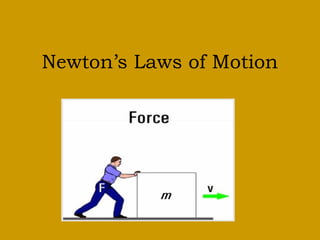
Newton’s Laws of Motion
Background
add to notes
Sir Isaac Newton (1643-1727) an
English scientist and mathematician
famous for his discovery of the law of
gravity also discovered the three laws
of motion.
Newton’s Laws of Motion
add to notes
Newton’s First Law:
Objects in motion tend to stay in motion and objects at rest tend to
stay at rest unless acted upon by an unbalanced force.
Newton’s Second Law:
Force equals mass times acceleration (F = ma).
Newton’s Third Law:
For every action there is an equal and opposite reaction.
Newton’s First Law
An object at rest tends to stay at rest
and an object in motion tends to stay in
motion unless acted upon by an
unbalanced force.
What does this mean?
Basically, an object will “keep doing what it
was doing” unless acted on by an
unbalanced force.
If the object was sitting still, it will remain
stationary. If it was moving at a constant
velocity, it will keep moving.
It takes force to change the motion of an
object.
What is meant by unbalanced
force?
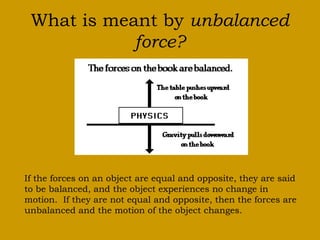
If the forces on an object are equal and opposite, they are said
to be balanced, and the object experiences no change in
motion. If they are not equal and opposite, then the forces are
unbalanced and the motion of the object changes.
Some Examples from Real Life
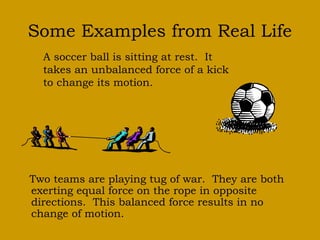
Two teams are playing tug of war. They are both
exerting equal force on the rope in opposite
directions. This balanced force results in no
change of motion.
A soccer ball is sitting at rest. It
takes an unbalanced force of a kick
to change its motion.
Newton’s First Law is also
called the Law of Inertia
add to notes
Inertia: the tendency of an object to
resist changes in its state of motion
The First Law states that all objects
have inertia. The more mass an object
has, the more inertia it has (and the
harder it is to change its motion).
Newton's 1Newton's 1stst
Law and YouLaw and You
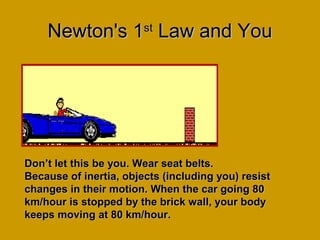
Don’t let this be you. Wear seat belts.Don’t let this be you. Wear seat belts.
Because of inertia, objects (including you) resistBecause of inertia, objects (including you) resist
changes in their motion. When the car going 80changes in their motion. When the car going 80
km/hour is stopped by the brick wall, your bodykm/hour is stopped by the brick wall, your body
keeps moving at 80 km/hour.keeps moving at 80 km/hour.
More Examples from Real Life
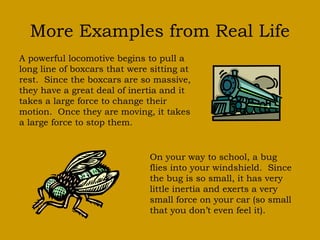
A powerful locomotive begins to pull a
long line of boxcars that were sitting at
rest. Since the boxcars are so massive,
they have a great deal of inertia and it
takes a large force to change their
motion. Once they are moving, it takes
a large force to stop them.
On your way to school, a bug
flies into your windshield. Since
the bug is so small, it has very
little inertia and exerts a very
small force on your car (so small
that you don’t even feel it).
If objects in motion tend to stay in motion,
why don’t moving objects keep moving
forever?
Things don’t keep moving forever because
there’s almost always an unbalanced force
acting upon it.
A book sliding across a table slows
down and stops because of the force
of friction.
If you throw a ball upwards it will
eventually slow down and fall
because of the force of gravity.
In outer space, away from gravity and any
sources of friction, a rocket ship launched
with a certain speed and direction would
keep going in that same direction and at that
same speed forever.
Newton’s Second Law
Force equals mass times acceleration.
F = ma
Acceleration: a measurement of how quickly an
object is changing speed.
What does F = ma mean?
Force is directly proportional to mass and acceleration.
Imagine a ball of a certain mass moving at a certain
acceleration. This ball has a certain force.
Now imagine we make the ball twice as big (double the
mass) but keep the acceleration constant. F = ma says
that this new ball has twice the force of the old ball.
Now imagine the original ball moving at twice the
original acceleration. F = ma says that the ball will
again have twice the force of the ball at the original
acceleration.
What does F = ma say?
Add to notes
• F = ma basically means that the force of an
object comes from its mass and its acceleration.
• If you double the mass, you double the force. If
you double the acceleration, you double the
force.
• Doubling the mass and the acceleration
quadruples the force.
(2m)(2a) = 4F
So . . . what if you decrease the mass by half?
How much force would the object have now?
What does F = ma say?
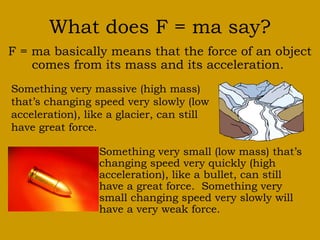
F = ma basically means that the force of an object
comes from its mass and its acceleration.
Something very small (low mass) that’s
changing speed very quickly (high
acceleration), like a bullet, can still
have a great force. Something very
small changing speed very slowly will
have a very weak force.
Something very massive (high mass)
that’s changing speed very slowly (low
acceleration), like a glacier, can still
have great force.
Newton’s Third Law
For every action there is an equal and
opposite reaction.
What does this mean?
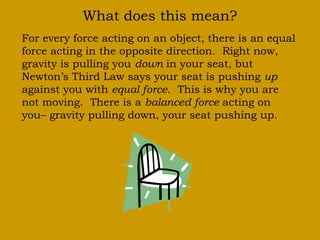
For every force acting on an object, there is an equal
force acting in the opposite direction. Right now,
gravity is pulling you down in your seat, but
Newton’s Third Law says your seat is pushing up
against you with equal force. This is why you are
not moving. There is a balanced force acting on
you– gravity pulling down, your seat pushing up.
Think about it . . .
What happens if you are standing on a
skateboard or a slippery floor and push against
a wall? You slide in the opposite direction
(away from the wall), because you pushed on
the wall but the wall pushed back on you with
equal and opposite force.
Why does it hurt so much when you stub
your toe? When your toe exerts a force on a
rock, the rock exerts an equal force back on
your toe. The harder you hit your toe against
it, the more force the rock exerts back on
your toe (and the more your toe hurts).
Newton’s Laws of Motion
Review
Newton’s First Law:
Objects in motion tend to stay in motion
and objects at rest tend to stay at rest
unless acted upon by an unbalanced force.
Newton’s Second Law:
Force equals mass times acceleration
(F = ma).
Newton’s Third Law:
For every action there is an equal and
opposite reaction.
Vocabulary add to notes
Inertia:
the tendency of an object to resist changes
in its state of motion
Acceleration:
•a change in velocity
•a measurement of how quickly an object is
changing speed, and direction
Velocity:
The rate of change of a position along
a straight line with respect to time
Force:
Push or Pull (strength or energy)

Discovering newtons laws and its basic uses in daily life.

  • 1.
  • 2.
    Background add to notes SirIsaac Newton (1643-1727) an English scientist and mathematician famous for his discovery of the law of gravity also discovered the three laws of motion.
  • 3.
    Newton’s Laws ofMotion add to notes Newton’s First Law: Objects in motion tend to stay in motion and objects at rest tend to stay at rest unless acted upon by an unbalanced force. Newton’s Second Law: Force equals mass times acceleration (F = ma). Newton’s Third Law: For every action there is an equal and opposite reaction.
  • 4.
    Newton’s First Law Anobject at rest tends to stay at rest and an object in motion tends to stay in motion unless acted upon by an unbalanced force.
  • 5.
    What does thismean? Basically, an object will “keep doing what it was doing” unless acted on by an unbalanced force. If the object was sitting still, it will remain stationary. If it was moving at a constant velocity, it will keep moving. It takes force to change the motion of an object.
  • 6.
    What is meantby unbalanced force? If the forces on an object are equal and opposite, they are said to be balanced, and the object experiences no change in motion. If they are not equal and opposite, then the forces are unbalanced and the motion of the object changes.
  • 7.
    Some Examples fromReal Life Two teams are playing tug of war. They are both exerting equal force on the rope in opposite directions. This balanced force results in no change of motion. A soccer ball is sitting at rest. It takes an unbalanced force of a kick to change its motion.
  • 8.
    Newton’s First Lawis also called the Law of Inertia add to notes Inertia: the tendency of an object to resist changes in its state of motion The First Law states that all objects have inertia. The more mass an object has, the more inertia it has (and the harder it is to change its motion).
  • 9.
    Newton's 1Newton's 1stst Lawand YouLaw and You Don’t let this be you. Wear seat belts.Don’t let this be you. Wear seat belts. Because of inertia, objects (including you) resistBecause of inertia, objects (including you) resist changes in their motion. When the car going 80changes in their motion. When the car going 80 km/hour is stopped by the brick wall, your bodykm/hour is stopped by the brick wall, your body keeps moving at 80 km/hour.keeps moving at 80 km/hour.
  • 10.
    More Examples fromReal Life A powerful locomotive begins to pull a long line of boxcars that were sitting at rest. Since the boxcars are so massive, they have a great deal of inertia and it takes a large force to change their motion. Once they are moving, it takes a large force to stop them. On your way to school, a bug flies into your windshield. Since the bug is so small, it has very little inertia and exerts a very small force on your car (so small that you don’t even feel it).
  • 11.
    If objects inmotion tend to stay in motion, why don’t moving objects keep moving forever? Things don’t keep moving forever because there’s almost always an unbalanced force acting upon it. A book sliding across a table slows down and stops because of the force of friction. If you throw a ball upwards it will eventually slow down and fall because of the force of gravity.
  • 12.
    In outer space,away from gravity and any sources of friction, a rocket ship launched with a certain speed and direction would keep going in that same direction and at that same speed forever.
  • 13.
    Newton’s Second Law Forceequals mass times acceleration. F = ma Acceleration: a measurement of how quickly an object is changing speed.
  • 14.
    What does F= ma mean? Force is directly proportional to mass and acceleration. Imagine a ball of a certain mass moving at a certain acceleration. This ball has a certain force. Now imagine we make the ball twice as big (double the mass) but keep the acceleration constant. F = ma says that this new ball has twice the force of the old ball. Now imagine the original ball moving at twice the original acceleration. F = ma says that the ball will again have twice the force of the ball at the original acceleration.
  • 15.
    What does F= ma say? Add to notes • F = ma basically means that the force of an object comes from its mass and its acceleration. • If you double the mass, you double the force. If you double the acceleration, you double the force. • Doubling the mass and the acceleration quadruples the force. (2m)(2a) = 4F So . . . what if you decrease the mass by half? How much force would the object have now?
  • 16.
    What does F= ma say? F = ma basically means that the force of an object comes from its mass and its acceleration. Something very small (low mass) that’s changing speed very quickly (high acceleration), like a bullet, can still have a great force. Something very small changing speed very slowly will have a very weak force. Something very massive (high mass) that’s changing speed very slowly (low acceleration), like a glacier, can still have great force.
  • 17.
    Newton’s Third Law Forevery action there is an equal and opposite reaction.
  • 18.
    What does thismean? For every force acting on an object, there is an equal force acting in the opposite direction. Right now, gravity is pulling you down in your seat, but Newton’s Third Law says your seat is pushing up against you with equal force. This is why you are not moving. There is a balanced force acting on you– gravity pulling down, your seat pushing up.
  • 19.
    Think about it. . . What happens if you are standing on a skateboard or a slippery floor and push against a wall? You slide in the opposite direction (away from the wall), because you pushed on the wall but the wall pushed back on you with equal and opposite force. Why does it hurt so much when you stub your toe? When your toe exerts a force on a rock, the rock exerts an equal force back on your toe. The harder you hit your toe against it, the more force the rock exerts back on your toe (and the more your toe hurts).
  • 20.
    Newton’s Laws ofMotion Review Newton’s First Law: Objects in motion tend to stay in motion and objects at rest tend to stay at rest unless acted upon by an unbalanced force. Newton’s Second Law: Force equals mass times acceleration (F = ma). Newton’s Third Law: For every action there is an equal and opposite reaction.
  • 21.
    Vocabulary add tonotes Inertia: the tendency of an object to resist changes in its state of motion Acceleration: •a change in velocity •a measurement of how quickly an object is changing speed, and direction Velocity: The rate of change of a position along a straight line with respect to time Force: Push or Pull (strength or energy)