Creative
nonfiction
Jellys fatima y. sarabillo
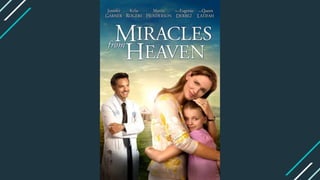
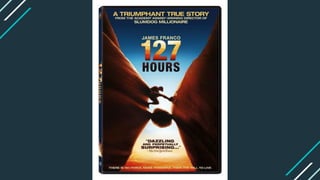
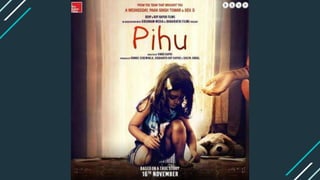
Do you know
about this?
Creative
nonfiction
Jellys fatima y. sarabillo
Learning
Competency
• Identify dominant literary
conventions of a particular
genre (HUMSS_CNF11/12-
Ia-1)
• Compare and contrast how
the elements are used in
the different genres
(HUMSS_CNF11/12-Ia-2)
SUBJECT DESCRIPTION
• Focusing on formal elements and writing techniques,
including autobiography and blogging, among others,
• The subject introduces the students to the reading
and writing of Creative Nonfiction as a literary form.
• The subject develops in students skills in reading, and
thinking critically and creatively, that will help them
to be imaginative readers and writers.
CREATIVE NONFICTION
• “True story well told”
• The words “creative” and “nonfiction” describe the
form.The word “creative” refers to the use of
literary craft, the techniques fiction writers,
playwrights or poets employ to present
nonfiction – factually accurate prose about real
people and events in a dramatic manner.
CREATIVE NONFICTION
• employs the literary techniques usually associated with
fiction or poetry to report on actual persons, places, or
events.
• The genre of creative nonfiction (also known as literary
nonfiction) is broad enough to include travel writing,
nature writing, science writing, sports writing,
biography, autobiography, memoir, the interview, and
both the familiar and personal essay.
CREATIVE NONFICTION
•The goal is to make nonfiction
stories read like fiction so that your
readers will be interested as they are
in fantasy.
EXAMPLES
• "Coney Island at Night" by James
Huneker
• "An Experiment in Misery" by Stephen
Crane
• "In Mammoth Cave" by John Burroughs
• "Outcasts in Salt Lake City" by James
Weldon Johnson
• "Rural Hours" by Susan Fenimore Cooper
• "The San Francisco Earthquake" by Jack
London
• "The Watercress Girl" by Henry Mayhew
LITERARY
GENRES
Quarter 3
What is
a
literary
genre?
•A genre is a
particular style
or type of
writing.
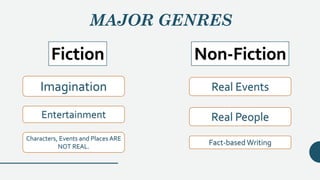
MAJOR GENRES
Fiction Non-Fiction
Imagination
Entertainment
Characters, Events and Places ARE
NOT REAL.
Real Events
Real People
Fact-based Writing
LITERARY
GENRES OF
NON-FICTION
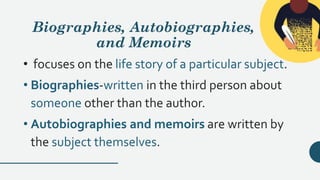
Biographies, Autobiographies,
and Memoirs
• focuses on the life story of a particular subject.
• Biographies-written in the third person about
someone other than the author.
• Autobiographies and memoirs are written by
the subject themselves.
Biographies, Autobiographies,
and Memoirs
• While autobiographies and memoirs are,
by necessity, written by someone who is
currently alive at the time of the writing,
biographies may profile subjects both
living and dead.
Personal Narrative
•a prose relating personal experience
and opinion to a factual narrative.
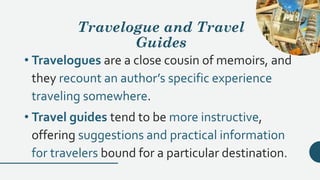
Travelogue and Travel
Guides
• Travelogues are a close cousin of memoirs, and
they recount an author’s specific experience
traveling somewhere.
• Travel guides tend to be more instructive,
offering suggestions and practical information
for travelers bound for a particular destination.
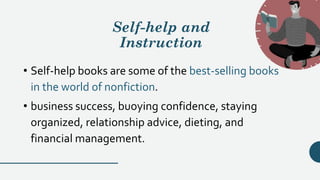
Self-help and
Instruction
• Self-help books are some of the best-selling books
in the world of nonfiction.
• business success, buoying confidence, staying
organized, relationship advice, dieting, and
financial management.
Humor and
Commentary
• analysis and reflection on real-world events are
distilled through the prism of an author’s point of
view.
• can be humorous, sometimes it’s political, and
sometimes it’s purely meditative.
• objective events, both present and historical.
Analyzing themes
and techniques
used in a text
Quarter 3: module 1
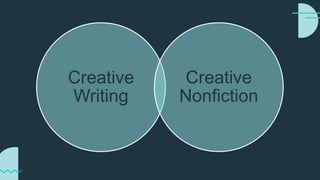
Creative
Writing
Creative
Nonfiction
• literary styles and techniques to create factual and
accurate narratives of events and individuals.
• literary nonfiction or narrative nonfiction.
• a hybrid of nonfiction components and literary features
which are done in essay form and story form with
setting, rhetorical patterns, characterization, concepts,
facts (not just beauty of words), and researched truths.
• narration, explanation, and exposition-engaged to the
experiences
Creative nonfiction
• ultimate goal: author to communicate well-researched details tailored like
that of a fiction.
• accuracy and style.
• broad categories under creative nonfiction:
A. Biographical narratives (e.g. full length biography, literary
biography, historical biography, profile, character sketch,
and interview story);
B. Autobiographical narratives (e.g. full-length autobiography,
multi-volume autobiography, memoir, diary, and journal);
C. Personal and informal essay (e.g. literary reportage, descriptive
essay, and reflective essay.)
D. Other types of creative nonfiction (travel writing, food writing,
nature writing, testimonio, blog, and Facebook status
report.
Creative nonfiction
Literary
techniques
Creative nonfiction
Literary techniques
 There are techniques used in
creative nonfiction that can also be
used also in fiction. However, the
techniques listed are features mainly
used for creative nonfiction.
Literary techniques
 are definite and intentional use of
words that the authors use to
convey the message of the text.
1. CREATIVE LICENSE
 Author exaggerates or alters the objective realities
for enhancing and clarifying the meaning in the
context of fiction.
 author’s freedom to go away with the conventions
or rules in writing.
 For example, the phrase “you and I” is used instead
of “you and me” in order to create and effect.
Another is applying small distortions as a way of
handling factual materials.
2. FIGURES OF SPEECH
 figurative language
 intended meaning is different from the actual
meaning of the words.
 Examples are simile, hyperbole,
personification, onomatopoeia, oxymoron,
and lot more.
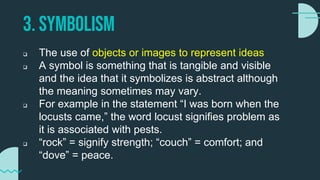
3. SYMBOLISM
 The use of objects or images to represent ideas
 A symbol is something that is tangible and visible
and the idea that it symbolizes is abstract although
the meaning sometimes may vary.
 For example in the statement “I was born when the
locusts came,” the word locust signifies problem as
it is associated with pests.
 “rock” = signify strength; “couch” = comfort; and
“dove” = peace.
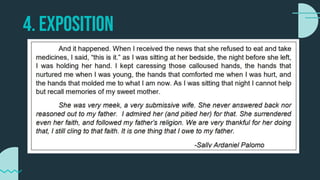
4. EXPOSITION
 author interrupts the story to explain
something or to give important background
information.
 A memoir entitled “A Virtuous Woman”.
Notice that the second paragraph provides
additional knowledge about the writer’s
mother.
4. EXPOSITION
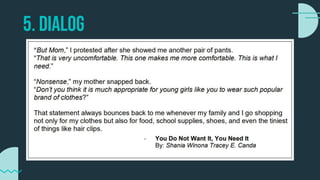
5. DIALOG
 characters speak to one another and is
used to substitute for exposition.
 many of the characters thoughts and
actions are being revealed.
5. DIALOG
6. IMAGERY
 This refers to the language that describes in
detail appealing to the senses like visual
imagery and sound imagery.
 The images are those that can be seen,
touched, heard, smelled, and tasted.
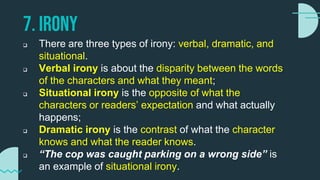
7. IRONY
 There are three types of irony: verbal, dramatic, and
situational.
 Verbal irony is about the disparity between the words
of the characters and what they meant;
 Situational irony is the opposite of what the
characters or readers’ expectation and what actually
happens;
 Dramatic irony is the contrast of what the character
knows and what the reader knows.
 “The cop was caught parking on a wrong side” is
an example of situational irony.
CREATIVE NONFICTION
ANALYSIS
ACTIVITY
As a student of public school, what
struggles have you faced and
conquered before?
What motivated you to study and
keep going?
Creative Non Fiction Q3 MODULE 1 ppt.pptx

Creative Non Fiction Q3 MODULE 1 ppt.pptx

  • 1.
  • 2.
  • 9.
  • 10.
    Learning Competency • Identify dominantliterary conventions of a particular genre (HUMSS_CNF11/12- Ia-1) • Compare and contrast how the elements are used in the different genres (HUMSS_CNF11/12-Ia-2)
  • 11.
    SUBJECT DESCRIPTION • Focusingon formal elements and writing techniques, including autobiography and blogging, among others, • The subject introduces the students to the reading and writing of Creative Nonfiction as a literary form. • The subject develops in students skills in reading, and thinking critically and creatively, that will help them to be imaginative readers and writers.
  • 12.
    CREATIVE NONFICTION • “Truestory well told” • The words “creative” and “nonfiction” describe the form.The word “creative” refers to the use of literary craft, the techniques fiction writers, playwrights or poets employ to present nonfiction – factually accurate prose about real people and events in a dramatic manner.
  • 13.
    CREATIVE NONFICTION • employsthe literary techniques usually associated with fiction or poetry to report on actual persons, places, or events. • The genre of creative nonfiction (also known as literary nonfiction) is broad enough to include travel writing, nature writing, science writing, sports writing, biography, autobiography, memoir, the interview, and both the familiar and personal essay.
  • 14.
    CREATIVE NONFICTION •The goalis to make nonfiction stories read like fiction so that your readers will be interested as they are in fantasy.
  • 15.
    EXAMPLES • "Coney Islandat Night" by James Huneker • "An Experiment in Misery" by Stephen Crane • "In Mammoth Cave" by John Burroughs • "Outcasts in Salt Lake City" by James Weldon Johnson • "Rural Hours" by Susan Fenimore Cooper • "The San Francisco Earthquake" by Jack London • "The Watercress Girl" by Henry Mayhew
  • 16.
  • 17.
    What is a literary genre? •A genreis a particular style or type of writing.
  • 18.
    MAJOR GENRES Fiction Non-Fiction Imagination Entertainment Characters,Events and Places ARE NOT REAL. Real Events Real People Fact-based Writing
  • 19.
  • 20.
    Biographies, Autobiographies, and Memoirs •focuses on the life story of a particular subject. • Biographies-written in the third person about someone other than the author. • Autobiographies and memoirs are written by the subject themselves.
  • 21.
    Biographies, Autobiographies, and Memoirs •While autobiographies and memoirs are, by necessity, written by someone who is currently alive at the time of the writing, biographies may profile subjects both living and dead.
  • 22.
    Personal Narrative •a proserelating personal experience and opinion to a factual narrative.
  • 23.
    Travelogue and Travel Guides •Travelogues are a close cousin of memoirs, and they recount an author’s specific experience traveling somewhere. • Travel guides tend to be more instructive, offering suggestions and practical information for travelers bound for a particular destination.
  • 24.
    Self-help and Instruction • Self-helpbooks are some of the best-selling books in the world of nonfiction. • business success, buoying confidence, staying organized, relationship advice, dieting, and financial management.
  • 25.
    Humor and Commentary • analysisand reflection on real-world events are distilled through the prism of an author’s point of view. • can be humorous, sometimes it’s political, and sometimes it’s purely meditative. • objective events, both present and historical.
  • 26.
    Analyzing themes and techniques usedin a text Quarter 3: module 1
  • 27.
  • 28.
    • literary stylesand techniques to create factual and accurate narratives of events and individuals. • literary nonfiction or narrative nonfiction. • a hybrid of nonfiction components and literary features which are done in essay form and story form with setting, rhetorical patterns, characterization, concepts, facts (not just beauty of words), and researched truths. • narration, explanation, and exposition-engaged to the experiences Creative nonfiction
  • 29.
    • ultimate goal:author to communicate well-researched details tailored like that of a fiction. • accuracy and style. • broad categories under creative nonfiction: A. Biographical narratives (e.g. full length biography, literary biography, historical biography, profile, character sketch, and interview story); B. Autobiographical narratives (e.g. full-length autobiography, multi-volume autobiography, memoir, diary, and journal); C. Personal and informal essay (e.g. literary reportage, descriptive essay, and reflective essay.) D. Other types of creative nonfiction (travel writing, food writing, nature writing, testimonio, blog, and Facebook status report. Creative nonfiction
  • 30.
  • 31.
    Literary techniques  Thereare techniques used in creative nonfiction that can also be used also in fiction. However, the techniques listed are features mainly used for creative nonfiction.
  • 32.
    Literary techniques  aredefinite and intentional use of words that the authors use to convey the message of the text.
  • 33.
    1. CREATIVE LICENSE Author exaggerates or alters the objective realities for enhancing and clarifying the meaning in the context of fiction.  author’s freedom to go away with the conventions or rules in writing.  For example, the phrase “you and I” is used instead of “you and me” in order to create and effect. Another is applying small distortions as a way of handling factual materials.
  • 34.
    2. FIGURES OFSPEECH  figurative language  intended meaning is different from the actual meaning of the words.  Examples are simile, hyperbole, personification, onomatopoeia, oxymoron, and lot more.
  • 35.
    3. SYMBOLISM  Theuse of objects or images to represent ideas  A symbol is something that is tangible and visible and the idea that it symbolizes is abstract although the meaning sometimes may vary.  For example in the statement “I was born when the locusts came,” the word locust signifies problem as it is associated with pests.  “rock” = signify strength; “couch” = comfort; and “dove” = peace.
  • 36.
    4. EXPOSITION  authorinterrupts the story to explain something or to give important background information.  A memoir entitled “A Virtuous Woman”. Notice that the second paragraph provides additional knowledge about the writer’s mother.
  • 37.
  • 38.
    5. DIALOG  charactersspeak to one another and is used to substitute for exposition.  many of the characters thoughts and actions are being revealed.
  • 39.
  • 40.
    6. IMAGERY  Thisrefers to the language that describes in detail appealing to the senses like visual imagery and sound imagery.  The images are those that can be seen, touched, heard, smelled, and tasted.
  • 41.
    7. IRONY  Thereare three types of irony: verbal, dramatic, and situational.  Verbal irony is about the disparity between the words of the characters and what they meant;  Situational irony is the opposite of what the characters or readers’ expectation and what actually happens;  Dramatic irony is the contrast of what the character knows and what the reader knows.  “The cop was caught parking on a wrong side” is an example of situational irony.
  • 45.
  • 46.
    As a studentof public school, what struggles have you faced and conquered before? What motivated you to study and keep going?