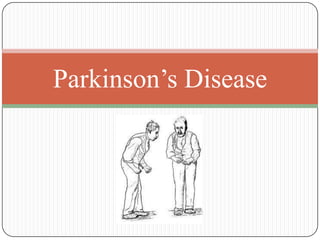
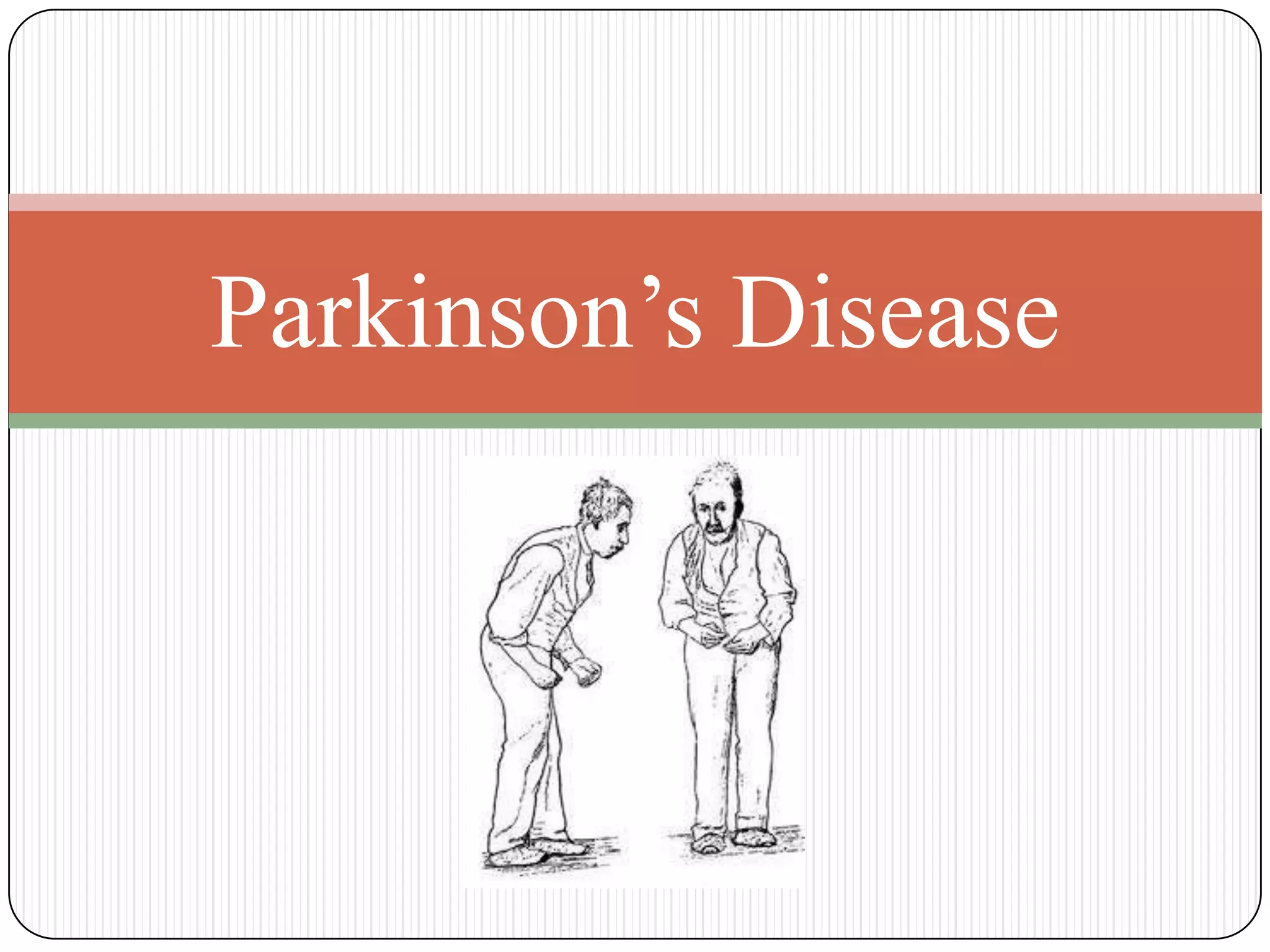
Parkinson’s Disease
Content
 Introduction
 Cause and pathogenesis
 Case Study:
Symptoms
Diagnosis
Treatment
Conclusion
oIntroduction
 It is a progressive neurological condition
 Results from the degeneration of dopamine-
producing neurons in the substantia nigra
 Afflicted 25,000 people in Malaysia
 Various types of Parkinson’s disease
 Risk factors:
Middle aged and increased risk with age
Hereditary
Men (1.5 times more)
Environmental exposure to toxins
Symptoms
 4 major symptoms:
Rigidity – muscles are tensed and contracted
Resting tremor – trembling which is most obvious
when the patient is at rest or when stressed
Bradykinesia – slowness in initiating movement
Loss of postural reflexes or instability – poor
balance and coordination
 Non-motor symptoms
Anxiety disorders, depression, sleep disturbances,
orthostatic hypotension, olfaction dysfunction,
dysphagia, sialorrhoea, dementia, psychosis and
visual hallucinations
Diagnosis and Treatment
 Diagnosis:
Neurological examination
Autopsy of brain to find lewy bodies (trademark
characteristic)
Judgement of physicians
 Treatment:
Medications
Diet
Exercise, physical and speech therapy
Surgery
 Cryothalamotomy
 Pallidotomy
 Deep brain stimulation
oCauses and Pathogenesis
 Degradation of dopaminergic neuron.
 Free radicals.
 Neurotoxin - MPTP
 Genetic factors.
Degradation of Dopaminergic Neuron
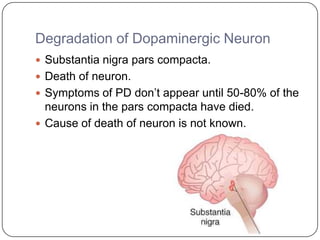
 Substantia nigra pars compacta.
 Death of neuron.
 Symptoms of PD don’t appear until 50-80% of the
neurons in the pars compacta have died.
 Cause of death of neuron is not known.
Free Radicals
 Unpaired electrons that can easily react with
surrounding molecules and destroy them.
 Metabolism of dopamine by MAO produce
hydrogen peroxide.
 Glutathione normally breaks down the hydrogen
peroxide quickly.
 Reduced glutathione = loss of protection against
free radicals  cell damage
Neurotoxin - MPTP
 1-methyl-4-phenyl-1,2,3,6-tetrahydropyridine
(MPTP) – neurotoxin.
 MPTP crosses the blood-brain barrier and
oxidized to 1-methyl-4-phenylpyridinium (MPP+)
by monoamine oxidase B (MAO)-B
 MPP+ selectively enters dopamine neurons via
the dopamine transporter.
 MPP+ inhibiting Complex I  leads to cell death
via energy deficit.
Genetic Factors
• Mutation of SNCA genes in chromosome 4.
• 2 types of alterations:
• Alanine is replaced with
threonine.
• Cause alpha-synuclein to
misfold.
• SNCA genes is
inappropriately duplicated
or triplicated.
• Extra copies of the gene
lead to an excess of alpha-
synuclein.
• Aggregate (Lewy bodies) and attract other protein.
• Clog neuron and impair the function of neuron.
oCase Study:
• 70 year-old male
• Farmer
• Referred to a movement disorders outpatient clinic
Symptoms
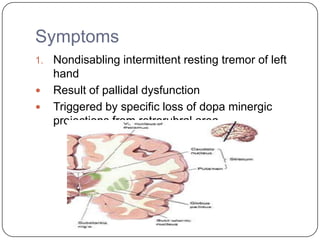
1. Nondisabling intermittent resting tremor of left
hand
 Result of pallidal dysfunction
 Triggered by specific loss of dopa minergic
projections from retrorubral area
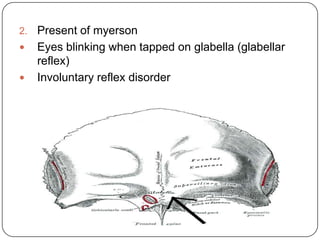
2. Present of myerson
 Eyes blinking when tapped on glabella (glabellar
reflex)
 Involuntary reflex disorder
3. Mild signs of asymmetrical cogwheel rigidity and
bradykinesia (left > right)
 Cause to muscular aches and sensation of fatigue
 Face become masklike, opened mouth, drooling
and reduced blinking
 Underscaling of movement commands in internally
generated movements
 Reflect the role of the basal ganglia in selecting
and reinforce appropriate patterns of cortical
activity during movement preparation and
performance
4. Normal gait and balance and postural reflexes
 Under activity in the left cerebellar hemisphere with
contrast of over activity in vermis
 Associated with loss of lateral gravity shift in
parkinsonian gait
 Loss of postural reflexes
 No tendency of falling forward
 No difficulty of walking, turning and stopping
Diagnostic Test
 No specific test.
 Usually based on present of symptoms.
 Referral time should not be more than 6 weeks
and not exceed two weeks in severe case.
 No specific lab test used for diagnosis.
 Follow – up= every 6 to 12 months.
 Suggested method include:
Neurologic examination
Oculomotor examination
Electroencephalograms (EEG)
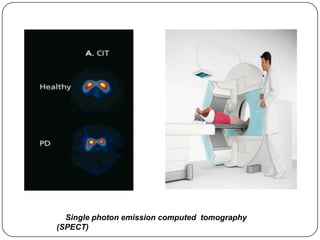
Single photon emission computed tomography
(SPECT)
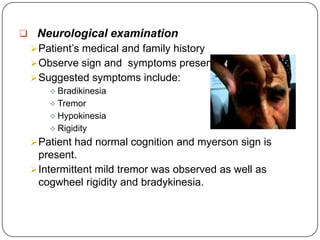
 Neurological examination
Patient’s medical and family history
Observe sign and symptoms present.
Suggested symptoms include:
 Bradikinesia
 Tremor
 Hypokinesia
 Rigidity
Patient had normal cognition and myerson sign is
present.
Intermittent mild tremor was observed as well as
cogwheel rigidity and bradykinesia.
 Oculomotor examination
To check abnormalities of eye movement, generation,
and control.
Normal in patient.
 Single photon emission computed tomography
(SPECT)
Show dramatic (50%) loss of striatal uptake in patient
compared to normal individual.
Electroencephalograms
Record patient’s brain electrical activity.
Single photon emission computed tomography
(SPECT)
Treatment
According to the case study the patient was on
initiation of treatment:In early-stage disease,
the pharmacological options for the treatment
of PD are multiple.
 Levodopa:
 is a medicine that the brain converts to dopamine.
is a medicine used to control symptoms
of Parkinson's disease and used at all stages of the
disease.
Levodopa does not slow the disease process, but it
improves muscle movement and delays severe
disability.
long-term levodopa therapy within 5 to 10 years can
cause complication to occur such as Dyskinesia.
 Dopamine agonist:
Example of drugs:pramipexole,ropinirole
directly stimulate the receptors in nerves in the
brain that normally would be stimulated
by dopamine.
used in the early stages of Parkinson’s disease to
reduce symptoms.
effective in people who have been newly diagnosed
with the disease (especially those younger than 60).
Not effective as levodopa in reducing symptom but
can prevent long term effect caused by levodopa.
 Monoamine oxidase type B inhibitor
MAO-B is an enzyme in our brain that naturally
breaks down several chemicals in our brain
including dopamine.
Prevent the breakdown dopamine.
they prevent the removal of dopamine between
nerve endings and enhance release of dopamine
from nerve cells.
Example of drug: Rasagiline and selegiline.
used in the early stages, to treat very mild
symptoms (such as resting tremor) and delay the
need for levodopa.
rasagiline or selegiline may be added to levodopa
treatment to reduce motor fluctuations , increase
the time of effect of the levodopa.
 Amantadine
 treat people who are in the early stages of
Parkinson's disease.
 It is best used in people who have mild to moderate
symptoms.
cause greater amounts of dopamine to be released
in the brain.
can be used with levodopa in the later stages of
Parkinson's disease to reduce dyskinesias.
 Anticholinergic
Example of drugs: benztropine,biperiden
Anticholinergic medicines decrease levels of
acetylcholine to achieve a closer balance with
dopamine levels.
In order to reduce the symptom.
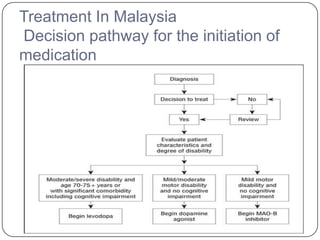
Treatment In Malaysia
Decision pathway for the initiation of
medication
 Levodopa ( L-Dopa)
the most effective antiparkinsonian medication.
“start low, go slow” approach, L-dopa can be started at
a dose of 50 mg daily (e.g., ¼ tablet of Madopar®
200/50 mg) increasing every 3-7 days by 50 mg to an
initial maintenance dose of 50-100 mg 3x daily.
 Selegiline ( Jumex and Selegos)
usual dose is 10 mg in the morning.
has a mild antiparkinsonian effect.
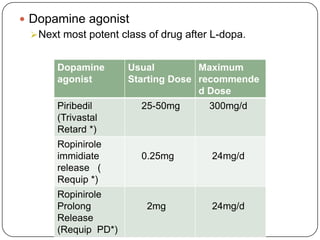
 Dopamine agonist
Next most potent class of drug after L-dopa.
Dopamine
agonist
Usual
Starting Dose
Maximum
recommende
d Dose
Piribedil
(Trivastal
Retard *)
25-50mg 300mg/d
Ropinirole
immidiate
release (
Requip *)
0.25mg 24mg/d
Ropinirole
Prolong
Release
(Requip PD*)
2mg 24mg/d
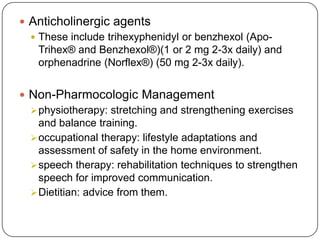
 Anticholinergic agents
 These include trihexyphenidyl or benzhexol (Apo-
Trihex® and Benzhexol®)(1 or 2 mg 2-3x daily) and
orphenadrine (Norflex®) (50 mg 2-3x daily).
 Non-Pharmocologic Management
physiotherapy: stretching and strengthening exercises
and balance training.
occupational therapy: lifestyle adaptations and
assessment of safety in the home environment.
speech therapy: rehabilitation techniques to strengthen
speech for improved communication.
Dietitian: advice from them.
Conclusion
 Patient has idiopathic Parkinson’s disease
 There is no cure but therapies are available
 Treatments aim to:
Prevent clinical progression
Improvement of parkinsonism
Delay of motor complications
 Complications: choking, falls and side effects of
drugs
 Prognosis: normal life expectancy for treated
patients
Reference
Anonymous. (2012). Tremor Fact Sheet. [Online]. Available from:
http://www.ninds.nih.gov/disorders/tremor/detail_tremor.htm.Nati
onal, Institute of Neurological Disorders and Stroke. Accessed on
2nd March 2013
Dr Ananya Mandal, MD. (2013). Parkinson's Disease
Pathophysiology. [Online]. Available from: http://www.news-
medical.net/health/Parkinsons-Disease-Pathophysiology.aspx.
[Accessed on 1st March 2013].
Dr. Ananya Mandal. (2013). Parkinson’s disease Prognosis.
[Online]. Available from: http://www.news-
medical.net/health/Parkinsons-Disease-Prognosis.aspx.
[Accessed on 2nd March 2013].
Malaysian Parkinson’s Disease Association. (2012). Association
wants Disability Rights for Parkinson’s Patients. [Online].
Available from:
http://mpda.org.my/article.php?type=news&9ja847hd0a1=144.
[Accessed on 2nd March 2013].
Mayo Clinic. Parkinson’s Disease: Risk Factors. [Online]. Available
from: http://www.mayoclinic.com/health/parkinsons-
disease/DS00295/DSECTION=risk-factors. [Accessed on 1st
March 2013].
Parkinson’s Disease Society. The professional’s guide to
Parkinson’s Disease. [Online]. Available from:
http://www.parkinsons.org.uk/pdf/B126_Professionalsguide.pdf.
[Accessed on 1st March 2013].
Parkinson’s UK. Types of Parkinson’s and parkinsonism. Online].
Available from:
http://www.parkinsons.org.uk/about_parkinsons/what_is_parkins
ons/types_of_parkinsons.aspx. [Accessed on 2nd March 2013].
Public Health and Genetics Information Series. Parkinson’s
disease. [Online]. Available from:
http://www.hgen.pitt.edu/counseling/public_health/parkinsons.pdf
. [Accessed on 1st March 2013].
Robert A Hauser, MD. (2013). Parkinson Disease . [Online].
Available from : http://emedicine.medscape.com/article/1831191-
overview#aw2aab6b2b1aa.[Accessed 1st March 2013].
Takashi Hanakawa. (1999). Mechanisms underlying gait
disturbance in Parkinson's disease. [Online]. Available
from :
http://brain.oxfordjournals.org/content/122/7/1271.full.
[Accessed on 2nd March 2013]
Ted K Koutouzis, MD. (2005). Parkinson's Disease.
[OnlineAvailable from :
http://www.emedicinehealth.com/parkinson_disease/article
_em.htm. [Accessed 1st March 2013].
University of Maryland Medical Centre. Diagnosing
Parkinson’s Disease. [Online]. Available from:
http://www.umm.edu/parkinsons/diagnosis.htm. [Accessed
on 1st March 2013].
Wooten. G.F., Currie. L.J., Bovbjerg. V.E., Lee.J.K. and
Patrie. J. (2013). Are men at greater risk for Parkinson’s
disease than women? J Neurol Neurosurg Psychiatry.
75:637-639.
Parkinson s disease

Parkinson s disease

  • 1.
  • 2.
    Content  Introduction  Causeand pathogenesis  Case Study: Symptoms Diagnosis Treatment Conclusion
  • 3.
    oIntroduction  It isa progressive neurological condition  Results from the degeneration of dopamine- producing neurons in the substantia nigra  Afflicted 25,000 people in Malaysia  Various types of Parkinson’s disease  Risk factors: Middle aged and increased risk with age Hereditary Men (1.5 times more) Environmental exposure to toxins
  • 4.
    Symptoms  4 majorsymptoms: Rigidity – muscles are tensed and contracted Resting tremor – trembling which is most obvious when the patient is at rest or when stressed Bradykinesia – slowness in initiating movement Loss of postural reflexes or instability – poor balance and coordination  Non-motor symptoms Anxiety disorders, depression, sleep disturbances, orthostatic hypotension, olfaction dysfunction, dysphagia, sialorrhoea, dementia, psychosis and visual hallucinations
  • 5.
    Diagnosis and Treatment Diagnosis: Neurological examination Autopsy of brain to find lewy bodies (trademark characteristic) Judgement of physicians  Treatment: Medications Diet Exercise, physical and speech therapy Surgery  Cryothalamotomy  Pallidotomy  Deep brain stimulation
  • 6.
    oCauses and Pathogenesis Degradation of dopaminergic neuron.  Free radicals.  Neurotoxin - MPTP  Genetic factors.
  • 7.
    Degradation of DopaminergicNeuron  Substantia nigra pars compacta.  Death of neuron.  Symptoms of PD don’t appear until 50-80% of the neurons in the pars compacta have died.  Cause of death of neuron is not known.
  • 8.
    Free Radicals  Unpairedelectrons that can easily react with surrounding molecules and destroy them.  Metabolism of dopamine by MAO produce hydrogen peroxide.  Glutathione normally breaks down the hydrogen peroxide quickly.  Reduced glutathione = loss of protection against free radicals  cell damage
  • 9.
    Neurotoxin - MPTP 1-methyl-4-phenyl-1,2,3,6-tetrahydropyridine (MPTP) – neurotoxin.  MPTP crosses the blood-brain barrier and oxidized to 1-methyl-4-phenylpyridinium (MPP+) by monoamine oxidase B (MAO)-B  MPP+ selectively enters dopamine neurons via the dopamine transporter.  MPP+ inhibiting Complex I  leads to cell death via energy deficit.
  • 10.
    Genetic Factors • Mutationof SNCA genes in chromosome 4. • 2 types of alterations: • Alanine is replaced with threonine. • Cause alpha-synuclein to misfold. • SNCA genes is inappropriately duplicated or triplicated. • Extra copies of the gene lead to an excess of alpha- synuclein. • Aggregate (Lewy bodies) and attract other protein. • Clog neuron and impair the function of neuron.
  • 11.
    oCase Study: • 70year-old male • Farmer • Referred to a movement disorders outpatient clinic
  • 12.
    Symptoms 1. Nondisabling intermittentresting tremor of left hand  Result of pallidal dysfunction  Triggered by specific loss of dopa minergic projections from retrorubral area
  • 13.
    2. Present ofmyerson  Eyes blinking when tapped on glabella (glabellar reflex)  Involuntary reflex disorder
  • 14.
    3. Mild signsof asymmetrical cogwheel rigidity and bradykinesia (left > right)  Cause to muscular aches and sensation of fatigue  Face become masklike, opened mouth, drooling and reduced blinking  Underscaling of movement commands in internally generated movements  Reflect the role of the basal ganglia in selecting and reinforce appropriate patterns of cortical activity during movement preparation and performance
  • 15.
    4. Normal gaitand balance and postural reflexes  Under activity in the left cerebellar hemisphere with contrast of over activity in vermis  Associated with loss of lateral gravity shift in parkinsonian gait  Loss of postural reflexes  No tendency of falling forward  No difficulty of walking, turning and stopping
  • 16.
    Diagnostic Test  Nospecific test.  Usually based on present of symptoms.  Referral time should not be more than 6 weeks and not exceed two weeks in severe case.  No specific lab test used for diagnosis.  Follow – up= every 6 to 12 months.
  • 17.
     Suggested methodinclude: Neurologic examination Oculomotor examination Electroencephalograms (EEG) Single photon emission computed tomography (SPECT)
  • 18.
     Neurological examination Patient’smedical and family history Observe sign and symptoms present. Suggested symptoms include:  Bradikinesia  Tremor  Hypokinesia  Rigidity Patient had normal cognition and myerson sign is present. Intermittent mild tremor was observed as well as cogwheel rigidity and bradykinesia.
  • 19.
     Oculomotor examination Tocheck abnormalities of eye movement, generation, and control. Normal in patient.  Single photon emission computed tomography (SPECT) Show dramatic (50%) loss of striatal uptake in patient compared to normal individual. Electroencephalograms Record patient’s brain electrical activity.
  • 20.
    Single photon emissioncomputed tomography (SPECT)
  • 21.
    Treatment According to thecase study the patient was on initiation of treatment:In early-stage disease, the pharmacological options for the treatment of PD are multiple.  Levodopa:  is a medicine that the brain converts to dopamine. is a medicine used to control symptoms of Parkinson's disease and used at all stages of the disease. Levodopa does not slow the disease process, but it improves muscle movement and delays severe disability. long-term levodopa therapy within 5 to 10 years can cause complication to occur such as Dyskinesia.
  • 22.
     Dopamine agonist: Exampleof drugs:pramipexole,ropinirole directly stimulate the receptors in nerves in the brain that normally would be stimulated by dopamine. used in the early stages of Parkinson’s disease to reduce symptoms. effective in people who have been newly diagnosed with the disease (especially those younger than 60). Not effective as levodopa in reducing symptom but can prevent long term effect caused by levodopa.
  • 23.
     Monoamine oxidasetype B inhibitor MAO-B is an enzyme in our brain that naturally breaks down several chemicals in our brain including dopamine. Prevent the breakdown dopamine. they prevent the removal of dopamine between nerve endings and enhance release of dopamine from nerve cells. Example of drug: Rasagiline and selegiline. used in the early stages, to treat very mild symptoms (such as resting tremor) and delay the need for levodopa. rasagiline or selegiline may be added to levodopa treatment to reduce motor fluctuations , increase the time of effect of the levodopa.
  • 24.
     Amantadine  treatpeople who are in the early stages of Parkinson's disease.  It is best used in people who have mild to moderate symptoms. cause greater amounts of dopamine to be released in the brain. can be used with levodopa in the later stages of Parkinson's disease to reduce dyskinesias.
  • 25.
     Anticholinergic Example ofdrugs: benztropine,biperiden Anticholinergic medicines decrease levels of acetylcholine to achieve a closer balance with dopamine levels. In order to reduce the symptom.
  • 26.
    Treatment In Malaysia Decisionpathway for the initiation of medication
  • 27.
     Levodopa (L-Dopa) the most effective antiparkinsonian medication. “start low, go slow” approach, L-dopa can be started at a dose of 50 mg daily (e.g., ¼ tablet of Madopar® 200/50 mg) increasing every 3-7 days by 50 mg to an initial maintenance dose of 50-100 mg 3x daily.  Selegiline ( Jumex and Selegos) usual dose is 10 mg in the morning. has a mild antiparkinsonian effect.
  • 28.
     Dopamine agonist Nextmost potent class of drug after L-dopa. Dopamine agonist Usual Starting Dose Maximum recommende d Dose Piribedil (Trivastal Retard *) 25-50mg 300mg/d Ropinirole immidiate release ( Requip *) 0.25mg 24mg/d Ropinirole Prolong Release (Requip PD*) 2mg 24mg/d
  • 29.
     Anticholinergic agents These include trihexyphenidyl or benzhexol (Apo- Trihex® and Benzhexol®)(1 or 2 mg 2-3x daily) and orphenadrine (Norflex®) (50 mg 2-3x daily).  Non-Pharmocologic Management physiotherapy: stretching and strengthening exercises and balance training. occupational therapy: lifestyle adaptations and assessment of safety in the home environment. speech therapy: rehabilitation techniques to strengthen speech for improved communication. Dietitian: advice from them.
  • 30.
    Conclusion  Patient hasidiopathic Parkinson’s disease  There is no cure but therapies are available  Treatments aim to: Prevent clinical progression Improvement of parkinsonism Delay of motor complications  Complications: choking, falls and side effects of drugs  Prognosis: normal life expectancy for treated patients
  • 31.
    Reference Anonymous. (2012). TremorFact Sheet. [Online]. Available from: http://www.ninds.nih.gov/disorders/tremor/detail_tremor.htm.Nati onal, Institute of Neurological Disorders and Stroke. Accessed on 2nd March 2013 Dr Ananya Mandal, MD. (2013). Parkinson's Disease Pathophysiology. [Online]. Available from: http://www.news- medical.net/health/Parkinsons-Disease-Pathophysiology.aspx. [Accessed on 1st March 2013]. Dr. Ananya Mandal. (2013). Parkinson’s disease Prognosis. [Online]. Available from: http://www.news- medical.net/health/Parkinsons-Disease-Prognosis.aspx. [Accessed on 2nd March 2013]. Malaysian Parkinson’s Disease Association. (2012). Association wants Disability Rights for Parkinson’s Patients. [Online]. Available from: http://mpda.org.my/article.php?type=news&9ja847hd0a1=144. [Accessed on 2nd March 2013].
  • 32.
    Mayo Clinic. Parkinson’sDisease: Risk Factors. [Online]. Available from: http://www.mayoclinic.com/health/parkinsons- disease/DS00295/DSECTION=risk-factors. [Accessed on 1st March 2013]. Parkinson’s Disease Society. The professional’s guide to Parkinson’s Disease. [Online]. Available from: http://www.parkinsons.org.uk/pdf/B126_Professionalsguide.pdf. [Accessed on 1st March 2013]. Parkinson’s UK. Types of Parkinson’s and parkinsonism. Online]. Available from: http://www.parkinsons.org.uk/about_parkinsons/what_is_parkins ons/types_of_parkinsons.aspx. [Accessed on 2nd March 2013]. Public Health and Genetics Information Series. Parkinson’s disease. [Online]. Available from: http://www.hgen.pitt.edu/counseling/public_health/parkinsons.pdf . [Accessed on 1st March 2013]. Robert A Hauser, MD. (2013). Parkinson Disease . [Online]. Available from : http://emedicine.medscape.com/article/1831191- overview#aw2aab6b2b1aa.[Accessed 1st March 2013].
  • 33.
    Takashi Hanakawa. (1999).Mechanisms underlying gait disturbance in Parkinson's disease. [Online]. Available from : http://brain.oxfordjournals.org/content/122/7/1271.full. [Accessed on 2nd March 2013] Ted K Koutouzis, MD. (2005). Parkinson's Disease. [OnlineAvailable from : http://www.emedicinehealth.com/parkinson_disease/article _em.htm. [Accessed 1st March 2013]. University of Maryland Medical Centre. Diagnosing Parkinson’s Disease. [Online]. Available from: http://www.umm.edu/parkinsons/diagnosis.htm. [Accessed on 1st March 2013]. Wooten. G.F., Currie. L.J., Bovbjerg. V.E., Lee.J.K. and Patrie. J. (2013). Are men at greater risk for Parkinson’s disease than women? J Neurol Neurosurg Psychiatry. 75:637-639.