
Parking
Presented by
aglaia
Parking
• Parking is the act of stopping and
disengaging a vehicle and leaving it
unoccupied.
• Parking on one or both sides of a road is
often permitted, though sometimes with
restrictions.
• Some buildings have parking facilities for
use of the buildings' users.
• Countries and local governments have rules
for design and use of parking spaces.
Parking Lot, New York
Parking Methods
• When an Architect or an Engineer is
designing Roads; he must take care that he
designs the required Parking Areas as per
the requirement and the study of the traffic in
that area.
• The Parking Methods play a major role in
controlling traffic and avoid chaotic confusion
and traffic jams because of lack of Parking
facility.
types of Parking
1. On Street Parking
2. Off Street Parking
On Street Parking
• As the name itself suggests, “On-street
Parking” means the area allotted for Parking
purpose at the sides of the roads.
• For efficiency in Parking system; the On
street Parking is divided into two types:
1. Angular Parking
2. Parallel Parking
3. Perpendicular Parking
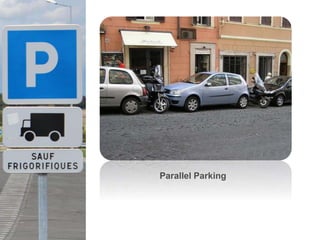
Parallel Parking System
• The vehicles are parked one behind the
other.
• The Parking lot is designed as per the
area required if Parallel Parking is
adopted.
• More number of vehicles can be parked
since area required is less.
• So this Parking system is generally
adopted.
Parallel Parking
Angular Parking
• The vehicles are parked at an angle.
• It may be a 30 degree angle or 45 degree.
• The vehicles can be easily reversed if
parked at an angle.
• Hence, proving as an efficient Parking
System in case of vehicular circulation.
• it requires larger space for parking so it is
used where the space is available in
plenty.
Angle parking
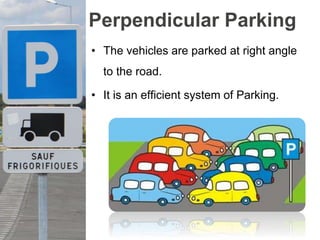
Perpendicular Parking
• The vehicles are parked at right angle
to the road.
• It is an efficient system of Parking.
Perpendicular parking
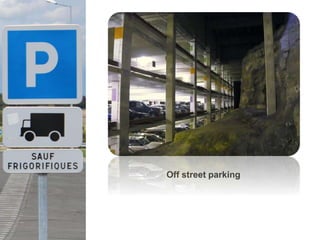
Off Street Parking
• This means a Parking Area is designed
adjacent to the Road or in a place or
building which is not the part of the road.
• examples of Off Street Parking
1. Parking lots
2. Bypass road
3. Multistory Building Garage
4. Parking Lanes
Off street parking
Parking technology
1. Sensors
2. Cameras
3. Assisted parking
4. Autonomous parking
Sensors
• Most new cars come with reversing
sensors now, and many come with
sensors on the front bumpers and sides.
• Sensors on the sides allow for automated
parallel and perpendicular parking, as well
as Rear Cross Traffic Alert which scans up
the road as you reverse out of a parking
space.
• Sometimes the sensors provide acoustic
feedback using a beep that increases in
frequency as you approach an object;
sometimes you may get a visualisation on
a screen; sometimes there’s both.
Assisted parking
• These systems mostly work on parallel
parking, although some will do
perpendicular parking, too.
• The driver usually remains in control of
the gears, throttle and braking while the
vehicle does the steering.
• These systems are not fool proof – heavy
rain and very dark conditions make it
more difficult for them to work effectively
– but work well almost all the time.
Autonomous parking
• Autonomous parking is where your
vehicle will park itself for you, but you
don’t have to be in it.
• The vehicle will take over all facets of the
parking manoeuvre – braking, throttle
and steering.
• When you return to your car, the vehicle
will extract itself from the parking space
and then you can get in.
Cameras
• Many cars now have reversing cameras.
• Some camera systems overlay graphics
that are linked to the steering angle,
showing lines that indicate your
projected path.
• Others attempt to identify objects that
might be slightly more difficult to interpret
on a screen, such as sharp corners on
buildings, or poles and posts.
• Premium cars may also have cameras
on the front facing forward or sideways,
or on the side to view how far the wheels
are from the kerb.
Thank you
For more…. Mail to
aglaiaconnect2018@gmail.com

Parking

  • 1.
  • 2.
    Parking • Parking isthe act of stopping and disengaging a vehicle and leaving it unoccupied. • Parking on one or both sides of a road is often permitted, though sometimes with restrictions. • Some buildings have parking facilities for use of the buildings' users. • Countries and local governments have rules for design and use of parking spaces.
  • 3.
  • 5.
    Parking Methods • Whenan Architect or an Engineer is designing Roads; he must take care that he designs the required Parking Areas as per the requirement and the study of the traffic in that area. • The Parking Methods play a major role in controlling traffic and avoid chaotic confusion and traffic jams because of lack of Parking facility. types of Parking 1. On Street Parking 2. Off Street Parking
  • 6.
    On Street Parking •As the name itself suggests, “On-street Parking” means the area allotted for Parking purpose at the sides of the roads. • For efficiency in Parking system; the On street Parking is divided into two types: 1. Angular Parking 2. Parallel Parking 3. Perpendicular Parking
  • 7.
    Parallel Parking System •The vehicles are parked one behind the other. • The Parking lot is designed as per the area required if Parallel Parking is adopted. • More number of vehicles can be parked since area required is less. • So this Parking system is generally adopted.
  • 8.
  • 9.
    Angular Parking • Thevehicles are parked at an angle. • It may be a 30 degree angle or 45 degree. • The vehicles can be easily reversed if parked at an angle. • Hence, proving as an efficient Parking System in case of vehicular circulation. • it requires larger space for parking so it is used where the space is available in plenty.
  • 10.
  • 11.
    Perpendicular Parking • Thevehicles are parked at right angle to the road. • It is an efficient system of Parking.
  • 12.
  • 13.
    Off Street Parking •This means a Parking Area is designed adjacent to the Road or in a place or building which is not the part of the road. • examples of Off Street Parking 1. Parking lots 2. Bypass road 3. Multistory Building Garage 4. Parking Lanes
  • 14.
  • 15.
    Parking technology 1. Sensors 2.Cameras 3. Assisted parking 4. Autonomous parking
  • 16.
    Sensors • Most newcars come with reversing sensors now, and many come with sensors on the front bumpers and sides. • Sensors on the sides allow for automated parallel and perpendicular parking, as well as Rear Cross Traffic Alert which scans up the road as you reverse out of a parking space. • Sometimes the sensors provide acoustic feedback using a beep that increases in frequency as you approach an object; sometimes you may get a visualisation on a screen; sometimes there’s both.
  • 18.
    Assisted parking • Thesesystems mostly work on parallel parking, although some will do perpendicular parking, too. • The driver usually remains in control of the gears, throttle and braking while the vehicle does the steering. • These systems are not fool proof – heavy rain and very dark conditions make it more difficult for them to work effectively – but work well almost all the time.
  • 20.
    Autonomous parking • Autonomousparking is where your vehicle will park itself for you, but you don’t have to be in it. • The vehicle will take over all facets of the parking manoeuvre – braking, throttle and steering. • When you return to your car, the vehicle will extract itself from the parking space and then you can get in.
  • 22.
    Cameras • Many carsnow have reversing cameras. • Some camera systems overlay graphics that are linked to the steering angle, showing lines that indicate your projected path. • Others attempt to identify objects that might be slightly more difficult to interpret on a screen, such as sharp corners on buildings, or poles and posts. • Premium cars may also have cameras on the front facing forward or sideways, or on the side to view how far the wheels are from the kerb.
  • 24.
    Thank you For more….Mail to aglaiaconnect2018@gmail.com