‘Traffic and Transportation Planning (CE-635)
Submitted by: Yajush G. Sonar (P17UP010)
Faculty Advisor: Dr. Krupesh A. Chauhan
P.G Section (Urban Planning),
Department of Civil Engineering,
सरदार वल्लभभाई राष्ट्रीय प्रौद्योगिकी संस्थान, सूरत
Sardar Vallabhbhai National Institute of Technology
Surat, Gujarat
(2017-2018)
A Graduate Report on
Bus Terminals and Logistics Parks
CONTENTS
• Definitions
• Bus Terminal
• Logistics Park
• Case Study: Model DPR for Ghaziabad Bus Terminal
• Summary
• References
DEFINITIONS
BUS TERMINAL:
• A bus terminal, or terminus, is the point where a bus
route starts or ends, where vehicles stop, turn or
reverse, and wait before departing on their return
journeys.
• A structure where city or intercity buses stop to pick
up and drop off passengers.
• While the term bus depot also refers to a bus
station, it can also refer to a bus garage.
• A bus station is larger than a bus stop, which is
usually simply a place on the roadside, where buses
can stop. It may be intended as a terminal station for
a number of routes, or as a transfer station where
the routes continue.
LOGISTICS PARK:
• Logistics can be defined as the most ancient trade in the
history of mankind although it had different existence and
identification varying from place to place; likewise the
existence of logistics parks shares a similar bondage.
• The key benefits of these parks are that they are cost
saving through economies of scale and growth.
• Logistics parks, as the definition rules, are a logistics
association and management with relative projection in
construction and sleek expansion.
• Industrial area or defined area for,
i. Activities relating to transport, logistics and the
distribution of goods
ii. Regional, national and/or international transit,
iii. Carried out by various operators
iv. Preferable with intermodal facilities
BUS STATION
FUNCTIONS:
• Primarily includes processing of vehicles, passengers
etc. with provision of necessary facilities for their
smooth flow. Terminal serves as a point and unit
where necessary information to user is made available
for processing.
• To create seamless multimodal connectivity, the bus
terminal should be integrated with other modes of
transport (train, metro, bicycle, pedestrian, private
car).
• A bus terminal also functions as the centre of a
neighbourhood with high density mixed use activities
in its vicinity. To provide a safe and attractive place
at all times, the presence of residential housing,
shopping complexes, offices and other commercial
activities are to be encouraged around the terminal.
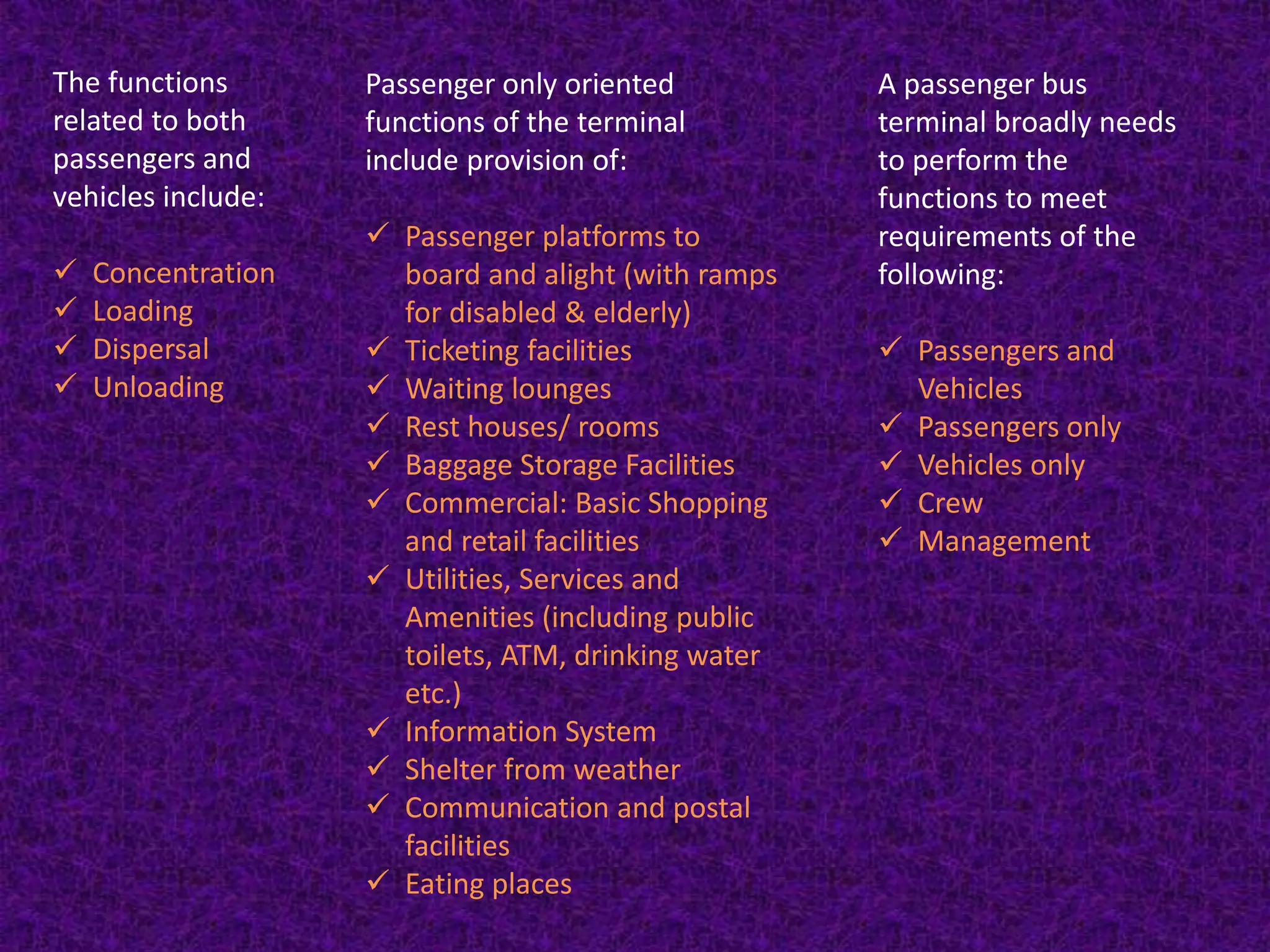
The functions
related to both
passengers and
vehicles include:
 Concentration
 Loading
 Dispersal
 Unloading
Passenger only oriented
functions of the terminal
include provision of:
 Passenger platforms to
board and alight (with ramps
for disabled & elderly)
 Ticketing facilities
 Waiting lounges
 Rest houses/ rooms
 Baggage Storage Facilities
 Commercial: Basic Shopping
and retail facilities
 Utilities, Services and
Amenities (including public
toilets, ATM, drinking water
etc.)
 Information System
 Shelter from weather
 Communication and postal
facilities
 Eating places
A passenger bus
terminal broadly needs
to perform the
functions to meet
requirements of the
following:
 Passengers and
Vehicles
 Passengers only
 Vehicles only
 Crew
 Management
CLASSIFICATION:
Bus terminals are predominantly inter-city and intra-city.
A workable hierarchy of bus terminals is as follows:
• Road based bus stop
• Road side bus bay
• Bus stop distributed
• Sub-nodal terminal
• Nodal bus terminal
• Inter-city bus terminal and inter-state bus terminal
(ISBT)
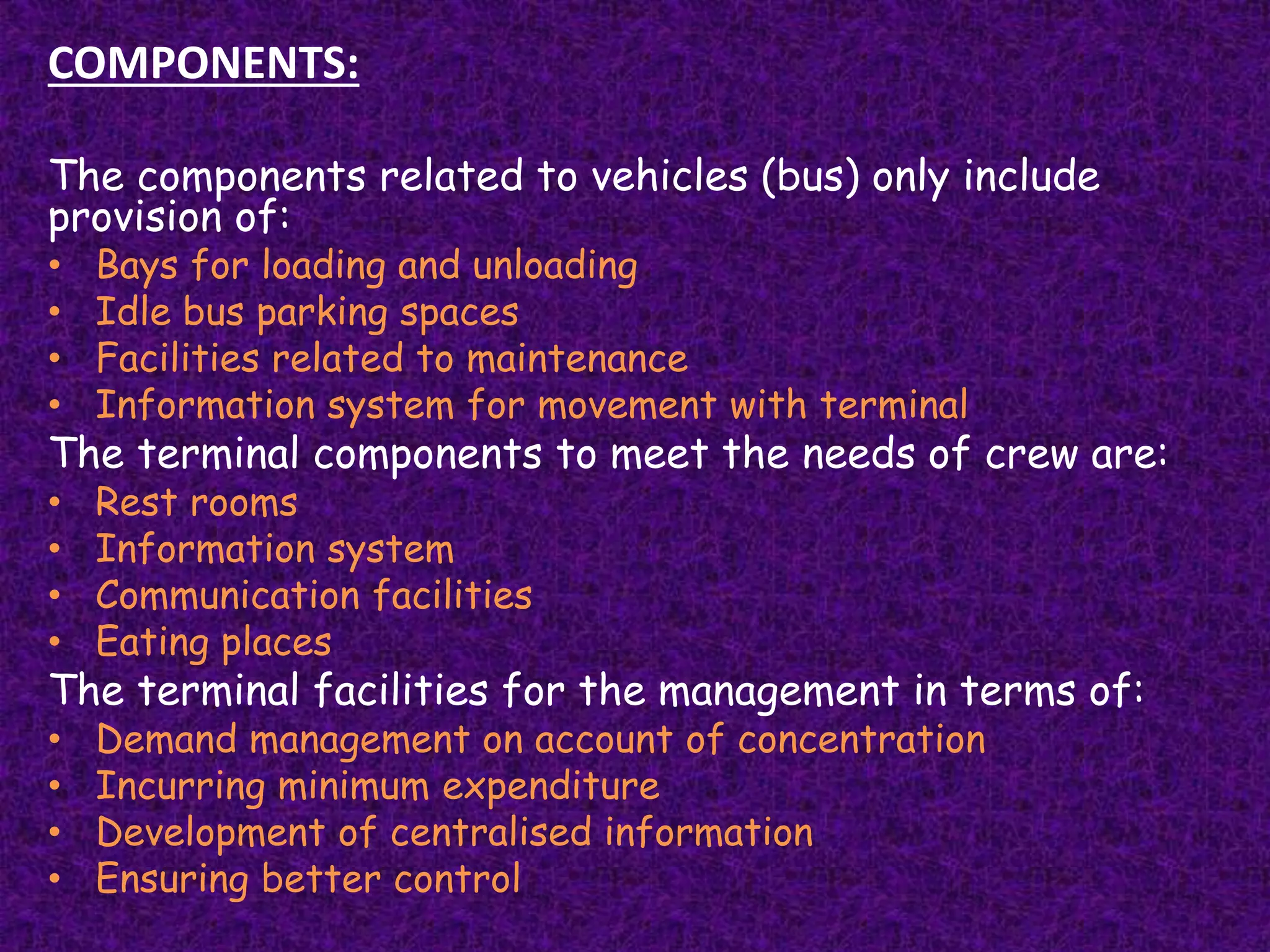
COMPONENTS:
The components related to vehicles (bus) only include
provision of:
• Bays for loading and unloading
• Idle bus parking spaces
• Facilities related to maintenance
• Information system for movement with terminal
The terminal components to meet the needs of crew are:
• Rest rooms
• Information system
• Communication facilities
• Eating places
The terminal facilities for the management in terms of:
• Demand management on account of concentration
• Incurring minimum expenditure
• Development of centralised information
• Ensuring better control
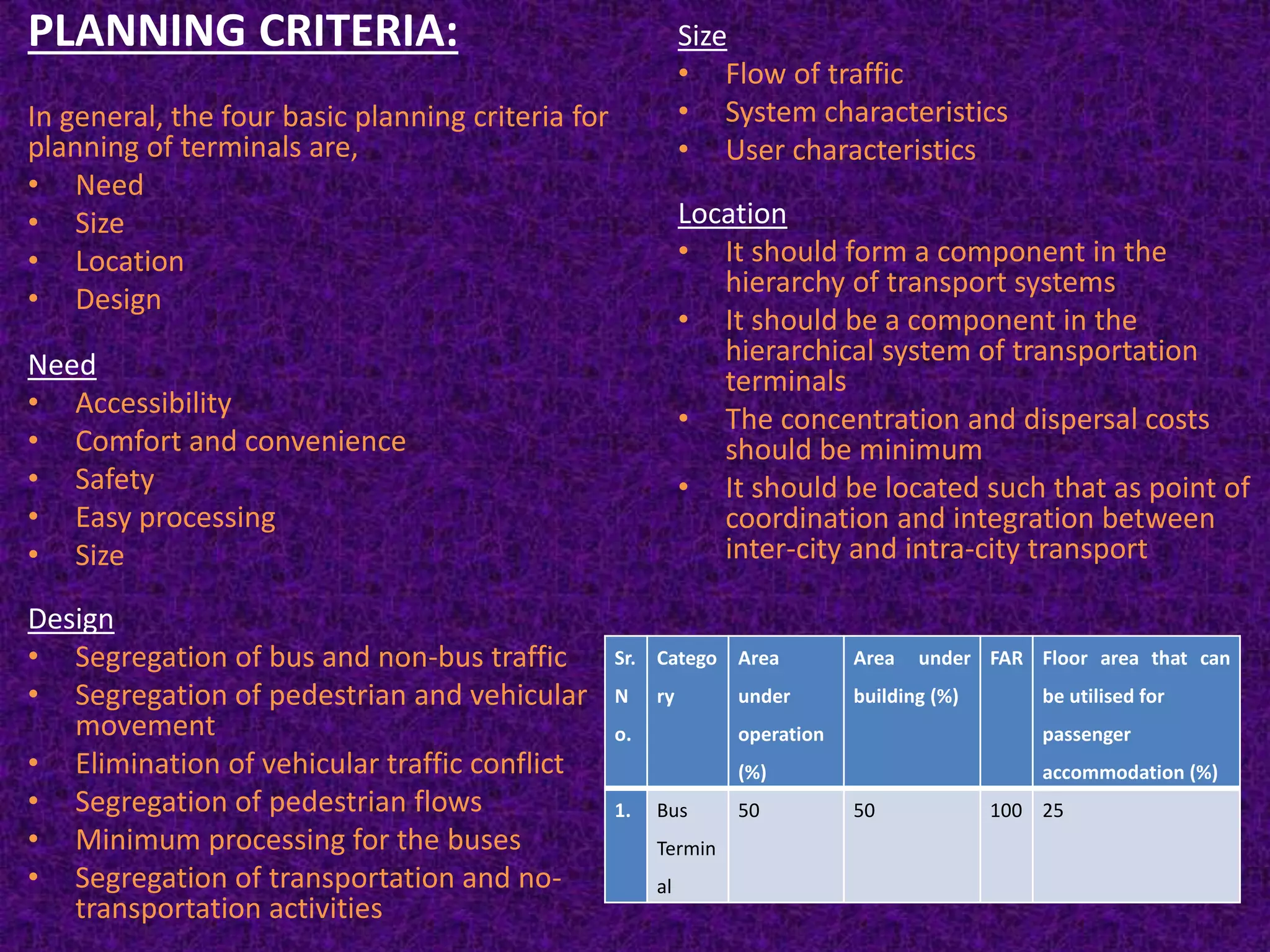
PLANNING CRITERIA:
In general, the four basic planning criteria for
planning of terminals are,
• Need
• Size
• Location
• Design
Need
• Accessibility
• Comfort and convenience
• Safety
• Easy processing
• Size
Design
• Segregation of bus and non-bus traffic
• Segregation of pedestrian and vehicular
movement
• Elimination of vehicular traffic conflict
• Segregation of pedestrian flows
• Minimum processing for the buses
• Segregation of transportation and no-
transportation activities
Size
• Flow of traffic
• System characteristics
• User characteristics
Location
• It should form a component in the
hierarchy of transport systems
• It should be a component in the
hierarchical system of transportation
terminals
• The concentration and dispersal costs
should be minimum
• It should be located such that as point of
coordination and integration between
inter-city and intra-city transport
Sr.
N
o.
Catego
ry
Area
under
operation
(%)
Area under
building (%)
FAR Floor area that can
be utilised for
passenger
accommodation (%)
1. Bus
Termin
al
50 50 100 25
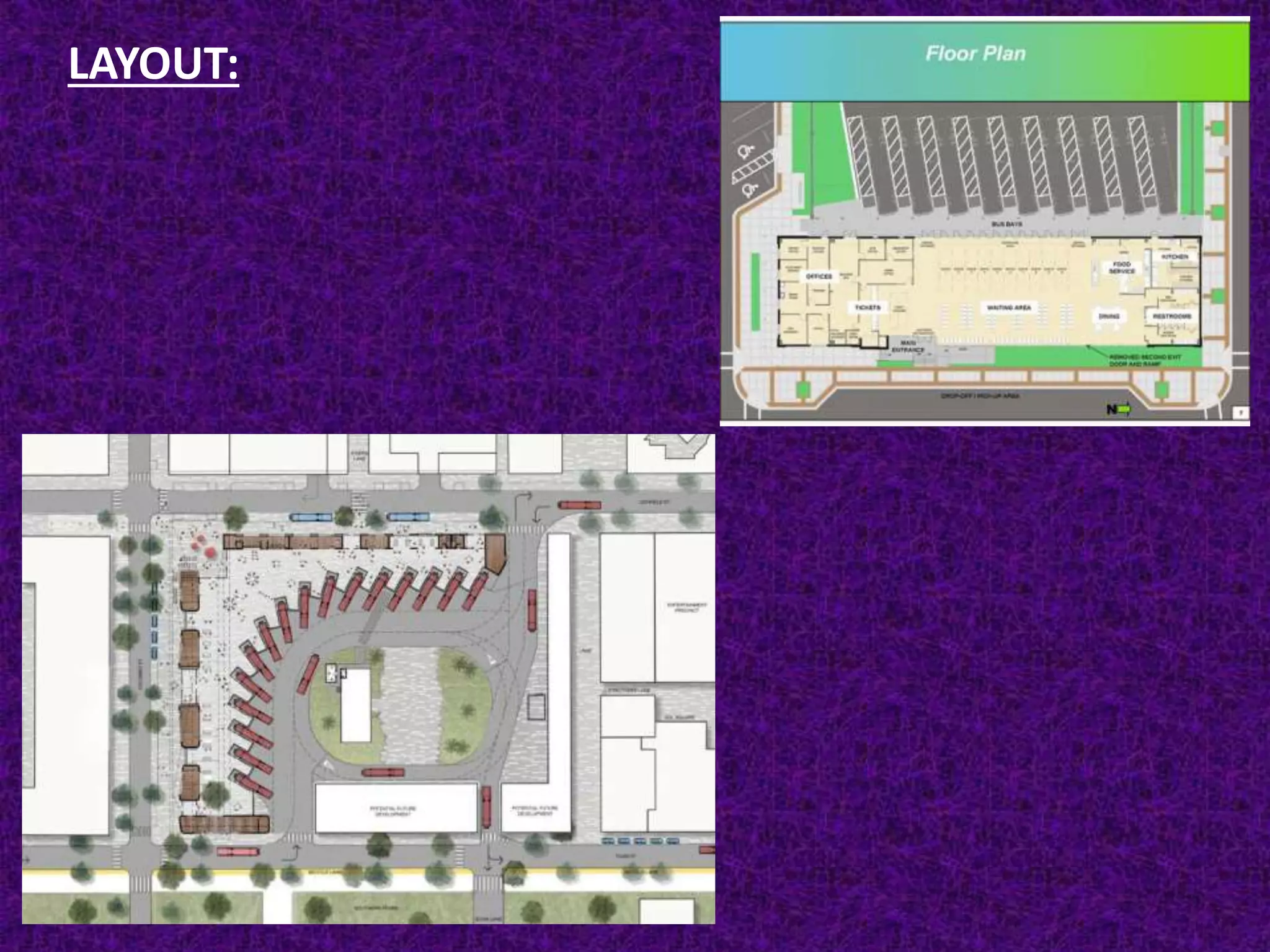
LAYOUT:
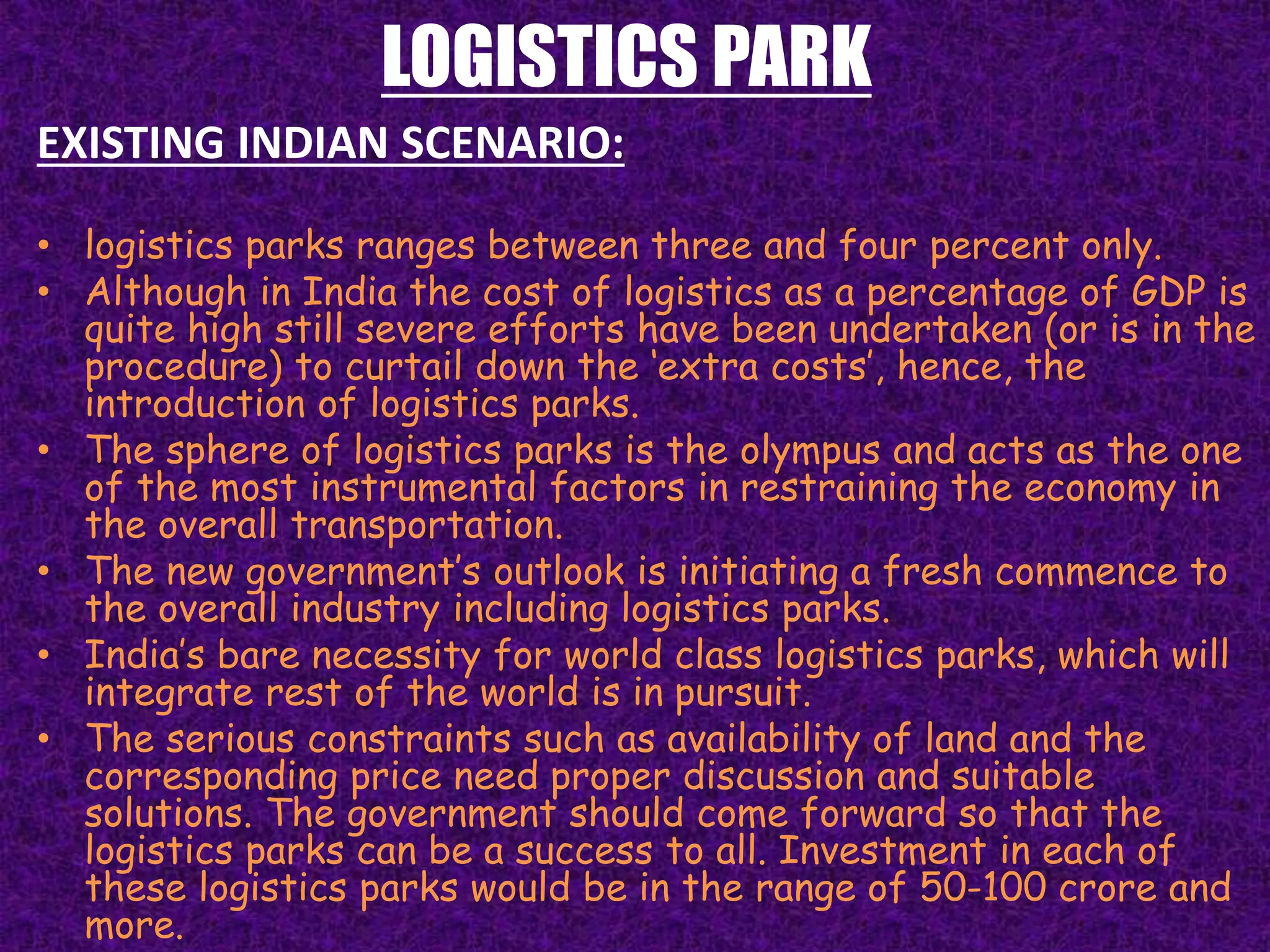
LOGISTICS PARK
EXISTING INDIAN SCENARIO:
• logistics parks ranges between three and four percent only.
• Although in India the cost of logistics as a percentage of GDP is
quite high still severe efforts have been undertaken (or is in the
procedure) to curtail down the ‘extra costs’, hence, the
introduction of logistics parks.
• The sphere of logistics parks is the olympus and acts as the one
of the most instrumental factors in restraining the economy in
the overall transportation.
• The new government’s outlook is initiating a fresh commence to
the overall industry including logistics parks.
• India’s bare necessity for world class logistics parks, which will
integrate rest of the world is in pursuit.
• The serious constraints such as availability of land and the
corresponding price need proper discussion and suitable
solutions. The government should come forward so that the
logistics parks can be a success to all. Investment in each of
these logistics parks would be in the range of 50-100 crore and
more.
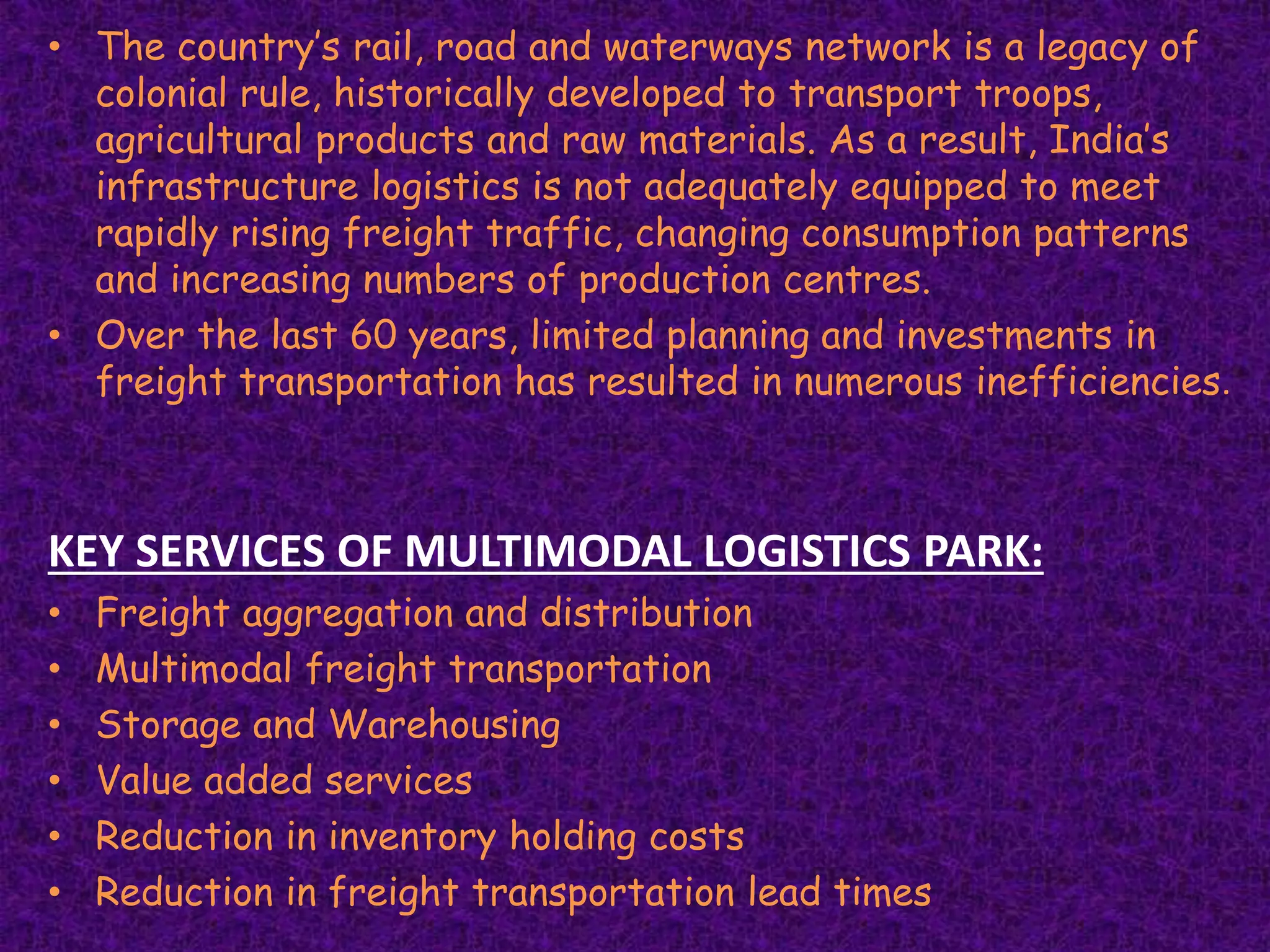
• The country’s rail, road and waterways network is a legacy of
colonial rule, historically developed to transport troops,
agricultural products and raw materials. As a result, India’s
infrastructure logistics is not adequately equipped to meet
rapidly rising freight traffic, changing consumption patterns
and increasing numbers of production centres.
• Over the last 60 years, limited planning and investments in
freight transportation has resulted in numerous inefficiencies.
KEY SERVICES OF MULTIMODAL LOGISTICS PARK:
• Freight aggregation and distribution
• Multimodal freight transportation
• Storage and Warehousing
• Value added services
• Reduction in inventory holding costs
• Reduction in freight transportation lead times
FUNCTIONS:
Logistic parks host the following elementary logistic activities:
• Private warehouses for general goods, dry goods, refrigerated
(chilled)/frozen goods and classified goods.
• Public warehouses, such as warehouse hotels and public
bounded warehouses.
• City distribution centre.
• Transhipment facilities for road, rail and if required
waterborne.
• Offices and parking lots for transport companies.
Activities that are related or associated to the elementary
activities of a logistic park include:
• Retail or wholesale distribution centres.
• Storage facilities for retailers.
• Pick-up centres for customers.
• Production companies related to value added logistics (VAL).
Specialised logistic parks are often connected or part of a larger
industrial complex
TYPES:
At seaports and inland ports
At airports:
• For air freight related activities
• Usually close to freight terminals, but not part of the air
side activities
National hubs or close to urban areas:
• As a link between long distances transport and short
distance collection or distribution
Specialised logistic parks:
• To bundle freight flows for different clients, such as
Green logistics parks in NL: for vegetables and fruits
• To concentrate transport activities near an industrial
site or other production locations
PLANNING GUIDELINES
FOR LOGISTICS PARKS:
Conventional Locational
factors to be considered:
• Infrastructure
• Labour cost
• Proximity to customers
• Community and site
characteristics
Three level approach:
• National/ International
level: network or stand
alone
• Regional level: depends on
situation
• Local level: available sites
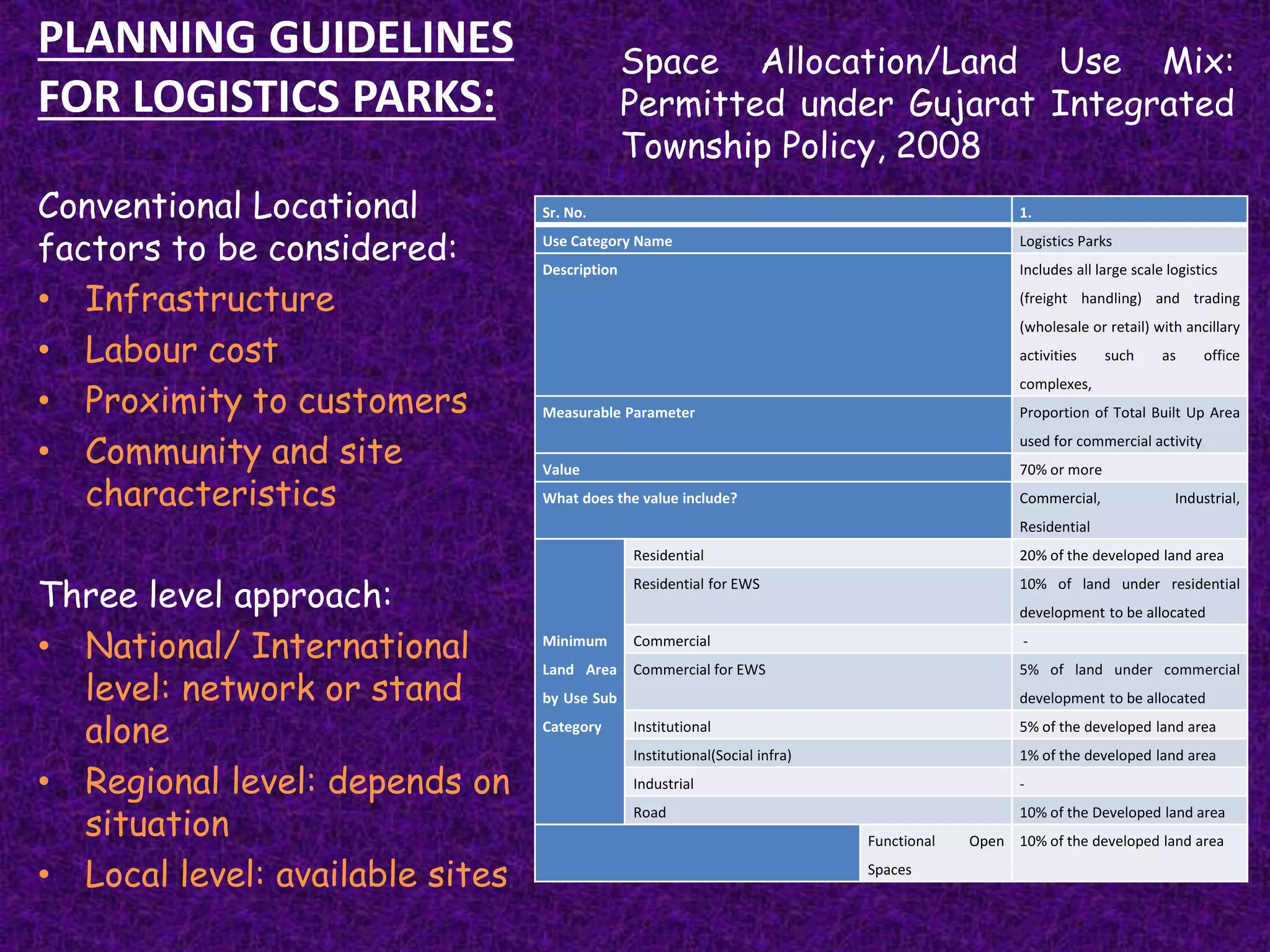
Sr. No. 1.
Use Category Name Logistics Parks
Description Includes all large scale logistics
(freight handling) and trading
(wholesale or retail) with ancillary
activities such as office
complexes,
Measurable Parameter Proportion of Total Built Up Area
used for commercial activity
Value 70% or more
What does the value include? Commercial, Industrial,
Residential
Minimum
Land Area
by Use Sub
Category
Residential 20% of the developed land area
Residential for EWS 10% of land under residential
development to be allocated
Commercial -
Commercial for EWS 5% of land under commercial
development to be allocated
Institutional 5% of the developed land area
Institutional(Social infra) 1% of the developed land area
Industrial -
Road 10% of the Developed land area
Functional Open
Spaces
10% of the developed land area
Space Allocation/Land Use Mix:
Permitted under Gujarat Integrated
Township Policy, 2008
LAYOUT:
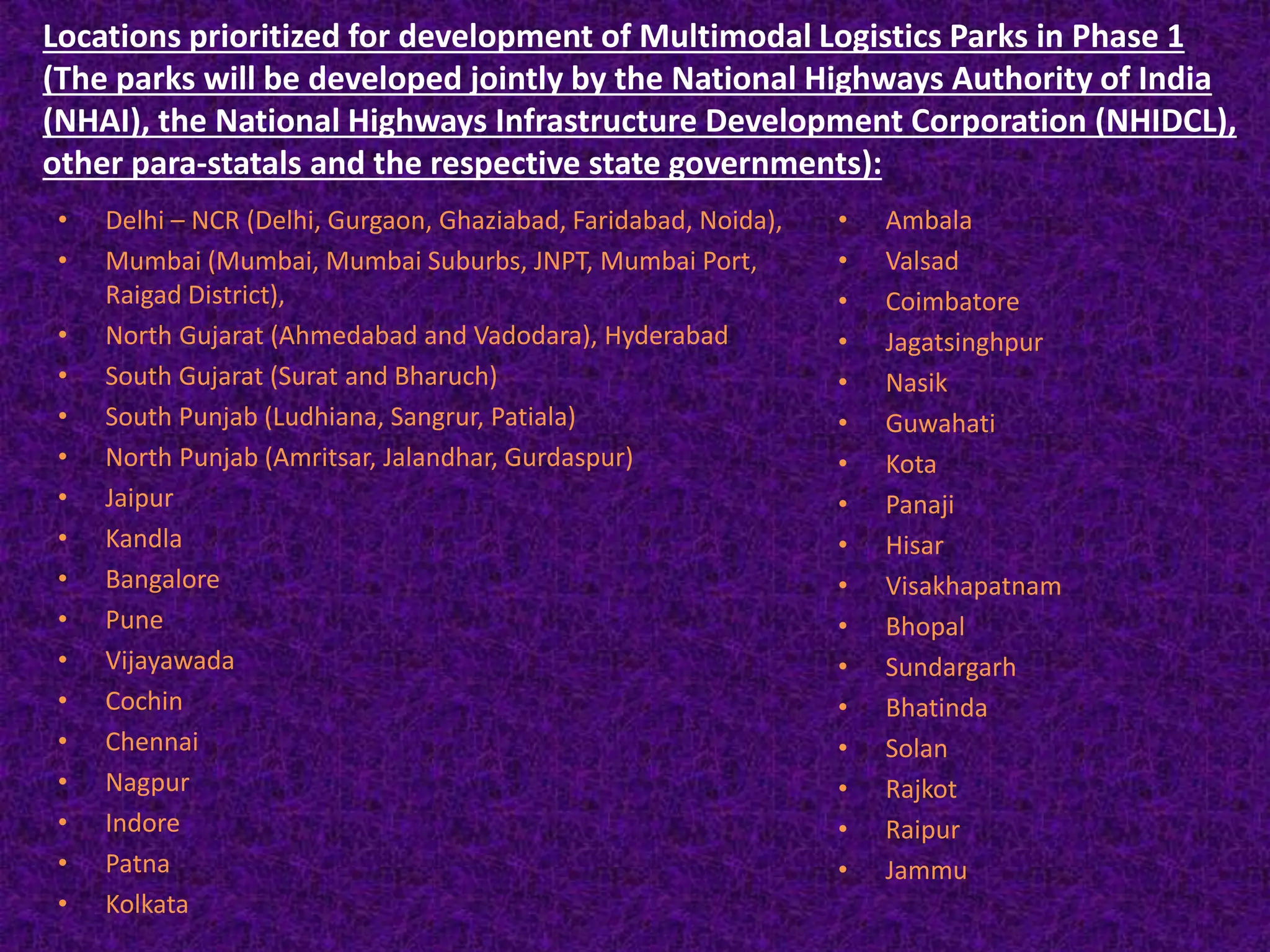
Locations prioritized for development of Multimodal Logistics Parks in Phase 1
(The parks will be developed jointly by the National Highways Authority of India
(NHAI), the National Highways Infrastructure Development Corporation (NHIDCL),
other para-statals and the respective state governments):
• Delhi – NCR (Delhi, Gurgaon, Ghaziabad, Faridabad, Noida),
• Mumbai (Mumbai, Mumbai Suburbs, JNPT, Mumbai Port,
Raigad District),
• North Gujarat (Ahmedabad and Vadodara), Hyderabad
• South Gujarat (Surat and Bharuch)
• South Punjab (Ludhiana, Sangrur, Patiala)
• North Punjab (Amritsar, Jalandhar, Gurdaspur)
• Jaipur
• Kandla
• Bangalore
• Pune
• Vijayawada
• Cochin
• Chennai
• Nagpur
• Indore
• Patna
• Kolkata
• Ambala
• Valsad
• Coimbatore
• Jagatsinghpur
• Nasik
• Guwahati
• Kota
• Panaji
• Hisar
• Visakhapatnam
• Bhopal
• Sundargarh
• Bhatinda
• Solan
• Rajkot
• Raipur
• Jammu
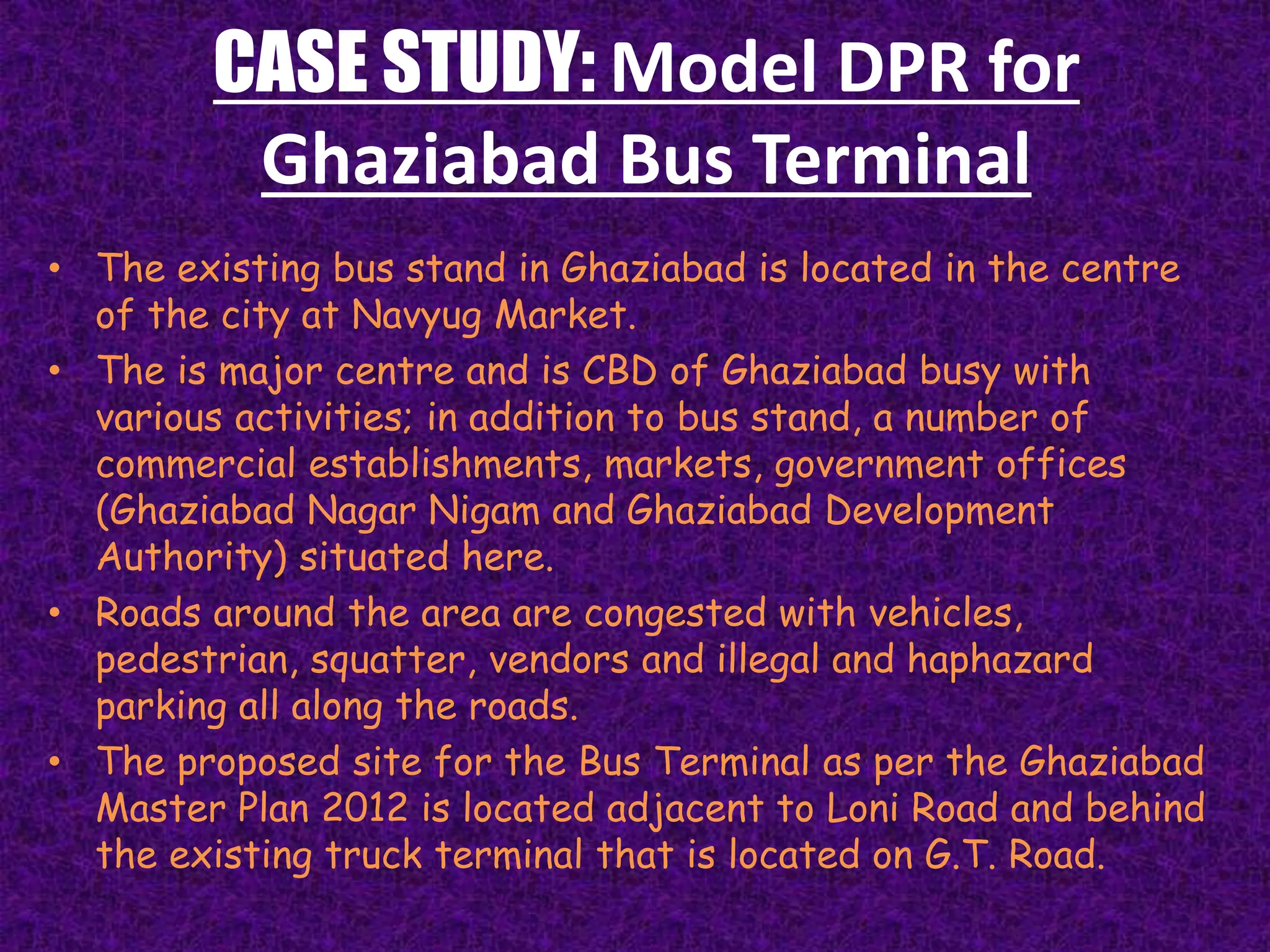
CASE STUDY: Model DPR for
Ghaziabad Bus Terminal
• The existing bus stand in Ghaziabad is located in the centre
of the city at Navyug Market.
• The is major centre and is CBD of Ghaziabad busy with
various activities; in addition to bus stand, a number of
commercial establishments, markets, government offices
(Ghaziabad Nagar Nigam and Ghaziabad Development
Authority) situated here.
• Roads around the area are congested with vehicles,
pedestrian, squatter, vendors and illegal and haphazard
parking all along the roads.
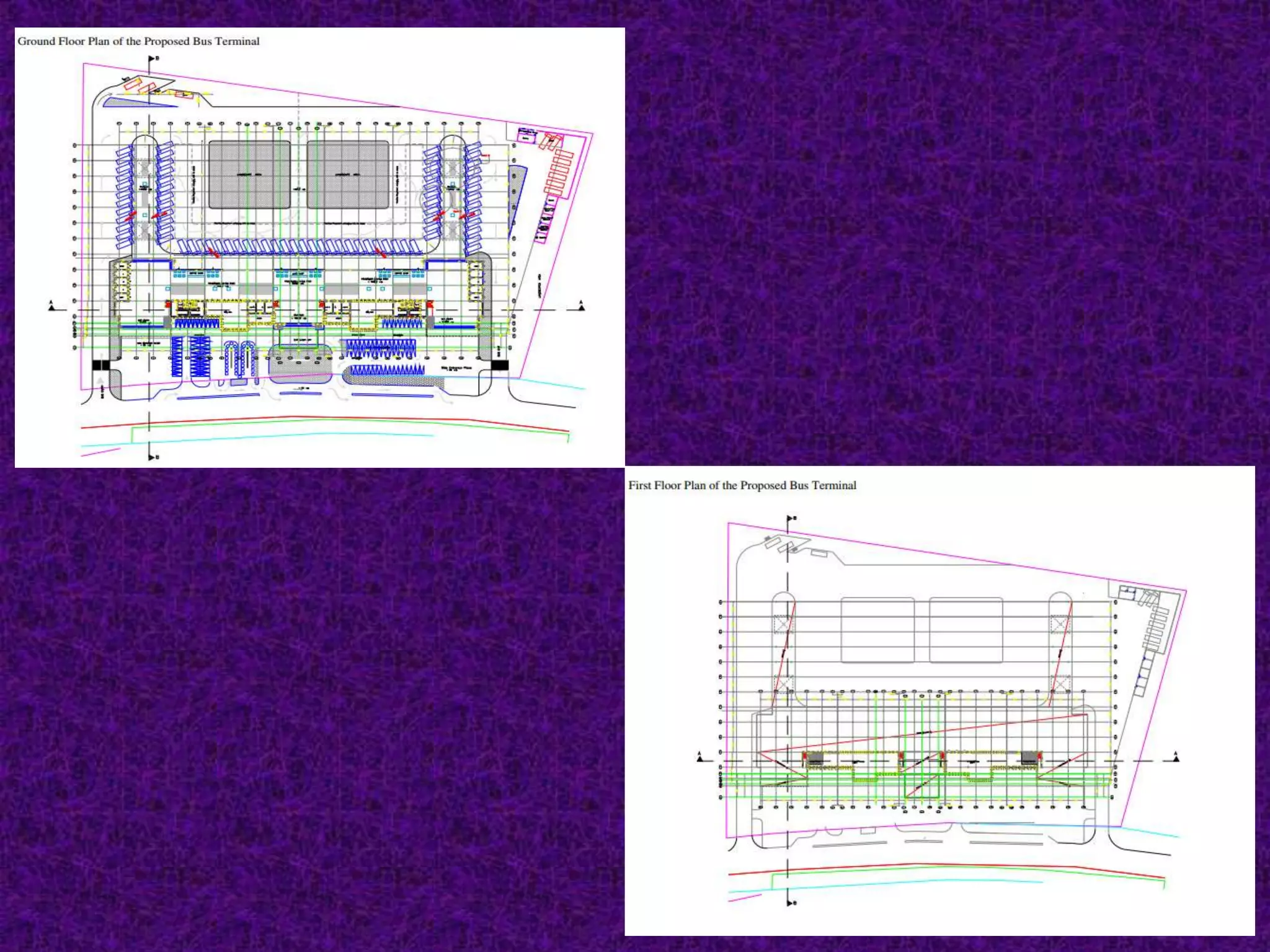
• The proposed site for the Bus Terminal as per the Ghaziabad
Master Plan 2012 is located adjacent to Loni Road and behind
the existing truck terminal that is located on G.T. Road.
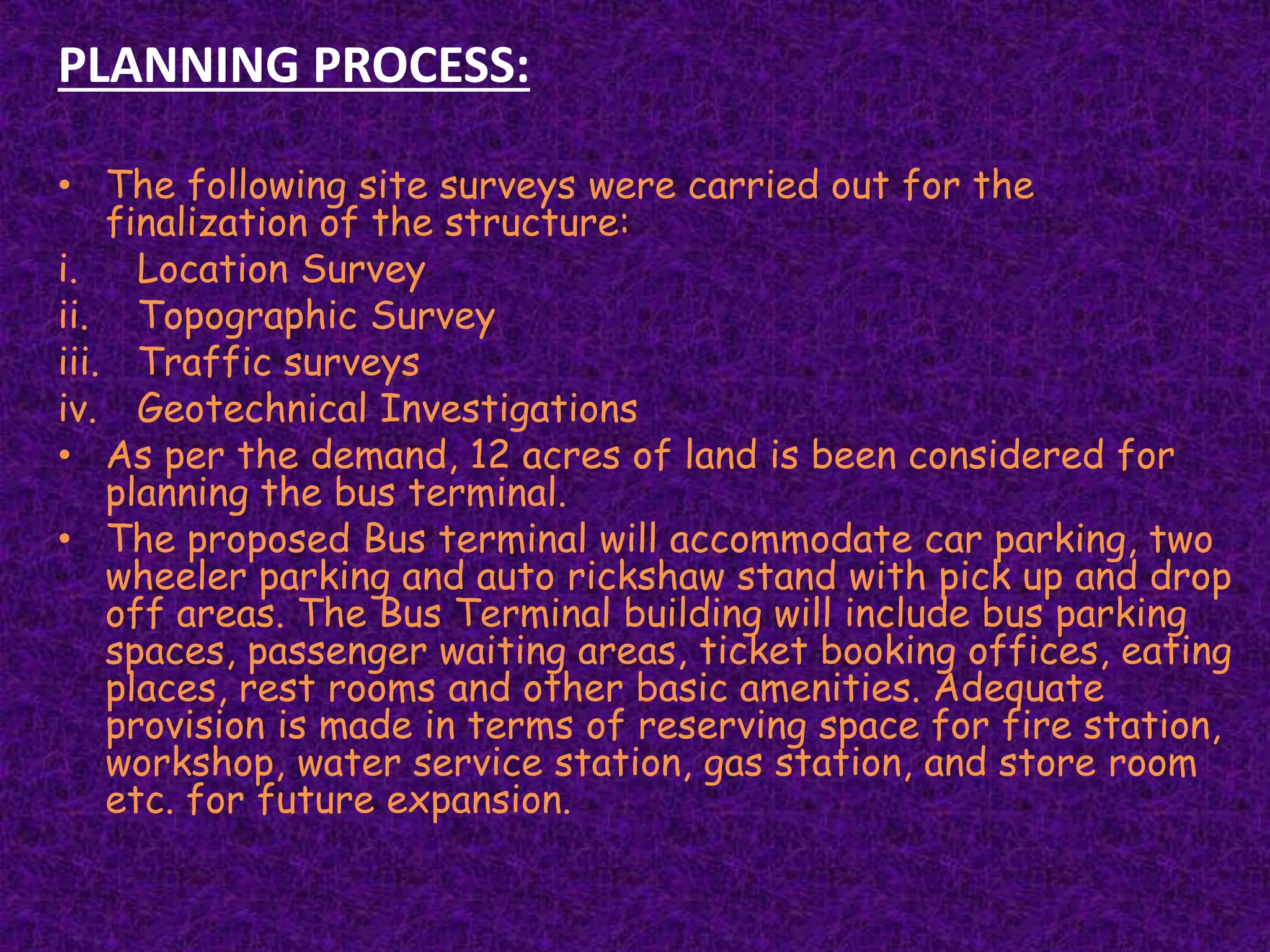
PLANNING PROCESS:
• The following site surveys were carried out for the
finalization of the structure:
i. Location Survey
ii. Topographic Survey
iii. Traffic surveys
iv. Geotechnical Investigations
• As per the demand, 12 acres of land is been considered for
planning the bus terminal.
• The proposed Bus terminal will accommodate car parking, two
wheeler parking and auto rickshaw stand with pick up and drop
off areas. The Bus Terminal building will include bus parking
spaces, passenger waiting areas, ticket booking offices, eating
places, rest rooms and other basic amenities. Adequate
provision is made in terms of reserving space for fire station,
workshop, water service station, gas station, and store room
etc. for future expansion.
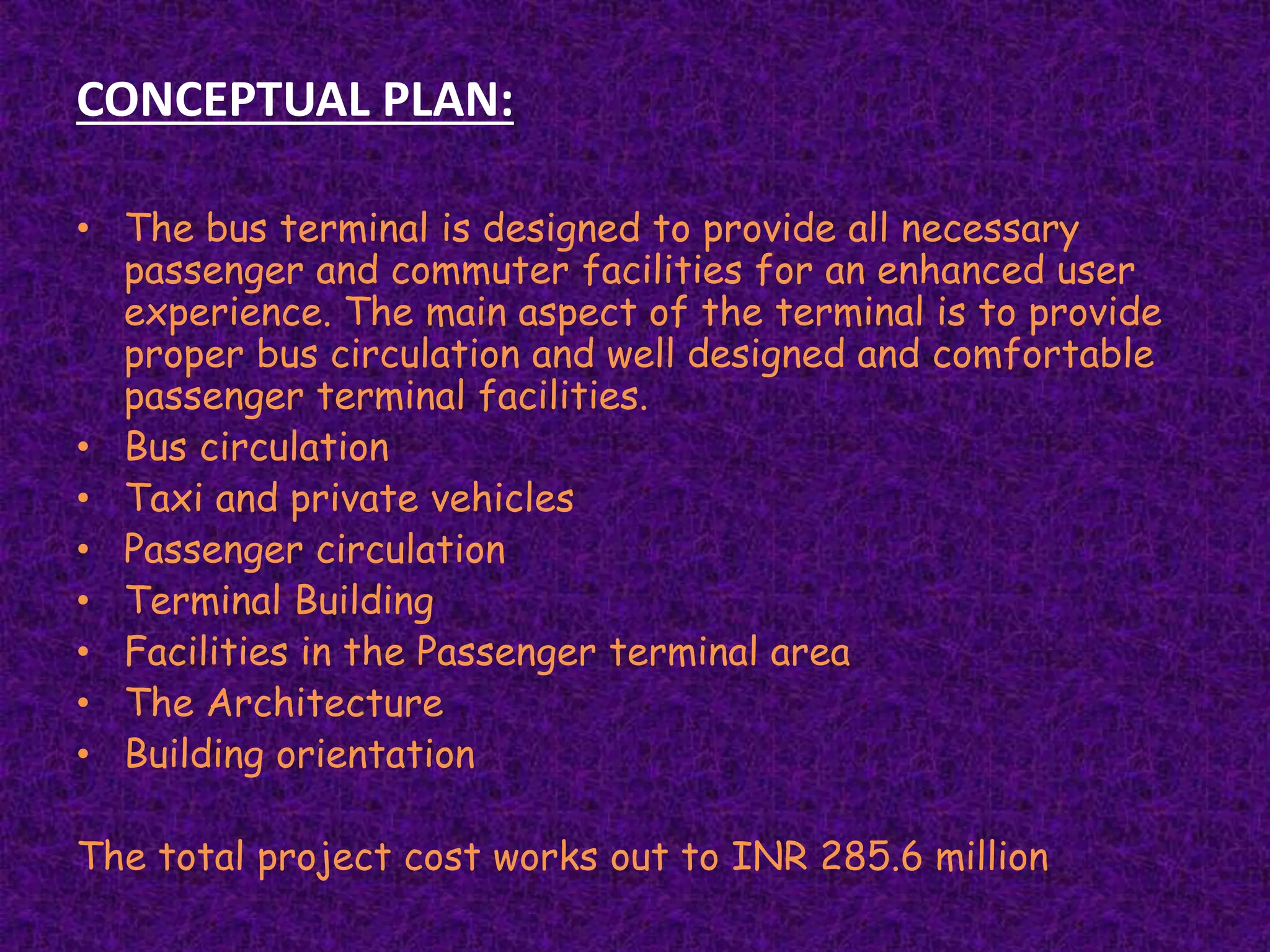
CONCEPTUAL PLAN:
• The bus terminal is designed to provide all necessary
passenger and commuter facilities for an enhanced user
experience. The main aspect of the terminal is to provide
proper bus circulation and well designed and comfortable
passenger terminal facilities.
• Bus circulation
• Taxi and private vehicles
• Passenger circulation
• Terminal Building
• Facilities in the Passenger terminal area
• The Architecture
• Building orientation
The total project cost works out to INR 285.6 million
SUMMARY
• As per Bus Terminals are considered in India, the
number of bus terminals are quite high and are at
every district headquarter, tehsil place and till the
villages. Hence, network of Bus terminals is quite good.
• But the main focus in the Bus terminals are its design
and planning criterion.
• The Bus terminals in India are not fulfilling the norms
and guidelines of the URDPFI and not at all in a well
planned and designed manner. Still Improvement is in
expected in this area.
• Whereas Logistic Parks are concerned, there are very
few numbers in India leading to resistance in Nation’s
development. However new 35 Logistic Parks are
sanctioned by MoRTH.
REFERENCES
BUS TERMINALS:
• [1] S.Logeswaran, “Design standards for planning a bus terminus”,
International Journal of Advanced Research in Basic Engineering
Sciences and Technology (IJARBEST), Vol.3, Special Issue.24, March
2017.
• [2] Technical Assistance Consultant’s Report, Volume V-C1: Main
Report, Model DPR for Bus Terminal at Ghaziabad.
• [3] www.wikipedia.com
LOGISTICS PARK:
• [1] Technical Assistance Consultant’s Report, McKinsey & Company.
• [2] Logistics parks: The dire need of the hour.
• [3] Introduction into the concept of logistics parks, Conference Paper ·
October 2009, https://www.researchgate.net/publication/274079841
• [4] India logistics Report 2014, “A definitive view on Mumbai and Pune
warehousing markets Research & warehousing:, Knight Frank.
• [5] Draft Policy Document, “Development of Multimodal Logistics Parks”,
Ministry of Road Transport and Highways.
Planning principles of Bus Terminals and Logistics Parks

Planning principles of Bus Terminals and Logistics Parks

  • 1.
    ‘Traffic and TransportationPlanning (CE-635) Submitted by: Yajush G. Sonar (P17UP010) Faculty Advisor: Dr. Krupesh A. Chauhan P.G Section (Urban Planning), Department of Civil Engineering, सरदार वल्लभभाई राष्ट्रीय प्रौद्योगिकी संस्थान, सूरत Sardar Vallabhbhai National Institute of Technology Surat, Gujarat (2017-2018) A Graduate Report on Bus Terminals and Logistics Parks
  • 2.
    CONTENTS • Definitions • BusTerminal • Logistics Park • Case Study: Model DPR for Ghaziabad Bus Terminal • Summary • References
  • 3.
    DEFINITIONS BUS TERMINAL: • Abus terminal, or terminus, is the point where a bus route starts or ends, where vehicles stop, turn or reverse, and wait before departing on their return journeys. • A structure where city or intercity buses stop to pick up and drop off passengers. • While the term bus depot also refers to a bus station, it can also refer to a bus garage. • A bus station is larger than a bus stop, which is usually simply a place on the roadside, where buses can stop. It may be intended as a terminal station for a number of routes, or as a transfer station where the routes continue.
  • 4.
    LOGISTICS PARK: • Logisticscan be defined as the most ancient trade in the history of mankind although it had different existence and identification varying from place to place; likewise the existence of logistics parks shares a similar bondage. • The key benefits of these parks are that they are cost saving through economies of scale and growth. • Logistics parks, as the definition rules, are a logistics association and management with relative projection in construction and sleek expansion. • Industrial area or defined area for, i. Activities relating to transport, logistics and the distribution of goods ii. Regional, national and/or international transit, iii. Carried out by various operators iv. Preferable with intermodal facilities
  • 5.
    BUS STATION FUNCTIONS: • Primarilyincludes processing of vehicles, passengers etc. with provision of necessary facilities for their smooth flow. Terminal serves as a point and unit where necessary information to user is made available for processing. • To create seamless multimodal connectivity, the bus terminal should be integrated with other modes of transport (train, metro, bicycle, pedestrian, private car). • A bus terminal also functions as the centre of a neighbourhood with high density mixed use activities in its vicinity. To provide a safe and attractive place at all times, the presence of residential housing, shopping complexes, offices and other commercial activities are to be encouraged around the terminal.
  • 6.
    The functions related toboth passengers and vehicles include:  Concentration  Loading  Dispersal  Unloading Passenger only oriented functions of the terminal include provision of:  Passenger platforms to board and alight (with ramps for disabled & elderly)  Ticketing facilities  Waiting lounges  Rest houses/ rooms  Baggage Storage Facilities  Commercial: Basic Shopping and retail facilities  Utilities, Services and Amenities (including public toilets, ATM, drinking water etc.)  Information System  Shelter from weather  Communication and postal facilities  Eating places A passenger bus terminal broadly needs to perform the functions to meet requirements of the following:  Passengers and Vehicles  Passengers only  Vehicles only  Crew  Management
  • 7.
    CLASSIFICATION: Bus terminals arepredominantly inter-city and intra-city. A workable hierarchy of bus terminals is as follows: • Road based bus stop • Road side bus bay • Bus stop distributed • Sub-nodal terminal • Nodal bus terminal • Inter-city bus terminal and inter-state bus terminal (ISBT)
  • 8.
    COMPONENTS: The components relatedto vehicles (bus) only include provision of: • Bays for loading and unloading • Idle bus parking spaces • Facilities related to maintenance • Information system for movement with terminal The terminal components to meet the needs of crew are: • Rest rooms • Information system • Communication facilities • Eating places The terminal facilities for the management in terms of: • Demand management on account of concentration • Incurring minimum expenditure • Development of centralised information • Ensuring better control
  • 9.
    PLANNING CRITERIA: In general,the four basic planning criteria for planning of terminals are, • Need • Size • Location • Design Need • Accessibility • Comfort and convenience • Safety • Easy processing • Size Design • Segregation of bus and non-bus traffic • Segregation of pedestrian and vehicular movement • Elimination of vehicular traffic conflict • Segregation of pedestrian flows • Minimum processing for the buses • Segregation of transportation and no- transportation activities Size • Flow of traffic • System characteristics • User characteristics Location • It should form a component in the hierarchy of transport systems • It should be a component in the hierarchical system of transportation terminals • The concentration and dispersal costs should be minimum • It should be located such that as point of coordination and integration between inter-city and intra-city transport Sr. N o. Catego ry Area under operation (%) Area under building (%) FAR Floor area that can be utilised for passenger accommodation (%) 1. Bus Termin al 50 50 100 25
  • 10.
  • 11.
    LOGISTICS PARK EXISTING INDIANSCENARIO: • logistics parks ranges between three and four percent only. • Although in India the cost of logistics as a percentage of GDP is quite high still severe efforts have been undertaken (or is in the procedure) to curtail down the ‘extra costs’, hence, the introduction of logistics parks. • The sphere of logistics parks is the olympus and acts as the one of the most instrumental factors in restraining the economy in the overall transportation. • The new government’s outlook is initiating a fresh commence to the overall industry including logistics parks. • India’s bare necessity for world class logistics parks, which will integrate rest of the world is in pursuit. • The serious constraints such as availability of land and the corresponding price need proper discussion and suitable solutions. The government should come forward so that the logistics parks can be a success to all. Investment in each of these logistics parks would be in the range of 50-100 crore and more.
  • 12.
    • The country’srail, road and waterways network is a legacy of colonial rule, historically developed to transport troops, agricultural products and raw materials. As a result, India’s infrastructure logistics is not adequately equipped to meet rapidly rising freight traffic, changing consumption patterns and increasing numbers of production centres. • Over the last 60 years, limited planning and investments in freight transportation has resulted in numerous inefficiencies. KEY SERVICES OF MULTIMODAL LOGISTICS PARK: • Freight aggregation and distribution • Multimodal freight transportation • Storage and Warehousing • Value added services • Reduction in inventory holding costs • Reduction in freight transportation lead times
  • 13.
    FUNCTIONS: Logistic parks hostthe following elementary logistic activities: • Private warehouses for general goods, dry goods, refrigerated (chilled)/frozen goods and classified goods. • Public warehouses, such as warehouse hotels and public bounded warehouses. • City distribution centre. • Transhipment facilities for road, rail and if required waterborne. • Offices and parking lots for transport companies. Activities that are related or associated to the elementary activities of a logistic park include: • Retail or wholesale distribution centres. • Storage facilities for retailers. • Pick-up centres for customers. • Production companies related to value added logistics (VAL). Specialised logistic parks are often connected or part of a larger industrial complex
  • 14.
    TYPES: At seaports andinland ports At airports: • For air freight related activities • Usually close to freight terminals, but not part of the air side activities National hubs or close to urban areas: • As a link between long distances transport and short distance collection or distribution Specialised logistic parks: • To bundle freight flows for different clients, such as Green logistics parks in NL: for vegetables and fruits • To concentrate transport activities near an industrial site or other production locations
  • 15.
    PLANNING GUIDELINES FOR LOGISTICSPARKS: Conventional Locational factors to be considered: • Infrastructure • Labour cost • Proximity to customers • Community and site characteristics Three level approach: • National/ International level: network or stand alone • Regional level: depends on situation • Local level: available sites Sr. No. 1. Use Category Name Logistics Parks Description Includes all large scale logistics (freight handling) and trading (wholesale or retail) with ancillary activities such as office complexes, Measurable Parameter Proportion of Total Built Up Area used for commercial activity Value 70% or more What does the value include? Commercial, Industrial, Residential Minimum Land Area by Use Sub Category Residential 20% of the developed land area Residential for EWS 10% of land under residential development to be allocated Commercial - Commercial for EWS 5% of land under commercial development to be allocated Institutional 5% of the developed land area Institutional(Social infra) 1% of the developed land area Industrial - Road 10% of the Developed land area Functional Open Spaces 10% of the developed land area Space Allocation/Land Use Mix: Permitted under Gujarat Integrated Township Policy, 2008
  • 16.
  • 17.
    Locations prioritized fordevelopment of Multimodal Logistics Parks in Phase 1 (The parks will be developed jointly by the National Highways Authority of India (NHAI), the National Highways Infrastructure Development Corporation (NHIDCL), other para-statals and the respective state governments): • Delhi – NCR (Delhi, Gurgaon, Ghaziabad, Faridabad, Noida), • Mumbai (Mumbai, Mumbai Suburbs, JNPT, Mumbai Port, Raigad District), • North Gujarat (Ahmedabad and Vadodara), Hyderabad • South Gujarat (Surat and Bharuch) • South Punjab (Ludhiana, Sangrur, Patiala) • North Punjab (Amritsar, Jalandhar, Gurdaspur) • Jaipur • Kandla • Bangalore • Pune • Vijayawada • Cochin • Chennai • Nagpur • Indore • Patna • Kolkata • Ambala • Valsad • Coimbatore • Jagatsinghpur • Nasik • Guwahati • Kota • Panaji • Hisar • Visakhapatnam • Bhopal • Sundargarh • Bhatinda • Solan • Rajkot • Raipur • Jammu
  • 18.
    CASE STUDY: ModelDPR for Ghaziabad Bus Terminal • The existing bus stand in Ghaziabad is located in the centre of the city at Navyug Market. • The is major centre and is CBD of Ghaziabad busy with various activities; in addition to bus stand, a number of commercial establishments, markets, government offices (Ghaziabad Nagar Nigam and Ghaziabad Development Authority) situated here. • Roads around the area are congested with vehicles, pedestrian, squatter, vendors and illegal and haphazard parking all along the roads. • The proposed site for the Bus Terminal as per the Ghaziabad Master Plan 2012 is located adjacent to Loni Road and behind the existing truck terminal that is located on G.T. Road.
  • 19.
    PLANNING PROCESS: • Thefollowing site surveys were carried out for the finalization of the structure: i. Location Survey ii. Topographic Survey iii. Traffic surveys iv. Geotechnical Investigations • As per the demand, 12 acres of land is been considered for planning the bus terminal. • The proposed Bus terminal will accommodate car parking, two wheeler parking and auto rickshaw stand with pick up and drop off areas. The Bus Terminal building will include bus parking spaces, passenger waiting areas, ticket booking offices, eating places, rest rooms and other basic amenities. Adequate provision is made in terms of reserving space for fire station, workshop, water service station, gas station, and store room etc. for future expansion.
  • 20.
    CONCEPTUAL PLAN: • Thebus terminal is designed to provide all necessary passenger and commuter facilities for an enhanced user experience. The main aspect of the terminal is to provide proper bus circulation and well designed and comfortable passenger terminal facilities. • Bus circulation • Taxi and private vehicles • Passenger circulation • Terminal Building • Facilities in the Passenger terminal area • The Architecture • Building orientation The total project cost works out to INR 285.6 million
  • 22.
    SUMMARY • As perBus Terminals are considered in India, the number of bus terminals are quite high and are at every district headquarter, tehsil place and till the villages. Hence, network of Bus terminals is quite good. • But the main focus in the Bus terminals are its design and planning criterion. • The Bus terminals in India are not fulfilling the norms and guidelines of the URDPFI and not at all in a well planned and designed manner. Still Improvement is in expected in this area. • Whereas Logistic Parks are concerned, there are very few numbers in India leading to resistance in Nation’s development. However new 35 Logistic Parks are sanctioned by MoRTH.
  • 23.
    REFERENCES BUS TERMINALS: • [1]S.Logeswaran, “Design standards for planning a bus terminus”, International Journal of Advanced Research in Basic Engineering Sciences and Technology (IJARBEST), Vol.3, Special Issue.24, March 2017. • [2] Technical Assistance Consultant’s Report, Volume V-C1: Main Report, Model DPR for Bus Terminal at Ghaziabad. • [3] www.wikipedia.com LOGISTICS PARK: • [1] Technical Assistance Consultant’s Report, McKinsey & Company. • [2] Logistics parks: The dire need of the hour. • [3] Introduction into the concept of logistics parks, Conference Paper · October 2009, https://www.researchgate.net/publication/274079841 • [4] India logistics Report 2014, “A definitive view on Mumbai and Pune warehousing markets Research & warehousing:, Knight Frank. • [5] Draft Policy Document, “Development of Multimodal Logistics Parks”, Ministry of Road Transport and Highways.