PARITY BITS
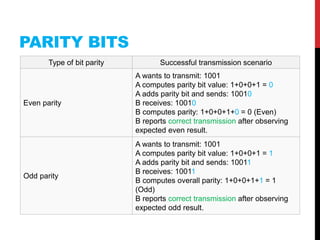
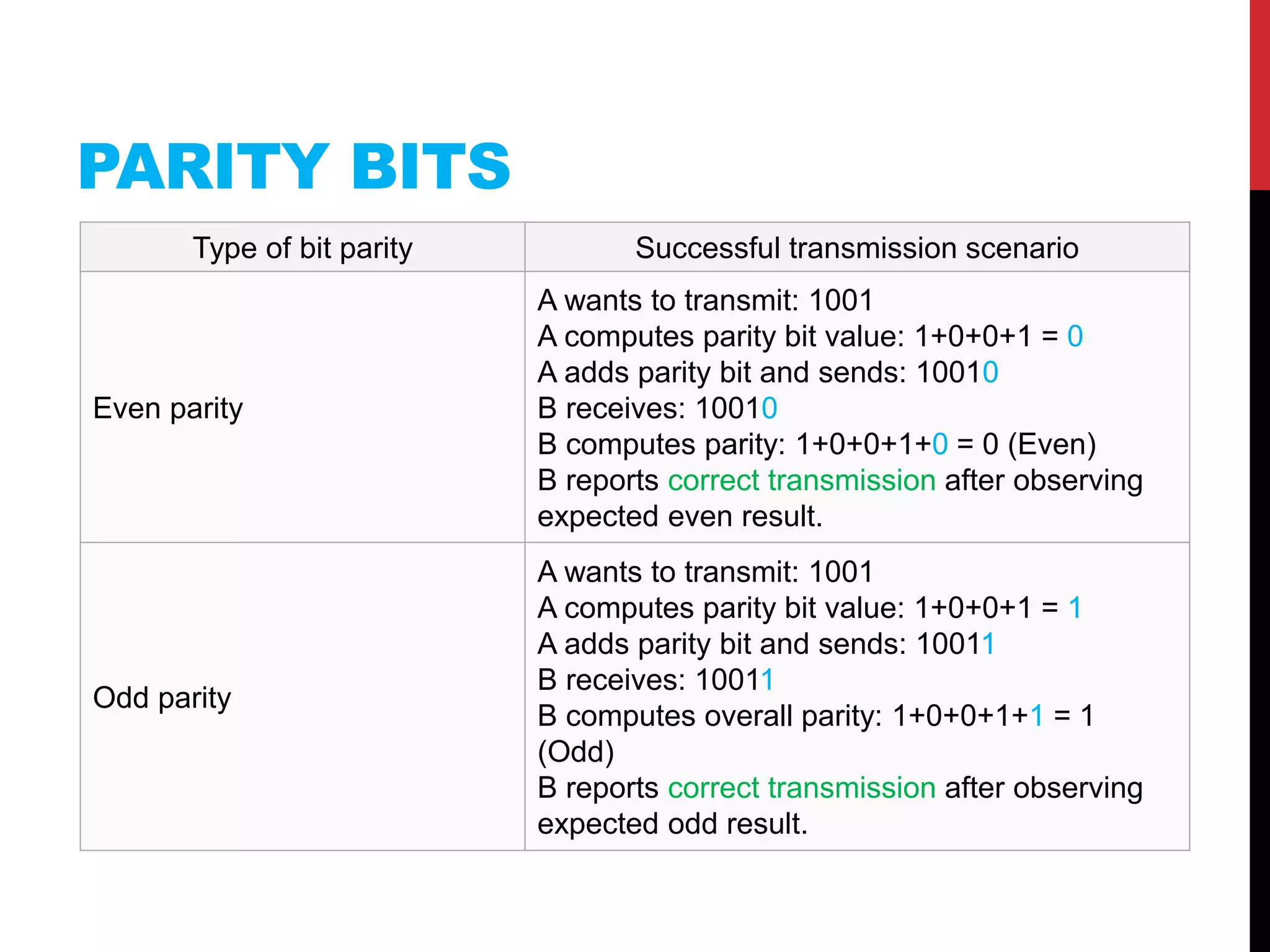
Type of bit parity Successful transmission scenario
Even parity
A wants to transmit: 1001
A computes parity bit value: 1+0+0+1 = 0
A adds parity bit and sends: 10010
B receives: 10010
B computes parity: 1+0+0+1+0 = 0 (Even)
B reports correct transmission after observing
expected even result.
Odd parity
A wants to transmit: 1001
A computes parity bit value: 1+0+0+1 = 1
A adds parity bit and sends: 10011
B receives: 10011
B computes overall parity: 1+0+0+1+1 = 1
(Odd)
B reports correct transmission after observing
expected odd result.
This enables the detection of single bit errors, because if one
bit gets flipped due to line noise, there will be an incorrect
number of ones in the received data. In the two examples
above, B's calculated parity value matches the parity bit in its
received value, indicating there are no single bit errors.
Consider the following example with a transmission error in
the second bit:
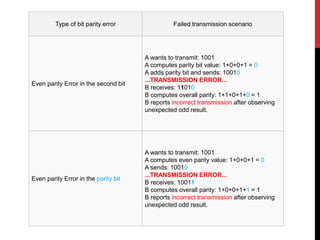
Type of bit parity error Failed transmission scenario
Even parity Error in the second bit
A wants to transmit: 1001
A computes parity bit value: 1+0+0+1 = 0
A adds parity bit and sends: 10010
...TRANSMISSION ERROR...
B receives: 11010
B computes overall parity: 1+1+0+1+0 = 1
B reports incorrect transmission after observing
unexpected odd result.
Even parity Error in the parity bit
A wants to transmit: 1001
A computes even parity value: 1+0+0+1 = 0
A sends: 10010
...TRANSMISSION ERROR...
B receives: 10011
B computes overall parity: 1+0+0+1+1 = 1
B reports incorrect transmission after observing
unexpected odd result.
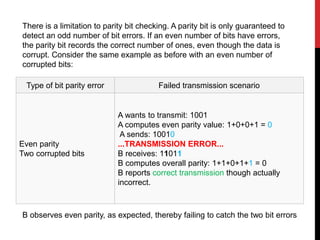
There is a limitation to parity bit checking. A parity bit is only guaranteed to
detect an odd number of bit errors. If an even number of bits have errors,
the parity bit records the correct number of ones, even though the data is
corrupt. Consider the same example as before with an even number of
corrupted bits:
Type of bit parity error Failed transmission scenario
Even parity
Two corrupted bits
A wants to transmit: 1001
A computes even parity value: 1+0+0+1 = 0
A sends: 10010
...TRANSMISSION ERROR...
B receives: 11011
B computes overall parity: 1+1+0+1+1 = 0
B reports correct transmission though actually
incorrect.
B observes even parity, as expected, thereby failing to catch the two bit errors
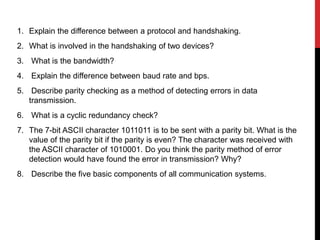
1. Explain the difference between a protocol and handshaking.
2. What is involved in the handshaking of two devices?
3. What is the bandwidth?
4. Explain the difference between baud rate and bps.
5. Describe parity checking as a method of detecting errors in data
transmission.
6. What is a cyclic redundancy check?
7. The 7-bit ASCII character 1011011 is to be sent with a parity bit. What is the
value of the parity bit if the parity is even? The character was received with
the ASCII character of 1010001. Do you think the parity method of error
detection would have found the error in transmission? Why?
8. Describe the five basic components of all communication systems.

Parity bits

  • 1.
    PARITY BITS Type ofbit parity Successful transmission scenario Even parity A wants to transmit: 1001 A computes parity bit value: 1+0+0+1 = 0 A adds parity bit and sends: 10010 B receives: 10010 B computes parity: 1+0+0+1+0 = 0 (Even) B reports correct transmission after observing expected even result. Odd parity A wants to transmit: 1001 A computes parity bit value: 1+0+0+1 = 1 A adds parity bit and sends: 10011 B receives: 10011 B computes overall parity: 1+0+0+1+1 = 1 (Odd) B reports correct transmission after observing expected odd result.
  • 2.
    This enables thedetection of single bit errors, because if one bit gets flipped due to line noise, there will be an incorrect number of ones in the received data. In the two examples above, B's calculated parity value matches the parity bit in its received value, indicating there are no single bit errors. Consider the following example with a transmission error in the second bit:
  • 3.
    Type of bitparity error Failed transmission scenario Even parity Error in the second bit A wants to transmit: 1001 A computes parity bit value: 1+0+0+1 = 0 A adds parity bit and sends: 10010 ...TRANSMISSION ERROR... B receives: 11010 B computes overall parity: 1+1+0+1+0 = 1 B reports incorrect transmission after observing unexpected odd result. Even parity Error in the parity bit A wants to transmit: 1001 A computes even parity value: 1+0+0+1 = 0 A sends: 10010 ...TRANSMISSION ERROR... B receives: 10011 B computes overall parity: 1+0+0+1+1 = 1 B reports incorrect transmission after observing unexpected odd result.
  • 4.
    There is alimitation to parity bit checking. A parity bit is only guaranteed to detect an odd number of bit errors. If an even number of bits have errors, the parity bit records the correct number of ones, even though the data is corrupt. Consider the same example as before with an even number of corrupted bits: Type of bit parity error Failed transmission scenario Even parity Two corrupted bits A wants to transmit: 1001 A computes even parity value: 1+0+0+1 = 0 A sends: 10010 ...TRANSMISSION ERROR... B receives: 11011 B computes overall parity: 1+1+0+1+1 = 0 B reports correct transmission though actually incorrect. B observes even parity, as expected, thereby failing to catch the two bit errors
  • 5.
    1. Explain thedifference between a protocol and handshaking. 2. What is involved in the handshaking of two devices? 3. What is the bandwidth? 4. Explain the difference between baud rate and bps. 5. Describe parity checking as a method of detecting errors in data transmission. 6. What is a cyclic redundancy check? 7. The 7-bit ASCII character 1011011 is to be sent with a parity bit. What is the value of the parity bit if the parity is even? The character was received with the ASCII character of 1010001. Do you think the parity method of error detection would have found the error in transmission? Why? 8. Describe the five basic components of all communication systems.