Author(s):  Matthew Velkey, 2009 License:  Unless otherwise noted, this material is made available under the terms of the  Creative Commons Attribution – Non-Commercial – Share Alike  3.0 License :  http://creativecommons.org/licenses/by-nc-sa/3.0/ We have reviewed this material  in accordance with U.S. Copyright Law  and have tried to maximize your ability to use, share, and adapt it.  The citation key on the following slide provides information about how you may share and adapt this material. Copyright holders of content included in this material should contact  [email_address]  with any questions, corrections, or clarification regarding the use of content. For more information about  how to cite  these materials visit http://open.umich.edu/education/about/terms-of-use. Any  medical information  in this material is intended to inform and educate and is  not a tool for self-diagnosis  or a replacement for medical evaluation, advice, diagnosis or treatment by a healthcare professional. Please speak to your physician if you have questions about your medical condition. Viewer discretion is advised : Some medical content is graphic and may not be suitable for all viewers.
Citation Key for more information see: http://open.umich.edu/wiki/CitationPolicy  Use + Share + Adapt Make Your Own Assessment Creative Commons – Attribution License  Creative Commons – Attribution Share Alike License Creative Commons – Attribution Noncommercial License Creative Commons – Attribution Noncommercial Share Alike License GNU – Free Documentation License Creative Commons – Zero Waiver Public Domain – Ineligible : Works that are ineligible for copyright protection in the U.S. (USC 17 § 102(b)) *laws in your jurisdiction may differ Public Domain – Expired : Works that are no longer protected due to an expired copyright term. Public Domain – Government : Works that are produced by the U.S. Government. (USC 17 § 105) Public Domain – Self Dedicated : Works that a copyright holder has dedicated to the public domain. Fair Use : Use of works that is determined to be Fair consistent with the U.S. Copyright Act. (USC 17 § 107) *laws in your jurisdiction may differ Our determination  DOES NOT  mean that all uses of this 3rd-party content are Fair Uses and we  DO NOT  guarantee that your use of the content is Fair. To use this content you should  do your own independent analysis  to determine whether or not your use will be Fair.  { Content the copyright holder, author, or law permits you to use, share and adapt. } { Content Open.Michigan believes can be used, shared, and adapted because it is ineligible for copyright. } { Content Open.Michigan has used under a Fair Use determination. }
Development of the Urinary System Matt Velkey Spring 2008
The Origin of the Kidney In the vertebrate embryo, the first stage of kidney development occurs  after gastrulation, within a region called the intermediate mesoderm. Epiblast Ectoderm Mesoderm Endoderm Neural tube Neural crest Paraxial Mesoderm Intermediate Mesoderm Lateral plate Mesoderm Gut, pancreas, liver, lung, etc. Muscle, Bone, Skin Mesenteries, Hemangioblastic Heart, limbs, etc. Kidney, Gonads,  Reproductive organs M. Velkey
Intermediate Mesoderm The midline NOTOCHORD secretes factors that organize the dorsal-ventral and medio-lateral axes of the embryo. Gilbert, Scott.  Developmental Biology.  2006.
The first epithelial component of the urogenital system is the NEPHRIC DUCT. It arises within the intermediate mesoderm adjacent to the 10-12th somites and extends posteriorly.  DiI lineage tracing in the chick embryo reveals that the Nephric Duct forms by extension rather than by recruitment of mesoderm to the epithelial duct. Obara-Ishihara et al., Develop. 126, 1103 (1999)
As the Nephric duct forms and grows caudally, Lim1 and Pax2 expression  mark the epithelium of the duct. Lim1 Pax2 Lim1 is essential for nephric duct formation Pax2 and its related gene Pax8 are also essential for nephric duct formation Carlson.  Human Embryology and Developmental Biology.  (Both Images)
Overview of early Pro-, Meso-, and Metanephric patterning
The outgrowth of the Ureteric  bud, or metanephric diverticulum is the first critical step in the development of the adult kidney. The ureteric bud epithelia and the adjacent metanephric blastema, or metanephric mesenchyme, are the two primordial cell types of the adult kidney.  Reciprocal inductive interactions between the ureteric bud epithelia and the metanephric mesenchyme generate  the nephrons, collecting ducts and the three dimensional  architecture of the kidney.  Errors in these interactions may result in renal dysfunction/agenesis
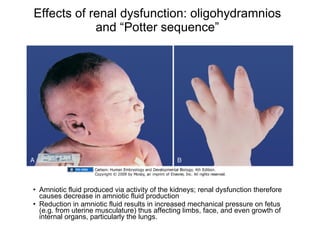
Effects of renal dysfunction: oligohydramnios and “Potter sequence” Amniotic fluid produced via activity of the kidneys; renal dysfunction therefore causes decrease in amniotic fluid production Reduction in amniotic fluid results in increased mechanical pressure on fetus (e.g. from uterine musculature) thus affecting limbs, face, and even growth of internal organs, particularly the lungs.
Overview of metanephric kidney induction Mesenchyme in blastema expresses WT1 (makes tissue competent to respond to signaling from epithelium of ureteric bud), and also produces glial-derived neurotrophic factor (GDNF)  and hepatocyte growth factor (HGF ) Ureteric bud expresses a GDNF receptor (aka RET) and an HGF receptor (aka MET) and responds by secreting BMP7 and FGF2, which stimulates proliferation of mesenchyme Mesenchyme undergoes mesenchymal-to-epithelial transition in response to WNT4 and PAX2 Mutations in any one of these may cause inhibition of ureteric bud growth and renal agenesis. Langman’s Medical Embryology, 9 th  ed. 2004.
The GDNF protein is Sufficient to induce Ureteric bud outgrowth  Within the posterior Aspect of the nephric Duct.  Source Undetermined
RET continues to be expressed in the tips of the branching ureteric buds This is where proliferation and induction are ongoing Induced mesenchyme (Nephron Precursors) Thus, the number of induced nephrons is proportional to the number of branch points of the developing ureteric bud. M. Velkey RET
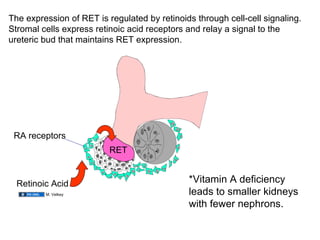
The expression of RET is regulated by retinoids through cell-cell signaling. Stromal cells express retinoic acid receptors and relay a signal to the ureteric bud that maintains RET expression. RA receptors Retinoic Acid *Vitamin A deficiency leads to smaller kidneys  with fewer nephrons. M. Velkey RET
Summary of branching morphogenesis and metanephric induction The RET/GFR  1/GDNF signaling complex regulates ureteric bud outgrowth and branching morphogenesis. Expression of RET in the ureteric bud tip requires signals from the stromal cells. These signals are controlled, at least in part, by retinoic acid receptors. The number of branches and branch points directly determine the number of nephrons in the adult kidney.
Next steps:  transforming  mesenchyme into epithelial tubes
Cytokeratin   Pax2   Laminin   Cytokeratin The Pax2 gene is a critical factor in the mesenchyme that controls the  Response to inductive signals This response is commonly called the  Mesenchyme-to-Epithelial Transition (MET) Source Undetermined Source Undetermined
In Pax2 null embryos, the Nephric Duct forms but there are no Pro- or mesonephric  Tubules, there is no ureteric bud and there is no metanephros.  Pax2 is required for the Mesenchyme to respond to inductive signals. mesonephros Metanephric  mesenchyme Ureteric bud cloaca Antibody staining Pax is red Epithelial cytokeratin is green Nephric duct Source Undetermined
  Loss of Pax2 Function: Mice homozygous for a Pax2 null allele have complete renal agenesis Humans carrying one mutant Pax2 allele (heterozygotes) exhibit - Renal-Coloboma Syndrome In both mice and humans, Pax2 is haplo-insufficient*, i.e. a reduction in  Gene dosage results in a phenotype of varying penetrance. Thus, the mutations are dominant because both normal Pax2 alleles are  required for normal kidney development * This is also true for other Pax genes, such as Pax6 (aniridia) in the developing eye CLINICAL CORRELATES
Renal-Coloboma Syndrome Patients typically exhibit at least these 3 symptoms: 1- Renal hypoplasia -  due to reduced proliferation of the    mesenchyme derived epithelia during development. 2- Vesicouretral Reflux -  most likely due to improper   connection of the ureter to the bladder or possibly due to   inherent defects in epithelial cells of the mature ureter.   3- Optic Nerve Colobomas -  due to failure of the optic fissure    to fuse.  Expression of Pax2 is observed in part of the optic    cup and optic stalk.
Pax2 Marks Proliferating Epithelia in a Variety of Renal Diseases. These include:  Renal Cell Carcinoma Wilms’ Tumor Juvenile Cystic and Dysplastic Kidneys Polycystic Kidney Disease Also, Pax2 is reactivated in regenerating proximal tubules after ischemia or toxic injury. Pax2 Gain of Function Thus, failure to suppress Pax2 during development or reactivation of Pax2 in the adult can lead to aberrant proliferation of the renal epithelia.
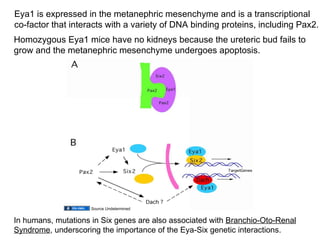
Eya1 is expressed in the metanephric mesenchyme and is a transcriptional co-factor that interacts with a variety of DNA binding proteins, including Pax2. Homozygous Eya1 mice have no kidneys because the ureteric bud fails to grow and the metanephric mesenchyme undergoes apoptosis.  In humans, mutations in Six genes are also associated with  Branchio-Oto-Renal Syndrome , underscoring the importance of the Eya-Six genetic interactions.  Source Undetermined
Branchio-Oto-Renal Syndrome (BOR) Renal anomalities include: Unilateral or bilateral hypoplasia, dysplasia, and aplasia, duplicated or absent ureters, hydroureter, distorted calyces. Hearing Impairment can be mild to severe, with defects found in: atresia or stenosis of auditory canal, absent or underdeveloped cochlea, absent or abnormal semi-circular canals. Cranio-Facial abnormalities include cervical cysts and fistulas BOR is caused by mutations in the Eya1or Six1 genes. As with Pax2, BOR is a dominantly inherited disease because Eya1 is haploinsufficient.
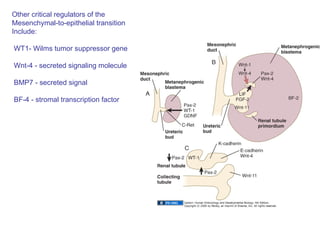
Other critical regulators of the  Mesenchymal-to-epithelial transition Include: WT1- Wilms tumor suppressor gene Wnt-4 - secreted signaling molecule BMP7 - secreted signal BF-4 - stromal transcription factor
Pax2 WT1 Expression of WT1 is dynamic, with low levels of protein in the mesenchyme and increasing amounts in the podocyte precursors of the glomerulus. The WT1 gene is essential for early kidney development - mesenchyme induction WT1 also plays an essential role in differentiation and maintenance of the Podocytes.  Source Undetermined Source Undetermined
Wilms’ Tumor  (Nephroblastoma) Found in infants from 0-24 months of age Consists of blastemal, epithelial, and stromal cell types Given the age of onset and the differentiation potential of tumors, it is likely that they arise from mutations in one or more genes that function during kidney development. There are both familial and sporadic forms of Wilms’ tumor Deletions or mutations of WT1 are associated with 10-20% of sporadic Wilms’ tumors Additional tumor suppressor genes may map to 11p13, IGF2, H19 etc. Source Undetermined Source Undetermined
Polarization of the metanephric mesenchyme is a step-wise process that requires changes in cell- adhesion molecule expression, the formation of adherends junctions, the deposition of a laminin containing basement membrane, and the formation of tight junctions. This establishes the apical and baso- lateral sides of the epithelial cell  Failure to make or maintain polarized epithelia results in renal cysts.
Abnormalities of Epithelial Cell Differentiation Cystic Diseases - Cysts are derived from epithelial cells - Are due to Proliferation and Accumulation of Fluid - Are associated with a Loss of Epithelial Cell Polarity - Commonly occur in multiple tissues, such as kidney   pancreas and liver
Polystic Kidney Disease (PKD) is the most common single gene  Disorder in the adult population.  About 1/3000 individuals  Have a mutation in the associated genes.  Patients have both Renal and pancreatic cysts.  There are dominant and recessive forms of PKD. The most common is autosomal dominant PKD (ADPKD) PKD
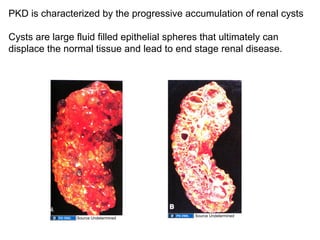
PKD is characterized by the progressive accumulation of renal cysts Cysts are large fluid filled epithelial spheres that ultimately can displace the normal tissue and lead to end stage renal disease. Source Undetermined Source Undetermined
egf Proliferation Blockage & budding Loss of Polarity EGF receptor Na,K ATPase Mechanism of Cyst Formation basal apical M. Velkey
Polycystic kidney disease and PKD1 (polycystin-1) Polycystin-1 is an essential protein that maintains polarity and/or fluid transport across the renal epithelia.  Mechanism of disease is probably similar in humans. E18 8 days Heterozygous mice show some cystogenesis later in life, i.e. 18-24 months Source Undetermined Source Undetermined
Glomerular Development Source Undetermined
Source Undetermined
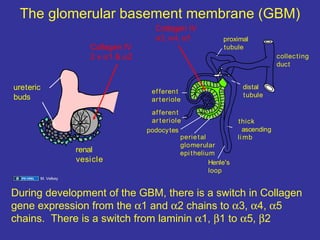
The glomerular basement membrane (GBM) Collagen IV 2 x   1 &   2  Collagen IV  During development of the GBM, there is a switch in Collagen gene expression from the   1 and   2 chains to   3,   4,   5 chains.  There is a switch from laminin   1,   1 to   5,   2 M. Velkey a f f e r e n t a r t e r i o l e e f f e r e n t a r t e r i o l e p o d o c y t e s p e r i e t a l g l o m e r u l a r e p i t h e l i u m t h i c k a s c e n d i n g l i m b d i s t a l t u b u l e c o l l e c t i n g d u c t p r o x i m a l t u b u l e H e n l e ' s l o o p r e n a l v e s i c l e u r e t e r i c b u d s
Normal GBM Alport’s Syndrome - thickening of GBM - separation of layers - electron dense granules - fusion of foot processes Failure to Switch Collagen IV Chains Results in Alport’s Syndrome Source Undetermined Source Undetermined
Interdigitated Podocyte foot processes form the pores that allow small molecules to flow into the urinary space but retain larger  proteins in the blood stream. Source Undetermined Source Undetermined
Slit Diaphragm Foot Processes Endothelial  Fenestrae Basement Membrane The Mature Filtration Barrier Source Undetermined
Development of the filtration barrier depends on endothelial, podocyte, and GBM interactions. a- Podocyte and endothelial precursor  cells align on opposite sides of GBM b- Cells begin to secrete GBM specific  extracellular matrix proteins c- Podocytes extend primary, secondary,  and tertiary foot processes that inter- digitate to make slit diaphragms. Endothelial cells become fenestrated. Source Undetermined
Human Congenital Nephrotic Syndrome (CNF) hereditary, with different degrees of severity early onset, from birth to adolescence characterized by high proteinuria, leakage of protein through the GBM filter microcysts and expanded Bowman’s spaces foot process effacement associated with mutations in nephrin (NPHS1) Source Undetermined Source Undetermined
Nephrin and Podocin interact at the slit diaphragm to maintain the filter pore and/or the integrity of the foot processes. Source Undetermined
Conclusions Mutations in nephrin or podocin cause congenital nephrotic syndromes Foot process effacement is a common feature among CNS and leads to high proteinurea  Both proteins are localized to the slit diaphragm and are membrane associated. The extracellular domains of Nephrin may help maintain the pore size
Other malformations: pelvic kidneys and horseshoe kidney Kidneys form near the tail of the embryo. Growth of the embryo in length causes the kidneys to  “ascend” to their final position in the lumbar region. One kidney might fail to ascend Fusion of the two kidneys into a single horseshoe kidney impedes ascent beyond the inferior mesenteric artery Langman’s Medical Embryology, 9 th  ed. 2004. Langman’s Medical Embryology, 9 th  ed. 2004. Langman’s Medical Embryology, 9 th  ed. 2004.
Other malformations:  abnormal ureter attachment sites Relationship of mesonephric (Wolffian), paramesonephric (Müllerian), and metanephric (ureteric) ducts is such that the ureters attach at sites other than the bladder. Langman’s Medical Embryology, 9 th  ed. 2004. Original image: Carlson - Human Embryology and Developmental Biology, 4th Edition.  Image of abnormal ureter attachment sites removed.
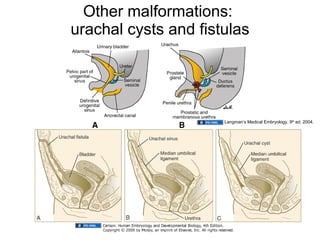
Other malformations:  urachal cysts and fistulas Langman’s Medical Embryology, 9 th  ed. 2004.
Slide 4: M. Velkey Slide 5: Gilbert, Scott.  Developmental Biology.  2006. Slide 6:  Obara-Ishihara et al., Develop. 126, 1103 (1999) Slide 7:  Carlson.  Human Embryology and Developmental Biology.  (Both Images)  Slide 8:  Carlson: Human Embryology and Developemental Biology, 4 th  Edition. Copyright 2009 by Mosby, an imprint of Elsevier, Inc.  Slide 10:  Carlson: Human Embryology and Developemental Biology, 4 th  Edition. Copyright 2009 by Mosby, an imprint of Elsevier, Inc. Slide 11:  Langman’s Medical Embryology, 9th ed. 2004. Slide 12: Source Undetermined Slide 13: M. Velkey Slide 14: M. Velkey Slide 16:  Carlson: Human Embryology and Developemental Biology, 4 th  Edition. Copyright 2009 by Mosby, an imprint of Elsevier, Inc.  Slide 17: Source Undetermined; Source Undetermined Slide 18: Source Undetermined Slide 22: Source Undetermined Slide 24:  Carlson: Human Embryology and Developemental Biology, 4 th  Edition. Copyright 2009 by Mosby, an imprint of Elsevier, Inc.  Slide 25: Source Undetermined; Source Undetermined Slide 26: Source Undetermined; Source Undetermined Slide 27: Carlson: Human Embryology and Developemental Biology, 4 th  Edition. Copyright 2009 by Mosby, an imprint of Elsevier, Inc.. Slide 30: Source Undetermined; Source Undetermined Slide 31: M. Velkey Slide 32:  Source Undetermined; Source Undetermined Slide 33: Source Undetermined Slide 34: Source Undetermined Additional Source Information for more information see: http://open.umich.edu/wiki/CitationPolicy
Slide 35: M. Velkey Slide 36: Source Undetermined; Source Undetermined Slide 37: Source Undetermined; Source Undetermined Slide 38: Source Undetermined Slide 39: Source Undetermined Slide 40: Source Undetermined; Source Undetermined Slide 41: Source Undetermined Slide 43: Langman’s Medical Embryology, 9th ed. 2004.; Langman’s Medical Embryology, 9th ed. 2004.; Langman’s Medical  Embryology, 9th ed. 2004. Slide 44: Langman’s Medical Embryology, 9th ed. 2004; Original Image  Carlson: Human Embryology and Developemental Biology, 4th Edition. Copyright 2009 by Mosby, an imprint of Elsevier, Inc.  Slide 45: Langman’s Medical Embryology, 9th ed. 2004;  Carlson: Human Embryology and Developemental Biology, 4th Edition.  Copyright 2009 by Mosby, an imprint of Elsevier, Inc.

05.28.09(b): Development of the Urinary System

  • 1.
    Author(s): MatthewVelkey, 2009 License: Unless otherwise noted, this material is made available under the terms of the Creative Commons Attribution – Non-Commercial – Share Alike 3.0 License : http://creativecommons.org/licenses/by-nc-sa/3.0/ We have reviewed this material in accordance with U.S. Copyright Law and have tried to maximize your ability to use, share, and adapt it. The citation key on the following slide provides information about how you may share and adapt this material. Copyright holders of content included in this material should contact [email_address] with any questions, corrections, or clarification regarding the use of content. For more information about how to cite these materials visit http://open.umich.edu/education/about/terms-of-use. Any medical information in this material is intended to inform and educate and is not a tool for self-diagnosis or a replacement for medical evaluation, advice, diagnosis or treatment by a healthcare professional. Please speak to your physician if you have questions about your medical condition. Viewer discretion is advised : Some medical content is graphic and may not be suitable for all viewers.
  • 2.
    Citation Key formore information see: http://open.umich.edu/wiki/CitationPolicy Use + Share + Adapt Make Your Own Assessment Creative Commons – Attribution License Creative Commons – Attribution Share Alike License Creative Commons – Attribution Noncommercial License Creative Commons – Attribution Noncommercial Share Alike License GNU – Free Documentation License Creative Commons – Zero Waiver Public Domain – Ineligible : Works that are ineligible for copyright protection in the U.S. (USC 17 § 102(b)) *laws in your jurisdiction may differ Public Domain – Expired : Works that are no longer protected due to an expired copyright term. Public Domain – Government : Works that are produced by the U.S. Government. (USC 17 § 105) Public Domain – Self Dedicated : Works that a copyright holder has dedicated to the public domain. Fair Use : Use of works that is determined to be Fair consistent with the U.S. Copyright Act. (USC 17 § 107) *laws in your jurisdiction may differ Our determination DOES NOT mean that all uses of this 3rd-party content are Fair Uses and we DO NOT guarantee that your use of the content is Fair. To use this content you should do your own independent analysis  to determine whether or not your use will be Fair. { Content the copyright holder, author, or law permits you to use, share and adapt. } { Content Open.Michigan believes can be used, shared, and adapted because it is ineligible for copyright. } { Content Open.Michigan has used under a Fair Use determination. }
  • 3.
    Development of theUrinary System Matt Velkey Spring 2008
  • 4.
    The Origin ofthe Kidney In the vertebrate embryo, the first stage of kidney development occurs after gastrulation, within a region called the intermediate mesoderm. Epiblast Ectoderm Mesoderm Endoderm Neural tube Neural crest Paraxial Mesoderm Intermediate Mesoderm Lateral plate Mesoderm Gut, pancreas, liver, lung, etc. Muscle, Bone, Skin Mesenteries, Hemangioblastic Heart, limbs, etc. Kidney, Gonads, Reproductive organs M. Velkey
  • 5.
    Intermediate Mesoderm Themidline NOTOCHORD secretes factors that organize the dorsal-ventral and medio-lateral axes of the embryo. Gilbert, Scott. Developmental Biology. 2006.
  • 6.
    The first epithelialcomponent of the urogenital system is the NEPHRIC DUCT. It arises within the intermediate mesoderm adjacent to the 10-12th somites and extends posteriorly. DiI lineage tracing in the chick embryo reveals that the Nephric Duct forms by extension rather than by recruitment of mesoderm to the epithelial duct. Obara-Ishihara et al., Develop. 126, 1103 (1999)
  • 7.
    As the Nephricduct forms and grows caudally, Lim1 and Pax2 expression mark the epithelium of the duct. Lim1 Pax2 Lim1 is essential for nephric duct formation Pax2 and its related gene Pax8 are also essential for nephric duct formation Carlson. Human Embryology and Developmental Biology. (Both Images)
  • 8.
    Overview of earlyPro-, Meso-, and Metanephric patterning
  • 9.
    The outgrowth ofthe Ureteric bud, or metanephric diverticulum is the first critical step in the development of the adult kidney. The ureteric bud epithelia and the adjacent metanephric blastema, or metanephric mesenchyme, are the two primordial cell types of the adult kidney. Reciprocal inductive interactions between the ureteric bud epithelia and the metanephric mesenchyme generate the nephrons, collecting ducts and the three dimensional architecture of the kidney. Errors in these interactions may result in renal dysfunction/agenesis
  • 10.
    Effects of renaldysfunction: oligohydramnios and “Potter sequence” Amniotic fluid produced via activity of the kidneys; renal dysfunction therefore causes decrease in amniotic fluid production Reduction in amniotic fluid results in increased mechanical pressure on fetus (e.g. from uterine musculature) thus affecting limbs, face, and even growth of internal organs, particularly the lungs.
  • 11.
    Overview of metanephrickidney induction Mesenchyme in blastema expresses WT1 (makes tissue competent to respond to signaling from epithelium of ureteric bud), and also produces glial-derived neurotrophic factor (GDNF) and hepatocyte growth factor (HGF ) Ureteric bud expresses a GDNF receptor (aka RET) and an HGF receptor (aka MET) and responds by secreting BMP7 and FGF2, which stimulates proliferation of mesenchyme Mesenchyme undergoes mesenchymal-to-epithelial transition in response to WNT4 and PAX2 Mutations in any one of these may cause inhibition of ureteric bud growth and renal agenesis. Langman’s Medical Embryology, 9 th ed. 2004.
  • 12.
    The GDNF proteinis Sufficient to induce Ureteric bud outgrowth Within the posterior Aspect of the nephric Duct. Source Undetermined
  • 13.
    RET continues tobe expressed in the tips of the branching ureteric buds This is where proliferation and induction are ongoing Induced mesenchyme (Nephron Precursors) Thus, the number of induced nephrons is proportional to the number of branch points of the developing ureteric bud. M. Velkey RET
  • 14.
    The expression ofRET is regulated by retinoids through cell-cell signaling. Stromal cells express retinoic acid receptors and relay a signal to the ureteric bud that maintains RET expression. RA receptors Retinoic Acid *Vitamin A deficiency leads to smaller kidneys with fewer nephrons. M. Velkey RET
  • 15.
    Summary of branchingmorphogenesis and metanephric induction The RET/GFR  1/GDNF signaling complex regulates ureteric bud outgrowth and branching morphogenesis. Expression of RET in the ureteric bud tip requires signals from the stromal cells. These signals are controlled, at least in part, by retinoic acid receptors. The number of branches and branch points directly determine the number of nephrons in the adult kidney.
  • 16.
    Next steps: transforming mesenchyme into epithelial tubes
  • 17.
    Cytokeratin Pax2 Laminin Cytokeratin The Pax2 gene is a critical factor in the mesenchyme that controls the Response to inductive signals This response is commonly called the Mesenchyme-to-Epithelial Transition (MET) Source Undetermined Source Undetermined
  • 18.
    In Pax2 nullembryos, the Nephric Duct forms but there are no Pro- or mesonephric Tubules, there is no ureteric bud and there is no metanephros. Pax2 is required for the Mesenchyme to respond to inductive signals. mesonephros Metanephric mesenchyme Ureteric bud cloaca Antibody staining Pax is red Epithelial cytokeratin is green Nephric duct Source Undetermined
  • 19.
    Lossof Pax2 Function: Mice homozygous for a Pax2 null allele have complete renal agenesis Humans carrying one mutant Pax2 allele (heterozygotes) exhibit - Renal-Coloboma Syndrome In both mice and humans, Pax2 is haplo-insufficient*, i.e. a reduction in Gene dosage results in a phenotype of varying penetrance. Thus, the mutations are dominant because both normal Pax2 alleles are required for normal kidney development * This is also true for other Pax genes, such as Pax6 (aniridia) in the developing eye CLINICAL CORRELATES
  • 20.
    Renal-Coloboma Syndrome Patientstypically exhibit at least these 3 symptoms: 1- Renal hypoplasia - due to reduced proliferation of the mesenchyme derived epithelia during development. 2- Vesicouretral Reflux - most likely due to improper connection of the ureter to the bladder or possibly due to inherent defects in epithelial cells of the mature ureter. 3- Optic Nerve Colobomas - due to failure of the optic fissure to fuse. Expression of Pax2 is observed in part of the optic cup and optic stalk.
  • 21.
    Pax2 Marks ProliferatingEpithelia in a Variety of Renal Diseases. These include: Renal Cell Carcinoma Wilms’ Tumor Juvenile Cystic and Dysplastic Kidneys Polycystic Kidney Disease Also, Pax2 is reactivated in regenerating proximal tubules after ischemia or toxic injury. Pax2 Gain of Function Thus, failure to suppress Pax2 during development or reactivation of Pax2 in the adult can lead to aberrant proliferation of the renal epithelia.
  • 22.
    Eya1 is expressedin the metanephric mesenchyme and is a transcriptional co-factor that interacts with a variety of DNA binding proteins, including Pax2. Homozygous Eya1 mice have no kidneys because the ureteric bud fails to grow and the metanephric mesenchyme undergoes apoptosis. In humans, mutations in Six genes are also associated with Branchio-Oto-Renal Syndrome , underscoring the importance of the Eya-Six genetic interactions. Source Undetermined
  • 23.
    Branchio-Oto-Renal Syndrome (BOR)Renal anomalities include: Unilateral or bilateral hypoplasia, dysplasia, and aplasia, duplicated or absent ureters, hydroureter, distorted calyces. Hearing Impairment can be mild to severe, with defects found in: atresia or stenosis of auditory canal, absent or underdeveloped cochlea, absent or abnormal semi-circular canals. Cranio-Facial abnormalities include cervical cysts and fistulas BOR is caused by mutations in the Eya1or Six1 genes. As with Pax2, BOR is a dominantly inherited disease because Eya1 is haploinsufficient.
  • 24.
    Other critical regulatorsof the Mesenchymal-to-epithelial transition Include: WT1- Wilms tumor suppressor gene Wnt-4 - secreted signaling molecule BMP7 - secreted signal BF-4 - stromal transcription factor
  • 25.
    Pax2 WT1 Expressionof WT1 is dynamic, with low levels of protein in the mesenchyme and increasing amounts in the podocyte precursors of the glomerulus. The WT1 gene is essential for early kidney development - mesenchyme induction WT1 also plays an essential role in differentiation and maintenance of the Podocytes. Source Undetermined Source Undetermined
  • 26.
    Wilms’ Tumor (Nephroblastoma) Found in infants from 0-24 months of age Consists of blastemal, epithelial, and stromal cell types Given the age of onset and the differentiation potential of tumors, it is likely that they arise from mutations in one or more genes that function during kidney development. There are both familial and sporadic forms of Wilms’ tumor Deletions or mutations of WT1 are associated with 10-20% of sporadic Wilms’ tumors Additional tumor suppressor genes may map to 11p13, IGF2, H19 etc. Source Undetermined Source Undetermined
  • 27.
    Polarization of themetanephric mesenchyme is a step-wise process that requires changes in cell- adhesion molecule expression, the formation of adherends junctions, the deposition of a laminin containing basement membrane, and the formation of tight junctions. This establishes the apical and baso- lateral sides of the epithelial cell Failure to make or maintain polarized epithelia results in renal cysts.
  • 28.
    Abnormalities of EpithelialCell Differentiation Cystic Diseases - Cysts are derived from epithelial cells - Are due to Proliferation and Accumulation of Fluid - Are associated with a Loss of Epithelial Cell Polarity - Commonly occur in multiple tissues, such as kidney pancreas and liver
  • 29.
    Polystic Kidney Disease(PKD) is the most common single gene Disorder in the adult population. About 1/3000 individuals Have a mutation in the associated genes. Patients have both Renal and pancreatic cysts. There are dominant and recessive forms of PKD. The most common is autosomal dominant PKD (ADPKD) PKD
  • 30.
    PKD is characterizedby the progressive accumulation of renal cysts Cysts are large fluid filled epithelial spheres that ultimately can displace the normal tissue and lead to end stage renal disease. Source Undetermined Source Undetermined
  • 31.
    egf Proliferation Blockage& budding Loss of Polarity EGF receptor Na,K ATPase Mechanism of Cyst Formation basal apical M. Velkey
  • 32.
    Polycystic kidney diseaseand PKD1 (polycystin-1) Polycystin-1 is an essential protein that maintains polarity and/or fluid transport across the renal epithelia. Mechanism of disease is probably similar in humans. E18 8 days Heterozygous mice show some cystogenesis later in life, i.e. 18-24 months Source Undetermined Source Undetermined
  • 33.
  • 34.
  • 35.
    The glomerular basementmembrane (GBM) Collagen IV 2 x  1 &  2 Collagen IV  During development of the GBM, there is a switch in Collagen gene expression from the  1 and  2 chains to  3,  4,  5 chains. There is a switch from laminin  1,  1 to  5,  2 M. Velkey a f f e r e n t a r t e r i o l e e f f e r e n t a r t e r i o l e p o d o c y t e s p e r i e t a l g l o m e r u l a r e p i t h e l i u m t h i c k a s c e n d i n g l i m b d i s t a l t u b u l e c o l l e c t i n g d u c t p r o x i m a l t u b u l e H e n l e ' s l o o p r e n a l v e s i c l e u r e t e r i c b u d s
  • 36.
    Normal GBM Alport’sSyndrome - thickening of GBM - separation of layers - electron dense granules - fusion of foot processes Failure to Switch Collagen IV Chains Results in Alport’s Syndrome Source Undetermined Source Undetermined
  • 37.
    Interdigitated Podocyte footprocesses form the pores that allow small molecules to flow into the urinary space but retain larger proteins in the blood stream. Source Undetermined Source Undetermined
  • 38.
    Slit Diaphragm FootProcesses Endothelial Fenestrae Basement Membrane The Mature Filtration Barrier Source Undetermined
  • 39.
    Development of thefiltration barrier depends on endothelial, podocyte, and GBM interactions. a- Podocyte and endothelial precursor cells align on opposite sides of GBM b- Cells begin to secrete GBM specific extracellular matrix proteins c- Podocytes extend primary, secondary, and tertiary foot processes that inter- digitate to make slit diaphragms. Endothelial cells become fenestrated. Source Undetermined
  • 40.
    Human Congenital NephroticSyndrome (CNF) hereditary, with different degrees of severity early onset, from birth to adolescence characterized by high proteinuria, leakage of protein through the GBM filter microcysts and expanded Bowman’s spaces foot process effacement associated with mutations in nephrin (NPHS1) Source Undetermined Source Undetermined
  • 41.
    Nephrin and Podocininteract at the slit diaphragm to maintain the filter pore and/or the integrity of the foot processes. Source Undetermined
  • 42.
    Conclusions Mutations innephrin or podocin cause congenital nephrotic syndromes Foot process effacement is a common feature among CNS and leads to high proteinurea Both proteins are localized to the slit diaphragm and are membrane associated. The extracellular domains of Nephrin may help maintain the pore size
  • 43.
    Other malformations: pelvickidneys and horseshoe kidney Kidneys form near the tail of the embryo. Growth of the embryo in length causes the kidneys to “ascend” to their final position in the lumbar region. One kidney might fail to ascend Fusion of the two kidneys into a single horseshoe kidney impedes ascent beyond the inferior mesenteric artery Langman’s Medical Embryology, 9 th ed. 2004. Langman’s Medical Embryology, 9 th ed. 2004. Langman’s Medical Embryology, 9 th ed. 2004.
  • 44.
    Other malformations: abnormal ureter attachment sites Relationship of mesonephric (Wolffian), paramesonephric (Müllerian), and metanephric (ureteric) ducts is such that the ureters attach at sites other than the bladder. Langman’s Medical Embryology, 9 th ed. 2004. Original image: Carlson - Human Embryology and Developmental Biology, 4th Edition. Image of abnormal ureter attachment sites removed.
  • 45.
    Other malformations: urachal cysts and fistulas Langman’s Medical Embryology, 9 th ed. 2004.
  • 46.
    Slide 4: M.Velkey Slide 5: Gilbert, Scott. Developmental Biology. 2006. Slide 6: Obara-Ishihara et al., Develop. 126, 1103 (1999) Slide 7: Carlson. Human Embryology and Developmental Biology. (Both Images) Slide 8: Carlson: Human Embryology and Developemental Biology, 4 th Edition. Copyright 2009 by Mosby, an imprint of Elsevier, Inc. Slide 10: Carlson: Human Embryology and Developemental Biology, 4 th Edition. Copyright 2009 by Mosby, an imprint of Elsevier, Inc. Slide 11: Langman’s Medical Embryology, 9th ed. 2004. Slide 12: Source Undetermined Slide 13: M. Velkey Slide 14: M. Velkey Slide 16: Carlson: Human Embryology and Developemental Biology, 4 th Edition. Copyright 2009 by Mosby, an imprint of Elsevier, Inc. Slide 17: Source Undetermined; Source Undetermined Slide 18: Source Undetermined Slide 22: Source Undetermined Slide 24: Carlson: Human Embryology and Developemental Biology, 4 th Edition. Copyright 2009 by Mosby, an imprint of Elsevier, Inc. Slide 25: Source Undetermined; Source Undetermined Slide 26: Source Undetermined; Source Undetermined Slide 27: Carlson: Human Embryology and Developemental Biology, 4 th Edition. Copyright 2009 by Mosby, an imprint of Elsevier, Inc.. Slide 30: Source Undetermined; Source Undetermined Slide 31: M. Velkey Slide 32: Source Undetermined; Source Undetermined Slide 33: Source Undetermined Slide 34: Source Undetermined Additional Source Information for more information see: http://open.umich.edu/wiki/CitationPolicy
  • 47.
    Slide 35: M.Velkey Slide 36: Source Undetermined; Source Undetermined Slide 37: Source Undetermined; Source Undetermined Slide 38: Source Undetermined Slide 39: Source Undetermined Slide 40: Source Undetermined; Source Undetermined Slide 41: Source Undetermined Slide 43: Langman’s Medical Embryology, 9th ed. 2004.; Langman’s Medical Embryology, 9th ed. 2004.; Langman’s Medical Embryology, 9th ed. 2004. Slide 44: Langman’s Medical Embryology, 9th ed. 2004; Original Image Carlson: Human Embryology and Developemental Biology, 4th Edition. Copyright 2009 by Mosby, an imprint of Elsevier, Inc. Slide 45: Langman’s Medical Embryology, 9th ed. 2004; Carlson: Human Embryology and Developemental Biology, 4th Edition. Copyright 2009 by Mosby, an imprint of Elsevier, Inc.