Paraprofessional Training: Is it Currently Best Practice?Paraprofessionals As EducatorsDiffering Perceptions, Responsibilities and TrainingJeri Katz, DEd. ProfessorBridgewater State UniversityBridgewater, MassachusettsJennifer A Boudreau, Ed.S.Doctoral CandidateNortheastern UniversityBoston, Massachusetts
AgendaParaprofessionalsProblem of PracticeResearch QuestionsOverview of LiteratureCurrent Research StudyResearch AspirationsQuestions
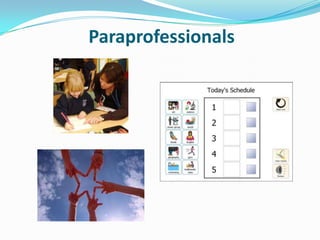
Paraprofessionals
Paraprofessionals Are School Employees Work under the supervision of teachers or other professionals Have responsibility for –A) Identifying learner needs B) Developing and implementing programs to meet these 	needsC) Assessing learner performance D) Evaluating the effectiveness of education programs and             	related services E) Assisting with the delivery of direct services as 	assigned and developed by their supervisors(Pickett, 2002)
…a rose by any other name…Paraeducator
Paraprofessional
Teacher Assistant
Teacher Aide
ParaThere are over 21 titles  for “paraprofessionals” What would you want your title to be?
Qualification Requirements For Instructional Paraprofessionals In MassachusettsInstructional Paraprofessionals in Title 1 follow the NCLB guidelines.  Special Education paraprofessionals are required to have:A high school diploma or equivalent; ANDAn Associate’s (or higher) degree; ORCompletion of 48 credit hours at an Institution of Higher Education; ORCompletion of one of the formal Massachusetts-endorsed Assessments:  Parapro or WorkKeysParaprofessionals must also work under the direct supervision of a teacher.(DESE, 2003)
Paraprofessionals: Special Education In MassachusettsNCLB guidelines are followedNo specialized training is requiredTraining is generally on the jobIncreasing numbers are 1:1 aidesThere are issues in many districts regarding supervision and training of special education paraprofessionals  There is no credentialing of instructional paraprofessionalsTeachers do not receive specific training regarding paraprofessionals
How Does MA Compare To Other States?Only 12 states have professional development programs for paraprofessionals: Delaware
Georgia
Hawaii
Idaho
Michigan
Mississippi
New Hampshire
New Mexico
New York
Ohio
Rhode Island
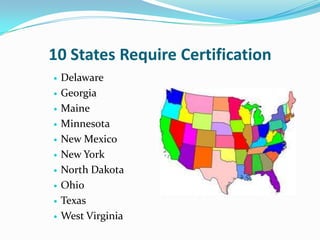
(Pennsylvania)10 States Require CertificationDelaware Georgia Maine Minnesota New Mexico New YorkNorth DakotaOhioTexasWest Virginia
12 States Exceed Federal RequirementsIllinois Maine Minnesota Mississippi Nebraska GeorgiaNew Hampshire New Mexico New York Rhode Island Washington West Virginia
SignificanceAccording to the Bureau of Labor Statistics (BLS) Occupational Outlook Handbook 2010-2011 Edition:Number of students identified for and enrolled in      	special education services is increasing.Dependency on paraprofessionals is expanding.As a result, the employment of paraprofessionals is 	expected to grow by 10% between 2008 and 	2018.
Has This changed?Data driven expectations : AYP, NCLB, IDEA 2004Supervision issuesSpecial education case loads have increasedIncreased focus on statewide and nationally mandated testsAccess to the general education curriculumQ : Are paraprofessionals being overused?
Literature ReviewWhat does prior research reveal about….The changing roles of paraprofessionals?Current practices for training?The essential skills and competencies needed for         paraprofessionals ?4.   The training needs for teachers to be able to effectively supervise paraprofessionals?5.   The roles and responsibilities of paraprofessionals?
Evolving RolesRoles and responsibilities have changed dramatically since they were first introduced into the classroom more than six decades ago.  Many new responsibilities and mandatory assessment requirements have been added to U.S. classrooms over the last 40 years. The use of paraprofessionals to support students, teachers and classrooms in meeting these increasing demands has grown proportionately.
Myth or Truth?Paraprofessionals always understand and support the inclusive philosophy that places them in the general classroom.MythMany paraprofessionals prefer the special education classroom and find the general classroom confusing and upsetting.
Training NeedsRequired training elements have not been defined: IDEA Amendment of 1997, requires that paraprofessionals be appropriately trained and supervised.The Amendment does not specify the type or amount of training required.  Similarly, NCLB legislation outlines paraprofessionals' qualifications and duties that they may perform.NCLB does not specify what an appropriate training program should entail.
Myth or Truth?The Paraprofessional doesn’t always know what to do with a student.TruthThe assumption is often made that ifa paraprofessional is placed in a classroom with a student then they know what to do.
Standards And CompetenciesThe American Federation of Teachers (AFT) and the National Joint Committee on Learning Disabilities, Inc. have advocated for the development of comprehensive standards and competencies for paraprofessionals. Paraprofessional standards address:Multiple aspects of education and instructionProvide guidelines for the skills paraprofessionals should master in each domain
Competencies Include:Foundations of special education Characteristics of learnersAssessment and evaluation Instruction, content and practice Planning and managementStudent behavior and social interaction Communication and collaboration Professionalism and ethical practices
Myth or Truth?The paraprofessional is fully trained for his or her classroom assignment.MythTraining often occurs on the job and isthe responsibility of all the professionalsassociated with the student and program.
Training Of Teachers Who Supervise ParaprofessionalsTeachers often feel as though they are not prepared to supervise paraprofessionals in school settings.  Teacher preparation programs, however, have not changed to accommodate the increasing need to prepare teachers for the supervisory role they must assume with the growing number of paraprofessionals.
Myth or Truth?The paraprofessional receives all instructions and directions from the special education teacher.MythThe paraprofessional will receive some instruction from the special educationteacher, from the general education teacher and from related service providers.
Pickett, Vasa And Steckelberg Stated:“In far too many cases, teachers are not prepared to direct paraeducators, to evaluate their performance, to provide feedback and training, or to assess the potential for greater use of paraeducators in order to free teachers to provide increased instructional services” (p.31). (1993)
Myth or Truth?Teachers are always trained and prepared to work with paraprofessionals.MythTeachers are not prepared to direct, evaluate or provide feedback and training to paraprofessionals
Roles And Responsibilities Of ParaprofessionalsParaprofessionals support the instruction, supervision and classroom management as a member of the school team.  Paraprofessionals have a high level of responsibility but a low level of training and support to help them do their jobs effectively.  Paraprofessionals are often utilized in schools to aid with direct student instruction, and serve as “learner supports”.
Roles And Responsibilities Continued…Special education paraprofessionals are hired to work directly with the most challenging students in the school:They are often unprepared for the task.Demands of parents, advocates, administrators and teachers have caused an increase in 1:1 paraprofessional assignments.Q: Are paraprofessionals being used effectively in your school settings?Q: Is there an overuse of paraprofessionals?
Myth or Truth?The paraprofessional can work with all students in the classroom.TruthThe paraprofessional can work with allstudents as long as the needs of theidentified students are being met.
Myth or Truth?There are restrictions on what paraprofessionals can do.TruthThere are actually legal and ethical limits on the responsibilities that paraprofessionals are allowed to have.
THIS JOB IS A TESTIT IS ONLY A TESTIf it had been an actual job you would have been given further instructions on where to go and what to do.
Myth or Truth?The paraprofessional will see that all the needs of the students with special needs are met.MythThe para is a support person - needsshould be met by collaborative planningby all adults.
Increasing Demands Require An In-depth Analysis Of:Current practicesExisting competencies  Areas for improvementInvestigation into the types of training that will 	support, develop, and facilitate  	paraprofessionals’  contributions to special 	education services. (Aldridge & Goldman, 2002; Carpenter & Dyal, 2007; D’Aquanni, 1997; Milner, 1998; Pickett, 2002; Young 2006)
Why Undertake This Study?The No Child Left Behind Act (2001):Increasing demands for paraprofessionals 	who are well trainedable to assist students in core academic areasRequires paraprofessionals to receive more intensive and 	“specific” training prior to entering the classroom Requires paraprofessionals to be “highly qualified”
Problem of PracticeParaprofessionals are academic support staff not primary decision makers.Roles are determined at many different levels.Training for paraprofessionals varies widely from community to community and state to state.Perceptions regarding the need for training differ based on the administrative expectations.The challenge of meeting the needs of all students.Teachers are trained to deal with learners, not adults.
Goals Of This StudyTo Identify and Evaluate:The responsibilities of paraprofessionalsThe current training practices for paraprofessionalsThe perceived training needs of paraprofessionals  as seen through the lens of supervisors, special education teachers and paraprofessionals. The differences and similarities that exist between current training practices and perceived training needs.
Research QuestionsHow are the roles and responsibilities of paraprofessionals, who work in substantially separate classrooms, perceived by their supervisors, special education teachers and the paraprofessionals?How are the current training practices of paraprofessionals perceived by their supervisors, special education teachers and the paraprofessionals?
Research Questions, Cont’dHow are the training needs of paraprofessionals perceived from the role of supervisor, special education teacher and the paraprofessional?What are the current structures that are in place for training paraprofessionals and to what degree do these structures align with the experiences that are described by the participants?
Current Research Study:A descriptive qualitative case study:  in order to capture the rich and complex details of the problem.  Based on French’s (2003) framework of the seven executive functions associated with paraprofessional supervision:Orientation, Task delegation, Scheduling, Planning, On-the-job training, Performance evaluation, Work environment
Sites And ParticipantsSITES:South Coast Educational Collaborative (SCEC), MAFour middle school classrooms within SCECPARTICIPANTS:  One middle school program supervisor

Paraprofessional Training: Is it Currently Best Practice?

  • 1.
    Paraprofessional Training: Isit Currently Best Practice?Paraprofessionals As EducatorsDiffering Perceptions, Responsibilities and TrainingJeri Katz, DEd. ProfessorBridgewater State UniversityBridgewater, MassachusettsJennifer A Boudreau, Ed.S.Doctoral CandidateNortheastern UniversityBoston, Massachusetts
  • 2.
    AgendaParaprofessionalsProblem of PracticeResearchQuestionsOverview of LiteratureCurrent Research StudyResearch AspirationsQuestions
  • 3.
  • 4.
    Paraprofessionals Are SchoolEmployees Work under the supervision of teachers or other professionals Have responsibility for –A) Identifying learner needs B) Developing and implementing programs to meet these needsC) Assessing learner performance D) Evaluating the effectiveness of education programs and related services E) Assisting with the delivery of direct services as assigned and developed by their supervisors(Pickett, 2002)
  • 5.
    …a rose byany other name…Paraeducator
  • 6.
  • 7.
  • 8.
  • 9.
    ParaThere are over21 titles for “paraprofessionals” What would you want your title to be?
  • 10.
    Qualification Requirements ForInstructional Paraprofessionals In MassachusettsInstructional Paraprofessionals in Title 1 follow the NCLB guidelines. Special Education paraprofessionals are required to have:A high school diploma or equivalent; ANDAn Associate’s (or higher) degree; ORCompletion of 48 credit hours at an Institution of Higher Education; ORCompletion of one of the formal Massachusetts-endorsed Assessments: Parapro or WorkKeysParaprofessionals must also work under the direct supervision of a teacher.(DESE, 2003)
  • 11.
    Paraprofessionals: Special EducationIn MassachusettsNCLB guidelines are followedNo specialized training is requiredTraining is generally on the jobIncreasing numbers are 1:1 aidesThere are issues in many districts regarding supervision and training of special education paraprofessionals There is no credentialing of instructional paraprofessionalsTeachers do not receive specific training regarding paraprofessionals
  • 12.
    How Does MACompare To Other States?Only 12 states have professional development programs for paraprofessionals: Delaware
  • 13.
  • 14.
  • 15.
  • 16.
  • 17.
  • 18.
  • 19.
  • 20.
  • 21.
  • 22.
  • 23.
    (Pennsylvania)10 States RequireCertificationDelaware Georgia Maine Minnesota New Mexico New YorkNorth DakotaOhioTexasWest Virginia
  • 24.
    12 States ExceedFederal RequirementsIllinois Maine Minnesota Mississippi Nebraska GeorgiaNew Hampshire New Mexico New York Rhode Island Washington West Virginia
  • 25.
    SignificanceAccording to theBureau of Labor Statistics (BLS) Occupational Outlook Handbook 2010-2011 Edition:Number of students identified for and enrolled in special education services is increasing.Dependency on paraprofessionals is expanding.As a result, the employment of paraprofessionals is expected to grow by 10% between 2008 and 2018.
  • 26.
    Has This changed?Datadriven expectations : AYP, NCLB, IDEA 2004Supervision issuesSpecial education case loads have increasedIncreased focus on statewide and nationally mandated testsAccess to the general education curriculumQ : Are paraprofessionals being overused?
  • 27.
    Literature ReviewWhat doesprior research reveal about….The changing roles of paraprofessionals?Current practices for training?The essential skills and competencies needed for paraprofessionals ?4. The training needs for teachers to be able to effectively supervise paraprofessionals?5. The roles and responsibilities of paraprofessionals?
  • 28.
    Evolving RolesRoles andresponsibilities have changed dramatically since they were first introduced into the classroom more than six decades ago. Many new responsibilities and mandatory assessment requirements have been added to U.S. classrooms over the last 40 years. The use of paraprofessionals to support students, teachers and classrooms in meeting these increasing demands has grown proportionately.
  • 29.
    Myth or Truth?Paraprofessionalsalways understand and support the inclusive philosophy that places them in the general classroom.MythMany paraprofessionals prefer the special education classroom and find the general classroom confusing and upsetting.
  • 30.
    Training NeedsRequired trainingelements have not been defined: IDEA Amendment of 1997, requires that paraprofessionals be appropriately trained and supervised.The Amendment does not specify the type or amount of training required. Similarly, NCLB legislation outlines paraprofessionals' qualifications and duties that they may perform.NCLB does not specify what an appropriate training program should entail.
  • 31.
    Myth or Truth?TheParaprofessional doesn’t always know what to do with a student.TruthThe assumption is often made that ifa paraprofessional is placed in a classroom with a student then they know what to do.
  • 32.
    Standards And CompetenciesTheAmerican Federation of Teachers (AFT) and the National Joint Committee on Learning Disabilities, Inc. have advocated for the development of comprehensive standards and competencies for paraprofessionals. Paraprofessional standards address:Multiple aspects of education and instructionProvide guidelines for the skills paraprofessionals should master in each domain
  • 33.
    Competencies Include:Foundations ofspecial education Characteristics of learnersAssessment and evaluation Instruction, content and practice Planning and managementStudent behavior and social interaction Communication and collaboration Professionalism and ethical practices
  • 34.
    Myth or Truth?Theparaprofessional is fully trained for his or her classroom assignment.MythTraining often occurs on the job and isthe responsibility of all the professionalsassociated with the student and program.
  • 35.
    Training Of TeachersWho Supervise ParaprofessionalsTeachers often feel as though they are not prepared to supervise paraprofessionals in school settings. Teacher preparation programs, however, have not changed to accommodate the increasing need to prepare teachers for the supervisory role they must assume with the growing number of paraprofessionals.
  • 36.
    Myth or Truth?Theparaprofessional receives all instructions and directions from the special education teacher.MythThe paraprofessional will receive some instruction from the special educationteacher, from the general education teacher and from related service providers.
  • 37.
    Pickett, Vasa AndSteckelberg Stated:“In far too many cases, teachers are not prepared to direct paraeducators, to evaluate their performance, to provide feedback and training, or to assess the potential for greater use of paraeducators in order to free teachers to provide increased instructional services” (p.31). (1993)
  • 38.
    Myth or Truth?Teachersare always trained and prepared to work with paraprofessionals.MythTeachers are not prepared to direct, evaluate or provide feedback and training to paraprofessionals
  • 39.
    Roles And ResponsibilitiesOf ParaprofessionalsParaprofessionals support the instruction, supervision and classroom management as a member of the school team. Paraprofessionals have a high level of responsibility but a low level of training and support to help them do their jobs effectively. Paraprofessionals are often utilized in schools to aid with direct student instruction, and serve as “learner supports”.
  • 40.
    Roles And ResponsibilitiesContinued…Special education paraprofessionals are hired to work directly with the most challenging students in the school:They are often unprepared for the task.Demands of parents, advocates, administrators and teachers have caused an increase in 1:1 paraprofessional assignments.Q: Are paraprofessionals being used effectively in your school settings?Q: Is there an overuse of paraprofessionals?
  • 41.
    Myth or Truth?Theparaprofessional can work with all students in the classroom.TruthThe paraprofessional can work with allstudents as long as the needs of theidentified students are being met.
  • 42.
    Myth or Truth?Thereare restrictions on what paraprofessionals can do.TruthThere are actually legal and ethical limits on the responsibilities that paraprofessionals are allowed to have.
  • 43.
    THIS JOB ISA TESTIT IS ONLY A TESTIf it had been an actual job you would have been given further instructions on where to go and what to do.
  • 44.
    Myth or Truth?Theparaprofessional will see that all the needs of the students with special needs are met.MythThe para is a support person - needsshould be met by collaborative planningby all adults.
  • 45.
    Increasing Demands RequireAn In-depth Analysis Of:Current practicesExisting competencies Areas for improvementInvestigation into the types of training that will support, develop, and facilitate paraprofessionals’ contributions to special education services. (Aldridge & Goldman, 2002; Carpenter & Dyal, 2007; D’Aquanni, 1997; Milner, 1998; Pickett, 2002; Young 2006)
  • 46.
    Why Undertake ThisStudy?The No Child Left Behind Act (2001):Increasing demands for paraprofessionals who are well trainedable to assist students in core academic areasRequires paraprofessionals to receive more intensive and “specific” training prior to entering the classroom Requires paraprofessionals to be “highly qualified”
  • 47.
    Problem of PracticeParaprofessionalsare academic support staff not primary decision makers.Roles are determined at many different levels.Training for paraprofessionals varies widely from community to community and state to state.Perceptions regarding the need for training differ based on the administrative expectations.The challenge of meeting the needs of all students.Teachers are trained to deal with learners, not adults.
  • 48.
    Goals Of ThisStudyTo Identify and Evaluate:The responsibilities of paraprofessionalsThe current training practices for paraprofessionalsThe perceived training needs of paraprofessionals as seen through the lens of supervisors, special education teachers and paraprofessionals. The differences and similarities that exist between current training practices and perceived training needs.
  • 49.
    Research QuestionsHow arethe roles and responsibilities of paraprofessionals, who work in substantially separate classrooms, perceived by their supervisors, special education teachers and the paraprofessionals?How are the current training practices of paraprofessionals perceived by their supervisors, special education teachers and the paraprofessionals?
  • 50.
    Research Questions, Cont’dHoware the training needs of paraprofessionals perceived from the role of supervisor, special education teacher and the paraprofessional?What are the current structures that are in place for training paraprofessionals and to what degree do these structures align with the experiences that are described by the participants?
  • 51.
    Current Research Study:Adescriptive qualitative case study: in order to capture the rich and complex details of the problem. Based on French’s (2003) framework of the seven executive functions associated with paraprofessional supervision:Orientation, Task delegation, Scheduling, Planning, On-the-job training, Performance evaluation, Work environment
  • 52.
    Sites And ParticipantsSITES:SouthCoast Educational Collaborative (SCEC), MAFour middle school classrooms within SCECPARTICIPANTS: One middle school program supervisor

Editor's Notes

  • #2 Jennifer Boudreau, Ed.S., Curriculum Leader, Facilitator, MCAS Alternative Assessment Specialist and Teacher of students with Significant Disabilities at the South Coast Educational Collaborative’s (SCEC) Pre-Vocational and Bridge programs, has been with SCEC since 2000. She holds an Ed.S. in Special Education Administration and a Master’s degree in Special Education. She is licensed as a Special Education Administrator and a Teacher of Children with Intensive Special Needs. Jennifer is also a MCAS Alternative Assessment Trainer for the Massachusetts Department of Elementary and Secondary Education. Jennifer is currently enrolled in the Doctoral Program through Northeastern University and expects to graduate in September, 2011.
  • #5 *For many years, educational researchers have been trying to determine the skills required of paraprofessionals. (Chung, 2006; Frith & Lindsey, 1982; Giangreco et al., 1997; Giangreco et al., 2001; Lamont & Hill, 1991; Pickett, 1981, 1986: Stallings, 2000). *In summary, they have found that a great deal of higher level thinking and working skills are required compared to the time when instructional assistants did simple clerical tasks for teachers. *They found the following skills and knowledge necessary for assisting in the classroom: (a) content knowledge (reading, writing, mathematical computation and reasoning), (b) thinking skills (creative thinking, decision making and problem solving, etc.), (c) interpersonal relations (leadership, communication, teamwork, etc.), (d) personal qualities (responsibilities, integrity, self-management, etc.), and (e) competencies that require very specific and advanced training (human growth and development, behavior management, laws, etc.).
  • #6 *The various titles attached to paraprofessionals, reflect the variety of roles and responsibilities assigned to this subgroup of the special education team.(California Education Code, 2008; French, 2003; Moody, 1967; Pickett, 2002; Pickettt, Gerlach, Morgan, Likins & Wallace, 2007; Shadgett, 1967; Young, 2006). *Today’s paraprofessionals may be found in a pre-kindergarten class for children with special needs, out in the community serving as job coaches for students with developmental disabilities, in a resource room for adolescents with learning disabilities, in a substantially separate classroom, or in a heterogeneous classroom (French, 1998). *Despite these varied settings and responsibilities, paraprofessionals’ skills are often not effectively or efficiently developed or supported by school systems.(D’Aquanni, 1997; Fletcher-Campbell, 1992; Pickett, 1999).
  • #12 *These increasing demands for and incorporation of paraprofessionals also indicates a need for an investigation into the types of training that will help to support their development and facilitate their contributions to special education services.(Aldridge & Goldman, 2002; Carpenter & Dyal, 2007; D’Aquanni, 1997; Milner, 1998; Pickett, 2002; Young 2006).
  • #13 Data driven expectations in schools for student and teacher performanceSupervision issues: New teachers are inadequately trained to supervise paraprofessionals.Retirement of teachers who know how to partner with paraprofessionals.Case loads of special education teachers have increased.Increased focus on statewide and nationally mandated tests.
  • #30 Within the current special education teacher-training curriculum, future teachers seldom receive any information or instruction on the appropriate ways to include and supervise paraprofessionals in the day-to-day work of the classroom and both paraprofessionals and teachers require further training regarding the most effective ways to incorporate paraprofessionals into the classroom.(Hilton & Gerlach, 1997; Scheuermann, Webber, Boutot, & Goodwin, 2003);(Marks, Schrader, & Levine, 1999; Scheuermann, Webber, Boutot, & Goodwin, 2003 ). *Poorly defined roles, responsibilities, and lack of direction decrease the effectiveness of paraprofessionals in classrooms and may contribute to a decrease in achievement of student receiving assistance from the paraprofessionals.(French, 2003; McKenzie, 2008; Pickett, Gerlach, Morgan, Likins & Wallace, 2007; York-Barr, Sommers, Ghere, & Montie, 2006).
  • #32 *According to the research, this type of training needs to address: (a) the increasingly sophisticated roles that paraprofessionals play in every classroom; (b) the lack of clarity regarding classroom-based roles for teachers and paraprofessionals; (c) the need for effective collaboration between paraprofessionals and their supervising teachers; (d) the lack of explicit strategies to support teachers’ supervision and training of paraprofessionals in their classrooms; and (e) the lack of administrative structures needed to support paraprofessionals and their supervising teachers (Giangreco, Edelman, Broer and Doyle, 2001; Likins, 2002).
  • #34 *The work performed by paraprofessionals will vary depending upon teachers’ expectations, paraprofessionals’ skills and experience and job assignment. Paraprofessionals are primarily responsible for assisting and supporting teachers or other certified licensed staff.*However, their actual role is determined by the program director, the teacher and the teacher’s interpretation of the role.*The lack of alignment between the teachers’ and paraprofessionals’ interpretation of these responsibilities can result in a negative impact on student learning .*Over time, strengthening the qualifications and professional development of all instructional paraprofessionals will eliminate disparities and enhance the quality of education that all students receive.(Carnahan, Williamson Clarke & Sorensen, 2009).
  • #35 The purpose of this case study is to identifyall of these within four substantially separate classrooms at SCEC.The data that is collected will be utilized to identify unique characteristics of training needs. From this the researcher will develop recommendations for a training program that is based on a thorough review of best practice and the strengths and weaknesses of the current process as revealed by the case study.
  • #38 *The proposed project meets each of these conditions. The case study approach is also appropriate because the researcher is studying a phenomenon that is inseparable from the context in which it occurs and includes many more variables than data points (Yin, 2009). *The phenomenon that is being investigated is a complex organizational issue with a large number of interconnected variables. For example, there are many different types of classrooms, students, and student needs that need to be addressed that the paraprofessionals need to be trained to deal with. However, the researcher will study how these different variables function within a small group of middle school supervisors, teachers and paraprofessionals.
  • #39 Site: The learning organization serving as the focus of this research study is the South Coast Educational Collaborative. SCEC is located in Swansea, MA, which is on the boarder of Mass and Rhode Island. *SCEC service students in over 44 districts located in Mass and Rhode Island. *SCEC currently services 239 students ages 3-22 all diagnosed as having special needs. *The student’s needs vary from moderate to severe in all areas of functioning.*SCEC currently employs 34 licensed teachers and 71 paraprofessionals.Participants: A purposive sampling selection strategy (Maxwell, 2005) was used to identify the participating paraprofessionals, teachers and supervisor for this study.*Within SCEC, teachers and paraprofessionals who currently work in the middle school substantially separate classrooms were invited to participate in this study, because according to Maxwell (2005) “This is a strategy in which particular settings, persons, or activities are selected deliberately in order to provide information that cannot be gotten as well from other choices” (p.88). *The researcher has chosen to focus on the middle school level programs because they are self-contained classrooms within two public school settings in Somerset and Swansea, Mass. *All of the other SCEC middle school classrooms are in substantially separate buildings and are not included into the regular public school settings so the researcher did not deem them as appropriate for this study. *These four classrooms are the target areas/classrooms for this case study and provided the researcher with a great deal of information regarding the issues and concerns of the problems of practice. *This group of participants also provided the research with a range of employees that have been employed at SCEC for as long as 15 years to as short as 1 year. *This gap has helped the researcher capture some of the history and some of the improvements that have been achieved over the years.
  • #40 Interviews: Is the primary selection that will be used as a means of collecting data to address the research questions in this study. As Merriam (2009) states, “Interviewing is necessary when we cannot observe behavior, feelings, or how people interpret the world around them; it is also necessary to interview when we are interested in past events that are impossible to replicate” (p. 88). All of the participants will be interviewed using a semi-structured interview protocol, asking a set of open-ended questions. The interviews will start with open-ended questions and will be followed by probe questions which will be employed to help the researcher focus the participants to share information about their experience as opposed to opinions or ideas that they think the researcher wants to hear (Merriam, 2009). A semi-structured interview protocol was selected for this study to ensure that the researcher could focus the participants on describing their perceptions and thoughts in relation to the problem of practice being researched. All three protocols are designed to solicit similar content and all are parallel in structure. Wording is modified to reflect the role differences among interviewees. The content of the protocols was developed based on the literature review, the theoretical framework and the research questions.Observations: Informal observations will be conducted in all four SCEC classrooms in Somerset and Swansea, Massachusetts. According to Merriam (2009), “observations can be distinguished from interviews in two ways. First, observations take place in the setting where the phenomenon of interest naturally occurs instead of a location designated for the purpose of interviewing; second observational data represents a firsthand encounter with the phenomenon of interest rather than a secondhand account of the world obtained in an interview” (p. 117). Each classroom will be observed on five different occasions for one hour each. This will provide the researcher with an opportunity to observe each classroom on a variety of different occasions, days and times, and allow for different topics to be covered and different dynamics to be observed.Documentation Review: According to Merriam (2009), documents are a third major source of data collection in qualitative research (p. 162). The researcher will review numerous documents related to the role of the paraprofessional and any references to their preparation and development at SCEC. Documents included, but are not limited to, policy manuals, program handbooks, job descriptions, job postings, induction program handbook, web-site information and memos (Yin, 2009).
  • #41 Interviews: After each interview, the researcher read and summarized the field notes to highlight key findings, record initial thoughts and emerging questions, and identify areas that needed further clarification. The individual interviews were digitally recorded and transcribed verbatim. After each case study was completed, the researcher analyzed the data within each interview to develop a complete picture of the events, processes and relationships between factors from each level of the organization. STAGE ONE: The first step in analyzing the data included reading and reviewing the interview transcriptions, observational notes, researcher memos and documents that were analyzed. Transcription were completed by the researcher herself. However, once the audio files were transcribed to the computer the researcher had to go back to ensure accuracy. Listening and reviewing the transcriptions provided the researcher with an opportunity to analyze the data for the first time around. During this listening, writing and reading process, it provided the researcher with the opportunity to rewrite and reorganize her rough observation notes and create notes and memos about what the researcher sees and hears in the data, and the researcher started to develop tentative ideas about categories and relationships in the data (Maxwell, 2005). STAGE TWO: Of the data analysis included categorizing and coding the data that has been collected. In qualitative research, the goal of coding is to “fracture” (Strauss, 1987, p. 29) the data and rearrange it into categories that facilitate comparisons between things in the same categories that aid in the development of the theoretical concepts. To begin the coding process all interview data was placed onto color coded card stock so that the researcher could easily rearrange the data in order to help identify themes or categories within the data. The color coded card stock was first be sorted into the seven categories identified in French’s (2003) framework which include staff orientation, planning, delegating, sharing of information, performance monitoring, on the job-training or mentoring and professional development opportunities. *Any data that did not initially fit into any of the categories was placed into a miscellaneous pile and was reviewed periodically as the data collection process continued to see if any other themes or categories emerge from this data. When no new or relevant information was uncovered, then the data collection and analysis processes was ceased (Merriam, 2009; Seidman, 2006).STAGE THREE: Of the data analysis, it included a data management “that consisted of a systematic, coherent process of data collection, storage and retrieval that served as three purposes: ensuring high quality, accessible data; documentation of just what analyses have been carried out; and retention of data and associated analyses” (p.180).With this in mind, the researcher utilized several strategies to manage the large amounts of data that wascollected. Interviews were digitally-recorded and transcribed within two days of the interview. The transcriptions and memoing notes are stored in a Word File on the researcher’s computer and backed up on an external hard drive. Observation notes and documentation reviews were also transcribed as soon as possible after the completion of each one. This aided the researcher in remembering key concepts, themes and ideas that emerged during these stages of the data collection process. These transcriptions and the memo notes written during these times are also be stored on a Word File on the researcher’s computer and backed up on an external hard drive. All field notes, research journals and memos are organized and maintained in a standard file cabinet for easy access. Management and analysis of the data will be facilitated by the use of NVivo software, a qualitative analysis research tool (NViVo 9, 2010). NVivo will provide an analysis across various data configurations, such as across case studies and across different levels of the organization (NViVo 9, 2010). It also allows for individual segments of data to be coded for multiple themes, which will provide a means for relevant data to be accessed and utilized in addressing multiple research questions and emergent analytic themes (NViVo 9, 2010).
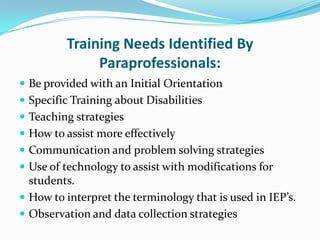
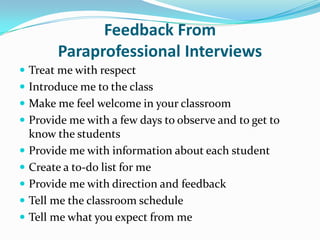
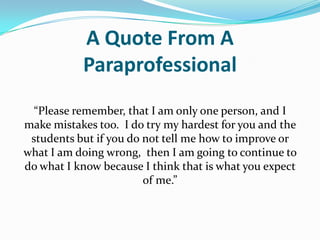
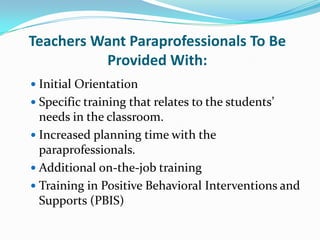
  • #42 These are a list of topics that Paraprofessionals mentioned during their interview process of trainings that they would like to participate in and see more training offered in.
  • #48 *This presentation has demonstrated how the intended research project responds to the problems of practice related to paraprofessionals and the gaps that have been identified in the literature. *The purpose of this proposed research project was to develop a better understanding of the specific roles and responsibilities assigned to paraprofessionals who work in substantially separate classrooms. *This information will ultimately assist school districts in creating more relevant job descriptions and providing appropriate training for paraprofessionals. *Having a specific job description for paraprofessionals will facilitate and guide appropriate paraprofessional training. *The current research on the supervisory role of the teacher and direct supervision of paraprofessionals will be used to clarify the teachers’ role in paraprofessional training and was used as the theoretical frame work for this study. *The intention of this investigation is also to lay the groundwork for a case study that will contribute to the research concerning the roles, responsibilities, training and supervision of paraprofessionals. *Additionally, this work seeks to assist others in understanding and adequately addressing paraprofessionals’ changing roles and training needs.  

  • #50 *It is the researcher’s belief that a systematic focus on the roles and responsibilities of classroom paraprofessionals will help to build a stronger educational environment for students by providing both paraprofessionals and lead teachers with the core knowledge, competencies and skills required to collaboratively strengthen the special education programs.*At SCEC there has been an increase in the number of paraprofessionals that are required to service the students that are presently enrolled (SCEC Union, 2010). SCEC employs seventy-one paraprofessionals; there are more paraprofessionals than teachers. *As the need for paraprofessional increases, there is going to be a greater demand for these educators to have proper, timely and valuable training before they enter the classroom. A formal internal training program to complement the training that takes place prior to entering the classroom, is needed to maximize the contributions the paraprofessionals make in the classroom, and in order to develop an effective training program, this proposal outlines a research project that will answer some of the fundamental questions that will allow the staff at SCEC to start to develop this type of effective training program.
  • #52 *To this end, the recognition of paraprofessionals as vital members of the school’s educational team will become a priority.