Parallelism
E. Siler
A Basic English Rule
• Whenever we put grammatical structures in a list
of two or more, the structures must be identical
in grammatical/structural type (form).
• This rule is called the rule of “parallelism.”
• It’s important to understand parallelism if you
plan to do any form of professional writing in
English.
• Slides, resumes, brochures, and technical papers
are all organized around the rule of parallelism.
Understanding Parallelism
• It’s best to think of parallelism in terms of
examples.
Example 1: Noun phrases
• Slides, resumes, brochures, and technical
papers are all organized around the principle
of parallelism.
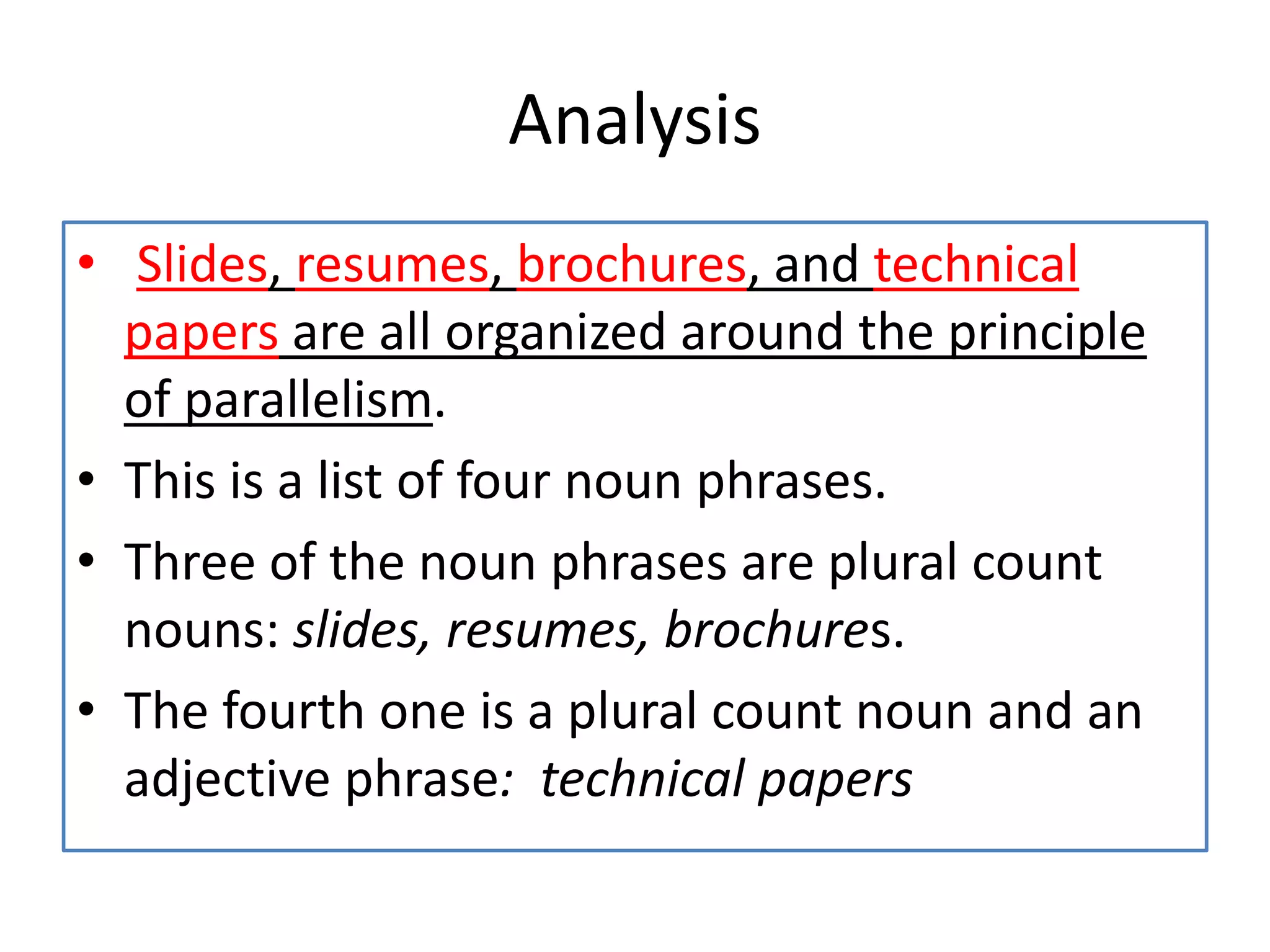
Analysis
• Slides, resumes, brochures, and technical
papers are all organized around the principle
of parallelism.
• This is a list of four noun phrases.
• Three of the noun phrases are plural count
nouns: slides, resumes, brochures.
• The fourth one is a plural count noun and an
adjective phrase: technical papers
Punctuation
• Slides, resumes, brochures, and technical
papers are all organized around the rule of
parallelism.
• Note that the parts of the list are divided by
commas (,) and the last two elements in the
list are connected with “and.”
Parallelism and Other Structures
• Parallelism is not just a way to arrange noun
phrases.
Example 2: Verb Phrases
• Sometimes we list verb phrases.
• My laboratory experience includes:
– Autoclaving
– Extracting DNA
– Operating the sanitary incinerator
Example 3: Adjective Phrases
• Sometimes we list adjective phrases.
• Bilingual; US-educated; Experienced in hotel
front desk work.
Example 4: Prepositional Phrases
• Sometimes we list prepositional phrases.
• Experience
– In hotels
– In restaurants
– At amusement parks
• Experience in
– Hotels
– Restaurants
– Cafeterias
Example 5: Clauses
• Sometimes we list clauses.
• I interviewed candidates , recommended short
list candidates, and organized interviews.
Resume Mistake #1
• [ Semester long one-on-one mentorship
opportunity designed to develop professional
skills and preparation in professional
engineering.]
Analysis
• [ Semester long one-on-one mentorship
opportunity designed to develop professional
skills and preparation in professional
engineering.]
• Problem: The two elements listed with “and”
are not in the same form.
• One is an infinitive phrase (to develop . . .)
• One is a noun phrase (preparation in . . .)
Fix it!
• [ Semester long one-on-one mentorship
opportunity designed to develop professional
skills and (to) prepare for a career in
professional engineering.]
• Solution: Now we have two infinitive
phrases.
Fix It!
• [ Semester long one-on-one mentorship
opportunity designed for the development of
professional skills and preparation in
professional engineering.]
• Solution: Now we have two noun phrases.
Resume Mistake #2
• Experience
• Shoe Company
Payless Shoes
Purchasing Agent Assistant
• Econometrics Lab
Unemployment Rate Research (USA) Fall
2010
Analysis
• Experience
• Shoe Company
Payless Shoes
Purchasing Agent Assistant
• Econometrics Lab
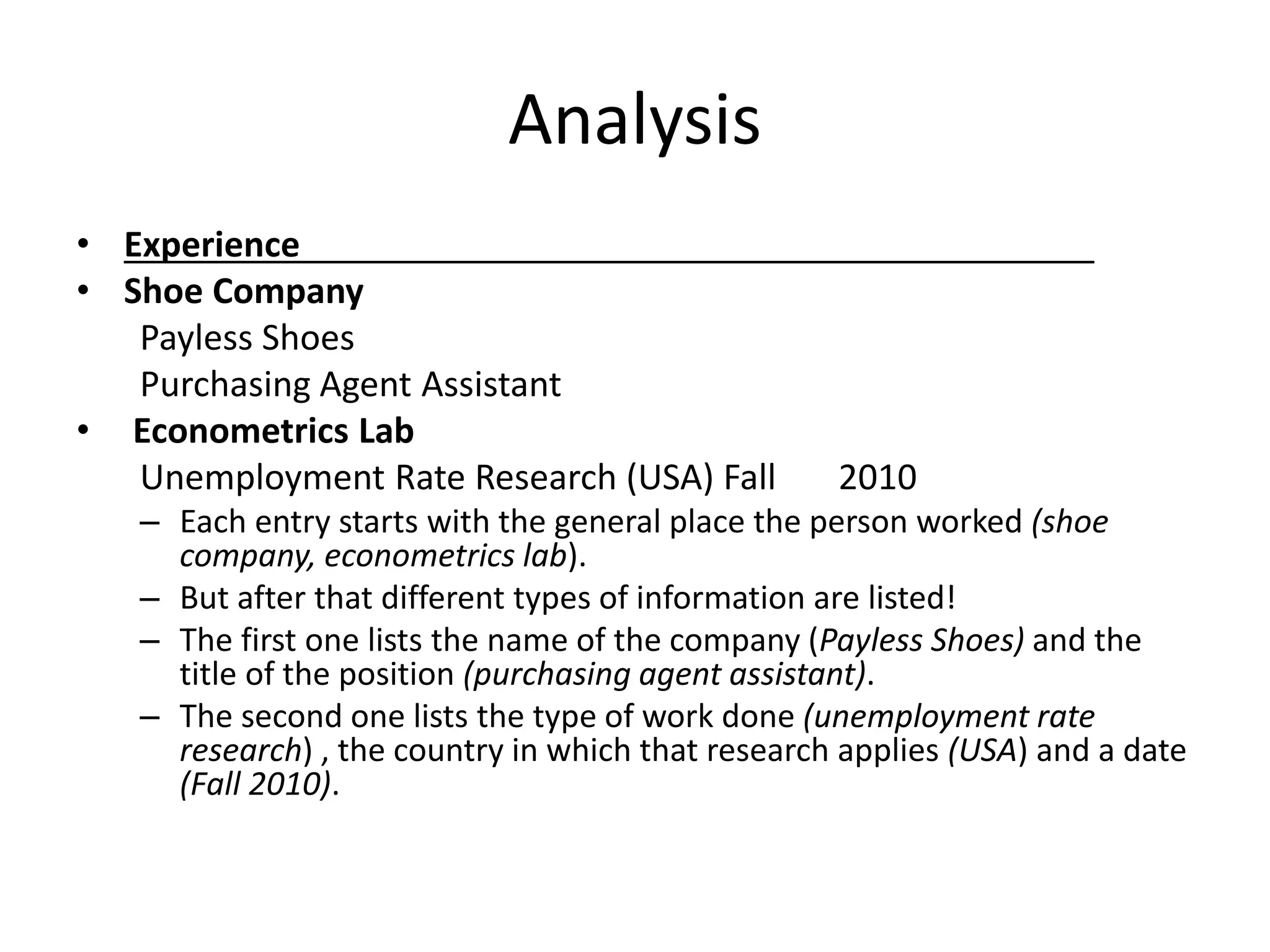
Unemployment Rate Research (USA) Fall 2010
– Each entry starts with the general place the person worked (shoe
company, econometrics lab).
– But after that different types of information are listed!
– The first one lists the name of the company (Payless Shoes) and the
title of the position (purchasing agent assistant).
– The second one lists the type of work done (unemployment rate
research) , the country in which that research applies (USA) and a date
(Fall 2010).
Fix It!
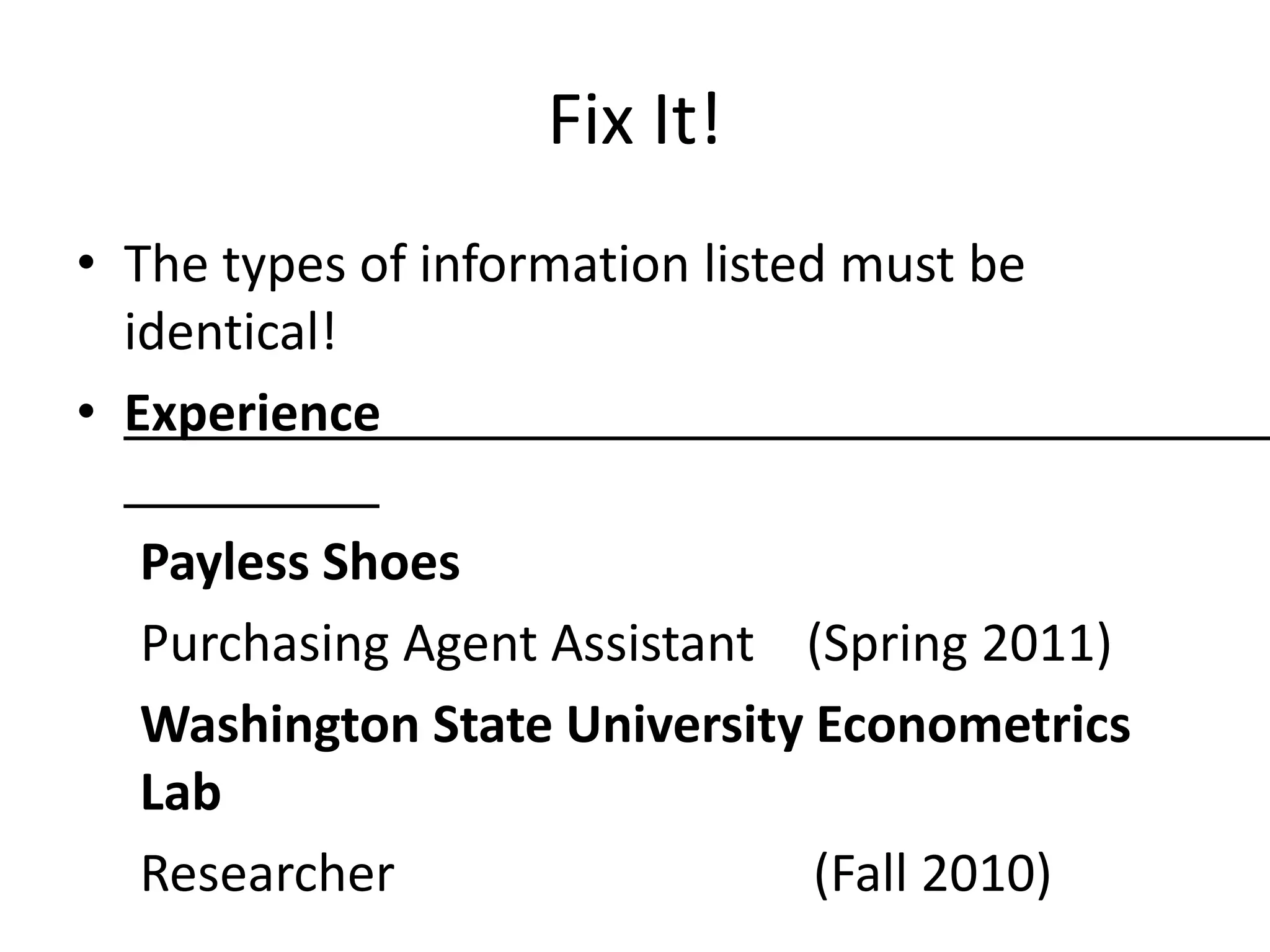
• The types of information listed must be
identical!
• Experience
Payless Shoes
Purchasing Agent Assistant (Spring 2011)
Washington State University Econometrics
Lab
Researcher (Fall 2010)
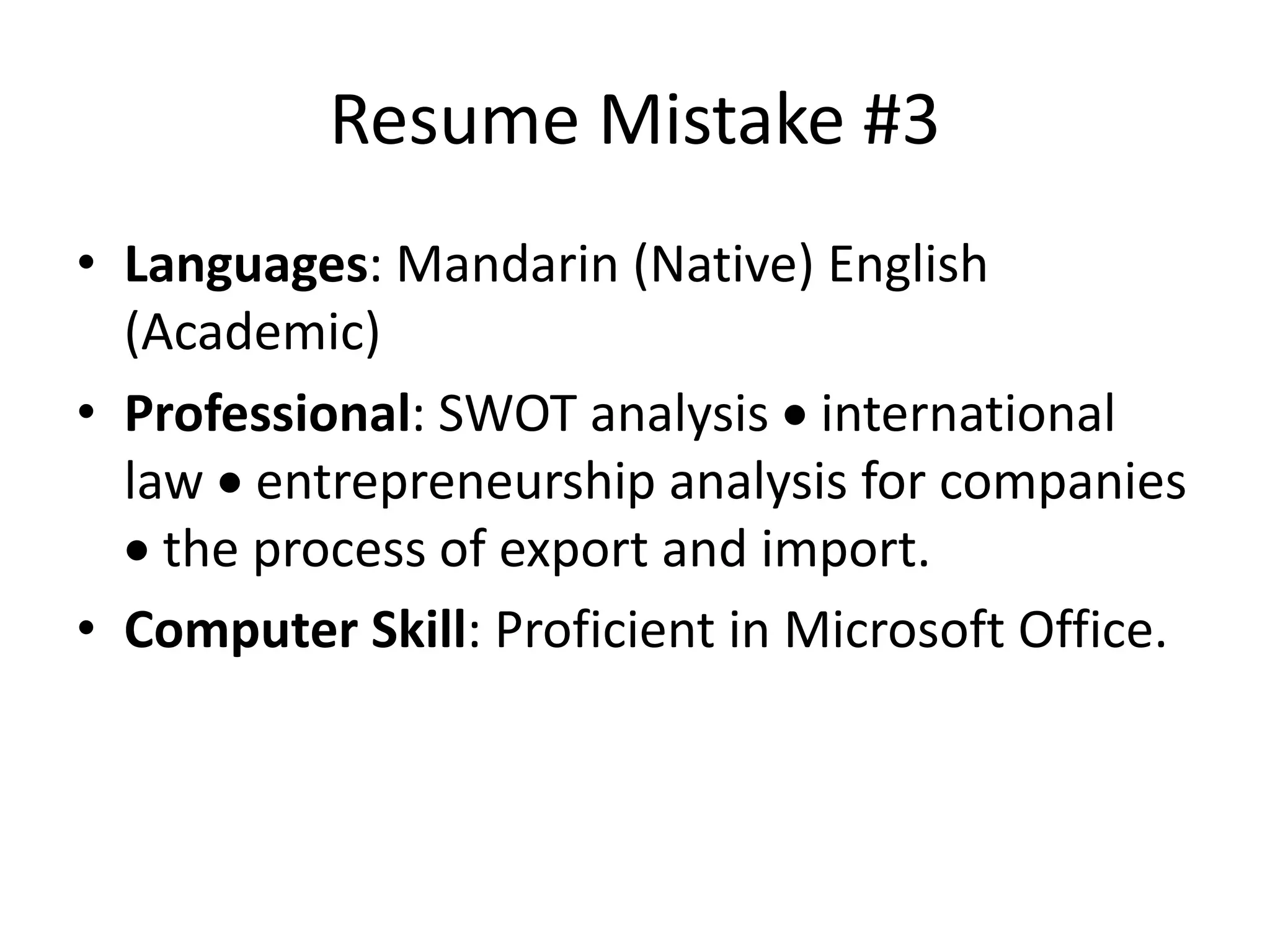
Resume Mistake #3
• Languages: Mandarin (Native) English
(Academic)
• Professional: SWOT analysis  international
law  entrepreneurship analysis for companies
 the process of export and import.
• Computer Skill: Proficient in Microsoft Office.
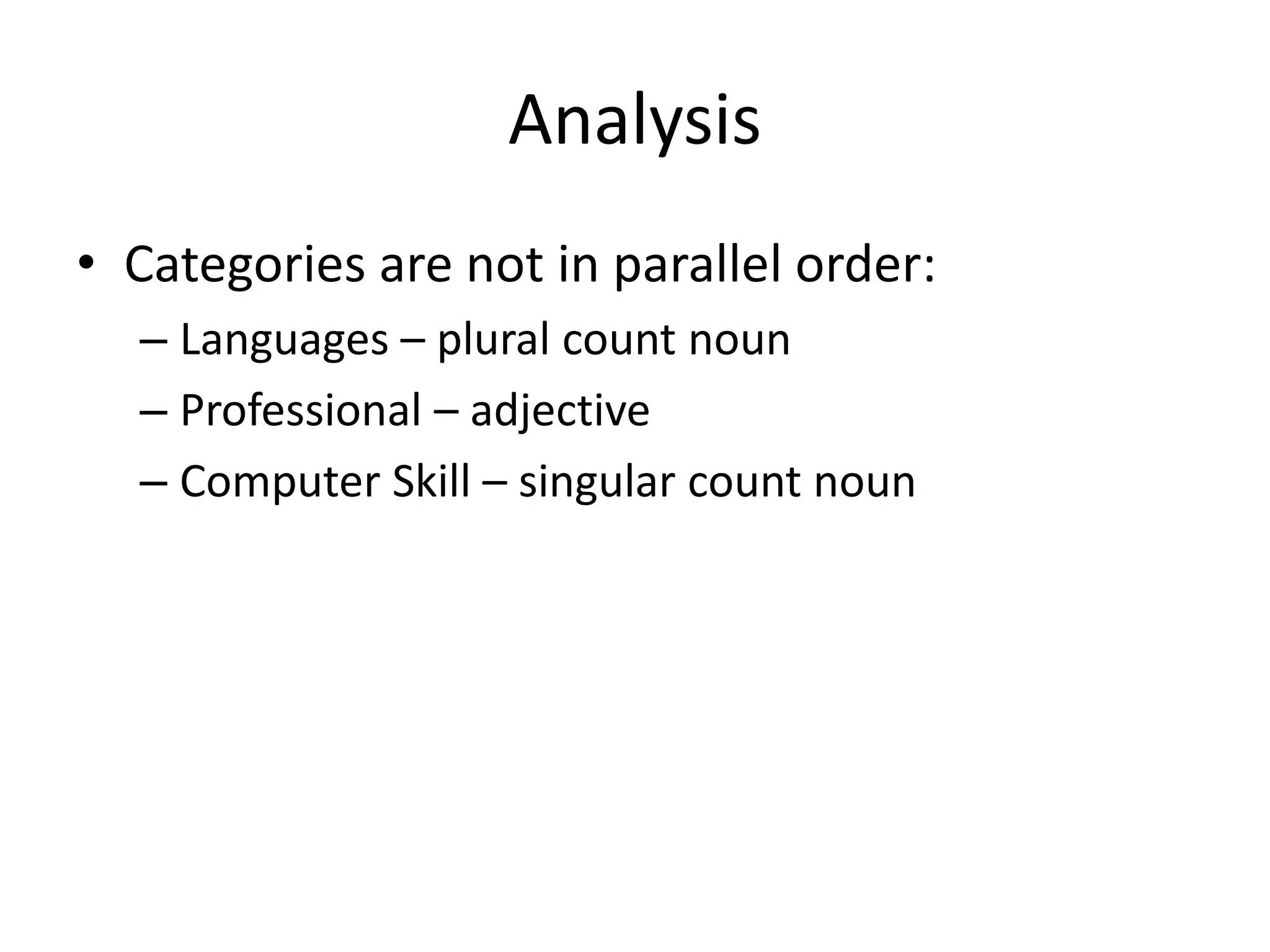
Analysis
• Categories are not in parallel order:
– Languages – plural count noun
– Professional – adjective
– Computer Skill – singular count noun
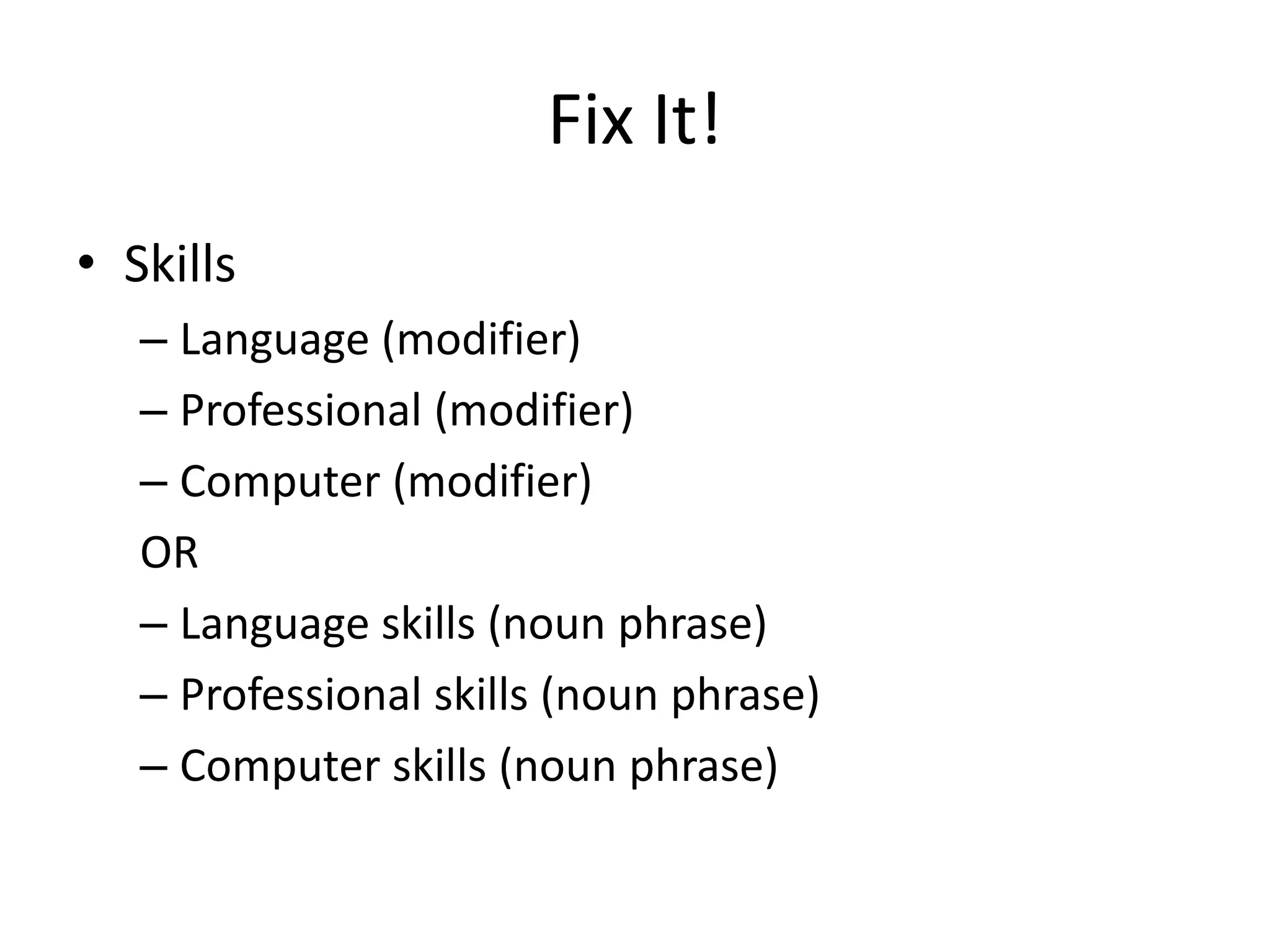
Fix It!
• Skills
– Language (modifier)
– Professional (modifier)
– Computer (modifier)
OR
– Language skills (noun phrase)
– Professional skills (noun phrase)
– Computer skills (noun phrase)
Analysis
• Remember: When we have two things in a
list, we combine with AND. In a resume we
could also use a semi-colon.
Language skills: Mandarin (Native) and
English (Academic).
OR
Language skills: Mandarin (Native); English
(Academic)
Analysis
• Remember: Wherever possible we want
phrases to be roughly the same type and length.
• Professional skills:
– SWOT analysis: (compound noun)
– international law: (adjective noun)
– entrepreneurship analysis for companies: (compound
noun with prepositional phrase)
– the process of export and import: (noun modified by
prepositional phrase.
Fix It!
• Professional skills:
• SWOT analysis: (compound noun)
• international law: (adjective noun)
• entrepreneurship analysis for companies:
(compound noun with prepositional phrase)
• import/export processes: (compound noun).
Resume Mistake #4
• Experienced specialist in International
Business  Bilingual in Mandarin/English 
Sales experience  Illustration experience
Analysis
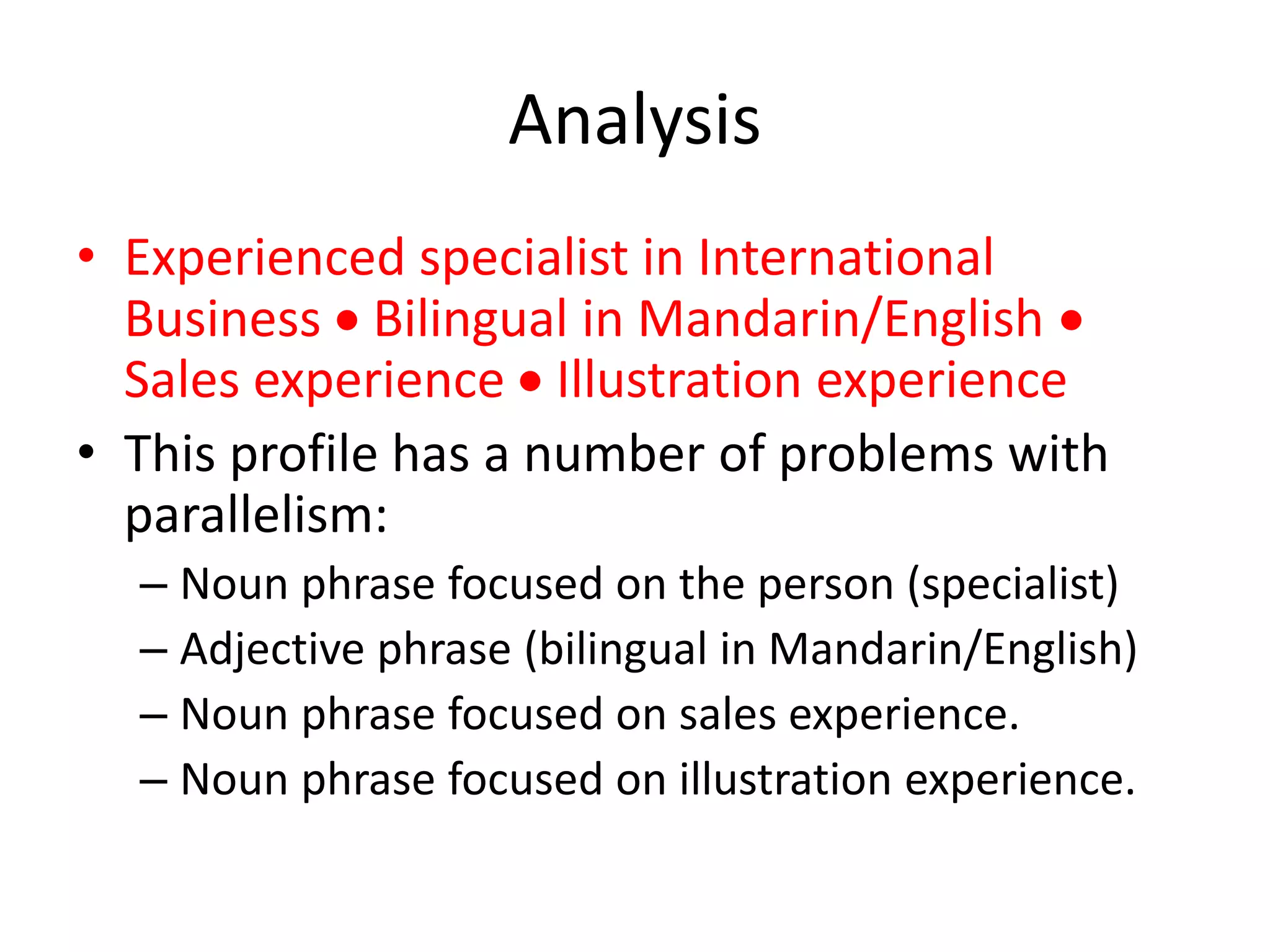
• Experienced specialist in International
Business  Bilingual in Mandarin/English 
Sales experience  Illustration experience
• This profile has a number of problems with
parallelism:
– Noun phrase focused on the person (specialist)
– Adjective phrase (bilingual in Mandarin/English)
– Noun phrase focused on sales experience.
– Noun phrase focused on illustration experience.
Fix It!
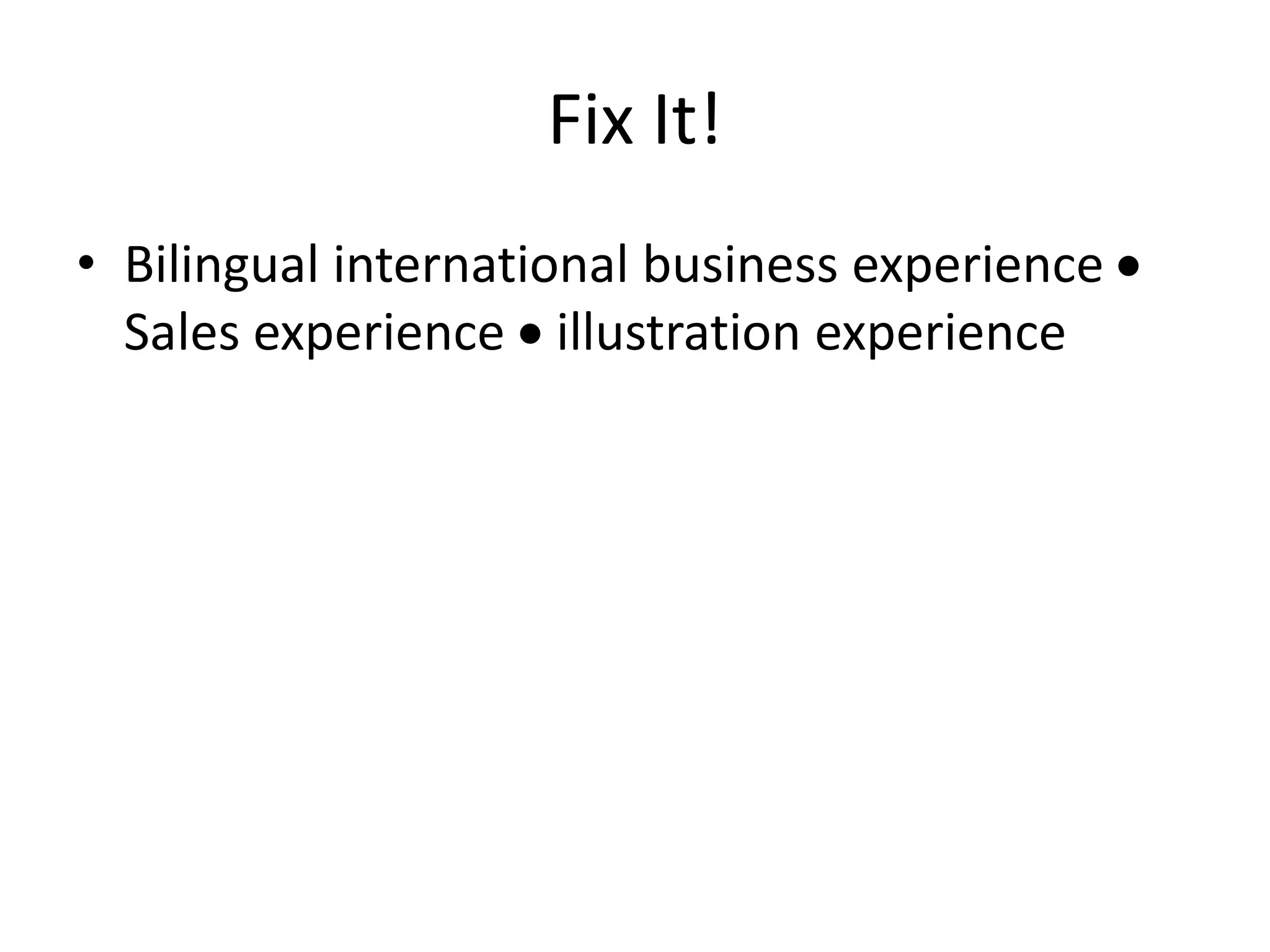
• Bilingual international business experience 
Sales experience  illustration experience

Parallelism 1

  • 1.
  • 2.
    A Basic EnglishRule • Whenever we put grammatical structures in a list of two or more, the structures must be identical in grammatical/structural type (form). • This rule is called the rule of “parallelism.” • It’s important to understand parallelism if you plan to do any form of professional writing in English. • Slides, resumes, brochures, and technical papers are all organized around the rule of parallelism.
  • 3.
    Understanding Parallelism • It’sbest to think of parallelism in terms of examples.
  • 4.
    Example 1: Nounphrases • Slides, resumes, brochures, and technical papers are all organized around the principle of parallelism.
  • 5.
    Analysis • Slides, resumes,brochures, and technical papers are all organized around the principle of parallelism. • This is a list of four noun phrases. • Three of the noun phrases are plural count nouns: slides, resumes, brochures. • The fourth one is a plural count noun and an adjective phrase: technical papers
  • 6.
    Punctuation • Slides, resumes,brochures, and technical papers are all organized around the rule of parallelism. • Note that the parts of the list are divided by commas (,) and the last two elements in the list are connected with “and.”
  • 7.
    Parallelism and OtherStructures • Parallelism is not just a way to arrange noun phrases.
  • 8.
    Example 2: VerbPhrases • Sometimes we list verb phrases. • My laboratory experience includes: – Autoclaving – Extracting DNA – Operating the sanitary incinerator
  • 9.
    Example 3: AdjectivePhrases • Sometimes we list adjective phrases. • Bilingual; US-educated; Experienced in hotel front desk work.
  • 10.
    Example 4: PrepositionalPhrases • Sometimes we list prepositional phrases. • Experience – In hotels – In restaurants – At amusement parks • Experience in – Hotels – Restaurants – Cafeterias
  • 11.
    Example 5: Clauses •Sometimes we list clauses. • I interviewed candidates , recommended short list candidates, and organized interviews.
  • 12.
    Resume Mistake #1 •[ Semester long one-on-one mentorship opportunity designed to develop professional skills and preparation in professional engineering.]
  • 13.
    Analysis • [ Semesterlong one-on-one mentorship opportunity designed to develop professional skills and preparation in professional engineering.] • Problem: The two elements listed with “and” are not in the same form. • One is an infinitive phrase (to develop . . .) • One is a noun phrase (preparation in . . .)
  • 14.
    Fix it! • [Semester long one-on-one mentorship opportunity designed to develop professional skills and (to) prepare for a career in professional engineering.] • Solution: Now we have two infinitive phrases.
  • 15.
    Fix It! • [Semester long one-on-one mentorship opportunity designed for the development of professional skills and preparation in professional engineering.] • Solution: Now we have two noun phrases.
  • 16.
    Resume Mistake #2 •Experience • Shoe Company Payless Shoes Purchasing Agent Assistant • Econometrics Lab Unemployment Rate Research (USA) Fall 2010
  • 17.
    Analysis • Experience • ShoeCompany Payless Shoes Purchasing Agent Assistant • Econometrics Lab Unemployment Rate Research (USA) Fall 2010 – Each entry starts with the general place the person worked (shoe company, econometrics lab). – But after that different types of information are listed! – The first one lists the name of the company (Payless Shoes) and the title of the position (purchasing agent assistant). – The second one lists the type of work done (unemployment rate research) , the country in which that research applies (USA) and a date (Fall 2010).
  • 18.
    Fix It! • Thetypes of information listed must be identical! • Experience Payless Shoes Purchasing Agent Assistant (Spring 2011) Washington State University Econometrics Lab Researcher (Fall 2010)
  • 19.
    Resume Mistake #3 •Languages: Mandarin (Native) English (Academic) • Professional: SWOT analysis  international law  entrepreneurship analysis for companies  the process of export and import. • Computer Skill: Proficient in Microsoft Office.
  • 20.
    Analysis • Categories arenot in parallel order: – Languages – plural count noun – Professional – adjective – Computer Skill – singular count noun
  • 21.
    Fix It! • Skills –Language (modifier) – Professional (modifier) – Computer (modifier) OR – Language skills (noun phrase) – Professional skills (noun phrase) – Computer skills (noun phrase)
  • 22.
    Analysis • Remember: Whenwe have two things in a list, we combine with AND. In a resume we could also use a semi-colon. Language skills: Mandarin (Native) and English (Academic). OR Language skills: Mandarin (Native); English (Academic)
  • 23.
    Analysis • Remember: Whereverpossible we want phrases to be roughly the same type and length. • Professional skills: – SWOT analysis: (compound noun) – international law: (adjective noun) – entrepreneurship analysis for companies: (compound noun with prepositional phrase) – the process of export and import: (noun modified by prepositional phrase.
  • 24.
    Fix It! • Professionalskills: • SWOT analysis: (compound noun) • international law: (adjective noun) • entrepreneurship analysis for companies: (compound noun with prepositional phrase) • import/export processes: (compound noun).
  • 25.
    Resume Mistake #4 •Experienced specialist in International Business  Bilingual in Mandarin/English  Sales experience  Illustration experience
  • 26.
    Analysis • Experienced specialistin International Business  Bilingual in Mandarin/English  Sales experience  Illustration experience • This profile has a number of problems with parallelism: – Noun phrase focused on the person (specialist) – Adjective phrase (bilingual in Mandarin/English) – Noun phrase focused on sales experience. – Noun phrase focused on illustration experience.
  • 27.
    Fix It! • Bilingualinternational business experience  Sales experience  illustration experience