PARALLELISM AND
PERPENDICULARITY
Math Prayer
Lord,
You have created us in different shapes and angles
But still you made sure that we are congruent one way or another.
No matter which sides, even if there are terms undefined, your teachings will remain our guide.
May our lesson today maybe made parallel with what you want us to become. And by the time
our paths perpendicularly crossed, may we face you with confidence
That you will shower us with your unending love and providence. AMEN.
This lesson seeks to answer the question:
“How can we establish
parallelism or
perpendicularity of lines?”
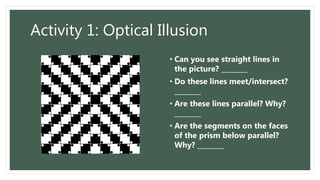
Activity 1: Optical Illusion
• Can you see straight lines in
the picture? ________
• Do these lines meet/intersect?
________
• Are these lines parallel? Why?
________
• Are the segments on the faces
of the prism below parallel?
Why? ________
Activity 1: Optical Illusion
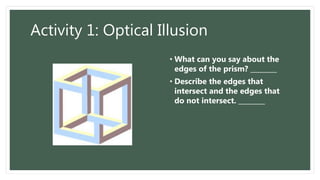
• What can you say about the
edges of the prism? ________
• Describe the edges that
intersect and the edges that
do not intersect. ________
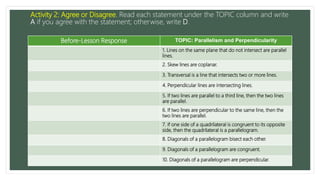
Activity 2: Agree or Disagree. Read each statement under the TOPIC column and write
A if you agree with the statement; otherwise, write D.
Before-Lesson Response TOPIC: Parallelism and Perpendicularity
1. Lines on the same plane that do not intersect are parallel
lines.
2. Skew lines are coplanar.
3. Transversal is a line that intersects two or more lines.
4. Perpendicular lines are intersecting lines.
5. If two lines are parallel to a third line, then the two lines
are parallel.
6. If two lines are perpendicular to the same line, then the
two lines are parallel.
7. If one side of a quadrilateral is congruent to its opposite
side, then the quadrilateral is a parallelogram.
8. Diagonals of a parallelogram bisect each other.
9. Diagonals of a parallelogram are congruent.
10. Diagonals of a parallelogram are perpendicular.
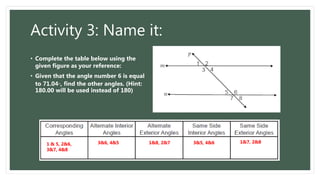
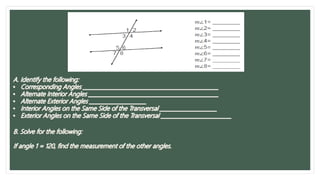
Activity 3: Name it:
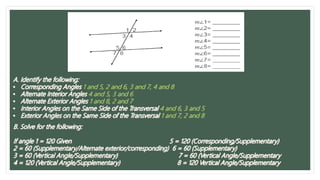
• Complete the table below using the
given figure as your reference:
• Given that the angle number 6 is equal
to 71.04◦, find the other angles. (Hint:
180.00 will be used instead of 180)
1 & 5, 2&6,
3&7, 4&8
3&6, 4&5 1&8, 2&7 3&5, 4&6 1&7, 2&8
Perpendicular distance
between parallel lines
GET READY!
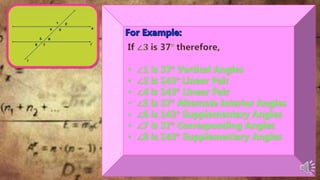
1 and 5, 2 and 6, 3 and 7, 4 and 8
4 and 5, 3 and 6
1 and 8, 2 and 7
4 and 6, 3 and 5
1 and 7, 2 and 8
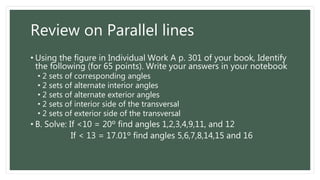
Review on Parallel lines
• Using the figure in Individual Work A p. 301 of your book, Identify
the following (for 65 points). Write your answers in your notebook
• 2 sets of corresponding angles
• 2 sets of alternate interior angles
• 2 sets of alternate exterior angles
• 2 sets of interior side of the transversal
• 2 sets of exterior side of the transversal
• B. Solve: If <10 = 20º find angles 1,2,3,4,9,11, and 12
If < 13 = 17.01º find angles 5,6,7,8,14,15 and 16
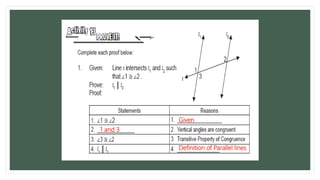
Given
1 and 3
Definition of Parallel lines

Parallelism and perpendicularity

  • 1.
  • 2.
    Math Prayer Lord, You havecreated us in different shapes and angles But still you made sure that we are congruent one way or another. No matter which sides, even if there are terms undefined, your teachings will remain our guide. May our lesson today maybe made parallel with what you want us to become. And by the time our paths perpendicularly crossed, may we face you with confidence That you will shower us with your unending love and providence. AMEN.
  • 3.
    This lesson seeksto answer the question: “How can we establish parallelism or perpendicularity of lines?”
  • 4.
    Activity 1: OpticalIllusion • Can you see straight lines in the picture? ________ • Do these lines meet/intersect? ________ • Are these lines parallel? Why? ________ • Are the segments on the faces of the prism below parallel? Why? ________
  • 5.
    Activity 1: OpticalIllusion • What can you say about the edges of the prism? ________ • Describe the edges that intersect and the edges that do not intersect. ________
  • 6.
    Activity 2: Agreeor Disagree. Read each statement under the TOPIC column and write A if you agree with the statement; otherwise, write D. Before-Lesson Response TOPIC: Parallelism and Perpendicularity 1. Lines on the same plane that do not intersect are parallel lines. 2. Skew lines are coplanar. 3. Transversal is a line that intersects two or more lines. 4. Perpendicular lines are intersecting lines. 5. If two lines are parallel to a third line, then the two lines are parallel. 6. If two lines are perpendicular to the same line, then the two lines are parallel. 7. If one side of a quadrilateral is congruent to its opposite side, then the quadrilateral is a parallelogram. 8. Diagonals of a parallelogram bisect each other. 9. Diagonals of a parallelogram are congruent. 10. Diagonals of a parallelogram are perpendicular.
  • 9.
    Activity 3: Nameit: • Complete the table below using the given figure as your reference: • Given that the angle number 6 is equal to 71.04◦, find the other angles. (Hint: 180.00 will be used instead of 180) 1 & 5, 2&6, 3&7, 4&8 3&6, 4&5 1&8, 2&7 3&5, 4&6 1&7, 2&8
  • 12.
  • 13.
  • 15.
    1 and 5,2 and 6, 3 and 7, 4 and 8 4 and 5, 3 and 6 1 and 8, 2 and 7 4 and 6, 3 and 5 1 and 7, 2 and 8
  • 16.
    Review on Parallellines • Using the figure in Individual Work A p. 301 of your book, Identify the following (for 65 points). Write your answers in your notebook • 2 sets of corresponding angles • 2 sets of alternate interior angles • 2 sets of alternate exterior angles • 2 sets of interior side of the transversal • 2 sets of exterior side of the transversal • B. Solve: If <10 = 20º find angles 1,2,3,4,9,11, and 12 If < 13 = 17.01º find angles 5,6,7,8,14,15 and 16
  • 18.
    Given 1 and 3 Definitionof Parallel lines