Accounting Information Systems, 6th
edition
James A. Hall
COPYRIGHT © 2009 South-Western, a division of Cengage Learning. Cengage Learning and South-Western
are trademarks used herein under license
Objectives for Chapter 6
Fundamental tasks of payroll and fixed asset
processes
Functional depts. of payroll and fixed asset activities
and the flow of transactions through the organization
Documents, journals, and accounts needed for audit
trails, record maintenance, decision making, and
financial reporting
Exposures associated with payroll and fixed asset
activities and the controls that reduce these risks
Operational features and the control implications of
technology used in payroll and fixed asset systems
DFD of Payroll Procedures
Manual Payroll System
Personnel dept. uses personnel
action forms to:
activate new employees
change the pay rate of employees
change marital status and/or number of
dependents
terminate employees
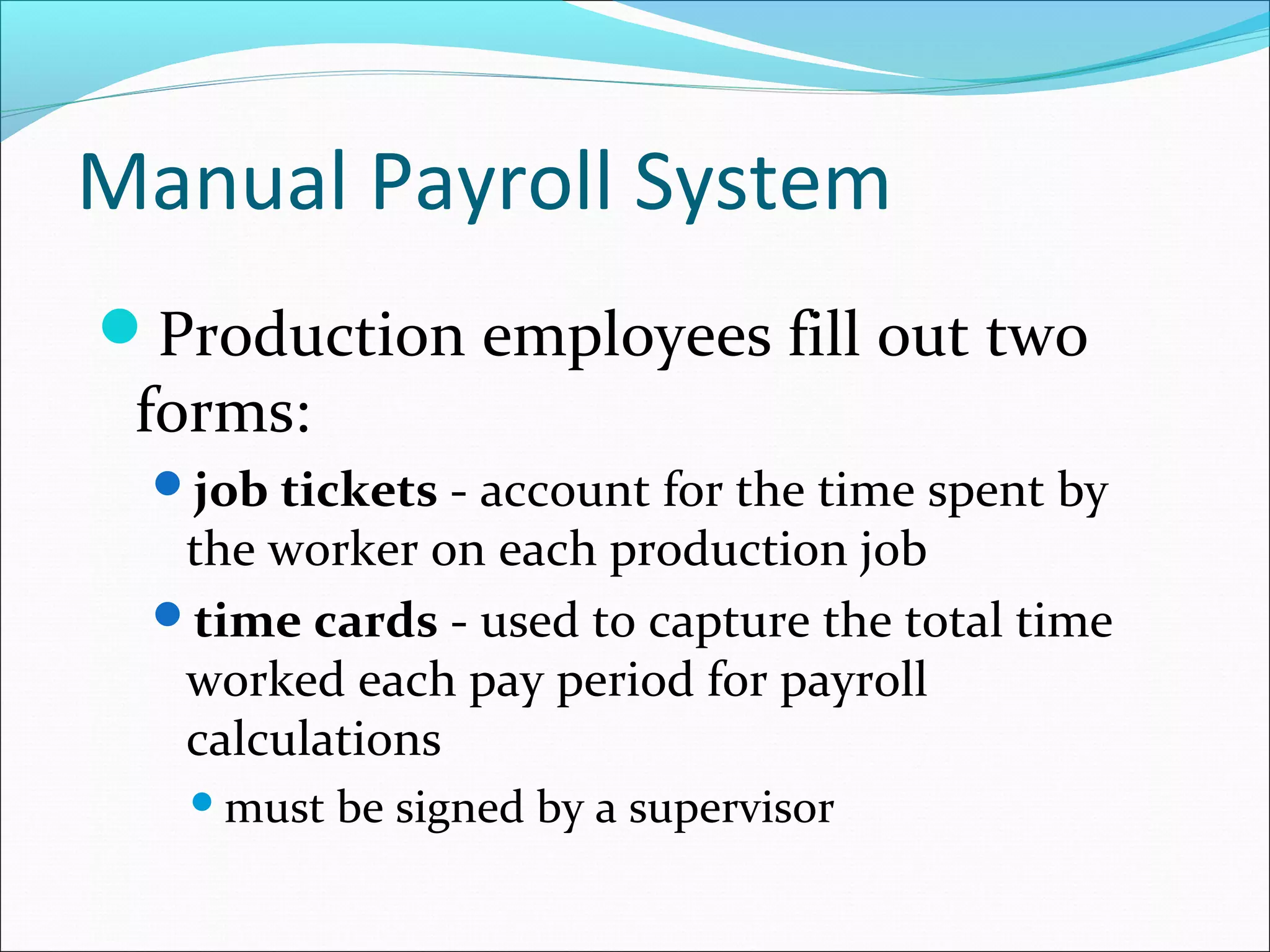
Production employees fill out two
forms:
job tickets - account for the time spent by
the worker on each production job
time cards - used to capture the total time
worked each pay period for payroll
calculations
must be signed by a supervisor
Manual Payroll System
Cost Accounting dept:
uses the job tickets to allocate labor
costs to WIP accounts
summarizes these charges in a labor
distribution summary which is
forwarded to G/L dept.
Manual Payroll System
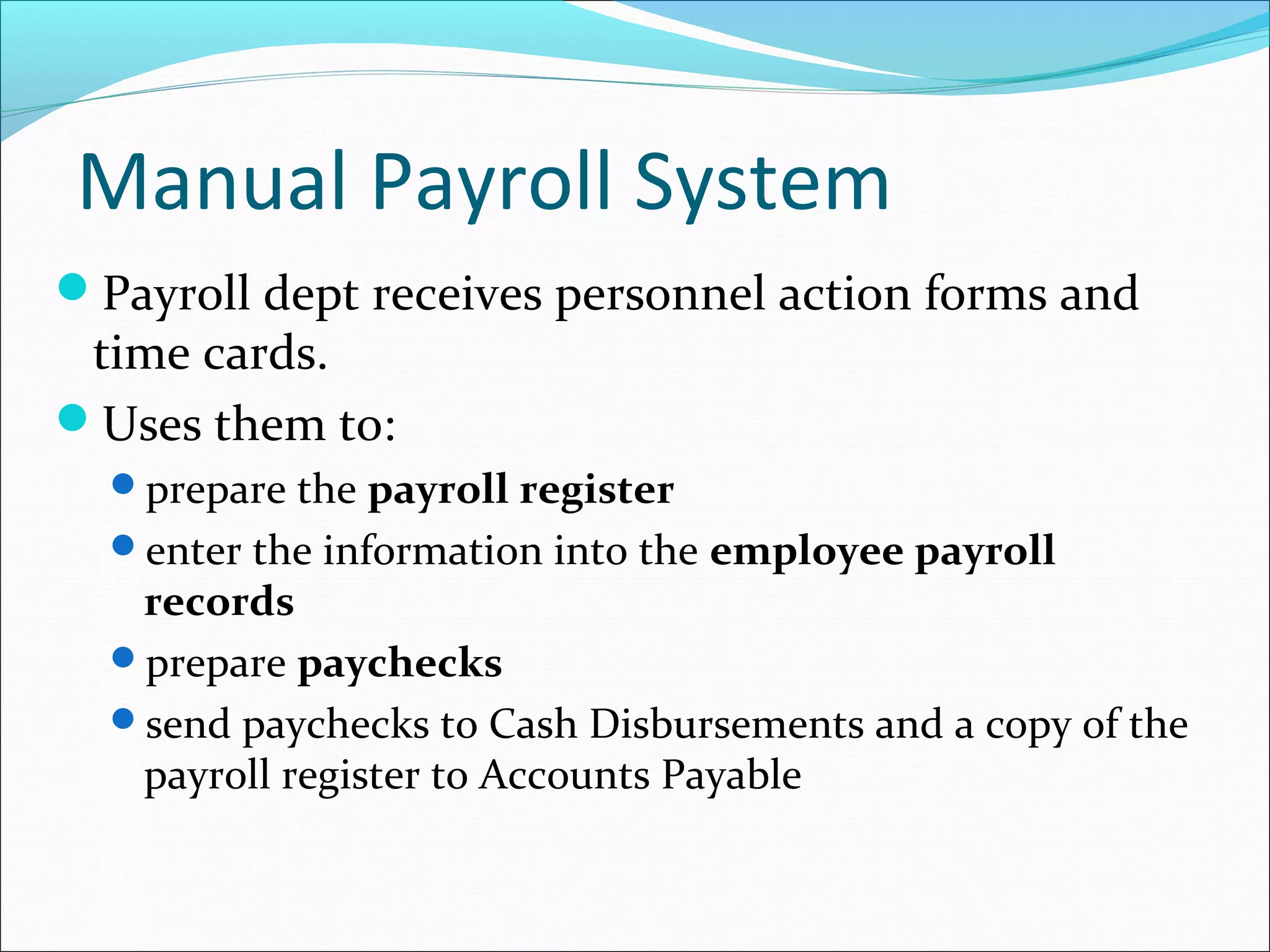
Payroll dept receives personnel action forms and
time cards.
Uses them to:
prepare the payroll register
enter the information into the employee payroll
records
prepare paychecks
send paychecks to Cash Disbursements and a copy of the
payroll register to Accounts Payable
Manual Payroll System
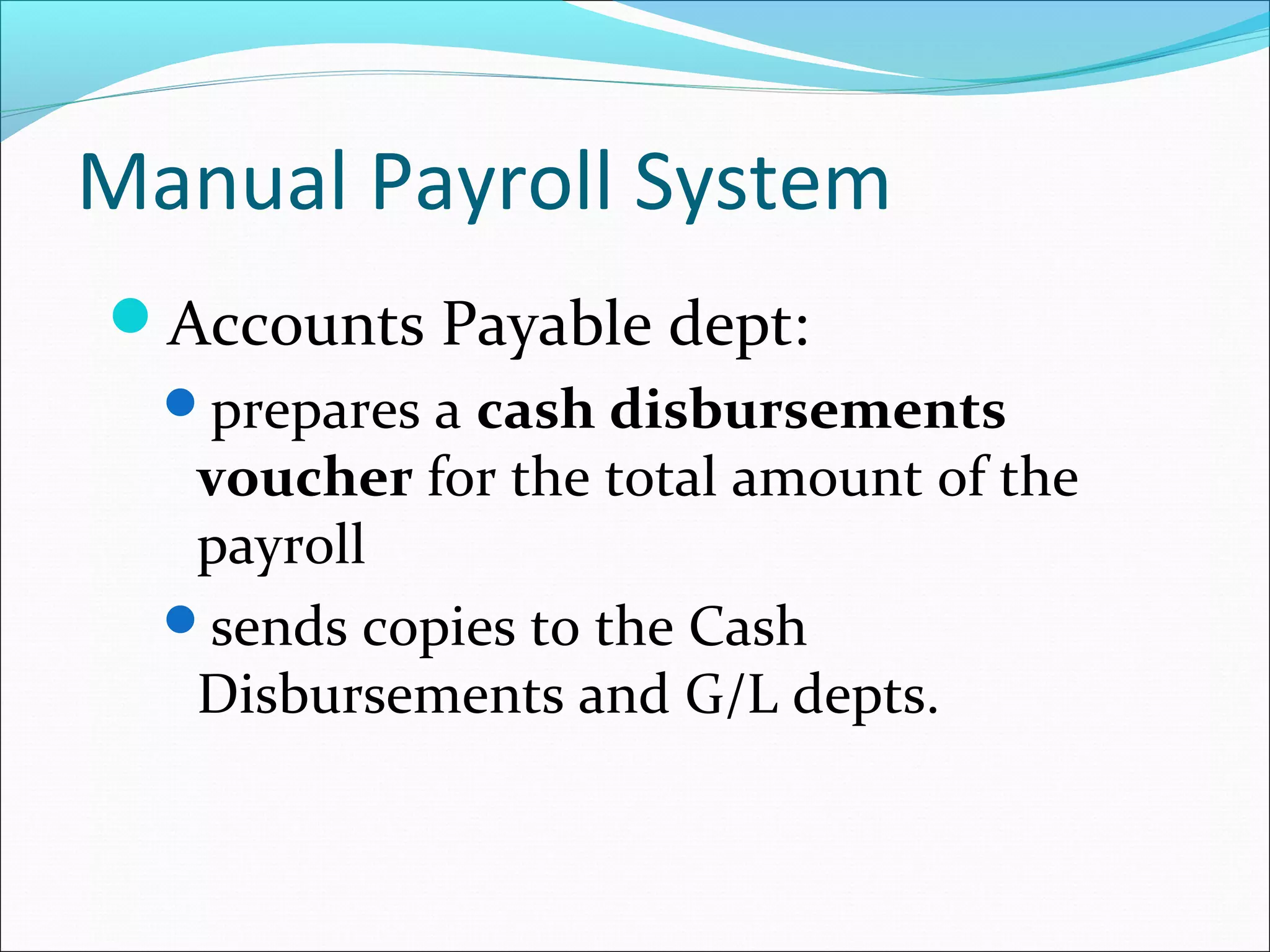
Accounts Payable dept:
prepares a cash disbursements
voucher for the total amount of the
payroll
sends copies to the Cash
Disbursements and G/L depts.
Manual Payroll System
Cash Disbursements dept:
reviews and signs the paychecks and
forwards them to a paymaster for
distribution to the employees
writes a check for the payroll and
deposits it into the payroll imprest
account
Manual Payroll System
G/L dept. makes the following journal entries:
From the Labor Distribution Summary
WIP (Direct Labor) DR
Factory Overhead (Indirect Labor) DR
Wages Payable CR
From the Distribution Voucher
Wages Payable DR
Cash CR
Fed. Inc. Tax Withholding Payable CR
State Inc. Tax Withholding Payable CR
FICA Withholding Payable CR
Other Withholding Payables CR
Manual Payroll System
G/L dept. makes a journal entry to transfer
the cash from the operating bank account to
the payroll imprest account:
Cash - Payroll Imprest Account DR
Cash - Operating Account CR
Manual Payroll System
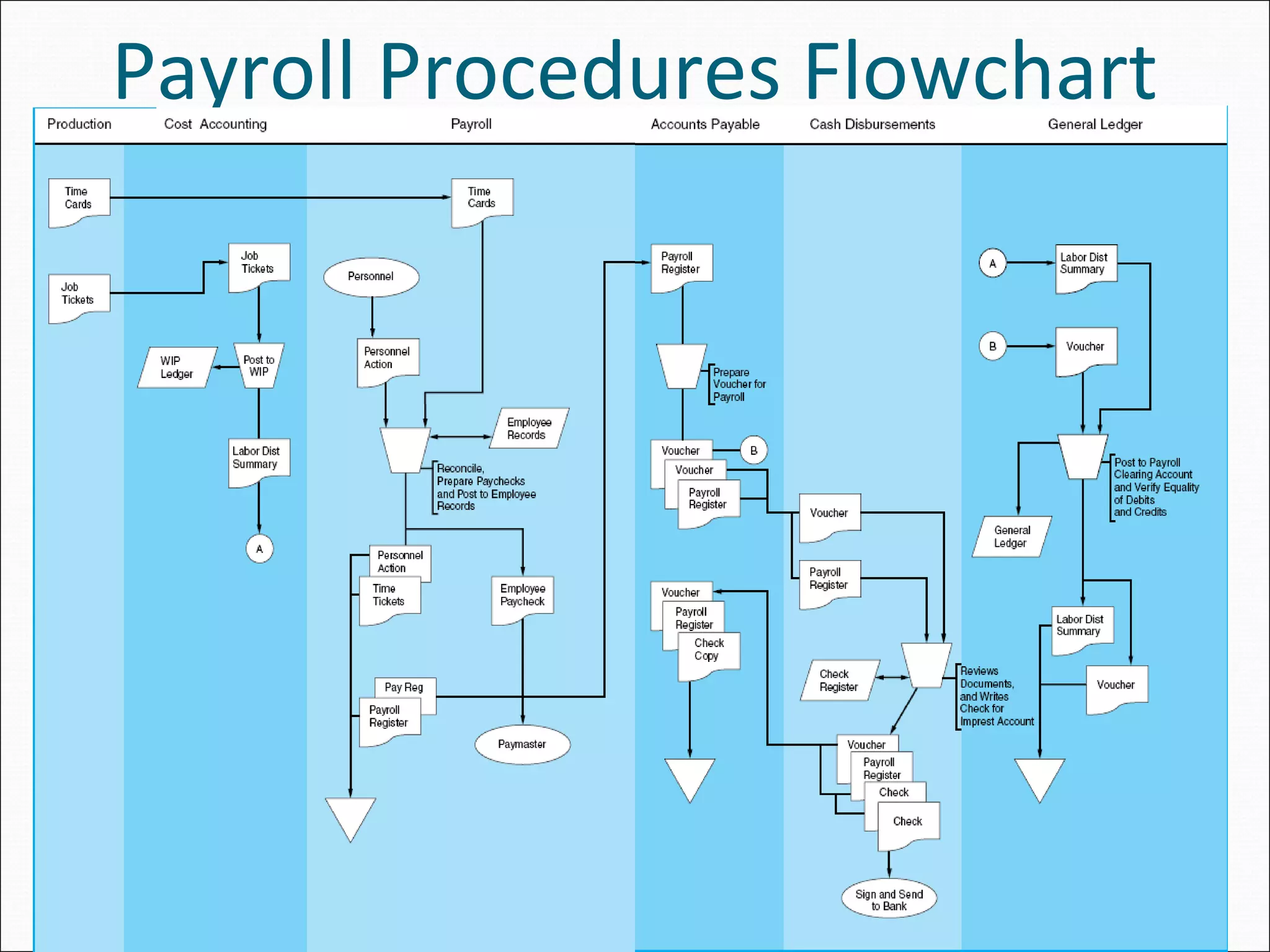
Payroll Procedures Flowchart
Payroll Controls
Transaction authorization - the
personnel action form helps prevent:
terminated employees from receiving
checks
wage rates from being improperly
changed for current employees
Segregation of Duties -
timekeeping and personnel
functions should be separated
Supervision - need to monitor
employees to ensure they are not
“clocking in” for one another
Payroll Controls
Accounting Records - audit trail
includes:
time cards
job tickets
disbursement vouchers
labor distribution summary
payroll register
subsidiary ledger accounts
general ledger accounts
Payroll Controls
Access Controls - need to prevent
employees from having improper
access to:
accounting records, such as time cards
which can be altered
unsigned checks
Payroll Controls
Independent Verification:
verification of time cards
distribution of paychecks to
authorized employees
verification of accuracy of payroll
register by A/P dept.
G/L dept. reconciles the labor
distribution summary and the payroll
disbursement voucher
Payroll Controls
Computer-Based Payroll
Systems
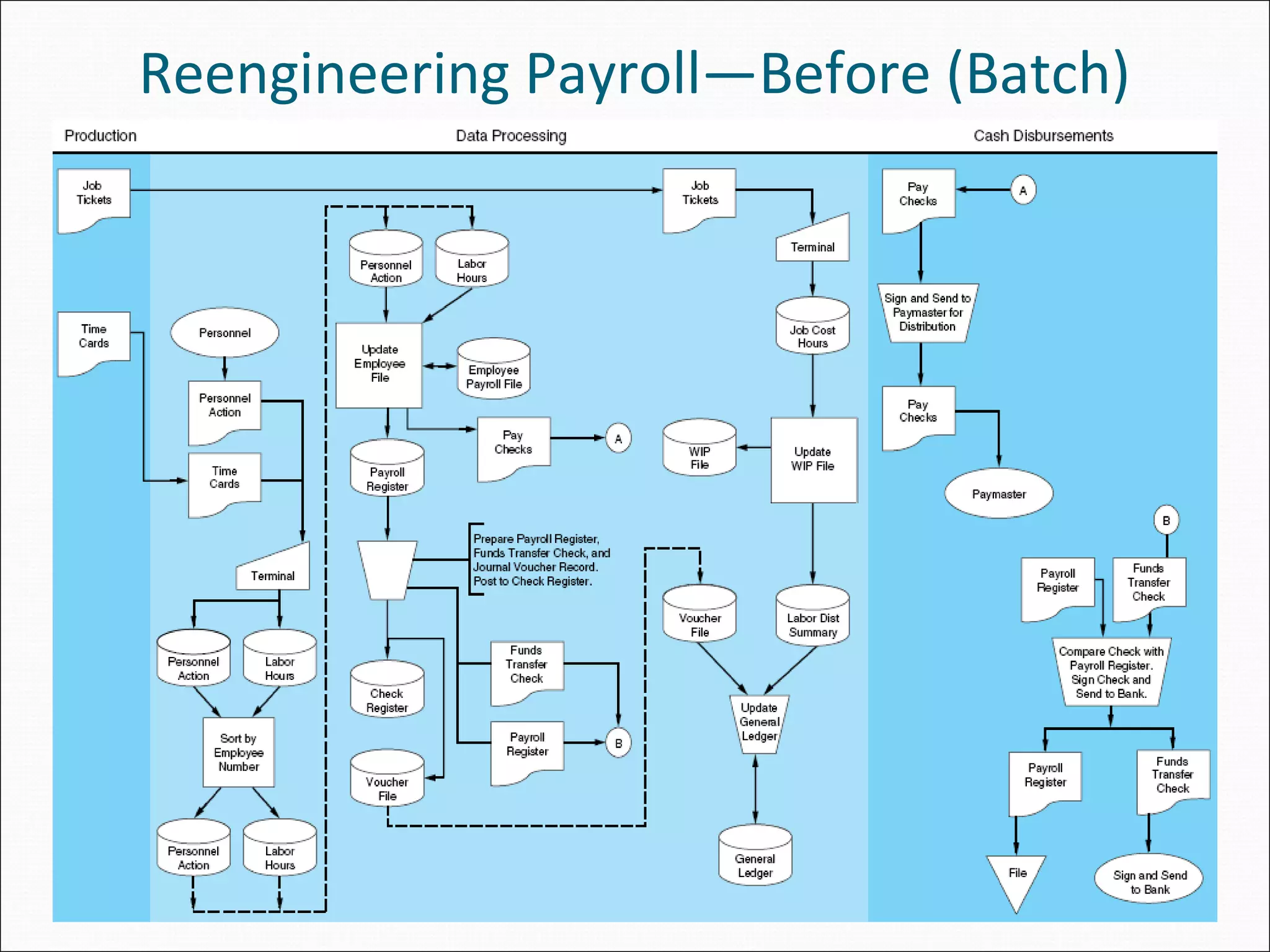
Payroll is well-suited to batch processing
and sequential files.
Most employees on the master file receive
paychecks periodically.
The computer program performs the
detailed record-keeping, check-writing, and
general ledger functions.
Reengineered HRM Systems
Payroll can be reengineered as a part of human
resource management (HRM).
IT can process a wide range of personnel-related
data, including:
employee benefits
labor resource planning
employee skills and training
pay rates, deductions, and pay checks
evaluations
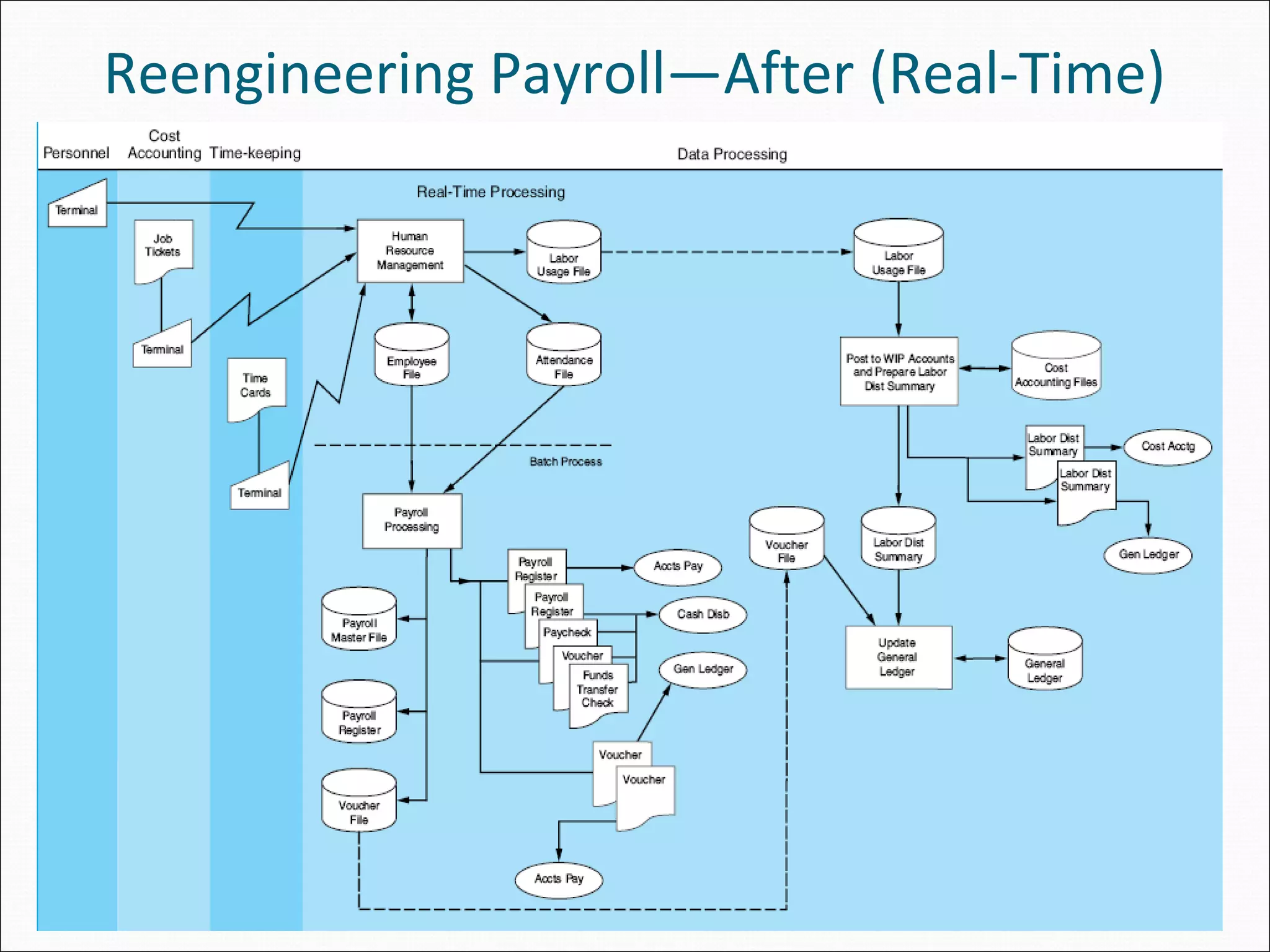
Key Features of Reengineered HRM
Personnel - can make changes to the
employee file in real time
Cost Accounting - enters job cost data
either daily or in real time
Timekeeping - enters the attendance
file daily
Data Processing - still uses batch
processing and prepares all reports, the
checks, and updates the general ledger
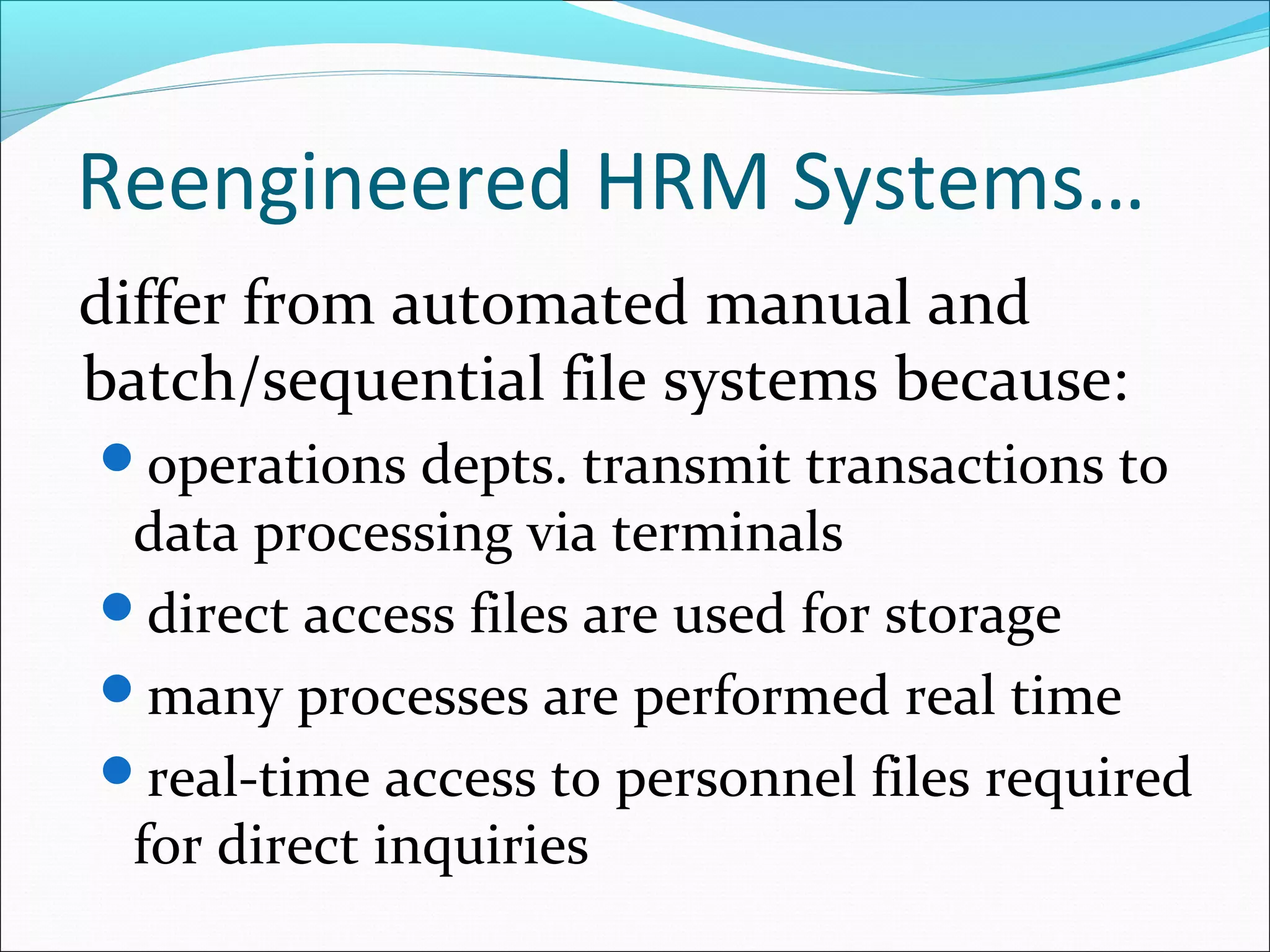
Reengineered HRM Systems…
differ from automated manual and
batch/sequential file systems because:
operations depts. transmit transactions to
data processing via terminals
direct access files are used for storage
many processes are performed real time
real-time access to personnel files required
for direct inquiries
Reengineering Payroll—Before (Batch)
Reengineering Payroll—After (Real-Time)
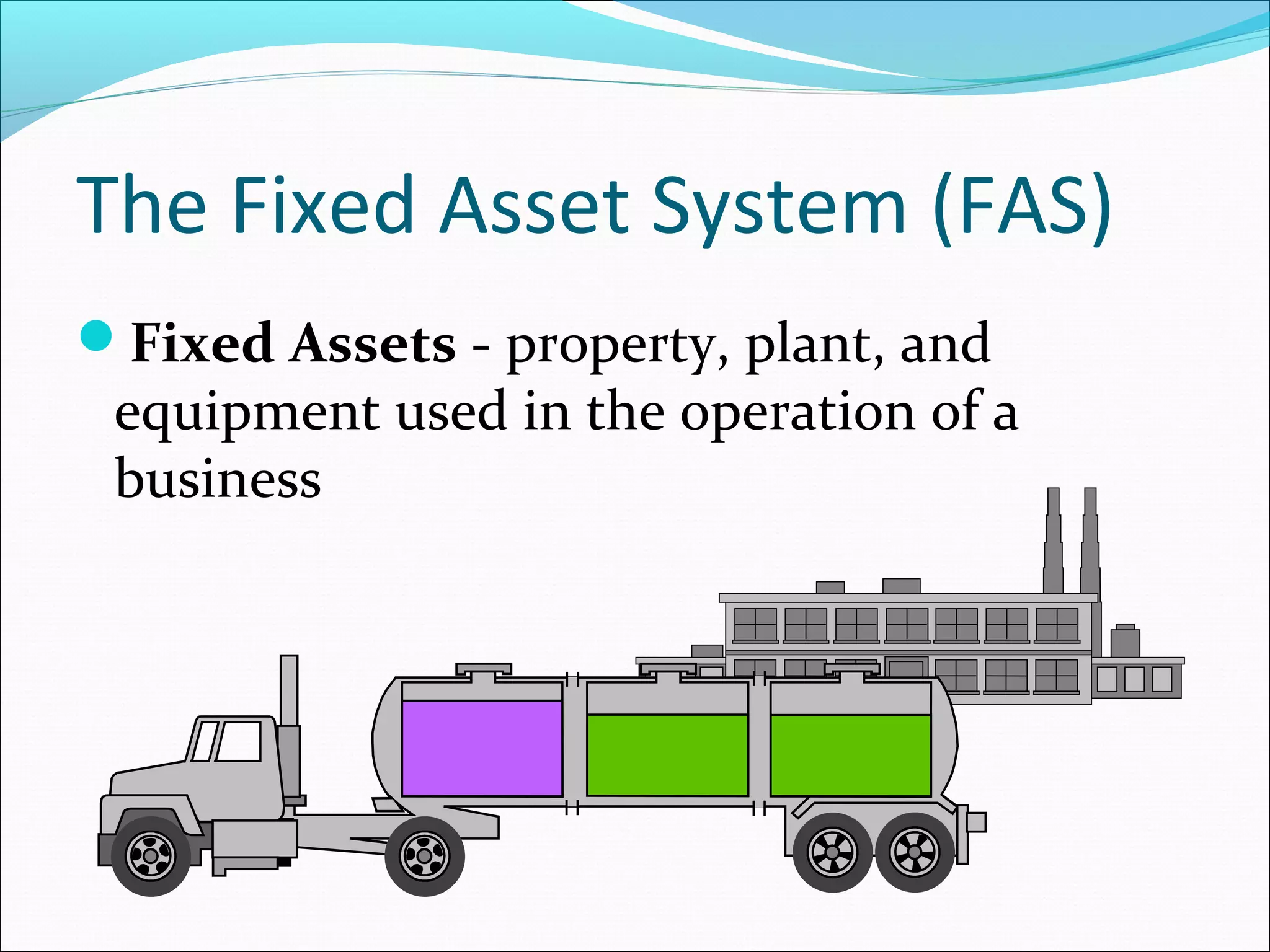
The Fixed Asset System (FAS)
Fixed Assets - property, plant, and
equipment used in the operation of a
business
1. Acquisition
of asset.
2. Depreciation.
3. Subsequent
expenditures.
4. Disposal
of asset.
Asset
cost
Salvage
value
$
Time (useful life)
Decline in asset’s service potential
Cost
DFD of Fixed Asset System
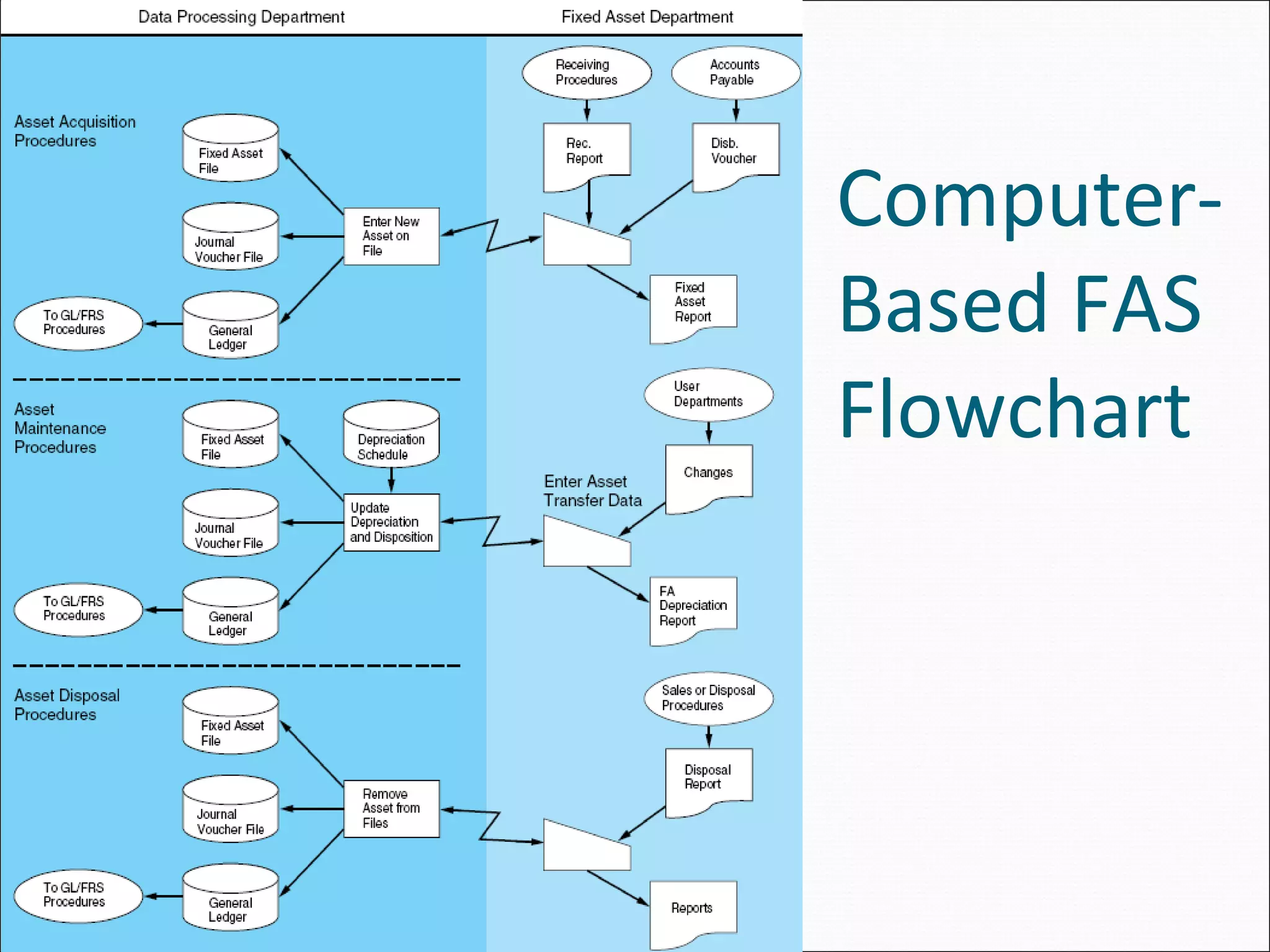
Computer-
Based FAS
Flowchart
Objectives of FAS
Acquire fixed assets in accordance with
management approval and procedures
Maintain adequate accounting records of asset
acquisition, cost, description, and location
Maintain depreciation records for depreciable
assets in accordance with acceptable method
Provide management with information to help it
plan future fixed asset investments
Properly record the retirement and disposal of
fixed assets
Asset Acquisition
Begins when a dept. manager determines that an
old fixed asset needs to be replaced or that a new
fixed asset is warranted
A purchase requisition is filled out.
May require an authorizing signature for items over a
pre-specified limit
FAS dept. performs record-keeping functions.
Asset Maintenance
Involves adjusting FAS subsidiary account balances
as assets depreciate
Depreciation calculations are internal transactions
that the FAS system bases upon a depreciation
schedule.
Physical improvements must also be recorded to
increase the subsidiary account balance and
depreciation schedule.
Asset Disposal
At the end of an asset’s useful life (or
earlier disposition), the asset must be
removed from the records and
depreciation schedule
Disposals require disposal request
forms and disposal reports as source
documents.
Computer-Based Fixed Asset
System—Acquisition
Receipt of assets are digitally
recorded in the system, along with
information such as its useful life,
depreciation methods, etc.
Ledgers are automatically updated
Computer-Based Fixed Asset
System—Maintenance
Computerized FAS automatically:
calculate current period’s depreciation
update accumulated depreciation and book-value fields
in the subsidiary records
post total depreciation to the affected general ledger
accounts
record depreciation transactions by adding records to
the journal voucher file
Computer-Based Fixed Asset
System—Disposal
Computerized FAS automatically:
post adjusting entries to the fixed asset
control account in the general ledger
record losses or gains associated with the
disposal transaction
prepare journal voucher records
FAS Controls
Authorization - should be formal and explicit
because of high cost of FAS:
acquisitions
changes in depreciation methods
Supervision - threat of misappropriation requires
constant management oversight:
theft - secure physical locations of assets
misuse - monitor on-the-job activities
Independent Verification - internal auditors
should periodically verify FAS records:
the reasonableness of factors used in decisions
(useful life, discounts, budgeting model)
location, condition, and fair value of the fixed
asset records in the subsidiary ledger
the programming logic for automatic calculations
(depreciation)
FAS Controls

James hall ch 6

  • 1.
    Accounting Information Systems,6th edition James A. Hall COPYRIGHT © 2009 South-Western, a division of Cengage Learning. Cengage Learning and South-Western are trademarks used herein under license
  • 2.
    Objectives for Chapter6 Fundamental tasks of payroll and fixed asset processes Functional depts. of payroll and fixed asset activities and the flow of transactions through the organization Documents, journals, and accounts needed for audit trails, record maintenance, decision making, and financial reporting Exposures associated with payroll and fixed asset activities and the controls that reduce these risks Operational features and the control implications of technology used in payroll and fixed asset systems
  • 3.
    DFD of PayrollProcedures
  • 4.
    Manual Payroll System Personneldept. uses personnel action forms to: activate new employees change the pay rate of employees change marital status and/or number of dependents terminate employees
  • 5.
    Production employees fillout two forms: job tickets - account for the time spent by the worker on each production job time cards - used to capture the total time worked each pay period for payroll calculations must be signed by a supervisor Manual Payroll System
  • 6.
    Cost Accounting dept: usesthe job tickets to allocate labor costs to WIP accounts summarizes these charges in a labor distribution summary which is forwarded to G/L dept. Manual Payroll System
  • 7.
    Payroll dept receivespersonnel action forms and time cards. Uses them to: prepare the payroll register enter the information into the employee payroll records prepare paychecks send paychecks to Cash Disbursements and a copy of the payroll register to Accounts Payable Manual Payroll System
  • 8.
    Accounts Payable dept: preparesa cash disbursements voucher for the total amount of the payroll sends copies to the Cash Disbursements and G/L depts. Manual Payroll System
  • 9.
    Cash Disbursements dept: reviewsand signs the paychecks and forwards them to a paymaster for distribution to the employees writes a check for the payroll and deposits it into the payroll imprest account Manual Payroll System
  • 10.
    G/L dept. makesthe following journal entries: From the Labor Distribution Summary WIP (Direct Labor) DR Factory Overhead (Indirect Labor) DR Wages Payable CR From the Distribution Voucher Wages Payable DR Cash CR Fed. Inc. Tax Withholding Payable CR State Inc. Tax Withholding Payable CR FICA Withholding Payable CR Other Withholding Payables CR Manual Payroll System
  • 11.
    G/L dept. makesa journal entry to transfer the cash from the operating bank account to the payroll imprest account: Cash - Payroll Imprest Account DR Cash - Operating Account CR Manual Payroll System
  • 12.
  • 13.
    Payroll Controls Transaction authorization- the personnel action form helps prevent: terminated employees from receiving checks wage rates from being improperly changed for current employees
  • 14.
    Segregation of Duties- timekeeping and personnel functions should be separated Supervision - need to monitor employees to ensure they are not “clocking in” for one another Payroll Controls
  • 15.
    Accounting Records -audit trail includes: time cards job tickets disbursement vouchers labor distribution summary payroll register subsidiary ledger accounts general ledger accounts Payroll Controls
  • 16.
    Access Controls -need to prevent employees from having improper access to: accounting records, such as time cards which can be altered unsigned checks Payroll Controls
  • 17.
    Independent Verification: verification oftime cards distribution of paychecks to authorized employees verification of accuracy of payroll register by A/P dept. G/L dept. reconciles the labor distribution summary and the payroll disbursement voucher Payroll Controls
  • 18.
    Computer-Based Payroll Systems Payroll iswell-suited to batch processing and sequential files. Most employees on the master file receive paychecks periodically. The computer program performs the detailed record-keeping, check-writing, and general ledger functions.
  • 19.
    Reengineered HRM Systems Payrollcan be reengineered as a part of human resource management (HRM). IT can process a wide range of personnel-related data, including: employee benefits labor resource planning employee skills and training pay rates, deductions, and pay checks evaluations
  • 20.
    Key Features ofReengineered HRM Personnel - can make changes to the employee file in real time Cost Accounting - enters job cost data either daily or in real time Timekeeping - enters the attendance file daily Data Processing - still uses batch processing and prepares all reports, the checks, and updates the general ledger
  • 21.
    Reengineered HRM Systems… differfrom automated manual and batch/sequential file systems because: operations depts. transmit transactions to data processing via terminals direct access files are used for storage many processes are performed real time real-time access to personnel files required for direct inquiries
  • 22.
  • 23.
  • 24.
    The Fixed AssetSystem (FAS) Fixed Assets - property, plant, and equipment used in the operation of a business
  • 25.
    1. Acquisition of asset. 2.Depreciation. 3. Subsequent expenditures. 4. Disposal of asset. Asset cost Salvage value $ Time (useful life) Decline in asset’s service potential Cost
  • 26.
    DFD of FixedAsset System
  • 27.
  • 28.
    Objectives of FAS Acquirefixed assets in accordance with management approval and procedures Maintain adequate accounting records of asset acquisition, cost, description, and location Maintain depreciation records for depreciable assets in accordance with acceptable method Provide management with information to help it plan future fixed asset investments Properly record the retirement and disposal of fixed assets
  • 29.
    Asset Acquisition Begins whena dept. manager determines that an old fixed asset needs to be replaced or that a new fixed asset is warranted A purchase requisition is filled out. May require an authorizing signature for items over a pre-specified limit FAS dept. performs record-keeping functions.
  • 30.
    Asset Maintenance Involves adjustingFAS subsidiary account balances as assets depreciate Depreciation calculations are internal transactions that the FAS system bases upon a depreciation schedule. Physical improvements must also be recorded to increase the subsidiary account balance and depreciation schedule.
  • 31.
    Asset Disposal At theend of an asset’s useful life (or earlier disposition), the asset must be removed from the records and depreciation schedule Disposals require disposal request forms and disposal reports as source documents.
  • 32.
    Computer-Based Fixed Asset System—Acquisition Receiptof assets are digitally recorded in the system, along with information such as its useful life, depreciation methods, etc. Ledgers are automatically updated
  • 33.
    Computer-Based Fixed Asset System—Maintenance ComputerizedFAS automatically: calculate current period’s depreciation update accumulated depreciation and book-value fields in the subsidiary records post total depreciation to the affected general ledger accounts record depreciation transactions by adding records to the journal voucher file
  • 34.
    Computer-Based Fixed Asset System—Disposal ComputerizedFAS automatically: post adjusting entries to the fixed asset control account in the general ledger record losses or gains associated with the disposal transaction prepare journal voucher records
  • 35.
    FAS Controls Authorization -should be formal and explicit because of high cost of FAS: acquisitions changes in depreciation methods Supervision - threat of misappropriation requires constant management oversight: theft - secure physical locations of assets misuse - monitor on-the-job activities
  • 36.
    Independent Verification -internal auditors should periodically verify FAS records: the reasonableness of factors used in decisions (useful life, discounts, budgeting model) location, condition, and fair value of the fixed asset records in the subsidiary ledger the programming logic for automatic calculations (depreciation) FAS Controls