Parallel Left Ventricle Simulation
Using the
FEniCS Framework
Timofei Epanchintsev and Vladimir Zverev
eti@imm.uran.ru
2nd Ural Workshop on Parallel, Distributed, and Cloud Computing for
Young Scientists
Anatomy of the Heart
2
L. Sherwood, Human physiology : from cells to systems. Australia ; United Kingdom:
Thomson Brooks/Cole, 2004.
Heart Simulation
3
Tissue OrganCell
• Multiscale modeling
• Cell
• Tissue
• Organ
• Heart simulation requires a lot of time
• Parallel computing is needed
Heart Simulation Obstacles
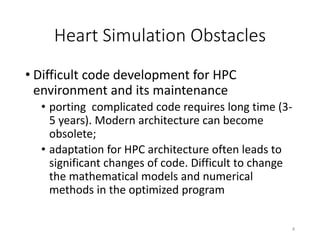
• Difficult code development for HPC
environment and its maintenance
• porting complicated code requires long time (3-
5 years). Modern architecture can become
obsolete;
• adaptation for HPC architecture often leads to
significant changes of code. Difficult to change
the mathematical models and numerical
methods in the optimized program
4
Automated Scientific Computing
Frameworks
5
• Automated Scientific Computing Frameworks
• OpenFOAM
• OpenCMISS
• Chaste
• FEniCS
• Advantages
• Software development using high level tools
• Automatic parallelization
• Disadvantage
• Low performance
• Performance improvements
• Just-in-time compilers, high performance mathematical libraries, etc.
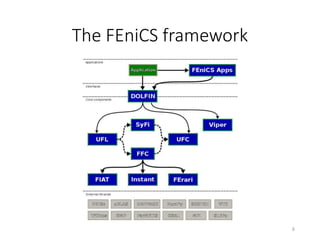
The FEniCS framework
6
7
• Ekaterinburg-Oxford [1] model describes electrical, chemical, and mechanical
processes
𝑑𝑆
𝑑𝑡
= 𝑔(𝑉, 𝑆)
• 𝑉 is the electrical potential, 𝑆 is the vector of state variables (the
dimension is 30) that governs the ion currents
𝑑𝑉
𝑑𝑡
= 𝐷𝛻2
𝑉 + 𝐼𝑖𝑜𝑛𝑠(V, S)
• 𝐷 is the diffusion matrix, 𝛻2 is the Laplace operator, and 𝐼𝑖𝑜𝑛𝑠 is the sum of the
ionic currents
1. Solovyova, O., Vikulova, N., Katsnelson, L.B., Markhasin, V.S., Noble, P., Garny, A., Kohl, P.,
Noble, D.: Mechanical interaction of heterogeneous cardiac muscle segments in silico: effects on Ca
2+ handling and action potential. International Journal of Bifurcation and Chaos 13(12) (2003)
Model of the Heart Electrical
Activity
Electric Potential and Ionic
Currents
8
Benchmark Problem
3D asymmetric left
ventricle model [1]
• Parameters were
captured by ultrasound
Implementation
• Operator splitting scheme
of the first order [2];
• Implicit method usage;
• No Newton-like iterations.
9
1. Pravdin, S.F., Berdyshev, V.I., Panfilov, A.V., Katsnelson, L.B., Solovyova, O., Markhasin, V.S.: Mathematical
model of the anatomy and fibre orientation field of the left ventricle of the heart. Biomedical engineering
online 54(12) (2013)
2. Li, Y., Chen, C.: An efficient split-operator scheme for 2-D advection-diffusion simulations using finite
elements and characteristics. Applied Mathematical Modelling 13(4) (1989) 248–253
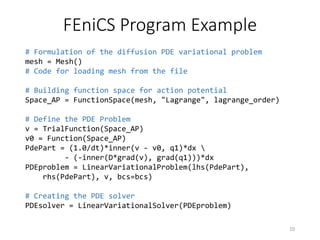
FEniCS Program Example
# Formulation of the diffusion PDE variational problem
mesh = Mesh()
# Code for loading mesh from the file
# Building function space for action potential
Space_AP = FunctionSpace(mesh, "Lagrange", lagrange_order)
# Define the PDE Problem
v = TrialFunction(Space_AP)
v0 = Function(Space_AP)
PdePart = (1.0/dt)*inner(v - v0, q1)*dx 
- (-inner(D*grad(v), grad(q1)))*dx
PDEproblem = LinearVariationalProblem(lhs(PdePart),
rhs(PdePart), v, bcs=bcs)
# Creating the PDE solver
PDEsolver = LinearVariationalSolver(PDEproblem)
10
FEniCS Program Example
# Solving the differential equation systems
for t in time_range[1:]:
# Solving diffusion equation
assign(v0, v)
PDEsolver.solve()
# Solving cell equations
assign(ode_vars0, ode_vars)
assign(ode_vars0.sub(0), v)
ODEsolver.solve()
# Storing data if necessary
if steps % saving_step_interval == 0:
v_file << (v, t)
steps += 1
11
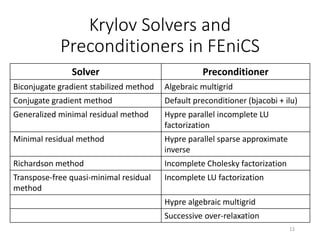
Krylov Solvers and
Preconditioners in FEniCS
12
Solver Preconditioner
Biconjugate gradient stabilized method Algebraic multigrid
Conjugate gradient method Default preconditioner (bjacobi + ilu)
Generalized minimal residual method Hypre parallel incomplete LU
factorization
Minimal residual method Hypre parallel sparse approximate
inverse
Richardson method Incomplete Cholesky factorization
Transpose-free quasi-minimal residual
method
Incomplete LU factorization
Hypre algebraic multigrid
Successive over-relaxation
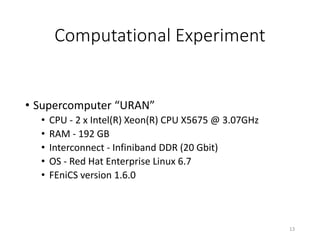
Computational Experiment
• Supercomputer “URAN”
• CPU - 2 x Intel(R) Xeon(R) CPU X5675 @ 3.07GHz
• RAM - 192 GB
• Interconnect - Infiniband DDR (20 Gbit)
• OS - Red Hat Enterprise Linux 6.7
• FEniCS version 1.6.0
13
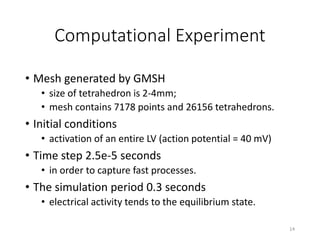
Computational Experiment
• Mesh generated by GMSH
• size of tetrahedron is 2-4mm;
• mesh contains 7178 points and 26156 tetrahedrons.
• Initial conditions
• activation of an entire LV (action potential = 40 mV)
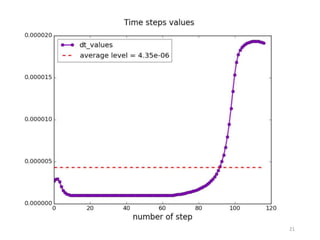
• Time step 2.5e-5 seconds
• in order to capture fast processes.
• The simulation period 0.3 seconds
• electrical activity tends to the equilibrium state.
14
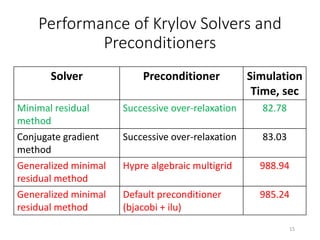
Performance of Krylov Solvers and
Preconditioners
15
Solver Preconditioner Simulation
Time, sec
Minimal residual
method
Successive over-relaxation 82.78
Conjugate gradient
method
Successive over-relaxation 83.03
Generalized minimal
residual method
Hypre algebraic multigrid 988.94
Generalized minimal
residual method
Default preconditioner
(bjacobi + ilu)
985.24
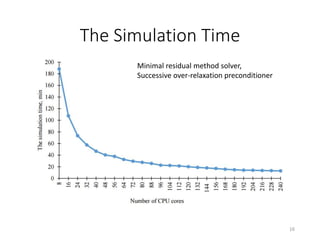
The Simulation Time
16
Minimal residual method solver,
Successive over-relaxation preconditioner
Simulation Speedup
17
Minimal residual method solver,
Successive over-relaxation preconditioner
Comparison with manual
implementation
LeVen
• Our previous implementation [1]
• C language
• OpenMP for shared memory
systems
• Limited scalability
Comparison with LeVen
• Same performance
• Better scalability
18
1. Sozykin, A., Pravdin, S., Koshelev, A., Zverev, V., Ushenin, K., Solovyova,
O.: LeVen - a parallel system for simulation of the heart left ventricle. 9th
IEEE International Conference on Application of Information and
Communication Technologies, AICT 2015 Proceedings (2015) 249–252
Conclusion
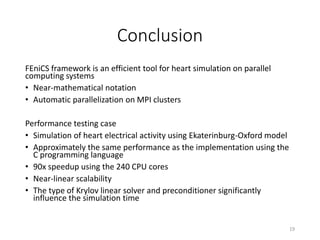
FEniCS framework is an efficient tool for heart simulation on parallel
computing systems
• Near-mathematical notation
• Automatic parallelization on MPI clusters
Performance testing case
• Simulation of heart electrical activity using Ekaterinburg-Oxford model
• Approximately the same performance as the implementation using the
C programming language
• 90x speedup using the 240 CPU cores
• Near-linear scalability
• The type of Krylov linear solver and preconditioner significantly
influence the simulation time
19
Thank you for your attention!
Epanchintsev Timofei
• eti@imm.uran.ru
Parallel Left Ventricle
Simulation Using the
FEniCS Framework
This work was supported by the Russian Science Foundation (grant no.
14-35-00005). Our study was performed using the Uran
supercomputer of the Krasovskii Institute of Mathematics and
Mechanics.
20
21

Parallel Left Ventricle Simulation Using the FEniCS Framework

  • 1.
    Parallel Left VentricleSimulation Using the FEniCS Framework Timofei Epanchintsev and Vladimir Zverev eti@imm.uran.ru 2nd Ural Workshop on Parallel, Distributed, and Cloud Computing for Young Scientists
  • 2.
    Anatomy of theHeart 2 L. Sherwood, Human physiology : from cells to systems. Australia ; United Kingdom: Thomson Brooks/Cole, 2004.
  • 3.
    Heart Simulation 3 Tissue OrganCell •Multiscale modeling • Cell • Tissue • Organ • Heart simulation requires a lot of time • Parallel computing is needed
  • 4.
    Heart Simulation Obstacles •Difficult code development for HPC environment and its maintenance • porting complicated code requires long time (3- 5 years). Modern architecture can become obsolete; • adaptation for HPC architecture often leads to significant changes of code. Difficult to change the mathematical models and numerical methods in the optimized program 4
  • 5.
    Automated Scientific Computing Frameworks 5 •Automated Scientific Computing Frameworks • OpenFOAM • OpenCMISS • Chaste • FEniCS • Advantages • Software development using high level tools • Automatic parallelization • Disadvantage • Low performance • Performance improvements • Just-in-time compilers, high performance mathematical libraries, etc.
  • 6.
  • 7.
    7 • Ekaterinburg-Oxford [1]model describes electrical, chemical, and mechanical processes 𝑑𝑆 𝑑𝑡 = 𝑔(𝑉, 𝑆) • 𝑉 is the electrical potential, 𝑆 is the vector of state variables (the dimension is 30) that governs the ion currents 𝑑𝑉 𝑑𝑡 = 𝐷𝛻2 𝑉 + 𝐼𝑖𝑜𝑛𝑠(V, S) • 𝐷 is the diffusion matrix, 𝛻2 is the Laplace operator, and 𝐼𝑖𝑜𝑛𝑠 is the sum of the ionic currents 1. Solovyova, O., Vikulova, N., Katsnelson, L.B., Markhasin, V.S., Noble, P., Garny, A., Kohl, P., Noble, D.: Mechanical interaction of heterogeneous cardiac muscle segments in silico: effects on Ca 2+ handling and action potential. International Journal of Bifurcation and Chaos 13(12) (2003) Model of the Heart Electrical Activity
  • 8.
    Electric Potential andIonic Currents 8
  • 9.
    Benchmark Problem 3D asymmetricleft ventricle model [1] • Parameters were captured by ultrasound Implementation • Operator splitting scheme of the first order [2]; • Implicit method usage; • No Newton-like iterations. 9 1. Pravdin, S.F., Berdyshev, V.I., Panfilov, A.V., Katsnelson, L.B., Solovyova, O., Markhasin, V.S.: Mathematical model of the anatomy and fibre orientation field of the left ventricle of the heart. Biomedical engineering online 54(12) (2013) 2. Li, Y., Chen, C.: An efficient split-operator scheme for 2-D advection-diffusion simulations using finite elements and characteristics. Applied Mathematical Modelling 13(4) (1989) 248–253
  • 10.
    FEniCS Program Example #Formulation of the diffusion PDE variational problem mesh = Mesh() # Code for loading mesh from the file # Building function space for action potential Space_AP = FunctionSpace(mesh, "Lagrange", lagrange_order) # Define the PDE Problem v = TrialFunction(Space_AP) v0 = Function(Space_AP) PdePart = (1.0/dt)*inner(v - v0, q1)*dx - (-inner(D*grad(v), grad(q1)))*dx PDEproblem = LinearVariationalProblem(lhs(PdePart), rhs(PdePart), v, bcs=bcs) # Creating the PDE solver PDEsolver = LinearVariationalSolver(PDEproblem) 10
  • 11.
    FEniCS Program Example #Solving the differential equation systems for t in time_range[1:]: # Solving diffusion equation assign(v0, v) PDEsolver.solve() # Solving cell equations assign(ode_vars0, ode_vars) assign(ode_vars0.sub(0), v) ODEsolver.solve() # Storing data if necessary if steps % saving_step_interval == 0: v_file << (v, t) steps += 1 11
  • 12.
    Krylov Solvers and Preconditionersin FEniCS 12 Solver Preconditioner Biconjugate gradient stabilized method Algebraic multigrid Conjugate gradient method Default preconditioner (bjacobi + ilu) Generalized minimal residual method Hypre parallel incomplete LU factorization Minimal residual method Hypre parallel sparse approximate inverse Richardson method Incomplete Cholesky factorization Transpose-free quasi-minimal residual method Incomplete LU factorization Hypre algebraic multigrid Successive over-relaxation
  • 13.
    Computational Experiment • Supercomputer“URAN” • CPU - 2 x Intel(R) Xeon(R) CPU X5675 @ 3.07GHz • RAM - 192 GB • Interconnect - Infiniband DDR (20 Gbit) • OS - Red Hat Enterprise Linux 6.7 • FEniCS version 1.6.0 13
  • 14.
    Computational Experiment • Meshgenerated by GMSH • size of tetrahedron is 2-4mm; • mesh contains 7178 points and 26156 tetrahedrons. • Initial conditions • activation of an entire LV (action potential = 40 mV) • Time step 2.5e-5 seconds • in order to capture fast processes. • The simulation period 0.3 seconds • electrical activity tends to the equilibrium state. 14
  • 15.
    Performance of KrylovSolvers and Preconditioners 15 Solver Preconditioner Simulation Time, sec Minimal residual method Successive over-relaxation 82.78 Conjugate gradient method Successive over-relaxation 83.03 Generalized minimal residual method Hypre algebraic multigrid 988.94 Generalized minimal residual method Default preconditioner (bjacobi + ilu) 985.24
  • 16.
    The Simulation Time 16 Minimalresidual method solver, Successive over-relaxation preconditioner
  • 17.
    Simulation Speedup 17 Minimal residualmethod solver, Successive over-relaxation preconditioner
  • 18.
    Comparison with manual implementation LeVen •Our previous implementation [1] • C language • OpenMP for shared memory systems • Limited scalability Comparison with LeVen • Same performance • Better scalability 18 1. Sozykin, A., Pravdin, S., Koshelev, A., Zverev, V., Ushenin, K., Solovyova, O.: LeVen - a parallel system for simulation of the heart left ventricle. 9th IEEE International Conference on Application of Information and Communication Technologies, AICT 2015 Proceedings (2015) 249–252
  • 19.
    Conclusion FEniCS framework isan efficient tool for heart simulation on parallel computing systems • Near-mathematical notation • Automatic parallelization on MPI clusters Performance testing case • Simulation of heart electrical activity using Ekaterinburg-Oxford model • Approximately the same performance as the implementation using the C programming language • 90x speedup using the 240 CPU cores • Near-linear scalability • The type of Krylov linear solver and preconditioner significantly influence the simulation time 19
  • 20.
    Thank you foryour attention! Epanchintsev Timofei • eti@imm.uran.ru Parallel Left Ventricle Simulation Using the FEniCS Framework This work was supported by the Russian Science Foundation (grant no. 14-35-00005). Our study was performed using the Uran supercomputer of the Krasovskii Institute of Mathematics and Mechanics. 20
  • 21.