PULP & PAPER INDUSTRY

BY:- ABHISHEK
RAJPUT
19/03/2012

1
CONTENTS
•
•
•
•
•
•
•

REQUIREMENTS
PROCESSES
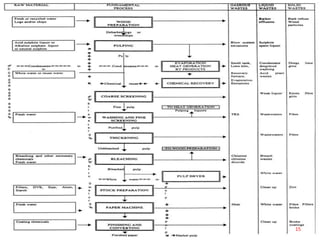
WASTE GENERATION POINTS
CHARACTERISTICS OF W/W
TREATMENT SCHEMES
CHARACTERISTICS OF TREATED W/W
INNOVATIVE TECHNOLOGY
Reff :- S. C. Bhatia

19/03/2012

2
REQUIREMENTS
• Raw Materials-Conventional raw material
are rice and wheat, straw, bagasse, jute,
cotton rags, grasses, gunny, hessian, etc.

• Chemical Requirements- About 5-12% of
NaOH is required per tonne of raw material.
Lime is used as supplement to NaOH.
Chlorine and calcium hypochlorite are
bleaching chemicals. Sizing chemicals and dyes
are also used.
19/03/2012

3
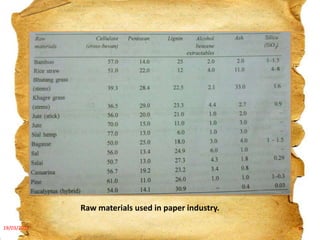
Raw materials used in paper industry.
19/03/2012

4
• Water Requirements- P and P industry’s
existence lies on water supply. Constant
water supply is required in all processes.
Agricultural residue based industries require
200-350 cubic meter per tonne of paper
made, however units using waste paper
require 100-150 cubic meter per tonne of
paper made.

19/03/2012

5
PROCESSES

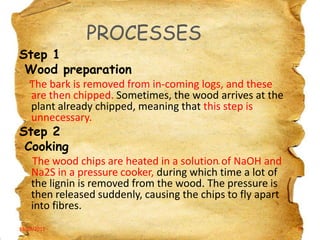
Step 1
Wood preparation

The bark is removed from in-coming logs, and these
are then chipped. Sometimes, the wood arrives at the
plant already chipped, meaning that this step is
unnecessary.

Step 2
Cooking

The wood chips are heated in a solution of NaOH and
Na2S in a pressure cooker, during which time a lot of
the lignin is removed from the wood. The pressure is
then released suddenly, causing the chips to fly apart
into fibres.
19/03/2012

6
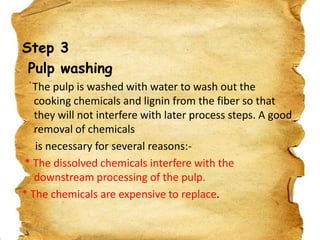
Step 3
Pulp washing
The pulp is washed with water to wash out the
cooking chemicals and lignin from the fiber so that
they will not interfere with later process steps. A good
removal of chemicals
is necessary for several reasons:* The dissolved chemicals interfere with the
downstream processing of the pulp.
* The chemicals are expensive to replace.
19/03/2012

7
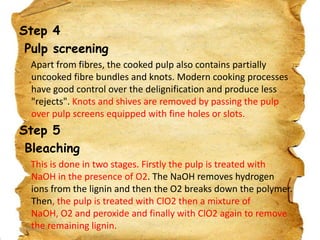
Step 4
Pulp screening
Apart from fibres, the cooked pulp also contains partially
uncooked fibre bundles and knots. Modern cooking processes
have good control over the delignification and produce less
"rejects". Knots and shives are removed by passing the pulp
over pulp screens equipped with fine holes or slots.

Step 5
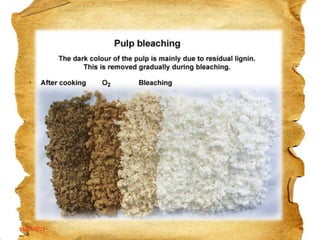
Bleaching
This is done in two stages. Firstly the pulp is treated with
NaOH in the presence of O2. The NaOH removes hydrogen
ions from the lignin and then the O2 breaks down the polymer.
Then, the pulp is treated with ClO2 then a mixture of
NaOH, O2 and peroxide and finally with ClO2 again to remove
the
19/03/2012 remaining lignin.

8
19/03/2012

9
Step 6
Paper making
The fibers are mechanically treated to make them bond
better to each other, chemicals added to provide special
properties such as color or water resistance, and then the
water is squeezed out and the pulp is rolled smooth and
dried.
Various ancillary processes result in the recovery of
CaO, NaOH and Na2S, the major chemicals used in the
process. Various utilities ensure that such conditions as
sufficient reaction times and adequate mixing are met.

19/03/2012

10
WASTE GENARATION
POINTS

• Sources of waste wateri) Black liquor* from cooking section.
ii) Pulp wash water from pouchers.
iii) Bleaching section.
iv) Paper machine.

* Black liquor is the spent cooking liquor from the kraft
process when digesting pulpwood into paper
pulp removing lignin, hemicelluloses and other
extractives from the wood to free the cellulose fibers.
19/03/2012

11
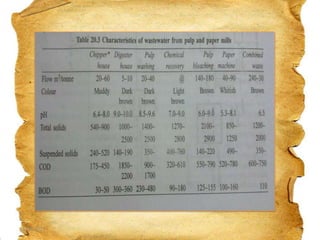
CHARACTERISTICS OF
WASTE WATER

19/03/2012

12
19/03/2012

13
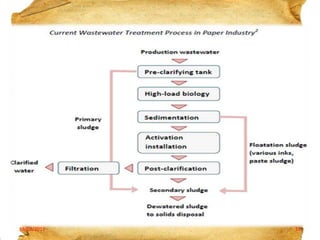
TREATMENT SCHEMES

19/03/2012

14
15
19/03/2012

16
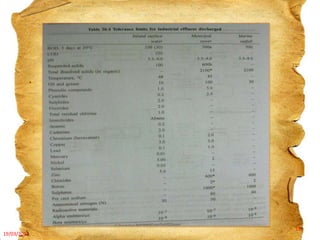
CHARACTERISTICS OF
TREATED WASTE WATER

19/03/2012

17
19/03/2012

18
INNOVATIVE TECHNOLOGY

19/03/2012

19
POLYMER INDUCED
FLOCULATION
• Treatment of Pulp and Paper Mill Wastewater by
Polyacrylamide (PAM) in Polymer Induced
Flocculation.
• Cationic polyacrlyamide Organopol 5415 with very
high molecular weight and low charge density is
found to give the highest flocculation efficiency in
the treatment of the paper mill wastewater.
19/03/2012

20
• It can achieve 95% of turbidity reduction, 98% of
TSS removal, 93% of COD reduction and sludge
volume index (SVI) of 14 ml g−1 at the optimum
dosage of 5 mg l−1.
• Based on the cost evaluation, the use of the
polyacrylamides is economically feasible to treat
the pulp and paper mill wastewaters.
• Result suggests that single-polymer system can
be used alone in the coagulation–flocculation
process due to the efficiency of the
polyacrylamide.
19/03/2012

21
• Sedimentation of the sludge by gravity
thickening with settling time of 30 min is
possible based on the settling characteristics of
the sludge produced by Organopol 5415 that
can achieve 91% water recovery and 99% TSS
removal after 30 min settling.

19/03/2012

22
Bio-innovation
• Enzymes offer a simple solution for addressing lignin
in effluent. Enzymes oxidize lignin and phenolic
compounds to enable and promote separation from
effluents and increase capacity.
• Moreover, enzymes can modify the residual lignin in
unbleached pulp to improve the physical and
mechanical properties of paper and board and the
runability of the paper machine.
• Enzymes are a biodegradable alternative to
petroleum-based and/or expensive strengthening
agents and effluent management additives.
19/03/2012

23
Bio-innovation contd.
• The application of enzymes directly leads to better
paper quality: While the brightness level goes up, the
residual dirt level goes down. Saving on bleaching
chemicals also means milder process conditions and
an accentuated sustainable profile.(deinking)
• The enzymatic treatment can reduce the kappa
number and increase pulp brightness when the same
bleaching chemical charges are applied. It also allows
savings in bleaching chemicals, while the final
brightness of the paper is increased.(bleaching)
19/03/2012

24
19/03/2012

25
19/03/2012

26

Pulp & paper industry by abhishek

  • 1.
    PULP & PAPERINDUSTRY BY:- ABHISHEK RAJPUT 19/03/2012 1
  • 2.
    CONTENTS • • • • • • • REQUIREMENTS PROCESSES WASTE GENERATION POINTS CHARACTERISTICSOF W/W TREATMENT SCHEMES CHARACTERISTICS OF TREATED W/W INNOVATIVE TECHNOLOGY Reff :- S. C. Bhatia 19/03/2012 2
  • 3.
    REQUIREMENTS • Raw Materials-Conventionalraw material are rice and wheat, straw, bagasse, jute, cotton rags, grasses, gunny, hessian, etc. • Chemical Requirements- About 5-12% of NaOH is required per tonne of raw material. Lime is used as supplement to NaOH. Chlorine and calcium hypochlorite are bleaching chemicals. Sizing chemicals and dyes are also used. 19/03/2012 3
  • 4.
    Raw materials usedin paper industry. 19/03/2012 4
  • 5.
    • Water Requirements-P and P industry’s existence lies on water supply. Constant water supply is required in all processes. Agricultural residue based industries require 200-350 cubic meter per tonne of paper made, however units using waste paper require 100-150 cubic meter per tonne of paper made. 19/03/2012 5
  • 6.
    PROCESSES Step 1 Wood preparation Thebark is removed from in-coming logs, and these are then chipped. Sometimes, the wood arrives at the plant already chipped, meaning that this step is unnecessary. Step 2 Cooking The wood chips are heated in a solution of NaOH and Na2S in a pressure cooker, during which time a lot of the lignin is removed from the wood. The pressure is then released suddenly, causing the chips to fly apart into fibres. 19/03/2012 6
  • 7.
    Step 3 Pulp washing Thepulp is washed with water to wash out the cooking chemicals and lignin from the fiber so that they will not interfere with later process steps. A good removal of chemicals is necessary for several reasons:* The dissolved chemicals interfere with the downstream processing of the pulp. * The chemicals are expensive to replace. 19/03/2012 7
  • 8.
    Step 4 Pulp screening Apartfrom fibres, the cooked pulp also contains partially uncooked fibre bundles and knots. Modern cooking processes have good control over the delignification and produce less "rejects". Knots and shives are removed by passing the pulp over pulp screens equipped with fine holes or slots. Step 5 Bleaching This is done in two stages. Firstly the pulp is treated with NaOH in the presence of O2. The NaOH removes hydrogen ions from the lignin and then the O2 breaks down the polymer. Then, the pulp is treated with ClO2 then a mixture of NaOH, O2 and peroxide and finally with ClO2 again to remove the 19/03/2012 remaining lignin. 8
  • 9.
  • 10.
    Step 6 Paper making Thefibers are mechanically treated to make them bond better to each other, chemicals added to provide special properties such as color or water resistance, and then the water is squeezed out and the pulp is rolled smooth and dried. Various ancillary processes result in the recovery of CaO, NaOH and Na2S, the major chemicals used in the process. Various utilities ensure that such conditions as sufficient reaction times and adequate mixing are met. 19/03/2012 10
  • 11.
    WASTE GENARATION POINTS • Sourcesof waste wateri) Black liquor* from cooking section. ii) Pulp wash water from pouchers. iii) Bleaching section. iv) Paper machine. * Black liquor is the spent cooking liquor from the kraft process when digesting pulpwood into paper pulp removing lignin, hemicelluloses and other extractives from the wood to free the cellulose fibers. 19/03/2012 11
  • 12.
  • 13.
  • 14.
  • 15.
  • 16.
  • 17.
  • 18.
  • 19.
  • 20.
    POLYMER INDUCED FLOCULATION • Treatmentof Pulp and Paper Mill Wastewater by Polyacrylamide (PAM) in Polymer Induced Flocculation. • Cationic polyacrlyamide Organopol 5415 with very high molecular weight and low charge density is found to give the highest flocculation efficiency in the treatment of the paper mill wastewater. 19/03/2012 20
  • 21.
    • It canachieve 95% of turbidity reduction, 98% of TSS removal, 93% of COD reduction and sludge volume index (SVI) of 14 ml g−1 at the optimum dosage of 5 mg l−1. • Based on the cost evaluation, the use of the polyacrylamides is economically feasible to treat the pulp and paper mill wastewaters. • Result suggests that single-polymer system can be used alone in the coagulation–flocculation process due to the efficiency of the polyacrylamide. 19/03/2012 21
  • 22.
    • Sedimentation ofthe sludge by gravity thickening with settling time of 30 min is possible based on the settling characteristics of the sludge produced by Organopol 5415 that can achieve 91% water recovery and 99% TSS removal after 30 min settling. 19/03/2012 22
  • 23.
    Bio-innovation • Enzymes offera simple solution for addressing lignin in effluent. Enzymes oxidize lignin and phenolic compounds to enable and promote separation from effluents and increase capacity. • Moreover, enzymes can modify the residual lignin in unbleached pulp to improve the physical and mechanical properties of paper and board and the runability of the paper machine. • Enzymes are a biodegradable alternative to petroleum-based and/or expensive strengthening agents and effluent management additives. 19/03/2012 23
  • 24.
    Bio-innovation contd. • Theapplication of enzymes directly leads to better paper quality: While the brightness level goes up, the residual dirt level goes down. Saving on bleaching chemicals also means milder process conditions and an accentuated sustainable profile.(deinking) • The enzymatic treatment can reduce the kappa number and increase pulp brightness when the same bleaching chemical charges are applied. It also allows savings in bleaching chemicals, while the final brightness of the paper is increased.(bleaching) 19/03/2012 24
  • 25.
  • 26.