PAPER MANUFACTURE
VANLALNGHAKA
UG116143
CONTENTS
 INTRODUCTION
 THE PAPER MACHINE
 THE HEADBOX
 THE FOURDRINIER WET END
1.INTRODUCTION
 Paper consists of a web of pulp fibers (normally
from wood), usually formed from an aqueous
slurry on a wire or screen, and held together by
hydrogen bonding.
 The basic steps are same for either hand- or
machine-made paper .
INTRODUCTION
 The steps are as follows:
1. Forming - applying the pulp slurry to a screen.
2. Draining - allowing water to drain by means of
a force such as gravity or a pressure difference
developed by a water column.
3. Pressing - further dewatering by squeezing
water from the sheet.
4. Drying - air drying or drying of the sheet over a
hot surface.
2.THE PAPER MACHINE
 The paper machine is a device for continuously
forming, dewatering, pressing, and drying a
web of paper fiber. Until recently, the most
common type of wet end was the fourdrinier,
where a dilute suspension of fibers (typically
0.3-0.6% consistency) is applied to an endless
wire screen or plastic fabric.
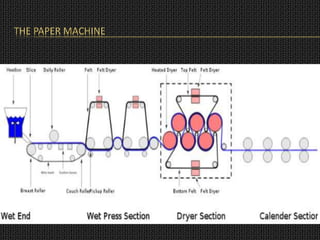
THE PAPER MACHINE
THE PAPER MACHINE
 Water is removed by gravity, or the pressure
difference developed by table rolls, foils or
suction equipment, and the drilled couch.
 The web at this point is 18-23% consistency.
 More water is squeezed out in the press section
to a consistency of 35-55%.
 Finally the sheet is dried with steam heating in
the dryer section.
THE PAPER MACHINE
 Machines that use two wires to form and drain water from
the dilute, pulp slurry are called twin wire formers. These
have become popular since the late 1960s for printing and
lightweight papers.
 During the 1970s, many multi-ply formers were developed
for heavyweight board.
 These formers use up to seven wires consecutively
 and are modifications of another type of paper
 machine, used for heavy-weight board, the cylinder
 machine, which has been used since the early 1800s.
THE PAPER MACHINE
 For every 1 lb of fiber 200 lb of water are used.
 For this 1 lb of fiber about 195 lb of water (98%) are
removed at the wet end with the web leaving at a
consistency of 20%.
 Another 2 to 3 lb of water are removed in
 the press section (1 to 1.5%) with the web leaving
 the press section at 35-50% consistency. The
 remaining 1 to 1.5 lb (0.5 to 0.75%) of water are
 removed by the dryer section.
3.THE HEADBOX
 Headbox
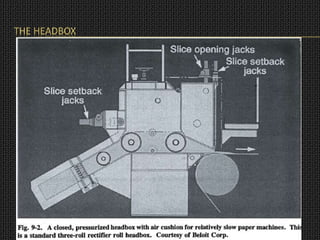
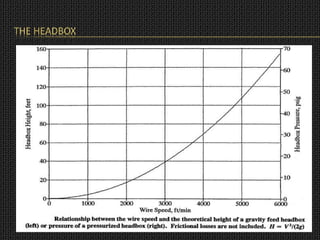
 It is a pressurized device that delivers a uniform pulp
slurry on the wire, through the slice, at approximately
the same velocity as that of the wire.
 The main purpose of the headbox is to convert a low
consistency fibre suspension flow (stock) in a round pipe
into a uniform flat jet several meters wide that will fall
on the wire to start the dewatering process.
 Original headboxes were open, unpressurized, and used
a hydrostatic head for the necessary pressure.
THE HEADBOX
THE HEADBOX
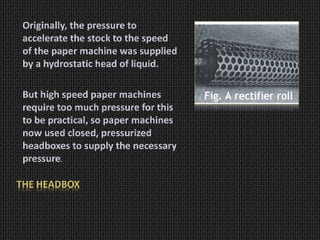
 Almost all headboxes on paper machines operating
below speeds of 2500 ft/min have two to five perforated
rectifier rolls (holey rolls) inside the headbox that create
microturbulence to keep the fibers in suspension, giving
even formation.
 The rolls are 0.2-0.8 meters (8-32 in.) in diameter
 with holes 1.5-2.5 cm (0.6-1.0 in.) in diameter that
occupy 40-52 % of the roll area and rotate at 5-20 rpm.
 A secondary headbox may be used part of the way down
the table to give a top coat of high quality fiber relative
to the rest of the sheet.
THE HEADBOX
Originally, the pressure to
accelerate the stock to the speed
of the paper machine was supplied
by a hydrostatic head of liquid.
But high speed paper machines
require too much pressure for this
to be practical, so paper machines
now used closed, pressurized
headboxes to supply the necessary
pressure.
THE HEADBOX
THE HEADBOX
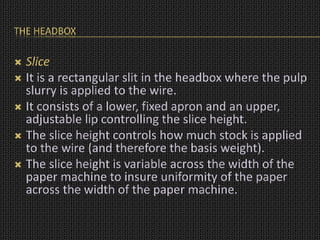
 Slice
 It is a rectangular slit in the headbox where the pulp
slurry is applied to the wire.
 It consists of a lower, fixed apron and an upper,
adjustable lip controlling the slice height.
 The slice height controls how much stock is applied
to the wire (and therefore the basis weight).
 The slice height is variable across the width of the
paper machine to insure uniformity of the paper
across the width of the paper machine.
4.THE FOURDRINIER WET END
 Fourdrinier
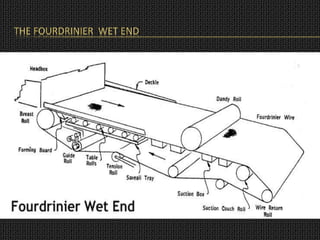
 The fourdrinier, or flat wire machine, is a paper
machine with a horizontal, moving, fine mesh,
woven wire cloth or plastic fabric upon which the
pulp slurry is deposited, forming the web.
 The front side or tending side is the side from
which the paper machine is controlled, whereas
the other side is the backside or drive side.
THE FOURDRINIER WET END
 Clothing
 Paper machine clothing consists of forming fabrics (wires),
press felts, and dryer felts.
 Wire, forming fabric
 It is a continuous loop or belt of finely woven screen made
from wire or plastic; the mesh size varies from 40 to 100
mesh (openings per inch).
 Before 1960, wires were made from metals such as
bronze but now they are mostly made from polyester
which is corrosion resistant and lasts much longer,
although it stretches more and cannot handle highly
abrasive furnishes.
THE FOURDRINIER WET END
 The forming media has three functions:
1. to transport the fiber.
2. to permit draining the sheet.
3. to transmit power.
 The power input is usually through the couch
and wire turning roll.
THE FOURDRINIER WET END
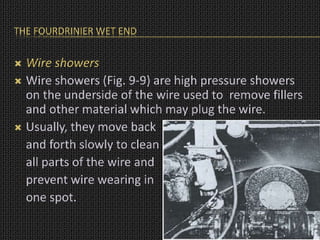
 Wire showers
 Wire showers (Fig. 9-9) are high pressure showers
on the underside of the wire used to remove fillers
and other material which may plug the wire.
 Usually, they move back
and forth slowly to clean
all parts of the wire and
prevent wire wearing in
one spot.
THE FOURDRINIER WET END
 Web
 The continuous mat of fibers that is in the process of forming
or which has already formed the final paper is known as the
web.
 Forming board
 The forming board (Fig. 9-12) consists of a large leading blade
to reach in close to the slice followed by several smaller blades,
usually with gaps between them.
 Breast roll
 The breast roll is located under the headbox and
serves to return the fabric to the forming area to receive the
stock once again. It must be rigid enough to resist deflection.
THE FOURDRINIER WET END
 Deckle board
 They are used to prevent the stock from flowing off
the two sides of the forming fabric when a thick
layer of stock is delivered to the fabric by a large
slice opening.
 Trim squirts, edge squirts
 The width of the sheet delivered to the press section
is controlled by trim squirts. The narrow bands of
stock left on the fabric are knocked off by edge
squirts.
THE FOURDRINIER WET END
 Table roll
 Table rolls are freely revolving rolls under the
fourdrinier wire that support the weight of the
wire and wet web.
 Water is removed from the bottom of the web by
a partial vacuum at the meniscus that forms at
the nip where the roll leaves the wire.
THE FOURDRINIER WET END
 Foils
 A foil introduced by Wrist and Burkhard (1956), is a
stationary blade 5-10 cm wide with a divergent surface so
that an angle forms between the stationary fabric and the
foil surface. The angle is usually between 0.5 to 3°.
 Lovacs
 A lovac (Hansen, 1991) develops suction using water-filled
drop legs to provide siphoning action.
 These are sometimes called wet boxes.
THE FOURDRINIER WET END
 Dandy roll
 The dandy roll (Fig. 9-27) is a hollow, light, wire
covered roll that rides on top of the fourdrinier wire
just ahead of the suction boxes.
 This roll has four purposes:
1. to impart a water mark to the sheet.
2. to improve the top surface for printing.
3. to improve formation by mechanical shear.
4. to increase the drainage capacity of the flat wire.
THE FOURDRINIER WET END
 Couch roll
 The couch roll is the guide or turning roll for the
fourdrinier wire, where the paper web leaves the
wire and the wire returns to the breast roll.
 It has two purposes: to transmit power to the fabric
and to increase the dryness of the sheet.
 Lump breaker roll
 The lump breaker roll (Fig. 9-28) is a solid roll with a
suitable soft cover that is mounted over the couch
roll to assist in drying the sheet by pressure.
THE FOURDRINIER WET END
 Pickup (transfer) felt
 The pickup felt is a traveling felt (blanket)
designed to pick the wet paper web off the wire
and transfer it to press section. This means that
the web is supported at all times by either the
wire or felt.
THE END
THANK YOU

Paper manufacture

  • 1.
  • 2.
    CONTENTS  INTRODUCTION  THEPAPER MACHINE  THE HEADBOX  THE FOURDRINIER WET END
  • 3.
    1.INTRODUCTION  Paper consistsof a web of pulp fibers (normally from wood), usually formed from an aqueous slurry on a wire or screen, and held together by hydrogen bonding.  The basic steps are same for either hand- or machine-made paper .
  • 4.
    INTRODUCTION  The stepsare as follows: 1. Forming - applying the pulp slurry to a screen. 2. Draining - allowing water to drain by means of a force such as gravity or a pressure difference developed by a water column. 3. Pressing - further dewatering by squeezing water from the sheet. 4. Drying - air drying or drying of the sheet over a hot surface.
  • 5.
    2.THE PAPER MACHINE The paper machine is a device for continuously forming, dewatering, pressing, and drying a web of paper fiber. Until recently, the most common type of wet end was the fourdrinier, where a dilute suspension of fibers (typically 0.3-0.6% consistency) is applied to an endless wire screen or plastic fabric.
  • 6.
  • 7.
    THE PAPER MACHINE Water is removed by gravity, or the pressure difference developed by table rolls, foils or suction equipment, and the drilled couch.  The web at this point is 18-23% consistency.  More water is squeezed out in the press section to a consistency of 35-55%.  Finally the sheet is dried with steam heating in the dryer section.
  • 8.
    THE PAPER MACHINE Machines that use two wires to form and drain water from the dilute, pulp slurry are called twin wire formers. These have become popular since the late 1960s for printing and lightweight papers.  During the 1970s, many multi-ply formers were developed for heavyweight board.  These formers use up to seven wires consecutively  and are modifications of another type of paper  machine, used for heavy-weight board, the cylinder  machine, which has been used since the early 1800s.
  • 9.
    THE PAPER MACHINE For every 1 lb of fiber 200 lb of water are used.  For this 1 lb of fiber about 195 lb of water (98%) are removed at the wet end with the web leaving at a consistency of 20%.  Another 2 to 3 lb of water are removed in  the press section (1 to 1.5%) with the web leaving  the press section at 35-50% consistency. The  remaining 1 to 1.5 lb (0.5 to 0.75%) of water are  removed by the dryer section.
  • 10.
    3.THE HEADBOX  Headbox It is a pressurized device that delivers a uniform pulp slurry on the wire, through the slice, at approximately the same velocity as that of the wire.  The main purpose of the headbox is to convert a low consistency fibre suspension flow (stock) in a round pipe into a uniform flat jet several meters wide that will fall on the wire to start the dewatering process.  Original headboxes were open, unpressurized, and used a hydrostatic head for the necessary pressure.
  • 11.
  • 12.
    THE HEADBOX  Almostall headboxes on paper machines operating below speeds of 2500 ft/min have two to five perforated rectifier rolls (holey rolls) inside the headbox that create microturbulence to keep the fibers in suspension, giving even formation.  The rolls are 0.2-0.8 meters (8-32 in.) in diameter  with holes 1.5-2.5 cm (0.6-1.0 in.) in diameter that occupy 40-52 % of the roll area and rotate at 5-20 rpm.  A secondary headbox may be used part of the way down the table to give a top coat of high quality fiber relative to the rest of the sheet.
  • 13.
    THE HEADBOX Originally, thepressure to accelerate the stock to the speed of the paper machine was supplied by a hydrostatic head of liquid. But high speed paper machines require too much pressure for this to be practical, so paper machines now used closed, pressurized headboxes to supply the necessary pressure.
  • 14.
  • 15.
    THE HEADBOX  Slice It is a rectangular slit in the headbox where the pulp slurry is applied to the wire.  It consists of a lower, fixed apron and an upper, adjustable lip controlling the slice height.  The slice height controls how much stock is applied to the wire (and therefore the basis weight).  The slice height is variable across the width of the paper machine to insure uniformity of the paper across the width of the paper machine.
  • 16.
    4.THE FOURDRINIER WETEND  Fourdrinier  The fourdrinier, or flat wire machine, is a paper machine with a horizontal, moving, fine mesh, woven wire cloth or plastic fabric upon which the pulp slurry is deposited, forming the web.  The front side or tending side is the side from which the paper machine is controlled, whereas the other side is the backside or drive side.
  • 17.
  • 18.
    THE FOURDRINIER WETEND  Clothing  Paper machine clothing consists of forming fabrics (wires), press felts, and dryer felts.  Wire, forming fabric  It is a continuous loop or belt of finely woven screen made from wire or plastic; the mesh size varies from 40 to 100 mesh (openings per inch).  Before 1960, wires were made from metals such as bronze but now they are mostly made from polyester which is corrosion resistant and lasts much longer, although it stretches more and cannot handle highly abrasive furnishes.
  • 19.
    THE FOURDRINIER WETEND  The forming media has three functions: 1. to transport the fiber. 2. to permit draining the sheet. 3. to transmit power.  The power input is usually through the couch and wire turning roll.
  • 20.
    THE FOURDRINIER WETEND  Wire showers  Wire showers (Fig. 9-9) are high pressure showers on the underside of the wire used to remove fillers and other material which may plug the wire.  Usually, they move back and forth slowly to clean all parts of the wire and prevent wire wearing in one spot.
  • 21.
    THE FOURDRINIER WETEND  Web  The continuous mat of fibers that is in the process of forming or which has already formed the final paper is known as the web.  Forming board  The forming board (Fig. 9-12) consists of a large leading blade to reach in close to the slice followed by several smaller blades, usually with gaps between them.  Breast roll  The breast roll is located under the headbox and serves to return the fabric to the forming area to receive the stock once again. It must be rigid enough to resist deflection.
  • 22.
    THE FOURDRINIER WETEND  Deckle board  They are used to prevent the stock from flowing off the two sides of the forming fabric when a thick layer of stock is delivered to the fabric by a large slice opening.  Trim squirts, edge squirts  The width of the sheet delivered to the press section is controlled by trim squirts. The narrow bands of stock left on the fabric are knocked off by edge squirts.
  • 23.
    THE FOURDRINIER WETEND  Table roll  Table rolls are freely revolving rolls under the fourdrinier wire that support the weight of the wire and wet web.  Water is removed from the bottom of the web by a partial vacuum at the meniscus that forms at the nip where the roll leaves the wire.
  • 24.
    THE FOURDRINIER WETEND  Foils  A foil introduced by Wrist and Burkhard (1956), is a stationary blade 5-10 cm wide with a divergent surface so that an angle forms between the stationary fabric and the foil surface. The angle is usually between 0.5 to 3°.  Lovacs  A lovac (Hansen, 1991) develops suction using water-filled drop legs to provide siphoning action.  These are sometimes called wet boxes.
  • 25.
    THE FOURDRINIER WETEND  Dandy roll  The dandy roll (Fig. 9-27) is a hollow, light, wire covered roll that rides on top of the fourdrinier wire just ahead of the suction boxes.  This roll has four purposes: 1. to impart a water mark to the sheet. 2. to improve the top surface for printing. 3. to improve formation by mechanical shear. 4. to increase the drainage capacity of the flat wire.
  • 26.
    THE FOURDRINIER WETEND  Couch roll  The couch roll is the guide or turning roll for the fourdrinier wire, where the paper web leaves the wire and the wire returns to the breast roll.  It has two purposes: to transmit power to the fabric and to increase the dryness of the sheet.  Lump breaker roll  The lump breaker roll (Fig. 9-28) is a solid roll with a suitable soft cover that is mounted over the couch roll to assist in drying the sheet by pressure.
  • 27.
    THE FOURDRINIER WETEND  Pickup (transfer) felt  The pickup felt is a traveling felt (blanket) designed to pick the wet paper web off the wire and transfer it to press section. This means that the web is supported at all times by either the wire or felt.
  • 28.