1
Under the guidance of:
Presented by: Mrs. V. Mounika.,M. Pharm
P. Naga Jyothi Dept. of Pharmaceutical Analysis
Y16MPH230
 Paper Chromatography (PC) was first introduced by
German scientist Christian Friedrich Schonbein
(1865).
 PC is considered to be the simplest and most widely
used of the chromatographic techniques because of its
applicability to isolation, identification and quantitative
determination of organic and inorganic compounds.
2
3
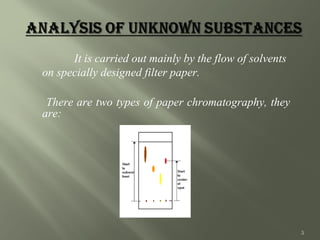
It is carried out mainly by the flow of solvents
on specially designed filter paper.
There are two types of paper chromatography, they
are:
1.1.PAPER ADSORPTION CHROMATOGRAPHYPAPER ADSORPTION CHROMATOGRAPHY
Paper impregnated with silica or alumina acts asPaper impregnated with silica or alumina acts as
adsorbent (stationary phase) and solvent as mobile phase.
2.2.PAPER PARTITION CHROMATOGRAPHYPAPER PARTITION CHROMATOGRAPHY
Moisture / Water present in the pores of celluloseMoisture / Water present in the pores of cellulose
fibers present in filter paper acts as stationary phase &fibers present in filter paper acts as stationary phase &
another mobile phase is used as solvent.another mobile phase is used as solvent.
4
The principle of separation is mainly partition rather
than adsorption.
Cellulose layers in filter paper contains moisture
which acts as stationary phase & organic
solvents/buffers are used as mobile phase
5
6
1)Stationary phase & papers used
2)Application of sample
3)Mobile phase
4)Development technique
5)Detecting or Visualizing agents
Whatman filter papers of different grades like
No.1, No.2, No.3, No.4, No.20, No.40, No.42 etc are
used. In general this paper contains 98-99% of α-
cellulose, 0.3 – 1% β –cellulose
Factors that governs the choice of paper:
» Nature of Sample and solvents used.
» Based on Quantitative or Qualitative analysis.
» Based on thickness of the paper.
7
 Modified Papers – acid or base washed filter paper,
glass fiber type paper.
 Hydrophilic Papers – Papers modified with
methanol, form amide, glycol, glycerol etc.
 Hydrophobic papers – acetylation of OH groups
leads to hydrophobic nature, hence can be used for
reverse phase chromatography.
 Impregnation of silica, alumina, or ion exchange
resins can also be made.
8
 Cut the paper into
desired shape and size
depending upon work to
be carried out.
 The starting line is
marked on the paper
with an ordinary pencil
5cm from the bottom
edge.
 On the starting line
marks are made 2cm
apart from each other.
9
 Choice of suitable solvent for making solution is very
important. Pure solutions can be applied direct on the
paper but solids are always dissolved in small quantity
of a suitable solvent.
10
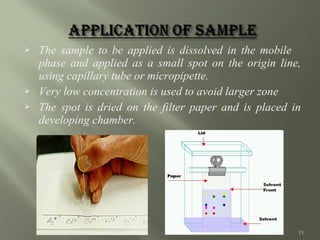
 The sample to be applied is dissolved in the mobile
phase and applied as a small spot on the origin line,
using capillary tube or micropipette.
 Very low concentration is used to avoid larger zone
 The spot is dried on the filter paper and is placed in
developing chamber.
11
 The commonly employed solvents are the polar solvents,
but the choice depends on the nature of the substance to
be separated.
 If pure solvents do not give satisfactory separation, a
mixture of solvents of suitable polarity may be applied.
12
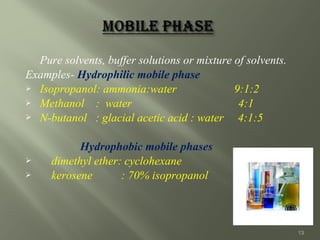
Pure solvents, buffer solutions or mixture of solvents.
Examples- Hydrophilic mobile phase
 Isopropanol: ammonia:water 9:1:2
 Methanol : water 4:1
 N-butanol : glacial acetic acid : water 4:1:5
Hydrophobic mobile phases
 dimethyl ether: cyclohexane
 kerosene : 70% isopropanol
13
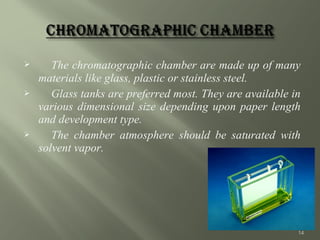
 The chromatographic chamber are made up of many
materials like glass, plastic or stainless steel.
 Glass tanks are preferred most. They are available in
various dimensional size depending upon paper length
and development type.
 The chamber atmosphere should be saturated with
solvent vapor.
14
 The paper is dipped in solvent in such a manner
that the spots will not dip completely into the
solvent.
 The solvent will rise up and it is allowed to run
2/3rd
of paper height for better and efficient result.
15
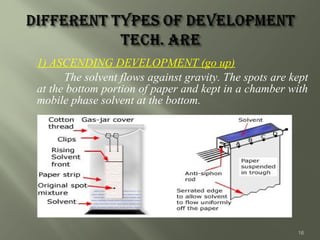
1) ASCENDING DEVELOPMENT (go up)
The solvent flows against gravity. The spots are kept
at the bottom portion of paper and kept in a chamber with
mobile phase solvent at the bottom.
16
 This is carried out in a special chamber where the
solvent holder is at the top. The spot is kept at the top
and the solvent flows down the paper.
 In this method solvent moves from top to bottom so it is
called descending chromatography.
 Advantage is that, DEVELOPMENT IS FASTER
17
A hybrid of above two technique is called
ascending-descending chromatography.
Only length of separation increased, first ascending
takes place followed by descending.
18
Spot is kept at the centre of a circular paper. The
solvent flows through a wick at the centre & spreads in
all directions uniformly.
19
In this method the paper is developed in one direction
and after development, the paper is developed in the
second direction allowing more compounds to be
separated into individual spots.
In the second direction, either same solvent/different
solvent system can be used for development.
20
21
 After the solvent has moved a certain distance for
certain time the chromatogram is taken out from the
tank & position of the solvent front is marked with a
pencil.
 They are dried by cold or hot air depending on
volatility of solvents. A simple hair dryer is a convenient
device to dry chromatograms.
22
If the substance are colored they are visually detected
easily.
But for colorless substance, Physical and chemical
methods are used to detect the spot.
(a)Non specific methods ( Physical methods)
E.g. Iodine chamber method, UV chamber for fluorescent
compounds – at 254 or at 365nm.
23
 Ferric chloride
 Ninhydrin in acetone
 Dragendroff’s reagents
 3,5 dinitro benzoic acid
 Phenolic comp. & tannins
 Amino acids
 Alkaloids
 Cardiac glycosides
24
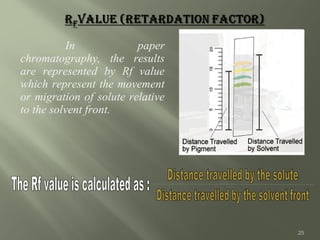
In paper
chromatography, the results
are represented by Rf value
which represent the movement
or migration of solute relative
to the solvent front.
25
i) The temperature
ii) The purity of the solvents used
iii) The quality of the paper, adsorbents & impurities
present n the adsorbents
iv) Chamber saturation techniques, method of drying &
development
v) The distance travelled by the solute & solvent
vi) Chemical reaction between the substances being
partitioned.
vii) pH of the solution
26
 In many cases it has been observed that the solvent
front is run off the end of the paper. Rx value is thus
used.
 It is the ratio of distance travelled by the sample and
the distance travelled by the standard. Rxvalue is always
closer to 1.
27
1. Error during application of the spots
Apply minimum volume of the concentrated solution in
order to avoid diffusion through the paper which leads to
poor separation
Spots should be approximately of the same diameter.
2. Development
Improper adjustment of the paper in the tank leads to this
error so the paper should be held vertically.
Do chamber saturation
3. Detection
The spraying methods affect the final result
28
 Separation of mixtures of drugs
 Separation of carbohydrates, vitamins, antibiotics, proteins,
etc.
 Identification of drugs
 Identification of impurities
 Analysis of metabolites of drugs in blood , urine ….
AdvAntAges of PCAdvAntAges of PC
 Simple
 Rapid
 Inexpensive
 excellent resolving power.
29
30

Paper Chromatography in simple words

  • 1.
    1 Under the guidanceof: Presented by: Mrs. V. Mounika.,M. Pharm P. Naga Jyothi Dept. of Pharmaceutical Analysis Y16MPH230
  • 2.
     Paper Chromatography(PC) was first introduced by German scientist Christian Friedrich Schonbein (1865).  PC is considered to be the simplest and most widely used of the chromatographic techniques because of its applicability to isolation, identification and quantitative determination of organic and inorganic compounds. 2
  • 3.
    3 It is carriedout mainly by the flow of solvents on specially designed filter paper. There are two types of paper chromatography, they are:
  • 4.
    1.1.PAPER ADSORPTION CHROMATOGRAPHYPAPERADSORPTION CHROMATOGRAPHY Paper impregnated with silica or alumina acts asPaper impregnated with silica or alumina acts as adsorbent (stationary phase) and solvent as mobile phase. 2.2.PAPER PARTITION CHROMATOGRAPHYPAPER PARTITION CHROMATOGRAPHY Moisture / Water present in the pores of celluloseMoisture / Water present in the pores of cellulose fibers present in filter paper acts as stationary phase &fibers present in filter paper acts as stationary phase & another mobile phase is used as solvent.another mobile phase is used as solvent. 4
  • 5.
    The principle ofseparation is mainly partition rather than adsorption. Cellulose layers in filter paper contains moisture which acts as stationary phase & organic solvents/buffers are used as mobile phase 5
  • 6.
    6 1)Stationary phase &papers used 2)Application of sample 3)Mobile phase 4)Development technique 5)Detecting or Visualizing agents
  • 7.
    Whatman filter papersof different grades like No.1, No.2, No.3, No.4, No.20, No.40, No.42 etc are used. In general this paper contains 98-99% of α- cellulose, 0.3 – 1% β –cellulose Factors that governs the choice of paper: » Nature of Sample and solvents used. » Based on Quantitative or Qualitative analysis. » Based on thickness of the paper. 7
  • 8.
     Modified Papers– acid or base washed filter paper, glass fiber type paper.  Hydrophilic Papers – Papers modified with methanol, form amide, glycol, glycerol etc.  Hydrophobic papers – acetylation of OH groups leads to hydrophobic nature, hence can be used for reverse phase chromatography.  Impregnation of silica, alumina, or ion exchange resins can also be made. 8
  • 9.
     Cut thepaper into desired shape and size depending upon work to be carried out.  The starting line is marked on the paper with an ordinary pencil 5cm from the bottom edge.  On the starting line marks are made 2cm apart from each other. 9
  • 10.
     Choice ofsuitable solvent for making solution is very important. Pure solutions can be applied direct on the paper but solids are always dissolved in small quantity of a suitable solvent. 10
  • 11.
     The sampleto be applied is dissolved in the mobile phase and applied as a small spot on the origin line, using capillary tube or micropipette.  Very low concentration is used to avoid larger zone  The spot is dried on the filter paper and is placed in developing chamber. 11
  • 12.
     The commonlyemployed solvents are the polar solvents, but the choice depends on the nature of the substance to be separated.  If pure solvents do not give satisfactory separation, a mixture of solvents of suitable polarity may be applied. 12
  • 13.
    Pure solvents, buffersolutions or mixture of solvents. Examples- Hydrophilic mobile phase  Isopropanol: ammonia:water 9:1:2  Methanol : water 4:1  N-butanol : glacial acetic acid : water 4:1:5 Hydrophobic mobile phases  dimethyl ether: cyclohexane  kerosene : 70% isopropanol 13
  • 14.
     The chromatographicchamber are made up of many materials like glass, plastic or stainless steel.  Glass tanks are preferred most. They are available in various dimensional size depending upon paper length and development type.  The chamber atmosphere should be saturated with solvent vapor. 14
  • 15.
     The paperis dipped in solvent in such a manner that the spots will not dip completely into the solvent.  The solvent will rise up and it is allowed to run 2/3rd of paper height for better and efficient result. 15
  • 16.
    1) ASCENDING DEVELOPMENT(go up) The solvent flows against gravity. The spots are kept at the bottom portion of paper and kept in a chamber with mobile phase solvent at the bottom. 16
  • 17.
     This iscarried out in a special chamber where the solvent holder is at the top. The spot is kept at the top and the solvent flows down the paper.  In this method solvent moves from top to bottom so it is called descending chromatography.  Advantage is that, DEVELOPMENT IS FASTER 17
  • 18.
    A hybrid ofabove two technique is called ascending-descending chromatography. Only length of separation increased, first ascending takes place followed by descending. 18
  • 19.
    Spot is keptat the centre of a circular paper. The solvent flows through a wick at the centre & spreads in all directions uniformly. 19
  • 20.
    In this methodthe paper is developed in one direction and after development, the paper is developed in the second direction allowing more compounds to be separated into individual spots. In the second direction, either same solvent/different solvent system can be used for development. 20
  • 21.
  • 22.
     After thesolvent has moved a certain distance for certain time the chromatogram is taken out from the tank & position of the solvent front is marked with a pencil.  They are dried by cold or hot air depending on volatility of solvents. A simple hair dryer is a convenient device to dry chromatograms. 22
  • 23.
    If the substanceare colored they are visually detected easily. But for colorless substance, Physical and chemical methods are used to detect the spot. (a)Non specific methods ( Physical methods) E.g. Iodine chamber method, UV chamber for fluorescent compounds – at 254 or at 365nm. 23
  • 24.
     Ferric chloride Ninhydrin in acetone  Dragendroff’s reagents  3,5 dinitro benzoic acid  Phenolic comp. & tannins  Amino acids  Alkaloids  Cardiac glycosides 24
  • 25.
    In paper chromatography, theresults are represented by Rf value which represent the movement or migration of solute relative to the solvent front. 25
  • 26.
    i) The temperature ii)The purity of the solvents used iii) The quality of the paper, adsorbents & impurities present n the adsorbents iv) Chamber saturation techniques, method of drying & development v) The distance travelled by the solute & solvent vi) Chemical reaction between the substances being partitioned. vii) pH of the solution 26
  • 27.
     In manycases it has been observed that the solvent front is run off the end of the paper. Rx value is thus used.  It is the ratio of distance travelled by the sample and the distance travelled by the standard. Rxvalue is always closer to 1. 27
  • 28.
    1. Error duringapplication of the spots Apply minimum volume of the concentrated solution in order to avoid diffusion through the paper which leads to poor separation Spots should be approximately of the same diameter. 2. Development Improper adjustment of the paper in the tank leads to this error so the paper should be held vertically. Do chamber saturation 3. Detection The spraying methods affect the final result 28
  • 29.
     Separation ofmixtures of drugs  Separation of carbohydrates, vitamins, antibiotics, proteins, etc.  Identification of drugs  Identification of impurities  Analysis of metabolites of drugs in blood , urine …. AdvAntAges of PCAdvAntAges of PC  Simple  Rapid  Inexpensive  excellent resolving power. 29
  • 30.