Ibrahim L. Mukattash
   The use and application of papers based
    survey among practitioners and academics
    have been used for a long time

   The purpose behind any survey is to collect
    measurable data from a specific group of
    people.
   Response Rate
    The success of a survey will be the response
    rate (how many people actually respond to
    your survey).

   Cost of producing and administering
     Survey researches have to function within the
    constraints of budgets and consider which
    survey mode will meet the needs of the study
 Designing & creating a PBS survey that will
  improve its response rate and its accuracy, the
  researcher has too focus on:
1. Formatting
2. Initial Design Considerations
     (Goals, Topic, Concept, Content, Wording, Length
     , Response Categories)
3.   The Cover and Cover Page (Short & Simple)
4.   Directions
5.   Ordering of Questions (Logic & Flow)
6.   Page Design
 Confidentiality assurance:
   Respondents can be confident that an
  unnamed piece of paper placed into a box is
  relatively untraceable, respondents often have
  concerns over confidentiality with web-based
  surveys (concerns regarding handwriting can
  be an issue)
 Mobility/ease of transport:
  paper-based surveys can be particularly
  useful for those respondents who do not have
  easy access to a PC
   Increases potential sample size
     Especially when questionnaires are
    distributed by hand or self administered
   Readability:
     A paper survey in black ink offers a better
    resolution than you will find on any computer
    monitor making it easier for the respondent
    to read
   Most popular survey approach to data
    collection
   Allows great flexibility regarding types of
    items and scales
   Participants work directly on the survey
    document
   Easy to change at last minute
   Can be completed anywhere, at any time, in
    any order
   Lower risk, fewer uncertainties with technical
    glitches
   Expensive when compared to online surveys:
    Paper surveys must be printed (large
    booklets) , posted, received and collated, and
    have their data entered and coded for
    analysis.
   Slow response: Printing, posting, distributing
    and responding may require a lot of time
   Incomplete responses: Respondents may not
    finish the complete survey, especially long
    surveys and Response burden can be high
    with long documents
 Increased data entry and analysis time
  Data processing is costly, complex, time-
  consuming and more prone to errors due to
  hand entry or scanning process
 Limited space and design
 May require good writing skills
 Appears ‘low tech’
   Regardless of the fact that the prices of
    paper, printing and posting are in the rise
    paper based surveys are still an important
    research tool.

   A researcher should know the needs of his
    respondents before designing either a paper
    based or a web survey.
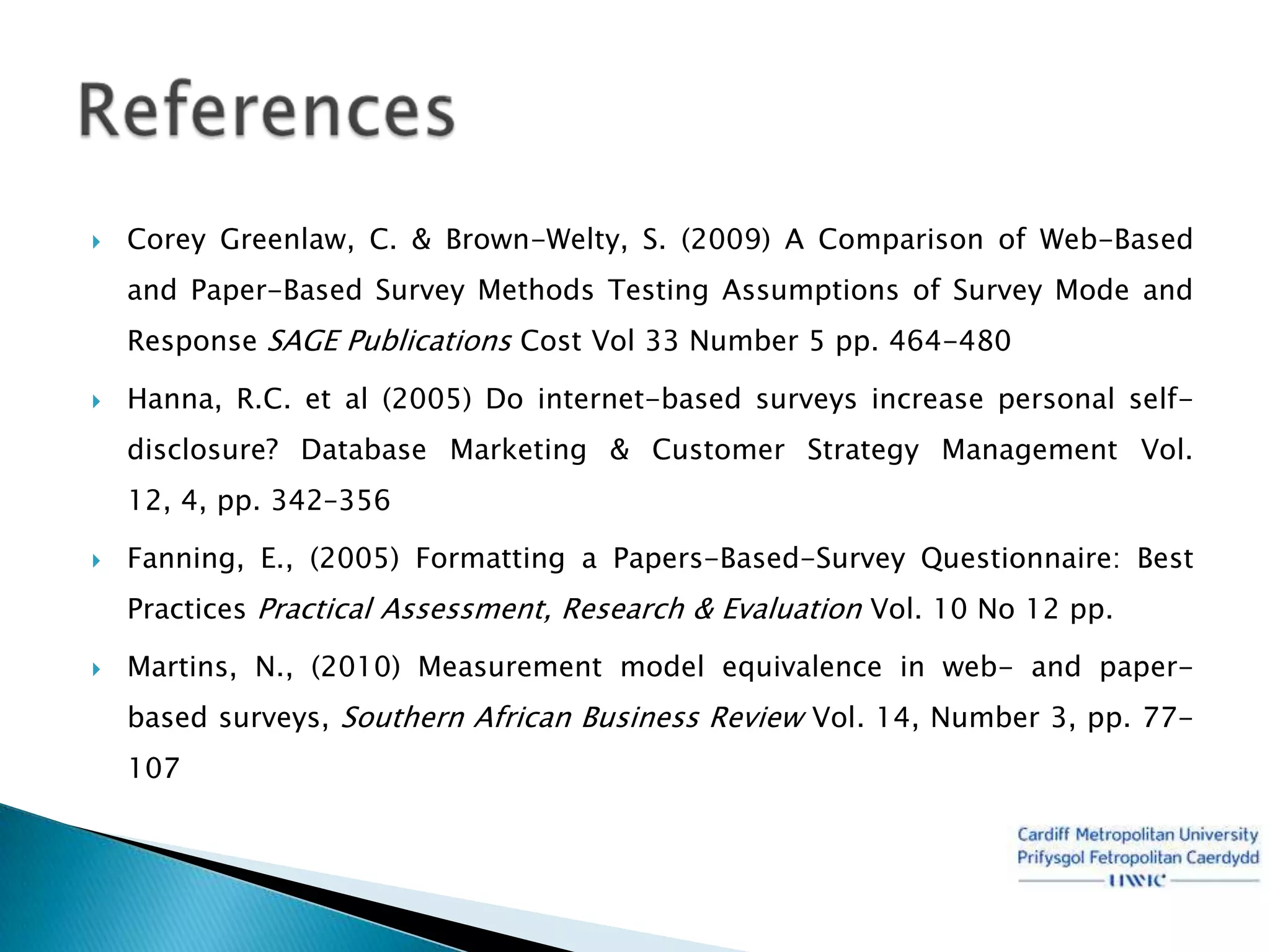
   Corey Greenlaw, C. & Brown-Welty, S. (2009) A Comparison of Web-Based
    and Paper-Based Survey Methods Testing Assumptions of Survey Mode and
    Response SAGE Publications Cost Vol 33 Number 5 pp. 464-480

   Hanna, R.C. et al (2005) Do internet-based surveys increase personal self-
    disclosure? Database Marketing & Customer Strategy Management Vol.
    12, 4, pp. 342–356

   Fanning, E., (2005) Formatting a Papers-Based-Survey Questionnaire: Best
    Practices Practical Assessment, Research & Evaluation Vol. 10 No 12 pp.

   Martins, N., (2010) Measurement model equivalence in web- and paper-
    based surveys, Southern African Business Review Vol. 14, Number 3, pp. 77-
    107

Paper based surveys

  • 1.
  • 2.
    The use and application of papers based survey among practitioners and academics have been used for a long time  The purpose behind any survey is to collect measurable data from a specific group of people.
  • 3.
    Response Rate The success of a survey will be the response rate (how many people actually respond to your survey).  Cost of producing and administering Survey researches have to function within the constraints of budgets and consider which survey mode will meet the needs of the study
  • 4.
     Designing &creating a PBS survey that will improve its response rate and its accuracy, the researcher has too focus on: 1. Formatting 2. Initial Design Considerations (Goals, Topic, Concept, Content, Wording, Length , Response Categories) 3. The Cover and Cover Page (Short & Simple) 4. Directions 5. Ordering of Questions (Logic & Flow) 6. Page Design
  • 5.
     Confidentiality assurance: Respondents can be confident that an unnamed piece of paper placed into a box is relatively untraceable, respondents often have concerns over confidentiality with web-based surveys (concerns regarding handwriting can be an issue)  Mobility/ease of transport: paper-based surveys can be particularly useful for those respondents who do not have easy access to a PC
  • 6.
    Increases potential sample size Especially when questionnaires are distributed by hand or self administered  Readability: A paper survey in black ink offers a better resolution than you will find on any computer monitor making it easier for the respondent to read
  • 7.
    Most popular survey approach to data collection  Allows great flexibility regarding types of items and scales  Participants work directly on the survey document  Easy to change at last minute  Can be completed anywhere, at any time, in any order  Lower risk, fewer uncertainties with technical glitches
  • 8.
    Expensive when compared to online surveys: Paper surveys must be printed (large booklets) , posted, received and collated, and have their data entered and coded for analysis.  Slow response: Printing, posting, distributing and responding may require a lot of time  Incomplete responses: Respondents may not finish the complete survey, especially long surveys and Response burden can be high with long documents
  • 9.
     Increased dataentry and analysis time Data processing is costly, complex, time- consuming and more prone to errors due to hand entry or scanning process  Limited space and design  May require good writing skills  Appears ‘low tech’
  • 10.
    Regardless of the fact that the prices of paper, printing and posting are in the rise paper based surveys are still an important research tool.  A researcher should know the needs of his respondents before designing either a paper based or a web survey.
  • 11.
    Corey Greenlaw, C. & Brown-Welty, S. (2009) A Comparison of Web-Based and Paper-Based Survey Methods Testing Assumptions of Survey Mode and Response SAGE Publications Cost Vol 33 Number 5 pp. 464-480  Hanna, R.C. et al (2005) Do internet-based surveys increase personal self- disclosure? Database Marketing & Customer Strategy Management Vol. 12, 4, pp. 342–356  Fanning, E., (2005) Formatting a Papers-Based-Survey Questionnaire: Best Practices Practical Assessment, Research & Evaluation Vol. 10 No 12 pp.  Martins, N., (2010) Measurement model equivalence in web- and paper- based surveys, Southern African Business Review Vol. 14, Number 3, pp. 77- 107