1. Define the Problem Defining a problem Understanding the purpose of the study Understanding the background issues E.g. the company growth rate is low. Discuss with decision makers, interviews with industry experts, analysis of secondary data, conducting focus groups analysis.
2. Developing an Approach to the Problem Formulating an analytical framework and models, research questions. Determine a hypothesis: an educated guess The hypothesis provides a research problem for the investigators which can be tested scientifically.
3.  Formulating a Research Design A framework or blueprint for conducting the marketing research Details procedures needed to obtain the required information. Conducting exploratory research, precisely defining the variables, designing appropriate scales to measure them. How to obtain the data: survey or experiment Design questionnarie
4.  Doing Field Work or Collecting Data Field work involves personal, telephone, mail, or electronic interviewing Proper selection, training, supervision, and evaluation of the field force are essential
5. Preparing and Analyzing Data Data Processing Editing, coding, transcribing of collected data. Analyze using different statistical techniques Interpreted the results, find conclusions related to the marketing research questions 6. Preparing and presenting the report.
First, select sources of information: Secondary data information already collected for another purpose If use secondary data—designing the questionnaire, planning the sample, and collecting data are done for you.  But make sure they are done right! Primary data   information collected for the specific purpose at hand Source of information
Sources of secondary data internal sources balance sheets, sales figures, customer DB government publications statistics Canada periodicals and books Canadian trade index, Advertising age commercial data A.C. Nielsen, IRI  internet Source of information
Advantages of  secondary data low cost less effort expended process less time consuming some information can be obtained only from secondary data Disadvantages of  secondary data collected for some other purpose may not be very accurate may be outdated Pros and Cons of Secondary Data
Primary data collection process Data collection methods surveys qualitative research—personal interviews & focus groups observation  Experiment Design study materials (e.g., questionnaire design) Sampling  Data collection Primary Data
Survey Data collection by asking people questions personal interview telephone survey mail survey Internet survey Advantages large size data, flexibility Disadvantages errors in questionnaire, expensive, response error Survey
Survey (cont.) Personal interview  Advantages flexible, more information  Disadvantages expensive, time-consuming, interviewer bias  e.g., “shopping mall intercept”: a convenient, low-cost  method but lacks representativeness Personal Interview
Survey (cont.) Telephone survey Advantages quickness, cost efficiency Disadvantages limited amount of information, limited accessibility of people, have to remember response options Telephone Survey
Survey (cont.) Mail survey Advantages low cost Disadvantages low response rate less control  Mail Survey
Survey (cont.) Internet survey Advantages low cost—much lower even than mail Disadvantages low response rate—large response bias Data reliability—difficult to verify if personal information is true Internet Survey
Qualitative research Types  individual depth interview focus group interview  Advantages resulting data have more depth and richness of context Disadvantages results not necessarily representative of population Hard to quantify the results Qualitative Research
Qualitative research (cont.) Focus group interview Loosely structured group discussion led by interviewer The discussion is observed or videotaped Best for preliminary research Individual depth interview: similar interview with a single person Difficult to understand without seeing it, so we have a video. Focus Group Interview
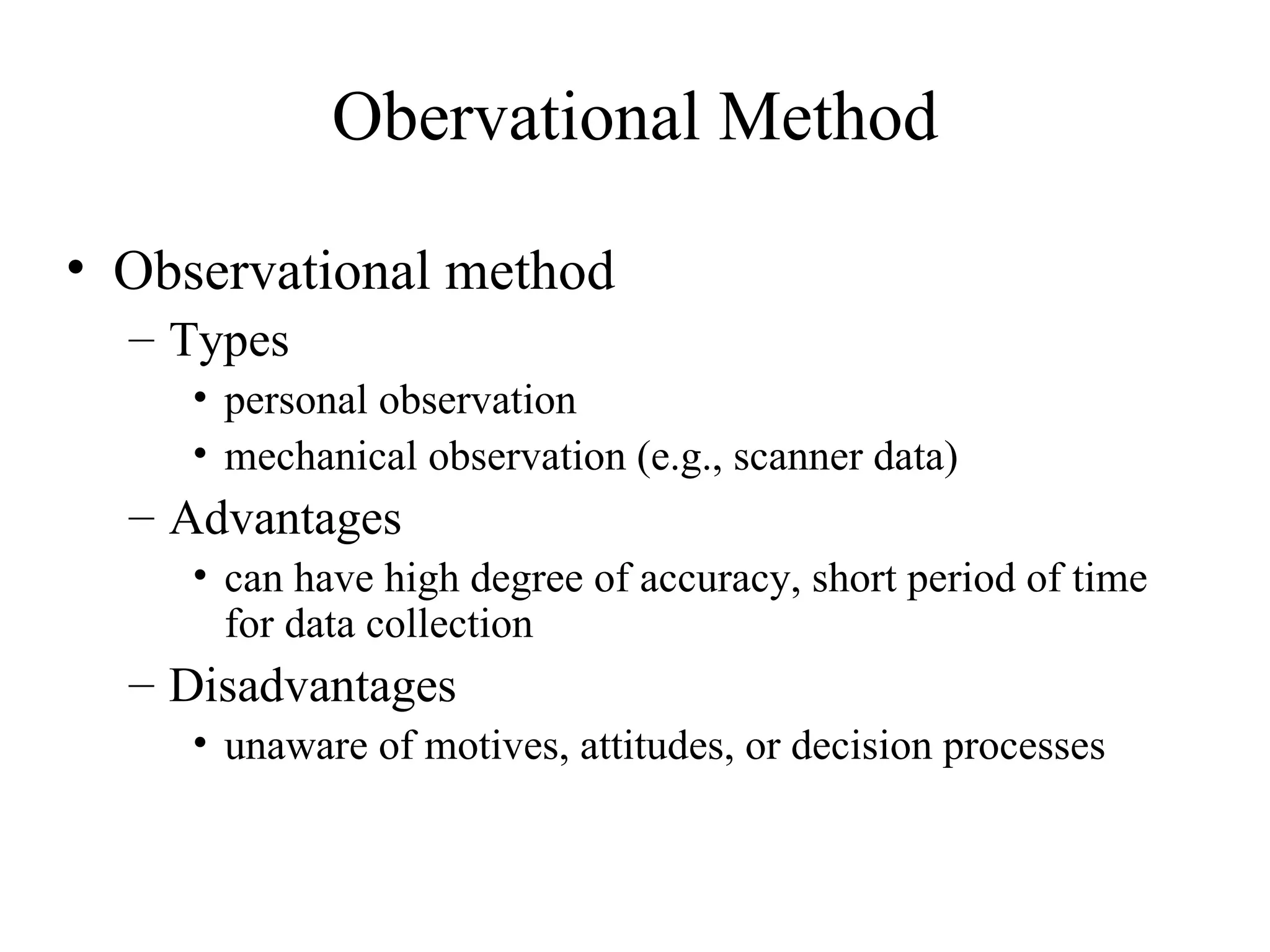
Observational method Types personal observation mechanical observation (e.g., scanner data) Advantages can have high degree of accuracy, short period of time for data collection  Disadvantages unaware of motives, attitudes, or decision processes Obervational Method
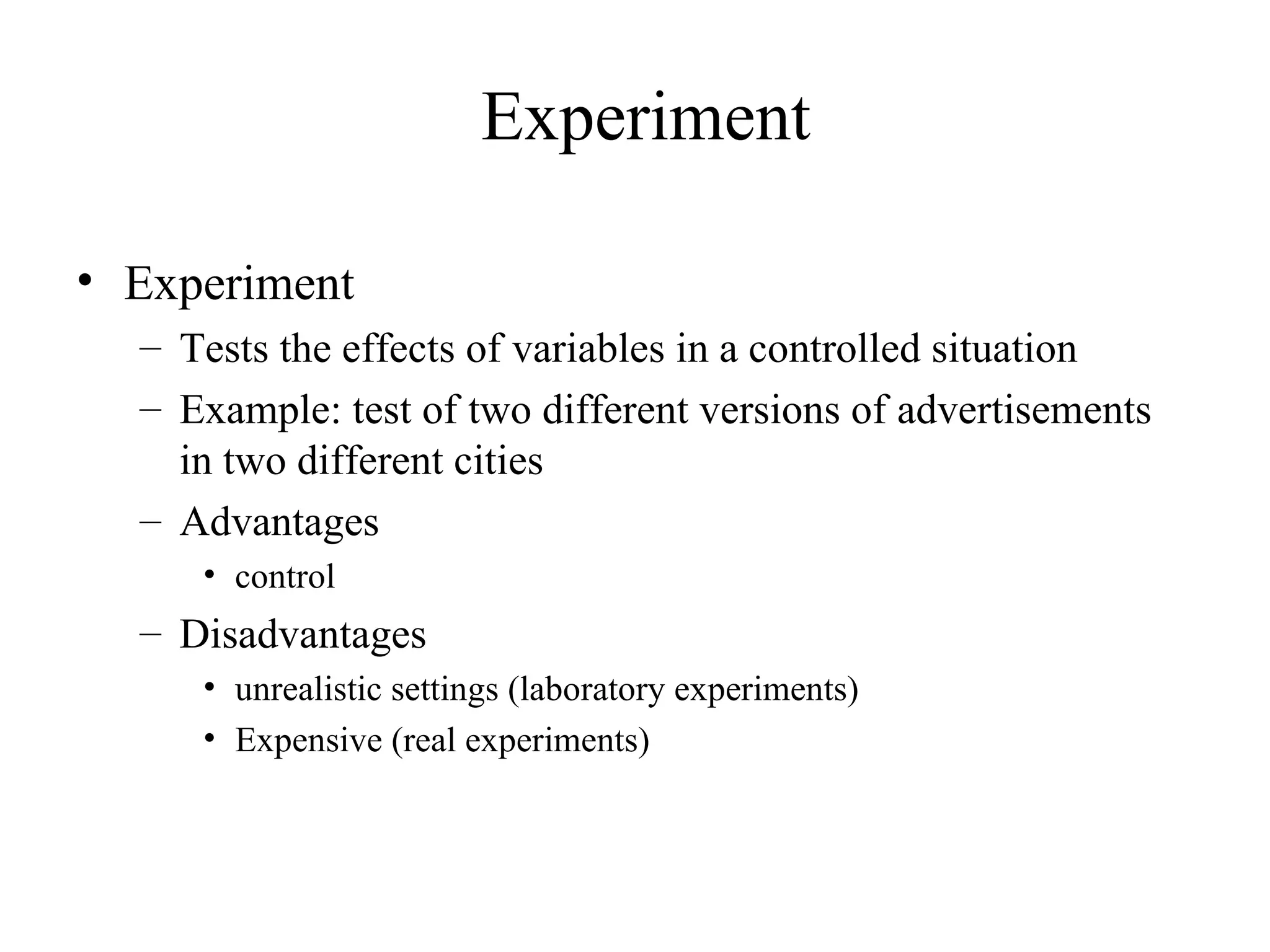
Experiment Tests the effects of variables in a controlled situation Example: test of two different versions of advertisements in two different cities Advantages control Disadvantages unrealistic settings (laboratory experiments) Expensive (real experiments) Experiment
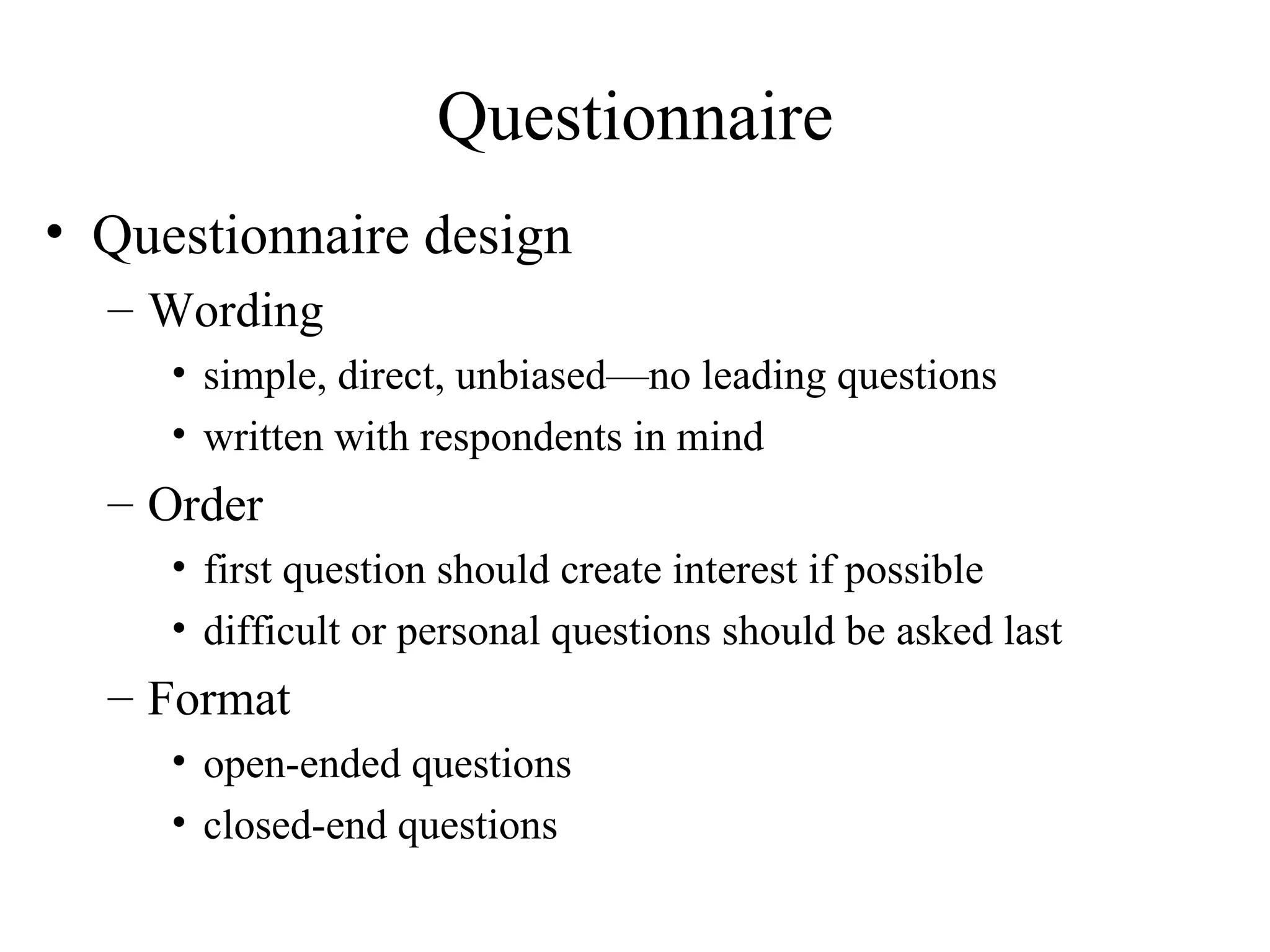
Questionnaire design Wording simple, direct, unbiased—no leading questions written with respondents in mind Order first question should create interest if possible difficult or personal questions should be asked last Format open-ended questions closed-end questions Questionnaire
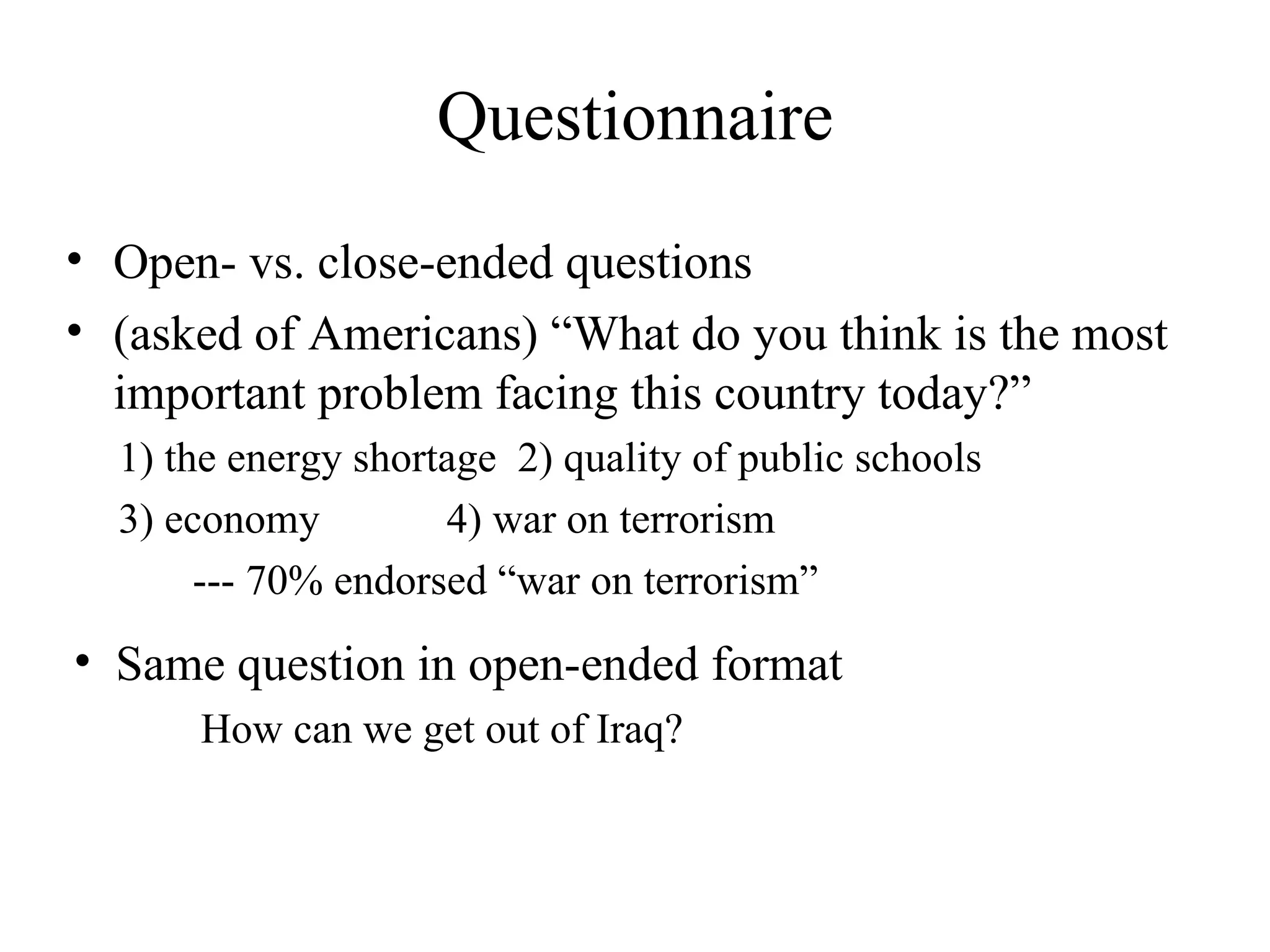
Open- vs. close-ended questions (asked of Americans) “What do you think is the most important problem facing this country today?” 1) the energy shortage  2) quality of public schools  3) economy  4) war on terrorism --- 70% endorsed “war on terrorism” Questionnaire Same question in open-ended format  How can we get out of Iraq?
Survey and questionnaire design Choosing a sample: Samples need to be as representative as possible, ideally randomly chosen from  the population of interest Sample size must be large enough to have confidence in the results—depends on situation Poorly chosen samples lead to biased results Sample selection
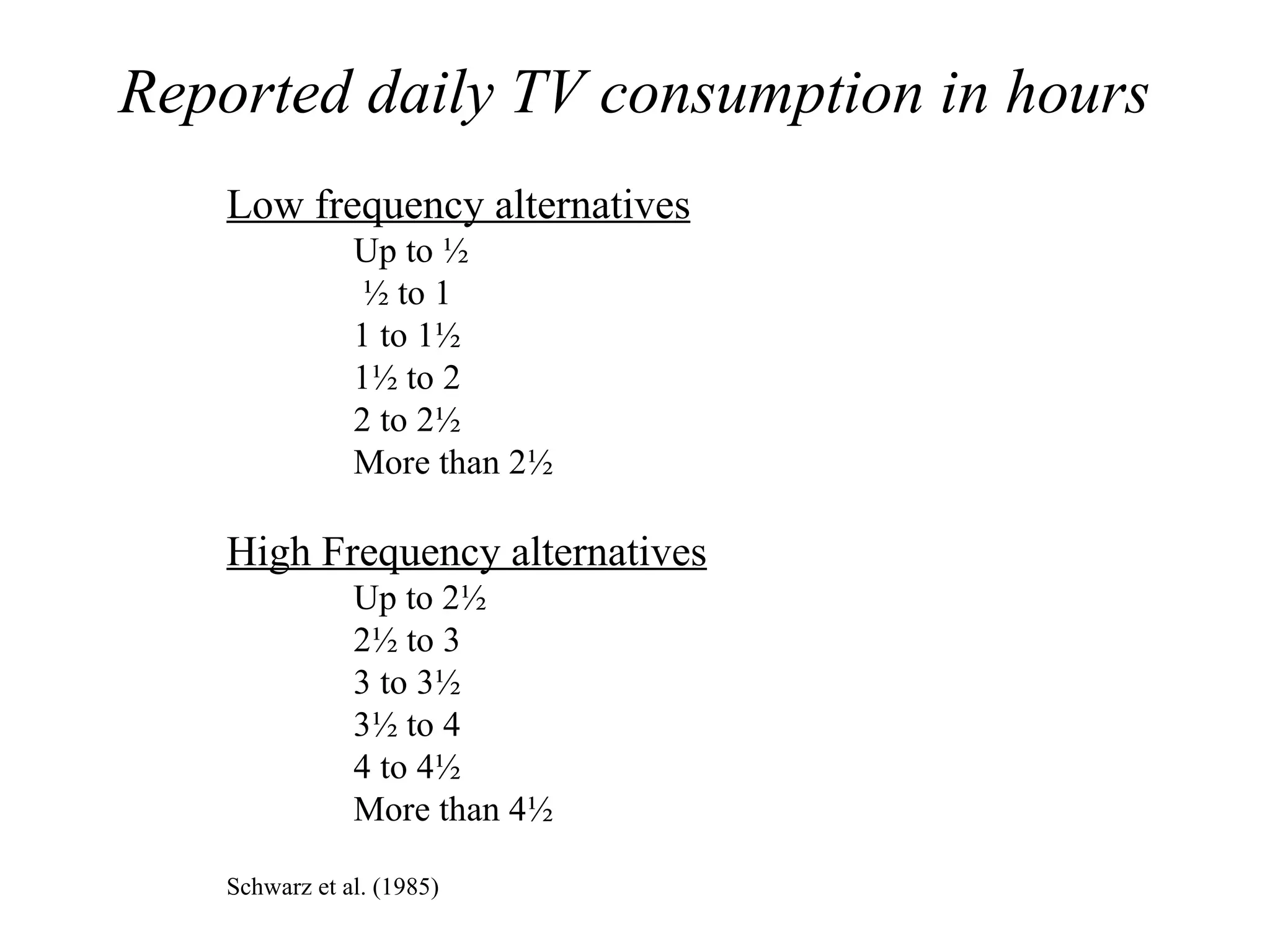
Reported daily TV consumption in hours Low frequency alternatives   Up to ½     ½ to 1 1 to 1½ 1½ to 2 2 to 2½ More than 2½ High Frequency alternatives   Up to 2½ 2½ to 3 3 to 3½   3½ to 4   4 to 4½   More than 4½   Schwarz et al. (1985)
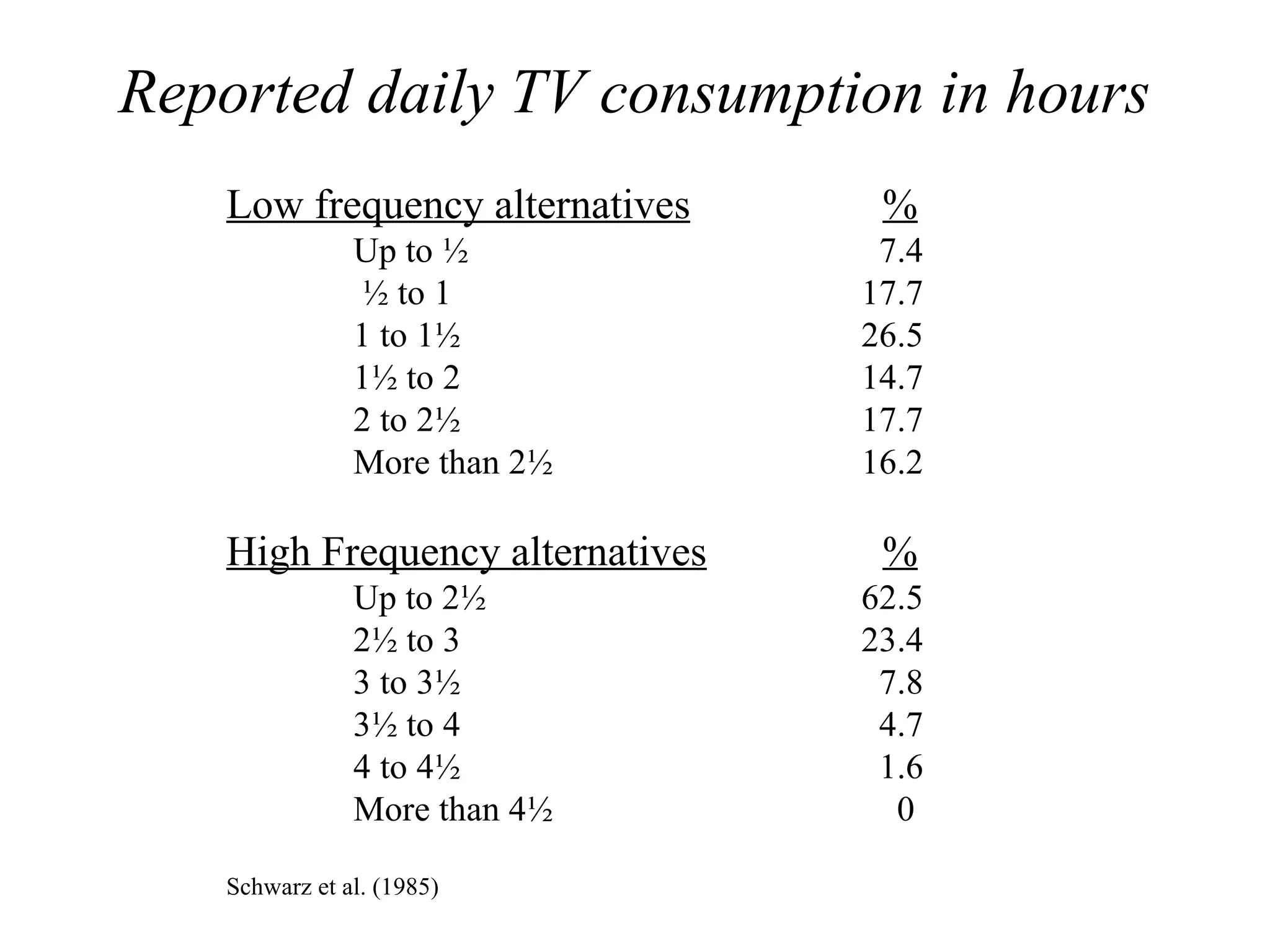
Reported daily TV consumption in hours Low frequency alternatives   % Up to ½   7.4   ½ to 1 17.7 1 to 1½ 26.5 1½ to 2 14.7 2 to 2½ 17.7 More than 2½ 16.2 High Frequency alternatives   % Up to 2½ 62.5 2½ to 3 23.4 3 to 3½   7.8 3½ to 4   4.7 4 to 4½   1.6 More than 4½   0 Schwarz et al. (1985)
Sampling A sample is a subset of the population selected to represent the population as a whole Samples should be representative of the population Sample size larger sample gives more reliable results small samples are OK when they represent the population  (US presidential election poll: sample size of 1,000) Sample
Sampling (cont.): Sampling procedure random sampling every member of the population has a known probability of being included convenience sampling the researcher selects easiest population members from which to obtain information lacks the representativeness of the population (e.g.) shopping mall intercept Sampling
Summary What is marketing research? The marketing research process Six stages

problem

  • 1.
    1. Define theProblem Defining a problem Understanding the purpose of the study Understanding the background issues E.g. the company growth rate is low. Discuss with decision makers, interviews with industry experts, analysis of secondary data, conducting focus groups analysis.
  • 2.
    2. Developing anApproach to the Problem Formulating an analytical framework and models, research questions. Determine a hypothesis: an educated guess The hypothesis provides a research problem for the investigators which can be tested scientifically.
  • 3.
    3. Formulatinga Research Design A framework or blueprint for conducting the marketing research Details procedures needed to obtain the required information. Conducting exploratory research, precisely defining the variables, designing appropriate scales to measure them. How to obtain the data: survey or experiment Design questionnarie
  • 4.
    4. DoingField Work or Collecting Data Field work involves personal, telephone, mail, or electronic interviewing Proper selection, training, supervision, and evaluation of the field force are essential
  • 5.
    5. Preparing andAnalyzing Data Data Processing Editing, coding, transcribing of collected data. Analyze using different statistical techniques Interpreted the results, find conclusions related to the marketing research questions 6. Preparing and presenting the report.
  • 6.
    First, select sourcesof information: Secondary data information already collected for another purpose If use secondary data—designing the questionnaire, planning the sample, and collecting data are done for you. But make sure they are done right! Primary data information collected for the specific purpose at hand Source of information
  • 7.
    Sources of secondarydata internal sources balance sheets, sales figures, customer DB government publications statistics Canada periodicals and books Canadian trade index, Advertising age commercial data A.C. Nielsen, IRI internet Source of information
  • 8.
    Advantages of secondary data low cost less effort expended process less time consuming some information can be obtained only from secondary data Disadvantages of secondary data collected for some other purpose may not be very accurate may be outdated Pros and Cons of Secondary Data
  • 9.
    Primary data collectionprocess Data collection methods surveys qualitative research—personal interviews & focus groups observation Experiment Design study materials (e.g., questionnaire design) Sampling Data collection Primary Data
  • 10.
    Survey Data collectionby asking people questions personal interview telephone survey mail survey Internet survey Advantages large size data, flexibility Disadvantages errors in questionnaire, expensive, response error Survey
  • 11.
    Survey (cont.) Personalinterview Advantages flexible, more information Disadvantages expensive, time-consuming, interviewer bias e.g., “shopping mall intercept”: a convenient, low-cost method but lacks representativeness Personal Interview
  • 12.
    Survey (cont.) Telephonesurvey Advantages quickness, cost efficiency Disadvantages limited amount of information, limited accessibility of people, have to remember response options Telephone Survey
  • 13.
    Survey (cont.) Mailsurvey Advantages low cost Disadvantages low response rate less control Mail Survey
  • 14.
    Survey (cont.) Internetsurvey Advantages low cost—much lower even than mail Disadvantages low response rate—large response bias Data reliability—difficult to verify if personal information is true Internet Survey
  • 15.
    Qualitative research Types individual depth interview focus group interview Advantages resulting data have more depth and richness of context Disadvantages results not necessarily representative of population Hard to quantify the results Qualitative Research
  • 16.
    Qualitative research (cont.)Focus group interview Loosely structured group discussion led by interviewer The discussion is observed or videotaped Best for preliminary research Individual depth interview: similar interview with a single person Difficult to understand without seeing it, so we have a video. Focus Group Interview
  • 17.
    Observational method Typespersonal observation mechanical observation (e.g., scanner data) Advantages can have high degree of accuracy, short period of time for data collection Disadvantages unaware of motives, attitudes, or decision processes Obervational Method
  • 18.
    Experiment Tests theeffects of variables in a controlled situation Example: test of two different versions of advertisements in two different cities Advantages control Disadvantages unrealistic settings (laboratory experiments) Expensive (real experiments) Experiment
  • 19.
    Questionnaire design Wordingsimple, direct, unbiased—no leading questions written with respondents in mind Order first question should create interest if possible difficult or personal questions should be asked last Format open-ended questions closed-end questions Questionnaire
  • 20.
    Open- vs. close-endedquestions (asked of Americans) “What do you think is the most important problem facing this country today?” 1) the energy shortage 2) quality of public schools 3) economy 4) war on terrorism --- 70% endorsed “war on terrorism” Questionnaire Same question in open-ended format How can we get out of Iraq?
  • 21.
    Survey and questionnairedesign Choosing a sample: Samples need to be as representative as possible, ideally randomly chosen from the population of interest Sample size must be large enough to have confidence in the results—depends on situation Poorly chosen samples lead to biased results Sample selection
  • 22.
    Reported daily TVconsumption in hours Low frequency alternatives Up to ½ ½ to 1 1 to 1½ 1½ to 2 2 to 2½ More than 2½ High Frequency alternatives Up to 2½ 2½ to 3 3 to 3½ 3½ to 4 4 to 4½ More than 4½ Schwarz et al. (1985)
  • 23.
    Reported daily TVconsumption in hours Low frequency alternatives % Up to ½ 7.4 ½ to 1 17.7 1 to 1½ 26.5 1½ to 2 14.7 2 to 2½ 17.7 More than 2½ 16.2 High Frequency alternatives % Up to 2½ 62.5 2½ to 3 23.4 3 to 3½ 7.8 3½ to 4 4.7 4 to 4½ 1.6 More than 4½ 0 Schwarz et al. (1985)
  • 24.
    Sampling A sampleis a subset of the population selected to represent the population as a whole Samples should be representative of the population Sample size larger sample gives more reliable results small samples are OK when they represent the population (US presidential election poll: sample size of 1,000) Sample
  • 25.
    Sampling (cont.): Samplingprocedure random sampling every member of the population has a known probability of being included convenience sampling the researcher selects easiest population members from which to obtain information lacks the representativeness of the population (e.g.) shopping mall intercept Sampling
  • 26.
    Summary What ismarketing research? The marketing research process Six stages