INTERNET BASED
RESEARCH
Ms. Vivian A. Tequillo
Master of Science Major in General Science
Education
Central Mindanao University
Research Methods in Education(educ241)
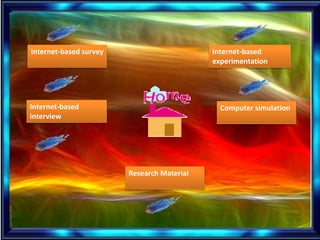
Internet-based survey
Internet-based
interview
Research Material
Internet-based
experimentation
Computer simulation
INTERNET-BASED SURVEY
Internet-based surveys
 using the Internet for the conduct of surveys is
becoming commonplace in many branches of
social science.
 Internet-based surveys have moved from being in
the form of emails to emails-plus-attachments of
the questionnaires itself, to emails directing
potential respondents to a web site.
Internet-based surveys
 Emails direct potentials participants to a web
site at which the survey questionnaire is
located in HTML form.
 Web- based surveys have the potential to
reach greater numbers of participants.
Advantages of Internet-based surveys
The most widely used data collection
instrument for Internet surveys is the
questionnaire.
The following are advantages to using an Internet
questionnaire in comparison to a paper questionnaire (
e.g Watt 1997; Dillman et al. 1999; Dillman and Bowket
2000; Roztocki and Labri 2002)
1. It reduces cost
2. It reduces the time to take to distribute ,gather and
process data.
3. It enables a wider and much larger population to be
accessed.
Advantages of Internet-based
surveys
Advantages of Internet-based
surveys
4. It enables researchers to reach difficult
population under the cover of anonymity
and non-traceability
5. It may have novelty value
6.Respondents can complete the
questionnaire from home.
Advantages of Internet-based
surveys
7. Respondents can complete it at a time
to suit themselves.
8. Respondents can complete the survey
over time.
9. Reduction of researcher effects.
Advantages of Internet-based
surveys
10. Responses in web-based surveys show
fewer missing entries than paper-based
surveys.
11. Human error is reduced in entering and
processing online data.
12. Additional features may make the
survey attractive.
Advantages of Internet-based
surveys
13. Greater generability may be obtained
as Internet users come from a wide and
diverse population.
14. Because of volunteer participation,
greater authentication of responses may
be obtained
Key issues in Internet-based surveys
 The importance of the visual aspect of questionnaire
is heightened in Internet surveys ( Smyth et al. 2004)
 Smyth et al. (2004) report that respondents use ‘pre-
attentive processing’ when approaching Internet
surveys which rests on Gestalt psychology that abides
by the principles of:
1. Proximity
2. similarity
3. Prägnanz
Gestalt psychology
1. Proximity
- grouping those items that are physically
close to each other
2. similarity
- grouping together those items that appear
alike
3. Prägnanz
- figures or items with simplicity, regularly
and symmetry are more easily perceived and
remembered
Problems and solutions in Internet-based surveys
Problems and solutions in Internet-
based surveys
Problem
SAMPLING
 Some subsample groups
may be under-represented
in the respondents
Solution
 Adjust the results by
weighing the sample
responses.
Problems and solutions in Internet-
based surveys
Problem
ETHICS
 Respondents may wish to
keep their identity from the
researcher , and an email
address identifies the
respondent.
Solution
 Direct respondents to a
web site rather than to
using email
correspondence. Provide
advice on using non-
traceable connections to
access and return to the
survey
Problems and solutions in Internet-
based surveys
Problem
TECHNICAL-HARDWARE and
SOFTWARE
 The configuration of the
questionnaire may vary
from one machine to
another and can lead to
dropout
Solution
 Test the survey on different
computer systems/browser
to ensure consistency.
Avoid survey that require
real time completion.
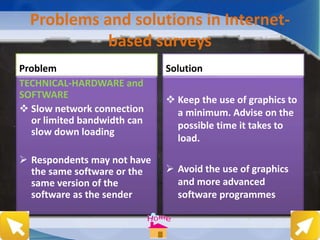
Problems and solutions in Internet-
based surveys
Problem
TECHNICAL-HARDWARE and
SOFTWARE
 Slow network connection
or limited bandwidth can
slow down loading
 Respondents may not have
the same software or the
same version of the
software as the sender
Solution
 Keep the use of graphics to
a minimum. Advise on the
possible time it takes to
load.
 Avoid the use of graphics
and more advanced
software programmes
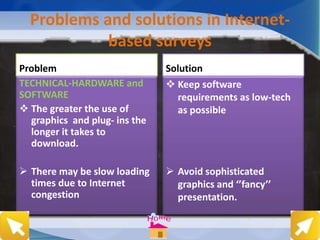
Problems and solutions in Internet-
based surveys
Problem
TECHNICAL-HARDWARE and
SOFTWARE
 The greater the use of
graphics and plug- ins the
longer it takes to
download.
 There may be slow loading
times due to Internet
congestion
Solution
 Keep software
requirements as low-tech
as possible
 Avoid sophisticated
graphics and ‘’fancy’’
presentation.
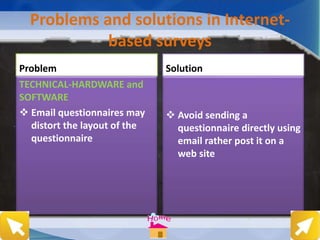
Problems and solutions in Internet-
based surveys
Problem
TECHNICAL-HARDWARE and
SOFTWARE
 Email questionnaires may
distort the layout of the
questionnaire
Solution
 Avoid sending a
questionnaire directly using
email rather post it on a
web site
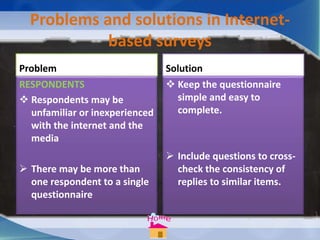
Problems and solutions in Internet-
based surveys
Problem
RESPONDENTS
 Respondents may be
unfamiliar or inexperienced
with the internet and the
media
 There may be more than
one respondent to a single
questionnaire
Solution
 Keep the questionnaire
simple and easy to
complete.
 Include questions to cross-
check the consistency of
replies to similar items.
Problems and solutions in Internet-
based surveys
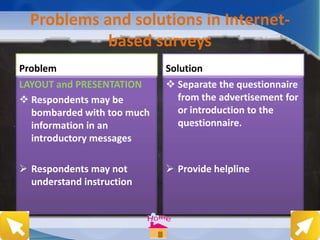
Problem
LAYOUT and PRESENTATION
 Respondents may be
bombarded with too much
information in an
introductory messages
 Respondents may not
understand instruction
Solution
 Separate the questionnaire
from the advertisement for
or introduction to the
questionnaire.
 Provide helpline
Problems and solutions in Internet-
based surveys
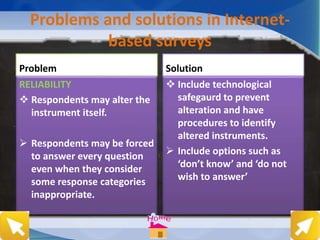
Problem
RELIABILITY
 Respondents may alter the
instrument itself.
 Respondents may be forced
to answer every question
even when they consider
some response categories
inappropriate.
Solution
 Include technological
safegaurd to prevent
alteration and have
procedures to identify
altered instruments.
 Include options such as
‘don’t know’ and ‘do not
wish to answer’
Problems and solutions in Internet-
based surveys
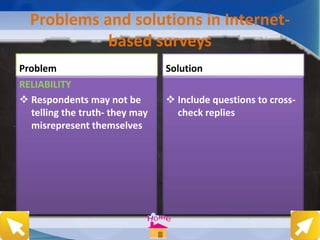
Problem
RELIABILITY
 Respondents may not be
telling the truth- they may
misrepresent themselves
Solution
 Include questions to cross-
check replies
Problems and solutions in Internet-
based surveys
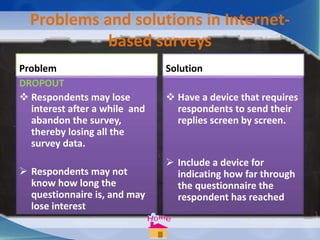
Problem
DROPOUT
 Respondents may lose
interest after a while and
abandon the survey,
thereby losing all the
survey data.
 Respondents may not
know how long the
questionnaire is, and may
lose interest
Solution
 Have a device that requires
respondents to send their
replies screen by screen.
 Include a device for
indicating how far through
the questionnaire the
respondent has reached
Problems and solutions in Internet-
based surveys
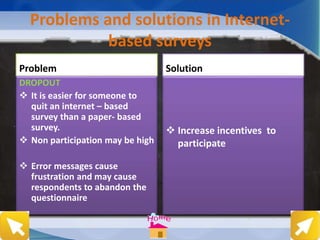
Problem
DROPOUT
 It is easier for someone to
quit an internet – based
survey than a paper- based
survey.
 Non participation may be high
 Error messages cause
frustration and may cause
respondents to abandon the
questionnaire
Solution
 Increase incentives to
participate
Internet-based surveys are subject
to the same ethical rules as paper-
based surveys
Sampling in Internet-based surveys
Sampling bias is a major concern for
Internet based surveys. Internet-mediated
research is immediately subject to serious
problems concerning sampling representatives
and validity of data( Coober 1997; Roztoki and
Lahri 2002)
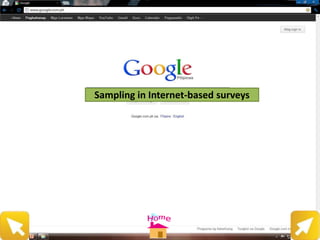
Sampling in Internet-based surveys
A major problem is estimating the size and
nature of the population from which the
sample is drawn.
 The researcher is using non-probability,
volunteer sampling, and this may decrease the
generability of the findings
Sampling in Internet-based surveys
Watt ( 1997) suggests the three types of Internet sample:
1. Unrestricted sample
-anyone can complete the questionnaire, but it
may have limited representatives.
2. Screened sample
- quotas are placed on the subsample categories
and types
3. Recruited sample
- respondents complete a preliminary classification
questionnaire and then , based on the data provided in
them, are recruited or not.
High Hurdle Technique ( Reips 2002) to increase
response rate in Internet-based survey
patience : loading time
and long texts
 duration
Seriousness
Personalization
 impression of control
Privacy
Preconditions
Technical pretest
Rewards
Internet-based experimenting
Internet-based Experiments
Hewson et al. (2003) classify the four principal types of
Internet-based experiments:
1. Static printed materials
- Sends formulated material to respondents (e.g
graphically presented material)
2. Use of non-printed material
(e.g video clips or sound)
3. Reaction- time experiments
- requires very precise timing
4. Internet interviewing
- facilitated by chat rooms
Reips (2002) reports that in comparison to
laboratory experiments, Internet-based
experiments experienced greater problems
dropout, that the dropout rate in an Internet
experiment was very varied.
Reips reported that Internet- based experiments
have an attraction over laboratory and
conventional experiments.
 greater generability
Greater ecological validity
 high degree of voluntariness
‘dos’ in Internet experimenting
 use dropout as a dependent variable
 use dropout to detect motivational
confounding
 place questions for personal information at
the beginning of the Internet study
 use technique that help ensure quality of
data collection over the Internet.
 use Internet- based tools and services to
develop and announce your study
‘don’ts’ in Internet experimenting
1. Do not allow external access to unprotected
directories
2. do not allow public display of confidential
participant data through URLs
3. Do not accidentally reveal the experiment’s
structure
4. Do not ignore the technical variance inherent in
the Internet
5. do not bias the results through improper use of
form elements, such as measurement errors
where omitting particular categories.
‘don’ts’ in Internet experimenting
Reips ( 2000b) points out that it is a
misconception to regard an Internet-based
experimarnt as the same as a laboratory
experiments.
Internet-based interviews
The opportunity that Internet interviews
present for interviewing respondents is
immense.
 It enable researchers to contact hard-to-reach
groups and individuals.
 Chat rooms provide opportunity for split
screens and shared screens, thereby
displaying the ongoing dialogue between
participants.
Internet-based interviews
 Internet interviewing can also go offline
 It requires both parties to agree a time to log
on to the computer in order to conduct the
interview
Computer simulation
Computer Simulations
Computer simulation and virtual technology have
significant contribution to make to educational
research.
A model of the real world in which the relevant
factors in the research can be included and
manipulated.
A model maybe operationalized theory and convert
it into a computer programme
Computer simulations are useful in
addressing ‘what if questions’
 The relevant elements are put into the
simulation and are then manipulated-set
to different parameters-to see what
happens and what results.
Two main components of Simulations:
1. System
- which the researcher is interested and that
itself to being modelled or simulated
2. Model
-the analogue of the system , is often
mathematical
Two forms of simulation
1. Deterministic simulation
- all the mathematical and logical
relationships between the components of a
system are known and fixed.
2. Stochastic simulation
- typically the used main types used in
educational research, at least one variable is
random.
Purpose of simulation
Discovery
Proof
Experiment
Prediction
Searching for research materials on the Internet
Searching for research materials on the
Internet
Data on storage and retrieval of
research the Internet play an important
role not only in keeping researchers
abreast of development across the world
but also in providing access to data which
can inform literature searches to establish
construct and content validity in their own
research.
Web sites for global access to literature
 American Educational Research Association:
http://www.aera.net
Chinese American Educational Research
Association:
http://www.ttu.eedu/~edupsy/regis.html
Web sites for online journal indices and
references for publishes research results
British Education Index
 http://www.leeds.ac.uk/bei
UNESCO web site for social science researches
 http://www.unesco.org/general.eng.infoserv
Social Science Information Gateway
 http://www.sosig.ac.uk and http://www.sosog.estc
Web sites for searching libraries
United States Library of Congress
 http://www.lights.com/webcats
British Library online catalogue
 http://www.bl.uk
Virtual Library
http://www.vlib.org
Web sites for online journals
 BIDShttp://www.bids.ac.uk
EBSCO http://www.ebsco.com
 Science Direct http://www.sciencedirect.com
Web for Science http://www.isinet.com
 Networked Digital Library of Theses and
Dissertations http://www.theses.org
Search engines
Search engines
Parallel search engines
- search several search engines at a time
File search engines
- search files across the world
 MSN Searchhttp://www.msn.com
Direct Hit http://www.directhit.com
Ask Jeeves http://www.askjeeves.com
Go To http://www.go2.com
Metacrawler http://www.metacraler.com
Netscape Navigator http://www.netscape.com
Evaluating web sites
The Internet is a vast store of disorganized
and largely unvetted material, and researchers
will need to be able to ascertain quite quickly
how far the web-based material is appropriate.
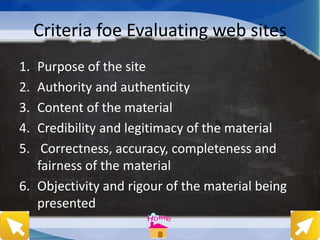
Criteria for Evaluating web sites
Criteria foe Evaluating web sites
1. Purpose of the site
2. Authority and authenticity
3. Content of the material
4. Credibility and legitimacy of the material
5. Correctness, accuracy, completeness and
fairness of the material
6. Objectivity and rigour of the material being
presented
Questions to consider in evaluating
educational research material:
Is the author identified
 Does the author establish his/her expertise in
the area, and institutional affiliation
Is the organization reputable
Is the material referenced; does the author
indicate how the material was gathered
Questions to consider in evaluating educational research material
Questions to consider in evaluating
educational research material:
What is the role that this web site is designed to
play
Is the material up-to-date
Is the material free from biases, personal
opinions and offence
 How do we know that the author is authorities
on this web site
I hope this material would be great help for you. Like
and share!

Internet-based research

  • 1.
    INTERNET BASED RESEARCH Ms. VivianA. Tequillo Master of Science Major in General Science Education Central Mindanao University Research Methods in Education(educ241)
  • 2.
  • 3.
  • 4.
    Internet-based surveys  usingthe Internet for the conduct of surveys is becoming commonplace in many branches of social science.  Internet-based surveys have moved from being in the form of emails to emails-plus-attachments of the questionnaires itself, to emails directing potential respondents to a web site.
  • 5.
    Internet-based surveys  Emailsdirect potentials participants to a web site at which the survey questionnaire is located in HTML form.  Web- based surveys have the potential to reach greater numbers of participants.
  • 6.
  • 7.
    Advantages of Internet-basedsurveys The most widely used data collection instrument for Internet surveys is the questionnaire.
  • 8.
    The following areadvantages to using an Internet questionnaire in comparison to a paper questionnaire ( e.g Watt 1997; Dillman et al. 1999; Dillman and Bowket 2000; Roztocki and Labri 2002) 1. It reduces cost 2. It reduces the time to take to distribute ,gather and process data. 3. It enables a wider and much larger population to be accessed. Advantages of Internet-based surveys
  • 9.
    Advantages of Internet-based surveys 4.It enables researchers to reach difficult population under the cover of anonymity and non-traceability 5. It may have novelty value 6.Respondents can complete the questionnaire from home.
  • 10.
    Advantages of Internet-based surveys 7.Respondents can complete it at a time to suit themselves. 8. Respondents can complete the survey over time. 9. Reduction of researcher effects.
  • 11.
    Advantages of Internet-based surveys 10.Responses in web-based surveys show fewer missing entries than paper-based surveys. 11. Human error is reduced in entering and processing online data. 12. Additional features may make the survey attractive.
  • 12.
    Advantages of Internet-based surveys 13.Greater generability may be obtained as Internet users come from a wide and diverse population. 14. Because of volunteer participation, greater authentication of responses may be obtained
  • 13.
    Key issues inInternet-based surveys
  • 14.
    Key issues inInternet-based surveys  The importance of the visual aspect of questionnaire is heightened in Internet surveys ( Smyth et al. 2004)  Smyth et al. (2004) report that respondents use ‘pre- attentive processing’ when approaching Internet surveys which rests on Gestalt psychology that abides by the principles of: 1. Proximity 2. similarity 3. Prägnanz
  • 15.
    Gestalt psychology 1. Proximity -grouping those items that are physically close to each other 2. similarity - grouping together those items that appear alike 3. Prägnanz - figures or items with simplicity, regularly and symmetry are more easily perceived and remembered
  • 16.
    Problems and solutionsin Internet-based surveys
  • 17.
    Problems and solutionsin Internet- based surveys Problem SAMPLING  Some subsample groups may be under-represented in the respondents Solution  Adjust the results by weighing the sample responses.
  • 18.
    Problems and solutionsin Internet- based surveys Problem ETHICS  Respondents may wish to keep their identity from the researcher , and an email address identifies the respondent. Solution  Direct respondents to a web site rather than to using email correspondence. Provide advice on using non- traceable connections to access and return to the survey
  • 19.
    Problems and solutionsin Internet- based surveys Problem TECHNICAL-HARDWARE and SOFTWARE  The configuration of the questionnaire may vary from one machine to another and can lead to dropout Solution  Test the survey on different computer systems/browser to ensure consistency. Avoid survey that require real time completion.
  • 20.
    Problems and solutionsin Internet- based surveys Problem TECHNICAL-HARDWARE and SOFTWARE  Slow network connection or limited bandwidth can slow down loading  Respondents may not have the same software or the same version of the software as the sender Solution  Keep the use of graphics to a minimum. Advise on the possible time it takes to load.  Avoid the use of graphics and more advanced software programmes
  • 21.
    Problems and solutionsin Internet- based surveys Problem TECHNICAL-HARDWARE and SOFTWARE  The greater the use of graphics and plug- ins the longer it takes to download.  There may be slow loading times due to Internet congestion Solution  Keep software requirements as low-tech as possible  Avoid sophisticated graphics and ‘’fancy’’ presentation.
  • 22.
    Problems and solutionsin Internet- based surveys Problem TECHNICAL-HARDWARE and SOFTWARE  Email questionnaires may distort the layout of the questionnaire Solution  Avoid sending a questionnaire directly using email rather post it on a web site
  • 23.
    Problems and solutionsin Internet- based surveys Problem RESPONDENTS  Respondents may be unfamiliar or inexperienced with the internet and the media  There may be more than one respondent to a single questionnaire Solution  Keep the questionnaire simple and easy to complete.  Include questions to cross- check the consistency of replies to similar items.
  • 24.
    Problems and solutionsin Internet- based surveys Problem LAYOUT and PRESENTATION  Respondents may be bombarded with too much information in an introductory messages  Respondents may not understand instruction Solution  Separate the questionnaire from the advertisement for or introduction to the questionnaire.  Provide helpline
  • 25.
    Problems and solutionsin Internet- based surveys Problem RELIABILITY  Respondents may alter the instrument itself.  Respondents may be forced to answer every question even when they consider some response categories inappropriate. Solution  Include technological safegaurd to prevent alteration and have procedures to identify altered instruments.  Include options such as ‘don’t know’ and ‘do not wish to answer’
  • 26.
    Problems and solutionsin Internet- based surveys Problem RELIABILITY  Respondents may not be telling the truth- they may misrepresent themselves Solution  Include questions to cross- check replies
  • 27.
    Problems and solutionsin Internet- based surveys Problem DROPOUT  Respondents may lose interest after a while and abandon the survey, thereby losing all the survey data.  Respondents may not know how long the questionnaire is, and may lose interest Solution  Have a device that requires respondents to send their replies screen by screen.  Include a device for indicating how far through the questionnaire the respondent has reached
  • 28.
    Problems and solutionsin Internet- based surveys Problem DROPOUT  It is easier for someone to quit an internet – based survey than a paper- based survey.  Non participation may be high  Error messages cause frustration and may cause respondents to abandon the questionnaire Solution  Increase incentives to participate
  • 29.
    Internet-based surveys aresubject to the same ethical rules as paper- based surveys
  • 30.
    Sampling in Internet-basedsurveys Sampling bias is a major concern for Internet based surveys. Internet-mediated research is immediately subject to serious problems concerning sampling representatives and validity of data( Coober 1997; Roztoki and Lahri 2002)
  • 31.
  • 32.
    Sampling in Internet-basedsurveys A major problem is estimating the size and nature of the population from which the sample is drawn.  The researcher is using non-probability, volunteer sampling, and this may decrease the generability of the findings
  • 33.
    Sampling in Internet-basedsurveys Watt ( 1997) suggests the three types of Internet sample: 1. Unrestricted sample -anyone can complete the questionnaire, but it may have limited representatives. 2. Screened sample - quotas are placed on the subsample categories and types 3. Recruited sample - respondents complete a preliminary classification questionnaire and then , based on the data provided in them, are recruited or not.
  • 34.
    High Hurdle Technique( Reips 2002) to increase response rate in Internet-based survey patience : loading time and long texts  duration Seriousness Personalization  impression of control Privacy Preconditions Technical pretest Rewards
  • 35.
  • 36.
    Internet-based Experiments Hewson etal. (2003) classify the four principal types of Internet-based experiments: 1. Static printed materials - Sends formulated material to respondents (e.g graphically presented material) 2. Use of non-printed material (e.g video clips or sound) 3. Reaction- time experiments - requires very precise timing 4. Internet interviewing - facilitated by chat rooms
  • 37.
    Reips (2002) reportsthat in comparison to laboratory experiments, Internet-based experiments experienced greater problems dropout, that the dropout rate in an Internet experiment was very varied.
  • 38.
    Reips reported thatInternet- based experiments have an attraction over laboratory and conventional experiments.  greater generability Greater ecological validity  high degree of voluntariness
  • 39.
    ‘dos’ in Internetexperimenting
  • 40.
    ‘dos’ in Internetexperimenting  use dropout as a dependent variable  use dropout to detect motivational confounding  place questions for personal information at the beginning of the Internet study  use technique that help ensure quality of data collection over the Internet.  use Internet- based tools and services to develop and announce your study
  • 41.
    ‘don’ts’ in Internetexperimenting 1. Do not allow external access to unprotected directories 2. do not allow public display of confidential participant data through URLs 3. Do not accidentally reveal the experiment’s structure 4. Do not ignore the technical variance inherent in the Internet 5. do not bias the results through improper use of form elements, such as measurement errors where omitting particular categories.
  • 42.
  • 43.
    Reips ( 2000b)points out that it is a misconception to regard an Internet-based experimarnt as the same as a laboratory experiments.
  • 44.
  • 45.
    Internet-based interviews The opportunitythat Internet interviews present for interviewing respondents is immense.  It enable researchers to contact hard-to-reach groups and individuals.  Chat rooms provide opportunity for split screens and shared screens, thereby displaying the ongoing dialogue between participants.
  • 46.
    Internet-based interviews  Internetinterviewing can also go offline  It requires both parties to agree a time to log on to the computer in order to conduct the interview
  • 47.
  • 48.
    Computer Simulations Computer simulationand virtual technology have significant contribution to make to educational research. A model of the real world in which the relevant factors in the research can be included and manipulated. A model maybe operationalized theory and convert it into a computer programme
  • 49.
    Computer simulations areuseful in addressing ‘what if questions’  The relevant elements are put into the simulation and are then manipulated-set to different parameters-to see what happens and what results.
  • 50.
    Two main componentsof Simulations: 1. System - which the researcher is interested and that itself to being modelled or simulated 2. Model -the analogue of the system , is often mathematical
  • 51.
    Two forms ofsimulation 1. Deterministic simulation - all the mathematical and logical relationships between the components of a system are known and fixed. 2. Stochastic simulation - typically the used main types used in educational research, at least one variable is random.
  • 52.
  • 53.
    Searching for researchmaterials on the Internet
  • 54.
    Searching for researchmaterials on the Internet Data on storage and retrieval of research the Internet play an important role not only in keeping researchers abreast of development across the world but also in providing access to data which can inform literature searches to establish construct and content validity in their own research.
  • 55.
    Web sites forglobal access to literature  American Educational Research Association: http://www.aera.net Chinese American Educational Research Association: http://www.ttu.eedu/~edupsy/regis.html
  • 56.
    Web sites foronline journal indices and references for publishes research results British Education Index  http://www.leeds.ac.uk/bei UNESCO web site for social science researches  http://www.unesco.org/general.eng.infoserv Social Science Information Gateway  http://www.sosig.ac.uk and http://www.sosog.estc
  • 57.
    Web sites forsearching libraries United States Library of Congress  http://www.lights.com/webcats British Library online catalogue  http://www.bl.uk Virtual Library http://www.vlib.org
  • 58.
    Web sites foronline journals  BIDShttp://www.bids.ac.uk EBSCO http://www.ebsco.com  Science Direct http://www.sciencedirect.com Web for Science http://www.isinet.com  Networked Digital Library of Theses and Dissertations http://www.theses.org
  • 59.
  • 60.
    Search engines Parallel searchengines - search several search engines at a time File search engines - search files across the world  MSN Searchhttp://www.msn.com Direct Hit http://www.directhit.com Ask Jeeves http://www.askjeeves.com Go To http://www.go2.com Metacrawler http://www.metacraler.com Netscape Navigator http://www.netscape.com
  • 61.
    Evaluating web sites TheInternet is a vast store of disorganized and largely unvetted material, and researchers will need to be able to ascertain quite quickly how far the web-based material is appropriate.
  • 62.
  • 63.
    Criteria foe Evaluatingweb sites 1. Purpose of the site 2. Authority and authenticity 3. Content of the material 4. Credibility and legitimacy of the material 5. Correctness, accuracy, completeness and fairness of the material 6. Objectivity and rigour of the material being presented
  • 64.
    Questions to considerin evaluating educational research material: Is the author identified  Does the author establish his/her expertise in the area, and institutional affiliation Is the organization reputable Is the material referenced; does the author indicate how the material was gathered
  • 65.
    Questions to considerin evaluating educational research material
  • 66.
    Questions to considerin evaluating educational research material: What is the role that this web site is designed to play Is the material up-to-date Is the material free from biases, personal opinions and offence  How do we know that the author is authorities on this web site
  • 67.
    I hope thismaterial would be great help for you. Like and share!