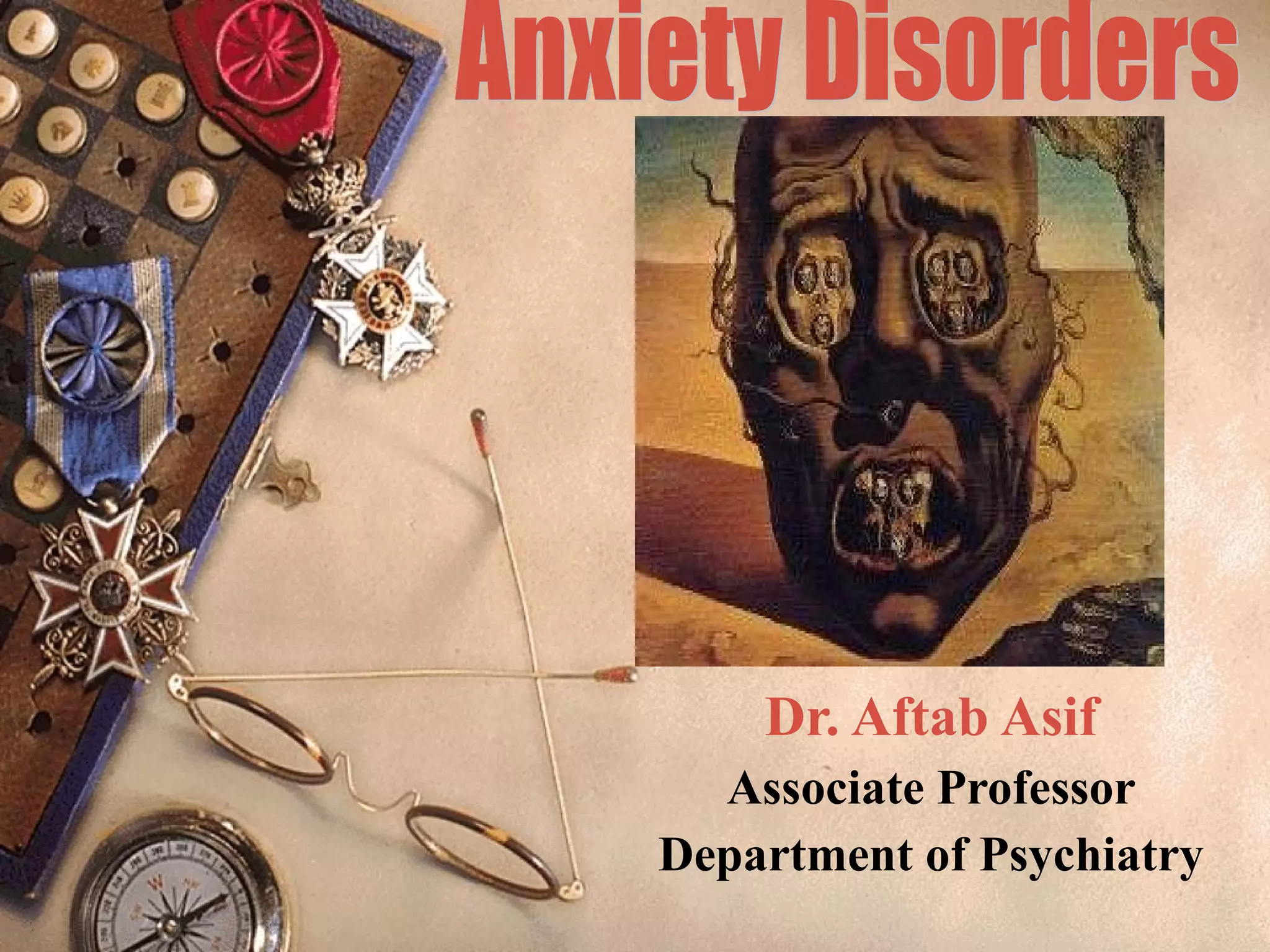
Dr. Aftab Asif Associate Professor Department of Psychiatry Anxiety Disorders
NORMAL ANXIETY  & PATHOLOGICAL TYPES OF ANXIETY     Behavior Ability to function   Assessment by patient, friend &    clinician Neuropsychiatric Evaluation
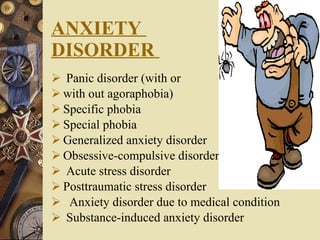
ANXIETY  DISORDER      Panic disorder (with or  with out agoraphobia) Specific phobia Special phobia Generalized anxiety disorder Obsessive-compulsive disorder Acute stress disorder Posttraumatic stress disorder    Anxiety disorder due to medical condition Substance-induced anxiety disorder
     PSYCHOANALYTIC THEORIES:     “ Anxiety around ego to take defensive action against the pressure from within”
MAJOR CATEGORIES: Depending on the nature of the feared consequences Id or impulse anxiety Separation anxiety Castration anxiety Superego anxiety
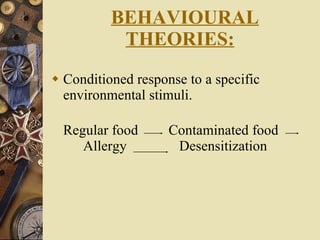
   BEHAVIOURAL THEORIES: Conditioned response to a specific environmental stimuli. Regular food    Contaminated food Allergy Desensitization
BIOLOGICAL THEORIES: Biological events precede the  psychological conflict    Autonomic nervous system Stimulation of ANS- like Cardiovascular – tachycardia   Muscular – headache Gastrointestinal – diarrhoea Respiratory – tachypnea
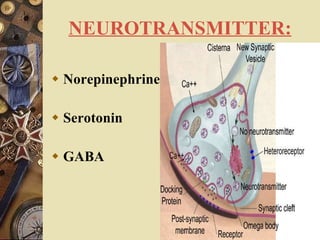
NEUROTRANSMITTER: Norepinephrine Serotonin GABA
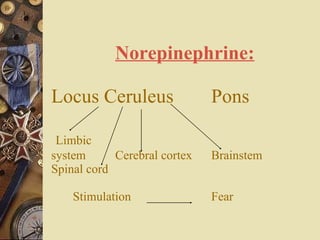
Norepinephrine: Locus Ceruleus Pons     Limbic  system  Cerebral cortex  Brainstem   Spinal cord      Stimulation  Fear
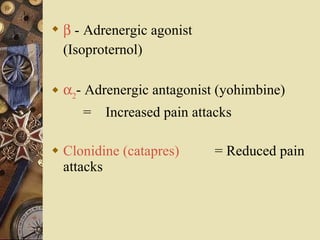
   -  Adrenergic agonist  (Isoproternol)    2 - Adrenergic antagonist (yohimbine) =  Increased pain attacks   Clonidine (catapres)  = Reduced pain attacks
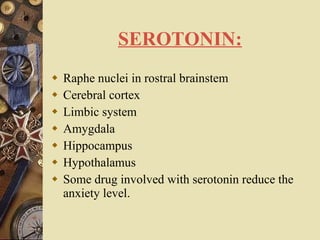
SEROTONIN: Raphe nuclei in rostral brainstem Cerebral cortex Limbic system Amygdala Hippocampus Hypothalamus Some drug involved with serotonin reduce the anxiety level.
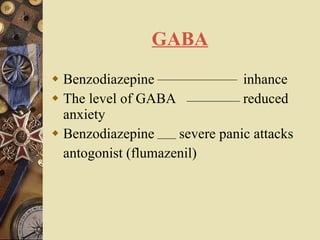
GABA Benzodiazepine inhance The level of GABA  reduced anxiety Benzodiazepine  severe panic attacks antogonist (flumazenil)
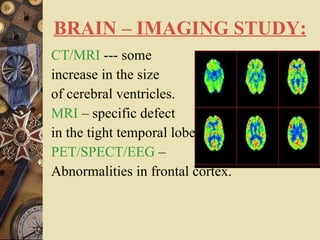
BRAIN – IMAGING STUDY: CT/MRI  --- some  increase in the size of cerebral ventricles. MRI  – specific defect  in the tight temporal lobe. PET/SPECT/EEG  –  Abnormalities in frontal cortex.
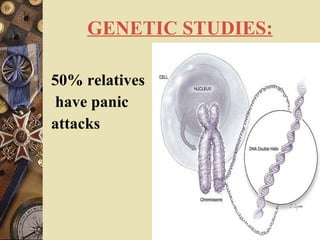
GENETIC STUDIES: 50% relatives have panic  attacks
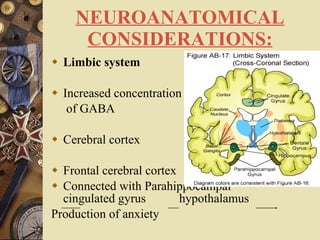
NEUROANATOMICAL CONSIDERATIONS: Limbic system Increased concentration   of GABA Cerebral cortex Frontal cerebral cortex Connected with Parahippocampal  cingulated gyrus  hypothalamus  Production of anxiety
DIFFERENT DISORDER VARIES Wide range of medical conditioning: Hyperthyroidism Hypothyroidism Hypoparathyroidism Vit B12 deficiency Cardiac arrythmias Hypoglycemia 83 % of cardiomyopathy patient awaiting cardiac transplantation have panic disorder. 25 % Parkinson’s disease hare panic attacks 25 % of chronic obstructive pulmonary disease (COPD) have panic attacks
Amphetamine Cocaine Caffeine Substance   Induced Anxiety  Disorder
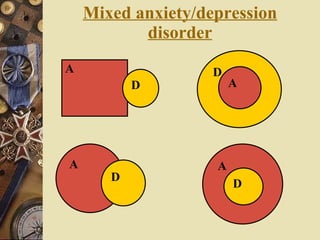
Mixed anxiety/depression disorder A D D A A D A D
PANIC DISORDER   Epidemiology: Life time prevalence 1.5 to 3 % - panic disorder   4 % - panic attacks   Women   Men 2-3 1 Mitral valve prolapse       Mid systolic dick on cardiac auscultation      Prolapse of one of the mitral valve leaflets      Heterogenous
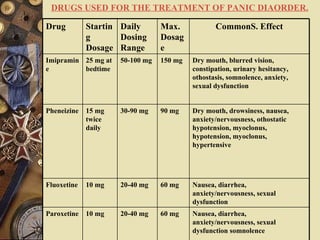
DRUGS USED FOR THE TREATMENT OF PANIC DIAORDER.   Nausea, diarrhea, anxiety/nervousness, sexual dysfunction   somnolence   60 mg   20-40 mg   10 mg   Paroxetine   Nausea, diarrhea, anxiety/nervousness, sexual dysfunction   60 mg   20-40 mg   10 mg   Fluoxetine   Dry mouth, drowsiness, nausea, anxiety/nervousness, othostatic hypotension, myoclonus, hypotension, myoclonus, hypertensive 90 mg   30-90 mg   15 mg twice daily   Pheneizine   Dry mouth, blurred vision, constipation, urinary hesitancy, othostasis, somnolence, anxiety, sexual dysfunction   150 mg   50-100 mg   25 mg at bedtime Imipramine  CommonS. Effect Max. Dosage   Daily Dosing Range   Starting Dosage   Drug
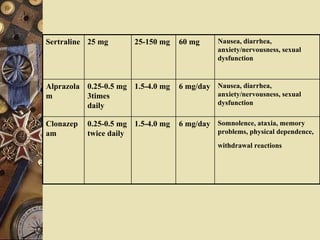
Somnolence, ataxia, memory problems, physical dependence, withdrawal reactions   6 mg/day 1.5-4.0 mg 0.25-0.5 mg twice daily   Clonazepam   Nausea, diarrhea, anxiety/nervousness, sexual dysfunction   6 mg/day 1.5-4.0 mg 0.25-0.5 mg 3times daily   Alprazolam   Nausea, diarrhea, anxiety/nervousness, sexual dysfunction   60 mg 25-150 mg 25 mg   Sertraline
PHOBIC DISORDERS “ A marked and persistent  fear that is excessive at  unreasonable, cued by  the presence or anticipation  of a specific object or  situation.”
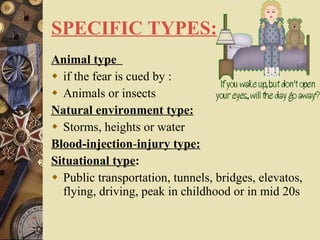
SPECIFIC TYPES:   Animal type  if the fear is cued by : Animals or insects Natural environment type: Storms, heights or water Blood-injection - injury type: Situational type : Public transportation, tunnels, bridges, elevatos, flying, driving, peak in childhood or in mid 20s
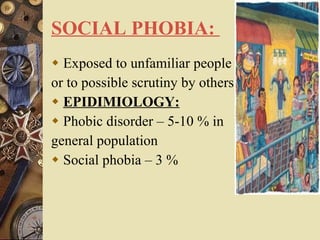
SOCIAL PHOBIA:    Exposed to unfamiliar people  or to possible scrutiny by others. EPIDIMIOLOGY: Phobic disorder – 5-10 % in  general population Social phobia – 3 %
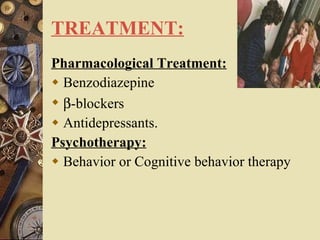
TREATMENT: Pharmacological Treatment: Benzodiazepine  -blockers Antidepressants. Psychotherapy: Behavior or Cognitive behavior therapy
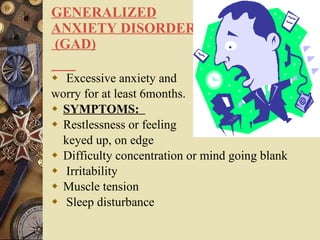
GENERALIZED ANXIETY DISORDER  (GAD)   Excessive anxiety and  worry for at least 6months.  SYMPTOMS:  Restlessness or feeling  keyed up, on edge Difficulty concentration or mind going blank   Irritability Muscle tension   Sleep disturbance
EPIDIMIOLOGY:   Early adult life.   Commonly in women   More frequently in general Medical practice than in Psychiatry   High rate of comorbidity   Symptoms of hyperarousal   Do not recognize themselves as having psychiatric illness
DIFFERENTIAL DIAGNOSIS: Major depression OCD Panic disorder Somatoform disorder Paranoid Eating disorder Hyper thyroidism Hypothyroidism Diabetes Drugs Mitral valve prolapse      
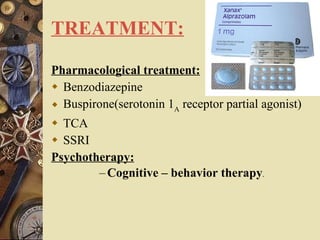
TREATMENT:   Pharmacological treatment: Benzodiazepine Buspirone(serotonin 1 A  receptor partial agonist) TCA SSRI Psychotherapy: Cognitive – behavior therapy .  

Anxiety

  • 1.
    Dr. Aftab AsifAssociate Professor Department of Psychiatry Anxiety Disorders
  • 2.
    NORMAL ANXIETY & PATHOLOGICAL TYPES OF ANXIETY     Behavior Ability to function   Assessment by patient, friend & clinician Neuropsychiatric Evaluation
  • 3.
    ANXIETY DISORDER   Panic disorder (with or with out agoraphobia) Specific phobia Special phobia Generalized anxiety disorder Obsessive-compulsive disorder Acute stress disorder Posttraumatic stress disorder   Anxiety disorder due to medical condition Substance-induced anxiety disorder
  • 4.
         PSYCHOANALYTIC THEORIES:   “ Anxiety around ego to take defensive action against the pressure from within”
  • 5.
    MAJOR CATEGORIES: Dependingon the nature of the feared consequences Id or impulse anxiety Separation anxiety Castration anxiety Superego anxiety
  • 6.
       BEHAVIOURAL THEORIES:Conditioned response to a specific environmental stimuli. Regular food Contaminated food Allergy Desensitization
  • 7.
    BIOLOGICAL THEORIES: Biologicalevents precede the psychological conflict  Autonomic nervous system Stimulation of ANS- like Cardiovascular – tachycardia Muscular – headache Gastrointestinal – diarrhoea Respiratory – tachypnea
  • 8.
  • 9.
    Norepinephrine: Locus CeruleusPons     Limbic system Cerebral cortex Brainstem Spinal cord   Stimulation Fear
  • 10.
    - Adrenergic agonist (Isoproternol)    2 - Adrenergic antagonist (yohimbine) = Increased pain attacks   Clonidine (catapres) = Reduced pain attacks
  • 11.
    SEROTONIN: Raphe nucleiin rostral brainstem Cerebral cortex Limbic system Amygdala Hippocampus Hypothalamus Some drug involved with serotonin reduce the anxiety level.
  • 12.
    GABA Benzodiazepine inhanceThe level of GABA reduced anxiety Benzodiazepine severe panic attacks antogonist (flumazenil)
  • 13.
    BRAIN – IMAGINGSTUDY: CT/MRI --- some increase in the size of cerebral ventricles. MRI – specific defect in the tight temporal lobe. PET/SPECT/EEG – Abnormalities in frontal cortex.
  • 14.
    GENETIC STUDIES: 50%relatives have panic attacks
  • 15.
    NEUROANATOMICAL CONSIDERATIONS: Limbicsystem Increased concentration of GABA Cerebral cortex Frontal cerebral cortex Connected with Parahippocampal cingulated gyrus hypothalamus Production of anxiety
  • 16.
    DIFFERENT DISORDER VARIESWide range of medical conditioning: Hyperthyroidism Hypothyroidism Hypoparathyroidism Vit B12 deficiency Cardiac arrythmias Hypoglycemia 83 % of cardiomyopathy patient awaiting cardiac transplantation have panic disorder. 25 % Parkinson’s disease hare panic attacks 25 % of chronic obstructive pulmonary disease (COPD) have panic attacks
  • 17.
    Amphetamine Cocaine CaffeineSubstance Induced Anxiety Disorder
  • 18.
  • 19.
    PANIC DISORDER Epidemiology: Life time prevalence 1.5 to 3 % - panic disorder   4 % - panic attacks   Women Men 2-3 1 Mitral valve prolapse       Mid systolic dick on cardiac auscultation      Prolapse of one of the mitral valve leaflets      Heterogenous
  • 20.
    DRUGS USED FORTHE TREATMENT OF PANIC DIAORDER. Nausea, diarrhea, anxiety/nervousness, sexual dysfunction somnolence 60 mg 20-40 mg 10 mg Paroxetine Nausea, diarrhea, anxiety/nervousness, sexual dysfunction 60 mg 20-40 mg 10 mg Fluoxetine Dry mouth, drowsiness, nausea, anxiety/nervousness, othostatic hypotension, myoclonus, hypotension, myoclonus, hypertensive 90 mg 30-90 mg 15 mg twice daily Pheneizine Dry mouth, blurred vision, constipation, urinary hesitancy, othostasis, somnolence, anxiety, sexual dysfunction 150 mg 50-100 mg 25 mg at bedtime Imipramine CommonS. Effect Max. Dosage Daily Dosing Range Starting Dosage Drug
  • 21.
    Somnolence, ataxia, memoryproblems, physical dependence, withdrawal reactions 6 mg/day 1.5-4.0 mg 0.25-0.5 mg twice daily Clonazepam Nausea, diarrhea, anxiety/nervousness, sexual dysfunction 6 mg/day 1.5-4.0 mg 0.25-0.5 mg 3times daily Alprazolam Nausea, diarrhea, anxiety/nervousness, sexual dysfunction 60 mg 25-150 mg 25 mg Sertraline
  • 22.
    PHOBIC DISORDERS “A marked and persistent fear that is excessive at unreasonable, cued by the presence or anticipation of a specific object or situation.”
  • 23.
    SPECIFIC TYPES: Animal type if the fear is cued by : Animals or insects Natural environment type: Storms, heights or water Blood-injection - injury type: Situational type : Public transportation, tunnels, bridges, elevatos, flying, driving, peak in childhood or in mid 20s
  • 24.
    SOCIAL PHOBIA: Exposed to unfamiliar people or to possible scrutiny by others. EPIDIMIOLOGY: Phobic disorder – 5-10 % in general population Social phobia – 3 %
  • 25.
    TREATMENT: Pharmacological Treatment:Benzodiazepine  -blockers Antidepressants. Psychotherapy: Behavior or Cognitive behavior therapy
  • 26.
    GENERALIZED ANXIETY DISORDER (GAD) Excessive anxiety and worry for at least 6months. SYMPTOMS: Restlessness or feeling keyed up, on edge Difficulty concentration or mind going blank   Irritability Muscle tension   Sleep disturbance
  • 27.
    EPIDIMIOLOGY:   Earlyadult life.   Commonly in women   More frequently in general Medical practice than in Psychiatry   High rate of comorbidity   Symptoms of hyperarousal   Do not recognize themselves as having psychiatric illness
  • 28.
    DIFFERENTIAL DIAGNOSIS: Majordepression OCD Panic disorder Somatoform disorder Paranoid Eating disorder Hyper thyroidism Hypothyroidism Diabetes Drugs Mitral valve prolapse      
  • 29.
    TREATMENT: Pharmacological treatment: Benzodiazepine Buspirone(serotonin 1 A receptor partial agonist) TCA SSRI Psychotherapy: Cognitive – behavior therapy .