GEOMATIC EDUCATION
BENEFITS AND FUTURE

GIS in the Rockies
October, 2013
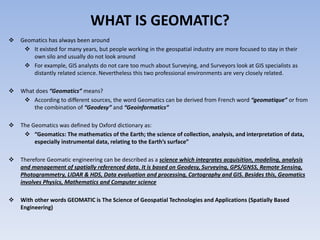
WHAT IS GEOMATIC?


Geomatics has always been around
 It existed for many years, but people working in the geospatial industry are more focused to stay in their
own silo and usually do not look around
 For example, GIS analysts do not care too much about Surveying, and Surveyors look at GIS specialists as
distantly related science. Nevertheless this two professional environments are very closely related.



What does “Geomatics” means?
 According to different sources, the word Geomatics can be derived from French word “geomatique” or from
the combination of “Geodesy” and “Geoinformatics”



The Geomatics was defined by Oxford dictionary as:
 “Geomatics: The mathematics of the Earth; the science of collection, analysis, and interpretation of data,
especially instrumental data, relating to the Earth’s surface”



Therefore Geomatic engineering can be described as a science which integrates acquisition, modeling, analysis
and management of spatially referenced data. It is based on Geodesy, Surveying, GPS/GNSS, Remote Sensing,
Photogrammetry, LIDAR & HDS, Data evaluation and processing, Cartography and GIS. Besides this, Geomatics
involves Physics, Mathematics and Computer science



With other words GEOMATIC is The Science of Geospatial Technologies and Applications (Spatially Based
Engineering)
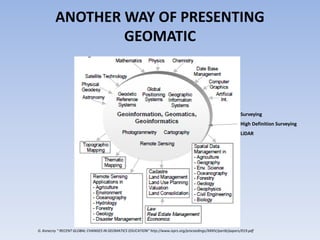
ANOTHER WAY OF PRESENTING
GEOMATIC

Surveying
High Definition Surveying
LiDAR

G. Konecny “ RECENT GLOBAL CHANGES IN GEOMATICS EDUCATION” http://www.isprs.org/proceedings/XXXIV/part6/papers/019.pdf
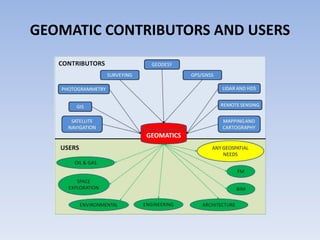
GEOMATIC CONTRIBUTORS AND USERS
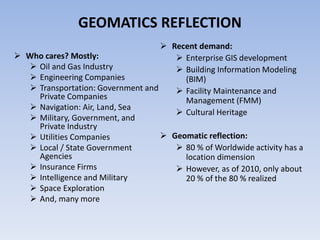
GEOMATICS REFLECTION
 Recent demand:
 Who cares? Mostly:
 Enterprise GIS development
 Oil and Gas Industry
 Building Information Modeling
 Engineering Companies
(BIM)
 Transportation: Government and
 Facility Maintenance and
Private Companies
Management (FMM)
 Navigation: Air, Land, Sea
 Cultural Heritage
 Military, Government, and
Private Industry
 Geomatic reflection:
 Utilities Companies
 80 % of Worldwide activity has a
 Local / State Government
Agencies
location dimension
 Insurance Firms
 However, as of 2010, only about
 Intelligence and Military
20 % of the 80 % realized
 Space Exploration
 And, many more
GEOMATIC IS NECESSITY!


In 2010, the Department of Labor developed new Geospatial Technology Competency Model (GTCM) in which
the geospatial profession was described as one of the most demanding and growing professions in United States
for the next 10 years



The GTCM sets standards for geospatial education and clearly describes the need of well educated engineers,
analysts, managers and scientists



According to the Bureau of Labor Statistics, the need for geospatial specialists will rise by 20,483 per year in the
next 10 years, and due to the growth and replacement needs, the overall demand will be 54,787 geospatial
professionals



According to the Bureau of Labor Statistics regarding Geospatial profession, in 2010, there was a need of 33,800
geospatial jobs



The job outlook for the next ten years is increasing at a rate of 21%-35% per year



The National Geospatial Agency (NGA) recently published a report titled "Future U.S. Workforce for Geospatial
Intelligence". The report was prepared in collaboration with The National Academies of Science and Engineering,
The Institute of Medicine and The National Research Council. This report clearly and definitively outline the
geospatial industry as one of the most demanded professions in the next ten years



A recent landmark study by the National Academy of Sciences (NAS) states: "US institutions of higher learning
are not educating enough qualified graduates in the Geospatial disciplines such as Photogrammetry, Geodesy,
Cartography, and GPS to meet needs specifically for the Workforce of the Future". This is even more important
for new interdisciplinary professions which will require a substantial spatial education and knowledge
FACTS
•
•
•
•

•
•
•
•

More than 400 programs offer GIS certificates and undergraduate degrees
About 35 GIS master programs
Only 5 universities offer Geomatic or Geomatic related undergraduate
and graduate degrees
According to “Foundation for innovation: Grand Challenges in Geodesy”,
2009 one of the backbone Geomatic fields – Geodesy is not in
educational curriculum in most geospatial related programs in US
universities
Most of the existing geospatial workers are educated in only one
geospatial discipline and stay in their own silo
Current geospatial programs provide more specialized (silo) education
Not enough fundamental geospatial education programs
Most of geospatial degrees and certificate curriculums are focused on
Training, not on Education
WHAT WE NEED TO DO
More Education than Training
 Training focuses on a specific tool or system to do a specific task.
 Education provides an understanding of the underlying concepts and
principles founded in scientific disciplines (math, computer science,
physics…) used by the tool
 Then, tool can be used again for un-related tasks
“Engine of Problem Solving”
“Education for Innovation: Leads to New Economies = Jobs!!”
MOTIVATION
 Key Elements:
 The Time Is Right
 No more silos (GIS vs. Surveying)
 The need is international and growing
 More than 400 GIS programs and only 5 Geomatic programs in US
 The talent exists in the Geospatial Alley
 Not enough geospatial scientist with Master and PhD degrees
 Demand for:
Online
eLearning
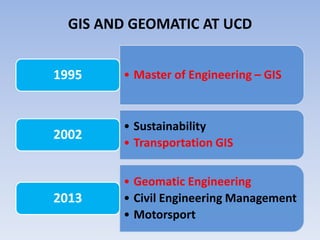
GIS AND GEOMATIC AT UCD
1995

• Master of Engineering – GIS

2002

• Sustainability
• Transportation GIS

2013

• Geomatic Engineering
• Civil Engineering Management
• Motorsport
GEOMATIC PROGRAM OBJECTIVES
 Develop robust and interdisciplinary curriculum allowing for
cross - industrial educational tracks
 Align the curriculum with the GTCM model and latest industry demands
 Offer complete online training with flexible schedule
 Make the Geomatic Program attractive for Colorado residents and non
residents including international students
 Develop a nationwide recognized research center
 Implement a research-driven Geospatial and STEM education
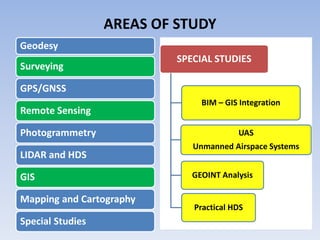
AREAS OF STUDY
Geodesy
Surveying

SPECIAL STUDIES

GPS/GNSS
Remote Sensing
Photogrammetry
LIDAR and HDS
GIS
Mapping and Cartography
Special Studies

BIM – GIS Integration
UAS
Unmanned Airspace Systems
GEOINT Analysis
Practical HDS
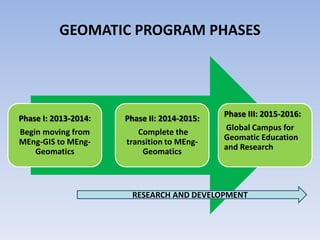
GEOMATIC PROGRAM PHASES

Phase I: 2013-2014:

Phase II: 2014-2015:

Begin moving from
MEng-GIS to MEngGeomatics

Complete the
transition to MEngGeomatics

Phase III: 2015-2016:
Global Campus for
Geomatic Education
and Research

RESEARCH AND DEVELOPMENT
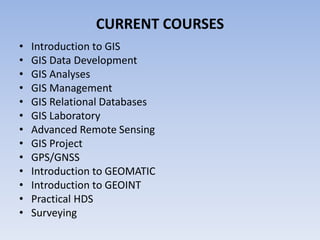
CURRENT COURSES
•
•
•
•
•
•
•
•
•
•
•
•
•

Introduction to GIS
GIS Data Development
GIS Analyses
GIS Management
GIS Relational Databases
GIS Laboratory
Advanced Remote Sensing
GIS Project
GPS/GNSS
Introduction to GEOMATIC
Introduction to GEOINT
Practical HDS
Surveying
QUESTIONS?
IDEAS?

apostol.panayotov@ucdenver.edu

2013 Education Track, Geomatic Education and Research in Colorado by Apostol Panayotov

  • 1.
    GEOMATIC EDUCATION BENEFITS ANDFUTURE GIS in the Rockies October, 2013
  • 2.
    WHAT IS GEOMATIC?  Geomaticshas always been around  It existed for many years, but people working in the geospatial industry are more focused to stay in their own silo and usually do not look around  For example, GIS analysts do not care too much about Surveying, and Surveyors look at GIS specialists as distantly related science. Nevertheless this two professional environments are very closely related.  What does “Geomatics” means?  According to different sources, the word Geomatics can be derived from French word “geomatique” or from the combination of “Geodesy” and “Geoinformatics”  The Geomatics was defined by Oxford dictionary as:  “Geomatics: The mathematics of the Earth; the science of collection, analysis, and interpretation of data, especially instrumental data, relating to the Earth’s surface”  Therefore Geomatic engineering can be described as a science which integrates acquisition, modeling, analysis and management of spatially referenced data. It is based on Geodesy, Surveying, GPS/GNSS, Remote Sensing, Photogrammetry, LIDAR & HDS, Data evaluation and processing, Cartography and GIS. Besides this, Geomatics involves Physics, Mathematics and Computer science  With other words GEOMATIC is The Science of Geospatial Technologies and Applications (Spatially Based Engineering)
  • 3.
    ANOTHER WAY OFPRESENTING GEOMATIC Surveying High Definition Surveying LiDAR G. Konecny “ RECENT GLOBAL CHANGES IN GEOMATICS EDUCATION” http://www.isprs.org/proceedings/XXXIV/part6/papers/019.pdf
  • 4.
  • 5.
    GEOMATICS REFLECTION  Recentdemand:  Who cares? Mostly:  Enterprise GIS development  Oil and Gas Industry  Building Information Modeling  Engineering Companies (BIM)  Transportation: Government and  Facility Maintenance and Private Companies Management (FMM)  Navigation: Air, Land, Sea  Cultural Heritage  Military, Government, and Private Industry  Geomatic reflection:  Utilities Companies  80 % of Worldwide activity has a  Local / State Government Agencies location dimension  Insurance Firms  However, as of 2010, only about  Intelligence and Military 20 % of the 80 % realized  Space Exploration  And, many more
  • 6.
    GEOMATIC IS NECESSITY!  In2010, the Department of Labor developed new Geospatial Technology Competency Model (GTCM) in which the geospatial profession was described as one of the most demanding and growing professions in United States for the next 10 years  The GTCM sets standards for geospatial education and clearly describes the need of well educated engineers, analysts, managers and scientists  According to the Bureau of Labor Statistics, the need for geospatial specialists will rise by 20,483 per year in the next 10 years, and due to the growth and replacement needs, the overall demand will be 54,787 geospatial professionals  According to the Bureau of Labor Statistics regarding Geospatial profession, in 2010, there was a need of 33,800 geospatial jobs  The job outlook for the next ten years is increasing at a rate of 21%-35% per year  The National Geospatial Agency (NGA) recently published a report titled "Future U.S. Workforce for Geospatial Intelligence". The report was prepared in collaboration with The National Academies of Science and Engineering, The Institute of Medicine and The National Research Council. This report clearly and definitively outline the geospatial industry as one of the most demanded professions in the next ten years  A recent landmark study by the National Academy of Sciences (NAS) states: "US institutions of higher learning are not educating enough qualified graduates in the Geospatial disciplines such as Photogrammetry, Geodesy, Cartography, and GPS to meet needs specifically for the Workforce of the Future". This is even more important for new interdisciplinary professions which will require a substantial spatial education and knowledge
  • 7.
    FACTS • • • • • • • • More than 400programs offer GIS certificates and undergraduate degrees About 35 GIS master programs Only 5 universities offer Geomatic or Geomatic related undergraduate and graduate degrees According to “Foundation for innovation: Grand Challenges in Geodesy”, 2009 one of the backbone Geomatic fields – Geodesy is not in educational curriculum in most geospatial related programs in US universities Most of the existing geospatial workers are educated in only one geospatial discipline and stay in their own silo Current geospatial programs provide more specialized (silo) education Not enough fundamental geospatial education programs Most of geospatial degrees and certificate curriculums are focused on Training, not on Education
  • 8.
    WHAT WE NEEDTO DO More Education than Training  Training focuses on a specific tool or system to do a specific task.  Education provides an understanding of the underlying concepts and principles founded in scientific disciplines (math, computer science, physics…) used by the tool  Then, tool can be used again for un-related tasks “Engine of Problem Solving” “Education for Innovation: Leads to New Economies = Jobs!!”
  • 9.
    MOTIVATION  Key Elements: The Time Is Right  No more silos (GIS vs. Surveying)  The need is international and growing  More than 400 GIS programs and only 5 Geomatic programs in US  The talent exists in the Geospatial Alley  Not enough geospatial scientist with Master and PhD degrees  Demand for: Online eLearning
  • 10.
    GIS AND GEOMATICAT UCD 1995 • Master of Engineering – GIS 2002 • Sustainability • Transportation GIS 2013 • Geomatic Engineering • Civil Engineering Management • Motorsport
  • 11.
    GEOMATIC PROGRAM OBJECTIVES Develop robust and interdisciplinary curriculum allowing for cross - industrial educational tracks  Align the curriculum with the GTCM model and latest industry demands  Offer complete online training with flexible schedule  Make the Geomatic Program attractive for Colorado residents and non residents including international students  Develop a nationwide recognized research center  Implement a research-driven Geospatial and STEM education
  • 12.
    AREAS OF STUDY Geodesy Surveying SPECIALSTUDIES GPS/GNSS Remote Sensing Photogrammetry LIDAR and HDS GIS Mapping and Cartography Special Studies BIM – GIS Integration UAS Unmanned Airspace Systems GEOINT Analysis Practical HDS
  • 13.
    GEOMATIC PROGRAM PHASES PhaseI: 2013-2014: Phase II: 2014-2015: Begin moving from MEng-GIS to MEngGeomatics Complete the transition to MEngGeomatics Phase III: 2015-2016: Global Campus for Geomatic Education and Research RESEARCH AND DEVELOPMENT
  • 14.
    CURRENT COURSES • • • • • • • • • • • • • Introduction toGIS GIS Data Development GIS Analyses GIS Management GIS Relational Databases GIS Laboratory Advanced Remote Sensing GIS Project GPS/GNSS Introduction to GEOMATIC Introduction to GEOINT Practical HDS Surveying
  • 15.